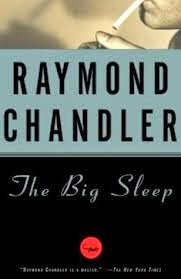
The Big Sleep by Raymond Chandler

“It was about eleven o’clock in the morning, mid October, with the sun not shining and a look of hard wet rain in the clearness of the foothills”

Yes, I went out of my comfort zone!  The Big Sleep is not a book I would usually choose to read, but since it’s on my Guardian 1000 list and a group on Goodreads was reading it for June, I decided to take the plunge.  Initially, I was rather apprehensive because I had read The Maltese Falcon a few years ago and didn’t enjoy it.  Yet within a few pages, I was completely immersed in this story.

Philip Marlowe; private detective; wise guy.  L.A. in the late 1930s.  A millionaire with two wild, uncontrollable daughters.  A missing son-in-law. Can Marlowe navigate the perilous world of high-society, which takes him into the shady dens of gangsters, gambling and murder, to extract truth from a myriad of lies?

With Marlowe was born one of the first of the new detectives.  The description he gives of himself in the beginning of the novel is a dry, witty sketch:

“I’m thirty-three years old, went to college once and can still speak English if there’s a demand for it.  There isn’t much in my trade.  I worked for Mr. Wilde, the District Attorney, as an investigator once.  His chief investigator, a man named Bernie Ohls, called me and told me you wanted to see me.  I’m unmarried because I don’t like policemen’s wives …………. I was fired.  For insubordination.  I test very high on insubordination, General.”

Los Angeles City Hall (1931)
source Wikipedia

The Big Sleep euphemistically refers to death and there are more than a few murders in this tale.  Billed as Chandler’s first novel, it is actually two of his short stories combined:  The Curtain and Killer in the Rain.  In it, he sets the scene with a flourishing skill:

“The air was thick, wet, steamy and larded with the cloying smell of tropical orchids in bloom.  The glass walls and roof were heavily misted and big drops of moisture splashed down on the plants.  The light had an unreal greenish colour, like light filtered through an aquarium tank.  The plants filled the place, a forest of them, with nasty meaty leaves and stalks like the newly washed fingers of dead men. They smelled as overpowering as boiling alcohol under a blanket.”

Curiously, while this is a mystery novel, Chandler often seems more concerned with the setting and characters than the minute details of the plot. Scenes are depicted with meticulous detail, and the characters each have personalities that radiate out, like the beacon of a lighthouse cutting through the mist.  Their charm, or helplessness, or audacity, or coquettishness is distinct and compelling.  In fact, the producer of the movie, The Big Sleep, contacted Chandler to remind him that in the novel, he had never revealed who had killed the chauffeur and asked for the identity of the murderer. Chandler replied that he had no idea.

 I really admired Philip Marlowe’s brash confidence, his raw sense of humour and his composure in dangerous situations.  Often impolitic and impertinent, nevertheless his understanding of human nature and the complexity of people’s personalities, made him a lively, compelling character.  With this work, Chandler managed to avoid the cliche 1930s male detective and invented a character and a book worth reading.  Very enjoyable!

Top Ten Tuesday: Best Books This Year

Straight from The Broke and the Bookish comes this Tuesday’s question:  

What are your best books of the year?

7.  Mrs. Dalloway:  I was pondering over whether to include this book.  While I wouldn’t say it was one of my favourite reads, it has potential.  I really need to read it again to get more appreciation for it.

  6.  Son Excellence, Eugène Rougon:  so interesting to learn all about French politics under the Second Empire.  Again, Zola’s wonderful descriptive powers made the journey into this story delightful!

  5.  The Old Man and the Sea:  It redeemed my opinion of Hemingway and made me willing to try more of his reads.  Very enjoyable!

  4.  The Warden:  I had no idea Trollope was so much fun!  I’m going to read the whole Barset Chronicles series.

  3.  The Chronicles of Narnia:  I’d read it as a child, but as an adult I was blown away by the various scholarly themes imbedded in it ……… Pascal, Plato, the chronicles had them all. 

  2.  The Odyssey:  a re-read and a read-along.  I truly gained a much greater love for this poem reading it the second time.  

  1.  Paradise Lost:  I’d been scared of this poem for years but I decided to plunge in with a read-along and what a plunge!  Milton’s use of the English language is masterfully stunning; I looked forward to every section read and every post on my blog.  Simple amazing!

Seven books was all I could come up with.  I’ve realized that I had a much better “line-up” at the beginning of last year.  I’m assuming that was simply coincidence, however I’m glad that I’ve posted on this topic because it will help me be more choosy in my reads for the rest of the year.
What about you?  What are your favourite books for the year?  Have you had good luck or bad luck with your choices?

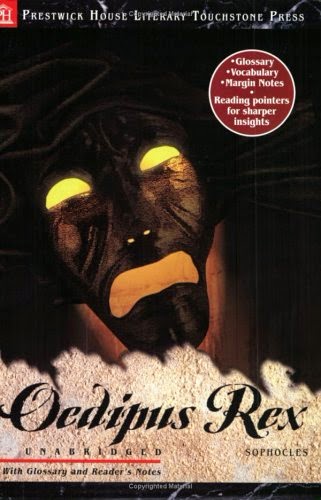
Oedipus Rex by Sophocles

“Children, young sons and daughters of old Cadmus, why do you sit here with your suppliant crowns?”

A dark curse is upon Thebes.  Blighted cattle and plants cover the land, the women are barren and a deadly plague creeps throughout the kingdom, sparing no one in its fatal grasp.  Creon, brother-in-law to King Oedipus, reveals that the curse placed on the kingdom is a result of the murder of its last king, Laius, and until the perpetrator is found, there is no hope of relief from their present woes.  Oedipus, king of Thebes, calls the wisest man to the palace, the blind prophet, Teiresias, to discover the identity of the vile culprit.  
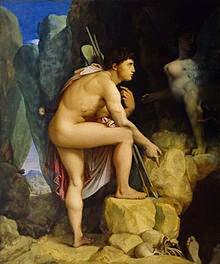
Yet through wise Teiresias and the shepherds of Laius, it is revealed that Oedipus was unwittingly the killer, slaying the king on a road to Thebes, in self-defence and completely unaware of his victim’s identity.  Unbeknownst to Oedipus, he was fulfilling a prior prophecy, that he would kill his father and marry his mother.  And true to prophecy, Oedipus, after freeing Thebes from a different curse by solving the riddle of the Sphinx, became the new king of Thebes and married the current queen, Jocasta, also his mother.

Oedipus after he solves the riddle
of the Sphinx (1808)
Jean-Auguste-Dominique Ingres
source Wikipedia

Upon hearing the fulfillment of the curse, a stunned and horrified Oedipus flees, yet soon finds Jocasta has hanged herself with shame and, grabbing the brooches from her garments, dashes his eyes out until blood flows in rivers down his face. At the behest of Oedipus, Creon banishes him from the city.

The sins of murder and incest has blighted the life of Oedipus and the lives of his progeny; his sons will be left without a father or inheritance and his daughters will be ostracized, unable to marry.  His anguished speech carries notes of his misery and devastation:

“What can I see to love?
What greeting can touch my ears with joy?
Take me away, and haste —– to a place out of the way!
Take me away, my friends, the greatly miserable,
the most accursed, whom God too hates
above all men on earth!”

The state of blindness and the character of Oedipus are closely linked. Instead of listening to the wisdom of the blind prophet, Teiresias, Oedipus refuses to believe him, therefore choosing blindness over knowledge.  Later in the play, when he accepts the knowledge of his actions, he physically blinds himself, which echoes his emotional blindness earlier in the story.

Can one commit a crime with complete lack of awareness and still be responsible for the repercussions of his actions?  Is the harshness of Oedipus’ penalty and the suffering he endures from the consequences, a justifiable outcome given the circumstances?  Why does no one in the kingdom disagree with the punishment of Oedipus, and appear more shocked by the unintentional sins than the maiming he inflicts upon himself?

Oedipus Separating from Jocasta
Alexandre Cabanel
source Wikipedia

What we can take away from this drama is helplessness in the hands of fate.  Though everyone pities Oedipus and does not blame him, there is nothing they can do in the face of his punishment.  To the Greeks, fate is supreme and unaffected by human choice; Oedipus attempts to avoid his destiny yet only succeeds in bringing it to fruition.  Finally, we are exposed to a chilling Greek worldview, that we can “Count no mortal happy till he has passed the limit of his life secure from pain.”

Apparently Oedipus Rex, while first chronologically of the three Theban plays, is in fact the second in written order.  I will enjoy trying to find out the common threads between the three, and if I feel there are any inconsistencies due to the fact they were composed out of order.  The next one on the schedule is Oedipus at Colonus where we meet Oedipus in exile.

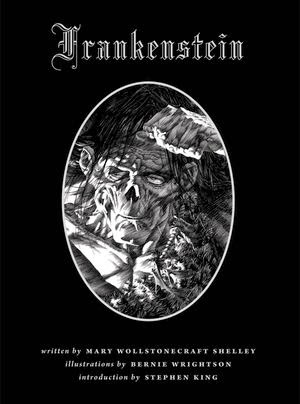
Frankenstein by Mary Shelley

“You will rejoice to hear that no disaster has accompanied the commencement of an enterprise which you have regarded with such evil forebodings.”

Gaining a passionate, yet unguided knowledge for science, young Victor Frankenstein arrives at university with an unquenchable thirst for learning and advancement.  When he involves himself in an isolated solitary experiment to create life, the resulting creature so appalls and revolts him, that he cannot contain his revulsion.  The consequent rejection of his creation culminates in a series of tragedies that could not even have entered Frankenstein’s imagination.

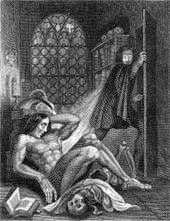
Theodor von Holst
from 1831 edition
source Wikipedia

Initially, the book begins with an introductory sub-plot of Robert Walton, a scientific adventurer who is on a naval quest to find a northern passage or discover the secret of the magnetic poles.  Walton is portrayed as a man intoxicated with the desire for knowledge, a clear indication that his character mirrors that of Victor Frankenstein, and his idealistic dreams parallel those of the friend he rescues (Frankenstein).  At the beginning of Frankenstein’s story, we see how he immerses himself in science and, by doing so, isolates himself from the friends and acquaintances around him, and remains housebound, separated from the outdoors. Without companionship and nature, the very things that feed our souls, he is blind to the spiritual aspects of humanity, seeing only the physiological perspective of a scientific creation.  In effect, he rejects his own Creator to put himself in His place.

In fact, the first sentence of the book, the beginning of a letter from Robert Walton to his sister, gives the reader a clue as to the lack of awareness the scientist can develop to the world around him:  “You will rejoice to hear that that no disaster has accompanied the commencement of an enterprise which you have regarded with such evil forebodings.”  In a frenzied quest for new discovery, the scientist can often lose any objectivity and will marginalize the prudent advice given by others, who have perhaps more objective insight.

In Frankenstein’s story, we get a cautionary tale of the consequences of unexamined and incautious actions based on a deification of science, yet therein also lies a theme of abandoned responsibility.  If Frankenstein had attempted to communicate with the creature and valiantly hid his disgust of it, would the outcome have been different?  Could he have humanized his creation with sympathy and nurturing?  I have my doubts. Upon the creature’s flight and escape to the woods, he discovers a family living there and, by observing them, he learns to read and write and is exposed to profound literature, which reveals both goodness and evil to him. The creature learns what it means to be human and, in fact, admires the goodness of the family.  However he ultimately chooses evil, using his rejection by humans as an excuse for his deviant actions.  Victor Frankenstein was another unsympathetic character.  Numerous times he had a chance to attempt to stop the evil he had created, yet each time he did nothing, often at the expense of a human life.  I was actually quite disgusted with him.  His inaction was almost on a level with the creature’s atrocities.

Boris Karloff
as Frankenstein’s monster
source Wikipedia

While I found the plot of this novel in some senses exaggerated, in a general sense it brought up a number of important issues for reflection.  Are we responsible for what we create and, if so, to what degree?  Is knowledge something to be pursued with unlimited passion, or should we approach it with a healthy respect, and should restrictions be put on our pursuit of it?  Does the development of character, values and morality depend on genetics or environment? Shelley brought attention to these universal and timeless issues which segued into more specific questions related to the story.  Should the creature be pitied?  Does his abandonment, rejection and isolation justify his actions of revenge?  Was Frankenstein’s rejection directly responsible for the tragic circumstances, and therefore, was he completely to blame for his own fate?  Is the creature evil, or simply a misunderstood creation, who, if loved and nurtured, would have developed love and empathy and a conscience, like most other human beings?

The story of Frankenstein was birthed during a trip to Geneva in 1816. Together with her husband, the poet Percy Bysshe Shelley, Mary Shelley spent the summer there with their companion, Lord Byron.  After Byron proposed that they each write a ghost story, Shelley found herself at a loss for inspiration.  It was only after a conversation about the “re-animation of a corpse,” that Shelley had a waking dream:

I saw the pale student of unhallowed arts kneeling beside the thing he had put together.  I saw the hideous phantasm of a man stretched out, and then, on the working of some powerful engine, show signs of life, and stir with an uneasy, half vital motion.  Frightful must it be; for supremely frightful would be the effect of any human endeavour to mock the stupendous mechanism of the Creator of the world.

And so Frankenstein was born.

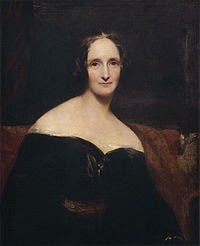
Portrait of Mary Shelley (1840)
Richard Rothwell
source Wikipedia

Mary Shelley was the daughter of William Godwin and Mary Wollstoncraft Godwin, the former a philosopher, novelist and journalist, the latter also a philosopher as well as a writer.  With such notable antecedents, Shelley’s exposure to books was unusually vast for a female of her era.  Here is a chronological list of the works of literature which she read during the years of 1814 to 1821.

Here, also, are two other excellent reviews of Frankenstein by M. Landers and Majoring in Literature for your reading pleasure!  Enjoy!

My Reading Habits

Through both Carola at Brilliant Years and Plethora of Books, I found a list of questions that relate to reading habits.  Since I have about 10 reviews on the go and haven’t finished any yet, I thought I would take the time to answer a few of the questions.


1.  Favourite children’s book?

Ooo, this is hard.  I would have to say Swallows and Amazons by Arthur Ransome, Finn Family Moomintroll by Tove Jansson, The Phantom Tollbooth by Norman Juster, and Five Children and It by E. Nesbit (hilarious!)

2.  What are you reading right now?

You really want to know?  Yikes!  Bleak House, The Screwtape Letters, Money (L’Argent), The Decameron, Augustine’s Confessions, the Oedips trilogy, Barchester Towers, Red Land Black Land, Plato’s Meno, and The History of the Ancient World.  And there are others but they are on hold until I get some of the listed ones cleared up.  How embarrassing!

3.  Bad book habit?

a) Too many books  …….  (is that bad?)  b) having too many books out from the library  c) not reading many of the books I have out from the library (they often go on TBR lists)

4.  What books do you have on request at the library?

The French Market Cookbook, Atomic Accidents, Capital in the Twenty-First Century, and many others (see answer to 3b & c).

5.  What do you have checked out from the library?

Classics of Western Philosophy, Backyard Bountry, Bleak House, The Big Sleep and many others (see answer to 3b & c).

6.  Do you have an e-reader?

I have a basic Kindle but I would choose a book over an e-reader any day.

7.  Do you read one book at a time or several at once.

I used to read one book at a time but now I read several.  I like reading this way but sometimes I can be extreme with my “several.”  Moderation is a good policy.

8.  Have your reading habits changed since you started a blog.

Well, I have less time to read, but I’m probably being more focussed when reading, because I know that I’ll have to review the book afterwards.  So there are positives and negatives, as in anything.

9.  Least favourite book that you’ve read this year (so far).

Can I choose three?  Wuthering Heights, Madame Bovary and Once and Future King.  I think I can make a good case for my dislike of Wuthering Heights; I have searched high and low through personal reviews and scholastic reviews and no one has been able to convey to me anything concrete that I can appreciate about this book.  I wanted to like Madame Bovary, but I just didn’t, and the longer the book sits with me, the less I like it. Once and Future King ……….. honestly, I think T.H. White was a little weird quirky …… okay, a lot quirky.  Some of his writing and portrayals were quite bizarre and I didn’t think he did justice to the original.  That said, I’m only ¼ through the original Le Morte, so perhaps I can’t justify that last comment yet.  I am going to hold him responsible for my inability to enjoy Le Morte d’Arthur, however.  Once and Future King, I think, just put me in a weird head-space for it.

10.  Favourite book that you’ve read this year.

I don’t even have to think about the answer.  Paradise Lost.  Hands down the best, absolutely.  Just brilliant.  An honourable mention goes to The Odyssey, one of my favourites.  This current reading gave me more of an appreciation for it.

11.  What is your favourite place to read?

I like reading in the hammock on the deck or on the beach when there is absolutely no one else there.  Do I get to read in these places?  No.  I’m usually being interrupted or I’m so busy that I have to sneak a few pages here or there.  Sigh!  I can’t wait for summer and more time to read!

12.  Do you ever dog-ear your books or write in their margins?

**** Shocked gasp! **** Dog-earing is taboo!!  However, I do jot notes in the margins of my paperbacks.  I used to be horrified at this practice too, but have since learned that having a conversation with the book is more important to understanding it than having it look pretty.  However, I don’t write in hardcovers (that is shocking) and some more favoured paperbacks I keep pristine and get another copy to write in.

13.  What is your favourite language to read in?

Well, I’m only proficient enough to read in English but I have high hopes of building my French skills to be able to read in that language too.  And while checking out some Spanish books for my Language Freak Summer Challenge, I don’t think it would take too much work to be able to read at a basic level in Spanish.  Of course, all these hopes require time, which I don’t have much of now.

14.  Favourite genre.

I like, of course, the classics.  I also enjoy reading non-fiction history and poetry (particularly epic poetry).

15.  Genre that you rarely read but wish you did.

Probably drama.  I have read some Shakespeare but lately have been reading through some Greek tragedy.  I’d like to explore more of this genre.

16.  Favourite biography.

John Adams by David McCullough.  I also enjoyed Thomas Jefferson, the Art of Power by Jon Meacham and The Seven Story Mountain by Thomas Merton.  With some other bloggers, I’m starting a Well-Educated Mind Biography Project on June 1st.  I can’t wait to acquaint myself with more works in this genre.  

17.  Favourite Cookbook.

The Whole Food Nutrition Cookbook, Food to Live By, The Sprouted Kitchen and It’s All Good.  Yes, I can never pick just one book. 😉

18.  Most intimidating book that you ever read.

Probably Dante’s The Divine Comedy.  It got tougher as I went along.  I felt that this first time I familiarized myself with all the historical allusions.  The next time I’ll be able to dig even deeper and I’m looking forward to it.

19.  Favourite poet.

Well, I haven’t had much poetry exposure but I’d say Homer.  And even with more exposure I’m not sure if that choice would change.  He is the master of crafting the epic poem!

20.  Favourite fictional character – male.

This is a really weird choice, but I loved Sarpedon in The Iliad.  He’s a completely minor character so figure that one out!  And, of course, I loved Hector too!   The only problem with my choices is that it’s probable that these characters aren’t fictional.  Oh well, they’re dead, so that should count for something.  😉

21.  Favourite fictional character – female.

I was going to say Lily Bart from Wharton’s The House of Mirth but I think I more liked the way Wharton portrayed, her instead of the character herself. So I’m going to go with Cassandra from Dodie Smith’s I Capture the Castle and also Ruth from Gaskell’s book of the same name.  The first is hilarious and has a spunkiness that is delightful; the latter is an example of patient long-suffering but with a quiet dignity that is an example to those around her.

22.  Name a book that you could not/would not finish.

The Name of the Rose by Umberto Eco.  I will go back to it at some point but at the time, I was too irritated with it to continue.

23.  Name a book that made you angry.

A New Lifetime Reading Plan.  I expected it to give summaries of various classic novels and a plan to read them, however the authors used the book as a personal platform to inject their modern opinions and judgement on classic literature.  Not only that, their comments while flip, often bordered on rudeness.  The book was a complete waste of money.

24.  Are there any books/authors you’ve been avoiding?

I tend to avoid Thomas Hardy because he’s depressing but I do plan to read through his novels.  I need to begin in a happy frame of mind though.  I also have avoided Ulysses and other Joyce novels, Faulkner, Maugham, and to a lesser extent Henry James.  With all, I will try to read some of their works ,but I’m certainly not stampeding to do so.

25.  Favourite guilt-free, pleasure reading?

Probably children’s novels.  Mostly pre-1970s.  I do like health and nutrition books so I’ll read those too, from time to time.


The Old Man and the Sea Read-Along

Hamlette from The Edge of the Precipice has decided to have a read-along of The Old Man and the Sea beginning July 21st.  Shall I join?  But, of course!

I have to admit, I just finished reading The Old Man and the Sea, but I’m going to revisit it during the read-along.  Why?  Because read-alongs give me a deeper understanding of the book that I’m reading, and it’s fun to have the company of other readers.  And I may need some help appreciating Hemingway because, honestly, the first book of his that I attempted to read years ago was a big flop.  Let’s hope the second read is a charm!

So please join us if you want to read a small book, with an unlucky man and a very big fish!

Im Wunderschönen Monat Mai by Heinrich Heine

Rolf Armstrong
source Wikiart

Im Wunderschönen Monat Mai
Im wunderschönen Monat Mai
Als alle Knospen sprangen
Da ist in meinem Herzen
Die Liebe aufgegangen
Im wunderschönen Monat Mai
Als alle Vögel sangen,
Da hab’ ich ihr gestanden
Mein Sehnen und Verlangen.

____________________________________________

In The Wondrously Beautiful Month of May
In the wondrously beautiful month of May
When all the buds sprang open
Then in my heart
Love sprouted.
In the wondrously beautiful month of May
When all the birds were singing
Then I confessed to her
My longing and desire.

This poem has long been one of my favourites.  And what a better time to share it than the month of May and for my Language Freak Summer Challenge.  After reading the English translation, I was left somewhat disconsolate ……… works in translation really do not do justice to the original.

Heinrich Heine was a German poet, journalist, essayist and literary critic, born in Düsseldorf in 1797 and died in Paris in 1856.  His lyric poetry was set to music by composing greats such as Robert Schumann and Franz Schubert.  The government did not take kindly to his radical political views; many of his works were banned in Germany and he spent the last 25 years of his life in exile.  


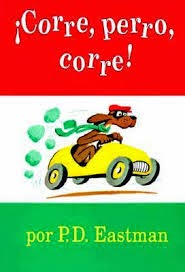
Corre, Perro, Corre – P.D. Eastman

Hay perros grandes, perros pequeños, perros amarillos, perros verdes, perros azules, perros rojos y una fiesta al fin del libro. Este libro es divertirse por los niños.

Phew!  That’s about all for my rusty Spanish as I have about 10 reviews that I’m trying to work on.  I remember this book from my childhood.  It reads pretty simply now, even in Spanish, but I can see the value of repetition when children are learning to read or learning another language.  Prepositions and opposites are sprinkled throughout the story, adding another aspect of learning.  And after all, what child could resist rainbow-coloured dogs, dogs driving cars, a party and the repeated silly question, “¿Te gusta mi sombrero? (Do you like my hat?)” 

If anyone knows of some easy Spanish books, I’d really appreciate any recommendations.  For some reason I’m struggling with coming up with any.  It’s very sad when you can think of more Latin books to read than Spanish ……


Preparing for Summer – Which Books?

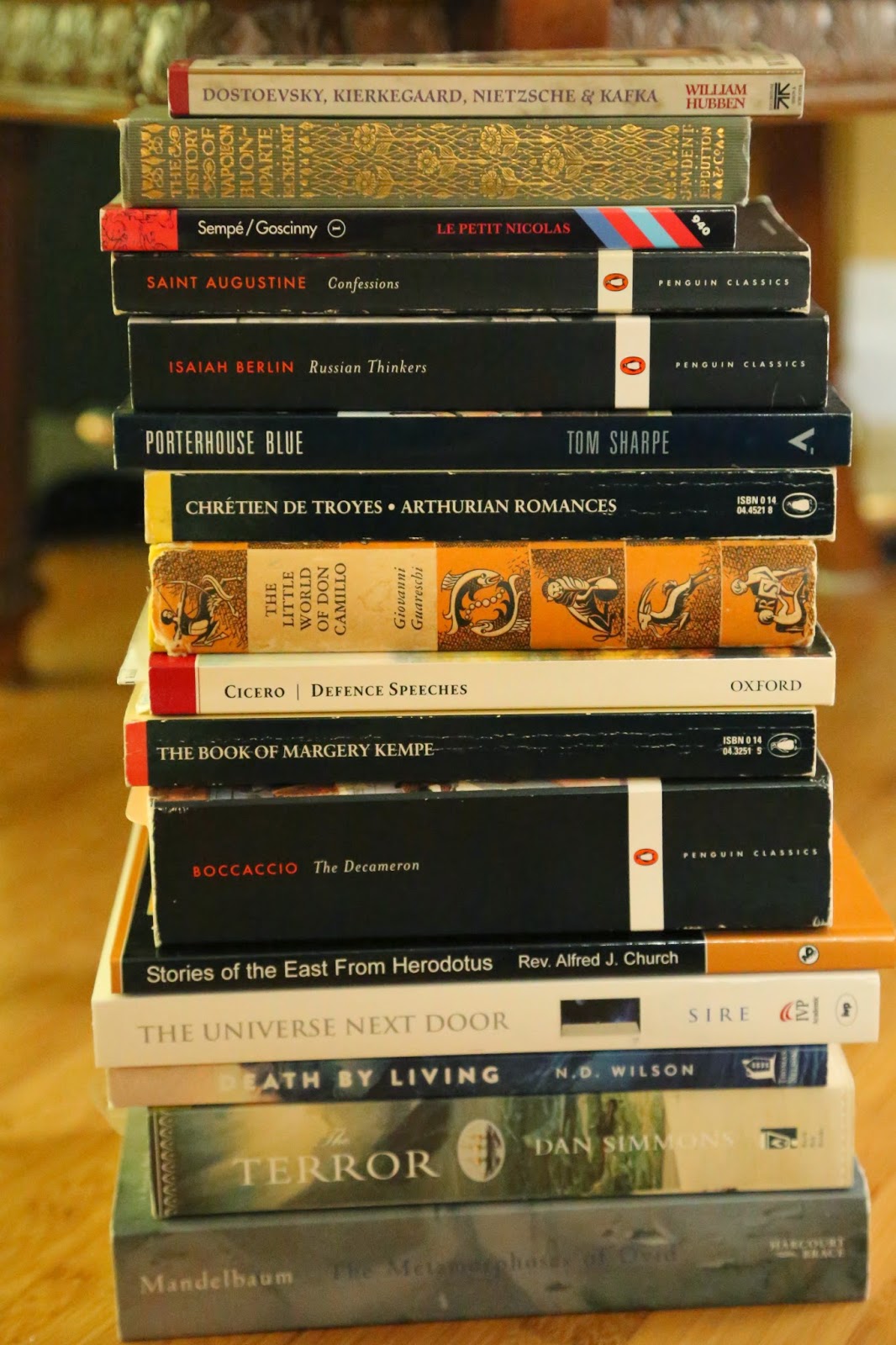
Inspired by Ruth at A Great Book Study, I am going to place aside my fear of having a list or goals to follow, and put together a pile of books that I hope to read during the much anticipated summer months.

Books To Complete:

The Chronicles of Barsetshire: I should be at Framley Parsonage for my Chronicles of Barsetshire Read-Along.  I’m in the middle of Barchester Towers at the moment and I hope to get through Doctor Thorne before summer.  I’m enjoying this series immensely.  Trollope captures the characters beautifully …… all their human faults and foibles as well as their kindnesses.  There is no better introduction to a small English village.

The Saying of the Desert Fathers:  another stalled book that I need to finish.  Not to mention that it’s in my TBR Pile Challenge.  I must admit, I’m not doing very well with this challenge.

Defence Speeches:  and another stalled one.  And another on my TBR Pile Challenge.  I don’t know why I stopped reading this.  I LOVE Cicero’s defence arguments; so logical and crafty!

The Decameron:  a long scheduled read.  Because of its style (a collection of stories), it has been easy to read and keep up with.

The Morte d’Arthur:  I am trying to slog through this.  I don’t know what is the matter with me.  This is a book I should be eating up but I just don’t care for it.  Perhaps it was my bad experience with Once and Future King, which I read prior to starting Le Morte.  Or maybe I haven’t had the attention span to devote to it.  Or perhaps I’ll never become enamoured with it.  In any case, I’m determined to finish it so I will do my best to get through a good portion of it in the summer.

The History of Napoleon Buonaparte:  yet another stalled book.  I really liked reading it; the history was fascinating and the author paints a very real picture of Buonaparte.  Other books just took over.

If On A Winter’s Night A Traveler:  ah, Calvino!  Will I gain an appreciation for your unique style and structure, or will I want to strangle you when I finish?  I guess time will tell ……

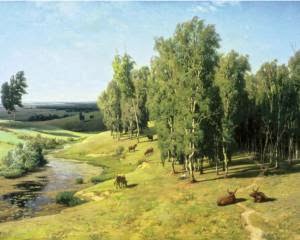
Summer Day
Volodymyr Orlovsky
source Wikiart

New Books To Read:

Ovid’s Metamorphoses:  one of my books that I attempted to read last year but didn’t get very far.  I anticipate that I’ll have time in the summer to concentrate on it property.

Russian Thinkers:  This book intrigues me.  By Isaiah Berlin, a Russian-born Jew, a social and political theorist and philosopher, these essays explore Russian thought and the idea of freedom, while exploring the minds of great Russian personages such as Herzen, Tolstoy and Turgenev and the political and social changes that stemmed from their influence.  And I can count it for my Russian Challenge!

Arthurian Romances:  This will count for my Arthurian challenge.  I need to get a move on with this challenge because so far I have only finished Once and Future King.  How shameful!

The Book of Margery Kempe:  for my Well-Educated Mind Biographies Challenge.

Surprised by Joy & A Grief Observed: for my C.S. Lewis Project

Dostoevsky, Kierkegaard, Nietzsche & Kafka:  “…. one of the most straightforward and easily understandable introductions to the whole modern experience of existentialism.”  Let’s hope so.  My poor brain can only handle an easy introduction.

The Universe Next Door:  a classic book for understanding the philosophy of different worldviews.  It looks very interesting.

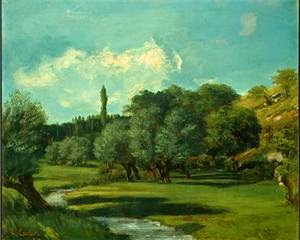
Le Bretonnerie in the Department of Indre
Gustave Courbet (1856)
source Wikiart

For Fun!:  (Ooops! That doesn’t sound good.  Perhaps I should say, “for more fun.”)

The Terror:  I received this book from Andrea from Tasseled Book Blog during her wonderful give-away contest and can’t wait to get to it.  A relaxing day on the beach will be a perfect time to read it!  Thanks, Andrea!

The Little World of Don Camillo:  an Italian classic based on the real life priest Don Camillo Valota.  It is supposed to give an excellent portrayal of the rural Italian countryside after WWII.

Porterhouse Blue:  I bought this book for no particular reason ….. on a whim, really, which is not like me, so I thought I’d see how my rash action turns out.  I am also humming-and-hawing over whether to try to start reading some books on the Guardian’s 1000 best book list.  Porterhouse Blue is on it.

Le Petit Nicolas:  for my Language Freak Summer Challenge

Ausgewählte Märchen:  German fairy tales for my Language Freak Summer Challenge.

Stories of the East From Herodotus:  really, I should just read Herodotus’ Histories but this old children’s book is on my TBR Pile Challenge list and the last thing I need is another tome to read.

Death By Living:  my brother-in-law gave me this book and said I would enjoy it.  I usually trust his judgement but, then again, this book is not a book I’d usually choose to read.  I’m stepping out of my comfort zone!

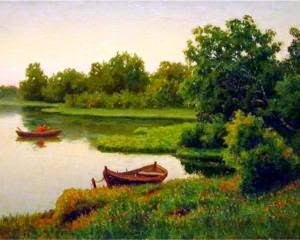
Summer Landscape with Fishermen
Efim Volkov
source Wikiart

No, I am not delusional.  I don’t expect to finish ALL of these books.  I also can see that if I don’t finish some of my “in progress” books soon, I won’t have time to read any new books, which is good incentive to focus on some unfinished reads before summer begins.  It will be interesting to see my progress at the end of the summer.  I do have one glorious month off, where, if I wanted to, I could read all day long, but I usually end up doing lots of hikes as well.  Last year I read 13 books during the months of July & August so hopefully I can either meet or beat that number.  I can only try!

What are your reading plans for the summer?

An Enthralling Novel (1885)
Julius LeBlanc Stewart
source Wikiart

Song on May Morning – John Milton

John Milton (1629)
National Portrait Gallery, London
source Wikipedia

I always have such good intentions to start reading poetry on a regular basis, but somehow those good intentions get backlogged.  So I thought that the least I could do is to post a poem every now and then on my blog.  Who knows, I may even start a full-fledged poetry project one day …….. but not yet …….


Song on May Morning
 
Now the bright morning Star, Dayes harbinger,
   
Comes dancing from the East, and leads with her
   
The Flowry May, who from her green lap throws

The yellow Cowslip, and the pale Primrose.
   Hail bounteous May that dost inspire [ 5 ]

   Mirth and youth, and warm desire,

   Woods and Groves, are of thy dressing,

   Hill and Dale, doth boast thy blessing.

Thus we salute thee with our early Song,
And welcome thee, and wish thee long. [ 10 ]

This poem is by John Milton, best know for his work, Paradise Lost, which I read earlier this year and reviewed here.  As you read through the poem you can perhaps discover two main themes.  Have you found them yet?  The focus in this poem is on “dawn” and, of course, “May.”  In fact, if you found the first theme, you will then know that this ten-line poem is an aubade. What is an aubade, you ask?  I didn’t know either.  The definition of an “aubade” is “a poem or piece of music appropriate to the dawn or morning.” Do you notice “song” in the title of the poem?  It appears that Milton covered the definition very thoroughly.  And, in honour of my Language Freak Summer Challenge, did you know that “aubade” translated into French, Spanish, German, Italian and German is “aubade”?  However in Japanese it is オーバード. 

Yellow Cowslips
Photo courtesy of Caroline
source Flickr


The poem mentioned both primroses and yellow cowslip.  I am familiar with primroses but had no idea what cowslip looked like, so I investigated.  As you will see from the photo above, I found a picture of beautiful yellow cowslip. Yet it only took me a moment to realize that strangely the cowslip looked very similar to …………. primroses (see photo below) ………… :-Z

Primroses
Photo courtesy of Pirate_Renee
source Flickr


More investigation revealed that primroses, or Primula Vulgaris, are actually a family of flowering plants, of which cowslip is one.  I must say I was rather disappointed.  In this poem, not only would you think that “bounteous May” would be able to produce more than one type of flower, but also that Milton would have the creativity to include more natural variety.  Oh, well.  At least I learned something.

And so, as you read through this poem, do any particular words stand out for you?  What feelings does it evoke?  What images does it bring to your mind?

And welcome bounteous, flowry, May!