
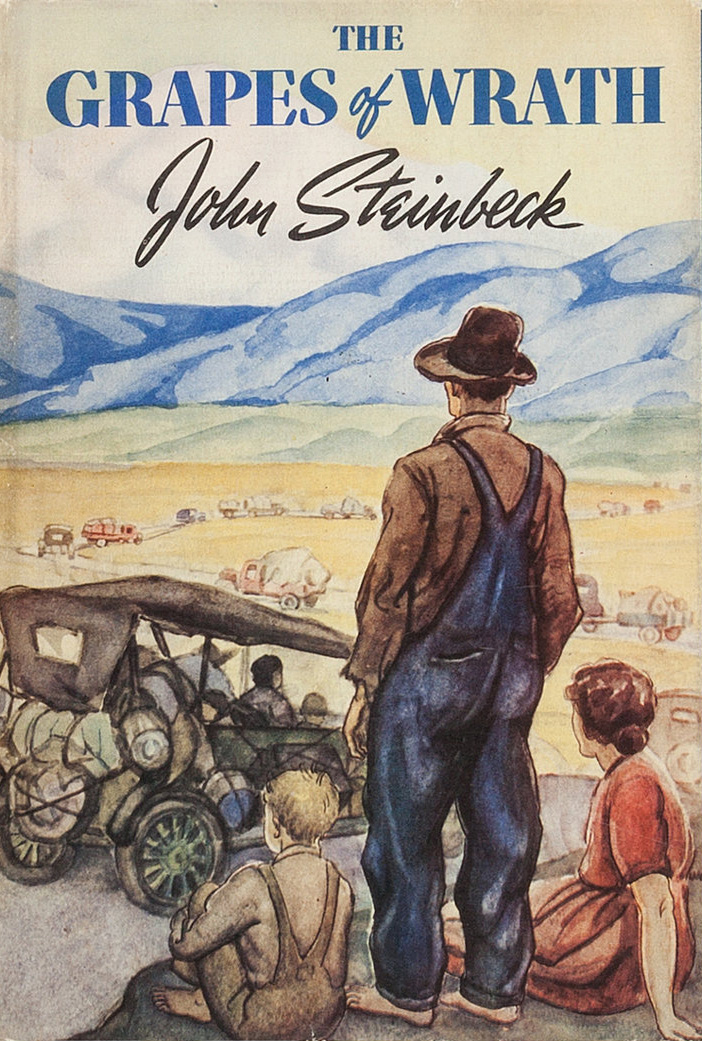
 “To the red country and part of the gray country of Oklahoma, the last rains came gently, and they did not cut the scarred earth.”
Okay, I’m just going to come out and admit it. I simply could not stand this book. I didn’t have high hopes because East of Eden was sort of a “meh” for me, but it was much more compelling and realistic than this one. I don’t like books that exaggerate circumstances to further the author’s point of view, and I don’t like being emotionally manipulated. This work did both and the method was highly irritating and disingenuous.
The book begins in Sallisaw, Oklahoma where the Joad family, who have made their living as sharecroppers, are forced off their land by a combination of the Great Depression, the Dust Bowl (according to Steinbeck, although apparently it did not occur in this area of Oklahoma) and the mechanization of farm equipment over the last decade or so. Deciding not to adjust to the new circumstances by learning to drive a tractor or finding other means of livelihood, the Joads are lured by pamphlets promising work on farms in California.
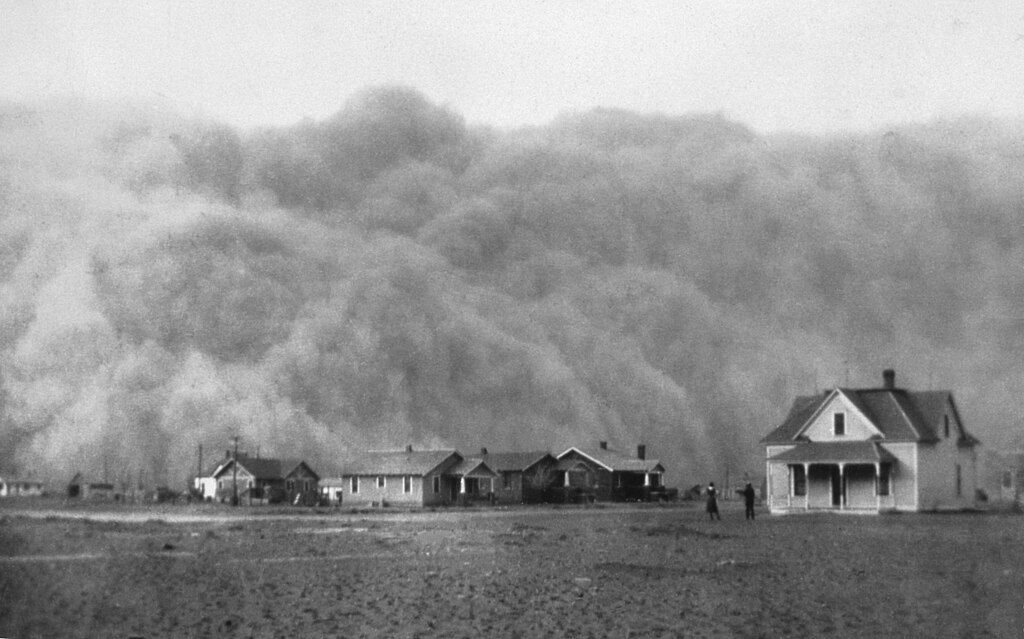
A Dust storm approaching Stratford, Texas
~ source Wikipedia
Tom Joad is just arriving home after his time in prison for killing a man in self-defence, and finds his family packing up to leave for California to find work. The Dust Bowl and continuous drought have destroyed their crops and after being unable to pay their rent, they are evicted from their farm. Lured by handbills promising work in California, they, along with an ex-preacher named Casey, tether their dreams to this new land of plenty. The reader then follows Grandma and Grandpa Joad, Pa and Ma, the sons, Noah, Tom, Al and Winfield, the daughters, Rose of Sharon and Ruthie, Uncle John, Connie who is Rose of Sharon’s husband, along with Casey, through their journey down Highway 66 and into California, as jobs are hard to come by and the reception by many Californians are antagonistic.
Along their journey they lose various members of the family from different means including death and desertion. All big businesses and banks are bad and conspire to suppress the helpless little people. All the authorities are conspiring to be nasty to them as well. The Joads finally are accepted into a government camp which protects them from these terrible people allied against them, but the family still needs to find work, as their resources have dwindled away during their journey. But as workers are hired, their wages are soon cut in half to a barely survivable level. Casey attempts to form a union but when the strike ends in violence, Tom sees Casey being killed from the blow of a pickaxe and kills his attacker. Forced to flee once again (he has already broken his parole sentence in Oklahoma), Tom lives in the woods with Ma bringing him provisions. Rose of Sharon’s baby is born stillborn and when the Joads dwelling is flooded, they move to higher ground. The book ends with a very weird scene.
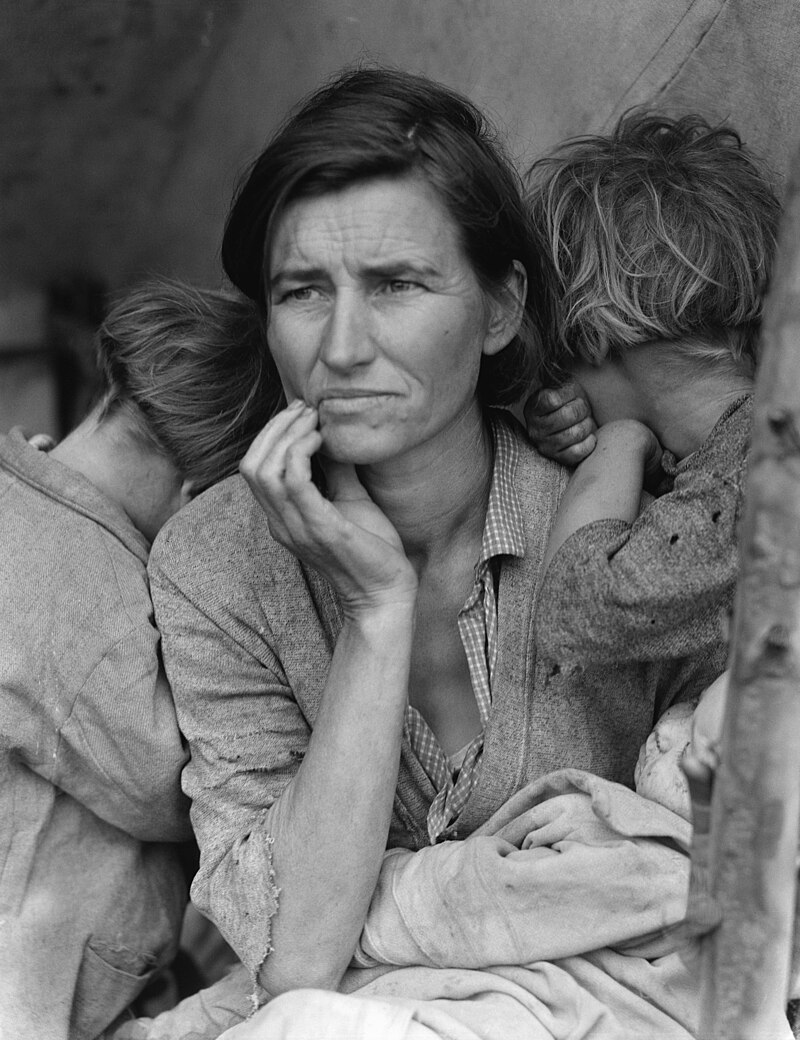
Migrant Mother by Dorothea Lange
~ source Wikipedia
Oh my, where do I start? First of all, Steinbeck uses hyperbole throughout, which doesn’t give a true example of the history of this time. He portrays the death of children because they have no food, but if you read about the Dust Bowl and/or the Great Depression, it was rare that people died of starvation. It was more common that they had poor nutrition and therefore would pick up diseases easily, but dying of starvation? Nope. So, in effect, he’s employing emotional manipulation.
He implies that banks were checking on farms and farmers, and were creating rules for the processes which harmed the workers, and also that farmers were paying workers less. According to Steinbeck, this was all a ploy by the farmers and banks to unilaterally suppress the poor migrants. He conveniently neglects to mention that the depression was hard on everyone (unemployment across the country was 20 – 25%) and that farmers often needed to reduce wages to get by. The banks were concerned about keeping farmers solvent so they were repaid the money that they had lent. The Smoot-Hawley Tariff Act of June 1930 under President Herbert Hoover, which was meant to protect the American economy from foreign competition, actually had the opposite effect, hampering the volume of trade and therefore economic recovery.
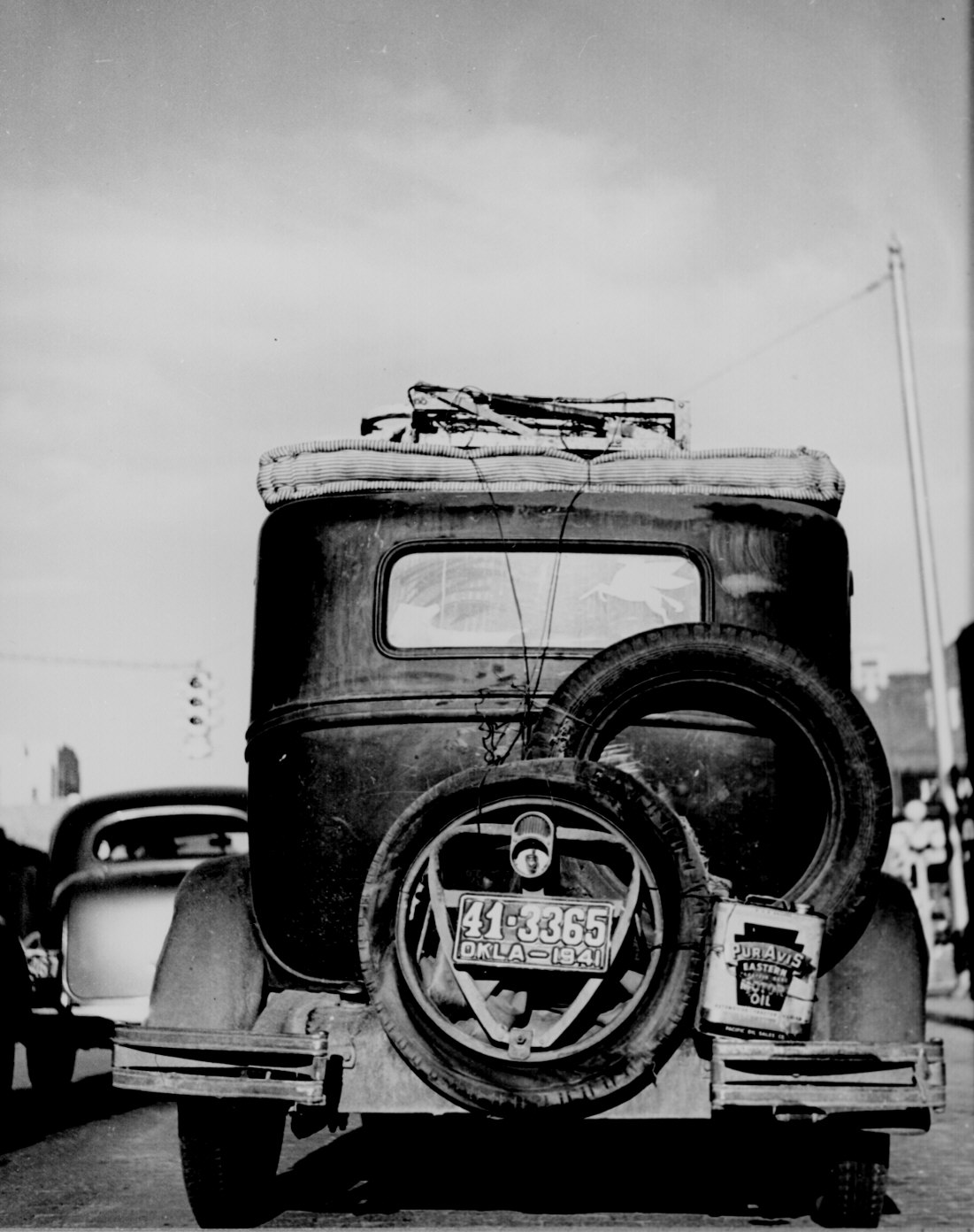
Rear view of an Okie’s car, passing through Amarillo, heading west, 1941
~ source Wikipedia
Steinbeck also seems to think that the migrants, who had contributed nothing to the state of California and its functioning, should be treated exactly the same as the people who had lived there all their lives and had paid into the success of the state, with not only money but hard work. It sounds like a lovely fairy-story perhaps, but it’s more than a little naive to expect equal treatment of the migrants in such difficult circumstances.
As for the religious tones in the work, I would suspect that the Joads displayed very little of the Christian behaviour that regular Oklahomans would have exhibited in that time, instead depicting a rather secular-Steinbeckian behaviour. I mention this point after reading a couple of similar criticisms from people whose grandparents experienced the Dust Bowl and the Great Depression and who had the same complaint. Steinbeck also inserted a token Christian crazy-person into the novel. In that, I would say, he was ahead of his time in entertainment, but not very realistic.
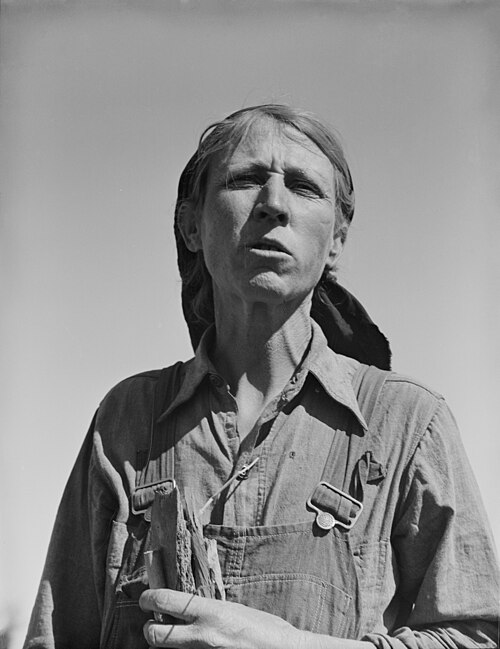
FSA/8b31000/8b317008b31740a.tif
So, in essence, Steinbeck seems to have interviewed a number of migrants, taken their absolute worst experiences and synthesized them all onto one family. Which is not an accurate portrayal of history. Then he emotionally manipulates the reader to create almost a false empathy for the situation, even if some of the situations in which the Joads find themselves could have been of their own creation. In this novel, all migrants (regardless of their own behaviour in situations) are victims, and all employers, big business and banks are the oppressors (regardless of their behaviour or situation). Again, it’s an inaccurate and a disgraceful way to portray history.
Don’t get me wrong. I know it was difficult for the migrants and I do have sympathy for them. I know many of them were treated in ways that in normal times would have been considered unfair. But these were not normal times and it’s important to consider the situation and the effect on everyone. Unfortunately, Steinbeck, in his quest for emotional capture of his reader, did not consider the practicalities at all.
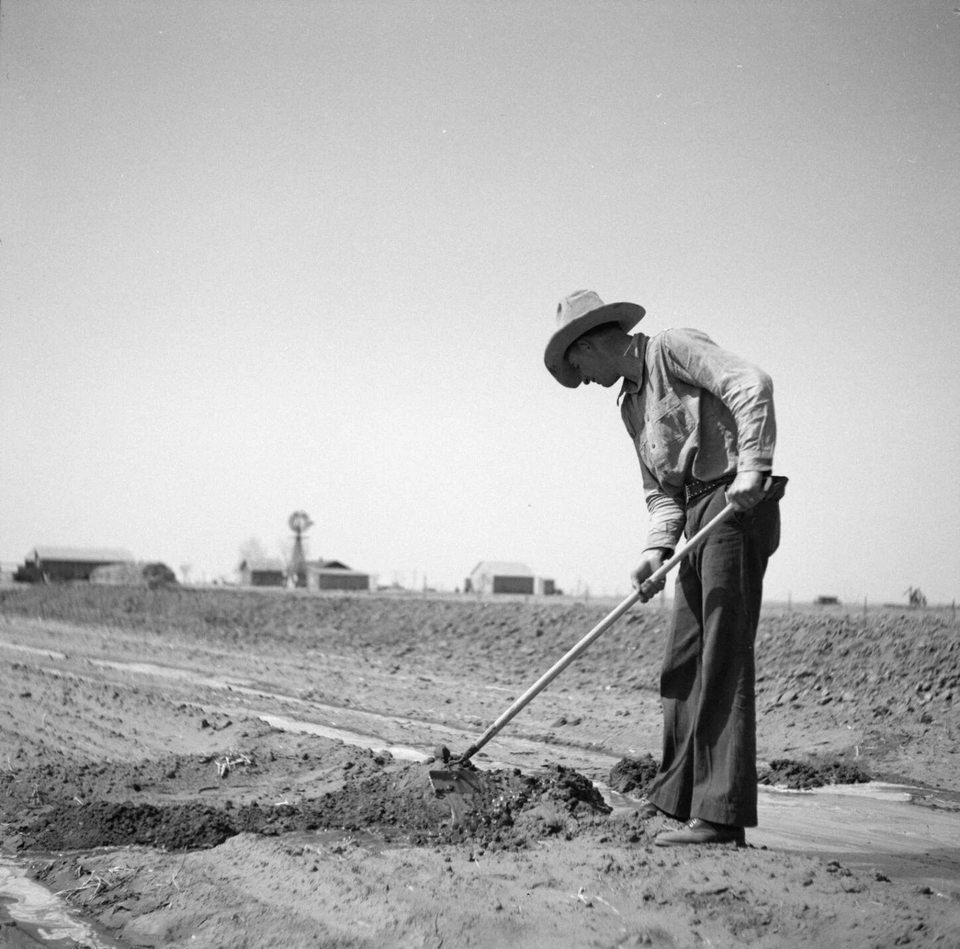
An Oklahoman farmer digging an irrigation channel in April, 1936 ~ source Wikimedia Commons
Apparently, when Steinbeck’s novel was published, it was condemned by much of the population of Oklahoma
Here are some articles which elaborate the situation which intersect with truth much more than this novel:
https://www.okhistory.org/publications/enc/entry?entry=OK008
“Sympathetic artists gained fame as they raised the national consciousness about their distressed subjects. John Steinbeck’s novel The Grapes of Wrath (1939) depicted a downtrodden Joad family trekking from Oklahoma to California, suffering scorn and economic oppression as they sought honest employment. This gritty portrayal offended some Oklahomans, but many others avidly read the book ……. The supposedly helpless “Okies” of these works might have been more symbols of the artists’ ideologies than the real migrants, who actually left a noticeable imprint on the central valleys of California ….”
It is true that many people left Oklahoma for California in the 1930s. This was anything but a novel phenomenon, however. People had been doing the same since before World War I, as the southwestern states’ economy failed to prosper and as better opportunities were available in other regions ….. It was not the Depression of the 30s but the economic boom of the 40s that caused an abnormal increase in Okie migration …… Moreover, most of the migrants who did leave Oklahoma in the Depression were not farmers. Most came from cities and towns. The 1940 Census showed that in the period of the supposed great Okie Exodus between 1935 and 1940, only thirty-six percent of southwesterners who migrated to California were from farms ….. Ironically, for someone whose politics have been described by his several biographers as a “typical New Deal Democrat,” Steinbeck identified the wrong culprit. In two separate studies of the plight of southern tenant farmers in the 1930s, the historians David Eugene Conrad and Donald H. Grubbs have blamed not the banks but the agricultural policies of the New Deal itself. In the early 1930s, some sixty percent of farms in Oklahoma, Arkansas, and Texas were operated by tenants. However, during the Depression they found themselves victims of Franklin Roosevelt’s 1933 Agricultural Adjustment Act, which required landlords to reduce their cotton acreage. Fortified by aaa subsidies, the landlords evicted their tenants and consolidated their holdings. It was government handouts, not bank demands, that led these landlords to buy tractors and decrease their reliance on tenant families. By 1940, tenant farmer numbers had declined in the southwest by twenty-four percent …… Gregory (who wrote, American Exodus: The Dust Bowl Migration and Okie Culture in California) argues that the real migrants were much better informed than [the Joads]. Most had direct information about working conditions from relatives already there. Two-thirds of Okies interviewed in the Salinas Valley had relatives living in California before they came west …… A 1937 study by a sociologist found that the average Oklahoma farmer moved four times in his working life, five times if he was a tenant. The Joads, who had all grown up in the same place where Grampa had fought off snakes and Indians in the nineteenth century, would have been most unusual Oklahomans ….. This version of the story, in which agricultural migrants had many more active choices than the powerless victims of Steinbeck’s novel, was also true of California. Although the state was hit particularly hard by the Depression, with the unemployment rate reaching twenty-nine percent in early 1933, its economy bounced back comparatively quickly between 1934 and 1937. In this period, Californian agriculture suffered not unemployment but labor shortages. At the time, Californian growers needed thousands of harvesters for their crops. In the San Joaquin Valley, cotton acreages quadrupled between 1932 and 1936. As a result, demand for cotton pickers soared and wages more than doubled ….. California also had a much more generous unemployment relief system: $40 a month for a family of four, compared to $10 to $12 a month in the southwest. Although paying relief to migrants generated resentment among Californian taxpayers, it was an important consideration for agricultural workers ….. Most Okies who went to the agricultural valleys, however, preferred other options. “Little Oklahoma” or “Okieville” settlements sprung up on subdivisions on the outskirts of larger inland cities like Bakersfield. For as little as $5 to $10 down and the same each month, migrant families could own land on which to build their own houses. They constructed them of cheap building materials and they initially had poor water supply and sewage disposal and no electricity. However downmarket they might have seemed to other neighborhoods, who often resented their presence, these typical Okie settlements were still a long way from either the canvas lean-tos and abandoned railway carriages Steinbeck made his characters inhabit in the novel, or the prim government camps he urged the New Deal to provide for them. The great majority of real Okies voted with their feet and went to the private market to buy their own land and build their own houses ….. Rather than a tragedy, the Okie migration was a success story by almost any measure. By 1940, well before the World War II manufacturing boom transformed the Californian economy, a substantial majority of Okies had attained the goals that had brought them west. Eighty-three percent of adult males were fully employed, a quarter in white-collar jobs and the rest evenly divided between skilled, semi-skilled, and unskilled occupations ….. It should be emphasized, however, that the received story of the great Okie Exodus was not entirely an invention. Instead of Steinbeck’s 300,000, there were actually about 90,000 agricultural workers fitting the Okie category who migrated to and settled in Californian farming valleys in the 1930s. While the great majority of them prospered, a small minority did not. In 1937, when the problem of migrant homelessness was at its worst, a Californian government health survey estimated there were 3,800 of these families living in squatter villages of the kind portrayed in The Grapes of Wrath. This would appear to be the most accurate estimate of the number of people who experienced what the Joads went through. This is not an insignificant number, but neither is it a quantity that warrants being the received image of the Great Depression. This number amounted to about five percent of the dimension claimed by Steinbeck and gives a fair idea of the scale of exaggeration his book has perpetrated. If this is so, it raises the question: how did such a grossly false picture become so entrenched in the popular imagination? ……. This was, in fact, widely recognized when the book was published. Many Californians were outraged at a story they believed was a grotesque misrepresentation that defamed their state. There were a number of anti-Steinbeck public meetings organized and several angry pamphlets produced. Steinbeck’s neighbor and fellow author Ruth Comfort Mitchell, wife of the Republican State Senator, called one of these meetings in San Francisco where she promised to write a reply to the libel and set the record straight. The sentimental novel she eventually produced, Of Human Kindness, however, was hardly a match for her rival’s ability to generate powerful literary mythology ….
If this had just been a book of fiction written without any historical anchoring, I would have at least been able to respect it, even if I still didn’t enjoy it. But Steinbeck deliberately distorted reality to further his own social and political opinions and I have no respect for that type of writing, especially because throughout the decades, it has informed so many people’s opinions on the Okies, migrants, Dust Bowl, the Great Depression, etc. with inaccurate “facts”. I’m not giving up on reading more Steinbeck novels, but I will do so with a much more skeptical approach.
