
 “The human race, to which so many of my readers belong, has been playing at children’s games from the beginning, and will probably do it till the end, which is a nuisance for the few people who grow up.”
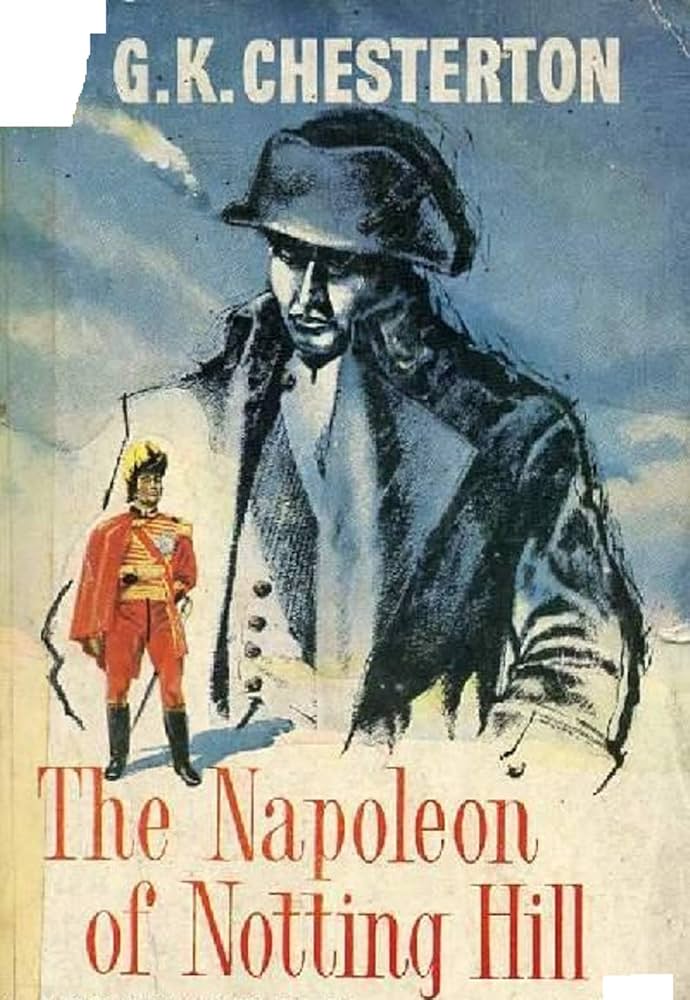
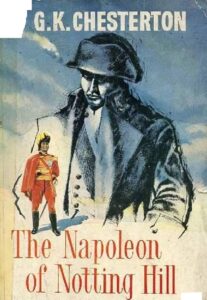
First of all, G.K. Chesterton is the most under-rated author there is. Perhaps it’s because his intellect is just so far beyond your average person’s that it takes attention and a willingness to think to get the most out of his works. But on the other hand, his novels are just so full of romps and fun and zany behaviour that it’s hard not to love them. The Napoleon of Notting Hill was his first endeavour.
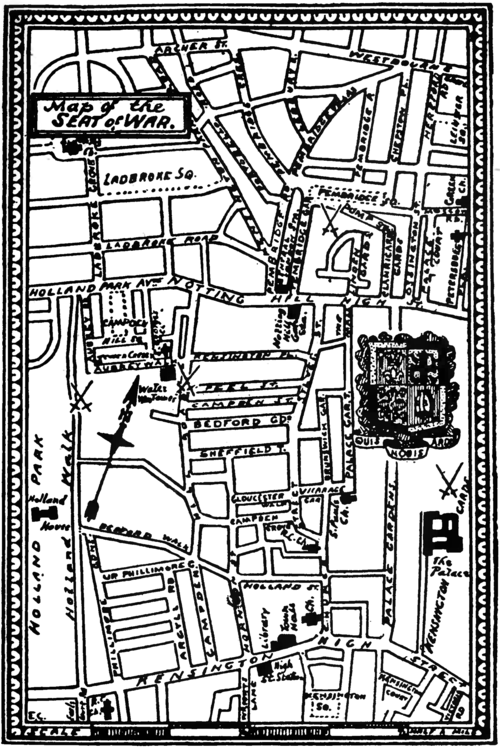
The Map of the Seat of War ~ source: Wikimedia Commons
Written by Chesterton in 1904, the novel’s setting is London eighty years later, so 1984. It’s somewhat ironic that I just finished George Orwell’s Nineteen Eighty-Four without knowing the setting of Chesterton’s story, but the novels have little comparison. While Orwell is more interested in the practical outcomes of a totalitarian regime, Chesterton focuses more on the unspoken internal corruption of the soul that happens when life is perfect and there is little purpose in life’s achievements.
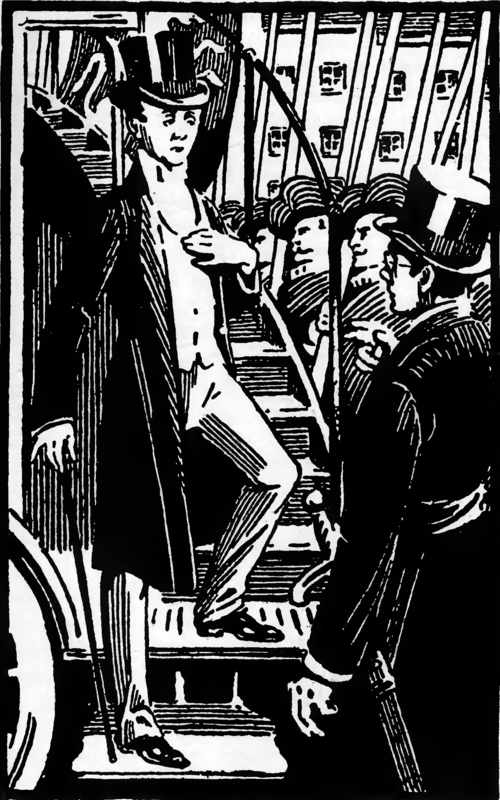
King Auberon descended from the omnibus with dignity ~ source Wikimedia Commons
The book begins in London with what I suspect is supposed to be a utopian bliss. War has been eradicated and everyone lives a life of tranquil, monotonous contentment. Yet because there is no struggle or discomfort of striving for something better, everyone seems to have the personality and liveliness of a squashed dead toad. In any case, all is not lost, as we see when we meet Auberon Quin, who still views life as an adventure and approaches it with a child-like wonder. To Auberon, everything is a joke. When he is inadvertently crowned King, he brings back all the pageantry and tradition of the Middle Ages, complete with medieval heraldry, where every borough in London flies its own colours.
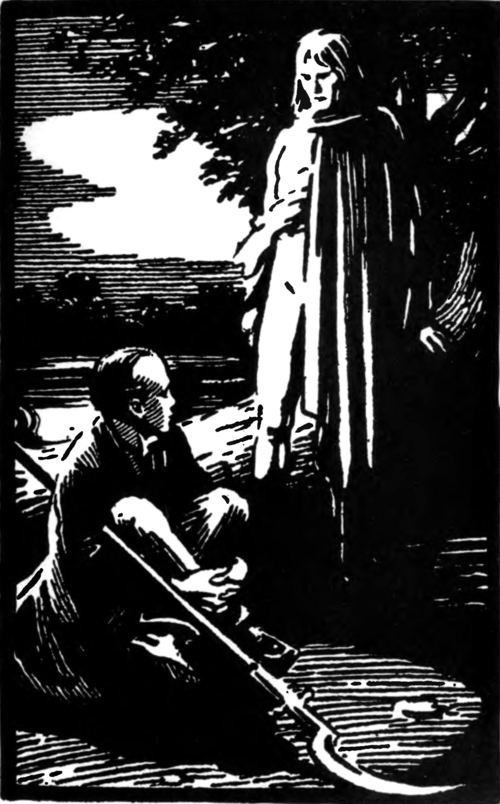
Wayne it was all a joke! ~ source Wikimedia Commons
The people go along with Auberon’s silliness as long as they are not troubled by it, socially or financially. Then one day a road is proposed, but to make it complete, it will have to pass right through Notting Hill. Now, Adam Wayne, the provost of Notting Hill has taken his king’s decrees even further than his word and struts around with a sword. He completely rejects the idea of a road passing through his territory and thus, from out of the sleepy, uninspired populous, begins a war that may not only change the landscape, but the souls of the men of that time.
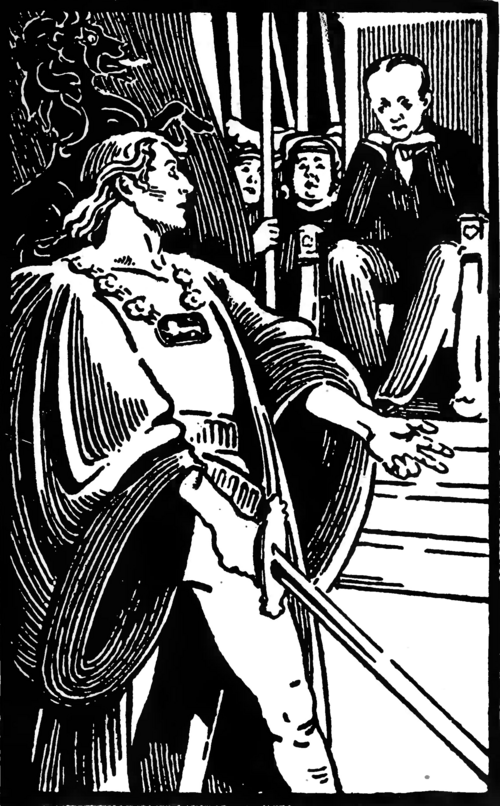
I bring homage to my king ~ source Wikimedia Commons
At the end of the war, everyone has changed. The grocer’s language and communication are no longer utilitarian but filled with meaning. The chemist’s shop is described in artistic terms. Barker, previously dull and uninteresting, no longer derides the king, and his idiom and behaviour have adopted this alteration. A war has brought forth meaning and brought all people closer together in spirit.
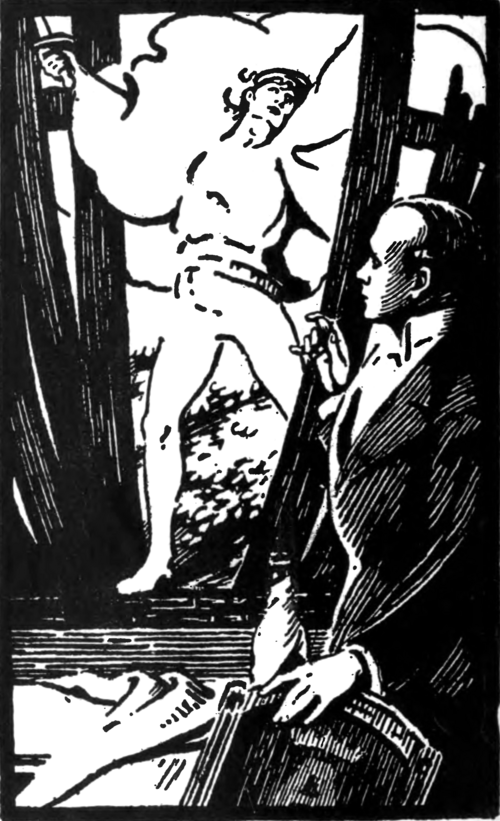
In the dark entrance there appeared a flaming figure ~ source Wikimedia Commons
Chesterton is showing that materialism and pragmatism and utilitarianism can only bring a society so far, and that society is still bereft of art and substance and meaning. Strangley, holding on to ancient tradition and childish wonder, and even the effects of war, bring a depth and meaning to life that few people realize.
Chesterton seems to start with an utopian theme, where there are no wars, everyone is employed and happy and has friendship with others but, in spite of the outward appearance, he allows us to see what it does to a man’s soul. Initially, while everything appears to be perfect, there is no diversity in thought or, in a sense, in action. Auberon Quin’s behaviour and manners seem odd and then, when he becomes king by lottery, everything gets turned upside down. Pagentry and tradition come to London and eventually war. But with all the tumult and the jolting out of their lifeless “bliss”, all the characters begin to emerge as distinct and begin to get a life and personality to them. While the end might not be a happy ending, there is a sense that humanity has been restored to the human race in a very positive way.

Notting Hill ~ source Wikimedia Commons
I believe Chesterton is trying to tell us that wars and struggles and tragedies in life, while they can be difficult and hard to bear, that they are part of what gives meaning to life and allow us to grow in character and strength. It’s a very insightful way of looking at the deeper aspects of life.
“I sometimes wondered how many other people felt the oppression of this union between quietude and terror. I see blank well-ordered streets and men in black moving about inoffensively, sullenly. It goes on day after day, day after day, and nothing happens; but to me it is like a dream from which I might wake screaming. To me the straighness of our life is the straightness of a thin cored stretched tight. Its stillness is terrible. It might nap with noise like thunder. And you who sit, amid the debris of the great war, you who sit, as it were, upon a battlefield, you know that war was less terrible than this evil peace; you know that the idle lad who carried those swords under Francis or Elizabeth, the rude Squire or Baron who swung that mace about in Picardy or Northumberland battle, may have been terribly noisy, but were not like us, terribly quiet.” (p. 78)
Other G.K. Chesterton Reviews:
The Man Who Was Thursday, A Nightmare
Father Brown: The Worst Crime in the World
