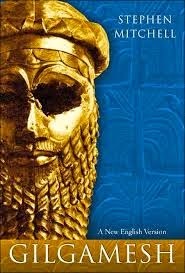
The Epic of Gilgamesh

“The one who saw the abyss I will make the land know;
of him who knew all, let me tell the whole story
 ………… in the same way …….
[as] the lord of wisdom, he who knew everything, Gilgamesh,
who saw things secret, opened the place hidden,
and carried back word of the time before the Flood —
he travelled the road, exhausted, in pain,
and cut his works into a stone tablet.”

Gilgamesh, king of Uruk.  Two-thirds god and one-third man, he built the walls of Uruk, the palace Eanna, and is powerful and commanding.  There is no king like him anywhere.  Yet in spite of having many of the qualities that could make him an honoured king, Gilgamesh oppresses his people and they cry out for relief.  The gods create a wild man, Enkidu is his name. They fight and become fast friends, relieving the people of Gilgamesh’s despotism. Many adventures they have together, and many discoveries they make. Together they behead Humbaba who lives in the cedar forest and they also manage to kill The Bull of Heaven.  Yet one of them must pay for this transgression and Enkidu falls ill, dying even as he laments.  A heart-torn Gilgamesh, determined to find Utnapishtim and find the secret of everlasting life, travels through a number of trials to his journey’s end.  “Surely, Gilgamesh,” Utnapishtim tells him, “you can stay awake for just a week, if you are expecting to have eternal life.”  But Gilgamesh fails the test.  In spite of his near godly status, our hero cannot escape the mortality common to all men.

“My friend Enkidu, whom I loved so dear, who with me went through every danger, the goom of mortals overtook him. 

Six days I wept for him and seven nights: I did not surrender his body for burial until a maggot dropped from his nostril.  Then I was afraid that I, too, would die.  I grew fearful of death, so I wandered the wild. 

…. How can I keep silent?  How can I stay quiet?  My friend, whom I loved, has turned to clay.  My friend Enkidu, whom I loved, has turned to clay.  Shall I not be like him and also lie down, never to rise again, through all eternity?”

Gilgamesh
from the Chaldean
account of Genesis
source Wikipedia

I found many paradoxes in this poem: Gilgamesh is a strong leader, yet he also abuses his power; Gilgamesh is two-thirds god, yet he is also doomed to die; Gilgamesh and Enkidu fight in order to bring peace to Uruk; women are portrayed as vehicles for pleasure, yet are also shown as being wise and having foresight; Enkidu is initially a wild-man, yet he is the one who “tames” Gilgamesh; and in spite of often not sleeping throughout most of the poem, Gilgamesh sleeps at the end, which prevents him from attaining immortality.

Yet in spite of the contradictions, the poet is clear that strength over reason is valueless. Gilgamesh learns that it is trust and integrity in the end that bring acclaim: valuing a friend’s life over his own, discovering the wisdom of accepting death as a part of life, and that being a true leader is about good character and responsibility to his subjects, rather than exercising tyranny, oppression and conquest over them.

And in spite of its ancient roots, the poem still resonates with us today.  Here is a video of Captain Picard from Star Trek the Next Generation giving a short summary of Gilgamesh, in the episode “Darmok” (my favourite episode, BTW!) 🙂

About the translation:  The Sîn-Leqi Unninni Gilgamesh story, found in the library of Ashurbanipal, is the most recent Akkadian version (circa 1200 BC), and is considered the “standard” version.  The editors used it as their fragment of choice and because it contained a number of books that had only a few recoverable words, they had to resort to notes and the Old Babylonian version, in order for the reader to get the gist of the story.  For my first read, in hindsight, I may have chosen a more fluid version, but this version was certainly adequate and scholarly enough that you got the full context of the poem.

Translated from the Sîn-Leqi Unninni version by John Gardiner and John Maier
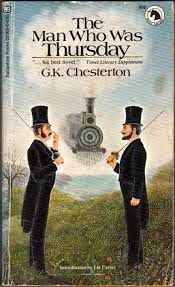
The Man Who Was Thursday, A Nightmare by G.K. Chesterton

“The suburb of Saffron Park lay on the sunset side of London, as red and ragged as a cloud of sunset.”

Why, oh why, does Chesterton confuse me so?  At first this book appeared to start as a mystery.  Two poets meet in Saffron Park, one, Lucian Gregory, a creative anarchist, the other, Gabriel Syme, a conservative poet and undercover police detective.  By his wit and resources, Syme infiltrates the anarchist’s group called the Central Anarchist Council, getting himself named one of its seven members, christened “Thursday”.  Yet can he stop the assassination attempt the group is planning and expose this dastardly anarchical organization?

The book is much more than a mystery, which readily becomes apparent as the reader makes his way through the entertaining yet confusing prose. There was an initial discussion about anarchy and art, yet I soon realized that the two poets were comparing anarchy and law.  As I read my way through, various questions arose.  Why were the council members named after the days of the week?  Does this point towards some sort of creation story?  Why do all the members who appear evil are not as they seem? What are they really fighting against?  Why is the subtitle “A Nightmare”?  And what was the point of Syme’s promise to Gregory? It is mentioned numerous times so it should have some importance.

Yet the big question that hangs over the characters and the reader alike is: Who is the leader of the group, Sunday?  The Professor, named Friday, reveals:

“I confess that I should feel a bit afraid of asking Sunday who he really is.” 

“Why,” asked the Secretary, “for fear of bombs?” 

“No,” said the Professor, “for fear that he might tell me.”

In one review, the reviewer claimed that Sunday represents Nature.  Well, perhaps.  He is both benign and frightening, as this description shows:

“You would not know [his name] ……  That is his greatness.  Caesar and Napoleon put all their genius into being heard of, and they were heard of.  He puts all his genius into not being heard of, and his is not heard of.  But you cannot be for five minutes in the room with him without feeling that Caesar and Napoleon would have been children in his hands.”

Sunday’s words about himself are even more chilling:

“Since the beginning of the world all men have hunted me like a wolf —- kings and sages, and poets and law-givers, all the churches, and all the philosophers.  But I have never been caught yet, and the skies will fall in the time I turn to bay.  I have given them a good run for their money ……….  There’s one thing I’ll tell you though about who I am.  I am the man in the dark room, who made you all policemen.”

After its publication in 1908, The Man Who Was Thursday came under a storm of critical approval.  Frighteningly complex, it has been  hailed as “amazingly clever”,  “shamelessly beautiful prose”, “a remarkable acrobatic performance” and “a scurrying, door-slamming farce that ends like a chapter in the Apocalypse.”  One reader declared himself “dazed” at the end of it, which perfectly described my puzzled demeanor as I closed the last page.

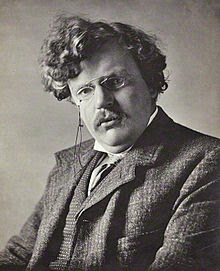
Gilbert Keith Chesterton (1909)
source Wikipedia

As you see, reading the book brought about more questions than answers, so instead I will leave you with a taste of what others have said about this novel:

“Roughly speaking, it’s about anarchists …… And roughly speaking, it’s a mystery story.  It can be guaranteed that you will never, never guess the solution until you get to the end —- it is even feared that you may not guess it then.  You may never guess what The Man Who Was Thursday is about.  But definitely, if you don’t, you’ll ask. “ 

                                                                     ~  Orson Welles  ~

“…… mystery and allegory take their turn in the scene.  Life, huge, shapeless, cruel and loving, killing and saving, full of antitheses, appearing to each one under a different aspect, measuring each man according to the strength of his soul, turns its strange face upon us.  Life, whose soul is law, nature, whose expression is law, confront the frantic lawlessness of struggling man —- and behold, those very struggles prove to be based on law again.  And when at the last you sit on the thrones with the Council of Days, you see the mad, miraculous world dance by, moving to a harmony none the less invincible because only half heard.”
                                                ~  Hildegarde Hawthorne  ~

I highly recommend this book to ……….. well, to anyone!  Read it as a mystery, read it as a commentary, read it as philosophy,  read it as a fantasy, read it as theology —- it has something for everyone. Perhaps it should be described as a mystery without end, a true symphony of brilliance by Chesterton, in which nothing is ever how it seems!

If you’ve read The Man Who Was Thursday, what do you think the story was about?

Further Reading:

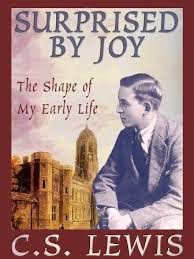
Surprised by Joy by C.S. Lewis

“I was born in the winter of 1898 at Belfast, the son of a solicitor and of a clergyman’s daughter.”

And so begins the autobiography of one of the most prolific writer’s of his time, C.S. Lewis.  While Lewis gives an engaging description of his life as a boy, first in Ireland, and then later in England, his main goal is to give the reader little windows into the experience that he called “Joy”, which one can equate with the German word, “Sehensucht” translated into English as an “intense longing”.  During his childhood, Lewis experienced brief yet keen feelings of this profound yearning.  If one tried to manufacture this emotion or hold onto it, it would simply remain illusive or slip away; it came of its own volition, which indicated to Lewis that this desire pointed to something beyond himself.

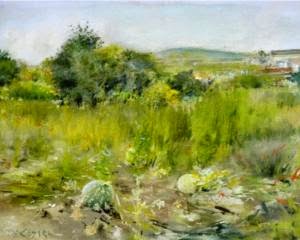
In the Garden (1885)
William Merritt Chase
source Wikiart

Lewis’ first glimpse of “Joy” was when his brother Warnie showed him a garden that he had built of moss and twigs on top of a biscuit tin. Lewis said, “As long as I live my imagination of Paradise will retain something of my brother’s toy garden.” Other experiences of joy appeared as he grew and Lewis felt that because our own natural world could not supply what our souls longed for, there must be something supernatural that could fulfill this Sehensucht.  Eventually Joy brought him face-to-face with God.

Magdalen College Oxford
source Wikipedia

What was especially refreshing about this biography was that Lewis didn’t treat his conversion as coming out of the darkness into the light, so much as presenting it as a recovery of the delights of childhood that he felt were pointing him in the direction of Christ.  In many ways, this is an Augustinian-type experience, yet while Augustine was definitely searching for a meaning to life, the “meaning” seemed to be pursuing Lewis, and he describes his conversion in startling terms, “You must picture me alone in that room in Magdalen, night after night, feeling, whenever my mind lifted even for a second from my work, the steady, unrelenting approach of Him whom I so earnestly desired not to meet.  That which I greatly feared had at last come upon me.  In the Trinity Term of 1929 I gave in, and admitted that God was God, and knelt and prayed: perhaps, that night, the most dejected and reluctant convert in all England.”  But he then goes on to say, “I did not then see what is now the most shining and obvious thing: the Divine humility which will accept a convert even on such terms …….  The hardness of God is kinder than the softness of men, and His compulsion is our liberation.”

Before I wrap up this review and somewhat off topic, Lewis made a curious reference to automobiles in this biography, which I found very insightful and profound.

“I number it among my blessings that my father had no car, while yet most of my friends had, and sometimes took me for a drive. This meant that all these distant objects could be visited just enough to clothe them with memories and not impossible desires, while yet they remained ordinarily as inaccessible as the Moon.  The deadly power of rushing about wherever I pleased had not been given me.  I measured distances by the standard of man, man walking on his two feet, not by the standard of the internal combustion engine.  I had not been allowed to deflower the very idea of distance; in return I possessed ‘infinite riches’ in what would have been to motorists ‘a little room’.  The truest and most horrible claim made for modern transport is that it ‘annihilates space.’  It does.  It annihilates one of the most glorious gifts we have been given.  It is a vile inflation which lowers the value of distance, so that a modern boy travels a hundred miles with less sense of liberation and pilgrimage and adventure than his grandfather got from traveling ten.  Of course if a man hates space and wants it to be annihilated, that is another matter.  Why not creep into his coffin at once?  There is little enough space there.”

A very biting commentary but for me it rang with truth and made me wonder how much “Joy” has been robbed by modern conveniences.  Hmmm …….

In any case, this was a wonderful, uplifting biography that I fortunately get to read again for my WEM Project at some point in the future!

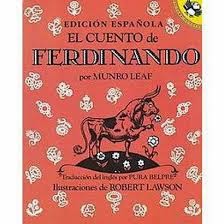
Ferdinandus Taurus – Munro Leaf

“Olim in Hispania erat taurulus nomine Ferdinandus.”

Well, right away I must confess that my Latin is not nearly good enough to read this book unaided.  I can read short paragraphs about Caesar fighting barbarians and Roman generals, but that’s about it.  However, the dictionary at the back of this book came to my aid as did other resources.  Honestly, I confess though, it took me ages to read this.

Almost everyone, I think, knows the Story of Ferdinand, the young bull who lives in Spain and would like nothing better than to sit in his meadow and to smell the flowers.  Yet when a bumblebee inopportunely stings him, just as some matadors are checking out bulls to take to Madrid to the fights, things go terribly wrong.  Ferdinand is mistaken for a magnificent fighter and is dragged off to the bullfights.  But our intrepid hero will not give in, no matter how many banderillos or picadores or matadores taunt him to fight. No, Ferdinand stays true to his placid nature and simply sits and smells the flowers. Finally he is sent back to his meadow and he is free.

And since this book is set in Spain, what better tribute than to read it in Spanish?  So that’s what I did after my foray into it in Latin.  “Había una vez en España un torito que se llamaba Ferdinando.”

This book was published in 1936, nine months before the civil war broke out in Spain, and was seen as a promotion of pacifism.  Francisco Franco, the Spanish dictator condemned it as propaganda, as did Hitler, who banned the book in Nazi Germany.  In contrast, the book was lauded by the political left; Gandhi claimed it was his favourite book, and it was the only non-communist book allowed in Poland by Joseph Stalin.

I did a comprehensive analysis of The Story of Ferdinand in English on my children’s book blog.  The depth of this book is astounding.  You can find my review here.

Okay, I squeaked in one more book (well, actually two if you count both the languages) for my Language Freak Summer Challenge.  Yippee!

La Parure (The Necklace) par Guy de Maupassant

“C’etait une de ces jolies et charmantes filles, nées, comme par une erreur du destin, dans une famille d’employés.”

Yes, she certainly was a pretty and charming girl who was born by a mistake of destiny into a family of office workers.  Mathilde would dream of riches and fame and jewels, covering her life of drudgery in a tapestry of fantasies and longings.  Finally, one day, her husband arrives with an invitation to a party.  Mathilde manipulates this honest, hard-working man into purchasing a new elegant dress for her, but when she complains of a lack of jewels, he has the answer: borrow some from her wealthy friend Madame Forestier!  A lovely diamond necklace of Madame’s catches Mathilde’s eye and she must have it.  Her friend, generous to the end, gladly loans it and the evening of her dreams begins.  She is admired, she is catered to, she is wrapped in a heavenly realm of blissful wealth and prestige.  Late do she and her husband return home, reluctant to leave the party until the end but, oh no!  The necklace has disappeared and she is sure that she left it in the taxi.  Days of searching yield nothing and finally there is only one thing to do.  Withdrawing their life savings and taking out a loan, they replace the necklace, hoping that Madame will not notice.  But this painful action causes them ten years of needless toil and suffering.  Why is it needless?  Well, you will have to read the tale to find out!

This short story was really a gem and, in spite of having an inkling of the final twist, it still held my attention to end.  In fact, I had expected to get fatigued by reading such a long (for me) story in French and I had planned to take a break, but instead, I was held rapt until the end.

I did wonder at the title of this story.  In the tale, the necklace is mostly referred to as “la rivière“, yet the title is “la parure“.  When I looked up “la rivière” in my French dictionary it says “river“, and “la parure“means “finery” or “jewelry“.  So then I looked up necklace and it had “le collier“.  What?  Do any of you Francophiles understand the distinction between these terms? Help!

In any case, this story has definitely been a huge incentive to read more of Maupassant.  His short stories are very readable and a good way to keep improving my French.  I certainly struggled here and there in parts of it and learned a number of new words, yet I was also pleased with my progress.

This will probably be the last book for my Summer Freak Language Challenge, unless I can squeak in a short children’s book before the end. Thanks Ekaterina, for holding this wonderful challenge.  It’s given me a chance to practice languages that I wouldn’t normally read in.  I’m already looking forward to next year’s challenge!

The Sayings of the Desert Fathers

“This book is an account of the virtuous asceticism and admirable way of life and also of the words of the holy and blessed fathers.”

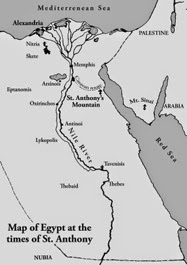
The Desert Fathers were a group of faithful monks and nuns who chose to settle mainly in Lower Egypt, mostly around the desert of Scetes. While some of them lived in groups and had at least some contact with the outside world, some were hermits who preferred to live in seclusion.  Asceticism was also practiced by many to purify their souls.  While Paul of Thebes was the first monk to retire to the desert, Saint Anthony the Great was the one to begin the exodus.  These Desert Fathers served as the early model for Christian monasticism.

As expected, there are many sayings that deal with religion:

Abba Epiphanius:

  • He also said, “Ignorance of the Scriptures is a precipice and a deep abyss.” 
  • Someone else asked him, “Is one righteous man enough to appease God?”  He replied, “Yes, for he himself has written: ‘Find a man who lives according to righteousness, and I will pardon the whole people.’ (Jer. 5:11)

We also find sayings from fathers instructing their disciples:

Abba Agathon:

  • The same Abba Agathon was walking with his disciples.  One of them, finding a small green pea on the road, said to the old man, “Father, may I take it?”  The old man, looking at him with astonishment, said, “Was it you who put it there?” “No,” replied the brother.  “How then,” continued the old man, “can you take up something which you did not put down?”

And fathers who seek harmony:

Abba Paul the Barber:

  • Abba Paul the Barber and his brother Timothy lived in Scetis. They often used to argue.  So Abba Paul said, “How long shall we go on like this?”  Abba Timothy said to him, “I suggest you take my side of the argument and in my turn I will take your side when you oppose me.”  They spent the rest of their days in this practice.

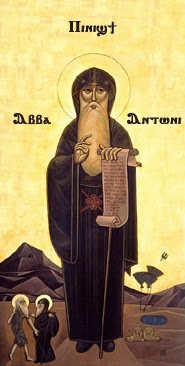
Coptic icon of
St. Anthony the Great
source Wikipedia

Philosophical fathers:

Abba Anthony the Great:

  • He also said, “God does not allow the same warfare and temptations to this generation as he did formerly, for men are weaker now and cannot bear so much.”

Abba Poeman:

  • He also said, “Men speak to perfection but they do precious little about it.”

And somewhat grumpy fathers:

Abba Arsenius:

  • Blessed Archbishop Theophilus, accompanied by a magistrate, came one day to find Abba Arsenius.  He questioned the old man to hear a word from him.  After a short silence the old man answered him, “Will you put into practice what I say to you?”  They promised him this.  “If you hear Arsenius is anywhere, do not go there.”
  • Another time the archbishop, intending to come to see him, sent someone to see if the old man would receive him.  Arsenius told him, “If you come, I shall receive you; but if I receive you, I receive everyone and therefore I shall no longer live here.”  Hearing that, the archbishop said, “If I drive him away by going to him, I shall not go anymore.”
    Saint Arsenius
    fresco at Mt. Athos, 14th century
    source Wikipedia

And lastly, not only sayings from the Desert Fathers, but saying from the “Desert Sisters,” as well:

Amma Syncletica:

  • She also said, “It is good not to get angry, but if this should happen, the Apostle does not allow you a whole day for this passion, for he says: “Let no the sun go down.” (Eph. 4:25)  Will you wait till all your time is ended?  Why hate the man who has grieved you?  It is not he who has done the wrong, but the devil.  Hate sickness but not the sick person.”
  • She also said, “Just as it is impossible to be at the same moment both a plant and a seed, so it is impossible for us to be surrounded by worldly honour and at the same time to bear heavenly fruit.”

I was expecting to have to slog through this book, but what a delightful surprise.  While these Fathers obviously knew their Scriptures and spent time with God, their focus was on themselves: refining their souls and being a good example to those around them. The personalities of each of them shone through in their sayings and, in spite of many of the sayings being quite short and compact, they brought a window into their lives of asceticism, their values and struggles that was very compelling.  An enlightening read that gives not only a fascinating window into this era of history, but also imparts values that are as relevant today as they were in the 3rd and 4th century.

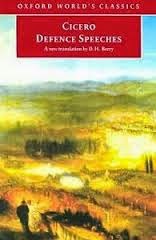
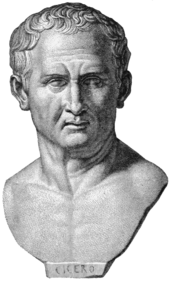
Defence Speeches by Cicero

“I imagine you must be wondering, members of the jury, why it is that, when there are so many leading orators and men of the highest rank present here in court, I of all people should have stood up to address you; for neither in age, nor in ability, nor in authority do I bear comparison with these men who have remained seated.”

So begins, Cicero’s first speech, Pro Roscio Amerino, his first speech delivered in a criminal court when he was a young 26-year-old defence advocate.  While Defence Speeches contains five speeches that Cicero gave during the years 80 B.C. to 52 B.C., this speech is my favourite.  It shows Cicero as a fresh, young advocate, willing to take chances, yet also using his wiles to sway listeners to his point of view.  His rhetoric is at once firm and decisive, yet also almost self-effacing at times, but in an astute and cunning manner that only serves to increase his power.  His client, Sextus Roscius, was, in the end, acquitted of patricide, and this case helped begin Cicero’s journey to rhetorical fame.

The defence speech, Pro Milone, is one of Cicero’s most famous, as he defended Titus Annius Milo against the charge of murdering the tyrant, Publius Clodius Pulcher.  It was an unusual defeat for him, but it is one speech for which we have an independent account from a 1st century scholar, Quintus Asconius Pedianus.  Because of the secondary source, we can target possible inconsistencies in Cicero’s presentation of the facts, which are backed by other evidence.  It is said that because the trial was so politically volatile and emotions so unstable, Cicero had to perform under unusual circumstances.  Ancient sources disagree as to the cause of Cicero’s less than stellar performance (some say threats from Clodian supporters, some say the soldiers stationed around the forum made him uneasy) but the end result was a vote of 38 to 13 of “guilty” and Milo was sent into exile.

In spite of the defeat, Milo did not seem to hold a grudge.  When Cicero sent a copy of this defence speech, written at a later date, to Milo, Milo joking replied that it was fortunate that a speech in that form had never been heard in court because he would then not be enjoying the wonderful mullets in Massalia (Marseilles – his place of exile).

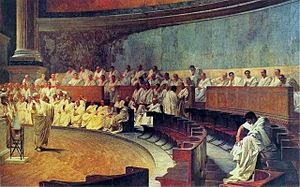
Cicero denounces Cataline (1882-88)
fresco by Caesare Maccari
source Wikipedia

If one is familiar with the history of Clodius, one can only conclude that Milo did the empire a favour by getting rid of him.  Suspected of committing incest with his sister, Clodius employed gangs to terrorize the citizens of Rome and the surrounding country, for his own political and monetary benefit.  In 63 B.C., he was able to exile Cicero for his involvement in the illegal execution of five Catlinarian conspirators, and while Cicero was away, proceeded to demolish his elegant house, attempting to have the ground consecrated to deny any further right to build upon the site.  Upon Cicero’s return, Clodius’ gangster tactics continued, as he regularly had his gangs harass Cicero’s workmen as they attempted to re-build his home.

Also included in this book are the speeches, Pro Murena, Pro Archia, and Pro Caelio, where he defends against electoral malpractice, illegal exercise of citizen rights, and civil disturbance, respectively.

From some of these speeches, the reader is given a window into Rome during its more turbulent times, and one realizes, among the grandeur, learning and sophistication, there is continual political unrest and moral decay, boiling in a cesspool of men grasping wildly for prestige and power. It’s a book that probably should be read in “doses”, but the value of the historical import and the insight into human ambition cannot be underestimated.

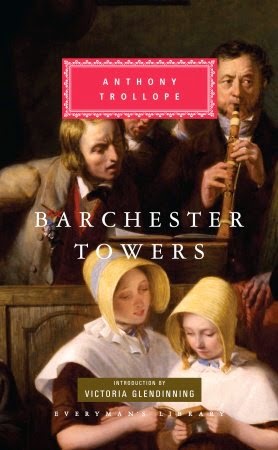
Barchester Towers by Anthony Trollope

“In the latter days of July in the year 185–, a most important question was for ten days hourly asked in the cathedral city of Barchester, and answered every hour in various ways —- Who was to be the new bishop?”

War has broken out in the city of Barchester.  The different factions are preparing by arming themselves with disingenuous weapons.  Tongues are being exercised, rapier wit is being sharpened, and soon a victor will be declared.

The new chaplain, Mr. Obadiah Slope has arrived in Barchester with the new bishop Proudie and his termagant wife .  Whilst Mr. Slope shows the high opinion he holds of himself, the clergy and certain townspeople take a strong dislike to his oily sycophancy and the fight is on.  Will Archdeacon Grantly be able to run Mr. Slope out of Barchester? Or will Mr. Slope become the new Dean?  Yet his marriage to the widow Eleanor Bold, Mr. Septimus Harding’s daughter, is a certainty.  Or is it?  Bertie Stanhope, the indolent son of Dr. Vessey Stanhope, is a contender for her affections but, oops ….. into the picture strides Mr. Arabin, vicar of St. Ewold and Grantly’s ally, to further muddy the marital waters.  And, as for the battle over the appointment of the new warden of Hiram’s Hospital, will Mr. Harding recover this honoured position, or will Mr. Quiverful triumph over his competitor, effectively providing his wife and children with the support they had heretofore been lacking?

In a town amongst characters, where black can seem white, and up suddenly down, the romping hilarity of the story firmly keeps the reader engaged and attentive.   Trollope, himself had a personal love for his masterpiece:  “In the writing of Barchester Towers I took great delight.  The bishop and Mrs. Proudie were very real to me, as were also the troubles of the archdeacon and the loves of Mr. Slope.”  Sadly his publishers were not initially in accord, claiming the novel to be full of “vulgarity and exaggeration.”  How fortunate, in spite of this initial critique, that this novel has captured the imagination and humour of readers worldwide for nearly 160 years, and has given the people of Barchester an immorality that was originally in jeopardy.

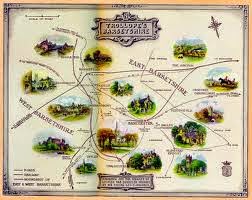
The Barsetshire Chronicles

War and Peace by Leo Tolstoy

“Well, Prince, so Genoa and Lucca are now just family estates of the Buonapartes …..”

I am very hesitant to even attempt to review this book.  How can one do even the slightest bit of justice to an epic like this? How can one even touch on the depth of the myriad of characters, not to mention communicate the complexities of a war that even the participants had difficulty distinguishing?  And how do you review such an epic tale without producing an epic review?

War and Peace follows the lives of five families of Tsarist Russia:  the Rostovs, the Bolkonskis, the Bezukhovs, the Kuragins and the Drubetskoys, their interactions and struggles, and the afflictions suffered by each set among the events leading up to and during Napoleon’s invasive campaign in the year of 1812.  Pierre Bezukhov is the illegitimate son of a nobleman and, through a series of circumstances, inherits a great  fortune.  His new position in society chafes against his natural character of simplicity, naiveté, and introspection. The Rostov family is a well-respected family, yet are in financial difficulties. The son, Nikolai, joins the Russian army, his brother, Petya, will soon follow, and their daughter, Natasha, a joyful free-spirit, becomes attached to a number of men throughout the story.  Sophia, an orphaned niece, is raised by the Rostovs, and shows a steady and loyal character as she pledges her love to Nikolai early in the novel.  Bolkonsky senior is a crochety old count who attempts to control his son, Andrei, and terrorizes his daughter, Maria.

Natasha Rostova (c. 1914)
Elisabeth Bohm
source Wikipedia

And so begins the dance between the cast of characters, sometimes a smooth waltz, and at others a frenzied tango.  There is contrast between generations, between old and new ideas, between life and its purpose, yet Tolstoy is adept as showing the gray tones overshadowing the blacks and whites; that situations are not always as they appear.

Tolstoy’s highest attribute is his ability to peel off the layers of each person and look into his soul.  His characters are crafted with such depth and such human motivations that the reader can only marvel at his skill.  And not only can he give birth to such characters, he understands them.  The scenes involving the Russian peasantry, who act completely contrary to reason, yet with such humanness, are evidence of Tolstoys profound comprehension of human nature and the human condition.

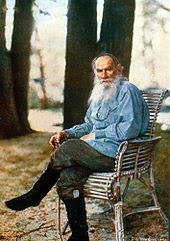
Count Leo Tolstoy, 1908
from Wikipedia

I love how Tolstoy lets humanity and compassion show through the animosity and the bloodletting of war.  One of my favourite characters of the novel was Ramballe, the French officer whom Pierre met in Bazdeev’s house and who showed brotherhood and goodwill despite that fact that, given the circumstances, they should have been pitted against each other as sworn enemies. Originally, Pierre is portrayed somewhat as a bumbling oaf, a man of a lower class who, by luck and circumstances has managed to rise to a position of prestige yet has never been able to cast aside his peasant-like origins. However by his actions in the novel, he becomes admirable, echoing a segment of humanity that shows kindness, goodness, bravery and integrity that shines out from the avariciousness and shallowness of high society.

Tolstoy himself was very ambiguous about his masterpiece stating that it was, “not a novel, even less is it a poem, and still less an historical chronicle.” He believed that if the work was masterful, it could not conform to accepted standards and therefore could not be labelled.

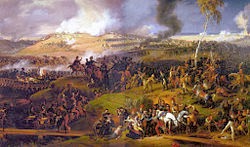
The Battle of Borodino by Louise-Françoise, Baron Lejeune, 1822
from Wikipedia 

“It is natural for us who were not living in those days to imagine that when half Russia had been conquered and the inhabitants were fleeing to distant provinces, and one levy after another was being raised for the desense of the fatherland, all Russians from the greatest to the least were solely engaged in sacrificing themselves, saving their fatherland, or weeping over its downfall.  The tales and descriptions speak only of the self-sacrifice, patriotic devotion, despair, grief, and the heroism of the Russians.  But it was not really so.  It appears so to us because we see only the general historic interest of that time and do not see all the personal human interests that people had.  Yet in reality those personal interest of the moment so much transcend the general interests that they always prevent the public interest from being felt or even noticed.  Most of the people at that time paid not attention to the general progress of events but were guided by their own private interests, and they were the very people whose activities at that period were most useful. Those who tried to understand the general course of events and to take part in it by self-sacrifice and heroism were the most useless members of society, they saw everything upside-down, and all they did for the common good turned out to be useless and foolish …….. Even those, fond of intellectual talk and of expressing their feelings, who discussed Russia’s position at the time involuntarily introduced into their conversation either a shade of pre tense and falsehood or useless condemnation and anger directed against people accused of actions no one could possibly be guilty of.  ………  Only unconscious action bears fruit, and he who plays a part in an historic event never understands its significance.  If he tries to realize it his efforts are fruitless. The more closely a man was engaged in the events then taking place in Russia the less did he realize their significance ……….”

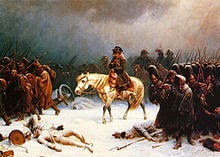
Napoleon’s Retreat from Moscow
Adolf Northern
source Wikipedia

Perhaps Tolstoy is showing us that people are imperfect, with human vice and human foibles and that, in spite of trying to find heroics in war, the actions are only the actions of people trying to survive.  It is history looking backwards that make the heroes, but in reality, the characters in these trials of life are all people acting out their parts in a very human way.  There is no glory in war, only people trying to deal with the circumstances as best they can, and to get by with a little human dignity.  Success can be more a matter of chance than planning, and it is often luck or misfortune that places people in either the bright spotlight of fame, or the dark dungeons of villainy.

I know that many people shy away from War and Peace because of its length, and I did too for a long time.  Another criticism is that Tolstoy’s “war” parts are monotonous.  It certainly is a lengthy novel but by doing some cursive research on this period of Russian history, the reader can gain enough of a base to allow him to relax and be pulled into the story.  And by viewing the wars scenes, not only as history, but as a chance to learn from people’s reactions in situations of stress and conflict, I think they can give us more of an insight into human motivations.  So pick it up and let yourself be swept away into the Russia Empire of the early 1800s.  You won’t be disappointed!

(translated by Aylmer & Louise Maude)


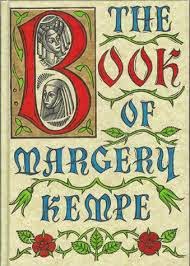
The Book of Margery Kempe

“When this creature was twenty years of age, or somewhat more, she was married to a worshipful burgess [of Lynn] and was with child within a short time, as nature would have it.”

The second book of my Well-Educated Mind Biographies Project took me to the turn of the fifteenth century when the Late Middle Ages was morphing into the Early Renaissance.  Margery Kempe, a married women with 14 children decides that her devotion to God eclipses everything else in her life, and embarks on a mystical journey to get as close as she can to His Love and Grace, and to conform her life to His will.  While the narrative is somewhat disjointed, springing back and forth between different episodes in Margery’s life, the reader must decide:  does Margery have a special relationship with God and are her actions spiritually beneficial, or is she somewhat unbalanced emotionally and do her actions have a negative impact on those around her?

While Margery speaks of her devotion to God and of the special protection and attention he sends her way, a repeated theme runs through this book of her unusually shocking weeping and crying, and how her behaviour alienates the people around her.  In story after story, Margery weeps and wails in loud outbursts, a person or the people get irritated with her and, at the least, want her to stop and, at the most, want her imprisoned.  Margery does show a comprehension that her behaviour sows discord with those around her, and does try to moderate her reactions, but is unable to because of the force of feeling for God in her heart; she simply cannot control her response.

At first, like many people Margery met, her weeping and sobbing drove me crazy.  I think in this book she described every incident that she wailed and moaned, and I was soon in complete sympathy with the people who wanted her either run out of town or put in prison.  Yet about mid-way through the book I began to think ………..  How did Margery conduct herself as a person?  What were her traits and how did she interact with other people whom she met in life?  Yes, her life was completely given to God and he was her primary source of love and care and motivation, but the result of that love was her willingness to help and care for people, her desire to see people saved and experience God’s grace like she had, and, surprisingly, her meek yet powerful words that she used against her accusers. Rarely did she respond in kind to their recriminations, intimidation or threats, but with an honest and sincere demeanour, that often would disarm them.  Did she ever hurt anyone with her behaviour?  No, she was simply annoying and, therefore, was it right to ostracize her, berate her and throw her in prison for being bothersome?

Ultimately I felt that this book said as much about the society around Margery, as Margery herself.  Their intolerance for anyone different than themselves, their impatience at her benign behaviour and their lust for vengeance was quite startling, yet when I compared it to our society today, how different was it really?  Don’t we display the same intolerance, the same prejudice and the same narrow-mindedness as the people of Margery’s time?   Are we exasperated or offended by people with different ideas or bothered when people behave differently than we expect?  I think, if we’re honest, we’d be compelled to answer “yes”.

The book also gives fascinating details of medieval life.  While we, as moderns, always tend to think women were oppressed and had no say in how they lived their lives, Margery chose to live apart from her husband, traveled around Europe often in the company of men, and quite forcefully made her own choices about the path her life would take.  Certainly she was occasionally reprimanded by priests or given advice by townspeople that she should behave like a “normal” woman, but the vast majority of people appeared to accept her lifestyle without comment and are much more concerned or annoyed with the quantity of her weeping and emotional distress.

Margery’s amazing perseverance in her beliefs, and her ability to remaining faithful when she is imprisoned, ostracized, mocked and threatened, are what impacted me while reading this biography.  Her lack of anger and her tolerance towards her persecutors is truly heroic.  While I wouldn’t want to be Margery Kempe, and I didn’t agree with all her decisions, I can certainly see traits within her that would be beneficial in my own life, and for that, I have a reluctant admiration for her single-minded faithfulness and unquenchable spirit.