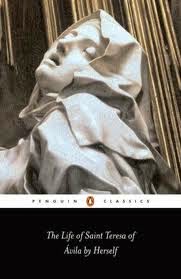
The Life of Saint Teresa of Avila by Herself

“As I have been commanded and left at liberty to describe at length my way of prayer, and the workings f the grace of our Lord within me, I could wish that I had been allowed at the same time to speak distinctly and in detail of my grievous sins and wicked life.”

Teresa was a Spanish mystic born in 1515 in Avila, Spain.  Early on, she showed a zealously pious nature but in her teens she began to be pulled in by worldly temptations and could not find peace, considering herself a miserable sinner.  When her father sent her to a convent school to be educated, she began her contemplative life.  Sickly throughout her life, Teresa used her discomfort as a means of shedding worldly cares and drawing closer to God.

This autobiography delves into Teresa’s prayer life (the four stages of prayer), union and trance, visions, temptations, the founding of the convent of St. Jospeh and the mercies of God.

I honestly have very little to say about this book.  Uncharacteristically I found my attention wandering numerous times while reading.  Was it because I dislike mystics?  Not at all.  Was it because the vocation of a nun is tedious.  No.  Was it Teresa’s writing?  Well …. perhaps …….  When reading a book, I usually look for an author to connect with the reader.  Some author’s are more successful than others in this area, but there has to be some connection to bring the writing to life.  In this case, Teresa’s prose remained lifeless on the page and while I could read about her experiences, it was very difficult for me to enter into them with her.  Because of her rather solitary life, she appeared no only to have little contact with outside cares and people, she also actively renounced both.  It was very challenging to understand someone who often stood in judgement of others.  I’ve never felt this attitude from other religious figures whom I’ve read about and I found it off-putting.  I also found Teresa seemed to write for herself rather than anyone else, so again, it was problematic establishing contact and therefore, any interest.

In spite of this rather lackluster read, I would still like to read her Interior Castle, which I’ve had on my list for awhile.  I can only hope that I’ll enjoy it more than this one.

translated by J. Cohen (I’ve heard that E. Alison Peers is a better translation)

Utopia by Thomas More

“The moste vyctoryous and tryumphante Kynge of Englande, Henry theight of that name, in all royal vertues Prince moste peerlesse, hadde of late in contrauersie with the right hyghe and myghtie king of Castell weightye matters, and of greate importaunce; for the debatement and final determination wherof the kinges Maieste sent me Ambassadour into flaunders, ioined in commission, and whom the kinges maiestie of late, to the greate reioysyng of all men, did preferre to the office of maister of the Rolles.”

I certainly promise not to write this review in Middle English but I thought I’d give you a taste of it.  And, no, I didn’t read the complete book in ME, I was able to get through about 1/5 of it and then changed to a modern English version.  And most happily, I might add.  The original Utopia was written in Latin in a fine emulation of Ciceronian Latin, yet More took it a step further in humour and playfulness.

Sir Thomas More, Lord Chancellor
Hans Holbein the Younger
source Wikipedia

Born in London in 1478, Thomas More was a very learned man and, if he had been able to follow his inclinations, would have been destined for the church.  His father, however, had other aspirations for him and, being a dutiful son, he conceded to his wishes and chose the law as his profession.  Unexpectedly, he was a marvellous success as a lawyer.  He soon had a thriving business and his extraordinary aptitude quickly brought him under scrutiny of the “higher-ups”. The political positions he was eventually offered were always accepted reluctantly, and More had a life-long dilemma with reconciling his loyalty to his sovereign and his loyalty as a Christian to his conscience.

As a Catholic, More opposed the Protestant Reformation.  Serving as Lord Chancellor under King Henry VIII, he was accused of inflicting harsh treatment on heretics, but he denied the accusations.  What is interesting is that his son-in-law at the time, was enticed by “Lutheran heresies”, and More’s reaction when speaking with his daughter, was surprisingly temperate: “Meg, I have borne a long time with thy husband.  I have reasoned and argued a long time with him and still given him my poor fatherly counsel; but I perceive none of all this can call him home again.  And, therefore, Meg, I will no longer dispute with him, not yet will I give him over; but I will go another way to work, and get me to God and pray for him.”

A man of honour and high standards, he would not even compromise for his family.  When one of his sons-in-law expected preferential treatment  because of More’s office, More stated, “If my father whom I dearly love were on one side and the devil, whom I sincerely hate, were on the other, the devil should have his rights.”

With King Henry VIII’s decision to divorce his queen, Catherine, More’s power began to unravel.  While remaining quiet publicly, he continued to support the Pope over the King, and when he was required to sign a letter asking the Pope to annul the marriage, More refused.  Henry soon began to isolate him. Eventually when More openly refused to acknowledge the annulment, Henry took action, arresting More for treason.  He was decapitated on July 6, 1535. When the Holy Roman Emperor, Charles V, heard of his death, he said, “Well, this we will say, if we had been the master of such a servant, we would rather have lost the best city of our dominions than have lost such a counsellor.”

Map: This picture was taken from
 one of the first editions of the book,
which is published online at the 
Bibliotheca Augustana

Probably inspired by his close friend, Desiderius Erasmus, Thomas More wrote Utopia in 1516 during an embassy to the Netherlands.  A very brief book, yet with a complex structure, More used himself and a character called Raphael Hythloday to present political philosophies that range from the insightful and wise, to the curiously peculiar.  In Book I, More crafts the setting for Utopia and then, through his character and Hythloday’s, offers a discourse on the evils and ills prevalent in European society.  While having a parallel set-up to Plato’s Republic (Morton = Cephalus; Hythlodaye = Socrates; lawyer = Thrasymachus), More adopts occurrences from his own day to structure the framework of Utopia and construct a more politically and socially organized text.   More uses this venue to chastize the actions of kings who use the country’s money for unproductive warmongering, and especially vilifies the practice of hanging thieves on the gallows, often for very petty infractions.  In Book II, More offers a detailed description of Utopia, its inhabitants and its societal structure. The Utopian community supports common property, slavery and religious tolerance.  Agriculture is the most treasured occupation but each Utopian is required to learn some other trade as well.  Finery is frowned upon, pre-marital sex and adultery punishable, and while atheists are allowed in Utopia, they are shunned because their views are counter-productive to the Utopian community.
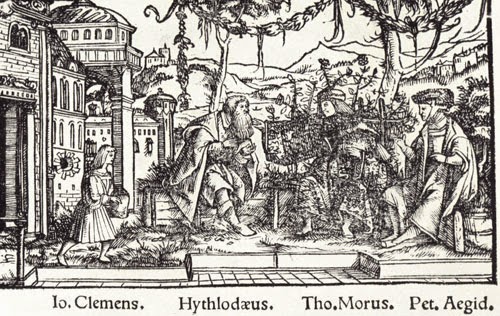
More & Hythloday discuss Utopia
source

Scholars are still in disagreement as to More’s purpose when writing this book. On one hand, some purport that More’s intent was to write and endorse a treatise on communism and its implementation.   Others scholars differ in opinion; while the book had a basis in the condition of European politics, it was nevertheless written tongue-in-cheek.  Brewer in his Reign of Henry VIII, appears to support this view:

“Though the Utopia was not to be literally followed —- was no more than an abstraction at which no one would have laughed more heartily than More himself, if interpreted too strictly.  Utopia might serve to show a corrupt Christendom what good could be effected by the natural instincts of men, when following the dictates of natural prudence and justice.  If kings could never be elective in Europe, Utopia might show the advantage to a nation where kings were responsible to some other will than their own.  If property could never be common, Utopia might teach men how great was the benefit to society, when the state regarded itself as created for the wellbeing of all, and not of a class of a favoured few …….”

C.S. Lewis, a medieval and renaissance scholar, takes More’s book as a light holiday work, and this summation rings true, as More make some comments himself that were obscure, but appeared to poke fun at his work.  Lewis states:

 “….. it appears confused only so long as we are trying to get out of it what it never intended to give.  It becomes intelligible and delightful as soon as we take it for what it is —- a holiday work, a spontaneous overflow of intellectual high spirits, a revel of debate, paradox, comedy and (above all) of invention, which starts many hare and kills none …..  There is a thread of serious thought funning through it, an abundance of daring suggestions, several back-handed blows at European institutions …….  But he does not keep our noses to the grindstone.  He says many things for the fun of them, surrendering himself to the sheer pleasure of imagined geography, imagined language, and imagined institutions.  That is what readers whose interests are rigidly political do not understand: but everyone who has ever made an imaginary map responds at once.”

If we take into account some of the regional names in this work, the purpose may become clearer still.  “Utopia” literally means, “no place”; “Achoria” means “Nolandia”; “Polyleritae” means “Muchnonsense”; “Macarenses” means “Happiland”; and the river “Anydrus” means “Nowater”.  Even Raphael’s last name, Hythlodaeus, translates as “dispenser of nonense”.  Was More being ironic or serious?  I doubt we can ever know for sure.

In spite of the obscurity of the book and some of the controversies surrounding More, I loved both the author and this work.  He appeared to treat both his wives well, quite clearly loved his children, was well thought of and respected, and in spite of his position, chose to write a story that not only amused his readers, but allowed them to explore human nature and come to their own conclusions with regard to universal issues.  Thomas More is a man to be admired and Utopia is certainly a book to be read!

  • translated by Clarence H. Miller (English translation)
  • also Oxford Press “student” edition edited by J. Churton Collins (Middle English translation)

Further reading:  

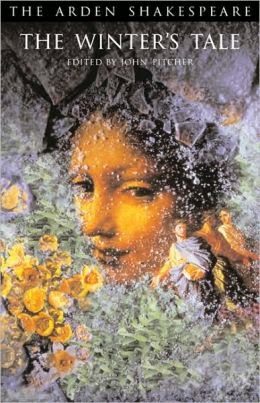
The Winter’s Tale by William Shakespeare

“What’s gone and what’s past help, should be past grief.”

Leontes, King of Sicilia and Polixenes, King of Bohemia, grew up together in a type of idyllic paradise, becoming as close as brothers.  At the opening of the play, Polixenes has been visiting Leontes and his queen, Hermoine, and is ready to return home after his nine-month stay.  Leontes begs his friend to remain longer, yet when he refuses, the king employs the queen’s pleading to try to change his mind.  And change his mind, Polixenes, does, unwittingly sparking a torrential storm of jealously within Leontes, as he, with Gollum-like psychosis, convinces himself that Hermoine has been unfaithful to him with his friend, and that the child she is about to give birth to does, in fact, belong to Polixenes.    Attempting to gain the sympathy of a Sicilian nobleman, Camillus, Leontes reveals his plot to poison the Bohemia king, but Camillus’ sensible and gentle nature will not allow him to commit such an atrocity and instead, he warns Polixenes and they both escape to the kingdom of Bohemia. Yet their escape leaves Hermoine at the mercy of her husband’s wrath and, against all the protests of his noblemen and, in particular, the wife of Antigonus, Paulina, Leontes tries Hermoine with the intent to condemn her to death.  While imprisoned she bears the child, a girl, who Leontes entrusts to Antigonus to abandon it in the wild, whereupon Antigonus leaves the child in the kingdom of Bohemia.  But tragedy strikes when part way through the hearing, Leontes learns of the death of his only son, Maxmillus.  Hermoine faints, then dies and Leontes suddenly realizes his foolish behaviour and repents.

Act II, Scene III
John Opie/Jean Pierre Simon
source Wikipedia

The child of Hermoine, Perdita, grows up in Bohemia as the daughter of a shepherd and we meet her again when she is sixteen and the love of Florizel, the son of Polixenes.  Through a quarrel with his father, Florizel and Perdita seek sanctuary in Sicilia, where Leontes has been spending the last 16 years doing penance for his harsh actions.  Paulina, in control of the situation as ever, makes Leontes promise not to marry unless a women in the likeness of Hermoine is approved by her, and he consents.  She then takes him to see a statue of his dead wife but lo!  This statue moves and Hermoine is alive again! There is much rejoicing and more when the identity of Perdita is discovered.  Winter has melted away from Sicilia and spring has come once again!

Perdita
Anthony Frederick Augustus Sandys
source Wikipedia

I really felt that this was certainly a weaker play of Shakespeare’s.  The audience was asked to immediately accept Leontes intemperate jealousy without any back-story or obvious proof of unwise behaviour on either the part of Hermoine or Polixenes.  What would cause a person who has always trusted and had the best relation with this friend, to suddenly question his character and honesty?  No other character believed in Hermoine’s guilt, yet Leontes persists in his delusion.

I also was taken aback by some of the staging of the play.  One senses that much of the important action takes place off stage:  the reason or backstory for Leontes’ jealousy; a reason for his immediate contrition; and shockingly, the climax with the reunion and reconciliations is not shown to us but told to us through a third party medium.  I’m still trying to grasp Shakespeare’s purpose in this structure.  The lack of all these critical ingredients cries lack of development and therefore, a lack of impact.  It’s not sensible, it’s not plausible and it’s certainly far from Shakespeare’s usually masterly grasp of his material and his audience.  I remain, puzzled.

I read this play for my Shakespeare: From the Page to the Stage course.

Richard II by William Shakespeare

” For God’s sake, let us sit upon the ground
And tell sad stories of the death of kings ….”

Why do they call this play a “history”?  It was an absolutely tragedy …. gut-wrenchingly tragic, and I still feel depressed about the outcome.  Dare I say this is my favourite Shakespearean play so far?  Isn’t that weird?  An historical play about a king of whom I knew little about ……..  Yet Shakespeare’s verse is astonishingly beautiful.  The words flow around you like a bubbling river, conveying the anguish, terror, loss, loyalty, courage, deception, abandonment and hopelessness.  Not only is the play alive, but the story is alive and the words have a life of their own.

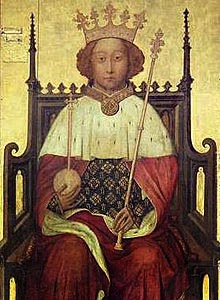
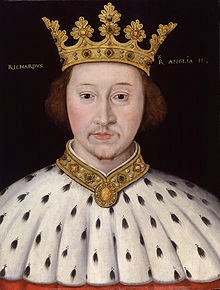
Richard II, King of England
portrait at Westminster Abbey (mid-1390s)
source Wikipedia

The play begins with a dispute between Henry Bullingbrook (Bolingbroke), cousin to King Richard, and Thomas Mowbray, Bullingbrook accusing Mowbray of misappropriating money and claiming that he was part of the murder of the Duke of Gloucester (which was probably orchestrated by Richard), yet before either can accomplish a duel, King Richard decides to banish both, Bullingbrook for 6 years and Mowbray for the term of his life.  John of Gaunt, is broken hearted at the exile of his son, Bullingbrook, and soon becomes sick with grief.  Upon Gaunt’s death, Richard decides to expropriate his estates and money, thereby defrauding Bullingbrook of his inheritance.  As Richard leaves to deal with the wars in Ireland, Bullingbrook gathers supporters and lands in England for the purpose, it appears, of regaining what is rightfully his.  Because Richard has taxed his subjects without remiss, and has fined the nobility for errors of their ancestors, most of the nobles rise up against him.

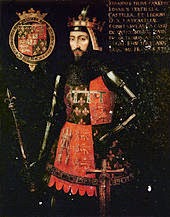
John of Gaunt
father of Henry IV
source Wikipedia

When Richard returns to England he is left with a small contingent of supporters including his cousin Aumerle, the Duke of York’s son, and lords Salisbury and Berkeley and other retainers.  Upon meeting with Bullingbrook, Richard relinquishes the throne to him, and Bullingbrook wastes no time in appointing himself King Henry IV.  Immediately, Richard is placed in prison.  When an uprising by Aumerle is discovered by his father and vehemently exposed, Aumerle is graciously pardoned by Henry IV, yet with dire threats towards the other conspirators.  In prison, Richard attacks his warden in frustration and is killed by Exton; when Henry hears about the murder, he is distressed and the play ends with his sad lament.

When I finished this play, I was so anguished by Richard’s sad end and how he’d been treated, yet reading some pre-history would have perhaps measured my emotions, as the good king was not entirely as innocent as he is made out.  Richard inherited the title of king when he was 10 years old and spent many years of his reign under the control of counsellors and advisors.  It wasn’t until later on, that he appeared to throw off their power and come into his own.  However, the fact that he taxed the populous to such extreme extents to finance his wars and royal coffers, contributed to the fact that he was not well loved or respected.  He was a king who ruled by impulse and without a justness that would have connected him to the people.  In fact, in the play, when he is walked through the streets, people dump garbage on his head, not a very fitting display for a monarch who truly believed that he was anointed by God.

Richard being taken into custody
by the Earl of Northumberland
source Wikipedia

Another consideration is that Shakespeare is writing drama.  He is known for taking the framework of history and then chopping and changing and perhaps, speculating for dramatic and political effect.   It is interesting that at the end of the play, Richard is seen as a pitiful figure who has voluntarily given up his kingship, and Bullingbrook condemns his murder, leaving the new king innocent of the crime and helpless to stop its culmination.  A very safe and uncontroversial tact on both sides for our playwright!

My favourite speech of Richard’s pulses with foresight, nostalgia and lament:

“For God’s sake let us sit upon the ground 
And tell sad stories of the death of kings:
How some have been deposed, some slain in war,
Some haunted by the ghosts they have deposed,
Some poisoned by their wives, some sleeping killed.
All murdered.  For within the hollow crown
That rounds the mortal temples of a king
Keeps Death his court and there the antic sits,
Scoffing his state and grinning at his pomp,
Allowing him a breath, a little scene,
To monarchize, be feared and kill with looks,
Infusing him with self and vain conceit,
As if this flesh which walls about our life,
Were brass impregnible.  And humoured thus,
Comes at the last and with a little pin
Bores through his castle walls, and farewell king!”

As Richard begins to realize the possible outcome of the circumstances and tries to reconcile them with his belief that a king is sanctioned by God, we see his syntax begin to break down, with his pronouns of “we”, being reduced to “I”.  It is truly pitiful.

Richard II
Anonymous impress from the 16th century
source Wikipedia

On a political note, this play was used to stir up populous support for Robert, earl of Essex, Queen Elizabeth I’s one-time favourite, during his rebellion against her.  On the eve of the uprising, his supporters paid for the play, Richard II, to be performed at the Globe Theatre, but Essex’s attempt to raise a coup against her failed. Retaliation was swift, however.  On February 25, 1601, Essex faced his execution and was beheaded on the Tower Green.  His was the last beheading at the Tower of London.

This was another wonderful experience with one of Shakespeare’s historical plays.  I had expected to like them least in the canon, but they are certainly quickly becoming by far my favourites!

Watched:  The Hollow Crown:  Richard II

Othello by William Shakespeare

“O, beware, my lord, of jealousy;
It is the green-ey’d monster, which doth mock
The meat it feeds on.”

Othello the Moor is lauded over Venice for his help in attempts to rid them of the pesky Turks in their battle over Cyprus.  Yet when Othello weds the beautiful Venetian Desdemona in secret, some opinions of his prowess change, notably those of Desdemona’s father.  And unbeknownst to Othello, Iago, his third-in-command, is plotting a dastardly revenge for being passed over for promotion, the position being given to Othello’s loyal lieutenant, Cassio.  Hence proceeds perhaps the most shocking example of manipulation in literature, as Iago takes possession of Othello’s mind and emotions, like a beast taking possession of its prey, transforming our noble Moor from a honest, straightforward, respected man into an enraged, vengeful monster who believes every evil of his innocent wife, including her unfaithfulness with his second-in-command, Cassio.  Othello’s jealousy manages to eclipse anything within our understanding.

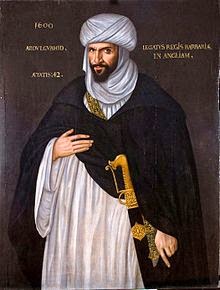
Abd el-Ouahed ben Messaoud
ben Mohammed Anoun,
Moorish ambassador to Elizabeth I
suggest inspiration for Othello
source Wikipedia

Iago reveals that, as well as the injury of being passed over for promotion, he also harbours a suspicion that Othello has been sleeping with his wife, Emilia, who is Desdemona’s lady-in-waiting.  There is no proof of this accusation in the play, and it is likely that Iago is expecting people to act with the same lack of integrity and base bestial urges, that he himself would, in the same circumstances.

How does a gentle and admired military leader allow himself to be reduced to a maddened beast, his fury leading him to commit the worst atrocity against a perfectly innocent human being, and one who has loved and supported him through their short marriage?  What hidden button inside Othello’s psyche has Iago discovered and pushed, knowing that it will make him snap?

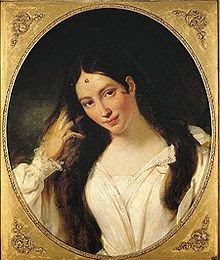
Maria Malibran as Rossini’s
Desdemona
Françoise Bouchot
source Wikipedia

Certainly there are various issues that come into play and work against Othello.  He is used to being a commander, yet is unused to being a husband and obviously, when in love, is out of his depth.  Perhaps he sees Desdemona as a possession that he has conquered and, instead of being able to relax in his marriage, he, like a military leader, feels that he must wage battle to keep her.  And when difficulties do arise, instead of trying to search out the truth, he acts like a military leader and attempts to “conquer the enemy”.  He has insecurities that lead to him being a willing pawn of Iago’s machinations. The jealousy that Iago is able to set aflame within him, corrupts his normal good sense and his actions become intemperate.  I certainly have compassion for his state, as I believe these aspects have severely affected his decison-making and emotional state, but, that said, he is still human and he still has the option of choice.  He knows right from wrong, yet he decides to allow his emotions to rule and himself to be led down the tragic path of mindless jealousy.  In reality, he allows himself to turn into a beast.

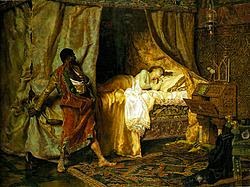
Othello & Desdemona
Antonio Muñoz Degrain
source Wikipedia

Shakespeare’s exhibits an uncanny ability to weave endless possibilities into a Gordian knot of drama and draw the reader into his poetic spell.  Will we ever know exactly what motivated Othello and his spiral from an honourable man to a madly jealous murderer.  Will we ever understand why he believed Iago without any “ocular proof”?  What happened to the military commander that must have been used to exhibiting self-control?  Do intense emotions subvert our ability to act as a human beings?  There are so many avenues to explore and no obvious or set answers.

Of all the characters in the play, my favourite character was Emilia.  While she remains surprisingly unaware of the plotting and intrigues of her husband, upon realizing the truth, she becomes the voice of the audience, who has until this point been mute in horror, and satisfyingly spews vile recriminations on the head of Othello.

T.S. Eliot had a different view of the last actions of Othello than many older critics:

“I have always felt that I have never read a more terrible exposure of human weakness — of universal human weakness — than the last great speech of Othello.  I am ignorant whether any one else has ever adopted this view, and it may appear subjective and fantastic in the extreme.  It is usually taken on its face value, as expressing the greatness in defeat of a noble but erring nature. What Othello seems to me to be doing in making this speech is cheering himself up. He is endeavouring to escape reality, he has ceased to think about Desdemona, and is thinking about himself. Humility is the most difficult of all virtues to achieve; nothing dies harder than the desire to think well of oneself. Othello succeeds in turning himself into a pathetic figure, by adopting an aesthetic rather than a moral attitude, dramatising himself against his environment. He takes in the spectator, but the human motive is primarily to take in himself. I do not believe that any writer has ever exposed this bovarysme, the human will to see things as they are not, more clearly than Shakespeare.”

I read this play as part of a Shakespeare: From the Page to the Stage course that I’m taking online, and it’s definitely moved in among my favourites!

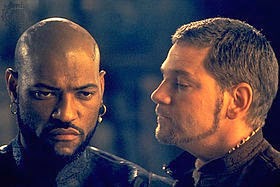
Laurence Fishburne & Kenneth Branaugh
Othello 1995
source Wikipedia

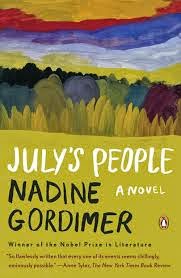
July’s People by Nadine Gordimer

“You like to have some cup of tea?  —– July bent at the doorway and began that day for them as his kind has always done for their kind.”

In South Africa, the black South Africans have risen up against the whites, and the country is in chaos.  July, the servant of Bamford and Maureen Smales, secrets them out of the city and transport them to his village, in order to save their lives and the lives of their three children.  Nadine Gordimer’s novel was written before the end of apartheid in South Africa and is a fictional account of the beginnings of a civil war where the black South Africans have thrown the country into chaos as they attempt to abolish the apartheid system.

Honestly, I decided to read this book because it was on my Guardian’s 1000 best novel list.  In spite of having a few South African friends, I have only very cursory knowledge of South Africa or apartheid.  I was hoping to acquire a basic understanding of the country and its struggles in reading this book, but unfortunately no larger pictures of life or the people were revealed.  The narrative was somewhat choppy and disjointed, requiring effort to follow Gordimer’s train of thought, but also to follow in detail the action in the story.

Drakensburg Mountains
source Wikipedia

Obviously there is no question about racial inequality with regard to the issues in South Africa, but I thought this book portrayed it in an unexpected way.  July had been a servant in the Smales house previous to the uprising and, while he had been treated well, he had been treated as such.  However, once he rescues the family, the roles invert and July gradually assumes more control of the situation, as the Smales are dependent on him for their livelihood and survival.  At climax of the novel,  July takes command of their yellow bakkie without their permission, and you sense that now they are completely in his power.  Yet with July’s increase in authority, there was really no exhibition of compassion or understanding.  One would think he would be able to see parallels in their situations and treat the Smales with an equality that had been lacking in their original treatment of him.  I’m really not sure what Gordimer was trying to communicate by this portrayal …….. that human nature is universal and unchangeable and that exploitation from one group can infect the victims if the tables are turned?  Are we so devoid of any sort of empathy and so self-centered, that no one can care about the freedom and identity of another person, no matter what the circumstances?  Sigh.  For me, Gordimer was not very clear with her intent, but perhaps that was the point.  In any case, the novel ends with Maureen Smales desperately running towards an unidentified helicopter that could carry South African police or revolutionaries.  Was she running to safety and freedom, or a different type of captivity, or even death?  Or perhaps she was simply wildly and mistakenly trying to run towards the life she once knew.

I honestly I can’t say that I enjoyed this read.  It was interesting in the way it is interesting to examine a dead insect, but nothing in it really spoke to my sympathies.   There was nothing beautiful in the writing that communicated the beauty of the country or the peoples, and no goodness shone through in the hearts of any of the characters.  I do realize that the dire situation in the country at this time may not have encouraged such writing, but people need hope in those times, and perhaps art that exemplifies that type of hope is never more necessary.

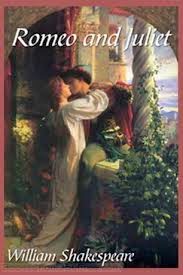
Romeo and Juliet by William Shakespeare

“O, Romeo, Romeo!  Wherefore art thou Romeo?
Deny thy father and refuse thy name
Of, if thou wilt not, be but sworn my love,
And I’ll no longer be a Capulet.”

Of course, we all know the story.   In Medieval Verona, the Capulets and Montagues are feuding, their hatred spilling over into battles in the streets; revenge and killings abound.  Yet Romeo, the Montague, meets Juliet, a Capulet, and all thoughts of his former love, Rosaline, fly from his head as his heart is captured by her beauty.  Will Romeo and Juliet’s love survive the heated rivalry and secret machinations of the houses of Montague and Capulet?

Well, no, of course not!

Juliet
John William Waterhouse
source Wikiart

While Romeo and Juliet is certainly a story of young love, it is also a cautionary tale against letting one’s heart (and other body parts) rule one’s head with unhealthy intensity.  Friar Lawrence cautiions Romeo during his effusive praise of Juliet after only one glance of her:

“These violent delights have violent ends 
And in their triumph die, like fire and powder, 
Which, as they kiss, consume.  The sweetest honey 
Is loathsome in his own deliciousness
And in the taste confounds the appetite.
Therefore love moderately.  Long love doth so.
Too swift arrives as tardy as too slow.”

Romeo and Juliet the tomb scene (1790)
Joseph Wright
source Wikiart

Later, when Romeo’s friend, Mercutio is slain by the Capulet, Tybalt, cousin to Juliet, love is forgotten in the passions of revenge and Tybalt’s life is forfeit under the steel of Romeo’s sword.  A sentence of exile is pronounced as the lovers’ hopes spiral into a well of despair.  A message gone astray, culminates in the deaths of these two lovers, echoing a tragic pathos that the reader can sense building throughout the play.  Right from the beginning, when you view their impulsive, forbidden love, blossoming amongst the fields of vendettas, discord and enmity, you know that it cannot last.  It’s like an explosion of fireworks that streak across the sky in a pattern of colours and textures and beauty.  But eventually these grand passions burn themselves out and in place of the awe-inspiring spectacle, darkness remains.

Yet while there is tragedy in the fateful story, Shakespeare also shines rays of hope.  With the deaths of the two heirs of both the Montagues and Capulets, all animosity melts away as the families share the pain of a double grief.  So instead of Romeo and Juliet’s deaths being merely tragic, the lovers’ demise turn out to be a kind of sacrifice, two deaths that culminate in the saving fate of the two families.  Is Shakespeare alluding to the belief that peace in society is more important than a passionate love of two individuals?  Who knows, but it’s a thought that resonated with me long after I turned the last page …….

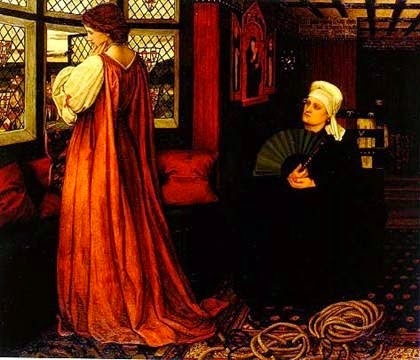
Juliet and her Nurse (c. 1860)
John Roddam Spencer Stanhope
source Wikiart

I read this play for my edX Shakespeare: On Page and Performance course, play 1 of 6.

Productions Watched:
         Romeo & Juliet – Shakespeare Stratford Collection    (★★★☆)
Audiobooks:
         Archangel Audiobook – Romeo & Juliet (★★★★★)                           

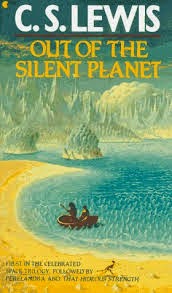
Out of the Silent Planet by C.S. Lewis

“The last drops of the thundershower had hardly ceased falling when the Pedestrian stuffed his map into his pocket, settled his pack more comfortably on his tired shoulders, and stepped out from the shelter of a large chestnut tree into the middle of the road.”

During a hike in the English hills, Elwin Ransom stumbles across a boyhood acquaintance, Devine, and his friend Weston, a scientist.  Secretly these two men drug Ransom and take him in a spaceship to the planet, Malacandra, known in earth language as Mars.  When he revives, Ransom overhears that he is to be offered as a human sacrifice for an alien race called the Sorns, and he plans his escape.  Finding himself alone on this strange planet, he eventually encounters creatures called the Hrossa.  Initially very simple and traditional in their ways, Ransom begins to realize that they have an intelligence that may surpass earthly intelligence.  Quickly he learns their language and begins to value their ways, yet all too soon he is sent on a mission to the Oyarsa, the ruling being of Malacandra.  His adventures not only throw him once again into conflict with Devine and Weston, where blind scientific ardour and unconscionable greed clash with humanity’s better nature, but Ransom is finally able to discover why Earth is considered the “silent planet”.

Malacandra is presented as a rather simple society, with the Hross being like shepherds and poets, and the Sorns the intellectuals, imparting wisdom to the community.  Yet, in spite of the obvious higher intellect of the inhabitants, Devine and Weston perceive them as being primitive and unintelligent because they do not have the scientific advances of Earth.  Weston, in particular, grasps onto his pre-conceptions like a drowning man, refusing to believe that such primitive appearance could ever understand or grapple with his vision of a new type of man.  His ingrained perceptions, that have been formed by science, make him blind to the beauty and intricacies of Malacandrian culture, and even worse, his grandiose plans for the needs of man, allows him to view the Malacandrians as sub-human and therefore, expendable.

source Wikipedia

Lewis wrote Out of the Silent Planet as a deliberate critique of Evolutionism, in particular in response to two written works, one by Olaf Stapledon, Last and First Men, and an essay by J.B. Haldane, published in a volume titled Possible Worlds.  Both saw men evolving into a divinity that could jump from planet to planet, a being stripped down to pure intelligence.  Lewis felt that each, while on one hand portrayed man as a fascinating and beautiful creature, nevertheless showed man’s littleness.  To him these views held a potential danger, opening the door to options of experiments on humans and animals. (Interestingly, Lewis was a firm anti-vivisectionist and he would never set traps for the mice who inhabited his rooms at Oxford.)  He stated that the trilogy was less a tribute to earlier science fiction than a kind of exorcism of some of its ideas.  At its heart, the trilogy is anti-Wellsian and to its conception, Lewis credited a one-of-a-kind novel, David Lindsay’s Voyage to Arcturus.  To his friend, Ruth Pitter, he wrote:  “From Lindsay I learned what other planets in fiction are really good for: for spiritual adventures.  Only they can satisfy the craving which sends our imaginations off the earth.  Or putting it in another way, in him I first saw the terrific results produced by the union of two kinds of fiction hitherto kept apart: the Novalis, G. MacDonald, James Stephens sort and the H.G. Wells, Jules Verne sort.  My debt to him is very great.”  Lewis was trying something new!

A wonderful start to The Space Trilogy.  When I first read the trilogy, this book was my favourite, probably because it was the least complex.  Even so, Lewis weaves in views of how medievals saw the universe and angels, as well as sprinkling elements of classicism throughout.  The next book is Perelandra. Hang on to your seats because “you ain’t seen nothing yet”!

“The weakest of my people does not fear death.  It is the Bent One, the lord of your world, who wastes your lives and befouls them with flying from what you know will overtake you in the end.  If you were subjects of Maledil you would have peace”

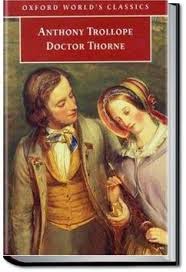
Doctor Thorne by Anthony Trollope

“Before the reader is introduced to the modest country medical practitioner who is to be the chief personage of the following tale, it will be well that he should be made acquainted with some particulars as to the locality in which, and the neighbours among whom, our doctor followed his profession.”

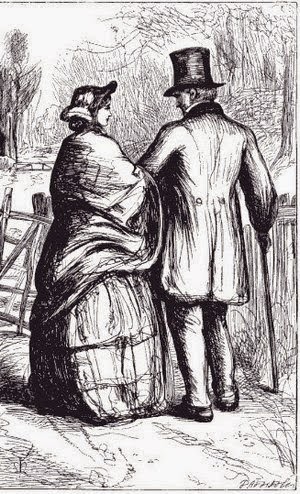
Good, dependable Doctor Thorne, our esteemed doctor of Greshambury, lives with his young niece named, Mary.  Yet there is a secret around Mary’s birth that few people know; she is the illegitimate daughter of Doctor Thorne’s older brother and the sister of Roger Scatcherd, a former poor stonemason and prison inmate, who has amassed a fortune that makes him the rich owner of a large estate.  The ruling family, the Greshams, accept Mary’s company and she is friends with some of the daughters, but when it is learned that Frank, the only son, is in love with her, she becomes persona non grata and is ostracized from their company.  A lively plot begins as Frank is determined to marry Mary, Roger Scatcherd is determined to drink himself to death, an inheritance is unclear, and society struggles to maintain its traditional structure.

As much as I enjoyed this book, there were a few disappointments, as well. Because this novel was serialized, I found the pacing somewhat inconsistent, which took away a little bit of the enjoyment. After building up slowly with the characters and their situations, Trollope suddenly had nearly a year pass by, a declaration, and then another year was gone, all in the space of a few dozen pages. My second disappointment dealt with the plot itself. One aspect that I enjoy about Jane Austen’s writing, for example, is her ability to take a traditional situation and explore possibilities just outside of that tradition. Trollope lulls the reader into expecting the same, yet at the end of the tale, tradition wins out: Scatcherd is shown as an example of what can happen to those who try to rise above their station, Mary becomes an heiress, she marries Frank, and everyone is happy only because convention is followed.  Well, I say, “bah!” to convention!  While I realize departing drastically from societal norms wouldn’t be believable, one would think that Trollope could have challenged convention in a plausible way that would have made the story more intriguing. But ultimately money remains the commodity that is worshiped, everyone is happily kept in their social positions, with the same perceptions and the same prejudices, and with nothing unusual or radical to stir them out of their complacency.  Bah!

Perhaps you are wondering why I have barely mentioned Doctor Thorne, who bears the prestigious title of the novel.  Well, curiously, the tale revolves around many characters other than Doctor Thorne.  But while the action circulates around these characters, his importance in this tale is inescapable. He is the respected thread that holds the neighbours together, the good sense in the quandry, the steadying force in the chaos.  He is like the eye of the hurricane, a calm centre while everything else blows in a whirlwind around him.  His tranquil, composed demeanor and sincere warmth and compassion never falter.  In this I can agree with Trollope; he was certainly the hero for me.

The next book up is Framley Parsonage.  So far my favourite is still The Warden but, with three more to go, a new favourite is not out of the question!

The Barsetshire Series

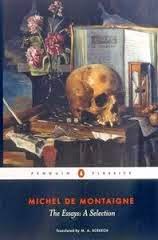
Montaigne’s Essays – Part One

Oh, Montaigne!  What a character!  I’m reading a series of recommended essays, and my plan is to split them into three posts.  So far my introduction to Montaigne has been pleasurable, but taxing to the brain.  His language and progression of ideas, examples and testimonies are not for the faint of heart.  In hindsight, it was wise to take him in measured doses.


On Sadness:  I felt that Montaigne was saying that the deepest sorrows often could not be expressed with outward emotions.  But then he ended by saying that he is little bothered by such violent passions;  I then wonder what gives him the authority to speak on sorrow if he knows nothing of it.  Hmmmm ……..

Our Fortune Must Not Be Judged Until After Death:  Well, this was not an uplifting little essay.  Montaigne believes, drawing from the tale of Croseus and Solon in the stories of Herodotus, that a man cannot be judged as fortunate until his death, because various calamities and suffering can plague him until the end.  Your final day tells all.  Nice.  Fortunately he appears to have amended his views on this subject later in life.

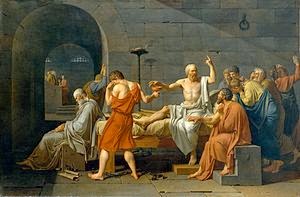
The Death of Socrates
Jacques-Louis David
source Wikipedia

To Think As A Philosopher Is To Learn To Die: Yikes!  Another death essay.  Montaigne emphasizes the need to learn to lose the fear of death.  Death is inescapable and it is a piteous error to try to avoid it by any means, as the hour is determined for everyone.  He tosses in Socrates rather wise and pithy remark:  to the man who said “The thirty tyrants have sentence you to death,” Socrates replied, “And Nature to them.”

Of The Powers of Imagination:  I’m somewhat perplexed as to where to begin with this one.  This essay is supposed to (I believe) explore the relationship of imagination to the mind and body, but Montaigne rather vividly gets into a discussion of the “male member” and “passing wind”.  I was laughing so hard I was crying at the end of the “passing wind” section.  I don’t think hilarity was intended by the author.  😉  Apparently though, people in Montaigne’s time wouldn’t have blinked an eye at these references, showing that they were much more mature and less sensitive than modern people. And since I was very surprised by his frankness given the era, it also demonstrates that our preconceived ideas can be less than accurate.

On Educating Children:  I have an interest in education, so this essay was perhaps the most interesting for me, if not the most amusing (see above).  Montaigne felt that an instructor of good moral character and sound understanding was much more valuable than one with founts of knowledge.  He emphasized the value of knowledge for its own sake, and was repelled by the thought that learning should be used to earn profit. The ancient Greeks would understand his dismay; only slaves were schooled to work, not free men.  Montaigne proceeds to say that he does not wish for an educational system that makes children parrot back what they have learned but rather that they are taught to make ideas their own.  He then expands his argument to suggest tossing out the classical education model in place of simply teaching children to philosophize.  He seems to forget that the classical model contains the building blocks that give the student the tools to be able to discuss topics philosophically, not to mention that young minds have to mature to be able to understand the abstract concepts which are required in philosophy.  He supports, as well, exercise and entertainment, but suggests training peculiarities and eccentricities out of people, as they are “a foe to intercourse and companionship of others”. Well, okay …….  I do understand Montaigne’s main point though.  He is advocating for the teaching of a virtuous character over that of intellectual learning.  In fact, this should be the goal of every teacher, however I believe that there should be a balance between the two, whereas Montaigne seems to want to throw the baby out with the bathwater.

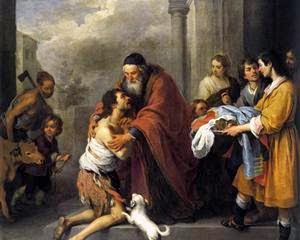
The Return of the Prodigal Son
Bartolome Esteban Murillo
source Wikiart

On the Affection of Fathers for Their Children:  In this case, Montaigne means male children but he does share some good advice. A man should not marry too early and responsible thought should be given to the purpose of having children, realizing that they will owe you much more than they can ever pay back.  Instead of forcing the son to be dependent on him when he comes of age, the father should share his wealth and guide him in the use of it, teaching the son to run the estate.  Now Montaigne claims if this is not done, the sons have no other recourse than to become thieves, a habit that will be nearly impossible to break.  I’m not sure I follow his rationale in this case, and cannot agree with it as an excuse, but hey, it’s Montaigne, right?  It just doesn’t feel normal if he doesn’t hit you with some sort of idiosyncratic reasoning.

In spite of some peculiarities, Montaigne has a charm that cannot be denied.  Perhaps Madame de Sévigné characterizes best what his readers experience:  “I have found entertainment in a volume of Montaigne that I did not think I had brought with me.  Ah, the charming man!  What good company he is!  He is an old friend of mine, but by dint of being old, he is new to me. …….. Mon Dieu!  how full this book is of good sense!”