The Plague by Albert Camus

“The unusual events described in this chronicle occurred in 194-, at Oran.”

Albert Camus was born in 1913 in Algeria.  His father was killed at the Battle of the Marne in World War I and he and his brother were raised by their mother in a state of poverty.  He became a journalist, and during World War II, moved to Paris where he worked for an underground newspaper, and it was then that he began to craft his “philosophy of the absurd.”  The Stranger, published in 1942, was followed by The Plague in 1947, and in 1957 Camus won the Nobel Prize for Literature.  Tragically he died in a car accident in the south of France at only 46 years old.

Often Camus is lumped in with the existential philosophy, but he rejected that appellation, claiming himself an absurdist.  What is an absurdist?  Well, I like to think of them as existentialists with hope.  Absurdism is an idea that man is longing for meaning and clarity in a world that contains neither.  The conflict between the search for a purpose and the lack of one, creates absurdism.  Yet while Camus felt a meaninglessness in life, he wondered if man could create his own morality and follow it, even though his achievements would be fruitless.

St. Macarius of Ghent giving aid
to the plague victims (1672)
Jacob van Oost
source Wikimedia Commons

The Plague is set in the town of Oran in Algeria, a town perhaps like any other, yet the citizens are so ingrained in their day-to-day activities, there is no real life or passion within its walls.  When the plague arrives, their lethargic outlook and self-centred actions initially prevent them from seeing the danger that is so obviously present, as evidenced by the number of rats dying throughout the town.  As the plague is finally realized and claims its victims, Camus employs a scientific and philosophical examination of how the people react to the pestilence, what emotions and actions are brought to the forefront and the significance of their struggle to survive, not only the plague but the day-to-day trials that they must face.

The Plague (1898)
Arnold Böcklin
source Wikimedia Commons

Camus shows the futility of attempted comprehension of the events, when the priest, Father Paneloux, declares the plague a judgement from God on the sins on the people.  In reality, the plague is not a moral judgement, nor anything that can be explained rationally, and therefore it is futile to try to rationalize it; one must simply accept the circumstances.  The plague means death, no more nor less than any other death, and the only reaction should be to battle against it.  Another character, Grand, decides to write a story perfect in its execution, but finally realizes his hopes are impossible.  As we meet more and more characters in Oran, we see its paralysis in the life of these men and women who choose actions that are meaningless and therefore self-isolating.  Because perfection cannot be obtained, a type of helplessness is portrayed, yet in a few characters we see another option.  While some victims have quietly succumbed to the inescapable death, others choose to fight, which gives their struggle significance within the inevitable.

Each character plays an important part in Camus’ philosophy, almost like a symphony, as Camus presses the loud pedal with one, and the soft with another. I’m still not sure how I feel about this tactic.  On one hand, it really gives the reader the ability to scrutinize each person’s part in the plague and, of course, Camus’ philosophy, but on the other, the story perhaps suffers. With such close dissection, the humanness fades into the background as the emphasis is given to worldview over plot, and in some cases the plausibility of the character and his/her actions is sacrificed to communicate Camus’ pet beliefs.


Plague in Ashod (1629)
Nicolas Poussin
source Wikimedia Commons

With the existentialist worldview, the novel would have signified defeat in the face of a world devoid of hope and purpose, but Camus spurs us to vigilance and action. He may not believe in truth or God, but one gets the feeling that he wants to believe.  It is as if he is waiting …… waiting for a sunbeam in a storm or a flower in the desert, and while he waits, he fights for the right to hope in what he tells himself is impossible.

Ultimately Camus struggled against his own belief system.  When the Nazi’s invaded France, he actively worked against them.  He made a judgement that their actions were wrong and attempted to stop them, showing that he did indeed believe there was something worth fighting for in the world.  Unlike the existentialists that I’ve encountered, Camus confronted the implications of his unbelief — and ultimately offered a solution, or at least a compromise with regard to his dilemma: while he still held to the absence of meaning within life, that did not mean that the search could not be rewarding.  At the end of his book, The Myth of Sisyphus, Camus concludes, “The struggle itself toward the heights is enough to fill a man’s heart.  One must imagine Sisyphus happy.”


A Read-Along with Bookstooge – January 2015


The Princess by Anton Chekhov

Portrait of Anton Chekhov (1886)
Isaac Levitan
source Wikiart

This short story is my fourth read for my Deal Me In Challenge 2015.

What happened to Narcissus when he looked at his own reflection in the pool? This beautiful hunter from Boeotia fell in love with himself, and in fact was so deeply infatuated, in his self-obsession he fell into the pool and drowned.  Not a very fitting end for one with so much promise.

Narcissus (1594-96)
Caravaggio
source Wikipedia

In Chekhov’s story we meet the Princess, a lovely young woman who arrives at an isolated monastery for a night’s stay.  She is so thrilled to be there, gushing effusively about the setting and the priests and brothers who have received her.  She wants to forget her life in the city and the monastery and its occupants give her the tools to do so.  But the reader soon realizes that her arrival, instead of being a moment of interest and delight, is instead looked upon with discomfort and even dread by the good brothers of the monastery, and one feels that the Princess, in spite of her outward joie-de-vivre and vivacious personality, is only noticing the benefits that she gets from her visit, without concern for anything or anyone around her.

Soon she meets Mikhail Ivanovitch there, a doctor whom she’d earlier employed in her service, but instead of a warm reception for her, the doctor’s replies drip icicles.  Our poor, puzzled Princess cannot understand ….. why the reserve, especially when she condoles with him upon the death of his wife, an event that is certainly sad, but of course, life must go on.  When she mentions the mistakes she’s made in life and the doctor agrees, she begs him to enlighten her.  Perhaps she should have been more careful in what she asked for.  Directly he begins to catalogue her offenses, taking her to task for her lack of sympathy, her greed, her complete disdain for the feelings of others ………. in fact, the whole system of life that she has built around her is false and cruel, breeding those traits, and choking out any love or caring.  She has replaced God with herself, and therefore is no longer able to understand the creation in which she lives.

Oh!  The Princess is hurt, she is distraught, she is devasted!  That cruel, uneducated, ill-bred man!  How could he speak so to her, to HER, a princess?!  She must use her only defence against these horrid accusations, and so she begins to cry.  The doctor is immediately contrite and leaves her.  When they meet the next day, the princess is once again herself, gay and blithe as she prepares to leave, expecting everyone to admire and entertain her even as she promises to come again soon.  The unpleasantness of the day before is blotted from memory as once more she strives to be the centre of the world.

The Unsmiling Tsarevna (1916-26)
Niktor Vasnetsov
source Wikiart

In spite of the inclination to laugh at the princess’ stupidity and complete self-absorption, this story is quite a tragic one.  Her character is certainly one of a narcissist, and anything that exists around her, merely exists for her alone.  She is devoid of the character traits that make one truly human and, therefore, is not much better than a beast.

On November 15, 1888, Chekhov wrote to his publisher, stating that he was writing a story about a “vile woman”.  Three days later Chekhov wrote, “I want to write protest stories this season ——  I must learn the knack, but it bores me because I’m not used to it,” which makes one wonder if the doctor’s social protest was supposed to be the hub of the story.  In any case, both character’s roles offered a ripe opportunity for social and psychological examination.  This was an excellent story that certainly makes me want to read more of Chekhov’s works.

Deal Me in Challenge (#4) – Six of Clubs


The Adventures of Pinocchio by Carlo Collodi

“There was, once upon a time …….”

The Adventures of Pinocchio was originally serialized in the two years prior to its publication in 1883, and was written by the Italian children’s writer Carlo Collodi.  Initially Collodi had Pinocchio die a rather gruesome death at the end of chapter 15 (which is rather reminiscent of Hilaire Belloc’s instructional children’s poetry), but his editor urged another ending, so the reader was finally treated to an extra 21 chapters and a wise addition it was!  The book has been translated into 240 languages and remains an icon in children’s literature.

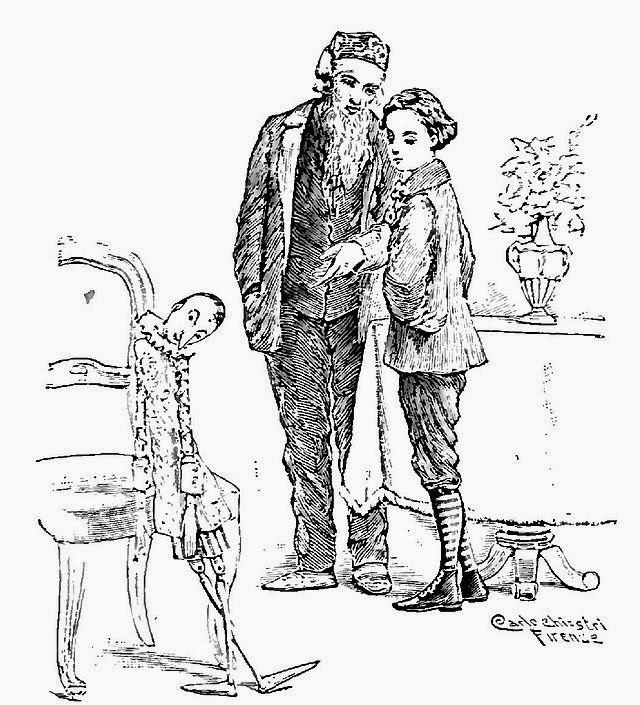
Pinocchio begins as a talking block of wood that is given to a woodcarver named Gepetto, who carves him into a puppet and tries to teach him sense, responsibility and moderation.  Yet instead of being grateful to his creator, Pinocchio follows his own selfish inclinations and calamitous adventures are the result of his self-indulgent, thoughtless decisions.

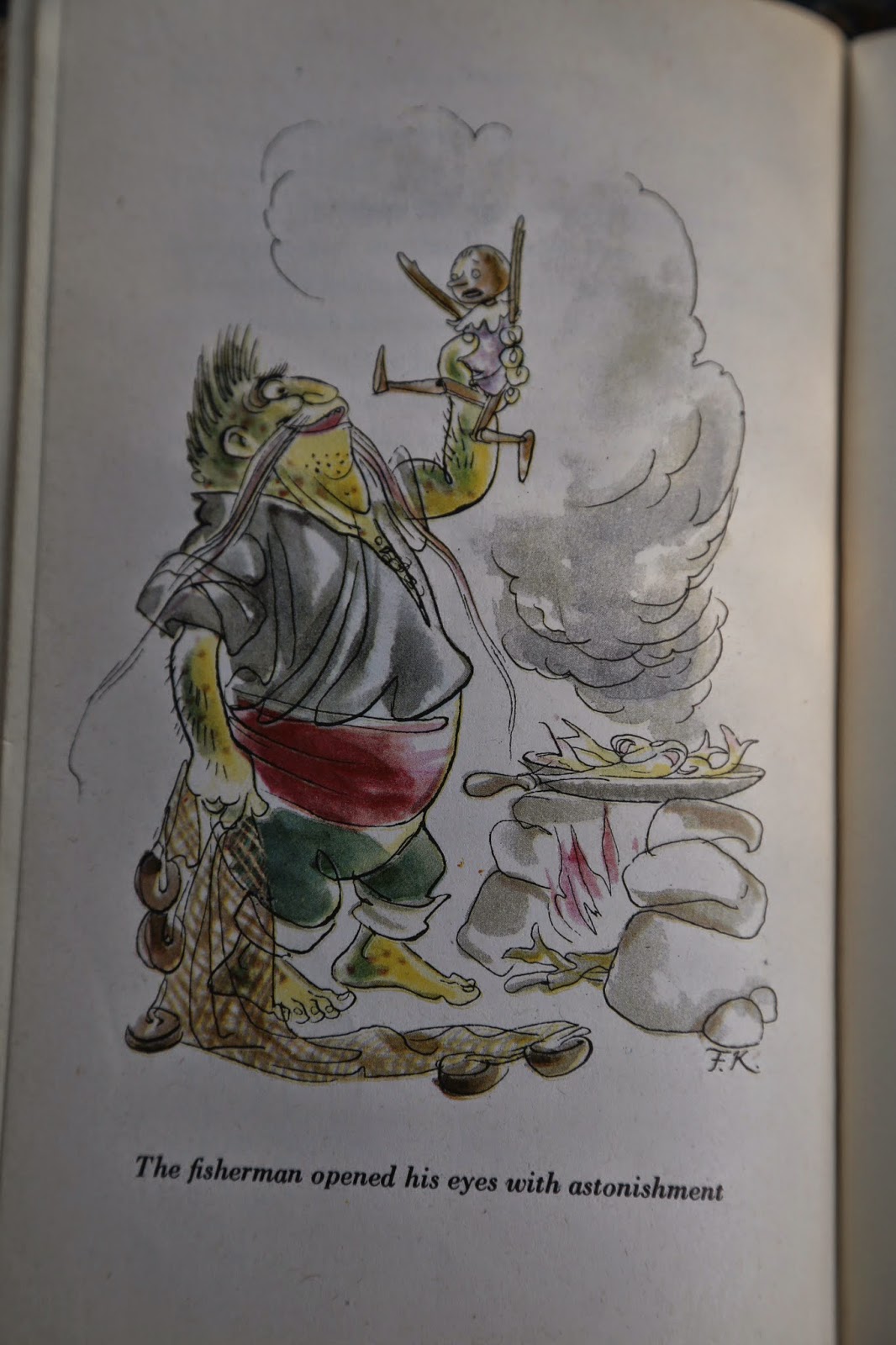
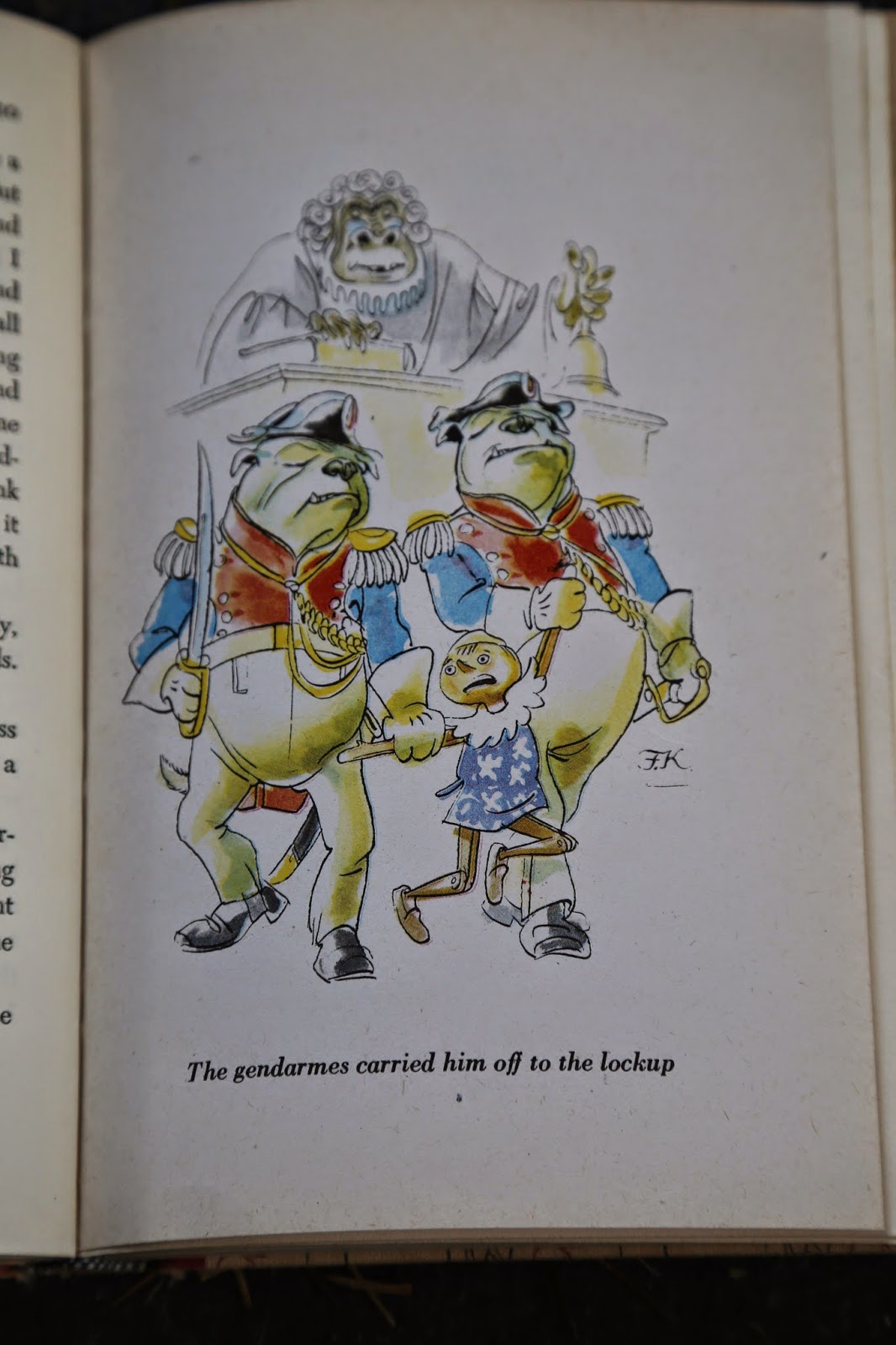
From being defrauded of his money by a Cat and a Fox, nearly roasted in a fire, hung by his neck on a tree, arrested and thrown in jail, turned into a donkey, and eaten by a fish, one wonders why Pinocchio doesn’t learn his lesson and become a good boy. But through these disastrous adventures, we see changes in Pinocchio that are like small flickering lights in the inky darkness of his character.  Initially his zest for fun is nearly uncontrollable but, while it can seem doubtful on the surface, he steadily learns from each adventure, and at each temptation, he is able to put up more resistance.  Pinocchio wants to be good, but his conscience is at continual war with his boyish enthusiasm and his childish lack of forethought and discipline.  The blue fairy, who is like a mother to him and attempts to aid in his moral development, is harsh in her instruction, but Pinocchio benefits from this treatment, knowing she is looking out for his best interests.  And in spite of her firmness, love is always in her actions:

“I saw from the sincerity of your grief that you had a good heart; and when boys have good hearts, even if they are scamps and have bad habits, there is always something to hope for: that is, there is always hope that they will turn to better ways …”

Eventually Pinocchio learns how dangerous it can be to follow your impulses of the moment, and that responsibility and hard work bring a maturity that is rewarded in a way, that fun and pleasure can never match.


Was I imagining it, or were there a number of Biblical allusions in the story? When Pinocchio buried his money, it reminded me of the parable of the talents, where the servant chooses selfishly to bury his money instead of making good use of it.  With the large fish swallowing Gepetto, of course, this alluded to Jonah and the whale.  And finally, all Pinocchio’s catastrophic adventures that come about by his poor life choices and his eventual change of heart, are on parallel with the story of the prodigal son, who finally returns home to the one who truly loves him and has his best interests at heart.

The Return of the Prodigal Son (1773)
Pompeo Batoni
source Wikipedia

In spite of some of the more bloodthirsty episodes, this was truly a heart-warming story.  That sentence sounds odd, I know, but I really appreciated the reality of Collodi’s message.  The company we keep has an enormous influence on the character that we will develop, and each of our decisions in life carry an import, sometimes with consequences that are not easily realized. For me, the most shocking part of the story was the episode where the Cat and Fox hung Pinocchio in a tree expecting him to die, but honestly in some bad decisions the outcome could be death, and it’s important to realize that.

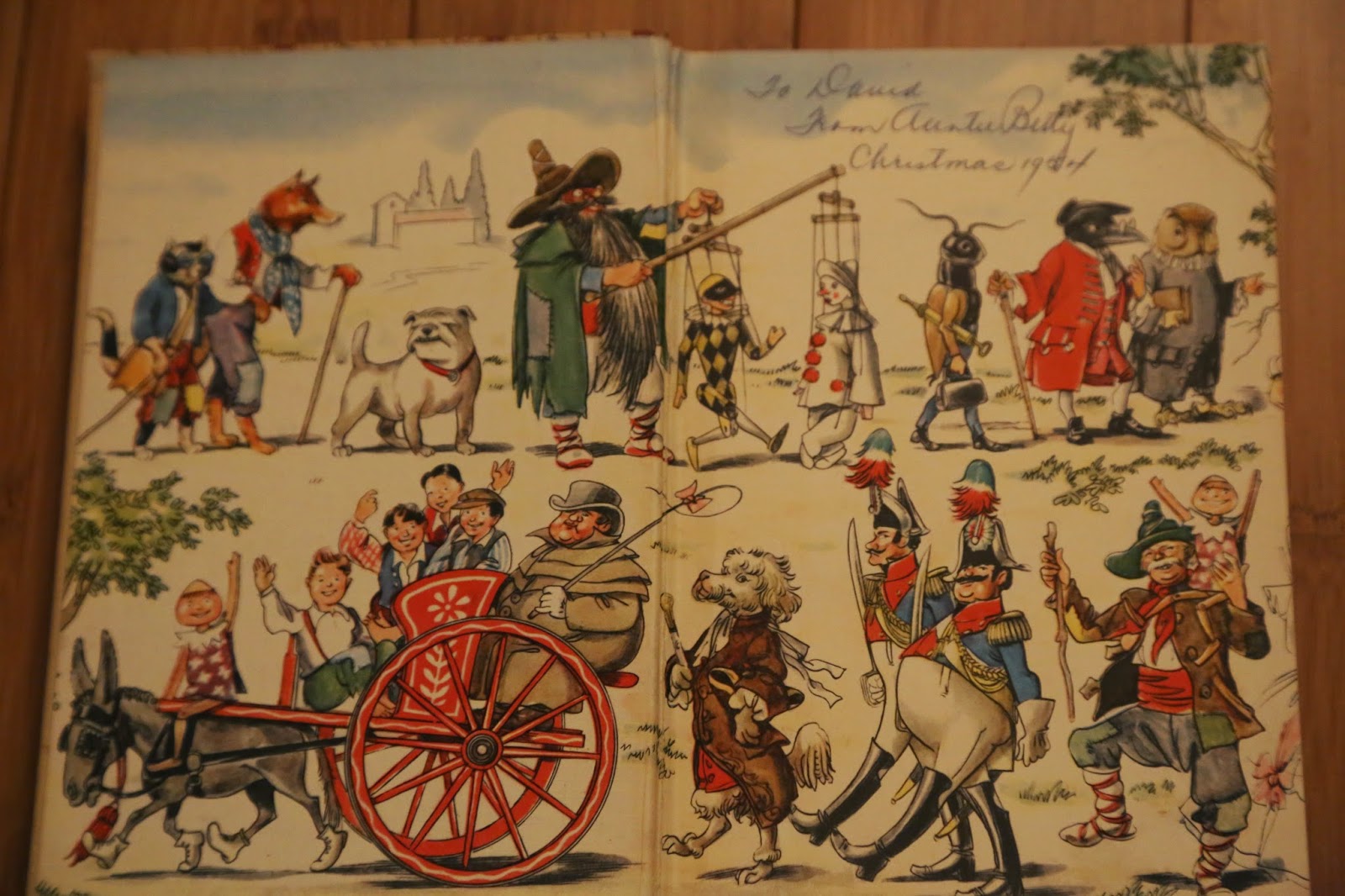
Finally, I’ll share a few pictures by illustrator Fritz Kredel from my 1946 edition that are rather fun:

Orlando: A Biography by Virginia Woolf

“He — for there could be no doubt of his sex, though the fasion of the time did something to disguise it — was in the act of slicing at the head of a Moor which swung from the rafters.”

My experience with Woolf’s writing is limited yet expanding.  I loved reading To The Lighthouse for its somewhat dream-like qualities and was rather pleasantly lulled by its stream-of-consciousness style.  Mrs. Dalloway I enjoyed, but I didn’t connect with it as much as I’d hoped and was left in a somewhat puzzled frame of mind at the end.  After reading Orlando, I was left with this same feeling.  What exactly did I just read and who was this Orlando?

Orlando is a young man born in the reign of Elizabeth I, and the novel follows him through his youth, as he has an affair with a Russian princess, cares for his ancestral estate, travels on diplomatic missions, etc.  The theme of writing is also explored, in his rejection by a famous poet and various other allusions. Finally he falls into a trace and, lo, awakes a woman.  This transformation does not seem  to surprise him, and she carries on her life as if nothing remise has occurred, yet upon returning to England she finds her estate embroiled in financial turmoil.  While remaining a woman, she fashionably switches between genders, eventually marries a sea captain, wins the lawsuit with regard to her property and that’s about it.  Woolf herself acts as an historical biographer and with her comic and satirical descriptions of certain people, I wasn’t sure if she was parodying herself as narrator, or taking a poke at a particular figure of her time and society.

Honestly I don’t have much to say about the book.  Twentieth century literature always does this to me.  I expect to be “informed and amused,” as books attempted to do historically (see my Gulliver’s Travels post for some extra information on writers’ intent) and end up somewhat disappointed when I’m only amused.  While I enjoyed the book, it would probably get only 3.5 stars from me.  In spite of my resolution to love it, 20th century literature always falls short.  Certainly the stream of consciousness writing is an interesting experiment, the disjointed prose perhaps a comment on the human psyche and the other artistic experiments are worth examining, but I’m always left with an empty feeling at the end.  What was the author really trying to say?  What did I learn?  What could I take away from the book that would change me in some fundamental way?

Yet, it turns out Woolf herself perhaps was not as satisfied with Orlando as she’d hoped.  Woolf wrote in her diary:

“I have written this book quicker than any; and it is all a joke; and yet gay and quick reading, I think; a writer’s holiday.”

“……… begun ….. as a joke: and now rather too long for my liking.  It may fall between stools; being too long for a joke, and too frivolous for a serious book.”

“Orlando taught me how to write a direct sentence; taught me continuity and narrative and how to keep the realities at bay.  But I purposely avoided, of course, any other difficulty.  I never got down to my depths and made shapes square up, as I did in the Lighthouse …… I want fun.  I want fantasy.”

And yes, Woolf wasn’t meaning this book to be serious at all:

“My notion is that there are offices to be discharged by talent for the relief of genius: meaning that one has the play side; the gift when it is mere gift, unapplied gift; and the gift when it is serious, going to business.  And one relieves the other.”

And so Orlando was a playful, frivolous fantasy that enraptures the reader, as Woolf captures your imagination with her wonderfully vibrant prose and light-hearted fanciful tone.  And I can enjoy it on that level.  Yet it is still only a wonderfully decorative cake, and I feel like I’ve missed the main meal.

O at Behold the Stars has an excellent review of Orlando, and with her comprehensive knowledge of Woolf, will be able to give you much more insight into the book than I have.

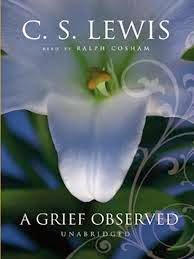
A Grief Observed by C.S. Lewis

“I never knew that grief felt so much like fear.”

In A Grief Observed Lewis shares his thoughts and emotions with regard to the death of his wife, Joy Davidson, and it is perhaps one of the most powerful books on suffering that I’ve ever read.  As a reader, you are drawn into his grief and, contrary to what the title suggests, you can feel and experience Lewis’ anguish right alongside him, at times almost against your will.  Lewis is pain personified, and it’s raw and it’s shocking.

In his book, The Problem of Pain, Lewis deals with suffering from an aspect of reason and pragmatism, but in A Grief Observed, he is a broken man, on one hand calling out for sense and understanding to apply to a situation that is beyond comprehension, and on the other, resisting examining his situation. Lewis’ faith was shaken but not broken.  He does not deny God, yet he does ask what kind of God is He?  What type of God would allow something like this to happen?  He asks hard questions, makes brutally honest statements, and you wonder if this man is on his way to losing his faith.

“Talk to me about the truth of religion and I’ll listen gladly. Talk to me about the duty of religion and I’ll listen submissively. But don’t come talking to me about the consolations of religion or I shall suspect that you don’t understand.”

Yet why can’t we ask hard questions of our Maker?  Why can’t we storm and rage against the injustices of life?  Lewis kicked and stormed against the door of Heaven and instead he found an opening into his own soul.

“God has not been trying an experiment on my faith or love in order to find out their quality. He knew it already. It was I who didn’t. In this trial He makes us occupy the dock, the witness box, and the bench all at once. He always knew that my temple was a house of cards. His only way of making me realize the fact was to knock it down.”

After long endeavouring to remember his wife’s countenance, it is only when he stops struggling to see Joy, that her face suddenly returns to his mind. Lewis finally realizes that we need to seek God for Himself — for who He is —- and not for what we can get from Him.

“You never know how much you really believe anything until its truth or falsehood becomes a matter of life and death to you. It is easy to say you believe a rope to be strong and sound as long as you are merely using it to cord a box. But suppose you had to hang by that rope over a precipice. Wouldn’t you then first discover how much you really trusted it?”

Madeleine L’Engle writes in her introduction to the book:  “I am grateful to Lewis for having the courage to yell, to doubt, to kick at God in angry violence. This is part of a healthy grief which is not often encouraged.  It is helpful indeed that C.S. Lewis, who has been such a successful apologist for Christianity, should have the courage to admit doubt about what he has so superbly proclaimed.  It gives us permission to admit our own doubts, our own anger and anguishes, and to know that they are part of the soul’s growth.”

courtesy of Dawn Huczek
source Flickr
Creative Commons
———————————————————————————–

C.S. Lewis Project

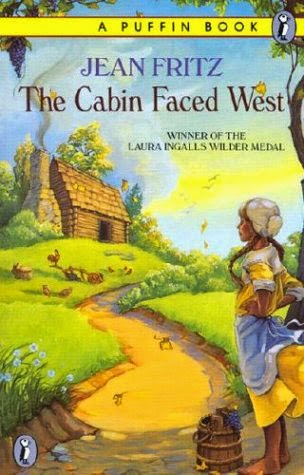
The Cabin Faced West

Author:  Jean Fritz
Illustrator:  Feodor Rojankovsky
Era:  1784
Published:  1958 (G.P. Puntam’s Sons)
Award:  none known 
Age Range:  3 – 12 years old
Review:  ★★★★★
Fritz relates the wonderfully poignant story of Ann Hamilton, a young girl who has moved west with her family, which include her parents, and two brothers. Her father, in his wisdom, emphasizes that the family must “look west” now, and that there should be no looking back.  Ann, however, finds this resolve difficult.  She misses her family, especially her cousin, Margaret, who was her best friend.  How will she be able to carve out a new identity for herself in this new unfamiliar land.  Who is this new Ann, who is now a pioneer girl?

Eventually, through various interactions with her family, other settlers, and George Washington himself, Ann learns the value of this new land and her place within it.

Set during the late 1700s, this story is based on a true one which happened to Fritz’s great-great-grandmother, Ann Hamilton.  George Washington did indeed stop at the Hamilton’s for dinner on September 18, 1784.  His diary reads:  “Set out with Doctr. Craik for my Land on Miller’s Run.  Crossed the Monongahela at Devore’s Ferry —- bated at one Hamilton’s about 4 miles from it, in Washington County, and lodged at Colo. Cannon’s”  And so the story passed down through generations to finally be shared with us all.

For a more extensive review, please see my Classical Children’s Carousel!

Oh yes, and the first book read for the January Classical Children’s Literature Event!

Deal Me in Challenge (#2) – Eight of Hearts


Meditations by René Descartes

“My reason  for offering you this book is very persuasive, and I am confident that you will have an equally strong reason for defending it once you understand why I wrote it; thus the best way of commending it to you is to say a few words about my objective in writing it”

Descartes set out to examine how “everything that can be known about God can be shown by reasons that derive from no other source but our own mind, …. and how God can be known more easily and more certainly than worldly things.”  However even as he claims his investigations as “certain and evident,” he is concerned that not everyone has the ability to grasp them.  Right then, I knew I was in for a philosophically dense read.  Yet while I trembled, I soon began to realize that Descartes splits his meditations into manageable chunks and, if you employ your brain for short periods, his explanations and arguments can penetrate.  I also realized that the title of the book could be of assistance.  These thoughts of Descartes were ideas that were probably products of hours and days and years of pondering and questioning and seeking.  If it took him that long to produce the ideas, I’d have to be willing to meditate on them if I wanted to develop a basic understanding.  And so I went on ….

First Meditation:  Things which can be called into Doubt

Descartes explores false knowledge, which he distinguishes from the unknowable: “there is nothing among my former beliefs that cannot be doubted and that this is so not as a result of levity or lack of reflection but for sound and considered reasons.”  It is necessary to discard all beliefs that aren’t absolute to determine what is known for certain.  There are many comparisons to thought while asleep and thought while dreaming.  He concludes with:

“I am like a prisoner who happens to enjoy an imaginary freedom in his dreams and who subsequently begins to suspect that he is asleep and, afraid of being awakened, conspires silently with his agreeable illusions.  Likewise, I spontaneously lapse into my earlier beliefs and am afraid of being awakened from them, in case my peaceful sleep is followed by a laborious awakening and I live in future, not in the light, but amid the inextricable darkness of the problems just discussed.”

Second Meditation:  The Nature of the Human Mind, and that it is better known than the Body

Descartes thoughts continue from his supposition from his first meditation and he decides that everything is false.  Yet if all he believes is false, he does conclude that one thing is true:  he exists.  His reasoning is something like this:

  1. He exists if he is not being deceived.
  2. He exists if he is being deceived.
  3. Therefore, if he is being deceived or not being deceived, he exists
  4. He is either being deceived or not being deceived.

Interestingly, St. Augustine also argued “fallor ergo sum”, or “I am being deceived, therefore I exist”.

I think here Descartes arguments are of a personal and not necessarily a general nature:  his mind exists because his thoughts exist.  However, he still hasn’t proven that he exists.

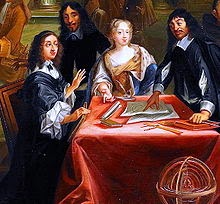
Rene Descartes with Queen
Christina of Sweden
source Wikipedia


Third Meditation:  The Existence of God

Descartes starts to lose me here.  He examines the dream state and questions how we can know it from reality and then he discusses the all-powerful God which we know and how we could be deceived in our perception of him (I think).  Very logically he states that if he is being deceived, that very fact proves his existence.  He comes to the conclusion that God is not a deceiver but leaves the door open to accept that there is something that is.

I was fascinated by Descartes exploration into ideas.  There are ideas which come to us that do not originate with us and, in fact, sometimes impose themselves on us.  If they are not products of our will, does that not point to there being something other than us?

“But if I derived my existence from myself, there would be nothing that I would either doubt or wish for, nor would I lack absolutely anything.  For I would have given myself every perfection of which I have some idea and thus I would be God himself.”

Whew, that’s certainly something to think about!

Fourth Meditation:  Truth and Falsehood

Yikes, and even deeper we go ……..  Descartes concludes that God exists and his existence depends on Him.  God cannot deceive because deception involves some sort of imperfection and God is perfect.  When Descartes focuses on God he finds no error in himself, but when he focuses on himself, he is full of errors.  He calls himself an intermediate being between God and nothingness.

With regard to errors, he proposes that two faculties come into play:  the faculty of knowledge and the faculty of choosing from his own free will, in other word, intellect and will.  Through his intellect he perceived ideas but through his will he can make judgements.  There is a problem though:  his intellect is limited —- it cannot perceive all ideas and it does not always perceive clearly and distinctly —– whereas his will is unlimited —- it can make, deny or suspend judgements on anything.  Yet as long as he does not make wrong judgements in his will, he is safe …… if he simply suspends judgement on ideas he’s not certain of, he cannot be wrong.

Descartes at Work
source Wikipedia


Fifth Meditation:  The Essence of Material Things, Another Discussion of God’s Existence

Descartes provides a new argument for the existence of God, in that if he thinks that he exists, existence in inseparable from God and therefore He exists …… or at least, I think that’s what he’s saying.  Such as:

1.  God is a being that has all perfections
2.  Existence is a perfection
——>   God exists

There are three famous arguments about Descartes’ position (one of them being Kant’s argument that existence isn’t a perfection) but none hold up to logical examination, so I guess Descartes is still the winner.

Sixth Meditation:  The Essence of Material Things, and the Real Distinction Between Mind and Body

Wow, this is getting challenging!  To argue for a material world, Descartes examines what is contained in his own soul.   There is a delineation between imagining and pure understanding.  He concludes he could exist without imagining, therefore imagining must be outside his mind and connected to the body.  Next he examines the senses, which he feels come involuntarily and therefore connect ideas to the mind.  The next puzzle is why the mind is connected to the body ………  With all these quite impressive logical acrobatics, he begins to believe material objects exist but perhaps not in the way he has always believed.  There are a number of other investigations into our senses and their role, why we make unwise decisions, and that the body is divisible, yet the mind is not.  He ends by stating:

” For from the fact that God is not a deceiver it follows that, in such cases, I am completely free from error.  But the urgency of things to be done does not always allow us time for such a careful examination; it must be granted, therefore, that human life is often subject to mistakes about particular things, and the weakness of our nature must be acknowledged.”

As much as it completely strained my brain, the Sixth Mediation really resonated with me.  I remember as a small child wondering why I was me. How was it that I felt contained in this particular body and not another?  Why was I chosen to be me?  How?  Why was I a soul living in Canada and not somewhere else?  I think this was the start of realizing that I had a soul and was something more than just a mechanical shell or a biological entity.  And if that was true, then where did I come from and who made me?  Perhaps not original questions, but ones that I think we should think about more in life.  Yes, we should all be philosophers!

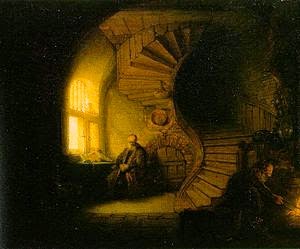
Philosopher in Meditation
Rembrandt (1631)
source Wikipedia

Getting back to the book, it continues with “objections” or responses from Johan de Kater, a Catholic theologian from Holland; Fr. Marin Mersenne; Antoine Arnauld, a Jansenism theologian; Thomas Hobbes; and Pierre Gassendi, a priest, scientist, astronomer and mathematician.  I really had to laugh reading some of these objections.  In fact, the Catholics were the ones who questioned the logic Descartes used to prove the existence of God.  So curious from a modern prospective but it appears that the church was willing to ask tough questions during these times and wasn’t afraid of searching for the truth.  So interesting!

Descartes’ Replies to the Objections are also very enlightening but so very deep.  A course in logic would have been very useful before reading this book, however, I think I’ve covered enough for now.  Descartes obviously liked to think and had alot of time to do it.  It was mental gymnastics to try to follow him but good for the brain.  To really understand it though, you need to have read Aristotlean philosophy along with a number of other more recent philosophies, as Descartes thoughts sprung from that already anchored base.  At least my understanding, while minuscule, is more than when I started.  Thanks, Descartes!

Gulliver’s Travels by Jonathan Swift

“My father had a small Estate in Nottinghamshire; I was the Third of five Sons.”

As Samuel Johnson stated, Gulliver’s Travels is a work “so new and strange, that it filled the reader with a mingled emotion of merriment and amazement.”  One must remember that at the time of Gulliver’s Travels, readers had rarely encountered prose fiction in the form of stories, let along the fantastical stories and adventures of Gulliver.  They didn’t quite know how to respond.

In the last chapter of the this book, its purpose is laid out to the reader, that Swift’s “principal Design was to inform, and not amuse thee.”, a deviation in form, since most medieval writers sought to do both.  The Roman lyric poet, Horace, stated that, “The poet who pleases everyone is the one who blends the useful with the sweet, simultaneously amusing and informing the reader.”  Likewise, Thomas More in his Utopia states that his book is “A Truly Golden Handbook, No Less Beneficial than Entertaining”; Shakespeare seeks also to entertain and instruct, and The Cantebury Tales are described as “tales of best sentence and sola”, expressing the standard medieval definition of literature which both informs and gives pleasure.  So why does Swift no longer want to amuse readers?  Why does he choose to change the medieval model of how literature was represented?  If his readers have not noticed the festering undercurrents of judgement within the story, it’s as if Swift was determined emphasis the seriousness of the work.  As throughout his story, he gives the English people strengths that do not exist, so he also gives the reader amusement, where amusement does not exist.   No wonder people were puzzled by his unique representation.

Born in Dublin  in 1667, Swift spent the early years of his life moving between his hometown and London, attempting to gain a footing both in politics and the Church.  His first position was with Sir William Temple a retired English diplomat who was writing his memoirs.  Swift formed a close relationship with Temple and when he died, Swift hoped to gain a position at Canterbury or Westminister through King William, but the position never materialized.  Amid various other disappointments, Swift continued his travels between Ireland and England, and during these years, he produced A Tale in a Tub and The Battle of the Books, gaining a reputation as a writer.  Gulliver’s Travels was published later in his career, in 1726.

Mural depicting Gulliver surrounded by
the citizens of Lilliput
source Wikipedia

Episodic in nature, Gulliver’s Travels follows Lemuel Gulliver as he visits various unknown civilizations and learns their ways while gently comparing their societies with those of his own.  I say gently because Gulliver makes his musings appear as a gentle examination, but Swift has other ideas. One doesn’t have to look very hard to see that this work is a sweeping condemnation of the human race.

Gulliver first lands in Lilliput where the society is diminutive in stature compared to Gulliver’s enormity.  Initially accepted by the Lilliputians because of his good behaviour, he eventually upsets them by refusing to help them conquer another province and he is forced to escape.

Gulliver exhibited to the Brobdingnag
Farmer – Richard Redgrave
source Wikipedia

His second adventure is nearly an inversion of the first, in that this time Gulliver is small and, landing in Brobdingnag, soon realizes the gigantic features of its inhabitants.  While being poorly treated by his first family, Gulliver eventually comes to the Queen who treats him reasonably well and he is able to converse with the King.  The King, however, becomes unhappy with his description of the state of Europe, in particular their use of guns and cannons.

Gulliver discovers Laputa,
the flying island
J.J. Granville
source Wikipedia

The next adventure includes the flying island of Laputa, which is a rather bizarre place.  The inhabitants are devotees of the arts of mathematics and music only, but not only fail to employ them for any benefit to society, they also, through self-deception, are blindly unable to recognize their failures.

The land of the Houyhnhnms is Gulliver’s fourth and final stop, a land of wise and noble horses, but he also encounters a race called Yahoos, a race very much like himself yet more filthy, vulgar, bestial and stupid.  Although they at first recognize him as a Yahoo, the Houyhnhnms finally take to Gulliver, impressed with his cleanliness and ability to reason.  Yet in spite of the relational ties he makes in this land and his desire to remain among these highly civilized beasts, the horses foresee a danger in Gulliver’s presence and send him off in a boat.  When he arrive home, our protagonist is a changed man.  Disgusted with the “Yahoos” of his country, he is barely able to live in their company, finally choosing a rather secluded life.

Gulliver taking final leave of
the Houyhnhnms (1769)
Sawrey Gilpin
source Wikipedia

Through Gulliver’s interaction with the Liliputans and the Brobdingnagans, Swift satirizes British politics.  The Liliputans are only concerned with petty and trivial problems, and in their self-aggrandization can only see themselves as governors of the whole world.  Yet while Liliput represents a small view of man, Brobdingnag represents a large one.  As in Liliput, Swift explores the contrasts between liberty and law, but now the situation is reversed as Gulliver is in miniature in a land of giants.  The island of Laputa is built upon philosophy and it’s inhabitants are seen as Swift’s critque of scientism, or that the only way to true knowledge is through scientific disciplines.  Only what can be seen and measured is taken into account, but, of course, this leaves no room to examine the soul.  The land of the Houyhnhnms is perhaps the most fascinating part of the voyages.  In this land the beasts are the civilized society and the Yahoos, who are human, are savages.  The Houyhnhnms live by reason and that reason, working within nature, give rise to their idyllic existence.  Gulliver believes that if he lives long enough with his friends, this virtue will rub off on him, but in fact the horses see his reason as imperfect and therefore he is more dangerous than a Yahoo who has no reason at all.  In reality, Gulliver is half-way between both species, halfway between pure passion and pure reason.

Apparently both Sir Walter Scott and William Thackeray were shocked and repulsed by Gulliver’s fourth voyage, yet there is still argument as to whether Swift’s work was a satire in the form of Horace, where he is only lightly satirizing Gulliver’s idealism, or the heavier satire of Juvenal, whereupon his writing is a vitriolic, sarcastic diatribe condemning the human race.  I’ll leave it to the reader to decide.  Yet perhaps Swift himself can shed light on his intentions:

“I have ever hated all Nations professions and Communityes and all my love is towards individualls for instance I hate the tribe of Lawyers, but I love Councellor such a one, and Judge such a one for so with Physicians (I will not speak of my own trade) Soldiers, English, Scotch, French; and the rest but principally I hate and detest that animal called man, although I hartily love John, Peter, Thomas and so forth.  This is the system upon which I have governed myself for many years (but do not tell) and so I shall go on until I have done with them I have got materials toward a treatise, proving the falsity of that definition animal rationale [rational animal], and to show it would be only rationis capax [capable of reason].  Upon this great foundation of Misanthropy (though not in Timon’s manner) The whole building of my Travells is erected.  And I will never have peace of mind until all honest men are of my Opinion.”

While I thought Swift’s satire brilliant, and his characterizations mostly just, I felt that he focused only on the negative aspects of human nature.  If Swift really saw the world only through a lense of disappointment, treachery, selfishness, and deceit, yet missed the integrity, loyalty, virtues and goodwill of the flip-side of human nature, that is truly a tragedy.

Read for my Classics Club Spin #8, Fariba from Exploring Classics joined me in reading this one.  Here is her most excellent review.  Thanks for the company, Fariba!

(And further reflections by Fariba on Gulliver’s Travels)

Montaigne’s Essays – Part Two

Oh, Montaigne!  The more of his essays that I read, the more I like him.  He’s inquisitive, does not let anything get in the way of giving his opinion on absolutely any subject, has a clever but disordered mind, and because of the last point, really makes you engage your brain as you read.  I would have loved to meet him in real life, but, I get the impression that we’d probably have occasionally annoyed each other.  

Some of the readings for this section were:

On The Vanity of Words:  After reading Montaigne’s essay On Education, I suppose this attack on rhetoricians can’t come as much of a surprise.  To be eloquent is to foster a type of deception, and Montaigne is scathing in his condemnation of it.

Cicero & the magistrates disovering the
tomb of Archimedes
Benjamin West
source Wikiart

On the Inconsistancy of Our Actions:  This one is very interesting. Montaigne laments the inconsistency of men, stating that instead of following a path to wisdom throughout their lives, they are ruled solely by their appetites, living for the here-and-now and are merely motivated by opportunity, very much like animals. They blow with the winds.  He gives various examples on inconstancy, leading us to believe that consistency as Montaigne defines it, is virtually impossible.  One must plan one’s life to the utmost and follow the course, not being swayed by emotions or outside forces to be consistent and, as Cicero says, “For nothing can be consistent that has not reason for its foundation.”  Therefore, in Montaigne’s eyes, everyone is lacking true reason.  This is one of the few essays that I’ve read so far where Montaigne actually managed to keep on track with his subject.  Bravo!  This is certainly one of my favourites.

On Conscience:  Even if one finds pleasure in their vices, their conscience will always convict them, says Montaigne.  With one of his usual unexpected leaps of thought, he discusses the futility of torture, labelling it a means of testing endurance rather than a means to ferret out truth.  He uses some fun examples in this one, my favourite being Scipio tearing up his account books before the court when accused of dishonesty with regard to the money entrusted to him.  According to Montaigne, his actions declared him an honest man because his big heart could not bear to be accused of such a vulgar crime. Perhaps one should be grateful that Montaigne did not choose to be a judge as his profession.

Portrait d’un homme portant un exemplaire des
Essais de Montaigne
Johann Anton de Peters
source Wikiart

On Rewards for Honour:  Basically I understood that Montaigne feels that rewards should not be given out too liberally or their value is decreased. He’d rather not give out rewards at all, than have too many people get them.  Not a very modern viewpoint, Montaigne, when we presently strive to give everyone a reward for anything.  I tend to side here with Montaigne.

On Books:  Montaigne employs a coyness in this essay, stating that he reads books for pleasure only and has little desire to truly exercise his brain.  His goals in reading are to learn to know himself, and to learn to live and die well. His self-deprecation is quite startling as he confesses to having little knowledge and once again admits to having a poor memory.  Elaborating on his poor memory, he ends by giving a number of examples of literary criticism (not his title for it) that he has written at the ends of books, so if he picks them up again, he is able to ascertain why he liked them or not, and if he would read them again.

On Presumption:  It is not good to think too highly of ourselves, nor is it beneficial to think of ourselves worse than we are.  Montaigne advocates for balance and a practical self-knowledge.  Yet Man has such a variety of differing opinions, there is a “maze of obscurity” which makes the school of Wisdom uncertain, and this gets on Montaigne’s nerves.  He then meanders through a lovely forest of subjects, from self-deprecating statements to mediocre poetry to appearances of famous men, etc., finally ending with his disdain for modern education, in that it teaches learning instead of wisdom and goodness.

” It seems to me that the nursing mother of the most erroneous ideas, both of men in general and of the individual, is the exaggerated opinion man has of himself.”


On Giving the Lie:  Montaigne indulges in more modesty (false-modesty?) and finally gets to the title of the essay, lamenting that lying has been turned into a virtue by modern society.  He strongly condemns it:

“Lying is an ugly vice, which is painted in its most shameful colours by an ancient writer (Lysander) when he says that ‘to lie is evidence that we despise God and at the same time fear men.'”

To be honest, I feel that Montaigne could have benefited highly from the type of education that he despised, however, then he wouldn’t have been Montaigne and only another highly intellectual rhetorician with the same habits as all other rhetoricians.  And our Montaigne is unique, that is certain!  Not always simple to follow, but unique!


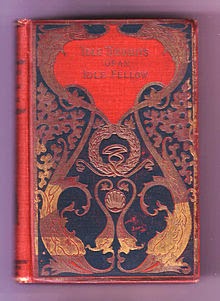
Idle Thoughts of an Idle Fellow by Jerome K. Jerome

“It is a most remarkable thing.  I sat down with the full intention of writing something clever and original; but for the life of me I can’t think of anything clever and original — at least — not at this moment.”

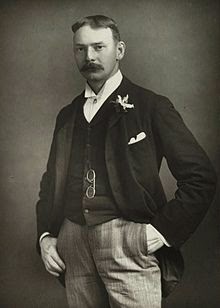
Jerome K. Jerome is an author best known for his comic travelogue, Three Men in a Boat, which I highly recommend as it is totally hilarious. Idle Thoughts of an Idle Fellow is a collection of essays; written with Jerome’s signature witty reparteé and lively humour, the essays are titled:

  1. On Being Hard Up
  2. On Being in the Blue
  3. On Vanity and Vanities
  4. On Getting On in the World
  5. On Being Idle
  6. On Being In Love
  7. On the Weather
  8. On Cats and Dogs
  9. On Being Shy
  10. On Babies
  11. On Eating and Drinking
  12. On Furnished Apartments
  13. On Dress and Deportment
  14. On Memory

Yet while Jerome’s anecdotes are amusing and give the reader a good chuckle, he also imparts wisdom to his writing.  In On Vanity and Being Vain, he, at first, pokes fun at the vanity of all men, but concludes that we all must be vain in the right manner.

“Let us be vain, not of our trousers and hair, but of brave hearts and working hands, of truth , of purity, of nobility.  Let us be too vain to stoop to aught that is mean or base, too vain for petty selfishness and little-minded envy, too vain to say an unkind world or do an unkind act.  Let us be vain of being single-hearted, upright gentlemen in the midst of a world of knaves.  Let us pride ourselves upon thinking high thoughts, achieving great deeds, living good lives.”

First Edition, 1886

Jerome also uses wonderfully descriptive sentences, that weave a vibrant and idyllic world around the reader:

“And oh, how dainty is spring —- Nature at sweet eighteen!  When the little, hopeful leaves peep out so fresh and green, so pure and bright, like young lives pushing shyly out into the bustling world; when the fruittree blossoms, pink and white, like village maidens in the Sunday frocks, hide each whitewashed cottage in a cloud of fragile splendor; and the cuckoo’s note upon the breeze is wafted through the woods!  And summer, with its deep, dark green, and drowsy hum — when the rain-drops whisper solemn secrets to the listening leaves, and the twilight lingers in the lanes! ….”

And, of course, one can’t say enough of his humour:

“But that’s just the way.  I never do get particularly fond of anything in this world, but what something dreadful happens to it.  I had a tame rat when I was a boy, and I loved that animal as only a boy would love an old water rat; and, one day, it fell into a large dish of gooseberry-fool that was standing to cool in the kitchen, and nobody knew what become of the poor creature until the second helping.”

If you want a book to make you feel good, read a book by Jerome K. Jerome. His writing is refreshing, light, profound, humorous, beautiful, timeless and educational, all at the same time.  And you won’t stop laughing!