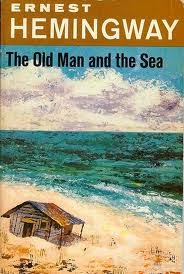
The Old Man and the Sea by Ernest Hemingway

“He was an old man who fished alone in a skiff in the Gulf Stream and he had gone eighty-four days now without taking a fish.”

I had disliked Hemingway ever since I attempted to read The Sun Also Rises as a teenager, but when Hamlettte from The Edge of the Precipice  announced her read-along of The Old Man and the Sea, I decided to give him another try.  Perhaps we would get along better this time.

This novella was an unexpected surprise and delight that has, well, perhaps not made me a Hemingway fan, but at least has made me very open to reading more of this works.

Imagine that you live in a small town in a simple hut and your life consists daily of fishing for a catch that will bring you your wages when you sell it in the market.  Now imagine going 30 days without a fish, then 40 days.  You lose your only helper, a boy, because you are now viewed as unlucky, and he is sent to work with more successful fishermen.  Day 60 passes but still you sail out as every other day, confident you will catch something.  By the time our story begins, most men would be worn with worry and care, but not the fisherman of this story, Santiago, who prepares his boat and sets sail as he has the previous 84 days that he did not return with a catch.  On this particular day, Santiago ventures into the Gulf Stream north of Cuba to set his lines and wait for his luck to change.  And does it change!  Hooking an enormous fish, Santiago begins his battle which lasts three days and pulls him out into the depths of the ocean, perhaps without the possibility of return. Yet return he does, but tragically his magnificent catch has been worried by sharks, and resembles nothing but a bony carcass.  Does this worry the old man?  Not one bit.  He makes the same climb to his shack that he has made the last 84 days, yet this time he is a different man.  Falling onto his bed, he dreams of lions and his youth.

While Santiago is fighting against defeat in the novella, at the end of the novel, instead of being defeated by the fact his catch returned only as a ragged skeleton, he returns a hero and his dreams of youth indicate the experience has given him life and vigor that had been missing before that day.  It was not the result of his struggle that mattered; it was the struggle itself and its purpose, that brought meaning back into the old fisherman’s life.

Ernest Hemingway and Henry (“Mike”) Strater
with the remaining 500 lbs of an estimated 1000 lb marlin
 that was half-eaten by sharks before it could be landed
 in the Bahamas in 1935.
source Wikipedia

Hamlette @ The Edge of the Precipice has given us some excellent questions that we can choose to answer for the read-along:

Some people say this story is full of symbolism, maybe even an allegory.  What do you think things like the old man, the fish, and the sharks could symbolize?

The book How To Read Literature Like a Professor states that The Old Man and the Sea is a “nearly perfect literary parable”, full of Christian imagery.  We encounter images of Christ in the story when, after grasping the line all night to hold the fish, Santiago made an exclamation that, as Hemingway tells us, is reminiscent of an exclamation “someone would have while having a nail passed through their hand into a piece of wood”.  After the completion of his voyage, Santiago stumbles up the hill, carrying his mast on his back, bringing the image of Christ carrying the cross to Golgotha, and when Santiago falls asleep in his house on his bed, are arms are spread wide, as if in the shape of a crucified Christ-figure.

source Wikipedia

Were these symbols intentionally put into the story?  Who can know for sure.  Hemingway, himself, when questioned, said:  “There isn’t any symbolism.  The sea is the sea.  The old man is an old man.  The boy is a boy and the fish is a fish.  The sharks are all sharks, no better or no worse.  All the symbolism that people say is sh*t.  What goes beyond is what you see beyond when you know.”  Personally I think that Hemingway used these images to convey meaning.  He didn’t intend to make Santiago, Christ or a Christ-type figure, he simply used images that all readers would be familiar with, to help us feel the old man’s struggle, pain, and sacrifice, and to share his triumph when he returned with the experience of the catch of his life.

Thanks for this excellent read-along, Hamlette.  Here are some other participant reviews:

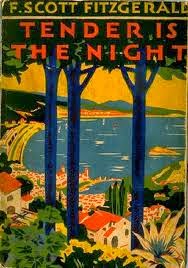
Tender is the Night by F. Scott Fitzgerald

“On the pleasant shore of the French Riviera, about half way between Marseilles and the Italian border, stands a large, proud, rose-coloured hotel.”

Early this year I read The Great Gatsby with, I’ll admit, some trepidation, since I’d read it in high school pretty much hated it. But my second exposure was much more pleasant and, if not my favourite book, I could definitely appreciate certain aspects of its structure, and especially Fitzgerald’s descriptive power.  So when my Goodreads group decided to read Tender is the Night, I was in with only minor hesitation.

Continue reading

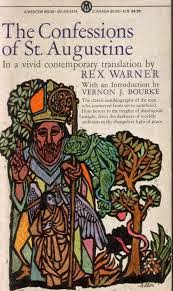
Confessions by Saint Augustine

“You are great, Lord, and highly to be praised: great is your power and your wisdom is immeasurable.”

Book No. 1

Book:  The Confessions of Saint                   Augustine
          
          Oxford World Classics
            Translation:  Henry Chadwick

I’m starting my Well-Educated Mind Biography Project with possibly the first biography ever written, Confessions by St. Augustine.  Born in 354 A.D. in Thagaste, which is modern day Algeria, Augustine reveals his time as a boy growing up in North Africa, his profession as a teacher of rhetoric, his travels to Rome, his connections with the Manicheans*, and finally his conversion to Christianity.  We, as a reader, are privileged to have a window into his life and internal struggles, as he asks questions about life and God.

*Manicheanism:  a quasi-religion that taught a dualism of everything that is material is evil, and everything that is spirit is good.  Their beliefs caused them to take rather bizarre views of Christian teachings such as:  because God created a material world, he cannot be good; Jesus did not become man because all material is evil, etc.

First Stage of Reading:

What historical events coincide-or merge-with these personal events?
Augustine lived in the Roman Empire during a time of political, social and religious turmoil, which helped him to produce prolific amounts of writing addressing these situations.  

Augustine was born in a century where at the beginning, Christianity was a persecuted religion, yet at the end of the century most people of the Roman Empire were at least ostensibly Christian and Christianity was the official religion of the Empire.  As the church attempted to determine its nature,  there were many disputes among Christians and much of Augustine’s writing deals with these issues.  He also endeavoured to reconcile pagan thought with Christian values, one of the first Latin writers to explore the benefits of pagan ideas as well as assessing their limitations.
Who is the most important person (or people) in the writer’s life?

Perhaps the most important person in Augustine’s life was his mother, Monica.  Her prayers and petitions for him were unceasing and what a wonderful thing for her to see him eventually become a believer.  

Ambrose, the archbishop of Milan, was instrumental in Augustine’s journey away from Manichean belief and towards a belief in God.  Augustine respected his intellect and his influence on Augustine was unequivocal, as he encouraged him to look beyond the literal into the substance of the Bible, and asserted that a deeper meaning could be found there, contrary to what Augustine had learned from his Manichean teachers.  

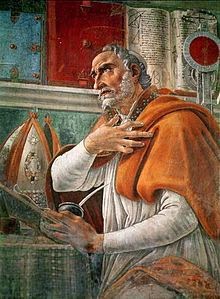
Saint Augustine in his study (1480)
Sandro Botticelli
source Wikipedia


The Second Stage of Reading:


What is the theme that ties the narrative together?
Confession is the most important word in this work.  It is as if Augustine must confess to make his journey complete. 
What is the life’s turning point?  Is there a conversation?

Well, of course, Confessions is a very long conversation of Augustine’s with God.  But in reference to his conversion, I believe it was more a process.  Augustine himself said that he believed that God was with him and guiding him even when he was living with sin and recriminations.  He also makes reference to not being ready to hear or act on certain convictions, so in retrospect, while Confessions is a conversation with God, it is also the story of his life.  I like this presentation because it makes his life meaningful; even though Augustine at times made poor choices and employed wrong-thinking, none of his life, in effect, was “wasted.”

The Confessions of Saint Augustine
source Wikipedia

The Third Stage of Reading:


What are the three moments, or time frames, of the autobiography?
1.        As a child, forming a poor character by stealing and valuing things that were superficial .  He grew up accepting the social value of using knowledge as an end, rather than as a means to forming good character, yet he could see that there was no fruit in this approach to life.

2.        As a young man, being influenced by friends and being draw into the Manichean beliefs as he searched for meaning in the world.  Augustine seemed to straddle the life of worldly pleasures and the search for a life of  abiding faith.

3.       As a more mature man, finding a way of reconciling God to his intellect, converting to Christianity, discovering joy and peace, and writing his confessions.
Do you agree with what the writer has done?

I absolutely love that Augustine kept searching.  We all get pulled into the world to a certain extent, by technology, materialism, etc. and we all struggle with our human nature.  Augustine’s search for God ended not only in finding Him, but by learning that God had been search for him all-along.  And in the end, Augustine was no longer living for himself but for God, a manner of living that brought such joy and contentment to his spirit.

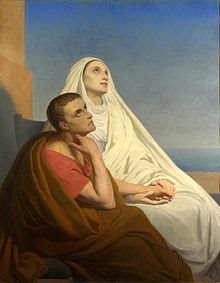
Saint Augustine & Saint Monica (1846)
Ary Scheffer
source Wikipedia

This book is broken up into two section, the first being Augustine’s autobiography (the first 9 books) and the second being theological & philosophical works (the last 4 books).  With regard to the latter, Augustine’s curiosity and quite astounding intellect can leave his reader going “huh?” as we try to navigate with him through the quite confusing realms of memory & senses, the meaning of time, and the book of Genesis and how it intersects with the Trinity.  In retrospect, the change in tone between these two sections are perhaps not as unusual as they first appear.  In the first nine autobiographical books, Augustine is dealing with the past, yet with the second section, he deals with the present and some of the thoughts that he is reflecting on during his life as a bishop.  These subjects also tie into the material he has already presented:  memory affects his presentation of his past experiences, time relates to the existence of his past recollections, and the chapters on Genesis and the Trinity are reminiscent of his earlier inquiries on how to read the Bible and how to view God.

During my first reading of Confessions, the last few chapters honestly went over my head, but with this second reading, I was able to follow Augustine’s train of thought at least now and then.  I will definitely re-read this book in the future.  There is so much to draw from this great intellect and I still feel that I have only scratched the surface.

Portrait by Phillipe de Champaigne
17th century
source Wikipedia

Favourite Quotes:

“If anyone find your simultaneity beyond his understanding, it is not for me to explain it.  Let him be content to say ‘What is this?’ (Exod. 16:15).  So too let him rejoice and delight in finding you who are beyond discovery rather than fail to find you by supposing you to be discoverable.”

In our present time, where progress counts for so much, how many people would be content with not knowing?  And how paradoxical that a desire for discovery of something unknowable, actually brings less knowledge than “not knowing”.

“There is never an obligation to be obedient to orders which it would be pernicious to obey.”

Further reading: 

http://www.college.columbia.edu/core/node/1759 


Délicieusement Cru par Judita Wignall

No, not a classic, but a book that can be added to my Summer Freak Language Challenge.  About four years ago, I went on a raw diet for about three weeks and felt the best that I’ve felt in a long time. So this summer I’ve been poking around raw cookbooks again, and this one just happened to be in French.

Délicieusement Cru, or Deliciously Raw in English, is a raw cookbook that takes raw food to a new level.  Using similar ingredients to other raw cookbooks, it adds new creative zest and additional ingredients and techniques which transform your common raw food recipes into something gourmet.

Stand-out recipes include:

  • Smoothie au piña colada
  • Crêpes aux petits fruits et à la crème
  • Salade vitaminée
  • Soupe verte énergétique
  • Hoummos de courgettes
  • Fromage de noix de cajou et de graines de chanvre
  • Sandwiches roulés aux légumes et au pesto
  • Pizza végétarienne
  • Mousse à l’orange et au chocolat
  • Tarte aux fruits d’été
  • Crème glacée à la vanille
  • Gâteau au fromage aux cerises et au chocolat blanc

An especially clever addition by the author, is a list of the soaking times, drying times and preparation times at top of the recipes.  Making raw food usually takes much less prep time than cooked food, but much more co-ordination.  By having the times listed, it makes this task less complicated.

As for the French used in this book, I was rather shocked to find out that I needed very little help with translation; I knew the majority of the words and those I didn’t know, I could accurately guess.  The one word that had me completely stumped was le chanvre, which my dictionary soon disclosed as “hemp”.   It was rather unsettling to discover that my French food vocabulary is rather large, but at least I’ve determined that if I want to increase my vocabulary, I need to stay away from French cookbooks. 🙂

Has anyone else tried raw foods or ever followed a raw food diet?  Please let me know!  I’d love to hear your experience!

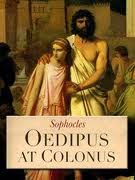
Oedipus at Colonus by Sophocles

“I am blind and old, Antigone, my child.”

Now blind and aged, Oedipus, with his daughter, Antigone, arrive at a place just outside of Athens called Colonus.  Though warned by a villager that this place in which they wish to reside is sacred, possessed by the all-seeing Eumenides (Furies), a land of Poseidon and Prometheus, and the founding stone of Athens, Oedipus refuses to leave.  A past prophecy has determined that the sacred grove of the Eumenides at Colonus, will be the site of his death, and here he is determined to stay.

Oedipus at Colonus
Jean-Antoine-Théodore (1788)
source Wikipedia

When a chorus of men of the city arrive and, upon learning the identity of Oedipus, they attempt to persuade him to depart from their city, fearing his curse will bring trouble to them.  Oedipus defends his position by agruing that because he had no knowledge of his crimes, he is therefore not responsible for the consequences, in particular, claiming self-defence in the murder of his father, Laius.

But lo, into the fray rides his daughter, Ismene, bringing news that Oedipus’ youngest son, Eteocles, has seized the throne of Thebes from the elder, Polynices, and both sons have heard from the oracle that the outcome of their conflict will depend entirely on the location of their father’s burial.  Yet there is more treachery!  Creon (brother-in-law to Oedipus) is, as she speaks, on his way to ensure that Oedipus will be buried at the border of Thebes, without the ceremony, in an attempt to negate the oracle’s proclamation.
Oedipus at Colonus
Fulchran-Jean Harriet (1798)
source Wikipedia

Denouncing them all as villains, Oedipus meets with Theseus, King of Athens who shows sympathy for his predicament, offering unconditional protection and making him a citizen of his country.  How Oedipus praises his saviour, and declares that his beneficent actions will ensure Athens victory in any altercation with Thebes!

When Theseus exits, Antigone announces the advent of Creon.  At first, he attempts to manipulate Oedipus using pity, but when he sees this tact will not bring him success, he admits to kidnapping Ismene, and grabs Antigone to forcibly take her away.  Theseus returns in kingly grandeur to scold Creon, then the Athenians overpower the Thebians, returning both girls to their father.

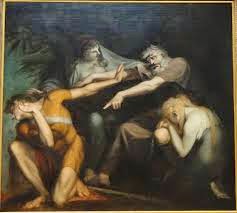
Oedipus Cursing Polynices (1786)
Henri Fuseli
source Wikipedia

One thinks that at last Oedipus might get some peace in his last hours, but it is not to be.  Informed by Theseus that a suppliant has arrived to speak with him, he learns it is his son, Polynices, who begs his father to release the curse he had placed on his sons for their part in his banishment from Thebes, knowing that their conflict is a result of the curse.  Oedipus, in complete disgust of his offspring, refuses and Polynices exits to meet his near-certain fate.

A thunderstorm ensues, which portends Oedipus’ passing.  Oedipus gifts Theseus with the promised gift of protection for Athens and then passes into Hades.  When Antigone wishes to see his tomb, Theseus refuses in response to a promise to Oedipus, never to reveal the location of his tomb.  Antigone departs to attempt to stop her brothers’ conflict.

There is a curious dichotomy in this play with regard to the character of Oedipus.  In spite of the fact he is an exiled, blind old man, with a terrible curse upon him, rarely do you find him subject to the other characters.  In fact, Antigone listens closely to his counsel, he has a command and influence over Theseus, he manages to overcome Creon, and also best his son by refusing to assist him.  On the outside, he is aged, infirm and at the mercy of his hosts, but in actuality, Oedipus is the master of each situation.

Yet Oedipus also places emphasis on his innocence with regard to his crimes.  Again and again, he proclaims to the chorus of Athenian men that he had no pre-knowledge of his transgressions and was, therefore, blameless.  This was a different reaction from Oedipus Rex, where he seemed to take the crimes on to himself, and punish himself for them.

The Death of Oedipus (1784)
Henry Fuseli
source Wikipedia

While on one level, the trials and sufferings born by Oedipus seemed somewhat random in Oedipus Rex, in Oedipus at Colonus we see a culmination of prophecy.  By his exile, Oedipus is brought to the sacred grove of the Eumenides (Furies), fulfilling prophecy, and although this exile was brought about by a curse, Oedipus is actually turned into a hero-type figure by bringing blessing and protection upon the important city of Athens.

Of the 123 plays that Sophocles wrote, only seven complete plays have survived.  That makes me want to cry.  However, parts of plays are still being discovered.  In 2005, additional fragments of a play about the second siege of Thebes, Epigoni, were discovered by employing infrared technology by classicists at Oxford University.  So there is hope that the ancients can still speak to us through time (and new technology) and, as Gandalf said, that is a very comforting thought, indeed!

The book was completed for my Classics Club Spin #6.

Translated by David Grene
Edited by David Grene & Richard Lattimore

⇐  Oedipus Rex  


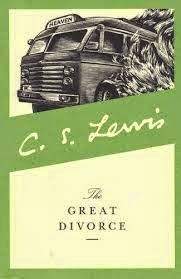
The Great Divorce by C.S. Lewis

“I seemed to be standing in a busy queue by the side of a long, mean street.”

If you found yourself in Hell and then were offered a chance to leave and spend an eternity in Heaven, you’d jump at it, wouldn’t you? …….. Or would you …….??

The Great Divorce tells of a journey of souls from the grey town, which we soon see represents Hell, to a wide open space of meadows, rivers and mountains.  Yet when the people disembark they are dismayed.  They now appears as Ghosts and all the vegetation is dense and tough in a way that makes movement difficult and, at times, dangerous.  And who are these shining Solid People coming towards them, and what do they want?  Full of joy and laughter, it appears that they only wish for the “Ghosts” to shed their prejudices and grudges and self-absorption and “rights”, to accept help and rescue from their troubles.  ‘Come to the mountain’, they say, yet most are unable to, so firmly have these detrimental traits taken root within them, to the exclusion of anything good.

The Assumption of the Virgin by Francesco Botticini
shows three hierarchies and nine orders of angels
source Wikipedia

The Great Divorce is Lewis’ The Divine Comedy.  As Dante is the narrator of The Divine Comedy, so too, the narrator in The Great Divorce is Lewis himself. George MacDonald, the well-known author of The Princess and the Goblin, Phantastes, and At The Back of the North Wind, a man whose writings had a profound affect on Lewis, serves as his Virgil, a guide to bring him understanding of Heaven and similarly, the grey town of Hell.

Yet while analogous in structure, the Hell of The Great Divorce is very different than that of Dante’s Hell.  It is not a world of men trapped in flaming tombs, immersed in rivers of blood and fire, whipped by demons or eaten by foul creatures.  In The Great Divorce, Hell looks surprisingly like Earth, but a corruption of earth, holding only the negative components of greed, envy, self-worship, revenge, jealously, grudges, etc.  The setting mirrors the emotions, being bleak, desolate and lacking any human goodness.  Rain and dingy twilight permeate the town, and a perpetual feeling of hopelessness is ever-present.  Yet while the souls of this dreary place, recognize intellectually what they live in, and practically understand their actions, they have become drowned in them through excuses, trends, weakness of character, reliance on intellect only, and have become blind to their effects.  In life, they allowed their choices and actions to carry them in the wrong direction and now have little desire to escape.  They have chosen Hell and are unable to conceive of anything outside of it.  Similar to the dwarves in the The Last Battle, ignorance has overcome them and they cannot escape it.

A vision of Hell
from Dante’s Divine Comedy
source Wikipedia

Lewis’ presentation of Hell is not only easily understandable, it is quite fascinating.  Lewis’ Hell is not a Hell for people.  Each “person” there, is there of their own choice, and their descent into it has been a gradual process, and not because of one big sin.  Each of their choices has progressively dehumanized them; it is not that they are beyond salvation, rather that there is no shred of humanness left to save.  Lewis also emphasizes the smallness of Hell by having the bus, not actually travel but grow, sprouting from a small crack in the soil to emerge in Heaven.  Hell, to Lewis is a tiny place and anything that lives there is already withered away.

On the other hand, the Bright or Solid People of Heaven did not get there through moral perfection.  One had been a murderer and confessed to doing worse than that, while another was hardly known on Earth but the people and animals that came into her presence were enriched by her love and charity.  And again, we have another echo from The Last Battle, that Heaven is much more real than earth, exemplified by the tough grass, the hard rivers and terrain that the Ghosts experience and would only have a change of perception if they chose to accept the invitation to become more real.

While Lewis states in his preface that this book is an answer to William Blakes’ The Marriage of Heaven and Hell, he makes if very clear that it is not a story that is meant to be taken in a literal sense; like his Narnia Chronicles, it is a supposition.  More, it is a work that explores human biases, perceptions and attitudes that either allow us to or prevent us from getting closer to God.

C.S. Lewis Project 2014

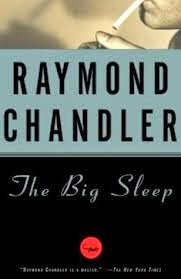
The Big Sleep by Raymond Chandler

“It was about eleven o’clock in the morning, mid October, with the sun not shining and a look of hard wet rain in the clearness of the foothills”

Yes, I went out of my comfort zone!  The Big Sleep is not a book I would usually choose to read, but since it’s on my Guardian 1000 list and a group on Goodreads was reading it for June, I decided to take the plunge.  Initially, I was rather apprehensive because I had read The Maltese Falcon a few years ago and didn’t enjoy it.  Yet within a few pages, I was completely immersed in this story.

Philip Marlowe; private detective; wise guy.  L.A. in the late 1930s.  A millionaire with two wild, uncontrollable daughters.  A missing son-in-law. Can Marlowe navigate the perilous world of high-society, which takes him into the shady dens of gangsters, gambling and murder, to extract truth from a myriad of lies?

With Marlowe was born one of the first of the new detectives.  The description he gives of himself in the beginning of the novel is a dry, witty sketch:

“I’m thirty-three years old, went to college once and can still speak English if there’s a demand for it.  There isn’t much in my trade.  I worked for Mr. Wilde, the District Attorney, as an investigator once.  His chief investigator, a man named Bernie Ohls, called me and told me you wanted to see me.  I’m unmarried because I don’t like policemen’s wives …………. I was fired.  For insubordination.  I test very high on insubordination, General.”

Los Angeles City Hall (1931)
source Wikipedia

The Big Sleep euphemistically refers to death and there are more than a few murders in this tale.  Billed as Chandler’s first novel, it is actually two of his short stories combined:  The Curtain and Killer in the Rain.  In it, he sets the scene with a flourishing skill:

“The air was thick, wet, steamy and larded with the cloying smell of tropical orchids in bloom.  The glass walls and roof were heavily misted and big drops of moisture splashed down on the plants.  The light had an unreal greenish colour, like light filtered through an aquarium tank.  The plants filled the place, a forest of them, with nasty meaty leaves and stalks like the newly washed fingers of dead men. They smelled as overpowering as boiling alcohol under a blanket.”

Curiously, while this is a mystery novel, Chandler often seems more concerned with the setting and characters than the minute details of the plot. Scenes are depicted with meticulous detail, and the characters each have personalities that radiate out, like the beacon of a lighthouse cutting through the mist.  Their charm, or helplessness, or audacity, or coquettishness is distinct and compelling.  In fact, the producer of the movie, The Big Sleep, contacted Chandler to remind him that in the novel, he had never revealed who had killed the chauffeur and asked for the identity of the murderer. Chandler replied that he had no idea.

 I really admired Philip Marlowe’s brash confidence, his raw sense of humour and his composure in dangerous situations.  Often impolitic and impertinent, nevertheless his understanding of human nature and the complexity of people’s personalities, made him a lively, compelling character.  With this work, Chandler managed to avoid the cliche 1930s male detective and invented a character and a book worth reading.  Very enjoyable!

Oedipus Rex by Sophocles

“Children, young sons and daughters of old Cadmus, why do you sit here with your suppliant crowns?”

A dark curse is upon Thebes.  Blighted cattle and plants cover the land, the women are barren and a deadly plague creeps throughout the kingdom, sparing no one in its fatal grasp.  Creon, brother-in-law to King Oedipus, reveals that the curse placed on the kingdom is a result of the murder of its last king, Laius, and until the perpetrator is found, there is no hope of relief from their present woes.  Oedipus, king of Thebes, calls the wisest man to the palace, the blind prophet, Teiresias, to discover the identity of the vile culprit.  
Yet through wise Teiresias and the shepherds of Laius, it is revealed that Oedipus was unwittingly the killer, slaying the king on a road to Thebes, in self-defence and completely unaware of his victim’s identity.  Unbeknownst to Oedipus, he was fulfilling a prior prophecy, that he would kill his father and marry his mother.  And true to prophecy, Oedipus, after freeing Thebes from a different curse by solving the riddle of the Sphinx, became the new king of Thebes and married the current queen, Jocasta, also his mother.

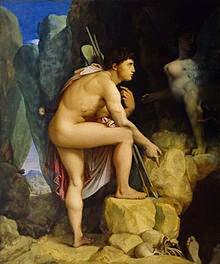
Oedipus after he solves the riddle
of the Sphinx (1808)
Jean-Auguste-Dominique Ingres
source Wikipedia

Upon hearing the fulfillment of the curse, a stunned and horrified Oedipus flees, yet soon finds Jocasta has hanged herself with shame and, grabbing the brooches from her garments, dashes his eyes out until blood flows in rivers down his face. At the behest of Oedipus, Creon banishes him from the city.

The sins of murder and incest has blighted the life of Oedipus and the lives of his progeny; his sons will be left without a father or inheritance and his daughters will be ostracized, unable to marry.  His anguished speech carries notes of his misery and devastation:

“What can I see to love?
What greeting can touch my ears with joy?
Take me away, and haste —– to a place out of the way!
Take me away, my friends, the greatly miserable,
the most accursed, whom God too hates
above all men on earth!”

The state of blindness and the character of Oedipus are closely linked. Instead of listening to the wisdom of the blind prophet, Teiresias, Oedipus refuses to believe him, therefore choosing blindness over knowledge.  Later in the play, when he accepts the knowledge of his actions, he physically blinds himself, which echoes his emotional blindness earlier in the story.

Can one commit a crime with complete lack of awareness and still be responsible for the repercussions of his actions?  Is the harshness of Oedipus’ penalty and the suffering he endures from the consequences, a justifiable outcome given the circumstances?  Why does no one in the kingdom disagree with the punishment of Oedipus, and appear more shocked by the unintentional sins than the maiming he inflicts upon himself?

Oedipus Separating from Jocasta
Alexandre Cabanel
source Wikipedia

What we can take away from this drama is helplessness in the hands of fate.  Though everyone pities Oedipus and does not blame him, there is nothing they can do in the face of his punishment.  To the Greeks, fate is supreme and unaffected by human choice; Oedipus attempts to avoid his destiny yet only succeeds in bringing it to fruition.  Finally, we are exposed to a chilling Greek worldview, that we can “Count no mortal happy till he has passed the limit of his life secure from pain.”

Apparently Oedipus Rex, while first chronologically of the three Theban plays, is in fact the second in written order.  I will enjoy trying to find out the common threads between the three, and if I feel there are any inconsistencies due to the fact they were composed out of order.  The next one on the schedule is Oedipus at Colonus where we meet Oedipus in exile.

Frankenstein by Mary Shelley

“You will rejoice to hear that no disaster has accompanied the commencement of an enterprise which you have regarded with such evil forebodings.”

Gaining a passionate, yet unguided knowledge for science, young Victor Frankenstein arrives at university with an unquenchable thirst for learning and advancement.  When he involves himself in an isolated solitary experiment to create life, the resulting creature so appalls and revolts him, that he cannot contain his revulsion.  The consequent rejection of his creation culminates in a series of tragedies that could not even have entered Frankenstein’s imagination.

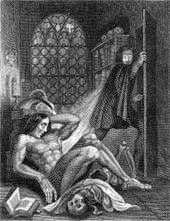
Theodor von Holst
from 1831 edition
source Wikipedia

Initially, the book begins with an introductory sub-plot of Robert Walton, a scientific adventurer who is on a naval quest to find a northern passage or discover the secret of the magnetic poles.  Walton is portrayed as a man intoxicated with the desire for knowledge, a clear indication that his character mirrors that of Victor Frankenstein, and his idealistic dreams parallel those of the friend he rescues (Frankenstein).  At the beginning of Frankenstein’s story, we see how he immerses himself in science and, by doing so, isolates himself from the friends and acquaintances around him, and remains housebound, separated from the outdoors. Without companionship and nature, the very things that feed our souls, he is blind to the spiritual aspects of humanity, seeing only the physiological perspective of a scientific creation.  In effect, he rejects his own Creator to put himself in His place.

In fact, the first sentence of the book, the beginning of a letter from Robert Walton to his sister, gives the reader a clue as to the lack of awareness the scientist can develop to the world around him:  “You will rejoice to hear that that no disaster has accompanied the commencement of an enterprise which you have regarded with such evil forebodings.”  In a frenzied quest for new discovery, the scientist can often lose any objectivity and will marginalize the prudent advice given by others, who have perhaps more objective insight.

In Frankenstein’s story, we get a cautionary tale of the consequences of unexamined and incautious actions based on a deification of science, yet therein also lies a theme of abandoned responsibility.  If Frankenstein had attempted to communicate with the creature and valiantly hid his disgust of it, would the outcome have been different?  Could he have humanized his creation with sympathy and nurturing?  I have my doubts. Upon the creature’s flight and escape to the woods, he discovers a family living there and, by observing them, he learns to read and write and is exposed to profound literature, which reveals both goodness and evil to him. The creature learns what it means to be human and, in fact, admires the goodness of the family.  However he ultimately chooses evil, using his rejection by humans as an excuse for his deviant actions.  Victor Frankenstein was another unsympathetic character.  Numerous times he had a chance to attempt to stop the evil he had created, yet each time he did nothing, often at the expense of a human life.  I was actually quite disgusted with him.  His inaction was almost on a level with the creature’s atrocities.

Boris Karloff
as Frankenstein’s monster
source Wikipedia

While I found the plot of this novel in some senses exaggerated, in a general sense it brought up a number of important issues for reflection.  Are we responsible for what we create and, if so, to what degree?  Is knowledge something to be pursued with unlimited passion, or should we approach it with a healthy respect, and should restrictions be put on our pursuit of it?  Does the development of character, values and morality depend on genetics or environment? Shelley brought attention to these universal and timeless issues which segued into more specific questions related to the story.  Should the creature be pitied?  Does his abandonment, rejection and isolation justify his actions of revenge?  Was Frankenstein’s rejection directly responsible for the tragic circumstances, and therefore, was he completely to blame for his own fate?  Is the creature evil, or simply a misunderstood creation, who, if loved and nurtured, would have developed love and empathy and a conscience, like most other human beings?

The story of Frankenstein was birthed during a trip to Geneva in 1816. Together with her husband, the poet Percy Bysshe Shelley, Mary Shelley spent the summer there with their companion, Lord Byron.  After Byron proposed that they each write a ghost story, Shelley found herself at a loss for inspiration.  It was only after a conversation about the “re-animation of a corpse,” that Shelley had a waking dream:

I saw the pale student of unhallowed arts kneeling beside the thing he had put together.  I saw the hideous phantasm of a man stretched out, and then, on the working of some powerful engine, show signs of life, and stir with an uneasy, half vital motion.  Frightful must it be; for supremely frightful would be the effect of any human endeavour to mock the stupendous mechanism of the Creator of the world.

And so Frankenstein was born.

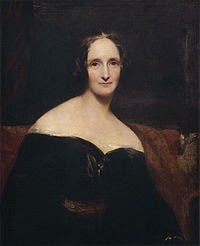
Portrait of Mary Shelley (1840)
Richard Rothwell
source Wikipedia

Mary Shelley was the daughter of William Godwin and Mary Wollstoncraft Godwin, the former a philosopher, novelist and journalist, the latter also a philosopher as well as a writer.  With such notable antecedents, Shelley’s exposure to books was unusually vast for a female of her era.  Here is a chronological list of the works of literature which she read during the years of 1814 to 1821.

Here, also, are two other excellent reviews of Frankenstein by M. Landers and Majoring in Literature for your reading pleasure!  Enjoy!

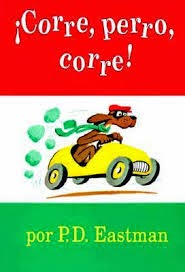
Corre, Perro, Corre – P.D. Eastman

Hay perros grandes, perros pequeños, perros amarillos, perros verdes, perros azules, perros rojos y una fiesta al fin del libro. Este libro es divertirse por los niños.

Phew!  That’s about all for my rusty Spanish as I have about 10 reviews that I’m trying to work on.  I remember this book from my childhood.  It reads pretty simply now, even in Spanish, but I can see the value of repetition when children are learning to read or learning another language.  Prepositions and opposites are sprinkled throughout the story, adding another aspect of learning.  And after all, what child could resist rainbow-coloured dogs, dogs driving cars, a party and the repeated silly question, “¿Te gusta mi sombrero? (Do you like my hat?)” 

If anyone knows of some easy Spanish books, I’d really appreciate any recommendations.  For some reason I’m struggling with coming up with any.  It’s very sad when you can think of more Latin books to read than Spanish ……