The Canterbury Tales ~~ The Prioress’ Prologue and Tale

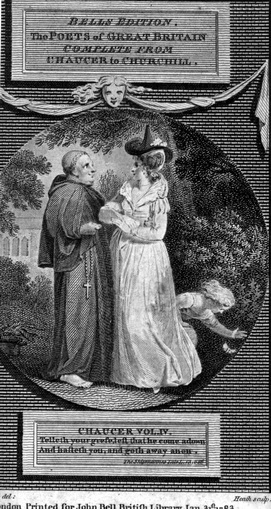
Okay, I really couldn’t let this pass; if you look closely at the picture of the Prioress below, doesn’t it appear that she has a beard?  Odd.
We begin with the Words of the Host to the Shipman and the Prioress, who makes a Latin blunder and then, referring to the last tale, warns the company to be wary of monks.  Turning to the Prioress, he bids her tell a tale, and she appears happy to comply.
She bases her first words on the 8th Psalm, and invokes Mary as her muse, lauding her purity, virtues and magnificence.  The Prioress is only a weak vessel but with Mary’s grace, she will tell her story.

The Prioress’s Tale

In a Christian town in Asia, there was a Jewish ghetto supported by the Crown. The Prioress categorizes the Jews as foul userers and has nothing good to say about them.  Near the ghetto, was situated a little school of Christian children, of whom one, a widow’s son of seven years old, was diligent in his prayers and reverence for all that was holy.  He sang all day praising Christ’s mother, Mary:

“He sang it with a childlike clarity
And boldly, word by word and note by note;
And twice a day it filled his little throat,
Going to school and coming back again,
Praising Christ’s mother with all this might and main.”

Middle English:

And thanne he song it wel and boldely
Fro word to word, acordynge with the note
Twies a day it passed thurgh his throte
To scoleward and homward whan he wente
On Cristes mooder set was his entente

Yet as he sang these praises going down the ghetto street, the Jews plotted his demise and ended up murdering the innocent child.  They dumped him in a sewage drain, but “murder will out” and the child’s voice continued its song. His mother went in search of him and though the Jews would not let her find her son, Jesus led her to him.  As they retrieved the child’s body, still his singing continued.  The provost condemned the guilty Jews to death by drawing them apart by horses and then hanging them from a cart.  The holy abbot, who conducted the boy’s funeral, asked him who permitted his song, whereupon he answered:

“‘Though to the bone my neck is cut, I know,’
Answered the child; ‘and had I been confined
By natural law I should, and long ago,
Have died.  But Christ, whose glory you may find
In books, wills it be also kept in mind.
So far the honour of his mother dear
I still may sing O Alma loud and clear.'”

Middle English:

“My throte is kut unto my nekke boon
Seyde this child, “and as by wey of kynde
I sholde have dyed, ye, longe tyme agon
But Jesu Crist, as ye in bookes fynde
Wil that his glorie laste and be in mynde,
And for the worship of his Mooder deere
Yet may I synge O Alma loude and cleere.

Mary, mother of Christ, bade him sing the anthem until his burying, and so at his burying, the singing stopped.  The convent began to weep at his holiness and reverence.  The story ends by mentioning Hugh of Lincoln, who was also murdered by Jews, and by a benediction for God’s mercy.

The Prioress’s Tale
Edward Coley Burne-Jones
source Wikipedia

This tale mirrors other tales in Medieval Christendom, particularly the story of Little Saint Hugh of Lincoln, where Jews are portrayed as greedy, power-seeking and enemies of the true faith.  The Prioress makes sure to demonize the Jews, yet shows the Christian element as little, innocent and helpless. However even with the tyranny of the Jews, Mary is able to set things aright with the miracle of the boy’s perpetual singing and the indication of his possible sainthood.

Hamlet ~ Act I, Scene I

We have begun Hamlette’s read-along of Hamlet for the month of October!  I’m happy to be guided by such an expert (she’ll tell you that she’s not an expert, but I’d hazard to guess that she has more understanding than most of us) through this play and I can’t wait to learn some more insights into Shakespeare’s masterpiece.  You can find the details at The Edge of the Precipice.

___________________________________________________


Hamlet  ~  Act I,  Scene I

As Horatio replaces Fransisco at his place as sentinel, the two other sentinels, Barnardo and Marcellus try to convince him that a ghost has appeared to them the last two nights while on watch. As they attempt to persuade the sceptic, the Ghost appears and Horatio, being the more learned of the three, attempts to communicate with him, in rather stern and commanding language, whereupon the Ghost disappears.

They recognize him as the late king Hamlet and wonder why he appears to them in his armour.  Horatio speculates with a story:  the late king defeated and killed king Fortinbras of Norway after an aggresive attack, yet his son is not honouring the tradition of lands to the winner, and it is rumoured that he’s going to gather some mercenaries and mount an attack against Denmark. The two now understand why the Ghost has appeared in battle gear and add that, like in ancient Rome in the times before Caesar’s death, there has been portents proceeding this possible altercation.

Yet once again the Ghost materializes, and Horatio has enough quickness and intelligence to question it about the fate of Denmark and to inquire if it knows of any treasure hoarded away.  The cock crows and, despite their efforts to waylay it with Marcellus’ sword, the Ghost, once again, withdraws.

Marcellus laments that they chose to practice violence on it, but Horatio states that a cock crowing could signal the approach of morning and that all spirits must return to their “confine(s)”.  It is said a cock also crows before Christmas, Marcellus adds, but Horatio stops him to herald the dawn:

“But look, morn, in russet mantle clad, 
Walks o’er the dew of yon high eastward hill.”

He suggests that they fetch Hamlet for they are sure that the Ghost will speak with him.

Thoughts:

Horatio’s initial disbelief, and then his first encounter with the ghost, starts the building tension in this scene.  He is obviously the most intelligent and sensible of the three, as his surmises and observations are well reasoned and insightful and he recommends fetching Hamlet.

Listening to the Cock (1944)
Marc Chagall
source Wikiart

A parallel between the former battle with Fortinbras and a possible new fight with his son, also called Fortinbras, can be conjectured by the Ghost king’s appearance in battle array.  It’s also possibly important to note that he first appears to the sentinels.  Yet he declines to speak with them.  Is he put off by their manners, or is he wanting conversation with someone else, and, if so, why didn’t he just appear to the person with whom he wishes to speak?

Importance might also be placed on the parallels between Fortinbras and his son, and king Hamlet and his son. With regard to Fortinbras Jr., already he has broken the traditional and honourable actions of forfeiting lands to the battle victor by legal document. And instead of raising an army from among his country’s soldiers, he has chosen to build an army from among the city’s hooligans.  Fortinbras Sr. & King Hamlet both esteemed obedience to tradition, honour and, to a certain degree, trust.  Fortinbras Jr.’s actions have shown disrespect and contempt, not only towards his enemy, but towards those important customs.  What will Hamlet’s actions prove?

The cock crowing is also a significant occurrence.  Certainly, cocks crow to herald a new day, but more importantly, in the New Testament, a cock crowed to portend the betrayal of Jesus by Peter:

“Truly I tell you,” Jesus answered, “this very night, before the rooster crows, you will disown me three times.”  Matthew 26:34

Betrayal just has to be an upcoming theme, but betrayal of whom and why?  We shall find out in the upcoming acts!

Hamlet Read-Along Posts
Act I  Scene I

The Canterbury Tales ~~ The Shipman’s Tale

The Shipman’s Tale

A merchant of St. Denys in northern France, lives with his wife in comparative luxury.  Sir John, a young monk with a pleasing face, often visits the couple, and he is as close as a brother, since he and the merchant grew up in the same village.  One day, on a visit, the merchant’s wife confesses to the monk that her sex-life with her husband is non-existant, her marriage is unhappy and her husband is miserly.  She is in need of 100 francs, on loan, to buy herself the pretty things which her husband denies her.  Sir John confesses his love for her and agrees to the loan, for which she pays him by sleeping with him after her husband leaves on a business trip.  The merchant’s trip is successful, yet he must borrow money to replenish his stores.  He goes to Paris for the loan and while there, visits Sir John who had borrowed money from him prior to his trip, but the monk claims that he repaid the loan to the merchant’s wife. Annoyed, the merchant confronts her when he arrives home.  Cursing Sir John, she claims that she thought the money was for her and had spent it on clothing.  She offers to repay him with sexual favours.  The merchant, deciding it is fruitless to deride her, forgives her.

Illustration from a 1792 edition

This tale, set in France, apparently has many French phrases in it, adding a touch of local colour and prompting scholars to speculate whether the tale was an early Chaucer and closer to the French fabliaux stories of the time.

There is definitely a parallel between money and sex in this tale.  Without access to money, the wife uses sexual favours as payment, but interestingly, she also uses sex to placate her husband, which makes it appear that sex is certainly the more flexible of the two forms of payment.  And just as the husband takes advantage of his business transactions, so does his wife take advantage of the situation to serve her purposes.  So then the question is, who has the most power in the tale ….. does the wife have all the power and the rich merchant only all the appearance of it?

The Canterbury Tales ~~ The Pardoner’s Prologue and Tale

The Pardoner begins by explaining his profession, using a rather conceited tone as he exults over all the people he’s managed to deceive into purchasing his pardons for their sins.  His theme is “Radix malorum est cupidas”, which means “Greed is the root of all evils” from 1 Timothy 6:10, yet he only applies this adage if it is to his own monetary gain.  He is willing to steal from a poor woman’s children and have them starve, yet he claims that, in spite of his monstrous character, he is able to tell a moral tale.  Given that his life is constructed from an abundance of lies, one would tend not to believe him.

The Pardoner’s Tale

In Flanders, lived three young men who were fond of carousing, drinking and gambling.  Discovering that their friend and thousands of others have been killed by a foul fiend known as “Death,” they set out bent on revenge.  An old man who had asked Death to take him, but with no luck, says that they can find him at the base of an old oak tree, but the only thing that they discover there is a pile of gold florins.  Immediately forgetting their quest, they draw straws to see who will fetch food and drink, as they plan to wait by the tree until night so they can carry the treasure away in secrecy.  The youngest of the three is chosen to go into town and while he is away, the others plot his murder, planning to stab him with their daggers upon his return.  The youngest, on his way to town, is thinking of how to dispose of his comrades, and places poison in two of the three bottles with which he returns.  The two slay the young man and then sit down to drink their fare.  Death takes them in terrible suffering and everyone receives his due.

The Pardoner attempts to sell his relics to the Host who reacts by venting his spleen upon the Pardoner.

“I wish I had your ballocks in my hand
Instead of relics in a reliquarium;
Have them cut off and I will help to carry ’em.
We’ll have them shrined for you in a hog’s turd.”

Middle English:

I wolde I hadde thy coillons in myn hond
In stide of relikes or of seintuarie.
Lat kutte hem of, I wol thee helpe hem carie;
They shul be shryned in an hogges toord!

The Pardoner is incensed and the Knight attempts to mediate between them before they all continue on their way.

Warwick Gobbel

In the tale, the men practice self-deception, neither suspecting the others, and the Pardoner himself practices a sort of self-deception, in that he confesses his sins without expectation of any consequences resulting from them.  The tale and prologue meld very well together in that we learn that such unconscionable evil is blind to the consequence of its actions and that it can occur both in the dregs of society and even a holy man of God.

The Canterbury Tales ~~ The Physician’s Tale

The Physician’s Tale

An illustrious and affluent knight, Virginius, had a daughter named Virginia who was very dear to his heart.  Thus follows a very long narrative on her chastity and how young women should be raised.

One day, while walking through the street, a judge named Appius, spies her and is lustfully determined to possess her.  He enlists the assistance of Claudius, a notable miscreant, to carry out his plan of seizing the maiden. Claudius falsely accuses Virginius of theft, in fact, theft of his own daughter, claiming that she was a servant who was taken from him.  Appius quickly rules in Claudius’ favour, decreeing that the girl must be returned to him.  Distraught, her father informs her of the circumstances and states that she must either face death or dishonour.  Virginia chooses her fate:

“And thus addressed her father, unafraid,
‘Blessed be God that I shall die a maid!
I take my death rather than take my shame, 
So do your will upon me in God’s name!'”

Middle English:

She riseth up, and to hir fader sayde,
“Blissed be God that I shal dye a mayde!
Yif me my deeth, er that I have a shame;
Dooth with youre child youre wyl, a Goddes name!”


Her father smites off her head and returns it to Appius, at which point the judge orders Virginius’ arrest.  Suddenly a thousand men of the town, learning of the treachery committed, seize Appius and murder him and would have done the same to Claudius if Virginius had not pleaded for his exile.

“Here one can see how sin is paid its wages;
Beware, for no one knows how God engages
Or when to smite the sinner, or how the rom
Of conscience will bring terror to the firm
In wickedness, however secretly,
Though none should know of it but God and he.
Be he illiterate or a man of learning,
How soon the blow will fall there’s no discerning.
I offer you this counsel; let it make you
Forsake your sins before your sins forsake you.”

Middle English:

Heere may men seen how synne hath his merite.
Beth war, for no man woot whom God wol smyte
In no degree, ne in which manere wyse;
The worm of conscience may agryse
Of wikked lyf, though it so pryvee be
That no man woot therof but God and he.
For be he lewed man, or ellis lered,
He noot how soone that he shal been afered.
Therfore I rede yow this conseil take:
Forsaketh synne, er synne yow forsake.

In the Words of the Host to the Physician and to the Pardoner, the Host vehemently berates all unscrupulous lawyers, and states that gifts that seem to us of great worth can also bring harm, depending on the circumstances.  In fact, the Physician’s tale has upset him so that he pleads for a cheerful tale from the Pardoner, whereupon the people request a tale of moral goodness and worth.

The Legend of Virginia
source Wikimedia

This tale is based on a tale from Livy’s Histories and is also retold in The Romance of the Rose.  While scholars consider it one of Chaucer’s weaker tales in structure, the drama certainly carries the reader along.  It reminded me a little of King Lear, in that the evil characters get their just deserts but the innocent partake of their destruction as well, which adds a definite poignancy to the story.

Top Ten Books on my Autumn TBR or Ten Books I Dream of Reading This Autumn

I’m not even going to sport with your intelligence and claim that I can even entertain reading ten books over this autumn.  If I get to five, I’ll dance a jig. So with that in mind, I think I should change my title post to Ten Books That I Dream of Reading This Autumn.  Just a second, and I’ll do that …..

Yes, it’s all a dream, but here are the books that I’d like to read.

Northanger Abbey

Emma

My Experiments With Truth


Dracula


Petrarch Selections from the Canzione

Hamlet


Notes From the Underground


Nightingale Wood


Framley Parsonage


Le Rêve


The Canterbury Tales ~~ The Franklin’s Prologue and Tale

Before we get to the prologue of this tale, there are Words of the Franklin to the Squire and of the Host to the Franklin, where the Franklin commends the Squire for the spirit in which he told his tale, and that his eloquence is surprising considering his youth.  He deprecates his own son until the Host interrupts to urge him to tell his tale.

The Franklin begs pardon for his lack of education and he, therefore, cannot adorn his words with the “colours of rhetoric”, but still he will do his best with his story.

The Franklin’s Tale

In Brittany, or in, at that time, Armorica, there lived a knight, Arvéragus, who held a deep abidding love for a lovely, high-born lady, Dorigen.  Alas, he neared despair of his love being returned due to her high status in society, but she saw the honourable worth of Arvéragus, and the two were joined in marriage.  He gave his promise that he would never show jealousy nor impose his will upon her, and, in turn, she pledged humbleness and faithfulness to her husband.  The Franklin next gives a quite wonderful description of love, and how to temper it for a successful relationship:

“Lovers must each be ready to obey
The other, if they would long keep company.
Love will not be constrained by mastery;
When mastery comes the god of love anon
Stretches his wings and farewell! he is gone.
Love is a thing as any spirit free;
Women by nature long for liberty
And not to be constrained or made a thrall,
And so do men, if I may speak for all.
  Whoever’s the most patient under love
Has the advantages and will rise above
The other; patiences is a conquering virtue,
The learned say that, if it not desert you,
It vanquishes what force can never reach;
Why answer back at every angry speech?
No, learn forbearance or, I’ll tell you what,
You will be taught it, whether you will or not.
No one alive — it needs no arguing —
But sometimes says or does a wrongful thing;
Rage, sickness, influence of some malign
Star-constellation, temper, woe or wine
Spur us to wrongful words or make us trip.
One should not seek revenge for every slip.
And temperance from the times must take her schooling
In those that are to learn the art of ruling.”

Middle English:

For o thyng, sires, saufly dar I seye,
That freendes everych oother moot obeye,
If they wol longe holden compaignye.
Love wol nat been constreyned by maistrye.
Whan maistrie comth, the God of Love anon
Beteth his wynges, and farewel, he is gon!
Love is a thyng as any spirit free.
Wommen, of kynde, desiren libertee,
And nat to been constreyned as a thral;
And so doon men, if I sooth seyen shal.
Looke who that is moost pacient in love,
He is at his avantage al above.
Pacience is an heigh vertu, certeyn,
For it venquysseth, as thise clerkes seyn,
Thynges that rigour sholde nevere atteyne.
For every word men may nat chide or pleyne.
Lerneth to suffre, or elles, so moot I goon,
Ye shul it lerne, wher so ye wole or noon;
For in this world, certein, ther no wight is
That he ne dooth or seith somtyme amys.
Ire, siknesse, or constellacioun,
Wyn, wo, or chaungynge of complexioun
Causeth ful ofte to doon amys or speken.
On every wrong a man may nat be wreken.
After the tyme moste be temperaunce
To every wight that kan on governaunce.

Arvéragus and Dorigen lived in wedded bliss until one day Arvéragus decided to leave to win renown and honour in Britain. Two years he will be gone, and Dorigen wept and bemoaned the loss of her husband every single day.  Unbeknownst to Dorigen, a handsome and lively squire, Aurelius, was sick with love for her, and finally confessed his suppressed passion. While Dorigen repeated her vow to be a faithful wife, in a moment of thoughtless gaiety, she promised her love if he was able to remove all the rocks from the coast of Brittany, an impossible task.  Yet she did not reckon on Aurelius’ determination and after praying to the gods and two years of bemoaning his hopeless assignment, he found a conjuror who completed the task.  When he informed Dorigen of his success, she was brokenhearted, for she had thoughtlessly broken the promise to her beloved husband.  She decided that she must die rather than defile her love, and sited various instances from ancient accounts of women who took this recourse.  However, when Arvéragus returned home, she confessed her transgression to him, whereupon he stated that she must keep her promise, no matter what pain it would bring them.  Yet when Aurelius saw her woe and learned of the noble deed of Arvéragus, he released the lady from her promise, even though he was left with an enormous debt payable to the conjuror.  Yet fate was kind, in this case, and the conjuror immediately forgave the debt, saying that he had been paid with Aurelius’ moving story.

This tale is possibly based on a similar one in Boccaccio’s The Decameron (Tenth Day, Fifth Tale), but the removal, or apparent removal of the rocks echo Merlin’s magical moving of the rocks accounted in The History of the Kings of Britain by Geoffrey Monmouth.

This tale was particularly moving because of the themes of loyalty, patience and keeping one’s promise.  My favourite tale so far (do I keep saying that?)

The Canterbury Tales ~~ The Squire’s Prologue and Tale

The Host encourages the Squire to step up and tell his tale, and the Squire, although employing a hesitant and self-conscious manner, agrees.

The Squire’s Tale

Part I
In the land of Tartary, there lived a noble king named Cambuskan (which is perhaps Genghis Khan, although the account of him is more memorable of his grandson, Kublai Khan).  He had two sons and a daughter, whose name was Canace.  Upon the king’s twentieth year of reign, he hosts a large celebration but a surprise is in store for him as an unknown knight arrives bearing gifts for the sovereign.  He gives the king a brass steed that can transport him to wherever he wishes, a mirror which can reveal true friends or enemies, a sword that has a deadly power but can heal its wounds as well, and a magical ring which will allow the wearer to comprehend the language of the birds.  
Part II
The last gift is given to Canace, whereupon the next morning on her walk, she comes upon a distraught falcon who confesses that she has been courted and then later abandoned by a handsome tercelet.  In her distress, she faints and Canace cares for her, building her a mew hung with the finest shade of velvet blue for faithfulness, and green for duplicity.  The Squire promises to tell how the falcon won back her repentant love, but first he wishes to relate Cambuskan’s conquests and to tell of Cambalo who won Canace for his wife.
Part III
“Apollo whirled his chariot on high
Up through the house of Mercury, the sly —“
Here the story breaks off and Chaucer leaves it unfinished.  The developing of the story in the initial 708 lines indicates that this tale, if completed, would have been one of the longest tales of the collection.  John Milton was convinced that a conclusion was necessary, writing in his Il Penseroso:
Or call him up who left half told

The story of Cambuscanbold

Of Camball, and of Algarsife ,

And who had Canace to wife,

That owns the vertuous Ring and Glass,

And of the wondrous Hors of Brass,

On which the Tartar King did ride;

And if ought els, great Bardsbeside,

In sage and solemn tunes have sung,

Of Turneys and of Trophies hung;

Of Forests, and inchantments drear,

Where more is meant than meets the ear.

Edmund Spenser did attempt to finish the tale in his books III and IV of The Faerie Queene, but apparently his verse bears little resemblance to Chaucer.

L’Argent (Money) by Émile Zola

“The clock on the Bourse had just struck eleven when Saccard walked into Champeaux’s, into the white and gold dining-room, with its two tall windows looking out over the square.”

Aristide Saccard is on the move again. Brought low by ruinous business practices (see La Curée or The Kill), his wife dead, and his estate sold, Saccard winds calculatingly through Paris like a snake looking for an opportunity to strike. At first, he is certain that his brother, the government minister, Eugène Rougon, will come to his assistance, but when he hears that his sibling wishes to remove him from Paris for fear of embarrassment, Saccard makes a precipitative move, declaring he will open a bank that will be the financial success of Paris, a venture in which everyone will be clamouring to be involved.  His passion and sheer energy sweeps people along with him, including Lady Caroline and her brother, Hamelin, honest and respectable souls, who admire Saccard’s genius.  Yet in the world of big money and La Bourse (the French equivalent to Wall Street), allegiances can fluctuate, affiliations change, and behind every corner is the face of your own demise.

Celebration in the Streets of Paris (Montemarte) (1863)
Vasily Perov
source Wikiart

“The Bourse is a real forest, a forest on a dark night, in which people can only grope their way along.  In all that darkness, if you’re foolish enough to take heed of everything, however inept and contradictory, that you’re told, then you’re sure to break your neck.”

Zola paints an excellent representative portrait of Paris’ frantic and unscrupulous financial world of 1863-during the reign of Napoleon II of the Second Empire.  We see how alliances and loyalties are formed only on the basis of financial gain, yet human concern or family loyalties have little value.

“In these covert and cowardly financial battles, in which the weak are quietly disembowelled, there are no more bonds of any sort, no kinship, no friendship, only the atrocious law of the strong, those who eat so as not to be eaten.”

La Bourse (1900)
source Wikimedia Commons

Zola demonstrates through his narrative and his colourful characters, how the lust for money, greed and power are not merely promoted, but in fact, worshiped.

“His wife was never seen, being unwell, said the Marquis, and kept to her apartment by infirmity.  However, the house and furniture were hers, and he merely lodged there in a furnished apartment, owning only his personal effects, in a trunk he could have carried away in a cab; they had been legally separated ever since he started living on speculation.  There had been two catastrophes already, in which he had blankly refused to pay what he owed and the official receiver, having taken stock of the situation, had not even bothered to send him an official document.  The slate was simply wiped clean.  As long as he won, he pocketed the money.  Then, when he lost, he didn’t pay:  everyone knew it and everyone was resigned to it.  He had an illustrious name, he made an excellent ornament for boards of directors; so new companies, looking for golden mastheads, fought over him:  he was never unemployed.”

As Saccard cleverly constructs his colossal financial empire, he is captivated by money but he is captivated by power more.  The thrill of financial battle is as addicting as as drug, and he is high on the power and the ultimate campaigns fought to gain it.  It is a house of cards and each trade, each purchase, each decision, is perhaps the one that will cause its downfall.

“Wealth for him had always taken the form of that dazzle of new coins, raining down through the sunshine like a spring shower and falling like hail on the ground, covering it with heaps of gold that you stirred with a shovel just to see their brightness and hear their music ……… But he had always been a man of imagination, seeing things on too grand a scale, transforming his shady and risky deals into epic poems; and this time, with this really colossal and prosperous enterprise, he had moved into extravagant dreams of conquest, with an idea so mad, so huge, that he did not even formulate it clearly to himself.”

Panorama of Paris, 1865
Charles Soulier
source Wikimedia Commons

Also explored are the feelings on anti-Semitism prevalent during the time.  Jews were often seen as good for loans but with little else to their character or worth to recommend them.  In a world were humanity is held in so little regard, this racism is another head on the monster of greed, power and manipulation.

With his usual descriptive flair and creative technique, Zola allows the reader to skim along the surface of the narrative, to first get your bearings, before he draws you into the story and you are held captive by the machinations of the characters, the vivid depictions of Paris and the power of that elusive yet ever-coveted currency, money.

This book was not Zola’s favourite to write.  “It’s very difficult to write a novel about money.  It’s cold, icy, lacking in interest ……”  Zola said in an interview, but he declined to demonize it, instead choosing to show the effects of its worship in a work that would “praise and exalt it’s generous and fecund power, it’s expansive force.”  His technique certainly worked, as the reader becomes the observer of an inanimate object that effectively controls the lives of an empire.

Other Reviews of the Rougon-Macquart Series (Zola’s recommended order):

Further Reading:

The Canterbury Tales ~~ The Merchant’s Prologue and Tale

Oh, the poor Merchant.  Married only two months and he swears that there is no one in existence as miserable as he.  His wife’s cruelty is unsurpassed, and he urges all men to avoid the matrimonial state if at all possible.

“Never again, never again the snare!
We married men, our life is grief and care.
Try it who will, and he will find, I promise
That I have spoken truly, by St. Thomas,
For most of us — I do not say for all,
And God forbid that such a thing befall”

Middle English:

“I wolde nevere eft comen in the snare.
We wedded men lyven in sorwe and care.
Assaye whoso wole, and he shal fynde
That I seye sooth, by Seint Thomas of Ynde,
As for the moore part — I sey nat alle.
God shilde that it sholde so bifalle!”

The Host wittily reparts that since the Merchant is a marriage expert, he must certainly tell his tale.  The Merchant agrees but cautions that he has said all he will of a personal nature.

The Merchant
source Wikimedia Commons

The Merchant’s Tale

Battle of Pavia (after 1525)
Unknown Flemish Artist
source Wikimedia Commons

In Lombardy, in the town of Pavia, lived a well-respected knight named January.  He had remained a bachelor for sixty winters, but in his old age decided that he would like nothing better than to marry. He highly praised the married state in spite of Theofrastus’ injunctions and warnings against it.

“This opinion, and a hundred things worse,
Writes this man, may God his bones curse!

But take no heed of all such foolishness;

Defy Theofrastus, and listen to me.”


Middle English:

This sentence, and an hundred thynges worse
Writeth this man, ther God his bones corse!
But take no kep of al swich vanytee;
Deffie Theofraste, and herke me.
January & May
©Trustees of the British Museum

He goes on to list the value a wife brings to a home, and councils men to always obey their wives in everything.  However, he has a number of requirements for his wife, in that she must be young, so he will not be driven to adultery, and not a widow, so she does not resort to trickery.  He pleads with his friends to help him in his quest, yet stife is stirred up between his two friends, Placebo (meaning “I shall please”), and Justinus (meaning, “the just one”). Placebo defers to January’s opinion on the matter, since he is his lord, yet Justinus cautions to choose a wife wisely, taking time and care, otherwise a man may regret his choice as he so rightly knows, as he is married and is subject only to a life of cares and duties.

January prefers Placebo’s advice, which echoes his own and, thoroughly obsessed with his goal, begins his search for a wife.

“Exaggerated imagination and constant thought
From day to day became fixed in the soul
Of January concerning his marriage.”

Middle English:

Heigh fantasye and curious bisynesse
Fro day to day gan in the soule impresse
Of Januarie aboute his mariage.

January helping May into the tree
Warwick Goble

He finds the perfect wife in May, a poor yet fair girl, but January is tormented by another thought.  It is said men cannot experience bliss twice and he is concerned that all the happiness he is sure to find with his wife, will then be denied to him in Heaven.  Justinus assures him that will not be the case, and, in fact, he can take comfort in the fact that his marriage will probably be a purgatory.

And so “tender youth has wedded stooping age” and all around them is mirth ….. and, of course, Chaucer’s playful spirit.  The wedding is described in detail, but January wishes it to end so he can slake his amorous desires on his new wife. Chaucer ensures that the descriptions of January are unflattering and lecherous, to place the reader into May’s viewpoint, and as January spends hours satisfying his passion with her and assuring her that he can do no wrong in the eyes of the law, she finally takes to her room and locks herself in for four days.

Yet there is a serpent in Eden and his name is Damian, the knight’s squire who is so enamoured of May “that for the very pain he was nearly crazy.”  January, believing that Damian is truly sick, visits him with May, whereupon Damian secretly give her a letter and she learns of his passion for her.

Meanwhile January decides to build a walled garden and he is the only one to possess the key.  But soon after January loses his eyesight, and one day he suggests that he walk with his wife in this garden.  Unbeknownst to him, May allows Damian to slip inside the garden, too.  He climbs up into a pear tree to await their assignation.  Meanwhile, the god Pluto and his queen Proserpine wander by and get into an argument, each giving examples of the treachery, deceit and sin of the opposite sex while supporting their own, thereby showing that the only true, good and perfect being is God.

Back to January and May, the latter who convinces her husband to let her climb on his back to get some pears in the pear tree.  While up there, Damian has sex with her, but lo, Pluto returns January’s sight and what meets his eyes causes him to explode in rage. Gentle May must reassure her husband that she is the cause of his regained sight and that since he has been blind for so long, what he sees at first is likely to be not at all accurate.  She is able to restore January’s faith and the story ends.  I cannot but think that the two of them deserve each other.

What a fabulous tale and one that could be studied in great depth.  Each line could be chewed over, and the allusions are numerous: from Esther to Solomon and from The Romance of the Rose to Venus, there are so many wonderful trails of stories from here that one could be kept busy for ages. January’s physical blindness certainly echoes his intellectual blindness towards the matrimonial state.  We may feel sympathy for January that he is unable to see his wife’s plotting and tryst, yet even Chaucer mentions that Argus who had one hundred eyes was deceived, again implying that January’s blindness is not merely a physical condition, but a condition of the heart.  He willfully chooses blindness and the outcome would not have been different even if he had the use of his eyes.  It reminded me of the play Oedipus Rex by Sophocles, another case of physical blindness paralleling a spiritual blindness.  Bravo, Chaucer!  This is my favourite tale so far!