“The Time Traveller (for so it will be convenient to speak of him) was expounding a recondite matter to us.”
I read this book for the Classics Club Spin #11. Was it my spin book? No, it was Mockingbirds, Looking Glasses, and Prejudices spin book but I decided to read along with her. Why? Well, her book was much shorter than my Spin book, and I couldn’t imagine getting through God in the Dock in the allotted time frame. Yes, I’m breaking the rules, but it’s on my Classics Club list, AND at least I read something!
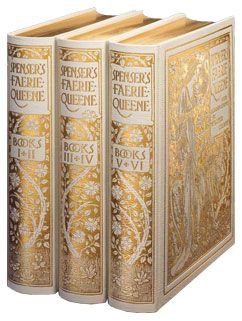
“Beyond all doubt it is best to have made one’s first acquaintance with Spenser in a very large — and, preferably, illustrated — edition of The Faerie Queene, on a wet day, between the ages of twelve and sixteen; and if, even at that age, certain of the names aroused unidentified memories of some still earlier, some almost prehistoric, commerce with a selection of ‘Stories from Spenser’, heard before we could read, so much the better.”
A number of us are going to be reading The Fairie Queene beginning sometime in April and, considering the difficulty of the poem, I decided to do some pre-reading investigation.
![]() |
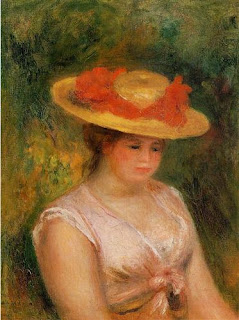
| Young Woman in a Straw Hat (1901) Pierre-Auguste Renoir source Wikiart |
Popular in medieval and renaissance times, this “complaint poem” is written in rhyme royal (ababbcc), with seven lines per stanza in iambic pentameter, which I just encountered while recently reading The Brubury Tales (in The Feet’s Prologue), a take on Chaucer’s The Canterbury Tales. Because this style was unusual for Shakespeare, some critics question his authorship, yet there are parts of the poem that certainly echo of Shakespeare, and coincidentially the first stanza is very close to the first stanza of The Rape of Lucrece.
As for figures of speech, the following are included in the poem: alliteration, anaphora, hyperbole, metaphor, paradox, personification and simile. Could I identify them all on the first read? No, but that means that I’ll have to read The Lover’s Complaint again!
Deal Me In Challenge #4
“I address these lines — written in India — to my relatives in England.”
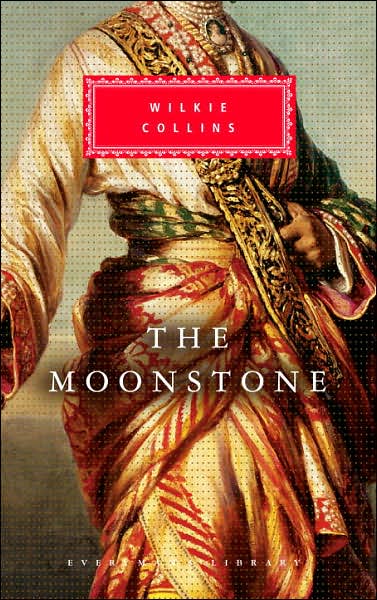
The Moonstone …….. a yellow diamond, sacred to the Indian people, guarded over by an ancient curse and three Brahmins devoted to its preservation. Yet the revered diamond is stolen. Time passes, and the Moonstone ends up in the hands of Colonel Hearncastle who returns to England with the ill-fated gem. Angry at the relatives who shun his advances, he leaves the Moonstone in his will to his niece, Rachel Verinder. Did the Colonel leave the stone as a profitable legacy, or was it intended to wreak destruction on those who had earlier rejected his gruff overtures?
“In Moulmein, in Lower Burma, I was hated by large numbers of people — the only time in my life that I have been important enough for this to happen to me.”
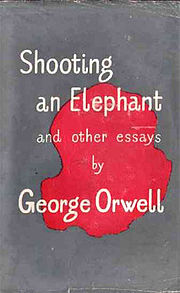
Orwell tells of his stint in Burma as a police officer under British colonial rule. He was despised by the people as an agent of the perceived oppressors, but in spite of his job, his sympathies lay with the natives and he felt constant guilt because of his duties.
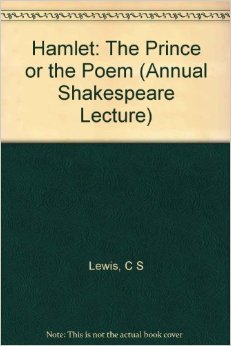
“A critic who makes no claim to be a true Shakespearian scholar and who had been honoured by an invitiation to speak about Shakespeare to such an audience as this, feels rather like a child brought in at dessert to recite his piece before the grown-ups.”
In the first case, if Hamlet is indeed a failure, we waste our time investigating why his actions were delayed. Yet, if this failure were indeed a reality, why does Hamlet touch us so? Why does it echo with “the sense of vast dignities and strange sorrows and teased ‘with thoughts beyond the reaches of our souls'”? If Hamlet is failure, then perhaps failure is better than success, and such a verdict could never be rendered with less certainty.
The last point seems to be the most logical, yet why then, in all three camps, does the play appear to hold each in thrall, enchanting the very critics who criticize it? Does the mystery and magical appeal of the play have little to do with Hamlet’s actual character, but instead is due to something entirely different?
![]() |
| Czachórski Actors Before Hamlet Wladyslaw Czachórski source Wikimedia Commons |
Lewis brings to light Aristotle’s definition of tragedy, which is an imitation not of men, but of action and life and happiness and misery, yet “action” by ancient standards means “situation.” Instead of always attempting to delineate a character, one should first “surrender oneself to the poetry and the situation.” It is through poetry and situation, and for their sake, that the characters exist.
![]() |
| Hamlet’s Vision (1893) Pedro Américo source Wikimedia Commons |
For Lewis, the ghost does not merely tell of the murder of Hamlet’s father. Instead, the ghost and Hamlet are inseparable, and indeed the spectre is different from most vile ghosts in Elizabethan drama; this ghost is willfully ambiguous. Its presence lends an enigmatic uneasiness to the play, filling Hamlet’s, and even other character’s, minds with doubt and uncertainty. ” ….. the appearance of the spectre means a breaking down of the walls of the world and the germination of thoughts that cannot be thought; chaos is come again.”
The subject of Hamlet is death. Lewis does not base the theme on the numerous deaths of the characters, rather the situations they find themselves contemplating. We read it in the ghost, in the line of “melting flesh”, in the rejection of suicide, in the graveyard, the skull …….. As we read Hamlet, we cannot escape it, which gives the play its quality of obscurity and apprehension. There are other elements to the play, but there is always this groping toward the final end and questions about the destiny of the soul or body.
Hamlet’s vacillations do not balance on his fear of dying, but instead a fear of being dead.
“Any serious attention to the state of being dead, unless it is limited by some definite religious or anti-religious doctrine, must, I suppose, paralyse the will by introducing infinite uncertainties and rendering all motives inadequate. Being dead is the unknown x in our sum. Unless you ignore it or else give it a value, you can get no answer.”
| Hamlet and Ophelia (1858) Dante Gabriel Rossetti source Wikimedia Commons |
Yet Lewis says that Shakespeare’s own text does not confirm his theory, nor has Shakespeare given “us data for any for any portrait of the kind critics have tried to draw.” We enjoy Hamlet’s speeches “because they describe so well a certain spiritual region through which most of us have passed and anyone in his circumstances might be expected to pass, rather than because of our concern to understand how and why this particular man entered it”. And, in fact, Hamlet is an Everyman. He is a hero yet also a “haunted man — man with his mind on the frontier of two worlds, man unable either quite to reject or quite to admit the supernatural, man struggling to get something done as man has struggled from the beginning, yet incapable of achievement because of his inability to understand either himself or his fellows or the real quality of the universe which has produced him.”
The critics have never doubted the greatness or mystery of the play, but they simply put it in the wrong place, “in Hamlet’s motives rather than in that darkness which enwraps Hamlet and the whole tragedy and all who read and watch it.” It is the mystery of the human condition.
Lewis ends by acknowledging the weakness of his theory, only because his type of criticism does not have centuries of vocabulary to support it, as does the other type of criticisms. Yet he wishes that Hamlet could be played as “a dishevelled man whose words make us at once think of loneliness and doubt and dread, of waste and dust and emptiness, and from whose hands, or from our own, we feel the richness of heaven and earth and the comfort of human affection slipping away.” Perhaps his views are childish, yet children remember the details of stories. So, is Lewis a literary child?
“On the contrary, I claim that only those adults who have retained, with whatever additions and enrichments, their first childish response to poetry unimpaired, can be said to have grown up.”
“To be or not to be, that is the question …….”
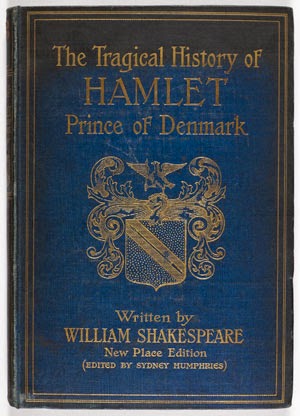
First publish around 1602 (although a working copy is thought to have been in use in 1601), Hamlet has come down to us in two forms. Issued in 1603, a corrupt or crude and probably pirated copy called the “First Quarto” (Q1) was produced, then in 1604 a more complete and artistically styled “Second Quarto” (Q2) followed. It is supposed that the errors in Q1, complete with pretentious and often meaningless rhetoric, spurred Shakespeare and his company to press for a more complete and credible version. Surprisingly, Hamlet was never performed or printed in its entirety during Shakespeare’s lifetime and the copies we read today are a compilation of Q2 and the 1623 Folio edition. In spite of the errors and incompleteness of the play, there is little doubt that it is Shakespeare’s as it was performed by his own acting company. The evidence of the dating of the play is quite fascinating, as it not only uses clues from registries, but clues imbedded within the play to events that happened in 1601 and 1600. Shakespeare actuates very detailed detective work.
![]() |
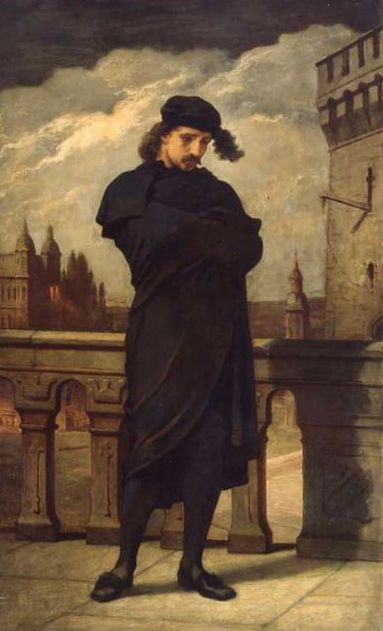
| Portrait of Hamlet (c.1864) William Morris Hunt source Wikimedia Commons |
The legend of Hamlet goes back centuries, dating to around the Scandinavian sagas. It was familiar to the people of Iceland in the 10th century, although Shakespeare possibly drew from Histories Tragiques (1559-70) by Francis de Belleforest, relating tragic stories of great kings and queens whose lives had been ravaged by love or ambition. A second hypothesis is that Shakespeare revived an extant version of a play by Thomas Kyd, revising this earlier piece to become the Second Quarto (Q2), and then afterward rewriting the complete acting text and play, which then became the basis for the Folio of 1623. With regard to the first hypothesis, the similarity of the stories are too apparent to be coincidental, but there are differences in names and some differences in narrative that indicate Shakespeare was intent on making the play his own.
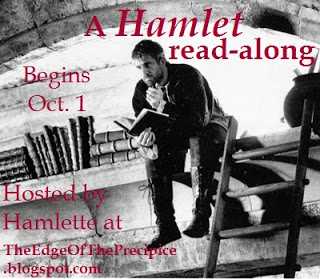
Hamlette at The Edge of the Precipice hosted a Hamlet Read-Along beginning in October and set a very leisurely pace, which was wonderful as it allowed me to dig very deeply into the play. My scene-by-scene postings were as follows:
Act I : Scene I, Scene II, Scene III, Scene IV, Scene V
Act II: Scene I, Scene II
Act III: Scene I, Scene II, Scene III, Scene IV
Act IV: Scene I, Scene II, Scene III, Scene IV, Scene V, Scene VI, Scene VII
Act V: Scene I, Scene II
![]() |
| The Young Lord Hamlet (1867) Philip Hermogenes Calderon source Wikimedia Commons |
The play itself begins in Denmark at Elsinore castle where two soldiers see a ghost on the ramparts. It is the ghost of the newly dead King Hamlet and immediately they inform his son, Hamlet, of the apparition. Horatio, his friend, keeps watch with him the following night, whereupon the ghost claims to his son that he has been murdered by his own brother, the new king, Claudius. To add insult to injury, Claudius has married Hamlet’s mother, Gertrude, an outrage that can hardly be borne by Hamlet. Yet questions pile upon Hamlet, enough to smother. Was the ghost truly there, and if so, was it really his father? Revenge was called for but how could the deed be done, and was he justified in taking a life? His father’s life was cut short “in the blossoms of his sin”, but if he dispatched Claudius in his guilty state, would not their deaths become parallel?
![]() |
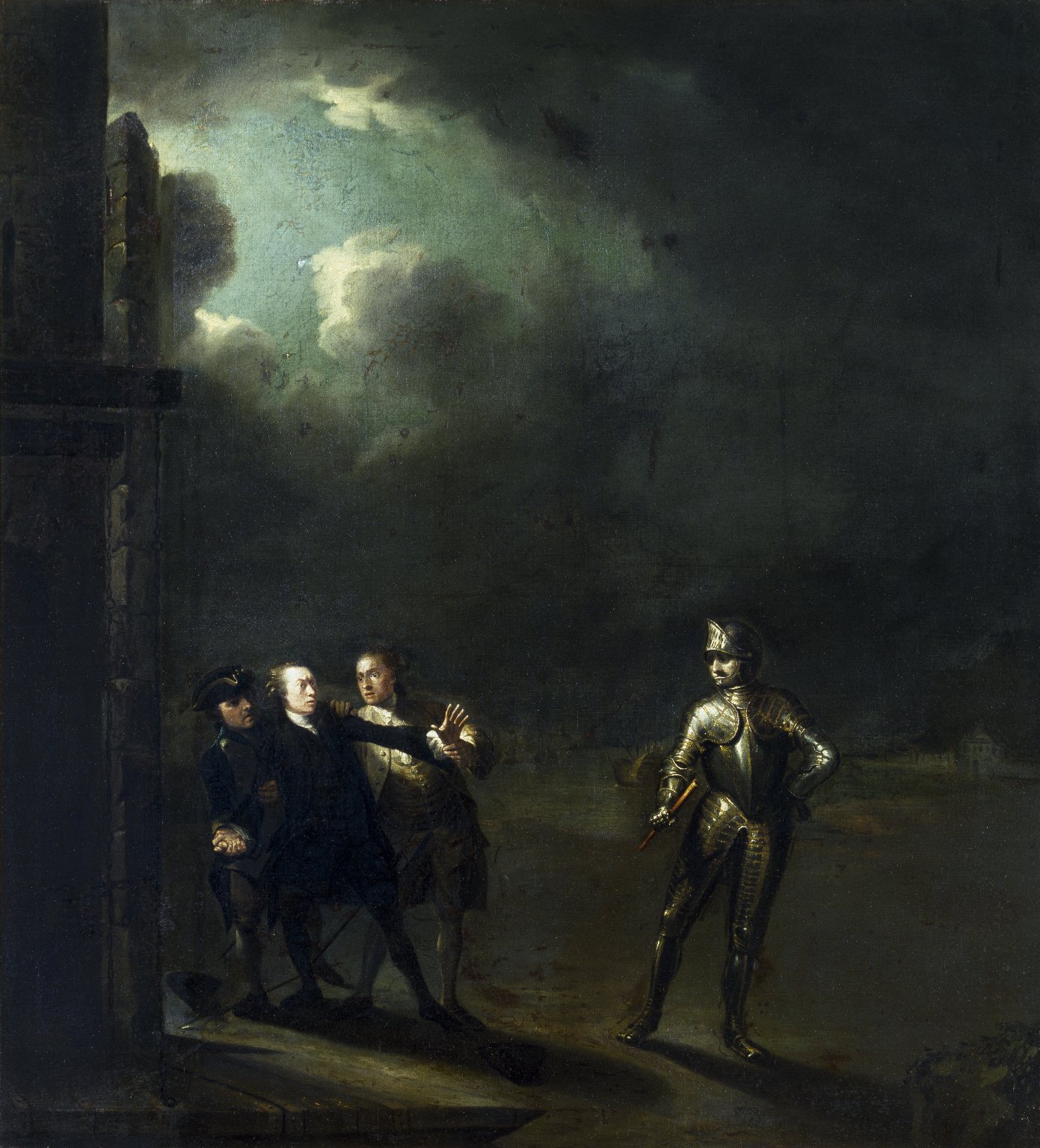
| Hamlet encountering the Ghost (1768-69) Benjamin Wilson source Wikimedia Commons |
The contrary questions paralyze Hamlet into a mire of inaction. He then works out a contrary persona, playing at an odd type of insanity, yet often dispensing insightful, sharp and clear rhetoric to torment Claudius into confusion. Is Hamlet as dangerous as Claudius believes or is he merely an innocent victim of the circumstances, grief-stricken over the death of his father? After Hamlet unwittingly commits the murder of Polonius, the advisor of Claudius, he forces the hand of the new king who sends him to England, with the intent of extinguishing any threat to his kingdom. Yet Hamlet has also injured the mind of one once dearest to him, Ophelia, the daughter of Polonius, and her decent into madness colours the kingdom with further calamity. Upon Hamlet’s return, the culmination of this revenge tragedy is set into motion. Will Claudius’ plotting bring him success? Can Laertes avenge his father, Polonius’, murder, and will Hamlet’s revenge bring him the peace he seems to seek?
You can see throughout the play the emphasis on action vs. inaction, words vs. action, thoughts vs. action, etc. While Hamlet bemoans his inability to act to avenge his father’s death, on the surface seeming cowardly and ineffective, the actuality is quite the opposite. All throughout the play, Hamlet uses thoughts and words to manipulate his enemy. His thoughts, though he bemoans them, actually have more of an effect than he imagines, controlling certain small acts in a very effective manner. His act of insanity twists Claudius into a Gordian knot of uncertainty, his letters announcing his return to Denmark pushing Claudius to drastic action. Thoughts and words appear to be more important and certainly more effective than action, torturing his enemy to the very limits of his endurance. While it’s demonstrated in the play that revenge only brings suffering, is there a underlying theme that words can be more effective than action?
![]() |
| Ophelia (1863) Arthur Hughes source Wikiart |
While the cultural precepts of the Danish society in Hamlet seem to support the desire for revenge, Shakespeare’s Elizabethan audience would have viewed the thirst for vengeance as primitive, and perhaps rather shocking. There is evidence throughout the play that revenge brings only suffering and death to those involved. Fortinbras, the heir of the Danish kingdom at the end of the play, calls for all the noblemen to hear the story of Hamlet:
” Let us haste to hear it,
And call the noblest to the audience ……”
He wants the nobles of the kingdom to attend to this tragedy and learn from it. Horatio responds:
“But let this same be presently performed,
Even while men’s minds are wild, lest more mischance
On plots and errors happen.”
Hamlet does get a hero’s remembrance, but the deaths, suffering and pain caused by his vengeful actions, and those of others, are strongly emphasized.
There is a question throughout the play of Hamlet’s sanity. Is he truly mad, or is it simply an act produced to set a trap for the murderer of his father? I tend to think the latter, but Shakespeare appears to quite closely link insanity with revenge, perhaps alluding to the fact that vengeance has a detrimental effect on our minds, distorting perceptions to bring about a type of madness. Hamlet is playing at being mad, but madness also plays with him, his malevolent sentiments poisoning his very psyche, and modifying his entire moral perspective. The whole character of Hamlet is played out in the agonizing conflict within his mind. Mad he is, and mad he is not, perhaps making him at once to be and not to be.
e
“Emma Woodhouse, handsome, clever, and rich, with a comfortable home and a happy disposition, seemed to unite some of the best blessings in existence; and had lived nearly twenty-one years in the world with very little to distress or vex her.”
Young Emma Woodhouse of Hartfield has been the pet of her father and governess, and perhaps indulged by both to a faulty degree. However, her character is one of kindness and charity, but enhanced with a healthy interest in the business of others, especially if it includes the subject of marriage. Mr. Knightley, a close family friend and owner of Donwell Abbey, attempts to correct Emma and steer her on a more prudent path, but Emma’s high spirits require the correction of life experience. As she stumbles through her attempts at matchmaking based on her faulty reasoning, we see Emma grow from a willful, impressionable, decisive girl into a more careful, thoughtful, and empathetic woman.
From the first sentence we can see that this is a type of coming-of-age novel. The struggles and challenges of life are what develop strength of character. Because Emma has lived a relatively trouble-free and pampered life, we initially see in her character a willful blindness which often only serves to punctuate the errors in her thinking and of her actions. The tension in the story is the uncertainty of Emma’s transformation. We know that she is able to learn, but with her stubborn nature, will that be possible? Her personal tenacity does not allow for an instant conversion, and instead we see small steps of correction in Emma’s character, even while she gets into more scrapes and misunderstandings. Yet Emma realizes, or is forced to realize, the value of the advice of those closest to her, admitting her faults and seeking to amend them.
![]() |
| Hartfield (Squerryes Court) |
As I contemplated this read, I felt that it was not simply Emma who was often mistaken. Not only is Emma completely blind, but all the other characters exhibit their own sort of blindness to varying degrees. Not only does no one know their neighbour or accurately guess their motivations, often people don’t even know themselves. Each person is often attempting to hide their observations, either out of personal gain or out of societal politeness, but in each case, these decisions are shown to be unwise. Does this tell us that by understanding our fellow human beings that we will gain a deeper knowledge of ourselves? However, perhaps Mr. Knightley had a more accurate indication of the issue, when he stated, “Mystery; Finesse —- how they pervert the understanding! My Emma, does not every thing serve to prove more and more the beauty of truth and sincerity in all our dealings with each other?” We need to be truthfully transparent with one another, even if it is difficult or uncomfortable, to truly cultivate relationships with minimum complication.
By the end of the novel, Emma is a much wiser woman. Are all of her faults erased? Not at all, but many of those faults are what make part of her character so delightful. It is the opening of her mind, the willingness to admit her wrongs and the receptiveness to bettering herself, that makes her a truly likeable heroine.
“The family of Dashwood had been long settled in Sussex.”
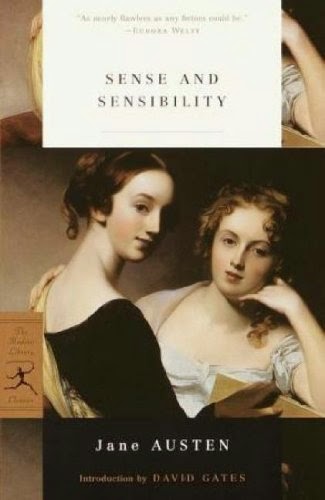
Mr. Dashwood of Norland Park has passed away leaving his wife, Mrs. Dashwood, and three daughters, Elinor, Marianne, and Margaret to the mercy of their half-brother, John Dashwood, now owner of their ancestral home. While John had promised his father to care for his step-mother and sisters and settle money on them for their comfort, he is quickly and deftly talked out of giving them anything by his mercenary wife. The Dashwood family is left to accept Barton Cottage, a small cottage in Devonshire, offered to them by a distant cousin, Mr. Sir John Middleton. Yet before they leave Norland, Elinor forms an attachment with Edward Ferrars, the brother of her callous sister-in-law, a good-natured young man, who appreciates Elinor’s sense and temperance.
At Barton Cottage, the family meet their benefactor, Sir John, a rather buffoonish cordial man, with a wife with a character as warm as winter. Despite their reduced circumstances, the Dashwoods accept their new life with, more-or-less, a cheerful resignation and begin to move about in society, meeting the dour and grave Colonel Brandon. Brandon is attracted to Marianne, but at thirty-five years old, he seems rather ancient to her, and his disposition does not exemplify all the sensitivity, feeling and passion that she considers essential in a man. During an accident in the rain, Marianne is rescued by a young gentleman, Willoughby, and his nature, in contrast to Brandon’s, appears to be everything her heart desires. His love of books, music and poetry correspond identically to hers; his impulsiveness and his carefree love of pleasure; his immoderate abandon in the face of love. Their marriage soon appears to be a surety, but when Marianne learns of his engagement to another, her heart and all her preconceived ideals are damaged.
Meanwhile, Edward Ferrars pays a visit, yet while Elinor feels an ardent connection between them, Edward appears indecisive. She soon learns of his engagement to a Miss Lucy Steele and, contrary to Marianne’s disposition, she is forced to suppress her natural feeling for the sake of convention, but also self-respect.
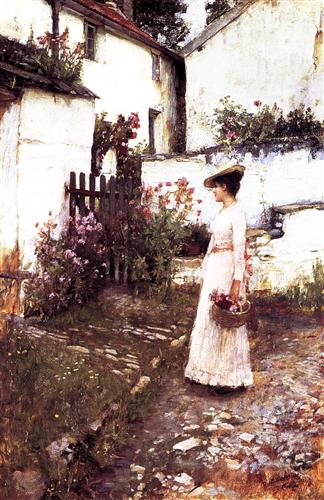
![]() |
| Gathering Flowers in a Devonshire Garden John William Waterhouse source Wikiart |
The juxtaposition of sense and sensibility is played out and embodied in the characters of Elinor and Marianne. Elinor’s sense is soon made apparent. “Elinor, the eldest daughter whose advice was so effectual, possessed a strength of understanding, and coolness of judgement, which qualified her, though only nineteen, to be the counsellor of her mother, and enabled her frequently to counteract, to the advantage of them all, that eagerness of mind in Mrs. Dashwood which must generally have led to impudence. She had an excellent heart; her disposition was affectionate, and her feelings were strong: but she knew how to govern them: it was a knowledge which her mother had yet to learn, and which one of her sisters had resolved never to be taught.”
Marianne, in contrast, is all unbridled sensibility, and shows a contempt for those who are not as passionate. While her sensibility is a sensation of passion induced by positive emotions and experience, such as love, poetry, music, and a response to beauty, it is a wild impulsive, unrestrained, vehement emotion, and Marianne allows herself to be governed by it entirely. As young colt strains against the teaching rein, so Marianne pulls against the constraints that society places on her as a young woman in Georgian England.
![]() |
| London (1808) William Turner source Wikiart |
Yet while Austen shows the differences and consequences of the two character traits, with her usual insights and character crafting she does not put either sister in a tidy box. While Marianne is wild and impulsive, she also show glimmers of sense. As her character develops, Willoughby’s true nature is revealed to her, and through him her own nature is reflected back into her eyes. She recognizes her faults and strives for change. Conversely, it is not that responsible, pragmatic Elinor doesn’t feel; she has similar strength of emotion and attachment as her sister, but her emotions are bridled. Elinor’s sensibility is there, but it does not overpower her sense and therefore allows her to see situations in a clearer light, and from that she is able to govern her life in a way that not only brings respect and contentment to herself, but is beneficial for those people around her.
As usual, Austen gives us a kaleidoscope of characters and while there is strict delineation between the different levels of society, she also shows the colourful interactions that cross those boundaries between them. She juxtaposes two situations, one were engagements are incorrectly assumed for both sisters, and then the turmoil of both sisters when it is known that Willoughby and Edward are engaged to other women. Yet it is the characters that offer us a lesson, as their behaviour determines the outcomes of each situation, and gives us an intimate look at the correct balance of both “sense” and sensibility”.