The Autobiography of Alice B. Toklas by Gertrude Stein

“I was born in San Francisco, California.”

Gertrude Stein was a Jewish-American writer who lived in France for over 40 years, becoming an intrinsic part of the Parisian art world in the early 1900s. Part of an avant garde artistic movement that thumbed its nose at past artistic structure, she was intimate with artists, both painters and writers, such as Pablo Picasso, Henri Matisse, Juan Gris, George Braque, Guillaume Appolonaire, Henri Rousseau, Ernest Hemingway, Mildred Aldrich  and many others, who were frequent visitors to her 27 rue de Fleurus location.  She attempted her own literary movement, writing many works that were deemed “incomprehensible”, but received a small following.  Her autobiography is perhaps a more gentle exposure to her “art”.

Continue reading

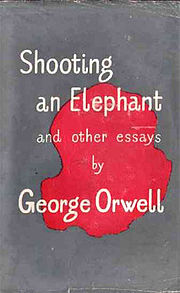
Shooting An Elephant by George Orwell

“In Moulmein, in Lower Burma, I was hated by large numbers of people — the only time in my life that I have been important enough for this to happen to me.”

Orwell tells of his stint in Burma as a police officer under British colonial rule.  He was despised by the people as an agent of the perceived oppressors, but in spite of his job, his sympathies lay with the natives and he felt constant guilt because of his duties.

Continue reading

The Persians by Aeschylus

“Of the Persians gone 
To the land of Greece
Here are the trusted:
As protectors of treasure …..”


Performed in Athens in  472 B.C., The Persians portrays the naval battle at Salamis between the Greeks and the Persians, which occurred seven years earlier.   It is unique from other tragedies, as it was without a prologue or exudos (final scene) of the chorus.  As it deals with contemporary history instead of the common mythic topics, it was not part of a unified triad of plays that Aeschylus appeared to favour, yet interestingly it was performed with two other “lost” mythic plays, Phineus and Glaucus Ponieus.  In comparing this play to later tragedies, these differences raise the possibility of tragedy developing out of an earlier form.

Battle of Salamis (1868)
Wilhelm von Kaulbach
source Wikimedia Commons
 
The play begins in 480 B.C., and at the palace of Xerxes at Sousa, the Persian elders are lauding the strength of Xerxes and his army as they are engaged in battle with the Greeks:
 
“And the furious leader the herd
Of populous Asia he drives,
Wonderful over the earth,
And admirals stern and rough
Marshals of men he trusts:
Gold his descent from Perseus,
He is the equal of god.”
 

Yet their tone of exhortation becomes tinged with concern over the question of victory in this battle, and the mother of Xerxes, the Queen, appearing, echoes their sentiments.  A herald arrives, bringing most unwelcome news:
 
“O cities of Asia, O Persian land,
And wealth’s great anchorage!
How at a single stroke prosperity’s
Corrupted, and the flower of Persia falls,
And is gone.  Alas!  the first herald of woe,
He must disclose entire what befell:
Persians, all the barbarian host is gone.”
 

The herald, an eyewitness, bitterly describes the Persians’ defeat at Salamis.  Momentarily speechless, the Queen finally asks about survivors.  Xerxes is still living, but the Herald lists the many dead heroes, casualties of the battle.  The survivors are scattered.


“Ship dashed against ship, till the Persian army
dead stewed the deep like flowers”
source Wikimedia Commons
While Xerxes is a great warrior, his errors in the battle are made apparent.  He harangued his captains publicly, “in ignorance of Greek guile and the jealousy of the gods” …. and, “he conned the future ill.”  In return for his pride and miscalculations:


“All the Persians, who were in nature’s prime,
Excellent in soul, and nobly bred to grandeur,
Always first in trust, met their death
In infamy, dishonor, and in ugliness.”


Lamenting that her dream of defeat has come to fruition, the Queen attempts to assuage her grief by offering prayers and gifts to the gods.  As she offers libations at the tomb of her dead husband, Darius, his ghost rises up, inquiring about the present woe.  When he hears of the tragic defeat, he appears to blame his son’s “youthful pride”, yet he counsels the Queen to receive her son gently when he returns.
 
Somber laments issue from the Persian council of elders until Xerxes arrives in grievous affliction.  He recounts more of his defeat, his words a song of sorrow until the end:
 
“Oh alas, woe,
The magic wheel of longing for my friends you turn, you tell
Me hateful sorrows.  Within my frame my heart resounds,

resounds ……”

Death of the Persian admiral (Ariabignes,
brother of Xerxes) early in the battle
source Wikipedia
Wow, this was a very powerful play.  By the Persians’ defeat, Xerxes has not only lost honour for himself, but he is responsible for the loss of honour of generations before him.  Yet the tragedy of the situation is in his overweening pride and his attempt to place himself in a position above the gods.  He ignored the wisdom of his elders, instead choosing to go his own way, and paid dearly for his folly.


Even though, Aeschylus was writing through Persians eyes, elements of a Greek mindset crept in here and there, as in Darius’ horror of the Persians plundering and burning the Greek temples.  And he counsels the Queen for the Persians not to invade Greece because “the Grecian soil is their own ally.”  Very convenient.  Yet there is also a sympathetic tone towards the Persians, as if the Greeks can empathize with the sufferings of battle and the woes of the aftermath of loss.  In fact, the sympathy is startling.  The great daring of such a play perhaps goes beyond both historical and contemporary understanding.  No playwright had risked presenting the enemy, not only from a sympathetic viewpoint, but also showing them as noble and heroic in battle.  The battle at Salamis was a recent event and it is a tribute to the rhetoric of Aeschylus that this play was so well-regarded.  Yet while his feat is indeed admirable, Aeschylus ensures that he remains in control of his creation.  Few names can be traced to real persons, hyperbole is employed and Persians adopt Greek tradition, preventing any person from drawing any concrete truth from his presentation.  His Persian War, while being historically based, is still in the realm of myth, as if he cannot escape it. 

Translated by Seth G. Bernardete


Hamlet: The Prince or The Poem? by C.S. Lewis

Hamlet the prince or the poem

“A critic who makes no claim to be a true Shakespearian scholar and who had been honoured by an invitiation to speak about Shakespeare to such an audience as this, feels rather like a child brought in at dessert to recite his piece before the grown-ups.”

In Hamlet: The Prince or the Poem, Lewis begins his lecture by claiming that his aim is not to examine what other critics have before him, but to consider why the critics have failed to agree about the procrastination exhibited by the character of Hamlet.  He first outlines the three different camps:

  1. Those who think the play “bad” and that there are no motivations to explain Hamlet’s actions
  2. Those who believe he did not delay and acted with as much alacrity as was possible.
  3. Those who believe he did procrastinate and explain his paralysis through his psychology.


Next, he asks you to suspend all knowledge of the play, as if “you had no independent knowledge of the thing being criticized,” and proceeds to examine each view.

In the first case, if Hamlet is indeed a failure, we waste our time investigating why his actions were delayed.  Yet, if this failure were indeed a reality, why does Hamlet touch us so?  Why does it echo with “the sense of vast dignities and strange sorrows and teased ‘with thoughts beyond the reaches of our souls'”?  If Hamlet is failure, then perhaps failure is better than success, and such a verdict could never be rendered with less certainty.

With regard to point two, the opponent to this view is Hamlet himself.  He declares that he is a procrastinator, a cowardly soul who wavers with indecision.  The ghost, for the most part, is in agreement.

The last point seems to be the most logical, yet why then, in all three camps, does the play appear to hold each in thrall, enchanting the very critics who criticize it?  Does the mystery and magical appeal of the play have little to do with Hamlet’s actual character, but instead is due to something entirely different?


Czachórski Actors Before Hamlet
Wladyslaw Czachórski
source Wikimedia Commons


Lewis brings to light Aristotle’s definition of tragedy, which is an imitation not of men, but of action and life and happiness and misery, yet “action” by ancient standards means “situation.”  Instead of always attempting to delineate a character, one should first “surrender oneself to the poetry and the situation.” It is through poetry and situation, and for their sake, that the characters exist.

Hamlet's Vision
Hamlet’s Vision (1893)
Pedro Américo
source Wikimedia Commons

For Lewis, the ghost does not merely tell of the murder of Hamlet’s father.  Instead, the ghost and Hamlet are inseparable, and indeed the spectre is different from most vile ghosts in Elizabethan drama; this ghost is willfully ambiguous.  Its presence lends an enigmatic uneasiness to the play, filling Hamlet’s, and even other character’s, minds with doubt and uncertainty.  ” ….. the appearance of the spectre means a breaking down of the walls of the world and the germination of thoughts that cannot be thought; chaos is come again.”

The subject of Hamlet is death.  Lewis does not base the theme on the numerous deaths of the characters, rather the situations they find themselves contemplating.  We read it in the ghost, in the line of “melting flesh”, in the rejection of suicide, in the graveyard, the skull ……..  As we read Hamlet, we cannot escape it, which gives the play its quality of obscurity and apprehension.  There are other elements to the play, but there is always this groping toward the final end and questions about the destiny of the soul or body.

Hamlet’s vacillations do not balance on his fear of dying, but instead a fear of being dead.

“Any serious attention to the state of being dead, unless it is limited by some definite religious or anti-religious doctrine, must, I suppose, paralyse the will by introducing infinite uncertainties and rendering all motives inadequate.  Being dead is the unknown x in our sum.  Unless you ignore it or else give it a value, you can get no answer.”


Hamlet and Ophelia
Hamlet and Ophelia (1858)
Dante Gabriel Rossetti
source Wikimedia Commons

Yet Lewis says that Shakespeare’s own text does not confirm his theory, nor has Shakespeare given “us data for any for any portrait of the kind critics have tried to draw.”   We enjoy Hamlet’s speeches “because they describe so well a certain spiritual region through which most of us have passed and anyone in his circumstances might be expected to pass, rather than because of our concern to understand how and why this particular man entered it”.  And, in fact, Hamlet is an Everyman.  He is a hero yet also a “haunted man — man with his mind on the frontier of two worlds, man unable either quite to reject or quite to admit the supernatural, man struggling to get something done as man has struggled from the beginning, yet incapable of achievement because of his inability to understand either himself or his fellows or the real quality of the universe which has produced him.”

The critics have never doubted the greatness or mystery of the play, but they simply put it in the wrong place, “in Hamlet’s motives rather than in that darkness which enwraps Hamlet and the whole tragedy and all who read and watch it.”  It is the mystery of the human condition.

Lewis ends by acknowledging the weakness of his theory, only because his type of criticism does not have centuries of vocabulary to support it, as does the other type of criticisms.  Yet he wishes that Hamlet could be played as “a dishevelled man whose words make us at once think of loneliness and doubt and dread, of waste and dust and emptiness, and from whose hands, or from our own, we feel the richness of heaven and earth and the comfort of human affection slipping away.”  Perhaps his views are childish, yet children remember the details of stories.  So, is Lewis a literary child?

“On the contrary, I claim that only those adults who have retained, with whatever additions and enrichments, their first childish response to poetry unimpaired, can be said to have grown up.”


Deal Me In Challenge #1 


deal me in challenge


The Story of My Experiments With Truth by Mohandas K. Gandhi

“The Gandhis belong to the Bania caste and seem to have been originally grocers.”

Encouraged by friends and colleagues to share the history of his movement, Gandhi began his autobiography as weekly installments which were published in his journal, Navjivan, and also, Young India.  Writing in jail, Gandhi wanted to communicate spiritual and moral truth that he has discovered through personal experiments and he shares the impetus for his search:

“But one thing took deep root in me — the conviction that morality is the basis of things, and that truth is the substance of all morality.  Truth became my sole objective.  It began to grow in magnitude every day, and my definition of it also has been ever widening.”

As many other biographers have done, Gandhi begins his narrative with his childhood, sharing his many childish misdemeanors such as smoking, drinking, stealing, etc.  Married at the age of thirteen, Gandhi condemns this practice, characterizing his desire for his wife as lust, feeling in bondage to his passions, which he laters frees himself from:

” …… (I) realized that the wife is not the husband’s bondslave, but his companion and helpmate, and an equal partner in all his joys and sorrows —- as free as the husband to choose her own path ….”

Gandhi in South Africa
source Wikipedia

As a young man, Gandhi travelled to England to study to become a lawyer.  Upon returning to India, and being bored with his opportunities, he accepted the position of legal advisor on a large law suit in South Africa. With regard to his vocation, Gandhi had sharp insights, and with a moral bent, turned a perhaps mistrusted profession into a respected appointment:

“I realized that the true function of a lawyer was to unite parties riven asunder.  The lesson was so indelibly burnt into me that a large part of my time during the twenty years of my practice as a lawyer was occupied in bringing about private compromises of hundreds of cases.  I lost nothing thereby — not even money, certainly not my soul.”

“The symbol of a Court of justice is a pair of scales held evenly by an impartial and blind but sagacious woman.  Fate has purposely made her blind, in order that she may not judge a person from his exterior but from his intrinsic worth.”

In spite of being an unimposing figure, Gandhi’s greatness came not only from his desire for unity among people and serving the poor, but also his unique ability to see situations from a different perspective.  What the world would see as a weakness, Gandhi often saw as a strength:

“I must say that, beyond occasionally exposing me to laughter, my constitutional shyness has been no disadvantage whatever. In fact, I can see that, on the contrary, it has been all to my advantage.  My hesitancy in speech, which was once an annoyance, is now a pleasure.  Its greatest truth has been that it has taught me the economy of words.  I have naturally formed the habit of restraining my thoughts ……. Experience has taught me that silence is part of the spiritual discipline of a votary of truth ……..  My shyness has been in reality my shield and buckler.  It has allowed me to grow.  It has helped me in my discernment of truth.”


With his Christian and Muslim friends, he noted the differences, but instead of attempting to erase those differences, he chose to celebrate them, focusing on the positive aspects that those differences brought to light:

“Yet even differences prove helpful, where there is tolerance, charity and truth.”

His work in South Africa spanned decades, as he fought for the rights of the Indians there, after encountering race prejudice himself.  Many of his political views became entrenched with his South African experiences, and his religious views grew as well.  He became known for the employment of satyagraha, or non-violent protest and elucidates how it played out in his life.  The reader follows Gandhi through the Boer War and into World War I and his return to life in India.  He began to see the detriment of British colonial rule and worked hard to make his country ready for the independence that he foresaw.

His humility and his concern for his fellow-man resonate from the pages, his wisdom bringing unique insight.

“Man and his deed are two distinct things.  Whereas a good deed should call forth approbation and a wicked deed disapprobation, the doer of the deed, whether good or wicked always deserves respect or pity as the case may be.  ‘Hate the sin and not the sinner’ is a precept which, though easy enough to understand, is rarely practised, and that is why the poison of hatred spreads in the world …………. It is quite proper to resist and attack a system, but to resist and attack its author is tantamount to resisting and attacking oneself.  For we are all tarred with the same brush, and are children of one and the same Creator, and as such the divine powers within us are infinite.  To slight a single human being is to slight those divine powers, and thus to harm not only that being but with him the whole world.”

His desire for truth through the restoration of broken relationships and systems resonated throughout his work and his life.

What really spoke to me in this biography is that Gandhi, in spite of claiming a natural affinity with all races, also worked hard to develop traits within himself that would foster unity, empathy, patience and love towards others.  While it was a conviction within himself to cultivate positive behaviour, it was done with great effort and sometimes at a cost.  It is a tragic irony that Gandhi’s life came to and end with an act of violence, but perhaps the man himself would turn that perception on its head and simply say that it was further evidence of our need of the very thing which, at times, seems out of reach.  Yet as long as we are striving for peace, it is perhaps the striving that truly matters.

“I have found by experience that man makes his plans to be often upset by God, but, at the same time where the ultimate goal is the search of truth, no matter how a man’s plans are frustrated, the issue is never injurious and often better than anticipated.”

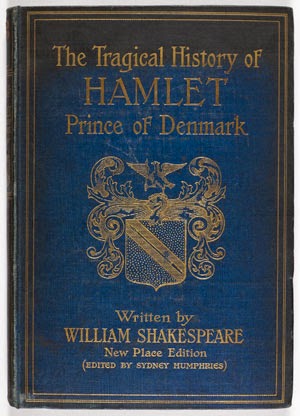
The Tragedy of Hamlet, Prince of Denmark by William Shakespeare

“To be or not to be, that is the question …….”

First publish around 1602 (although a working copy is thought to have been in use in 1601), Hamlet has come down to us in two forms. Issued in 1603, a corrupt or crude and probably pirated copy called the “First Quarto” (Q1) was produced, then in 1604 a more complete and artistically styled “Second Quarto” (Q2) followed.  It is supposed that the errors in Q1, complete with pretentious and often meaningless rhetoric, spurred Shakespeare and his company to press for a more complete and credible version.  Surprisingly, Hamlet was never performed or printed in its entirety during Shakespeare’s lifetime and the copies we read today are a compilation of Q2 and the 1623 Folio edition.  In spite of the errors and incompleteness of the play, there is little doubt that it is Shakespeare’s as it was performed by his own acting company. The evidence of the dating of the play is quite fascinating, as it not only uses clues from registries, but clues imbedded within the play to events that happened in 1601 and 1600. Shakespeare actuates very detailed detective work.

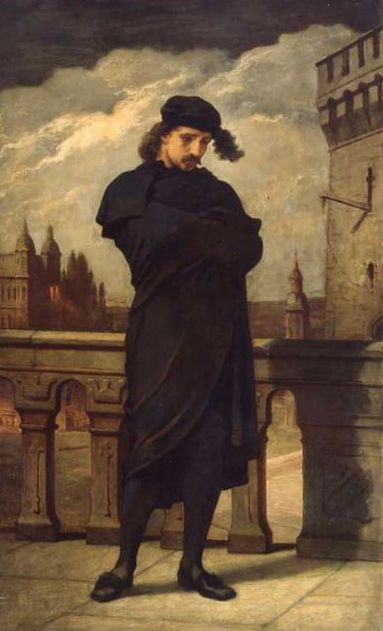
Portrait of Hamlet (c.1864)
William Morris Hunt
source Wikimedia Commons

The legend of Hamlet goes back centuries, dating to around the Scandinavian sagas.  It was familiar to the people of Iceland in the 10th century, although Shakespeare possibly drew from Histories Tragiques (1559-70) by Francis de Belleforest, relating tragic stories of great kings and queens whose lives had been ravaged by love or ambition.  A second hypothesis is that Shakespeare revived an extant version of a play by Thomas Kyd, revising this earlier piece to become the Second Quarto (Q2), and then afterward rewriting the complete acting text and play, which then became the basis for the Folio of 1623.  With regard to the first hypothesis, the similarity of the stories are too apparent to be coincidental, but there are differences in names and some differences in narrative that indicate Shakespeare was intent on making the play his own.

Hamlette at The Edge of the Precipice hosted a Hamlet Read-Along beginning in October and set a very leisurely pace, which was wonderful as it allowed me to dig very deeply into the play.  My scene-by-scene postings were as follows:

Act I :   Scene I,  Scene II,  Scene III,  Scene IV,  Scene V
Act II:   Scene I,  Scene II
Act III:  Scene I,  Scene II,  Scene III,  Scene IV
Act IV:  Scene I,  Scene II,  Scene III,  Scene IVScene V,  Scene VI,  Scene VII
Act V:   Scene I,  Scene II


The Young Lord Hamlet (1867)
Philip Hermogenes Calderon
source Wikimedia Commons

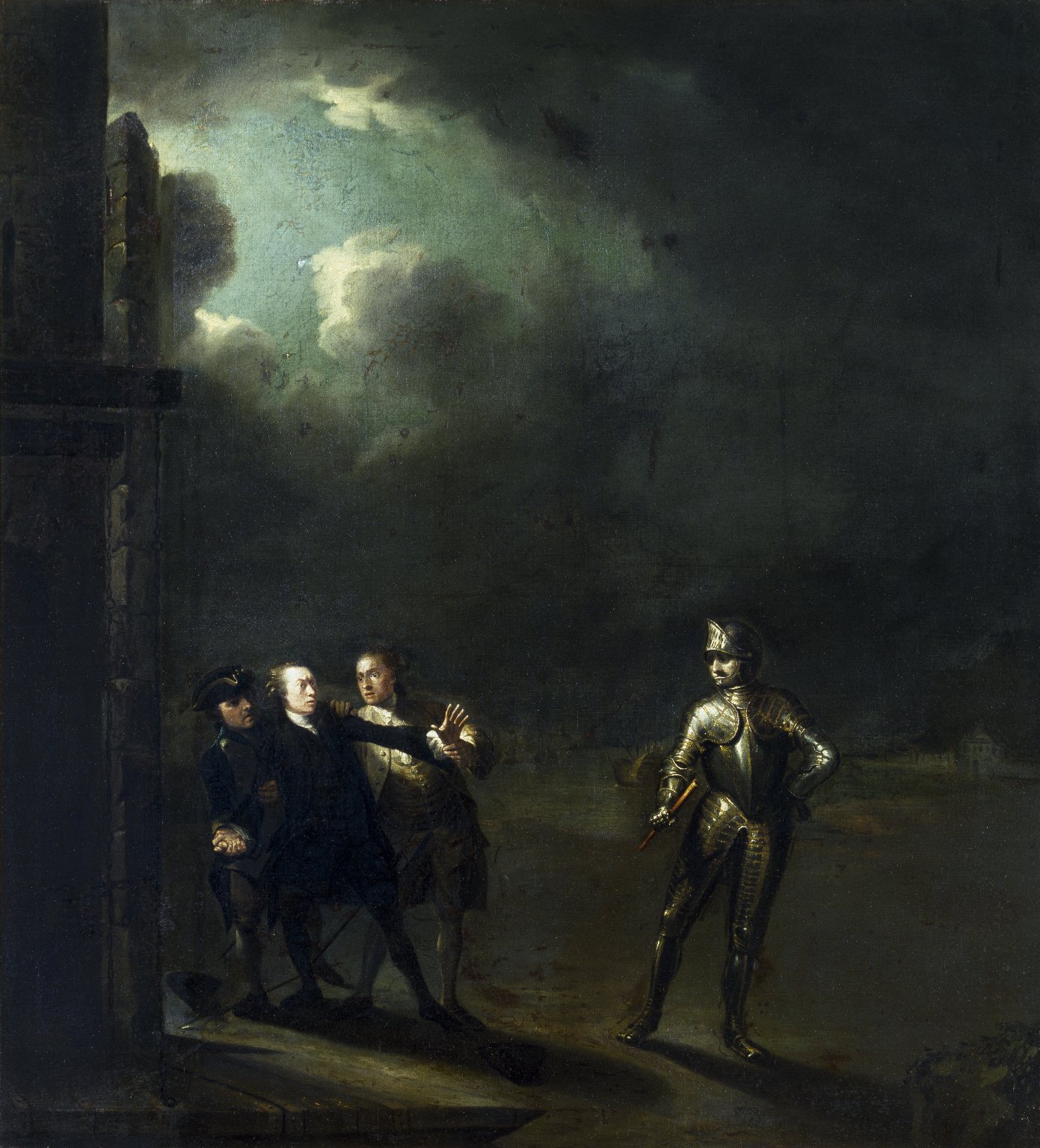
The play itself begins in Denmark at Elsinore castle where two soldiers see a ghost on the ramparts.  It is the ghost of the newly dead King Hamlet and immediately they inform his son, Hamlet, of the apparition.  Horatio, his friend, keeps watch with him the following night, whereupon the ghost claims to his son that he has been murdered by his own brother, the new king, Claudius.  To add insult to injury, Claudius has married Hamlet’s mother, Gertrude, an outrage that can hardly be borne by Hamlet.  Yet questions pile upon Hamlet, enough to smother.  Was the ghost truly there, and if so, was it really his father?  Revenge was called for but how could the deed be done, and was he justified in taking a life?  His father’s life was cut short “in the blossoms of his sin”, but if he dispatched Claudius in his guilty state, would not their deaths become parallel?

Hamlet encountering the Ghost (1768-69)
Benjamin Wilson
source Wikimedia Commons

The contrary questions paralyze Hamlet into a mire of inaction.  He then works out a contrary persona, playing at an odd type of insanity, yet often dispensing insightful, sharp and clear rhetoric to torment Claudius into confusion.  Is Hamlet as dangerous as Claudius believes or is he merely an innocent victim of the circumstances, grief-stricken over the death of his father?  After Hamlet unwittingly commits the murder of Polonius, the advisor of Claudius, he forces the hand of the new king who sends him to England, with the intent of extinguishing any threat to his kingdom.  Yet Hamlet has also injured the mind of one once dearest to him, Ophelia, the daughter of Polonius, and her decent into madness colours the kingdom with further calamity. Upon Hamlet’s return, the culmination of this revenge tragedy is set into motion. Will Claudius’ plotting bring him success?  Can Laertes avenge his father, Polonius’, murder, and will Hamlet’s revenge bring him the peace he seems to seek?

You can see throughout the play the emphasis on action vs. inaction, words vs. action, thoughts vs. action, etc.  While Hamlet bemoans his inability to act to avenge his father’s death, on the surface seeming cowardly and ineffective, the actuality is quite the opposite.  All throughout the play, Hamlet uses thoughts and words to manipulate his enemy.  His thoughts, though he bemoans them, actually have more of an effect than he imagines, controlling certain small acts in a very effective manner.  His act of insanity twists Claudius into a Gordian knot of uncertainty, his letters announcing his return to Denmark pushing Claudius to drastic action. Thoughts and words appear to be more important and certainly more effective than action, torturing his enemy to the very limits of his endurance.  While it’s demonstrated in the play that revenge only brings suffering, is there a underlying theme that words can be more effective than action?

Ophelia (1863)
Arthur Hughes
source Wikiart

While the cultural precepts of the Danish society in Hamlet seem to support the desire for revenge, Shakespeare’s Elizabethan audience would have viewed the thirst for vengeance as primitive, and perhaps rather shocking. There is evidence throughout the play that revenge brings only suffering and death to those involved.  Fortinbras, the heir of the Danish kingdom at the end of the play, calls for all the noblemen to hear the story of Hamlet:

”                                    Let us haste to hear it,
And call the noblest to the audience ……”

He wants the nobles of the kingdom to attend to this tragedy and learn from it. Horatio responds:

“But let this same be presently performed,
Even while men’s minds are wild, lest more mischance
On plots and errors happen.”

Hamlet does get a hero’s remembrance, but the deaths, suffering and pain caused by his vengeful actions, and those of others, are strongly emphasized.

There is a question throughout the play of Hamlet’s sanity.  Is he truly mad, or is it simply an act produced to set a trap for the murderer of his father?  I tend to think the latter, but Shakespeare appears to quite closely link insanity with revenge, perhaps alluding to the fact that vengeance has a detrimental effect on our minds, distorting perceptions to bring about a type of madness.  Hamlet is playing at being mad, but madness also plays with him, his malevolent sentiments poisoning his very psyche, and modifying his entire moral perspective.  The whole character of Hamlet is played out in the agonizing conflict within his mind.  Mad he is, and mad he is not, perhaps making him at once to be and not to be.


e

Notes from the Underground by Fyodor Dostoyevsky

“I am a sick man …….. I am an angry man.”

Notes from The Underground is the third book in my unannounced and (spur of the moment) Turgenev/ Chernyshevsky/ Dostoyevsky challenge.  After reading Turgenev’s novel Fathers and Sons, Nikolai Chernyshevsky wrote in response to it, his then politically persuasive novel, What Is To Be Done? , and in response to Chernyshevsky, Dostoyevsky wrote his powerful Notes from the Underground.  I assumed that it would be an interesting literary, political and philosophical conversation.

Dostoyevsky begins this book with a monologue from a retired 40-year-old civil servant, living in St. Petersburg.  He is our man from the Underground.  His ramblings appear to be disjointed, sometimes silly and then, disturbingly insightful.  But in this novel, is anything as it really appears?

” ….. doesn’t there, in fact, exist something that is dearer to almost every man than his own very best interests, or — not to violate logic — some best good …. which is more important and higher than any other good, and for the sake of which man is prepared if necessary to go against all the laws, against, that is, reason, honour, peace and quiet, prosperity — in short against all those fine and advantageous things — only to attain that primary, best good, which is dearer to him than all else? ….. to justify his logic he is prepared to distort the truth intentionally.”


The Soul of the Underground (1959)
Jean Dubuffet
source Wikiart

The Underground Man argues that perhaps science is not the highest good. The behaviour of man under the laws of nature and of reason does not confirm them; man has a perplexing innate inclination to destroy his own happiness and well-being.  One may argue that man needs to be brought into order, to conform to demands that will improve his life.   But what if man does not want that, and further, what makes one think that this is even good for man?

“Even if we assume it as a rule of logic, it may not be a law for all mankind at all …… And why are you so firmly and triumphantly certain that only what is normal and positive —- in short, only well-being —- is good?  After all, perhaps prosperity isn’t the only thing that pleases mankind, perhaps he is just as attracted to suffering.  Perhaps suffering is just as good for him as prosperity.”

Using historical examples, the Underground Man strengthens his argument. Man is beyond nature, and beyond reality; he is infinitely more complex than science, and therefore beyond the ability of science to completely understand him.

With his Underground Man, Dostoyevsky is attempting to shatter the philosophy seen in Nikolai Chernyshevsky’s, What is To Be Done?, a novel that promoted a type of monistic materialism brought about through a rational egoism: if only one used reason to discern the higher purpose of man, working through enlightened self-interest the perfect society would be created. Chernyshevsky’s dogmatic ideology excluded the possibility of “free will”, labelling it as a mistaken perception of what was simply a causal process. However Dostoyevsky, from his years in a prison camp, had continually witnessed the innate human desire to express individual free will, often to the person’s own detriment, and with his Underground Man, he strove to prove the ridiculousness of Chernyshevsky’s philosophy:

“all the beautiful systems, these theories of explaining his best interests to man ……. are nothing but sophistry.  Isn’t there something that is dearer to almost every man than his own very best interests, some best good which is more important and higher than any other good, and for the sake of which man is prepared, if necessary, to go against all the laws — that is against reason, honour, peace and quiet, prosperity — only to attain that primary, best good, which is dearer to him than all else?”


“One’s own free and unfettered volition, one’s own caprice, however wild, one’s own fancy, inflamed sometimes to the point of madness — that is the one best and greatest good, which is never taken into consideration because it will not fit into any classification, and the commission of which always sends all systems and theories to the devil.  Where did all the sages get the idea that a man’s desires must be normal and virtuous?  Why do they imagine that he must be normal and virtuous?  Why do they imagine that he must inevitably will what is reasonable and profitable?  What a man meeds is simply and solely independent volition, whatever that independence may cost and wherever it may lead.”


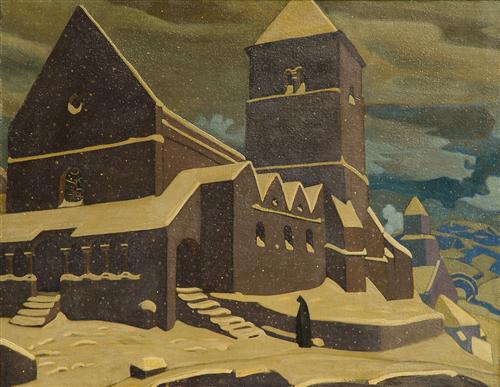
Underground Chud (1928)
Nicolas Roerich
source Wikiart

The second part of the novel, entitled “Falling Sleet”, tells of the experiences of the Undergound Man.  First, he is disrespected by an officer on the street who will not give way to him and the Underground Man plots a revenge of deliberately bumping into him.  The narrative then moves to the Underground Man’s presence at a party for old school mates and his contentious behaviour towards them, as he feels the strength his inadequacies in their presence. Finally, he falls into a type of relationship with a sympathetic prostitute named Liza.  In the Underground Man’s interactions with the outside world, the reader sees a man struggling to use his faculties to assimilate himself into the situations around him, and failing in his attempts. Dostoyevsky created a character who believed in Chernyshevsky’s ideals, but demonstrated through his actions, his inability to live up to them.

And so finishes my “trilogy” of conversation between these three authors.  I have been educated not only historically, but politically and philosophically, and encourage anyone who wants to read any of these books, to read the three in sequence.  With Chernyshevsky and Dostoyevsky particularly, you can sense the antagonism within their writing, yet their passion for their ideologies are very effective and make for enlightening reading.

Trilogy:


Further Reading:
Dostoyevsky: The Mantle of the Prophet by Joseph Frank


Emma by Jane Austen

“Emma Woodhouse, handsome, clever, and rich, with a comfortable home and a happy disposition, seemed to unite some of the best blessings in existence; and had lived nearly twenty-one years in the world with very little to distress or vex her.”

Young Emma Woodhouse of Hartfield has been the pet of her father and governess, and perhaps indulged by both to a faulty degree.  However, her character is one of kindness and charity, but enhanced with a healthy interest in the business of others, especially if it includes the subject of marriage.  Mr. Knightley, a close family friend and owner of Donwell Abbey, attempts to correct Emma and steer her on a more prudent path, but Emma’s high spirits require the correction of life experience. As she stumbles through her attempts at matchmaking based on her faulty reasoning, we see Emma grow from a willful, impressionable, decisive girl into a more careful, thoughtful, and empathetic woman.

From the first sentence we can see that this is a type of coming-of-age novel. The struggles and challenges of life are what develop strength of character. Because Emma has lived a relatively trouble-free and pampered life, we initially see in her character a willful blindness which often only serves to punctuate the errors in her thinking and of her actions.  The tension in the story is the uncertainty of Emma’s transformation.  We know that she is able to learn, but with her stubborn nature, will that be possible?  Her personal tenacity does not allow for an instant conversion, and instead we see small steps of correction in Emma’s character, even while she gets into more scrapes and misunderstandings.  Yet Emma realizes, or is forced to realize, the value of the advice of those closest to her, admitting her faults and seeking to amend them.

Hartfield
(Squerryes Court)

As I contemplated this read, I felt that it was not simply Emma who was often mistaken. Not only is Emma completely blind, but all the other characters exhibit their own sort of blindness to varying degrees.  Not only does no one know their neighbour or accurately guess their motivations, often people don’t even know themselves.  Each person is often attempting to hide their observations, either out of personal gain or out of societal politeness, but in each case, these decisions are shown to be unwise. Does this tell us that by understanding our fellow human beings that we will gain a deeper knowledge of ourselves?  However, perhaps Mr. Knightley had a more accurate indication of the issue, when he stated, “Mystery; Finesse —- how they pervert the understanding!  My Emma, does not every thing serve to prove more and more the beauty of truth and sincerity in all our dealings with each other?”  We need to be truthfully transparent with one another, even if it is difficult or uncomfortable, to truly cultivate relationships with minimum complication.

By the end of the novel, Emma is a much wiser woman.  Are all of her faults erased?  Not at all, but many of those faults are what make part of her character so delightful.  It is the opening of her mind, the willingness to admit her wrongs and the receptiveness to bettering herself, that makes her a truly likeable heroine.


The Rule of Saint Benedict

“Listen carefully, my son, to the master’s instructions, and attend to them with the ear of your heart.”

Benedict of Nursia lived in Italy during the collapse of the Roman Empire and during his life, the empire was in constant battle with barbarian tribes.  Leaving his home in Nursia, in the region of Umbria during the reign of the barbarian king, Theodoric, Benedict arrived in Rome to attend school but, disgusted with the paganism and dissolution that he witnessed, he eschewed worldly cares, taking residence in a cave at Subiaco, thirty miles east of Rome.

Saint Benedict (circa 1437-1446)
Fra Angelico
source Wikipedia

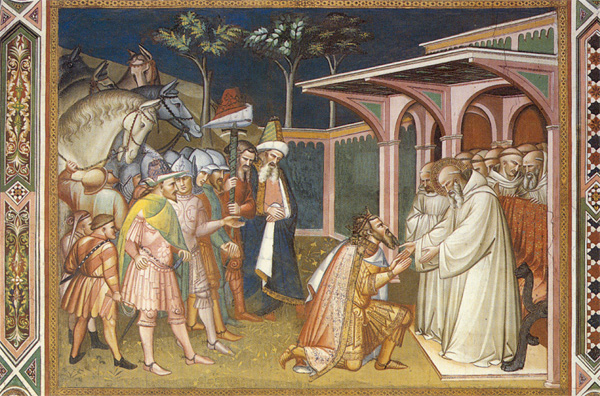
During three years in his cave, Benedict became admired for his spiritual devotion, and when an abbot in a nearby monastery passed away, Benedict was convinced, against his inclination, to take his place.  But twice, monks envious of Benedict attempted to poison him, from which he was saved by miracles.  He eventually took some disciples and founded a monastery on the mountain above Cassino, located eighty miles south of Rome.  As his fame spread, even the great king of the Goths, Totila, sought out an audience with him.

Benedict called his Rule, “a little book for beginners,” and he covers such disciplines as obedience, humility, contemplation and living in community.  Yet he first introduces us to four types of monks, the cenobites (belonging to a monastery and serving under an abbot), the anchorites or hermits (having lived in a monastery for a long time and their zeal for the monastic life has cooled), the sarabites (detestable monks who have “a character as soft as lead”, and are captured by worldly delights, a law unto themselves), and gyrovagues (drifters who are captives to their own selfish desires).  His rule is to assist the first class of monks.

Some specific areas Benedict covers are church songs and readings, excommunication and re-entry, working hours and manual labour, personal gifts, community rank, etc.  The importance of humility was highly emphasized:

The Rules of Humility

  1. Keep the fear of God always before your eyes
  2. Love not your own will but the Lord’s
  3. Submit to your superior in obedience
  4. In obedience, submit to unjustice and difficulties with endurance
  5. Do not conceal (from the abbott) any sinful thought or wrongdoing
  6. Be content with low or menial treatment
  7. Admit with not only your tongue, but with your heart, of your inferiority
  8. Do only what is endorsed by common rule in the monatery
  9. Control your tongue and be silent unless asked a question
  10. Be not given to ready laughter
  11. Speak gently, seriously and with modesty
  12. Manifest humility in bearing, as well as in heart

There were a number of interesting revelations in the rule, which I found rather interesting.  Benedict states that the Lord usually reveals what is best to the younger monks, yet still the abbot has the final decision.  This is a fascinating merging of both older and younger wisdom in a hierarchical framework which is designed to work best for all parties.

Totila and St. Benedict (1400-10)
Spinello Aretino
source Wikipedia

While Benedict’s rule is, in many ways, strict, I was actually surprised at the flexibility within it.  There is grace for those who stumble and understanding of human weaknesses, as is evidenced by the description of abbots and their moral duties:

“……. He must hate faults but love the brothers.  When he must punish them, he should use prudence and avoid extremes; otherwise, by rubbing too hard to remove the rust, he may break the vessel.  He is to distrust his own frailty and remember not to crush the bruised reed.  By this we do not mean that he should allow faults to flourish, but rather, as we have already said, he should prune them away with prudence and love as he sees best for each individual. Let him strive to be loved rather than feared.”

Apparently prior to Benedict’s rule, the theological view was that each person was struggling towards God, and spiritual direction had a very personal aspect to it.  Benedict’s rule signified a turning point in perception, eventually making the process more regimented than personal.  The Rule has further reaching implications as well, being the forerunner to the rule of law and written constitutions, assisting in the shaping of medieval ideas.

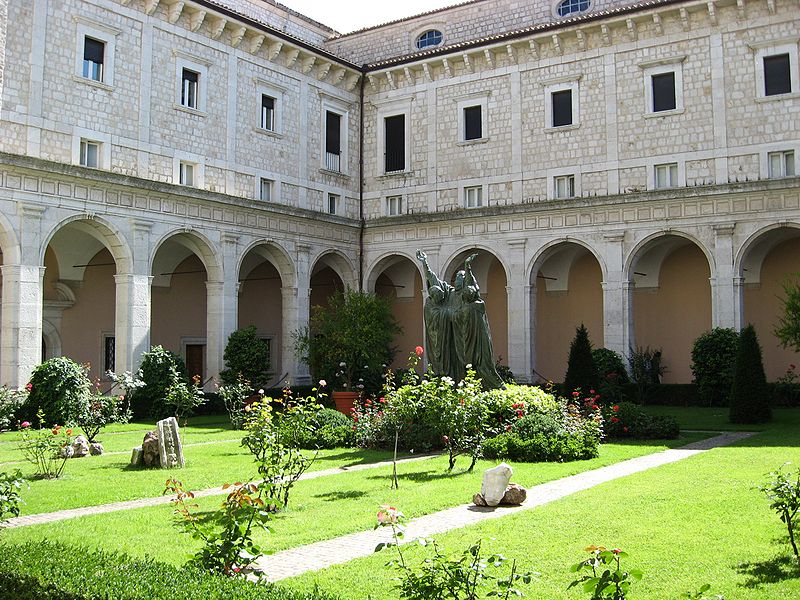
Benedict’s abbey at Monte Cassino was severely damaged by Allied bombing during World War II, having to be rebuilt afterwards.  A bit of trivia:  author Walter J. Miller was part of the bombing raids on Monte Cassino and was severely affected by them.  His dystopian book A Canticle for Leibowitz has echoes of both the monastery and his struggles to come to terms with his part in its destruction.  It’s a great book, if anyone is looking for a recommendation.


Rebuilt abbey of Monte Cassino
source Wikimedia Commons


Montaigne’s Essays – Part Three

Finally, this is the last of my postings on Montaigne’s selected essays, which I started at the beginning of my WEM Project.  I’ve enjoyed his unique character and passionate zest for all his topics that I plan to try to read through all his essays at some point.  Montaigne has the ability to mesmerize you, yet I could sometimes find myself both agreeing and disagreeing with him in the same sentence.  His approach is so singularly charming, a mixing of intellect with storytelling, which make (most of) his essays a joy to read. 

On Freedom of Conscience:  Quite an unusual essay.  Montaigne examines Roman Emperor, Julian the Apostate, so called for having abandoned Catholicism. Nevertheless, Julian had a very tolerant view of religion and allowed all religions equal status.  Montaigne appears suspicious of these motives, claiming that this permissive action can have two outcomes:

1) “to give a loose rein to the factions to hold to their opinions, is to sow and scatter division, and almost to lend a hand to increase it, there being no barrier and restraint of the laws to check and impede its course.”

2)  “to give the factions the reins to hold to their beliefs is to render them soft and lax through ease and facility, and to blunt the edge which is sharpened by rarity, novelty and difficulty.”

Again, Montaigne shows the reader his ingenuity at being able to see more than one possibility.

We Can Savour Nothing Pure:  This is a somewhat melancholy essay. Montaigne reveals that because of the “feebleness of our condition”, we can experience nothing in its natural purity and that all the pleasures or goods that we enjoy are “compounded with some evil or injury.”  Every virtue is tainted with vice, every justice with injustice.

I love his example from Socrates: when Socrates said that the gods wished to join pleasure and pain together, but when they were unsuccessful, they decided to join them by their tails.

Est quædam flere voluptas ~ There is a certain pleasure in our tears.  (Ovid)

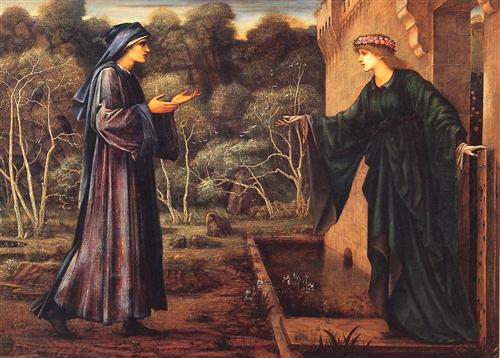
The Pilgrim at the Gate of Idleness (1875-93)
Edward Burne-Jones
source Wikiart

Against Indolence:  Montaigne gives examples of kings who, even though they were in situations that might work agains them, did not allow themselves to become slaves to idleness:

“…… there is nothing that can so justly disgust a subject, and make him unwilling to expose himself to hardships and dangers in the service of his Prince, as to see him all the while lolling in idleness, or busy over paltry and frivolous things ….”

As usual, Montaigne digresses, or perhaps, his topic deconstructs, as he begins with the offense of idleness in leaders, and moves on to how a man should die valiantly and how to meet death.

“……. bravely meeting death, is to look upon her not only without dismay, but unconcernedly, freely continuing one’s wonted course of life even into her very lap.”

And, oh my goodness, the sarcasm!!  He makes me laugh:

“Those who would number Kings of Castile and Portugal among warlike and great-hearted conquerors, because at twelve hundred leagues distance from their abodes of idleness, by the skin of their agents, they made themselves masters of the East and West Indies, may seek some other than myself to agree with them; since it is doubtful whether they would even have had the courage to go in person to take possession of their conquests.”

On Virtue:  With regard to actions spurred by emotion versus actions performed because of resolution or habit, Montaigne maintains that some great deeds can be accomplished by the former, but to truly gage the measure of a man, one must look to his common behaviour.

I was somewhat following him when he gives the example of Pyhrro distrusting human instinct, and so resolutely living by his philosophy, but I was completely confused by the example of a man, winning his love and then, when unable to perform, cutting off his penis and sending it to his mistress.  Further examples of maiming, suicide and death follow; Montaigne appearing to be lauding the people’s premeditated fortitude.

I can hardly make head nor tail of this essay, but is he possibly saying that virtue needs to be cultivated?  He later makes reference to fate, of everyone’s final hour being known, therefore nothing can prolong or shorten our lives.

Anger or The Tussle (1516)
Dosso Dossi
source Wikiart

On Anger:  Montaigne is upset that many places leave the governing of wife and children to the husband, who could be stupid and evil, instead of to the state (who obviously is completely pure and omniscient — do you sense my sacrasm?). He is often seeing children beaten in the street and justice does nothing.

As much as I disagree with the first part of Montaigne’s essay, the next part has some wonderful quotes:

“There is no passion that so disturbs the clearness of our judgement as anger.”

“Faults, when seen through passion, appear greater to us, like bodies seen through a mist.”

Children, servants, etc. should be punished thoughtfully and by using discretion, and thus, the punishment will be taken more to heart and have more effect.

Withheld anger, simmering under the surface is dangerous too, and it is better to have an outburst than have it fester and grow within.  Otherwise, make sure that your anger is controlled, short, and to the point, with no undisciplined passions, resulting in tirades or violence.

On the Useful and the Honourable:  Political office is often filled with lies, betrayal and violence.  Montaigne, however, has always conducted himself with an ingratiating and mildness of manner, and the utmost candour and disinterestedness.  He is not swayed by political passions nor private interest. He could play both sides, but he refuses.

I quite liked this quote:

“When one’s country is disturbed and the people are divided I think it neither handsome nor honourable to be a wobbler and a hybrid, to be unmoved in one’s affections and to incline to neither side.”

Montaigne dislikes war and prefers to be of use to both parties, but his methods of negotiating have not been appreciated, and therefore he prefers working in a private, as opposed to public, manner.

Leadership can require treachery and dishonourable action, but while the person may think that they’ll profit by this behaviour, the end may prove otherwise.

Repentance (1917)
Nicholas Roerich
source Wikiart

Of Repentance:  This essay was extremely difficult but I’ll give it a shot.  Montaigne announces that he very seldom repents. If you show vice, you will be troubled by it, if you show virtue, you will receive the award of its goodness.  To base your actions on other people’s opinions is to build an unsteady foundation. You alone know yourself.  There are base actions ingrained by habit in our will that we cannot fully escape, and are part of our nature, so what is the use of repenting them?

An evil person can be inspired to do good, just as a virtuous person can be inspired to act evilly.  To truly judge a man, one must see him at work at home, or at least in a state of repose.  Montaigne says that to act out a sin, the sin must have lived in the heart of a man and he must consciously will it, therefore, I wonder if he is implying that to repent is almost an insincere act? The disease itself needs to be thrown off.  God must work in our hearts and the conscious must be truly amended.  Wishing to be different is not true repentance.

Montaigne claims to take very little advice, but he gives even less.  He knows of nothing that his advice has benefitted and people do not often act on it, in any case.  Drawing upon a Stoic mindset, the universe unfolds as it may, and Montaigne is happy to be self-contained away from others and any responsibility concerning them.

My favourite quotes:

“Many a man has been a wonder in the eyes of the world in whom neither his wife nor his valet have ever detected anything even remarkable.  Few men have been admired by their own household.”

“To enter a breach, conduct an embassy, rule a people, are conspicuous actions.  To chide, laugh, sell, pay, love, hate, to live in communion with one’s people and oneself, pleasantly and correctly, not to give way to passion, not to contradict oneself; that is more rarely seen, more difficult and less remarked.”

On Experience:  Man has a great natural desire for knowledge but when reason fails, he looks to his experience.  Experience is not the greatest way to knowledge but in the noble search for truth, one may use any option at his means.  Montaigne uses examples from law, science, philosophy and religion to explain that as soon as you attempt to define truth through numerous different perspectives, truth itself is lost.  By spreading it out, we dilute it.

“Men do not realize the natural infirmity of their mind; it does nothing but ferret and hunt around, incessantly like a silkworm, and there suffocating.”

Death and Life (1908-16)
Gustav Klimt
source Wikiart

He has more wise words concerning life and death:

“But you do not die because you are ill; you die because you are alive.  Death will kill you right enough without the help of sickness.  And maladies have kept death away from some who have lived the longer for thinking they were dying. Besides, there are maladies, as there are wounds, that are medicinal and health-bringing.

…… Nature has given it (life) into our hands, trimmed with so many and such happy surrounding, that we have only ourselves to blame if we feel it a burden, and if we waste it unprofitably ….. And yet I am resigned to lose it without regret; but as a thing that is by its nature losable, not as if it were a troublesome burden …. Not to hate the idea of death is properly becoming only in those who enjoy life ……. It needs good management to enjoy life.  I enjoy it doubly as much as others, for the measure of enjoyment depends upon the more or less attention we give to it …… The shorter my possession of life the fuller and deeper must I live it …… Rather should we study, relish and ruminate it, in order to give adequate thanks to him who bestows it upon us.”

This last essay of Montaigne’s marries ideas contained in his former essays, showing through his life experience, as he uses various culinary, emotional, and especially physical examples, how life can be best approached and enjoyed.  It’s a fitting end to my reading of his selected essays!