Language Freak Summer Challenge

Ekaterina at In My Book is hosting a Language Freak Summer Challenge. Since I continually profess that I am going to attempt a book in French, but as yet have had little inspiration, I thought a challenge would be a good shove forward.

How to Participate:

Read books in a foreign language this summer.  The challenge runs from May 1st to August 31st.

The Levels of the Challenge:

Beginner: read 1 book in any foreign language
Intermediate: read 2 books in any foreign language
Advanced: read 3+ books in any foreign language

The books can be in one or in several different foreign languages. You choose what you want to practice! But for really crazy linguists I have a special offer, which is called accordingly:

Crazy Linguist: read at least 1 book in EACH foreign language you know. Of course, this one is additional to the above listed three levels!

Bonus level is for films:

Subs Fan: watch any number of films in a foreign language (Why is it called so? Because subs are allowed, of course!)

After you read your book (or watch a movie), you are encouraged to post about your experience! It can be a review, or a reflection, or a rant, whatever! If the book’s language affected your experience, write about it! Is it easy or difficult? Does it have crazy grammar or so many rare words that you couldn’t put down your dictionary? Share!

For the hardcore language freaks I have another optional task! Try to write about the book in the language you read it in! Just a few phrases, to practice your writing! Last year native speakers were known to friendly explain the mistakes in the reviews, so don’t be afraid to make them! It’s all for your benefit, you know. 

Introductory Post Questions:


1.  What languages do you know?  I know basic French and Spanish (although my Spanish is very rusty), less than basic German with a smattering of Latin and ancient Greek.  

2.  What is your history with these languages?  I studied French for seven years in school but with sub-par instruction, so my French is embarrassingly weak when you consider the study time.  I studied both Spanish and German in school for one semester, but my German teacher was amazing so the German I learned in one semester was comparable to about three years of French class. Latin and Greek I’ve learned alongside my daughter while homeschooling her, but she has surpassed me now.  I wish I had more time to devote to learning these languages.

3.  Do you use them or are you out of practice?  I was very fortunate to be able to travel to France about 5 years ago, twice, for about 6 weeks each time.  Initially my French was woefully inadequate (I had to use Spanish to find my hotel), but gradually it came back and when I left the last time, I was able to understand conversations, although my speaking skills still needed much practice.  I’ve tried to keep it up since then.  My Spanish used to be pretty good, but needs a tune-up.  In German, I’d be lucky if I could read children’s books —- I need more instruction.  As for Latin & Greek, I have glorious dreams of being able to read Homer or Xenephon in Greek and the Aeneid in Latin ……… sadly I have a loooong way to go to reach that point but I can read a short story about the Gallic wars in Latin.  Such is my pitiful claim to fame. 😉

4.  Have you read some books in these languages?  Did you like it (them)?  I’ve read a number of children’s books in both French and Spanish.  I also started both Candide and Alice in Wonderland in French but didn’t finish them.  I tried reading The Cat in the Hat in Latin but crashed and burned. 

5.  What are your plans for the challenge?  I plan to try to read either Le Petit Nicolas, Le Tour de la France par Deux Enfants or Les Malheurs de Sophie as a main book.  Otherwise I would like to read some Fables de Fontaine, a Martine book, some German fairy tales, Ferdinand in Latin and a Spanish book, perhaps Corre, Perro, Corre, or another choice.  It’s nice to have four months for this challenge ~~ there are so many possibilities to explore and I will certainly have the time to investigate them!


Does it sound like fun?  Do you want to join in?  Then write an introductory post and then go to Ekaterina’s blog and link it to the linky there.  Please see her blog for other details about this exciting challenge.  Thanks for hosting, Ekaterina!

What Did I Read?

  1.  Corre, Perro, Corre – P.D. Eastman (Spanish)
  2.  Im Wunderschönen Monat Mai – Heinrich Heine
  3.  Rotkäppchen (Little Red Riding Hood) – Brothers Grimm
  4.  Nuits de Juin – Victor Hugo
  5.  Desiderata (en Français) – Max Ehrmann

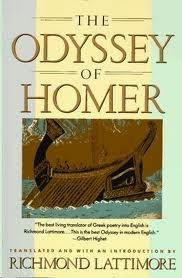
The Odyssey (an Oral Tradition) by Homer

The Odyssey

“Tell me, Muse, of the man of many ways, who was driven far journeys, after he had sacked Troy’s sacred citadel.”

It is nearly 20 years after the Trojan War and Ithaka is still without its king, Odysseus.  Anarchy reigns, as numerous suitors vie for the hand of his wife, Penelope, while ravaging his household goods and disrespecting his memory, and his son, Telemachos, is helpless to prevent them.  Has our hero perished in his quest to reach his homeland, or is he still alive somewhere, struggling to reach home?

The Odyssey begins in media res, or in the middle, where Odysseus is near the end of his journey, becoming shipwrecked on the land of the Phaiakians. These people, who we learn are very close to the gods, give Odysseus an audience for the retelling of his story and the various adventures he has experienced, while attempting to return home from the battlegrounds of Troy.

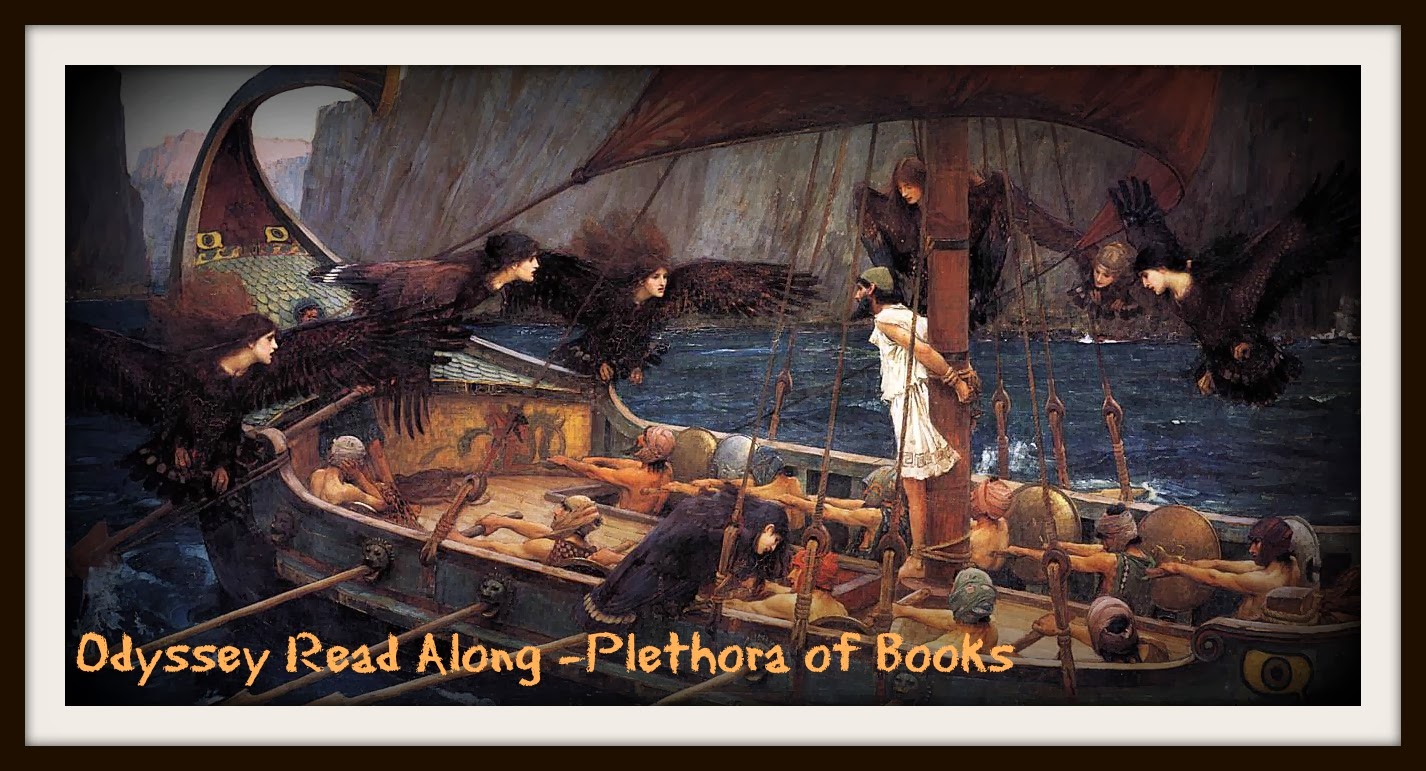
From a violent assault on the land of the Cicones, to narrowly escaping a drugged existence in the land of the Lotus-Eaters, Odysseus endangers his men by deciding to stay in the land of the Cyclops in hopes of gaining host-gifts, and they must set to perilous flight.  Poseidon, angered at the maiming of his Cyclops son, Polyphemus, plots their suffering and Odysseus and his men must endure captivity by Circe, an island goddess; a trip to the land of the Dead; a narrow escape from the Sirens, Scylla and Charybdis; and further imprisonment by the nymph, Calypso, lasting seven years, before he is released and lands on the island of the Phaiakians.  Yet, mainly because of the rage of Poseidon, but due also to Odysseus’ and his men’s misguided judgement, his whole crew is killed on the way home and he is left to continue the final part of his journey alone.

The Odyssey Homer

Fame and glory, or in Greek, kleos, are the most important values in this society. It appears that the suitors can disrespect and commandeer Odysseus’ household, only because there is no story attached to his fate.  If he had died fighting in Troy, and therefore receiving a generous helping of fame and glory, this inheritance would have passed down to Telemachus, which would have engendered a reverence and respect among the people. It might not have prevented a few of the more aggressive suitors attempting to utilize their power, but Telemachos certainly would have received more support and sympathy from other Ithakan families.   Gifts and spoils are another aspect of fame and glory.  The more one acquires, the more renown is added to their reputations.  This perhaps explains why Odysseus pours on the charm with the Phaiakians, who bestow on him more gifts than he could have won at Troy, then taxi him to Ithaka, unaware that they have angered Poseidon, who turns their ship to stone in the harbour on their journey back.

The guest-host relationship, or in Greek, xenia, is another aspect of Greek culture unfamiliar to modern readers.  If a guest visits your house, you are required by the tenets of hospitality to give him food and shelter.  These acts are even more important than discovering his name and peoples, as we often see this information offered after the initial formalities are served.  The concept of xenia is emphasized because one never knows if one is hosting a man or a god.  As a modern reader, it was amusing to see poor Telemachos attempt to extricate himself from Menelaos’ hospitality and avoid Nestor’s, in an effort to avoid wasting time in the search for his father.  I’m certain amusement wasn’t Homer’s intention but it wasn’t surprising as to the emphasis placed on this tradition.  Any deviation from this custom could result in dishonour and a possible feud with your potential host or guest.

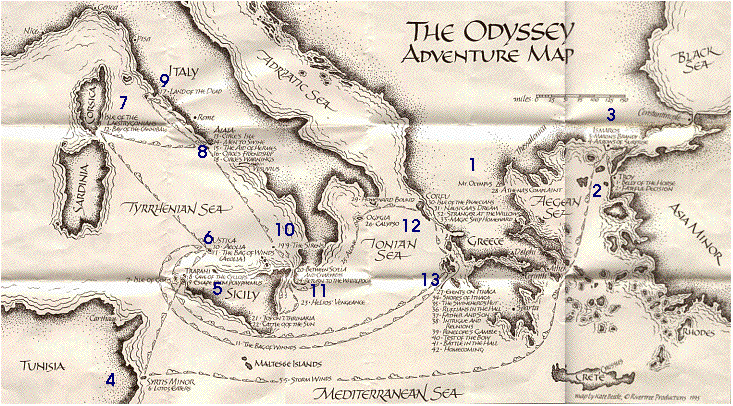
The Odyssey Homer
1. Mt. Olympus   2. Troy   3. Kikonians   4. Lotus-Eaters   5. Cyclops
6. Aeolia’s Island   7. Laestrygonians   8. Circe’s Kingdom  9. Land of the Dead
10. Sirens   11. Scylla & Charybdis   12. Kalypso   13. Ithaka
source Nada’s ESL Island

Greek literature has been a surprising passion of mine.  From my first read of The Iliad, I was hooked and I often wonder why?  The heroes are chiefly concerned with fame, glory, reputation, pillaging and the spoils of war; the gods are jealous, capricious, vindictive and possess far too many human traits for comfort.  Yet I think what draws me to these characters is that they are so real …….. fallible, vulnerable, imperfect, yet they exhibit these deficiencies through an heroic, courageous and larger-than-life persona. They have their customs and traditions, institutions designed to help their society flourish, and which are important enough to sacrifice happiness, comfort and, at times, even their lives, to preserve.

The Odyssey Read Along Posts:  Book I & II / Book III & IV /  Book V & VI /  Book VII & VIII /  Book IX & X /  Book XI & XII / Book XIII & XIV /  Book XV & XVI /  Book XVII & XVIII /  Book XIX & XX /  Book XXI & XXII /  Book XXIII & XXIV

A note on translations:  if you plan to read only one translation of The Odyssey, I would highly recommend Richard Lattimore’s translation, as it is supposed to be closest to the original Greek, while also conveying well the substance of the story.  Fitzgerald is adequate but likes to embellish, and the Fagles translation …….. well, as one learned reviewer put it, “they are so colloquial, so far from Homeric that they feel more like modern adaptations than translations.”  I would have to agree.

For people who are interested in introducing their children to the tales of Homer, there are a number of excellent books for children which I will list here:

This book counts as Plethora of Books Classic Club Spin, so I finished her book and my spin book, as well.  I’m going to give myself a pat on the back and less guilt for not finishing my previous spin book (yet). 🙂

Translated by Richard Lattimore


Classics Club


Madame Bovary Read-Along Part I

Madame Bovary Read-Along Hosted by ebookclassics &         Cedar Station

Madame Bovary by Gustave Flaubert
Part I

Characters:

Charles Bovary:  in Charles we see a character who is conventional, steadfast, responsible, yet with an uninteresting, mundane aspect to his nature, that is readily apparent.  After a short rebellion, while studying for his medical examinations, he passes with a fairly good grade and begins his life as a doctor.  After an arranged marriage (by his controlling mother) with a much older widow, he finds himself attracted to Emma Rouault, the daughter of one of his patients.  When his wife dies, he marries Emma quickly and, while treating her with a dog-like devotion, he does not see deeply enough within her character to truly understand her.  His life is lived in blacks and white and shades of grey; no colour is perceived and this is to his detriment.

Emma Bovary:  how do I describe Emma?  Is she spoiled?  Is she temperamental?  Is she sentimental?  Perhaps she is all these, but her character traits play out through a soul that seems wounded or perhaps, damaged.  Sent to a convent as a young girl to be educated, Emma complies with the rules to a point, but it is evident that she has a natural rebellious streak and the nuns are relieved when she finally returns to the home of her father.  Within the convent she has managed to acquire and adopt a steady diet of romantic, sentimental novels, from which, given her isolated circumstances, she develops a warped understanding of the manner in which life should be lived.  A poetic, dramatic, imaginative fantasy life permeates most of her waking moments and when Charles appears, she fits him into her illusions, hoping he will fill the emptiness inside her.  As a reader, while you can understand the difficulty of her isolation, her complete self-absorption is startling and, as a character, she is not at all sympathetic.

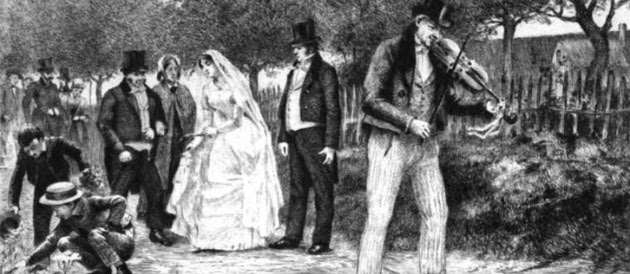
The Bovary’s Wedding Day

After learning about Charles’ childhood, I felt that his character was made up both by circumstances and an inherent ……. well, I’m not sure if I can say “goodness”.  There is a lack of action about him, his inertness perhaps being mistaken for a deeper integrity than he deserves.  I was somewhat disappointed that, because of his first wife’s shrewish character, he allowed himself to become unreasonably infatuated with Emma.  One can only wonder if he will have gotten what he deserves.

Emma’s time in the nunnery appears to have had little affect on her character.  She did not learn patience or temperance or sacrifice.  The explanation as to how she acquired all her romance books seemed a little weak to me, but the affect of their sentimentality is apparent.  I’m not sure that we can blame all of Emma’s character on the romances though; Emma does not appear to want to face reality if it does not correspond with her inner fantasy life.  I anticipate tragic results.

Madame Bovary
Illustration by Charles Léandre (1931)
source Wikimedia Commons

So far, the picture on the right speaks volumes about Emma:  no matter what is happening, no matter if there is upset or happiness or entertainment or silence, Emma Bovary is bored, bored, bored!

Candide by Voltaire

“In the castle of Baron Thunder-ten-tronckh in Westphalia, there once lived a youth endowed by nature with the gentlest of characters.”

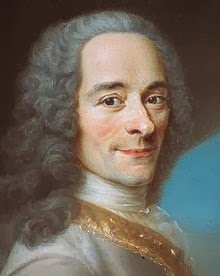
Published when Voltaire was 66 years old, Candide was expressly written to satirize the philosophy of Optimism.  This optimism was not simply the positive hope of better circumstances, but the belief that everything that happened was for the best, no matter if good or bad, happy or tragic.  This philosophy disgusted Voltaire because he felt that it left no facility for bettering oneself or one’s surroundings and that it supported fatalism and complacency.  The tragic earthquake in Lisbon in 1755 seemed to precipitated the writing of this novel, causing the author to question justice in such a calamity, and reflected in his poem, “Poem on the Disaster of Lisbon,” written weeks afterward.  Candide was further emphasis of Voltaire’s rejection of the attitude that life was the “best of all possible worlds” and that everything that happened in it was for the best.

Voltaire
detailed portrait by Maurice Quenton de la Tour
source Wikipedia

Voltaire was an established writer and thinker by the time he wrote Candide, yet a controversial figure who by many was both admired and hated.  He  was continuously clashing with the government and the church, suffering two periods of incarceration, and most of his adult life was spent exiled from Paris, the city of his birth.  Much of his works were published under a pseudonym to avoid prosecution.  During a stint in exile, he spent three years in Great Britain and, impressed with the freedoms of England, particularly that of speech, his stay intensified his desire for reforms in his home country.  In 1758 he settled in Ferney in eastern France, spending his time farming, writing and supporting local business.  Candide was written there, not long after his move.

Satire:  the use of humour, irony, exaggeration, or ridicule to expose and criticize people’s stupidity or vices, particularly in the context of contemporary politics and other topical issues

Candide is a young man who has grown up living in a state of perfect happiness, guided by his tutor, Pangloss, who is entrenched in the doctrines of Leibnizian Optimism.  Leibnizian Optimism, a philosophy of Gottfried Wilhelm Leibniz, believed that this world is the best of all possible worlds because it was created by an omniscient God who would not create flaws if a better world could have been created, therefore, whatever we experience in this world, be it good or bad, must work towards good.  When Candide is thrown out of his paradise, he travels the world, at times escaping persecution, and at others, searching for his love, Cunégonde, experiencing many horrific trials and suffering that challenge the philosophy entrenched by his tutor, causing him to question over and over, if this really is “the best of all possible worlds.”

I really whiffle-waffled over how I felt about this book.  On one hand, Voltaire can write a fast-moving, engaging tale.  His storyline was amusing and it did contain deeper themes that, if the reader had a strong attention span, challenged him to think about his view of the world, his place in society and his response to injustice.  Yet Voltaire’s method was rushed and honestly, just too absurd to ellict introspection for long.  Candide flew from one adventure to the other, characters threw philosophical comments around, but there was no time or room for philosophy itself.  Voltaire never took a thought or comment from a character into deeper conversation; he simply told the reader what the characters did or thought, but we weren’t privy to the conversation.  As a reader, you were often left swimming in a murky haze of Voltaire-imposed ignorance ……. Yet perhaps this was Voltaire’s intention.  Perhaps at the end of the book, as Candide states, “we must cultivate our garden,” Voltaire meant that we should all mind our own business, not examine things too closely, and just work with what is at hand.  Okay, but it is self-introspection that causes a human being to better himself, it is dialogue and discussion that can often help a society, as well as having the possibility to harm it.  People need to have hope, and to cultivate hope it often means having dreams that reach outside our immediate circle of life.  Within the light-hearted narrative that almost masked the tragedy, I felt a fatalism with which I could not accept or sympathize.

That said, these were only my impressions of a book that touches on topics of which I have a limited understanding.  To give an informed opinion on Voltaire’s stance, you would really need to have more than a cursory knowledge of Leibnizian Optimism, as well as having at least summary knowledge of his contemporaries, with a dollop of the study of the Enlightenment on top.  So I will count this as the beginning of my inquiry into the Enlightenment and Voltaire, and hope that my journey fairs better than the journey of Candide.  And until my next foray into Voltaire, I will be cultivating my garden.

Translated by Lowell Blair

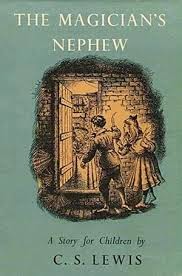
The Magician’s Nephew by C.S. Lewis

“This is a story about something that happened long ago when your grandfather was a child.”

When Digory’s father is posted to India and his mother becomes ill, they must leave their country life and settle in London with Uncle Andrew and his sister, Aunt Letty. Fortunately Digory soon meets Polly, a girl who lives in one of the connecting row houses, and the adventure begins!

While trying to find a passage through the attics from Polly’s house to Digory’s, they inadvertently stumble into the workroom of Uncle Andrew.  To this point, Digory has not had much contact with his scientific uncle, but this experience proves without a doubt his uncle’s evil nature.  With a magic ring, he sends Polly into another world with no chance of returning, without Digory entering the world as well, with two magic rings that will bring them back.


Aslan in the process of creating Narnia’s animals
Pauline Baynes 1955

Lewis believed that each one of our actions in life either took us one step closer to Heaven, or one step closer to Hell.  Now, this didn’t mean that by doing something bad, you would go to Hell; Lewis wanted people to be aware that their actions matter.  Our actions are what form our character and each action works either towards forming a good, trustworthy, amiable character, or a bad, prideful, self-centred character.

Uncle Andrew is a fine example of a character gone rotten.  He is untrustworthy, lacks a conscience and is extraordinarily narcissistic, believing because of his perceived superior intellectual skills and his ability as a magician and scientist, that he is exempt from societal conventions and moral obligations.  His cultivated vanity is uncontainable, and in his selfishly aggrandized mind, the ends always justify the means.

At the beginning of the story, while being different from his uncle, Digory, however, shows some disturbingly similar traits.  He exhibits the same weakness as his uncle when, in The Wood Between Two Worlds, he suggests that instead of going directly back to the study, they explore another pool.  Curiosity overcomes his common sense and a stubborn prideful attitude closes his ears to Polly’s initial prudent advice. Fortunately he agrees to Polly’s insistent demand to test the rings to see if they are able to return easily; unconstrained curiosity can get one into unexpected perils and it is important that a thirst for knowledge is tempered with a respect for the nature of things.

Similarly in Charn, even though Digory senses that it is a “queer place,” he once again ignores Polly’s suggestion to leave, using words to deride and mortify her to make her abandon common sense.  Finally, he again allows his curiosity to override his good judgement, when he rings the bell in Charn, waking an evil that is beyond his imagination.  Curiously, just before this act, Polly remarks, “You look exactly like your uncle when you say that.”

Yet finally Digory starts to make wise choices.  In spite of being initially captivated by the evil Empress Jadis, his enchantment begins to dissipate after he hears of her ruthless destruction of Charn and of her plans to travel to their world.  He also has the integrity to make a full confession when Aslan asks him about the evil that he brought into Narnia, and his bravery and honesty serve him well, as Aslan trusts him with the quest of bringing back a magic apple to grow a tree to protect Narnia from the evil that lurks there.  Within the garden there is a replay of the temptation of Eve, this time with Jadis as the tempter and Digory the intended victim.  Yet Digory shows surprising resilience, faithfully resisting the witch’s manipulations and temptations, returning to fulfil his quest.  Through the characters of Uncle Andrew and Digory, we see the formation of a virtuous character who makes prudent choices (with mistakes along the way), and the result of a deceptive and corrupt character who makes the wrong choices .

The Mountains of Mourne
…. inspired Lewis to write the Chronicles of Narnia …
source Wikipedia

Ah, this post is already too long but there are so many other elements enmeshed in this fascinating tale. Lewis’ use of “supposition” to represent the creation of Narnia was just lovely. There are obvious parallels to Genesis and the creation of Earth, but also differences, that are as creative as they are compelling.  Aslan singing the entire world of Narnia into existence, evoking edenic and pastoral images, is a beautifully captivating scene.  The Deplorable Word is thought to be a reference to the atomic bomb; when Lewis began writing this book, the world was at war, and its annihilation would certainly have been foremost in his mind.  And there is also an example Plato’s theme of self-deception, which we see played out in the character of Uncle Andrew.  Plato believed that self-deception was a state of mind where irrational desires supersede natural reason as a guide for ethical behaviour, and while the person believes that their conduct will bring them happiness, in effect, it only brings them misery.  Socrates also levelled the charge against his countrymen that blindly pursuing knowledge through any means, with the goal being the resulting power attained, can only be realized at the expense of truth and morality.

The last book in the Chronicles of Narnia series is, of course, The Last Battle.  I can’t wait!


C.S. Lewis Project 2014


Other Narnia Books

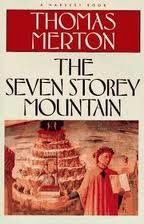
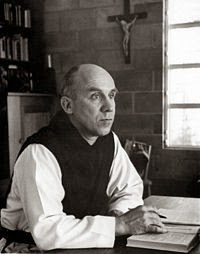
The Seven Storey Mountain by Thomas Merton (Classic Club Spin #5)

“On the last day of January 1915, under the sign of the Water Bearer, in a year of a great war, and down in the shadow of some French mountains on the borders of Spain, I came into the world.”

I had heard many stories about Thomas Merton, the “Buddhist Trappist monk” and I was interested in finding out the commonalities he discovered between Buddhism and Catholicism. However, as it turns out, The Seven Storey Mountain is an autobiography of Merton’s early life, before he converted to Catholicism, and covering a few of the years after he entered the Trappist monastery, so I’ll have to search further to read about the Buddhist-Catholic component.  Nevertheless, this book, which was featured in the National Review’s 100 Best Books of the Century, was charming, funny, heart-warming, spiritual, serious, emotional and intellectual.

Born in Prades, southern France on January 31, 1915, and during the First World War, Merton had a somewhat nomadic life as a child.  Perhaps gaining perspective and creativity from his artistic French father and a certain practicality from his American mother, he draws the reader into the book in the first chapter:

“On the last day of January 1915, under the sign of the Water Bearer, in a year of a great war, and down in the shadow of some French mountains on the borders of Spain, I came into the world.  Free by nature, in the image of God, I was nevertheless the prisoner of my own violence and my own selfishness, in the image of the world into which I was born.  That world was the picture of Hell, full of men like myself, loving God and yet hating Him; born to love Him, living instead in fear and hopeless self-contradictory hungers …… My father and mother were captives in that world, knowing they did not belong with it or in it, and yet unable to get away from it.  They were in the world and not of it —— not because they were saints, but in a different way: because they were artists.  The integrity of an artist lifts a man above the level of the world without delivering him from it ……… I inherited from my father his way of looking at things and some of his integrity and from my mother some of her dissatisfaction with the mess the world is in, and some of her versatility.  From both I got capacities for work and vision and enjoyment and expression that ought to have made me some kind of King, if the standards the world lives by were the real ones.  Not that we ever had any money; but any fool knows that you don’t need money to get enjoyment out of life.”  

From Merton’s early life in France, we move with him to America and then, after the death of his mother, his return to France with his father, while his brother, John Paul, is left behind with his grandparents.  When Merton is 13 years old, they move to England, but when his father dies of a brain tumour, he eventually moves to the U.S. again, and finds himself enrolled in Columbia University, on his way to a possible promising professorship.  Yet life intervenes and through various circumstances, Merton finds the church and from there, a personal relationship with God.

Merton was not a man who was searching for an escape from life. Fascinatingly, he did not find the monastery; the monastery found him. Initially, as a young man, his life consisted of university, friends, bars, girls and fun.  Calling himself a true child of the modern world, he was a mirror of its afflictions: selfishness, ambition, irreligion, materialism, etc.   His expectations were to graduate and find employment, as other young men in his situation.  Yet within the social activity and superficial amusements that he experienced as a typical American youth, he nevertheless felt an emptiness that came with an increasingly strong desire to be filled.  Perhaps Merton had tried it all and the only thing left was God.

Merton’s prose is delightful, both beautifully description and harmonious, yet he is also adept at injecting light humour into situations:

“‘France!’ I said, in astonishment.  Why should anybody want to go to France?  I thought: which shows that I was a very stupid and ignorant child.”

And an excerpt from a trip to Switzerland with his family when he was about 11 years old:

“The rest of the time was one long fight.  We fought on pleasure steamers, we fought on funicular railways, we fought on the tops of mountains and at the foot of mountains and by the shores of lakes and under the heavy branches of evergreens ……………. By the time we got to the Jungfrau koch, everybody was ready to fall down from nervous exhaustion, and the height made Bonnemaman faint, and Pop began to feel sick, and I had a big crisis of tears in the dining room, and then when Father and I and John Paul walked out into the blinding white-snow field without dark glasses we all got headaches; and so the day, as a whole, was completely horrible …………… John Paul humiliated the whole family by falling fully dressed into a pond full of gold-fish and running through the hotel dripping with water and green-weeds.”

Merton’s deep understanding of human nature is punctuated by intelligent comments throughout the book.

On school:  “But when a couple of hundred of these southern French boys were thrown together in the prison of that Lycée, a subtle change was operated in their spirit and mentality.  In fact, I noticed that when you were with them separately, outside of school, they were mild and peaceable and humane enough.  But when they were all together there seemed to be some diabolical spirit of cruelty and viciousness and obscenity and blasphemy and envy and hatred that banded them together against all goodness and against one another in mockery and fierce cruelty and in vociferous, uninhibited filthiness.”

On literature:  “A course in literature should never be a course in economics or philosophy or sociology or psychology …….. the material of literature and especially drama is chiefly human acts — that is, free acts, moral acts.  And, as a matter of fact, literature, drama, poetry, make certain statements about these acts that can be made in no other way.  That is precisely why you will miss all the deepest meaning of Shakespeare, Dante, and the rest if you reduce their vital and creative statements about life and men to the dry matter-of-fact terms of history, or ethics, or some other science.  They belong to a different order.”

On capitalism:  “It is true that the materialistic society, the so-called culture that has evolved under the tender mercies of capitalism, has produced what seems to be the ultimate limit of this worldliness.  And nowhere, except perhaps in the analogous society of pagan Rome has there ever been such a flowering of cheap and petty and disgusting lusts and vanities as in the world of capitalism, where there is no evil that is not fostered and encouraged for the sake of making money.  We live in a society whose whole policy is to excite every nerve in the human body and keep it at the highest pitch of artificial tension, to strain every human desire to the limit and to create as many new desires and synthetic passions as possible, in order to cater to them with the products of our factories and printing presses and movie studios and all the rest.”

courtesy of The Thomas Merton Center at Bellarmine University   

Through his writing, Merton’s connection with the outside world was only enlivened and strengthened after he entered the Trappist monastery. Most of his most vibrant and inspirational work was produced while he was cloistered, as if being in the world made him understand it less, but by being removed from it, he gained a greater understanding.  While his post-monastery accomplishments were vast, he initially felt the vocation of a writer in conflict with his vows, but under the urging of his abbey superior, he became a prolific author, producing more than 70 books on spirituality, social justice and pacifism, and The Seven Storey Mountain gained him a world-wide reputation.  He became more interested in inter-faith dialogue and amassed a huge correspondence with a great number of influential people.  In 1968 he attended an inter-faith conference for Catholic and non-Christian monks in Thailand, and, after stepping out of the bathtub in his hotel room, Merton was accidentally electrocuted by touching an electrical fan. He was 53 years old.

Upon its publication, The Seven Storey Mountain won critical acclaim, appealing to a post World War II society looking for meaning and stability.  Grahame Greene had high praise for it, saying: “Is is a rare pleasure to read an autobiography with a pattern and meaning valid for us all.  The Seven Storey Mountain is a book one reads with a pencil so as to make it one’s own.”  By 1984 it had sold 3 million copies, and to-date is in continuous printing and is published in 15 different languages.

The value of a book such as this is that it takes you out of life as you see it from your own perspective.  Like it nor not, society influences our thoughts, our choices, our perceptions and our actions.  We often see situations from one vantage point and must struggle to get a different view.  Merton starts with the familiar, living the status quo, but then takes you out of the normal, the complacent, the mundane, and allows you to see life from a completely different aspect.  The door is open and you are free explore.

I’m looking forward to reading more of Merton’s work.  He examines so many fascinating ideas in so many different areas, and really gets me thinking.  And I actually finished my Classic Club Spin #5 so I’m going to celebrate!  Yay!

Candide Read-Along Chapters 25 – 30

Chapter 25 – 26

Pococurante received them politely but he is strangely unenthusiastic. Candide attempts to engage him on a number of subjects but he is always very blasé about each and finds something negative in every topic presented.   Claiming that in Italy, they only write what they don’t believe, he abuses Milton and then pronounces that he always says what he thinks whether people agree with him or not.  Flabbergasted at his continual judgements, when they leave Candide claims that Pococurante must be a happy man because he is above everything around him.  Martin, however, sets him straight, claiming, au contraire, that the senator is digested with everything.  When Candide inquires if there is not pleasure in being critical, Martin restates his question asking if there is pleasure in no pleasure. Claiming that he’ll be a happy man if he can see Cunégonde again, Candide, with Martin, continues on his way.  While Candide and Martin prepare to have a meal with six other foreigners, Cacambo appears and reveals that Cunégonde is in Constantinople, while he is a slave.  He then whispers in his master’s ear that he must leave the table and four other slaves do the same to their masters, while the sixth says to his master that they have no more credit and will be put in jail.  Amazed, Candide asks them if they are kings and they introduce themselves as six dethroned kings, Ahmed III, a great Sultan; Ivan, emperor of Russia; Charles Edward, King of England; a King of Poland; another King of Poland; and Theodore, elected king of Corsica, who is penniless; the others assist him with money, and Candide gives him a diamond.  Four Serene Highnesses who have also been dethroned arrive but Candide is too busy trying to figure out how he is going to reach Cunégonde.

Pococurante is similar to Martin, but different.  He is arrogant and condescending and even Martin does not admire his lifestyle.  The kings are all real kings, and I assume their narrative is to demonstrate the capriciousness of good fortune ……… you can be a king one day; exiled and a pauper the next.

Charles Edward “Bonnie Prince Charlie”
John Petite (1898)
source Wikipedia

Chapter 27 – 28

Candide convinces Cacambo’s master to take them to Constantinople, overjoyed at the thought of seeing Cunégonde and professing Pangloss’ philosophy with glee.  Candide remarks over their curious adventure with the dethroned kings, but Martin is not surprised by their fate.  Cacambo confesses to Candide that Cunégonde has lost her beauty but Candide is not dismayed and states that it is his duty to love her.  After arriving at the Bosphorus, Candide buys Cacambo’s freedom and they set off in a galley. Candide notices two galley slaves who resemble Pangloss and the Jesuit baron, Cunégonde’s brother, and they are revealed as such.  They are all introduced and Candide buys the freedom of his friends.  In response to Candide’s apology for his attack on him, the baron describes how he survived and how he arrived at his present circumstance.  Pangloss then gives his explanation of how they did not hang him properly, and how he revived in the middle of being dissected.  When he tried to put a bouquet back into a woman’s decolletage in a mosque, he was arrested and sold into slavery. When Candide asks him if he still believes his philosophy, he replies that he must, along with other obscure references.

“Candide …. reeled back three steps in horror,
and then, for politeness sake, advanced”
(Ilustration 1787 edition)

Chapter 29 – 30

As they land on the shore of the Sea of Marmora, they are still discussing “adventures, reasoning about the contingent or non-contingent events of this universe, and arguing about cause and effect, moral and physical evil, freedom and necessity and the consolations that one can find as a slave ….” The first person they see is Cunégonde, and they are all startled at her altered appearance.  The Baron recoils but recovers and embraces her.  Candide buys the old woman’s freedom (she is there too), and then they find an old farm nearby which Candide purchases.  When he tells the Baron that he is going to marry his sister, the Baron refuses and the old quarrel springs up with threats of murder.  Really, Cunégonde’s ugliness made him wish that he did not have to marry her, but because she was pressing and because of her brother’s arrogance, he is determined.  Instead of killing the Baron, he sells him back as a galley slave.  Now Candide has spent so much money and was cheated and robbed so many times, he now only has his farm left.  Cunégonde grows uglier every day, Cacambo is exhausted by work, and Pangloss is depressed that he is exiled from intellectual society. They have many discussions and arguments about metaphysics, morals, etc.  Martin concludes that man is either bored or afflicted; Candide does not agree; and Pangloss sticks to his philosophy, although he does not believe it. The arrival of the Venetian monk, Brother Gironde with tales of his tragedies shake Candide’s faith, but then they encounter the dervish of the neighbourhood who tells him not to question, to mind one’s own business and to keep quiet, before slamming the door in their faces.  Next, they meet an old-man who tells them that he  cultivates his land and that his work keeps him free from the three great evils: boredom, vice and poverty.  Pangloss says, “man was not born to be idle”; Martin replies, “let’s work without theorizing,” whereupon each “began to exercise his own talents” and “made himself useful”.  One day Pangloss mentions that if all the tragedies and adventures hadn’t happened, they wouldn’t be here now, but Candide only replies: “Well said, but we must cultivate our garden.”

The last chapter is somewhat telling.  Instead of being hit by calamity after calamity, our characters are now simply bored, and the old woman believes this may be worse.  Both the encounter with the dervish and the old man appear significant.  The dervish, while giving them no wisdom on the course they should take, is very insistent on what they should stop doing:  questioning.  The old man, on the other hand, gives them wisdom that appears to turn their lives in a different direction:  work.  Candide now appears to have control of his thoughts and, in the end, it is he that forestalls Pangloss’ speech and tells them what they must do.

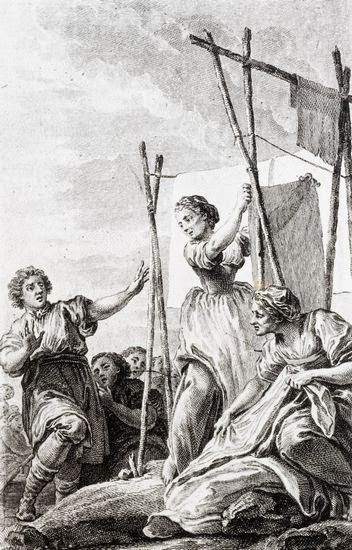
Illustration by Fernand Siméon from ‘Candide ou L’optimisme’ by Voltaire.
Paris: Jules Meynial, 1922. NYPL, General Research Division.

The Horse and His Boy by C.S. Lewis

First Edition Dust Jacket
source Wikipedia

“This is the story of an adventure that happened in Narnia and Calormen and the lands between, in the Golden Age when Peter was High King in Narnia and his brother and his two sisters were King and Queens under him.”

The Horse and His Boy, the fifth Narnian adventure, is set outside of Narnia in a land far to the south called Calormen.  Appearing to be modeled after an eastern land, Calormen is inhabited by dark-skinned people who are traders, merchants and lords, all living under their ruler, the great Tisroc, a descendant of the god Tash.   Shasta, a fair-skinned boy lives with his “father”, a Calormen fisherman, but when a great lord arrives and attempts to purchase the boy, he escapes on the lord’s horse, a talking Narnian horse named Bree.  In their flight they are joined by Aravis, a young Calormen girl escaping on another Narnian horse, Hwin, as she attempts to avoid a distasteful arranged marriage.  Together they learn of the plans of Tisroc’s son, Rabadash to invade Archenland, a kingdom friendly to Narnia, and have to use all their skill and wits to avert a disaster and to find Shasta’s true heritage.

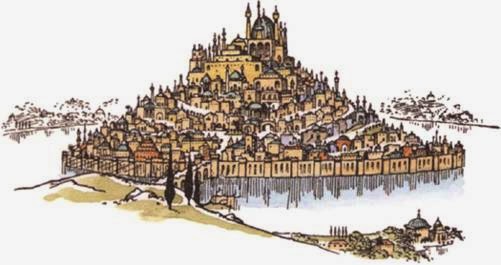
Elements of The Arabian Nights permeate this story.  Calormen is reminiscent of an Arabian city, and the people are perceptive, knowledgeable, wealthy and courteous, yet a ruthlessness runs through their ancient blood.  They are also respected storytellers, able to weave elaborately fabulous tales.

From another viewpoint, the storyline could be compared to a Shakespearean drama.  Lost or mistaken identity are favourite devices of the Bard, and Shasta’s situation fits just this scenario:  a boy who has been taken from his parents, discovers he does not belong within the culture where he lives, and sets out to find out his true heritage.

And finally, a prophecy is given at the beginning of Cor’s (Shasta’s) life, that he will one day save Archenland from a terrible catastrophe.  This prophecy is reminiscent of the Greek story of Oedipus told by Sophocles: a prophecy is given at his birth as well and, as in the case of Cor, every attempt to prevent the prophecy, only causes its fulfilment.

Tashbaan by Pauline Baynes (1953)

Instead of Aslan appearing outright to the children as in other stories and directly affecting the adventure, in The Horse and His Boy, he is presented as a shadowy presence that hovers at the edge of the adventure.  Finally he does intervene but the book makes it very clear that his actions are still behind the story not driving it.  When Aravis remarks that it is “luck” that she was not more seriously wounded by the Lion, the hermit replies, “…. I have never met any such thing as luck”; instead of fortune, it is Aslan or Providence that is helping them on.  As Shasta so wisely remarks, ” ……. Aslan (he seems to be at the back of all stories) …..”

I believe there is also some “reverse-theology” incorporated into the making of the characters of Shasta and Aravis.  Aravis is strong and courageous; she is adept on a horse, knows her mind, and often mocks or secretly despises some of the tentativeness or perceived weakness shown by Shasta.  Yet, at the climax of the story, it is Shasta who shows unexpected bravery and is ultimately trusted with the task of saving Archenland from the troops of Rabadash.  Aravis is forced to admit her pride, which she does most willingly:  “There’s something I’ve got to say at once.  I’m sorry I’ve been such a pig.  But I did change [her opinion of him] before you were a Prince, honestly I did: when you went back, and faced the Lion,” echoing the biblical maxim, “for those who exalt themselves shall be humbled, and those who humble themselves will be exalted.”

The Magician’s Nephew is up next.  It used to be my least favourite chronicle but we’ll see if the years have changed my mind!

C.S. Lewis Project 2014

Other Narnia Books

The Odyssey Read-Along Book XXIII & XXIV (the end!)

The Odyssey Read-Along @ Plethora of Books

Book XXIII

Eurykleia announces to Penelope of her husband’s return, yet Penelope calls her crazy and laments that she is torturing her.  Eurykleia claims she is speaking the truth; Penelope believes, then does not believe her again.  When she descends and sees Odysseus, she produces the same pattern of vacillating feelings, until Odysses produces knowledge of the construction of their bed, the frame built around an olive tree, and her resistance crumbles as she throws herself into his arms.  She confesses that she had always been afraid of tricks from the suitors and that was the reason she felt it necessary to always keep her guard up.  They go to bed, make love, then afterwards fall into conversation, as Odysseus tells her of the prophecy of Teiresias and of the stories of his voyage home.  Waking in the morning, he informs her that he is going to visit his father on his estate, but he is also concerned that a rumour of the death of the suitors may have spread and instructs her to stay in her upper chamber.  He leaves with Telemachos, the swine and oxherd, and as they leave the city, Athene covers them in darkness.

Penelope
What a lovely reunion between Odysseus and his wife!  Although she oscillates between disbelief and belief, I think her reaction is sincere; she truly has been afraid of tricks from the suitors, yet her dearest wish is for her husband to return home.  Her greatest wish and her greatest fear together vie for supremacy in her mind, and is it no wonder that she cannot reconcile her feelings and make a reasonable judgement?
Deception
Odysseus’ plan for the murder of the suitors, again shows his wily reasoning.  He also had devised a plan if anyone questioned the noise coming from the palace:

“So I will tell you they way of it, how it seems best to me.  First, all go and wash, and put your tunics upon you, and tell the women in the palace to choose out their clothing.  Then let the inspired singer take his clear-sounding lyre, and give us the lead for festive dance, so that anyone who is outside, some one of the neighbours, or a person going along the street, who hears us, will think we are having a wedding.  Let no rumour go abroad in the town that the suitors have been murdered, until such time as we can make our way out to our estate with its many trees, and once there see what profitable plan the Olympians show us.”


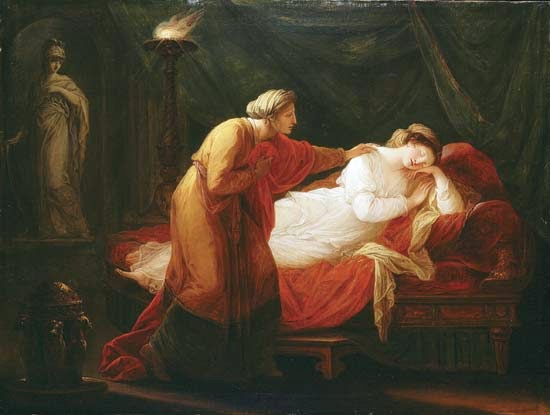
Penelope & Euryclea
Angelica Kauffman 1772
source Wikimedia Commons


Book XXIII

Hermes summons the souls of the suitors and “they followed, gibbering,” as he leads them to Hades.  There, a number of Greek heroes appear, including Achilles and Agamemnon.  Achilles laments that Agamemnon was cut down in the prime of his life and experienced a “death most pitiful”, when he could have died in the land of the Trojans.  Agememnon reciprocates with a narrative of the funeral of Achilles.  When they see the souls of the suitors, they are astounded, and Agamemnon questions Amphimedon, who appears to give an accurate accounting, but puts the blame on Penelope for her “planning out death and black destruction.”  He also criticizes Odysseus’ treatment of them after their death.  Amusingly, after Amphimedon’s elaborately long story, Agamemnon only remarks on the wonderful loyalty of Penelope.  As this is happening, Odysseus and his company arrive at his estate and find his father in the orchard.  Odysseus ponders whether to announce himself outright, or “to make a trial of him and speak in words of mockery.”  He decides the latter.  Chiding his father for his ragged appearance, he then pretends that he has encountered Odysseus in another country, and offers another extravagant lie as to his history.  When his father begins to groan and lament, he finally reveals himself.  Laertes, like Penelope, is at first sceptical, whereupon Odysseus shows him his scar.  His father hugs him with joy but then expresses fear at repercussions that must come because of Odysseus’ actions.  They go into the house where Laertes is bathed and anointed, then appearing like an immortal god; he laments he did not take part in the battle against the suitors with his son.  Meanwhile “rumour” is flying through the city and Eupeithes, the father of Antinoös calls for revenge, yet Medon says that Odysseus’ conduct was with the approval of the gods, throwing fear into the assembly.  Halitherses reasons that the suitors’ own actions brought on the terrible tragedy, bringing half the crowd to his side.  Athene asks Zeus for advice and he judges that Odysseus’ actions were proper, and that it is time for friendship and peace.  Athene flies down in the form of Mentor, as Odysseus sees men approaching the estate and cautions Telemachos not to “shame the blood of your fathers.”   Athene gives Laertes an uncommon strength and he is able to throw his spear right through the helmet of Eupeithes.  The parties fall to fighting until Athene stops them, calling for a cessation from “wearisome fighting” and claiming that “without blood, you can settle anything.”  Recognizing the goddess, the men flee towards the city.  Odysseus makes to follow, but Zeus throws down a thunderbolt and Athene commands him to stop the quarrelling.  So pledges were sworn on both sides, settled by Athene, and we can assume Odysseus lived and prospered until his death, as foretold by the prophecy of Teiresias.
Fame and Glory
The conversation between Achilles and Agamemnon were contrasting an ignoble death vs. a noble one.  Achilles had fought and died bravely at Troy, and therefore he was buried with honour and ceremony, and his name is still remembered.  Conversely, Agamemnon died a shameful death, struck down covertly by his wife’s lover, and his body was not treated properly after burial.  It seems that in Hades, his only concern is the loyalty or disloyalty of women
Deception
Will the deception of Odysseus never end?  I could not believe he chose to tease and “play with” his father, after all the poor old man had been through.  However, he called his actions a “trial” so perhaps he felt he still needed to establish the loyalty of whoever knew is true identity.

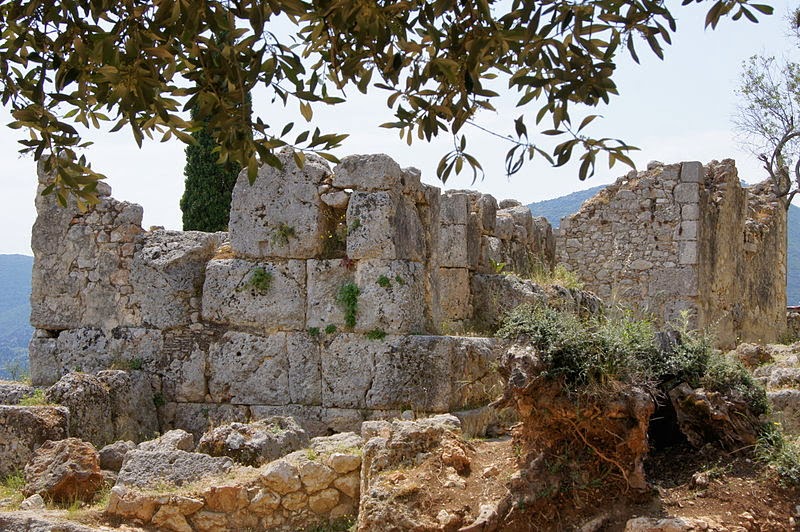
The Palace of Ulysses
source Wikimedia Commons

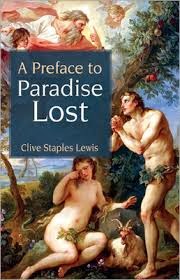
A Preface to Paradise Lost by C.S. Lewis

C.S. Lewis does it again.  Not only does he supply enlightening commentary to accompany a reading of Paradise Lost, but he touches on a number of other books and subjects, conveying fascinating information in an extremely accessible narrative.

A Preface to Paradise Lost is a compilation of Lewis’ Ballard Matthews Lectures, which he gave in 1941 to students at the University College of Northern Wales. Lewis’ expertise was Medieval and Renaissance literature, and while reading this book, it is apparent that he is in his element, as he covers not only Paradise Lost but also gives the reader an introduction to the genre of epic and insights into how to read it.

Lewis’ initial chapters — more than one-third of the book — cover epic poetry, both primary and secondary, and he provides numerous examples contrasting the two, from The Odyssey, The Iliad, Beowulf, The Aeneid and, of course, Paradise Lost, to further the readers’ understanding.  Next, in a lecture titled, The Unchanging Human Heart, he deals with how to read a poem (or book), which is perhaps my favourite lecture of all.  How do we deal with the gulf between our era and the author’s?  Do we read only for what is relevant to us, or do we attempt to engage with the author?  Lewis deals with both approaches:

“A method often recommended may be called the method of The Unchanging Human Heart.  According to this method the things which separate one age from another are superficial ……. if we stripped [off the superficialities] …… we should find beneath … an anatomy identical with our own ….. we shall find the Unchanging Human Heart, and on this we are to concentrate.   

I held this theory myself for many years, but I have now abandoned it.  I continue, of course, to admit that if you remove from people the things that make them different, what is left must be the same, and that the Human Heart will certainly appear as Unchanging if you ignore its changes ……. [thus] our whole study of the poem will then become a battle between us and the author in which we are trying to twist his work into a shape he never gave it, to make him use the loud pedal where he really used the soft, to force into false prominence what he took in his stride, and to slur over what he actually threw into prominence ……….. I do not say that even on these terms we shall not get some value out of our reading; but we must not imagine that we are appreciating the works the old writers actually wrote ……

Fortunately, there is a better way.  Instead of stripping the knight of his armour you can try to put his armour on yourself ………. I would much rather know what I should feel like if I adopted the beliefs of Lucretius than how Lucretius would have felt if he had never entertained them.  The possible Lucretius in myself interests me more than the possible C.S. Lewis in Lucretius …… 

To enjoy our full humanity we ought, so far as is possible, to contain within us potentially at all times, and on occasion to actualize, all the modes of feeling and thinking through which man has passed …….. Only thus will you be able to judge the work ‘in the same spirit that its author writ’ and to avoid chimerical criticism.  It is better to study the changes in which the being of the Human Heart largely consists than to amuse ourselves with fictions about its immutability ……….”


Finally Lewis delves into Paradise Lost, but instead of summarizing the chapters, Lewis concentrates on expounding on particular characters and certain themes.  He explores the poem’s theology, hierarchy, Satan, Satan’s followers, the angels, Adam and Eve, unfilled sexuality, and the Fall. Addressing some of the controversies over the poem, Lewis deals with the difficulties with his typical logical summations and a sprinkling of dry wit.  And while mostly praising Milton’s achievement, he does not hesitate to point out perceived flaws in the work, and while doing so, gives the reader a more profound comprehension of the challenges of Milton’s task.

While amazingly thorough, Lewis’ writing is simple, clear and understandable.  His lectures encourage the reader to read critically, and his explanation of Milton’s worldview is not only helpful, but necessary, to gain a good understanding of the poem.  While being very readable, this guide is the definitive “go-to” book for tackling Paradise Lost for readers who want to go in-depth with their study.

Paradise Lost Review