Classics Club Spin #9

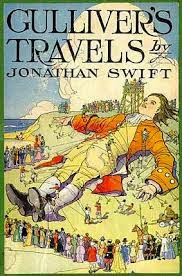
It seems like it’s been a long time between Spins.  My last one was a gem ………  Gulliver’s Travels.  I can only hope to get a book this time that will live up to Gulliver.  He’s going to be a hard act to follow.

As per usual, the rules for the spin are:

  1. Go to your blog.
  2. Pick twenty books that you’ve got left to read from your Classics Club list.
  3. Post that list, numbered 1 – 20, on your blog by next Monday.
  4. Monday morning, we’ll announce a number from 1 – 20.  Go to the list of twenty books you posted and select the book that corresponds to the number we announce.
  5. The challenge is to read that book by October 6th.

I used the random list organizer here to choose the 20 books from my master list.  So my list ended up looking like this:
  1. She Stoops to Conquer (1773) – Oliver Goldsmith
  2. Erewhon (1872) – Samuel Butler
  3. Bleak House (1852/53) – Charles Dickens 
  4. The Histories (450 – 420 B.C.) – Herodotus 
  5. Henry V (1599) – William Shakespeare
  6. We (1921) – Yevgeny Zamyatin
  7. The Mysteries of Udolpho (1794) – Ann Radcliffe
  8. Wives and Daughters (1864/66) – Elizabeth Gaskell 
  9. The Prince (1513) – Niccolo Machiavelli 
  10. The History of Napoleon Buonoparte (1829) – John Gibson Lockhart
  11. Invisible Cities (1972) – Italo Calvino
  12. Twenty Years After (1845) – Alexandre Dumas
  13. Lives (75) – Plutarch
  14. Sense and Sensibility (1811) – Jane Austen 
  15. Dead Souls (1842) – Nikolai Gogol 
  16. That Hideous Strength (1945) – C.S. Lewis
  17. O Pioneers! (1913) – Willa Cather 
  18. The Moonstone (1868) – Wilkie Collins 
  19. The Waves (or other) 1931) – Virginia Woolf 
  20. One Day in the Life of Ivan Denisovitch (1962) – Alexander Solzhenitsyn
I must say that this is a pretty good list.  
Five books that I’m dreading to read:

1.  The Mysteries of Udolpho (for length and mindlessness)
2.  Invisible Cities (so far Calvino and I have yet to be properly introduced)
3.   
4.
5.


Five book that I can’t wait to read:

1.  Bleak House
2.  The Histories by Herodotus
3.  Wives and Daughters 
4.  The Moonstone
5.  O Pioneers!
So we shall see what the spin will bring us in a week.  I have a good feeling about it.

Gulliver’s Travels by Jonathan Swift

“My father had a small Estate in Nottinghamshire; I was the Third of five Sons.”

As Samuel Johnson stated, Gulliver’s Travels is a work “so new and strange, that it filled the reader with a mingled emotion of merriment and amazement.”  One must remember that at the time of Gulliver’s Travels, readers had rarely encountered prose fiction in the form of stories, let along the fantastical stories and adventures of Gulliver.  They didn’t quite know how to respond.

In the last chapter of the this book, its purpose is laid out to the reader, that Swift’s “principal Design was to inform, and not amuse thee.”, a deviation in form, since most medieval writers sought to do both.  The Roman lyric poet, Horace, stated that, “The poet who pleases everyone is the one who blends the useful with the sweet, simultaneously amusing and informing the reader.”  Likewise, Thomas More in his Utopia states that his book is “A Truly Golden Handbook, No Less Beneficial than Entertaining”; Shakespeare seeks also to entertain and instruct, and The Cantebury Tales are described as “tales of best sentence and sola”, expressing the standard medieval definition of literature which both informs and gives pleasure.  So why does Swift no longer want to amuse readers?  Why does he choose to change the medieval model of how literature was represented?  If his readers have not noticed the festering undercurrents of judgement within the story, it’s as if Swift was determined emphasis the seriousness of the work.  As throughout his story, he gives the English people strengths that do not exist, so he also gives the reader amusement, where amusement does not exist.   No wonder people were puzzled by his unique representation.

Born in Dublin  in 1667, Swift spent the early years of his life moving between his hometown and London, attempting to gain a footing both in politics and the Church.  His first position was with Sir William Temple a retired English diplomat who was writing his memoirs.  Swift formed a close relationship with Temple and when he died, Swift hoped to gain a position at Canterbury or Westminister through King William, but the position never materialized.  Amid various other disappointments, Swift continued his travels between Ireland and England, and during these years, he produced A Tale in a Tub and The Battle of the Books, gaining a reputation as a writer.  Gulliver’s Travels was published later in his career, in 1726.

Mural depicting Gulliver surrounded by
the citizens of Lilliput
source Wikipedia

Episodic in nature, Gulliver’s Travels follows Lemuel Gulliver as he visits various unknown civilizations and learns their ways while gently comparing their societies with those of his own.  I say gently because Gulliver makes his musings appear as a gentle examination, but Swift has other ideas. One doesn’t have to look very hard to see that this work is a sweeping condemnation of the human race.

Gulliver first lands in Lilliput where the society is diminutive in stature compared to Gulliver’s enormity.  Initially accepted by the Lilliputians because of his good behaviour, he eventually upsets them by refusing to help them conquer another province and he is forced to escape.

Gulliver exhibited to the Brobdingnag
Farmer – Richard Redgrave
source Wikipedia

His second adventure is nearly an inversion of the first, in that this time Gulliver is small and, landing in Brobdingnag, soon realizes the gigantic features of its inhabitants.  While being poorly treated by his first family, Gulliver eventually comes to the Queen who treats him reasonably well and he is able to converse with the King.  The King, however, becomes unhappy with his description of the state of Europe, in particular their use of guns and cannons.

Gulliver discovers Laputa,
the flying island
J.J. Granville
source Wikipedia

The next adventure includes the flying island of Laputa, which is a rather bizarre place.  The inhabitants are devotees of the arts of mathematics and music only, but not only fail to employ them for any benefit to society, they also, through self-deception, are blindly unable to recognize their failures.

The land of the Houyhnhnms is Gulliver’s fourth and final stop, a land of wise and noble horses, but he also encounters a race called Yahoos, a race very much like himself yet more filthy, vulgar, bestial and stupid.  Although they at first recognize him as a Yahoo, the Houyhnhnms finally take to Gulliver, impressed with his cleanliness and ability to reason.  Yet in spite of the relational ties he makes in this land and his desire to remain among these highly civilized beasts, the horses foresee a danger in Gulliver’s presence and send him off in a boat.  When he arrive home, our protagonist is a changed man.  Disgusted with the “Yahoos” of his country, he is barely able to live in their company, finally choosing a rather secluded life.
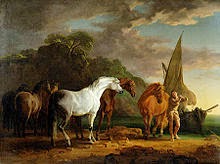
Gulliver taking final leave of
the Houyhnhnms (1769)
Sawrey Gilpin
source Wikipedia

Through Gulliver’s interaction with the Liliputans and the Brobdingnagans, Swift satirizes British politics.  The Liliputans are only concerned with petty and trivial problems, and in their self-aggrandization can only see themselves as governors of the whole world.  Yet while Liliput represents a small view of man, Brobdingnag represents a large one.  As in Liliput, Swift explores the contrasts between liberty and law, but now the situation is reversed as Gulliver is in miniature in a land of giants.  The island of Laputa is built upon philosophy and it’s inhabitants are seen as Swift’s critque of scientism, or that the only way to true knowledge is through scientific disciplines.  Only what can be seen and measured is taken into account, but, of course, this leaves no room to examine the soul.  The land of the Houyhnhnms is perhaps the most fascinating part of the voyages.  In this land the beasts are the civilized society and the Yahoos, who are human, are savages.  The Houyhnhnms live by reason and that reason, working within nature, give rise to their idyllic existence.  Gulliver believes that if he lives long enough with his friends, this virtue will rub off on him, but in fact the horses see his reason as imperfect and therefore he is more dangerous than a Yahoo who has no reason at all.  In reality, Gulliver is half-way between both species, halfway between pure passion and pure reason.

Apparently both Sir Walter Scott and William Thackeray were shocked and repulsed by Gulliver’s fourth voyage, yet there is still argument as to whether Swift’s work was a satire in the form of Horace, where he is only lightly satirizing Gulliver’s idealism, or the heavier satire of Juvenal, whereupon his writing is a vitriolic, sarcastic diatribe condemning the human race.  I’ll leave it to the reader to decide.  Yet perhaps Swift himself can shed light on his intentions:

“I have ever hated all Nations professions and Communityes and all my love is towards individualls for instance I hate the tribe of Lawyers, but I love Councellor such a one, and Judge such a one for so with Physicians (I will not speak of my own trade) Soldiers, English, Scotch, French; and the rest but principally I hate and detest that animal called man, although I hartily love John, Peter, Thomas and so forth.  This is the system upon which I have governed myself for many years (but do not tell) and so I shall go on until I have done with them I have got materials toward a treatise, proving the falsity of that definition animal rationale [rational animal], and to show it would be only rationis capax [capable of reason].  Upon this great foundation of Misanthropy (though not in Timon’s manner) The whole building of my Travells is erected.  And I will never have peace of mind until all honest men are of my Opinion.”

While I thought Swift’s satire brilliant, and his characterizations mostly just, I felt that he focused only on the negative aspects of human nature.  If Swift really saw the world only through a lense of disappointment, treachery, selfishness, and deceit, yet missed the integrity, loyalty, virtues and goodwill of the flip-side of human nature, that is truly a tragedy.

Read for my Classics Club Spin #8, Fariba from Exploring Classics joined me in reading this one.  Here is her most excellent review.  Thanks for the company, Fariba!

(And further reflections by Fariba on Gulliver’s Travels)

Classics Club Spin #8 ……… And the Winner Is ……………

Number 13 !

Yipes!  That means I’ll be reading:

I’m not quite sure how I feel about that.  I’m happy to read it but I think there is a deeper message, a commentary on government or society, or something like that ……..???

Curiously, I’m reading Utopia by Thomas More at the moment so it might be interesting to do a comparison.

For anyone who has read Gulliver’s Travels, can you offer any advice or let me know what to expect?  Should I do some research beforehand?

Okay,  a deep breath, and happy reading everyone!

Classics Club Spin #8

Oh, no.  When I saw it was spin time at the Classics Club, I stopped breathing. I’m swamped beneath a pile of books for online book groups AND courses. For one course, I’m actually required to read Dante’s Inferno and Vita Nuova three times in six weeks!  Help!  So the sane thing to do would be to let this spin pass, right?  …….. Are you kidding?  I wouldn’t miss it!

For my last spin I finished The Importance of Being Earnest (review still in progress) and Moonlight Readers spin book, Summer by Edith Wharton.  This time I’m not going to be attempting double spins, I promise!

As per usual, the rules for the spin are:

  1. Go to your blog.
  2. Pick twenty books that you’ve got left to read from your Classics Club list.
  3. Post that list, numbered 1 – 20, on your blog by next Monday.
  4. Monday morning, we’ll announce a number from 1 – 20.  Go to the list of twenty books you posted and select the book that corresponds to the number we announce.
  5. The challenge is to read that book by October 6th.

I used the random list organizer here to choose the 20 books from my master list.  So my list ended up looking like this:

  1. Ivanhoe (1820) – Sir Walter Scott
  2. Tevye the Dairyman and Motl the Cantor’s Son (1894) – Sholem Aleichem
  3. Twenty Years After (1845) – Alexandre Dumas
  4. Tom Sawyer (1876) – Mark Twain
  5. King Lear (1603 – 1606) – William Shakespeare
  6. 1984 (1949) – George Orwell
  7. Bondage of the Will (1525) – Martin Luther
  8. Henry V (1599) – William Shakespeare
  9. The Cherry Orchard (1904) – Anton Chekhov
  10. The Hunchback of Notre Dame (1831) – Victor Hugo
  11. Hamlet (1603 – 1604) – William Shakespeare
  12. Pensées (1669) – Blaise Pascal
  13. Gulliver’s Travels (1726) – Jonathan Swift
  14. The Time Machine (1895) – H.G. Wells
  15. The Civilization of the Renaissance in Italy (1860) – Jacob Burckhardt
  16. Dead Souls (1842) – Nikolai Gogol
  17. Animal Farm (1945) – George Orwell
  18. L’Argent (1891) – Emile Zola
  19. The Interpretation of Dreams (1899) – Sigmund Freud
  20. The Prince (1513) – Niccolo Machiavelli
Five Books I’m Hesitant to Read
1.  The Interpretation of Dreams – Sigmund Freud (uh, why did I include this
           on my list???)
2.  The Prince – Niccolo Machiavelli (but it’s short so that’s not too bad)
3.  Ivanhoe – Walter Scott (only because it’s so long)
4.  ——
5.  ——
Five Books I Can’t Wait to Read
1.  Ivanhoe – Walter Scott (I’ve been wanting to read it for ages!)
2.  L’Argent – Émile Zola (I can’t wait to visit Zola again)
3.  The Cherry Orchard – Anton Chekhov (I think I’m hooked on Russian lit)
4.  Tevye the Dairyman and Moti the Cantor’s Son – Sholem Aleichem
           (looks like fun)
5.  King Lear – William Shakespeare (loved it the first time, what about the
            second?)

This list is a fantastic draw.  My only concern is the length of the book chosen. Reading anything extra in November is impossible, so that will only leave me one month to finish.  Ivanhoe, as much as I’m dying to read it, is probably not the best choice.

So now all I have to do is hold my breath, cross my fingers and wait.

Are you excited about this spin?  Which titles do you hope to see chosen?

Classics Club Spin #7 …………. And The Winner Is ………..

The winning number for the Classics Club Spin #7 is number 17!  I’m completely happy with this choice because it means that I’ll be able to read Oscar Wilde’s, The Importance of Being Earnest!

It will be fun to read a comedic play and to experience some light-hearted humour after some of the more serious reads I have taken on lately.

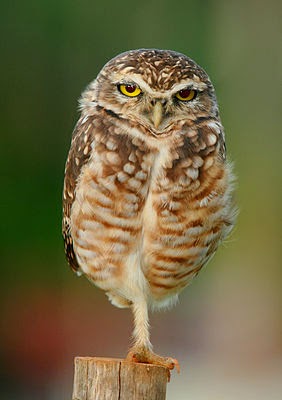
A Burrowing Owl
source Wikimedia Commons

Now I’m off to see what books the rest of my blogger friends will be reading!

Classics Club Spin #7

It’s time for another spin!  I still have my first spin book (from spin #4) to finish, Bleak House, but other than that I’ve completed spins for Oedipus at Colonus, The Seven Storey Mountain, and even someone else’s spin book, The Odyssey.  So I’m not doing too badly.

The usual rules state:

  1. Go to your blog.
  2. Pick twenty books that you’ve got left to read from your Classics Club list.
  3. Post that list, numbered 1 – 20, on your blog by next Monday.
  4. Monday morning, we’ll announce a number from 1 – 20.  Go to the list of twenty books you posted and select the book that corresponds to the number we announce.
  5. The challenge is to read that book by October 6th.

I used the random list organizer here to choose the 20 books from my master list.  So my list ended up looking like this:

  1. O Pioneers! (1913) – Willa Cather
  2. The Rule of Saint Benedict (529)? – Saint Benedict
  3. Ethan Fromme (1911) – Edith Wharton
  4. She Stoops to Conquer (1773) – Oliver Goldsmith
  5. Animal Farm (1945) – George Orwell
  6. Atlas Shrugged (1957) – Ayn Rand
  7. Defense Speeches (80 – 63 B.C.) – Marcus Tullius Cicero
  8. We (1921) – Yevgeny Zamyatin
  9. A Distant Mirror: The Calamitous Fourteenth Century (1978) – Barbara Tuchman
  10. Erewhon (1872) – Samuel Butler
  11. 1984 (1949) – George Orwell
  12. Tartuffe (1669) – Molière
  13. Doctor Thorne (1858) – Anthony Trollope
  14. On the Social Contract (1762) – Jean-Jacques Rousseau
  15. Hamlet (1603 – 1604) – William Shakespeare
  16. Swann’s Way (1913) – Marcel Proust
  17. The Importance of Being Earnest (1895) – Oscar Wilde
  18. The Prince (1513) – Niccolo Machiavelli
  19. The Stranger (1942) – Albert Camus
  20. A Connecticut Yankee in King Arthur’s Court (1889) – Mark Twain

Five Books I’m Hesitant to Read
1.  Swann’s Way – Marcel Proust
2.  Atlas Shrugged – Ayn Rand
3.  A Distant Mirror – Barbara Tuchman
4.  On the Social Contract – Jean-Jacques Rousseau
5.  A Connecticut Yankee in King Arthur’s Court – Mark Twain
Five Books I Can’t Wait to Read
1.  Defence Speeches – Cicero
2.  We – Yevgeny Zamyatin
3.  The Stranger – Albert Camus
4.  She Stoops to Conquer – Oliver Goldsmith
5.  Hamlet – William Shakespeare

With regard to Swann’s Way, I’m only hesitant because of the length; I really have no desire to read Ayn Rand;  A Distant Mirror I’d love to read but I’m just finishing up her The Guns of August and I’d like a breather in between.

Cicero, of course, is awesome; We is supposed to be weird and I’d love a weird book to read; I am so excited to start reading some Camus —- he sounds like an interesting fellow; and I loved Goldsmith’s novel, The Vicar of Wakefield, so I’d like to read something else by him.

How did you spin list go?  Any thrills or any books that you’re dreading?

Oedipus at Colonus by Sophocles

“I am blind and old, Antigone, my child.”

Now blind and aged, Oedipus, with his daughter, Antigone, arrive at a place just outside of Athens called Colonus.  Though warned by a villager that this place in which they wish to reside is sacred, possessed by the all-seeing Eumenides (Furies), a land of Poseidon and Prometheus, and the founding stone of Athens, Oedipus refuses to leave.  A past prophecy has determined that the sacred grove of the Eumenides at Colonus, will be the site of his death, and here he is determined to stay.

Oedipus at Colonus
Jean-Antoine-Théodore (1788)
source Wikipedia

When a chorus of men of the city arrive and, upon learning the identity of Oedipus, they attempt to persuade him to depart from their city, fearing his curse will bring trouble to them.  Oedipus defends his position by agruing that because he had no knowledge of his crimes, he is therefore not responsible for the consequences, in particular, claiming self-defence in the murder of his father, Laius.

But lo, into the fray rides his daughter, Ismene, bringing news that Oedipus’ youngest son, Eteocles, has seized the throne of Thebes from the elder, Polynices, and both sons have heard from the oracle that the outcome of their conflict will depend entirely on the location of their father’s burial.  Yet there is more treachery!  Creon (brother-in-law to Oedipus) is, as she speaks, on his way to ensure that Oedipus will be buried at the border of Thebes, without the ceremony, in an attempt to negate the oracle’s proclamation.
Oedipus at Colonus
Fulchran-Jean Harriet (1798)
source Wikipedia

Denouncing them all as villains, Oedipus meets with Theseus, King of Athens who shows sympathy for his predicament, offering unconditional protection and making him a citizen of his country.  How Oedipus praises his saviour, and declares that his beneficent actions will ensure Athens victory in any altercation with Thebes!

When Theseus exits, Antigone announces the advent of Creon.  At first, he attempts to manipulate Oedipus using pity, but when he sees this tact will not bring him success, he admits to kidnapping Ismene, and grabs Antigone to forcibly take her away.  Theseus returns in kingly grandeur to scold Creon, then the Athenians overpower the Thebians, returning both girls to their father.

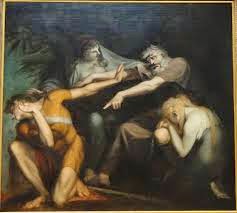
Oedipus Cursing Polynices (1786)
Henri Fuseli
source Wikipedia

One thinks that at last Oedipus might get some peace in his last hours, but it is not to be.  Informed by Theseus that a suppliant has arrived to speak with him, he learns it is his son, Polynices, who begs his father to release the curse he had placed on his sons for their part in his banishment from Thebes, knowing that their conflict is a result of the curse.  Oedipus, in complete disgust of his offspring, refuses and Polynices exits to meet his near-certain fate.

A thunderstorm ensues, which portends Oedipus’ passing.  Oedipus gifts Theseus with the promised gift of protection for Athens and then passes into Hades.  When Antigone wishes to see his tomb, Theseus refuses in response to a promise to Oedipus, never to reveal the location of his tomb.  Antigone departs to attempt to stop her brothers’ conflict.

There is a curious dichotomy in this play with regard to the character of Oedipus.  In spite of the fact he is an exiled, blind old man, with a terrible curse upon him, rarely do you find him subject to the other characters.  In fact, Antigone listens closely to his counsel, he has a command and influence over Theseus, he manages to overcome Creon, and also best his son by refusing to assist him.  On the outside, he is aged, infirm and at the mercy of his hosts, but in actuality, Oedipus is the master of each situation.

Yet Oedipus also places emphasis on his innocence with regard to his crimes.  Again and again, he proclaims to the chorus of Athenian men that he had no pre-knowledge of his transgressions and was, therefore, blameless.  This was a different reaction from Oedipus Rex, where he seemed to take the crimes on to himself, and punish himself for them.

The Death of Oedipus (1784)
Henry Fuseli
source Wikipedia

While on one level, the trials and sufferings born by Oedipus seemed somewhat random in Oedipus Rex, in Oedipus at Colonus we see a culmination of prophecy.  By his exile, Oedipus is brought to the sacred grove of the Eumenides (Furies), fulfilling prophecy, and although this exile was brought about by a curse, Oedipus is actually turned into a hero-type figure by bringing blessing and protection upon the important city of Athens.

Of the 123 plays that Sophocles wrote, only seven complete plays have survived.  That makes me want to cry.  However, parts of plays are still being discovered.  In 2005, additional fragments of a play about the second siege of Thebes, Epigoni, were discovered by employing infrared technology by classicists at Oxford University.  So there is hope that the ancients can still speak to us through time (and new technology) and, as Gandalf said, that is a very comforting thought, indeed!

The book was completed for my Classics Club Spin #6.

Translated by David Grene
Edited by David Grene & Richard Lattimore

⇐  Oedipus Rex  


Oedipus Rex by Sophocles

“Children, young sons and daughters of old Cadmus, why do you sit here with your suppliant crowns?”

A dark curse is upon Thebes.  Blighted cattle and plants cover the land, the women are barren and a deadly plague creeps throughout the kingdom, sparing no one in its fatal grasp.  Creon, brother-in-law to King Oedipus, reveals that the curse placed on the kingdom is a result of the murder of its last king, Laius, and until the perpetrator is found, there is no hope of relief from their present woes.  Oedipus, king of Thebes, calls the wisest man to the palace, the blind prophet, Teiresias, to discover the identity of the vile culprit.  
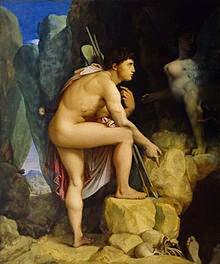
Yet through wise Teiresias and the shepherds of Laius, it is revealed that Oedipus was unwittingly the killer, slaying the king on a road to Thebes, in self-defence and completely unaware of his victim’s identity.  Unbeknownst to Oedipus, he was fulfilling a prior prophecy, that he would kill his father and marry his mother.  And true to prophecy, Oedipus, after freeing Thebes from a different curse by solving the riddle of the Sphinx, became the new king of Thebes and married the current queen, Jocasta, also his mother.

Oedipus after he solves the riddle
of the Sphinx (1808)
Jean-Auguste-Dominique Ingres
source Wikipedia

Upon hearing the fulfillment of the curse, a stunned and horrified Oedipus flees, yet soon finds Jocasta has hanged herself with shame and, grabbing the brooches from her garments, dashes his eyes out until blood flows in rivers down his face. At the behest of Oedipus, Creon banishes him from the city.

The sins of murder and incest has blighted the life of Oedipus and the lives of his progeny; his sons will be left without a father or inheritance and his daughters will be ostracized, unable to marry.  His anguished speech carries notes of his misery and devastation:

“What can I see to love?
What greeting can touch my ears with joy?
Take me away, and haste —– to a place out of the way!
Take me away, my friends, the greatly miserable,
the most accursed, whom God too hates
above all men on earth!”

The state of blindness and the character of Oedipus are closely linked. Instead of listening to the wisdom of the blind prophet, Teiresias, Oedipus refuses to believe him, therefore choosing blindness over knowledge.  Later in the play, when he accepts the knowledge of his actions, he physically blinds himself, which echoes his emotional blindness earlier in the story.

Can one commit a crime with complete lack of awareness and still be responsible for the repercussions of his actions?  Is the harshness of Oedipus’ penalty and the suffering he endures from the consequences, a justifiable outcome given the circumstances?  Why does no one in the kingdom disagree with the punishment of Oedipus, and appear more shocked by the unintentional sins than the maiming he inflicts upon himself?

Oedipus Separating from Jocasta
Alexandre Cabanel
source Wikipedia

What we can take away from this drama is helplessness in the hands of fate.  Though everyone pities Oedipus and does not blame him, there is nothing they can do in the face of his punishment.  To the Greeks, fate is supreme and unaffected by human choice; Oedipus attempts to avoid his destiny yet only succeeds in bringing it to fruition.  Finally, we are exposed to a chilling Greek worldview, that we can “Count no mortal happy till he has passed the limit of his life secure from pain.”

Apparently Oedipus Rex, while first chronologically of the three Theban plays, is in fact the second in written order.  I will enjoy trying to find out the common threads between the three, and if I feel there are any inconsistencies due to the fact they were composed out of order.  The next one on the schedule is Oedipus at Colonus where we meet Oedipus in exile.

Classics Club Spin #6 ……. The Winner Is ………..

The Classic Club Spin number is #1, which means I get Oedipus at Colonus. This choice is both easy, and not as easy as I expected.  Oedipus at Colonus is the second of Sophocles Three Theban plays.  Well, how can I read the second play without the first?  So I’ve decided that I’m going to read Oedipus Rex, the first play, then Oedipus at Colonus followed by Antigone, the final play.

I am looking forward to it.  I spent some time yesterday micro-scheduling my reading (not that I’ll follow it, but at least I’ll know whether I’m ahead or behind, and by how much), so I think this spin will be quite manageable. And, of course, I get to dip into my beloved Greek literature, so for what more could I ask?

Photo courtesy of Olga Filonenko
source Flickr

What is your spin choice?

Classics Club Spin #6

Another Classics Club Spin is in the works.  I can go into this one holding my head a little higher; I finished not only my Spin #5, The Seven Storey Mountain, but I also finished Plethora’s Spin, The Odyssey.  I’ve also begun my Spin #4, Bleak House, so I will be soon caught up, provided I can finish this new Spin book.

And the rules:

  1. Go to your blog.
  2. Pick twenty books that you’ve got left to read from your Classics Club list.
  3. Post that list, numbered 1 – 20, on your blog by next Monday.
  4. Monday morning, we’ll announce a number from 1 – 20.  Go to the list of twenty books you posted and select the book that corresponds to the number we announce.
  5. The challenge is to read that book by July 7th.

I used the random list organizer here to choose the 20 books from my master list.  So my list ended up looking like this:

  1. Oedipus at Colonus (406 B.C.) – Sophocles
  2. Swann’s Way (1913) – Marcel Proust
  3. Tartuffe (1669) – Molière
  4. The Canterbury Tales (1390s??) – Geoffrey Chaucer
  5. Le Rêve (1888) – Emile Zola
  6. The Well at the World’s End (1896) – William Morris
  7. The Small House at Allington (1864) – Anthony Trollope
  8. O Pioneers! (1913) – Willa Cather
  9. Henry IV Part I (1597) – William Shakespeare
  10. The Man Who Was Thursday (1908) – G.K. Chesterton
  11. The Silver Chalice (1952) – Thomas Costain
  12. The Praise of Folly (1509) – Erasmus
  13. The Custom of the Country (1913) – Edith Wharton
  14. Pericles, Prince of Tyre (1607 – 1608) – William Shakespeare
  15. We (1921) – Yevgeny Zamyatin
  16. Persuasion (1818) – Jane Austen
  17. Lives (75) – Plutarch
  18. War and Peace (1869) – Leo Tolstoy
  19. Henry V (1599) – William Shakespeare
  20. The Pickwick Papers (1836 – 1837) – Charles Dickens

Five Books I’m Hesitant to Read

1.  Swann’s Way – Marcel Proust
2.  Lives – Plutarch
3.  The Cantebury Tales – Chaucer
4.  ———
5.  ———

Five Books I Can’t Wait to Read

1.  The Man Who Was Thursday – G.K. Chesterton
2.  Persuasion – Jane Austen
3.  Pericles, Prince of Tyre – Shakespeare
4.  The Custom of the Country – Edith Wharton
5.  War and Peace – Leo Tolstoy (to finish it!)


I’m quite happy with the choices.  I have a few Shakespeare on the list, which is wonderful because I haven’t even read one for my challenge.  The only problems I foresee are the Zola and Trollope choices, because I’m reading through both series in order, however if one of them is chosen, I’ll simply substitute the next book and read on.  I am extremely terrified of choice #2 though.  Can I get through Proust in time?  And Plutarch’s Lives is loooong, although I’d love to read it.  Next Monday will reveal the winner!  I can’t wait!