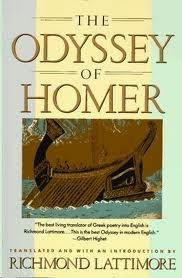
The Odyssey (an Oral Tradition) by Homer

The Odyssey

“Tell me, Muse, of the man of many ways, who was driven far journeys, after he had sacked Troy’s sacred citadel.”

It is nearly 20 years after the Trojan War and Ithaka is still without its king, Odysseus.  Anarchy reigns, as numerous suitors vie for the hand of his wife, Penelope, while ravaging his household goods and disrespecting his memory, and his son, Telemachos, is helpless to prevent them.  Has our hero perished in his quest to reach his homeland, or is he still alive somewhere, struggling to reach home?

The Odyssey begins in media res, or in the middle, where Odysseus is near the end of his journey, becoming shipwrecked on the land of the Phaiakians. These people, who we learn are very close to the gods, give Odysseus an audience for the retelling of his story and the various adventures he has experienced, while attempting to return home from the battlegrounds of Troy.

From a violent assault on the land of the Cicones, to narrowly escaping a drugged existence in the land of the Lotus-Eaters, Odysseus endangers his men by deciding to stay in the land of the Cyclops in hopes of gaining host-gifts, and they must set to perilous flight.  Poseidon, angered at the maiming of his Cyclops son, Polyphemus, plots their suffering and Odysseus and his men must endure captivity by Circe, an island goddess; a trip to the land of the Dead; a narrow escape from the Sirens, Scylla and Charybdis; and further imprisonment by the nymph, Calypso, lasting seven years, before he is released and lands on the island of the Phaiakians.  Yet, mainly because of the rage of Poseidon, but due also to Odysseus’ and his men’s misguided judgement, his whole crew is killed on the way home and he is left to continue the final part of his journey alone.
The Odyssey Homer

Fame and glory, or in Greek, kleos, are the most important values in this society. It appears that the suitors can disrespect and commandeer Odysseus’ household, only because there is no story attached to his fate.  If he had died fighting in Troy, and therefore receiving a generous helping of fame and glory, this inheritance would have passed down to Telemachus, which would have engendered a reverence and respect among the people. It might not have prevented a few of the more aggressive suitors attempting to utilize their power, but Telemachos certainly would have received more support and sympathy from other Ithakan families.   Gifts and spoils are another aspect of fame and glory.  The more one acquires, the more renown is added to their reputations.  This perhaps explains why Odysseus pours on the charm with the Phaiakians, who bestow on him more gifts than he could have won at Troy, then taxi him to Ithaka, unaware that they have angered Poseidon, who turns their ship to stone in the harbour on their journey back.

The guest-host relationship, or in Greek, xenia, is another aspect of Greek culture unfamiliar to modern readers.  If a guest visits your house, you are required by the tenets of hospitality to give him food and shelter.  These acts are even more important than discovering his name and peoples, as we often see this information offered after the initial formalities are served.  The concept of xenia is emphasized because one never knows if one is hosting a man or a god.  As a modern reader, it was amusing to see poor Telemachos attempt to extricate himself from Menelaos’ hospitality and avoid Nestor’s, in an effort to avoid wasting time in the search for his father.  I’m certain amusement wasn’t Homer’s intention but it wasn’t surprising as to the emphasis placed on this tradition.  Any deviation from this custom could result in dishonour and a possible feud with your potential host or guest.
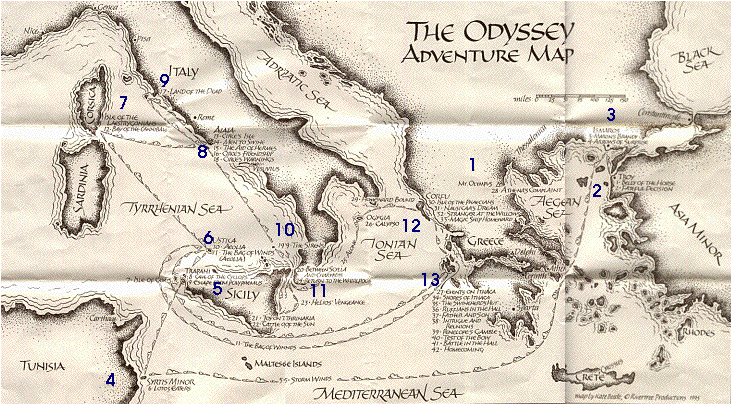
The Odyssey Homer
1. Mt. Olympus   2. Troy   3. Kikonians   4. Lotus-Eaters   5. Cyclops
6. Aeolia’s Island   7. Laestrygonians   8. Circe’s Kingdom  9. Land of the Dead
10. Sirens   11. Scylla & Charybdis   12. Kalypso   13. Ithaka
source Nada’s ESL Island

Greek literature has been a surprising passion of mine.  From my first read of The Iliad, I was hooked and I often wonder why?  The heroes are chiefly concerned with fame, glory, reputation, pillaging and the spoils of war; the gods are jealous, capricious, vindictive and possess far too many human traits for comfort.  Yet I think what draws me to these characters is that they are so real …….. fallible, vulnerable, imperfect, yet they exhibit these deficiencies through an heroic, courageous and larger-than-life persona. They have their customs and traditions, institutions designed to help their society flourish, and which are important enough to sacrifice happiness, comfort and, at times, even their lives, to preserve.

The Odyssey Read Along Posts:  Book I & II / Book III & IV /  Book V & VI /  Book VII & VIII /  Book IX & X /  Book XI & XII / Book XIII & XIV /  Book XV & XVI /  Book XVII & XVIII /  Book XIX & XX /  Book XXI & XXII /  Book XXIII & XXIV

A note on translations:  if you plan to read only one translation of The Odyssey, I would highly recommend Richard Lattimore’s translation, as it is supposed to be closest to the original Greek, while also conveying well the substance of the story.  Fitzgerald is adequate but likes to embellish, and the Fagles translation …….. well, as one learned reviewer put it, “they are so colloquial, so far from Homeric that they feel more like modern adaptations than translations.”  I would have to agree.

For people who are interested in introducing their children to the tales of Homer, there are a number of excellent books for children which I will list here:

This book counts as Plethora of Books Classic Club Spin, so I finished her book and my spin book, as well.  I’m going to give myself a pat on the back and less guilt for not finishing my previous spin book (yet). 🙂

Translated by Richard Lattimore


Classics Club


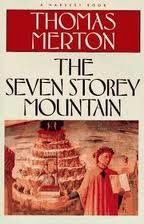
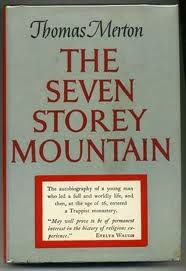
The Seven Storey Mountain by Thomas Merton (Classic Club Spin #5)

“On the last day of January 1915, under the sign of the Water Bearer, in a year of a great war, and down in the shadow of some French mountains on the borders of Spain, I came into the world.”

I had heard many stories about Thomas Merton, the “Buddhist Trappist monk” and I was interested in finding out the commonalities he discovered between Buddhism and Catholicism. However, as it turns out, The Seven Storey Mountain is an autobiography of Merton’s early life, before he converted to Catholicism, and covering a few of the years after he entered the Trappist monastery, so I’ll have to search further to read about the Buddhist-Catholic component.  Nevertheless, this book, which was featured in the National Review’s 100 Best Books of the Century, was charming, funny, heart-warming, spiritual, serious, emotional and intellectual.

Born in Prades, southern France on January 31, 1915, and during the First World War, Merton had a somewhat nomadic life as a child.  Perhaps gaining perspective and creativity from his artistic French father and a certain practicality from his American mother, he draws the reader into the book in the first chapter:

“On the last day of January 1915, under the sign of the Water Bearer, in a year of a great war, and down in the shadow of some French mountains on the borders of Spain, I came into the world.  Free by nature, in the image of God, I was nevertheless the prisoner of my own violence and my own selfishness, in the image of the world into which I was born.  That world was the picture of Hell, full of men like myself, loving God and yet hating Him; born to love Him, living instead in fear and hopeless self-contradictory hungers …… My father and mother were captives in that world, knowing they did not belong with it or in it, and yet unable to get away from it.  They were in the world and not of it —— not because they were saints, but in a different way: because they were artists.  The integrity of an artist lifts a man above the level of the world without delivering him from it ……… I inherited from my father his way of looking at things and some of his integrity and from my mother some of her dissatisfaction with the mess the world is in, and some of her versatility.  From both I got capacities for work and vision and enjoyment and expression that ought to have made me some kind of King, if the standards the world lives by were the real ones.  Not that we ever had any money; but any fool knows that you don’t need money to get enjoyment out of life.”  

From Merton’s early life in France, we move with him to America and then, after the death of his mother, his return to France with his father, while his brother, John Paul, is left behind with his grandparents.  When Merton is 13 years old, they move to England, but when his father dies of a brain tumour, he eventually moves to the U.S. again, and finds himself enrolled in Columbia University, on his way to a possible promising professorship.  Yet life intervenes and through various circumstances, Merton finds the church and from there, a personal relationship with God.

Merton was not a man who was searching for an escape from life. Fascinatingly, he did not find the monastery; the monastery found him. Initially, as a young man, his life consisted of university, friends, bars, girls and fun.  Calling himself a true child of the modern world, he was a mirror of its afflictions: selfishness, ambition, irreligion, materialism, etc.   His expectations were to graduate and find employment, as other young men in his situation.  Yet within the social activity and superficial amusements that he experienced as a typical American youth, he nevertheless felt an emptiness that came with an increasingly strong desire to be filled.  Perhaps Merton had tried it all and the only thing left was God.

Merton’s prose is delightful, both beautifully description and harmonious, yet he is also adept at injecting light humour into situations:

“‘France!’ I said, in astonishment.  Why should anybody want to go to France?  I thought: which shows that I was a very stupid and ignorant child.”

And an excerpt from a trip to Switzerland with his family when he was about 11 years old:

“The rest of the time was one long fight.  We fought on pleasure steamers, we fought on funicular railways, we fought on the tops of mountains and at the foot of mountains and by the shores of lakes and under the heavy branches of evergreens ……………. By the time we got to the Jungfrau koch, everybody was ready to fall down from nervous exhaustion, and the height made Bonnemaman faint, and Pop began to feel sick, and I had a big crisis of tears in the dining room, and then when Father and I and John Paul walked out into the blinding white-snow field without dark glasses we all got headaches; and so the day, as a whole, was completely horrible …………… John Paul humiliated the whole family by falling fully dressed into a pond full of gold-fish and running through the hotel dripping with water and green-weeds.”

Merton’s deep understanding of human nature is punctuated by intelligent comments throughout the book.

On school:  “But when a couple of hundred of these southern French boys were thrown together in the prison of that Lycée, a subtle change was operated in their spirit and mentality.  In fact, I noticed that when you were with them separately, outside of school, they were mild and peaceable and humane enough.  But when they were all together there seemed to be some diabolical spirit of cruelty and viciousness and obscenity and blasphemy and envy and hatred that banded them together against all goodness and against one another in mockery and fierce cruelty and in vociferous, uninhibited filthiness.”

On literature:  “A course in literature should never be a course in economics or philosophy or sociology or psychology …….. the material of literature and especially drama is chiefly human acts — that is, free acts, moral acts.  And, as a matter of fact, literature, drama, poetry, make certain statements about these acts that can be made in no other way.  That is precisely why you will miss all the deepest meaning of Shakespeare, Dante, and the rest if you reduce their vital and creative statements about life and men to the dry matter-of-fact terms of history, or ethics, or some other science.  They belong to a different order.”

On capitalism:  “It is true that the materialistic society, the so-called culture that has evolved under the tender mercies of capitalism, has produced what seems to be the ultimate limit of this worldliness.  And nowhere, except perhaps in the analogous society of pagan Rome has there ever been such a flowering of cheap and petty and disgusting lusts and vanities as in the world of capitalism, where there is no evil that is not fostered and encouraged for the sake of making money.  We live in a society whose whole policy is to excite every nerve in the human body and keep it at the highest pitch of artificial tension, to strain every human desire to the limit and to create as many new desires and synthetic passions as possible, in order to cater to them with the products of our factories and printing presses and movie studios and all the rest.”

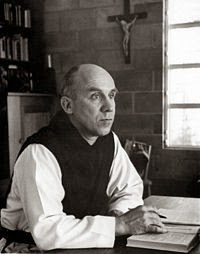
courtesy of The Thomas Merton Center at Bellarmine University   

Through his writing, Merton’s connection with the outside world was only enlivened and strengthened after he entered the Trappist monastery. Most of his most vibrant and inspirational work was produced while he was cloistered, as if being in the world made him understand it less, but by being removed from it, he gained a greater understanding.  While his post-monastery accomplishments were vast, he initially felt the vocation of a writer in conflict with his vows, but under the urging of his abbey superior, he became a prolific author, producing more than 70 books on spirituality, social justice and pacifism, and The Seven Storey Mountain gained him a world-wide reputation.  He became more interested in inter-faith dialogue and amassed a huge correspondence with a great number of influential people.  In 1968 he attended an inter-faith conference for Catholic and non-Christian monks in Thailand, and, after stepping out of the bathtub in his hotel room, Merton was accidentally electrocuted by touching an electrical fan. He was 53 years old.

Upon its publication, The Seven Storey Mountain won critical acclaim, appealing to a post World War II society looking for meaning and stability.  Grahame Greene had high praise for it, saying: “Is is a rare pleasure to read an autobiography with a pattern and meaning valid for us all.  The Seven Storey Mountain is a book one reads with a pencil so as to make it one’s own.”  By 1984 it had sold 3 million copies, and to-date is in continuous printing and is published in 15 different languages.

The value of a book such as this is that it takes you out of life as you see it from your own perspective.  Like it nor not, society influences our thoughts, our choices, our perceptions and our actions.  We often see situations from one vantage point and must struggle to get a different view.  Merton starts with the familiar, living the status quo, but then takes you out of the normal, the complacent, the mundane, and allows you to see life from a completely different aspect.  The door is open and you are free explore.

I’m looking forward to reading more of Merton’s work.  He examines so many fascinating ideas in so many different areas, and really gets me thinking.  And I actually finished my Classic Club Spin #5 so I’m going to celebrate!  Yay!

Classics Club Spin #5 …………. And The Winner Is …………..!

My excitement has turned to a cold sweat.  I am reading:

No, I haven’t spent the morning breathing into a paper bag, but nearly.  I do want to read this book, just not now.  I have read a number of chunksters lately (War & Peace, David Copperfield, Once & Future King, Ovid, etc.), my reading schedule is on overload and I have been and will be reading so many books on faith this year (my Lewis Project, Paradise Lost, the Pilgrim’s Progress ….) that I was really hoping to get something else.  Is that bad?  In any case, it is what it is.

Okay, I am going to grab my book, get myself a hot cup of tea and a better attitude!  🙂

photo courtesy of
Serge Bertasius Photography
source Free Photos

Best of luck to everyone on their attempts to complete their Spin!

Classics Club Spin #5

How embarrassing to admit that I have not even started to read my Spin, Bleak House, from Classics Club Spin #4.  HOWEVER, I am going to be starting it at the end of this month, so I’m not too concerned about it, which is why I am joining another Spin!

For this spin, the rules are as follows:
1.  Go to your blog.
2.  Pick twenty books that you’ve got left to read from your Classics Club List.
3.  Post that list, numbered 1 – 20, on your blog by next Monday.
4.  Monday morning, we’ll announce a number from 1 – 20.  Go to the list of
      twenty books you posted and select the book that corresponds to the 
      number we announce.
5.  The challenge is to read that book in February or March.
I used the random list organizer here to choose the 20 books from my master list.  If On A Winter’s Night A Traveler, I’ve already started but I left it on the list because a situation like a Spin is the only way I’m going to be forced to finish it. 😛  So my list ended up looking like this:

  1. One Day in the Life of Ivan Denisovitch (1962) – Alexander Solzhenitsyn
  2. The Robe (1942) – Lloyd C. Douglas
  3. Persuasion (1818) – Jane Austen
  4. Gulliver’s Travels (1726) – Jonathan Swift
  5. Frankenstein (1818) – Mary Shelley
  6. The Rule of St. Benedict (529)? – Saint Benedict
  7. The Praise of Folly (1509) – Erasmus
  8. Aristotle, Ethics (330 B.C.) – Aristotle
  9. Wives and Daughters (1864/66) – Elizabeth Gaskell
  10. The Heart of Darkness (1899) – Joseph Conra
  11. The Warden (1855) – Anthony Trollope
  12. East of Eden (1952) – John Steinbeck
  13. The Taming of the Shrew (1590 – 1592) – William Shakespeare
  14. The Stranger (1942) – Albert Camus
  15. Richard III (1592) – William Shakespeare
  16. If On A Winter’s Night A Traveler (1979) – Italo Calvino
  17. She Stoops to Conquer (1773) – Oliver Goldsmith
  18. The Time Machine (1895) – H.G. Wells
  19. La Curée (1871 – 1872) – Emile Zola
  20. Seven Story Mountain (1948) – Thomas Merton
Then I broke them into the listed categories …….

5 Books I’m Hesitant to Read:

  1. Aristotle, Ethics (330 B.C.) – Aristotle (complete terror!)
  2. The Praise of Folly (1509) – Erasmus (is Erasmus going to be over my head?)
  3. She Stoops to Conquer (1773) – Oliver Goldsmith  (don’t know what to expect)
  4. East of Eden (1952) – John Steinbeck (will I like Steinbeck?)
  5. Seven Story Mountain (1948) – Thomas Merton  (I’m excited about this but it’s very looong!)


5 Books I Can’t Wait to Read:

  1. Persuasion (1818) – Jane Austen (the only Austen I haven’t read yet)
  2. Wives and Daughters (1864/66) – Elizabeth Gaskell (love Gaskell!)
  3. The Warden (1855) – Anthony Trollope (Barsetshire series, here I come!)
  4. La Curée (1871 – 1872) – Emile Zola (it’s Zola.  What more can I say?)
  5. The Robe (1942) – Lloyd C. Douglas (looks great!)

5 Books I Am Neutral About Reading:

  1. Gulliver’s Travels (1726) – Jonathan Swift
  2. The Heart of Darkness (1899) – Joseph Conrad
  3. The Taming of the Shrew (1590 – 1592) – William Shakespeare
  4. The Stranger (1942) – Albert Camus
  5. The Time Machine (1895) – H.G. Wells

5 Free Choice:

  1. One Day in the Life of Ivan Denisovitch (1962) – Alexander Solzhenitsyn
  2. Frankenstein (1818) – Mary Shelley
  3. Richard III (1592) – William Shakespeare
  4. If On A Winter’s Night A Traveler (1979) – Italo Calvino
  5. The Rule of St. Benedict (529)? – Saint Benedict
In spite of wanting to read Seven Storey Mountain, I hope I don’t get it because it will be a struggle to read such a long memoir with such a full schedule.  I am absolutely terrified of Aristotle.  I have a book by Mortimer J. Adler called Aristotle for Everybody, which I had hoped to read before tackling Aristotle, but if he is chosen there is little hope for me to fit it in beforehand.  Otherwise, I won’t mind getting any of the others listed.
Oh, I just realized that in spite of not reading my last Spin book yet, I did read two other novels from the original list, so that makes me feel much better!!
Good luck with your Spin, everyone!

Classic Spin #4 – And the Winner Is …… (Drum Roll …..)

From my Classics Spin #4 post, the Spin number chosen was 10, so my classic to read is ……… BLEAK HOUSE!

The spin number worked in my favour as I am scheduled to read Bleak House after David Copperfield, so I won’t have to add any extra books to my ever-expanding pile.  This is good.

However, I must admit that I am not going to start this read until I’ve finished David Copperfield, which won’t be until mid-January so I won’t technically complete the Spin as specified (finish date January 1st).

Perhaps next time I will get one of the books which make me tremble, such as Ulysses, Moby Dick or The Communist Manifesto, but for now I’m happy with such a convenient read.

_____________________________________________________________

Classics Club Spin #4

For this spin, the rules are the following:

1.  Go to your blog.
2.  Pick twenty books that you’ve got left to read from your Classics Club List.
3.  Try to challenge yourself: list five you are dreading/hesitant to read, five you
      can’t WAIT to read, five you are neutral about, and five free choice (favourite
      author, rereads, ancients — whatever you choose.)
4.  Post that list, numbered 1-20, on your blog by next Monday.
5.  Monday morning, we’ll announce a number from 1-20.  Go to the list of twenty
      books you posted, and select the book that corresponds to the number we 
      announce.
6.  The challenge is to read that book by January 1, even if it’s an icky one you
      dread reading!  (No fair not listing any scary ones!)

I used the random list organizer here to choose the 20 books from my master list.  After having to drop a few books for various reasons (out of series order, they are scheduled with a group at a certain time, etc.) my list looked like this:

  1. The Bucanneers (1938) – Edith Wharton
  2. Paradise Lost (1667) – John Milton
  3. The Mysteries of Udolpho (1794) – Ann Radcliffe
  4. Thus Spoke Zarathustra (1883 – 1885) – Freidrich Nietzsche
  5. The Cloister and the Hearth (1861) – Charles Reade
  6. Common Sense (1775 – 1776) – Thomas Paine
  7. Slaughterhouse Five (1969) – Kurt Vonnegut
  8. Travels with a Donkey in Cévennes (1879) – Robert Louis Stevenson
  9. The Mill on the Floss (1860) – George Eliot
  10. Bleak House (1852/53) – Charles Dickens
  11. The Moonstone (1868) – Wilkie Collins
  12. Tales of Ghosts and Men (1910) – Edith Wharton
  13. Antigone (441 B.C.) – Sophocles
  14. Tevye the Dairyman and Motl the Cantor’s Son (1894) – Sholem Aleichem
  15. The Warden (1855) – Anthony Trollope
  16. Murder in the Cathedral (1935) – T.S. Eliot
  17. Essays (1580) – Michel de Montaigne
  18. We (1921) – Yevgeny Zamyatin
  19. Utopia (1516) – Thomas More
  20. The Pilgrim’s Regress (1933) – C.S. Lewis

Then I broke them into the listed categories …….

5 Books I’m Hesitant to Read:

  1. Paradise Lost (1667) – John Milton
  2. Thus Spoke Zarathustra (1883 – 1885) – Freidrich Nietzsche
  3. Common Sense (1775 – 1776) – Thomas Paine
  4. Essays (1580) – Michel de Montaigne
  5. Utopia (1516) – Thomas More


5 Books I Can’t Wait to Read:

  1. Travels with a Donkey in Cévennes (1879) – Robert Louis Stevenson
  2. The Bucanneers (1938) – Edith Wharton
  3. The Pilgrim’s Regress (1933) – C.S. Lewis
  4. The Warden (1855) – Anthony Trollope
  5. The Cloister and the Hearth (1861) – Charles Reade

5 Books I Am Neutral About Reading:

  1. The Mill on the Floss (1860) – George Eliot
  2. Murder in the Cathedral (1935) – T.S. Eliot
  3. We (1921) – Yevgeny Zamyatin
  4. Slaughterhouse Five (1969) – Kurt Vonnegut
  5. The Mysteries of Udolpho (1794) – Ann Radcliffe

5 Free Choice:

  1. Tevye the Dairyman and Motl the Cantor’s Son (1894) – Sholem Aleichem
  2. Bleak House (1852/53) – Charles Dickens
  3. The Moonstone (1868) – Wilkie Collins
  4. Tales of Ghosts and Men (1910) – Edith Wharton
  5. Antigone (441 B.C.) – Sophocles

Please God, don’t let me get Montaigne’s Essays.  That will kill me, especially with the January 1st deadline.  I await the number to be chosen with trepidation and hope it is one of the books that I already have in progress (The Pilgrim’s Regress and Tales of Men and Ghosts), although I know that is not the purpose of the spin.  Normally I would be happy to be challenged, but with Christmas just around the corner I wonder if I will be able to accomplish it.

Strangely this is a little like gambling ………..  although, safe gambling with a purpose of higher education.  No wonder it’s so fun!

________________________________________________________