Hamlet ~ Act V Scene II (the end)

Hamlet, Horatio and Osric (1830)
H.C. Selous
source

Hamlet  ~~  Act V  Scene II

Ah ha!  Hamlet reveals to Horatio that on his way to England, he discovered one night upon opening the sealed directive to the English king, that Claudius had plotted his murder.  Covertly, he replaces his name on the letters with those of Rosencrantz and Guildenstern, and reseals them with his father’s old seal.  It appears that Hamlet has no regrets, except perhaps in his treatment of Laertes, as he sees Laertes as a mirror image of himself.

Madness (1883)
Odilon Redon
source Wikiart

A young courtier, Osric, enters and announces a request from Claudius for Hamlet to spar with Laertes using swords, but not before much circumlocution and apparently senseless bantering between Hamlet and the courtier.  Hamlet reveals to Horatio that he expects to emerge the winner, but still he has a unsettled feeling.

The King and Queen enter with Laertes and entourage. Hamlet makes an apology to Laertes, blaming his madness for his actions, whereupon Laertes proclaims that he will not accept the apology upon his honour until a higher council has advised him, but he will accept Hamlet’s love.

Before they begin, Claudius announces that he will drink each time Hamlet scores a hit and will drop a precious pearl into the cup.  Hmmm, we can only imagine what the “pearl” will be.  They begin, yet Hamlet refuses to drink from the cup, claiming that he wants to finish the match.  Gertrude, however, drinks before anyone can stop her and the tragedy is underway.  After Hamlet scores two hits, Laertes decides to deal the fateful stroke but guilt nearly stays his hand.  However, Laertes scores a hit, then they scuffle, somehow the rapiers are exchanged and Hamlet wounds Laertes.  The queen collapses from the poisoned drink and likewise, immediately afterward, Laertes announces that he has been slain by his own treachery.  He tells Hamlet that he, too, has only an half hour to live, implicating Claudius in the murderous plot.  Hamlet then both skewers Claudius and forces him to drink the poison, thereby killing him with his own poisonous “union”.  Laertes requests Hamlet’s forgiveness as he dies.  Yet the drama is yet to abate.  Horatio, claiming he is more Roman than Dane, attempts to follow Hamlet to the grave, but his friend stays his hand.  He needs Horatio alive so his story can be told, otherwise who is to really know the truth of the plotting and machinations.  Horatio is to revel the implications of the “rottenness” in Denmark.  With his “dying voice”, Hamlet passes the crown to Fortinbras who arrives to witness the carnage.  The English ambassador announces that Rosencrantz and Guilderstern are dead but wonders who will receive the news.  Horatio begins his promise to Hamlet:

“And let me speak to the’ yet unknowing world
How these things came about.  So shall you hear
Of carnal, bloody, and unnatural acts,
Of accidental judgments, casual slaughters,
Of deaths put on by cunning and forced cause,
And, in this upshot, purposes mistook
Fall’n on th’ inventors’ heads.  All this can I
Truly deliver.”

Fortinbras will call the nobles to audience to hear of these deeds and Horatio urges:

“But let the same be presently performed
Even while men’s minds are wild, lest more mischance
On plots and errors happen.”

The trust must be told before more unwitting tragedy unfolds.  Hamlet is born away like a soldier, with honour and respectful words from Fortinbras.

Prince Hamlet kills King Claudius
Gustave Moreau
source Wikiart

Thoughts:

In the last scene it appeared that the returned Hamlet was a different Hamlet than had left Denmark, and this scene confirms it.  Hamlet begins to act, but act with reason and deliberation.

Hamlet’s Death
Eugène Delacroix
source Wikimedia Commons

Osric’s behaviour towards Hamlet is suspect.  He agrees with everything Hamlet says as if he’s trying to placate him.  Hamlet must know that Claudius’ machinations are behind his behaviour.  The Prince appears to know that the confrontation with Claudius is coming to a head. However, Osric also defies Hamlet in refusing to put on his hat when requested.  Really?  Defy the Prince of Denmark?  Is this an indication of Hamlet’s loss of power?

Again, instead of being wholly fixated on revenge, Hamlet shows concern for others, regretting his behaviour toward Laertes and wishing for a reconciliation.

There are a number of questions this scene brings up which will perhaps remain unanswered.  Does Hamlet really believe that he is/was mad?  Does Gertrude drink the poison unknowingly or not?  Does Claudius make a true effort to stop her drinking?  Does Hamlet suspect about the poisoned drink?

Initially all three characters, Fortinbras, Hamlet and Laertes are united by the deaths of their fathers and a thirst for revenge; at the end of the play they are united by a goodwill towards each other, and perhaps a realization that revenge only brings catastrophe and tumult into lives, and in this case, a kingdom.  The latter point is amplified by Horatio at the end, where he appears to want to educate the influential masses, using Hamlet as an example. Revenge is like a poison and kills those who come in contact with it.

Hamlet Read-Along Posts

2015 Challenge Wrap-Up

I’ve been dreading this post, because I feel like I’ve failed at most of my challenges during the year.    However, all is not usually as dire as I expect, so let’s have a look at my successes and failures for 2015.

I completed this challenge, strangely most of it in the first three months of the year, then it took me right to the end of the year to read the last book. The titles I read were:

  1.  Persuasion – Jane Austen
  2.  East of Eden – John Steinbeck
  3.  Orlando: A Biography – Virginia Woolf
  4.  The Plague – Albert Camus 
  5.  Confessions – Jean-Jacques Rousseau
  6.  Ethan Frome – Edith Wharton
  7.  The Narrative of the Life and Times of Frederick Douglass
  8.  Gulliver’s Travels – Jonathan Swift
  9.  The Club of Queer Trades – G.K. Chesterton
10.  Meditations – René Descartes
11.  The Adventures of Pinocchio – Carlo Collodi
12.  Hamlet – William Shakespeare

My accomplishment on this one was a pleasant surprise.  I’d aimed for Level Two at 4-6 books, but made Level Four (12+ books) reading 15 books during 2015.  Woo hoo!
Bedfordshire

Devon

Hertfordshire

  • Pride and Prejudice by Jane Austen


Kent


London


Northamptonshire

  • Mansfield Park by Jane Austen

Somersetshire

I managed to read all 6 of Austen’s main novels in 2015.

1.  Persuasion
2.  Sense & Sensibility
3.  Pride and Prejudice
4.  Mansfield Park
5.  Emma
6.  Northanger Abbey

I still want to add her lesser known works but I’m pleased that I managed to finish all of these.

Ew, this was a fail for me this year.  Normally I have no problem covering a number of pre-printing press books, but this year I only read three.

1.  Beowulf
2.  The Canterbury Tales
3.  The Rule of Saint Benedict.

Yipes!  Next year with my Ancient Greek challenge, I will certainly read more.

Oh, another fail.  I’ve never been able to complete this challenge. That’s because it’s impossible for me to follow a list. Actually I didn’t do too badly this year, managing to read 9 of the 12 books.

1.  Meditations – René Descartes
2.  Orlando: A Biography – Virginia Woolf
3.  The Plague – Albert Camus
4.  Confessions – Jean-Jacques Rousseau
5.  Hamlet – William Shakespeare
6.  Walden – Henry David Thoreau
7.  Persuasion – Jane Austen
8.  Notes from the Underground – Fyodor Dostoyevsky
9.  The Canterbury Tales – Geoffrey Chaucer

This was one of my favourite challenges of the year.  The Canterbury Tales were so wonderful —- Chaucer is not only a poetic master but a connoisseur of human nature.  And Frank Mundo’s The Brubury Tales were a delightful surprise.  Like Chaucer, he not only showed a poetic prowess but also gave wonderful insights into the human condition, and wove a number of classic allusions through his modern retelling.  And excellent read!

In spite of initially being wary of my success with this challenge because of my concurrent Reading England challenge, this challenge turned out to be rather successful.  I made it to the highest level, “The Linguist”, reading 15 translated books.

  1. Meditations – René Descartes
  2. The Adventures of Pinocchio – Carlo Collodi
  3. The Plague – Albert Camus 
  4. Erewhon – Samuel Butler (original in Latin)
  5. Confessions – Jean-Jacques Rousseau
  6. Beowulf 
  7. Ecce Homo – Friedrich Nietzsche
  8. What Is To Be Done? – Nikolai Chernyshevsky
  9. Money (L’Argent) – Émile Zola
  10. Mein Kamp – Adolf Hitler
  11. The Story of My Experiments with Truth – Mohandas Gandhi
  12. The Canterbury Tales – Geoffrey Chaucer
  13. Notes from the Underground – Fyodor Dostoyevsky
  14. Selected Essays – Michel de Montaigne
  15. The Rule of Saint Benedict 

I didn’t make it!  Boo hoo!  I read 50 books.  I’ve never read so few books in one year.  I’m pathetic!  And that’s all I have to say about that!

In spite of failing miserably at this challenge, it was one of my most beneficial challenges ….. well, ever.  It forced me to focus on so many categories that I’ve always have good intentions to read from but never do: poetry, essays, short stories and classic children’s books.  I’m definitely going to choose this challenge in 2016 and hopefully improve my Deal-Me-In reputation.

Clubs – Short Stories
3 – Doctor Marigold – Charles Dickens
6 – The Princess – Anton Chekhov
7 – Father Brown: the Worst Crime in the World- G.K. Chesterton

Spades – Essays
2 – Friendship – Emerson
4 – Christianity and the Survival of Creation- Wendell Berry
5 – A Panegyric for Dorothy L. Sayers – C.S. Lewis

Diamonds – Poetry
A – Ode to a Nightengale – John Keats
4 – Sonnet XXIX – Garcilaso de la Vega
7 – Ode VIII: Quiet Night – Fray Luis de León
J – Song II:  The Dark Night – San Juan de la Cruz
Q – A Red, Red Rose – Robert Burns

Hearts – Children’s Classics
A – The Forgotten Daughter – Caroline Dale Snedeker
4 – The Ides of April – Mary Ray (1)
8 – The Cabin Faced West – Jean Fritz

I was quite astounded that many of these reviews were some of my most popular reviews of the year.

I’m still mulling over my challenges for 2016.  Deal Me In, Back To The Classics, Reading England, and the Ancient Greek challenge are definite choices, but there are so many other tempting ones floating around.  Stay tuned!

Ancient Greek Challenge 2016

Woo hoo!  After some not-so-subtle prodding by yours truly, Keely from We Went Outside and Saw The Stars has decided to host a Greek literature challenge for 2016.  I’m so excited about this challenge as it will allow me to choose books from one of my favourite periods.

General Rules: 
•                the Ancient Greek Reading Challenge 2016 runs from the 1st of January to the 31st of December 2016
•                I will be accepting sign ups throughout the rest of 2015 and all through 2016. 
•                You don’t have to blog about each text, or any, but the purpose of this challenge is to encourage everyone to read Ancient Greek texts so it would be amazing if you spread Ancient Greek love around the blogosphere! 
•                If there is enough interest I’ll make check in posts semi often so you can link your reviews or just general comments about this challenge as you see fit. 
•                Everything counts for this challenge: plays, essays, non-fiction history, poetry, fragments of texts, criticism etc. As long as it is an Ancient Greek text or a modern text about Ancient Greece it counts! I’ll personally be reading texts from Ancient Greece and the Byzantine Era so you can make this challenge whatever you want it to be. 
•                I’ll also love it if you would be interested in writing guest posts here related to this challenge. The more the merrier! 
•                Most of all HAVE FUN and spread your passion for Ancient Greek texts. This genre could always use more love. 
The Levels: 
•                Level One: 1-4 Texts 
•                Level Two: 4-6 Texts 
•                Level Three: 7-9 Texts 
•                Level Four: 10-12 Texts
•                Level Five: 12+ Texts 
I will be aiming for Level Five as I have plans to read as many Ancient Greek plays by the four greats (Euripides, Sophocles, Aeschylus, Aristophanes).
List of (some) Ancient Greek Texts: 
****a lot of ancient greek texts only survive in fragments but i’ve included these in this list if you’re still interested in reading some of them
•                Homer: The Iliad and The Odyssey 
•                Hesiod: Works and Days and Theogony 
•                Archilochus of Paros: Fragments 
•                Sappho: Poems 
•                Alcaeus: Fragments 
•                Pindar: Epinikia and Fragments 
•                Aeschylus: The Suppliant Maidens, The Persians, The Seven Against Thebes, Prometheus Bound, Agamemnon, Choephoroe, Eumenides 
•                Sophocles: Oedipus the King, Oedipus at Colonus, Antigone, Ajax, Electra, Trachiniae, Philoctetes
•                Euripides: Rhesus, Medea, Hippolytus, Alcestis, Heracleidae, The Suppliants, The Trojan Women, Ion, Helen, Andromache, Electra, The Bacchae, Hecuba, Heracles Mad, The Phoenician Maidens, Orestes, Iphigenia Among the Tauri, Iphigenia At Aulis, The Cyclops
•                Aristophanes: the Archarnians, the Knights, the Clouds, the Wasps, the Peace, the Birds, the Frogs, the Lysistrata, The Thesmophoriazusae, the Ecclesiazusae, the Plutus
•                Herodotus: Histories 
•                Thucydides: History of the Peloponnesian War 
•                Xenophon: Anabasis, Apology, Symposium, Memorabilia 
•                Aristotle: Metaphysics, On the Soul, On Poetics, etc. A complete list can be found here (x)
•                Plato: Republic, On Justice, On Virtue, etc. A complete list can be found here: (x) 
•                Theocritus: Idylls and Epigrams
•                Callimachus: Hymns, Fragments 
•                Apollonius of Rhodes: Argonautica

•                 Menander: Fragments 

I’m not sure what I’m going to choose to read, but I have some literature on my Classics Club list that I should get to, and then there are so many other possibilities.

Menander – Fragments
Aristotle – Nicomachean Ethics, Poetics
Ovid – Metamorphoses
Plato – The Republic, Meno, Crito, Phaedo
Plutarch – Lives
Aristophanes – Birds, Lysistrata
Euripides –
Aeschylus – The Suppliant Maidens, The Persians, Seven Against Thebes, Prometheus Bound
Sophocles – Ajax, The Women of Trachis, Electra, Philoctetes

Ooo, I can’t wait to get started!

Notes from the Underground by Fyodor Dostoyevsky

“I am a sick man …….. I am an angry man.”

Notes from The Underground is the third book in my unannounced and (spur of the moment) Turgenev/ Chernyshevsky/ Dostoyevsky challenge.  After reading Turgenev’s novel Fathers and Sons, Nikolai Chernyshevsky wrote in response to it, his then politically persuasive novel, What Is To Be Done? , and in response to Chernyshevsky, Dostoyevsky wrote his powerful Notes from the Underground.  I assumed that it would be an interesting literary, political and philosophical conversation.

Dostoyevsky begins this book with a monologue from a retired 40-year-old civil servant, living in St. Petersburg.  He is our man from the Underground.  His ramblings appear to be disjointed, sometimes silly and then, disturbingly insightful.  But in this novel, is anything as it really appears?

” ….. doesn’t there, in fact, exist something that is dearer to almost every man than his own very best interests, or — not to violate logic — some best good …. which is more important and higher than any other good, and for the sake of which man is prepared if necessary to go against all the laws, against, that is, reason, honour, peace and quiet, prosperity — in short against all those fine and advantageous things — only to attain that primary, best good, which is dearer to him than all else? ….. to justify his logic he is prepared to distort the truth intentionally.”


The Soul of the Underground (1959)
Jean Dubuffet
source Wikiart

The Underground Man argues that perhaps science is not the highest good. The behaviour of man under the laws of nature and of reason does not confirm them; man has a perplexing innate inclination to destroy his own happiness and well-being.  One may argue that man needs to be brought into order, to conform to demands that will improve his life.   But what if man does not want that, and further, what makes one think that this is even good for man?

“Even if we assume it as a rule of logic, it may not be a law for all mankind at all …… And why are you so firmly and triumphantly certain that only what is normal and positive —- in short, only well-being —- is good?  After all, perhaps prosperity isn’t the only thing that pleases mankind, perhaps he is just as attracted to suffering.  Perhaps suffering is just as good for him as prosperity.”

Using historical examples, the Underground Man strengthens his argument. Man is beyond nature, and beyond reality; he is infinitely more complex than science, and therefore beyond the ability of science to completely understand him.

With his Underground Man, Dostoyevsky is attempting to shatter the philosophy seen in Nikolai Chernyshevsky’s, What is To Be Done?, a novel that promoted a type of monistic materialism brought about through a rational egoism: if only one used reason to discern the higher purpose of man, working through enlightened self-interest the perfect society would be created. Chernyshevsky’s dogmatic ideology excluded the possibility of “free will”, labelling it as a mistaken perception of what was simply a causal process. However Dostoyevsky, from his years in a prison camp, had continually witnessed the innate human desire to express individual free will, often to the person’s own detriment, and with his Underground Man, he strove to prove the ridiculousness of Chernyshevsky’s philosophy:

“all the beautiful systems, these theories of explaining his best interests to man ……. are nothing but sophistry.  Isn’t there something that is dearer to almost every man than his own very best interests, some best good which is more important and higher than any other good, and for the sake of which man is prepared, if necessary, to go against all the laws — that is against reason, honour, peace and quiet, prosperity — only to attain that primary, best good, which is dearer to him than all else?”


“One’s own free and unfettered volition, one’s own caprice, however wild, one’s own fancy, inflamed sometimes to the point of madness — that is the one best and greatest good, which is never taken into consideration because it will not fit into any classification, and the commission of which always sends all systems and theories to the devil.  Where did all the sages get the idea that a man’s desires must be normal and virtuous?  Why do they imagine that he must be normal and virtuous?  Why do they imagine that he must inevitably will what is reasonable and profitable?  What a man meeds is simply and solely independent volition, whatever that independence may cost and wherever it may lead.”


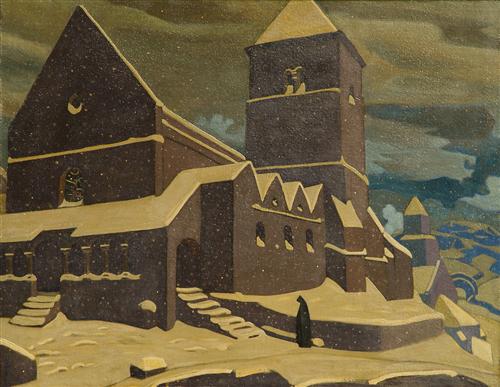
Underground Chud (1928)
Nicolas Roerich
source Wikiart

The second part of the novel, entitled “Falling Sleet”, tells of the experiences of the Undergound Man.  First, he is disrespected by an officer on the street who will not give way to him and the Underground Man plots a revenge of deliberately bumping into him.  The narrative then moves to the Underground Man’s presence at a party for old school mates and his contentious behaviour towards them, as he feels the strength his inadequacies in their presence. Finally, he falls into a type of relationship with a sympathetic prostitute named Liza.  In the Underground Man’s interactions with the outside world, the reader sees a man struggling to use his faculties to assimilate himself into the situations around him, and failing in his attempts. Dostoyevsky created a character who believed in Chernyshevsky’s ideals, but demonstrated through his actions, his inability to live up to them.

And so finishes my “trilogy” of conversation between these three authors.  I have been educated not only historically, but politically and philosophically, and encourage anyone who wants to read any of these books, to read the three in sequence.  With Chernyshevsky and Dostoyevsky particularly, you can sense the antagonism within their writing, yet their passion for their ideologies are very effective and make for enlightening reading.

Trilogy:


Further Reading:
Dostoyevsky: The Mantle of the Prophet by Joseph Frank


Emma by Jane Austen

“Emma Woodhouse, handsome, clever, and rich, with a comfortable home and a happy disposition, seemed to unite some of the best blessings in existence; and had lived nearly twenty-one years in the world with very little to distress or vex her.”

Young Emma Woodhouse of Hartfield has been the pet of her father and governess, and perhaps indulged by both to a faulty degree.  However, her character is one of kindness and charity, but enhanced with a healthy interest in the business of others, especially if it includes the subject of marriage.  Mr. Knightley, a close family friend and owner of Donwell Abbey, attempts to correct Emma and steer her on a more prudent path, but Emma’s high spirits require the correction of life experience. As she stumbles through her attempts at matchmaking based on her faulty reasoning, we see Emma grow from a willful, impressionable, decisive girl into a more careful, thoughtful, and empathetic woman.

From the first sentence we can see that this is a type of coming-of-age novel. The struggles and challenges of life are what develop strength of character. Because Emma has lived a relatively trouble-free and pampered life, we initially see in her character a willful blindness which often only serves to punctuate the errors in her thinking and of her actions.  The tension in the story is the uncertainty of Emma’s transformation.  We know that she is able to learn, but with her stubborn nature, will that be possible?  Her personal tenacity does not allow for an instant conversion, and instead we see small steps of correction in Emma’s character, even while she gets into more scrapes and misunderstandings.  Yet Emma realizes, or is forced to realize, the value of the advice of those closest to her, admitting her faults and seeking to amend them.

Hartfield
(Squerryes Court)

As I contemplated this read, I felt that it was not simply Emma who was often mistaken. Not only is Emma completely blind, but all the other characters exhibit their own sort of blindness to varying degrees.  Not only does no one know their neighbour or accurately guess their motivations, often people don’t even know themselves.  Each person is often attempting to hide their observations, either out of personal gain or out of societal politeness, but in each case, these decisions are shown to be unwise. Does this tell us that by understanding our fellow human beings that we will gain a deeper knowledge of ourselves?  However, perhaps Mr. Knightley had a more accurate indication of the issue, when he stated, “Mystery; Finesse —- how they pervert the understanding!  My Emma, does not every thing serve to prove more and more the beauty of truth and sincerity in all our dealings with each other?”  We need to be truthfully transparent with one another, even if it is difficult or uncomfortable, to truly cultivate relationships with minimum complication.

By the end of the novel, Emma is a much wiser woman.  Are all of her faults erased?  Not at all, but many of those faults are what make part of her character so delightful.  It is the opening of her mind, the willingness to admit her wrongs and the receptiveness to bettering herself, that makes her a truly likeable heroine.


Hamlet ~ Act V Scene I

Hamlet  ~~  Act V  Scene I

Hamlet and the Gravediggers
Pascal Adolphe Jean Dagnan-Bouveret
source Wikimedia Commons

And we begin with a little levity topped with introspection.  The scene changes, quite surprisingly, to a cemetery where two grave diggers are acting the parts of fools.  One is musing that permission was given to bury Ophelia in the graveyeard, only because she was nobility (normally, under Catholic law, suicides could not be buried on holy ground). They banter some more until Hamlet and Horatio arrive and Hamlet is disturbed by the disrespectful treatment that the bones of the dead are receiving as the gravedigger digs.  He muses about mortality and that death knows no class or boundaries, treating all in the same manner.  Death, in her universality, has no respect for rank or class, as a leader such as Ceasar or Alexander the Great can turn to dust and end up being used to plug barrels.

The King and Queen arrive on the scene, and both the reader and Hamlet learn that it is Ophelia’s funeral procession.  Hamlet is shocked at first, yet bursts into the ceremony in his grief, almost defying anyone to question his love for her.  When he departs, Claudius reminds Laertes of their plans for Hamlet’s demise.

Eugène Delacroix
source Wikimedia Commons

Thoughts:

With regard to Hamlet’s contemplation on mortality, will the nothingness of death prompt him to revenge, in effect, spurring him to action in life?

The most poignant lines in the play come right before Hamlet jumps into Ophelia’s grave in his grief:

”                       What is he whose grief
Bears such an emphasis, whose phrase of sorrow
Conjures the wandering stars, and makes them stand
Like wonder-wounded hearers?  This is I,
Hamlet the Dane.”

Which brings us to the big question:  did Hamlet really love Ophelia, and can we can determine the answer from what we’ve gathered so far during the play?  I believe that his love was real — there’s no good reason to disbelieve his claim here.  Yet why did he treat her so dismally earlier on in the play?  I tend to think that Hamlet was so consumed with the task of revenging his father that the only benefit he saw in the people around him was how they could help him achieve that goal.  In his thirst for revenge, Hamlet lost his humanity and in this scene we see a little of its return.  We see it even before Ophelia’s burial scene, in the sensitivity he shows towards the mishandling of the bones and skulls in the graveyard.  Yet this scene could also be a foreshadowing of his own death, and perhaps the sympathy we see from Hamlet is directed only towards himself.  Ah, Shakespeare, you tie us in mental knots once again!

Hamlet and the Gravedigger (1873-74)
Camille Cordot
source Wikiart

Hamlet Read-Along Posts

The Rule of Saint Benedict

“Listen carefully, my son, to the master’s instructions, and attend to them with the ear of your heart.”

Benedict of Nursia lived in Italy during the collapse of the Roman Empire and during his life, the empire was in constant battle with barbarian tribes.  Leaving his home in Nursia, in the region of Umbria during the reign of the barbarian king, Theodoric, Benedict arrived in Rome to attend school but, disgusted with the paganism and dissolution that he witnessed, he eschewed worldly cares, taking residence in a cave at Subiaco, thirty miles east of Rome.

Saint Benedict (circa 1437-1446)
Fra Angelico
source Wikipedia

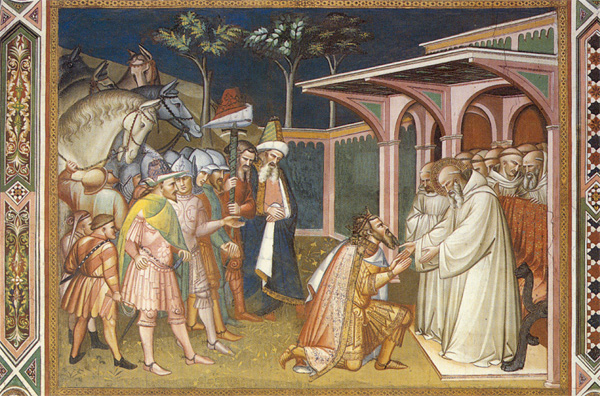
During three years in his cave, Benedict became admired for his spiritual devotion, and when an abbot in a nearby monastery passed away, Benedict was convinced, against his inclination, to take his place.  But twice, monks envious of Benedict attempted to poison him, from which he was saved by miracles.  He eventually took some disciples and founded a monastery on the mountain above Cassino, located eighty miles south of Rome.  As his fame spread, even the great king of the Goths, Totila, sought out an audience with him.

Benedict called his Rule, “a little book for beginners,” and he covers such disciplines as obedience, humility, contemplation and living in community.  Yet he first introduces us to four types of monks, the cenobites (belonging to a monastery and serving under an abbot), the anchorites or hermits (having lived in a monastery for a long time and their zeal for the monastic life has cooled), the sarabites (detestable monks who have “a character as soft as lead”, and are captured by worldly delights, a law unto themselves), and gyrovagues (drifters who are captives to their own selfish desires).  His rule is to assist the first class of monks.

Some specific areas Benedict covers are church songs and readings, excommunication and re-entry, working hours and manual labour, personal gifts, community rank, etc.  The importance of humility was highly emphasized:

The Rules of Humility

  1. Keep the fear of God always before your eyes
  2. Love not your own will but the Lord’s
  3. Submit to your superior in obedience
  4. In obedience, submit to unjustice and difficulties with endurance
  5. Do not conceal (from the abbott) any sinful thought or wrongdoing
  6. Be content with low or menial treatment
  7. Admit with not only your tongue, but with your heart, of your inferiority
  8. Do only what is endorsed by common rule in the monatery
  9. Control your tongue and be silent unless asked a question
  10. Be not given to ready laughter
  11. Speak gently, seriously and with modesty
  12. Manifest humility in bearing, as well as in heart

There were a number of interesting revelations in the rule, which I found rather interesting.  Benedict states that the Lord usually reveals what is best to the younger monks, yet still the abbot has the final decision.  This is a fascinating merging of both older and younger wisdom in a hierarchical framework which is designed to work best for all parties.

Totila and St. Benedict (1400-10)
Spinello Aretino
source Wikipedia

While Benedict’s rule is, in many ways, strict, I was actually surprised at the flexibility within it.  There is grace for those who stumble and understanding of human weaknesses, as is evidenced by the description of abbots and their moral duties:

“……. He must hate faults but love the brothers.  When he must punish them, he should use prudence and avoid extremes; otherwise, by rubbing too hard to remove the rust, he may break the vessel.  He is to distrust his own frailty and remember not to crush the bruised reed.  By this we do not mean that he should allow faults to flourish, but rather, as we have already said, he should prune them away with prudence and love as he sees best for each individual. Let him strive to be loved rather than feared.”

Apparently prior to Benedict’s rule, the theological view was that each person was struggling towards God, and spiritual direction had a very personal aspect to it.  Benedict’s rule signified a turning point in perception, eventually making the process more regimented than personal.  The Rule has further reaching implications as well, being the forerunner to the rule of law and written constitutions, assisting in the shaping of medieval ideas.

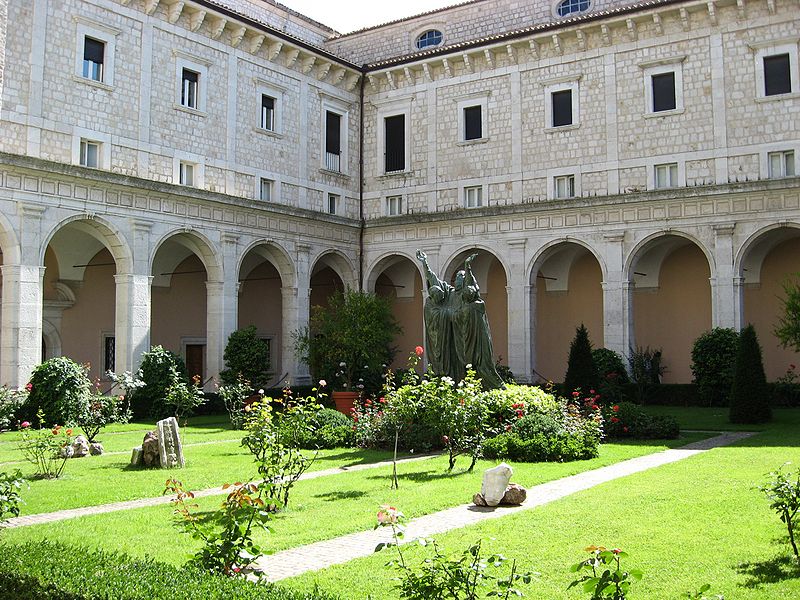
Benedict’s abbey at Monte Cassino was severely damaged by Allied bombing during World War II, having to be rebuilt afterwards.  A bit of trivia:  author Walter J. Miller was part of the bombing raids on Monte Cassino and was severely affected by them.  His dystopian book A Canticle for Leibowitz has echoes of both the monastery and his struggles to come to terms with his part in its destruction.  It’s a great book, if anyone is looking for a recommendation.


Rebuilt abbey of Monte Cassino
source Wikimedia Commons


Hamlet ~ Act IV Scene VII

Hamlet  ~~  Act IV  Scene VII

Ophelia
Konstantin Makovsky
source Wikiart

Claudius appears to have placated Laertes, but then a messenger arrives with the letters from Hamlet. Once again, Claudius is befuddled.  What could his letter mean?  Hamlet claims that he is returning alone. Is he lying?  Is it another trick? Laertes has no insight to add but Claudius first ensures his loyalty against his young enemy. Claudius has heard it bandied about that Laertes is a master swordsman.  Using quite masterful manipulation of Laertes’ grief, Claudius urges him to challenge Hamlet to a sword fight.  Not only does Laertes agree, he reveals that he will put poison on the end of his sword, so that even a little scratch, will kill Hamlet.  Claudius approves the plan but he is hesitant.  It must be done in a way that leaves no doubt of Hamlet’s death.  If the sword doesn’t do the job, he will have a poison drink ready for Hamlet.

Their plans are interrupted by Gertrude, who hurries in to announce the death of poor Ophelia.  In her muddled madness, Ophelia wandered down to the brook, making wreaths of flowers.  When she tried to climb out on a branch to hang her garland, the limb gave way and she fell into the brook.  She sang lovely old hymns as her garments dragged her down to her death.

Laertes is once again grief-stricken and Claudius follows him to try to moderate his actions.

Ophelia (1852)
John Everett Millais
source Wikiart

Thoughts:

Again Hamlet keeps Claudius on his toes.  The king must be in agony wondering what he will do next.  Claudius also spends an inordinate amount of time attempting to sooth Laertes’ wrath, aiming it in the appropriate direction, and ensuring his loyalty to the crown.  Using serpentine manipulation, he almost taunts Laertes, bringing up words vs. deeds and action vs. inaction.  I almost get the feeling that Claudius is getting desperate.  He already has Hamlet to deal with and another young man out of his control is certainly, at the least, worrisome.  Remember, the people are presently calling for Laertes as king.  Claudius’ hold on his power is tenuous at best.

I kind of liked Laertes before these last few scenes, but recently he’s showed himself to be a hot-head, easily manipulated, and perhaps not too bright. While it is understandable that he wishes to avenge his father’s death, his plan for Hamlet’s demise is rather dishonourable.

And, ah, the death of Ophelia, made more poignant by her singing and the symbols of flowers.  It’s as if she’s making wreaths for her own grave before her death actually occurs.  Does this emphasize her aloneness ….. with her father dead, she only has her brother, and in her madness is truly isolated.

Ophelia (c. 1900)
Gaston Bussiere
source Wikimedia Commons

Hamlet Read-Along Posts

Montaigne’s Essays – Part Three

Finally, this is the last of my postings on Montaigne’s selected essays, which I started at the beginning of my WEM Project.  I’ve enjoyed his unique character and passionate zest for all his topics that I plan to try to read through all his essays at some point.  Montaigne has the ability to mesmerize you, yet I could sometimes find myself both agreeing and disagreeing with him in the same sentence.  His approach is so singularly charming, a mixing of intellect with storytelling, which make (most of) his essays a joy to read. 

On Freedom of Conscience:  Quite an unusual essay.  Montaigne examines Roman Emperor, Julian the Apostate, so called for having abandoned Catholicism. Nevertheless, Julian had a very tolerant view of religion and allowed all religions equal status.  Montaigne appears suspicious of these motives, claiming that this permissive action can have two outcomes:

1) “to give a loose rein to the factions to hold to their opinions, is to sow and scatter division, and almost to lend a hand to increase it, there being no barrier and restraint of the laws to check and impede its course.”

2)  “to give the factions the reins to hold to their beliefs is to render them soft and lax through ease and facility, and to blunt the edge which is sharpened by rarity, novelty and difficulty.”

Again, Montaigne shows the reader his ingenuity at being able to see more than one possibility.

We Can Savour Nothing Pure:  This is a somewhat melancholy essay. Montaigne reveals that because of the “feebleness of our condition”, we can experience nothing in its natural purity and that all the pleasures or goods that we enjoy are “compounded with some evil or injury.”  Every virtue is tainted with vice, every justice with injustice.

I love his example from Socrates: when Socrates said that the gods wished to join pleasure and pain together, but when they were unsuccessful, they decided to join them by their tails.

Est quædam flere voluptas ~ There is a certain pleasure in our tears.  (Ovid)

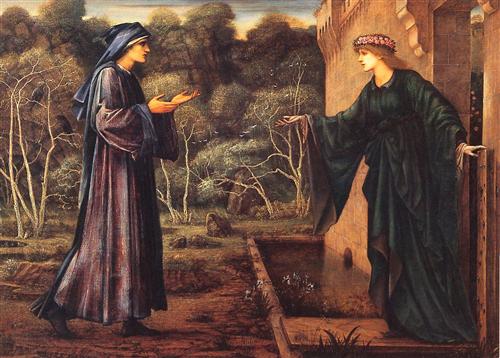
The Pilgrim at the Gate of Idleness (1875-93)
Edward Burne-Jones
source Wikiart

Against Indolence:  Montaigne gives examples of kings who, even though they were in situations that might work agains them, did not allow themselves to become slaves to idleness:

“…… there is nothing that can so justly disgust a subject, and make him unwilling to expose himself to hardships and dangers in the service of his Prince, as to see him all the while lolling in idleness, or busy over paltry and frivolous things ….”

As usual, Montaigne digresses, or perhaps, his topic deconstructs, as he begins with the offense of idleness in leaders, and moves on to how a man should die valiantly and how to meet death.

“……. bravely meeting death, is to look upon her not only without dismay, but unconcernedly, freely continuing one’s wonted course of life even into her very lap.”

And, oh my goodness, the sarcasm!!  He makes me laugh:

“Those who would number Kings of Castile and Portugal among warlike and great-hearted conquerors, because at twelve hundred leagues distance from their abodes of idleness, by the skin of their agents, they made themselves masters of the East and West Indies, may seek some other than myself to agree with them; since it is doubtful whether they would even have had the courage to go in person to take possession of their conquests.”

On Virtue:  With regard to actions spurred by emotion versus actions performed because of resolution or habit, Montaigne maintains that some great deeds can be accomplished by the former, but to truly gage the measure of a man, one must look to his common behaviour.

I was somewhat following him when he gives the example of Pyhrro distrusting human instinct, and so resolutely living by his philosophy, but I was completely confused by the example of a man, winning his love and then, when unable to perform, cutting off his penis and sending it to his mistress.  Further examples of maiming, suicide and death follow; Montaigne appearing to be lauding the people’s premeditated fortitude.

I can hardly make head nor tail of this essay, but is he possibly saying that virtue needs to be cultivated?  He later makes reference to fate, of everyone’s final hour being known, therefore nothing can prolong or shorten our lives.

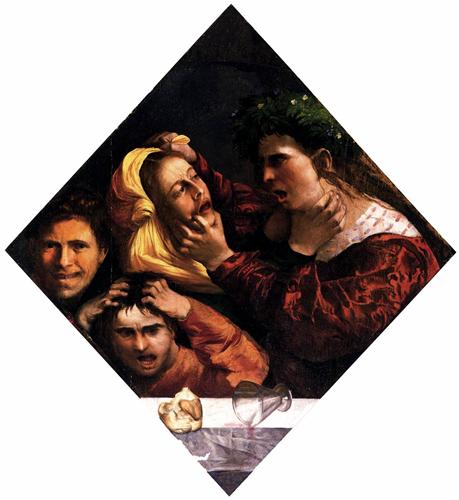
Anger or The Tussle (1516)
Dosso Dossi
source Wikiart

On Anger:  Montaigne is upset that many places leave the governing of wife and children to the husband, who could be stupid and evil, instead of to the state (who obviously is completely pure and omniscient — do you sense my sacrasm?). He is often seeing children beaten in the street and justice does nothing.

As much as I disagree with the first part of Montaigne’s essay, the next part has some wonderful quotes:

“There is no passion that so disturbs the clearness of our judgement as anger.”

“Faults, when seen through passion, appear greater to us, like bodies seen through a mist.”

Children, servants, etc. should be punished thoughtfully and by using discretion, and thus, the punishment will be taken more to heart and have more effect.

Withheld anger, simmering under the surface is dangerous too, and it is better to have an outburst than have it fester and grow within.  Otherwise, make sure that your anger is controlled, short, and to the point, with no undisciplined passions, resulting in tirades or violence.

On the Useful and the Honourable:  Political office is often filled with lies, betrayal and violence.  Montaigne, however, has always conducted himself with an ingratiating and mildness of manner, and the utmost candour and disinterestedness.  He is not swayed by political passions nor private interest. He could play both sides, but he refuses.

I quite liked this quote:

“When one’s country is disturbed and the people are divided I think it neither handsome nor honourable to be a wobbler and a hybrid, to be unmoved in one’s affections and to incline to neither side.”

Montaigne dislikes war and prefers to be of use to both parties, but his methods of negotiating have not been appreciated, and therefore he prefers working in a private, as opposed to public, manner.

Leadership can require treachery and dishonourable action, but while the person may think that they’ll profit by this behaviour, the end may prove otherwise.

Repentance (1917)
Nicholas Roerich
source Wikiart

Of Repentance:  This essay was extremely difficult but I’ll give it a shot.  Montaigne announces that he very seldom repents. If you show vice, you will be troubled by it, if you show virtue, you will receive the award of its goodness.  To base your actions on other people’s opinions is to build an unsteady foundation. You alone know yourself.  There are base actions ingrained by habit in our will that we cannot fully escape, and are part of our nature, so what is the use of repenting them?

An evil person can be inspired to do good, just as a virtuous person can be inspired to act evilly.  To truly judge a man, one must see him at work at home, or at least in a state of repose.  Montaigne says that to act out a sin, the sin must have lived in the heart of a man and he must consciously will it, therefore, I wonder if he is implying that to repent is almost an insincere act? The disease itself needs to be thrown off.  God must work in our hearts and the conscious must be truly amended.  Wishing to be different is not true repentance.

Montaigne claims to take very little advice, but he gives even less.  He knows of nothing that his advice has benefitted and people do not often act on it, in any case.  Drawing upon a Stoic mindset, the universe unfolds as it may, and Montaigne is happy to be self-contained away from others and any responsibility concerning them.

My favourite quotes:

“Many a man has been a wonder in the eyes of the world in whom neither his wife nor his valet have ever detected anything even remarkable.  Few men have been admired by their own household.”

“To enter a breach, conduct an embassy, rule a people, are conspicuous actions.  To chide, laugh, sell, pay, love, hate, to live in communion with one’s people and oneself, pleasantly and correctly, not to give way to passion, not to contradict oneself; that is more rarely seen, more difficult and less remarked.”

On Experience:  Man has a great natural desire for knowledge but when reason fails, he looks to his experience.  Experience is not the greatest way to knowledge but in the noble search for truth, one may use any option at his means.  Montaigne uses examples from law, science, philosophy and religion to explain that as soon as you attempt to define truth through numerous different perspectives, truth itself is lost.  By spreading it out, we dilute it.

“Men do not realize the natural infirmity of their mind; it does nothing but ferret and hunt around, incessantly like a silkworm, and there suffocating.”

Death and Life (1908-16)
Gustav Klimt
source Wikiart

He has more wise words concerning life and death:

“But you do not die because you are ill; you die because you are alive.  Death will kill you right enough without the help of sickness.  And maladies have kept death away from some who have lived the longer for thinking they were dying. Besides, there are maladies, as there are wounds, that are medicinal and health-bringing.

…… Nature has given it (life) into our hands, trimmed with so many and such happy surrounding, that we have only ourselves to blame if we feel it a burden, and if we waste it unprofitably ….. And yet I am resigned to lose it without regret; but as a thing that is by its nature losable, not as if it were a troublesome burden …. Not to hate the idea of death is properly becoming only in those who enjoy life ……. It needs good management to enjoy life.  I enjoy it doubly as much as others, for the measure of enjoyment depends upon the more or less attention we give to it …… The shorter my possession of life the fuller and deeper must I live it …… Rather should we study, relish and ruminate it, in order to give adequate thanks to him who bestows it upon us.”

This last essay of Montaigne’s marries ideas contained in his former essays, showing through his life experience, as he uses various culinary, emotional, and especially physical examples, how life can be best approached and enjoyed.  It’s a fitting end to my reading of his selected essays!

The Canterbury Tales ~ Chaucer’s Retraction

Chaucer concludes his tales by stating that if this sermon has pleased anyone, it is because of Christ, but if it has displeased them, he takes all the blame. He prays for forgiveness for his translation of a number of well-known books, including “tales of Canterbury”, although only the tales that tend towards sin. He then bookends more spiritual books in his closing comments, perhaps hoping those more edifying books will wipe out any sins for his translation of any immoral ones.

There is speculation as to whether this Retraction was a death-bed retraction, a confession, written by someone else, a continuation of The Parson’s Tale, or simply a method employed to ensure his safety from the church for these sometimes bawdy tales.  While it’s entirely possible that Chaucer regretted writing such morally bankrupt stories, I think it more likely that Chaucer was simply giving himself an out.  Like Thomas More who is perhaps deliberately unclear with his intentions in Utopia to protect himself from the state, Chaucer gives himself an excuse for the church: yes, I did it but I’m very sorry and I’ll spend the rest of my life repenting.  How can one argue with that?

Chaucer as a pilgrim from
the Ellesmere manuscript
source Wikipedia

And here finishes my first, but not my last read, of The Canterbury Tales. They honestly exceeded all of my expectations.  Chaucer is not only a master of poetry, he is a master of human nature and a master of the reader.  One of my favourite reads of 2015!