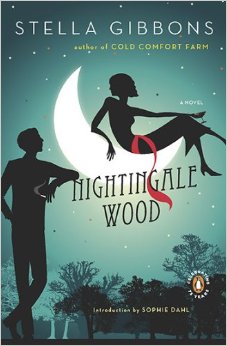
Nightingale Wood by Stella Gibbons

“It is difficult to make a dull garden, but old Mr. Wither had succeeded.”

Stella Gibbons writes rather odd books.  Cold Comfort Farm, her best known and highly acclaimed novel, follows an orphaned, pert young woman to a mucky, rural farm and observes while she neatens and tidies all the morose, lurking, and deranged occupants into their proper places, finding love in the process.  Gibbons has a knack for depicting rather unusual and sometimes bizarre characters, and this flair for the unique has continued in her writing of Nightingale Wood. The introduction to the story labels it as a “fairy tale” and it is, although not along the usual lines one would expect from such a tale.  Gibbons’ evil creatures often have angelic faces, and her happily-ever-afters can leave the reader uncertain of reality.  In playing with her characters, Gibbons appears to play with society and even the reader himself.  Her writing is not easily defined.

Continue reading

Out Of Your Car, Off Your Horse by Wendell Berry


This “essay” is set up in point-form with the sub-title, Twenty-seven Propositions About Global Thinking and the Sustainability of Cities.  It’s going to be difficult to review, not only because of the structure, but also because Berry is such an original thinker and has so much of value to say.  It is almost a shame to leave anything out.

Continue reading

Metamorphoses Book VII

Book VII


Medea and Jason / Medea and Aeson / Medea and Pelias / The Flight of Medea / Theseus and Aegus / Minos / Cephalus / The Plague / The Myrmidons / Cephalus, Procris & Aurora


Jason and Medea (1907)
John William Waterhouse
source Wikiart

The twin sons of Boreas assist King Phineus, who aids them in their journey to Colchis, where Jason meets with King Aeëtes to claim the Golden Fleece. The king agrees to relinquish his prize upon Jason completing three horrendous tasks. Yet Medea, daughter of the king, has fallen madly in love with Jason.  In spite of Jason’s foreign origin and the loyalty she owes to her father, she agrees to help Jason succeed in his trials in exchange for his promise of marriage.  First, he tames the dangerous bulls with herbs of Hecate given to him by Medea, yoking them to plow a field that has never before been plowed.  As he drops snake’s teeth into the ground from a bronze helmet, each takes the shape of an armoured warrior who attacks Jason.  But the young man hurls a stone into their ranks and they turn on each other, perishing in a civil war.  In his last test, Jason puts to sleep a dragon with juices from a hypnagogic herb, gains the Fleece and sails home with his new wife.

Continue reading

Lysistrata by Aristophanes

“The War shall be women’s business …….”

Staged during the Peloponnesian War and a mere two years after the disastrous defeat of Athens during the Sicilian Expedition, Aristophanes wrote Lysistrata ( Λυσιστραταη), meaning “disbander of the army”, as a protest against the waste of both resources and lives caused by the acts of war.

The play begins in the year 411 B.C., the twentieth year of the Peloponnesian War between the city states of Athens and Sparta, and the women of the participating factions are becoming disaffected by the incessant fighting.  Lysistrata, a woman of Athens, gathers neighbouring women from the areas of Sparta, Bœotia, Corinth, Peloponnese, etc. in protest of this gratuitous war.

Continue reading

A Man’s A Man For A’ That by Robert Burns

A Man’s a Man For A’ That
By Robert Burns


Is there, for honest poverty,
         That hings his head, an’ a’ that?
The coward slave, we pass him by,
         We dare be poor for a’ that!
                For a’ that, an’ a’ that,
                        Our toils obscure, an’ a’ that;
                The rank is but the guinea’s stamp;
                        The man’s the gowd for a’ that,


Continue reading

Metamorphoses – Book VI


Book VI


Arachne / Niobe / Latona and the Lycian Peasants / Marsyas / Pelops / Tereus, Prochne, Philomela / Boreas and Orithyia

The Fable of Arachne or The Spinner (1656)
Diego Velazquez
source Wikiart

Minerva is quite pleased by the Muses’ story, but, wanting to punish someone herself, she finds Arachne, a girl of lowly birth raised up by the renown of her artistic weaving. Minerva, in the guise of an old woman, attempts to warn her of her pride, but Arachne shows complete contempt for the goddess, who reveals herself and accepts the girl’s spinning challenge. As a warning, Minvera weaves in the four corners of her cloth:  Thracians, Rhodope and Haemus, who took names from the gods and were turned into mountains; the Pygmaean queen who defeated Juno and was transformed into a crane; Antigone, daughter of the Trojan king, for being Jove’s consort was changed into a stork; and because of the boasting of their beauty, King Cinyras’ daughters were tranformed into the marble steps of Juno’s temple.  In what appears to be a forceful indictment against the gods, Arachne weaves into her cloth various scenes of the gods, representing deceptions, manipulations and transformations of humans.  Furious, Minerva strikes her; Arachne takes a nooses and hangs herself but in pity, Minerva allows her to live but in the form of a spider.

Continue reading

Seven Against Thebes by Aeschylus

“You citizens of Cadmus, he must speak home
that in the ship’s prow, watches the event
and guides the rudder, his eyes not drooped in sleep.”

Produced in 467 B.C. and winning first prize in the City Dionysia drama competition, The Seven Against Thebes is assumed to be the last of a trilogy of plays which dealt with the Oedipus cycle, the other two being called Laius, and Oedipus, both lost, as was the concluding satyr play, The Sphinx.  Driven mostly by dialogue, this play requires some background history to add some further insight.

Continue reading

Big John’s Secret by Eleanore Jewett

This was one of my children’s books that I had scheduled for my Deal Me In Challenge, and I was planning to review it only on my children’s blog, yet it was such a wonderfully uplifting story that I decided to share it here too!

The book is initially set in England during the reign of King John. The main character, John, is a twelve year old boy, yet big for his age, who works on the manor of Sir Eustace as a villein. Old Marm, is an old woman who acts as his guardian, and through her we learn of John’s noble connections, of how she saved him from an attack on his father’s castle when he was a mere babe.  With his father either dead, or missing, John’s heartfelt desire is to find him and wreak vengeance on the baron who attacked his family estate when his father fell afoul of the king.

Continue reading

Metamorphoses – Book V

Book V


Perseus and Phineus / Proetus / Polydectes / Minerva, the Muses, Pegasus / Pyreneus / The Pierides / Typhoeus / Ceres & Prosperina / Arethusa & Alpheus / Triptolemus & Lycnus / The Pierides — Again


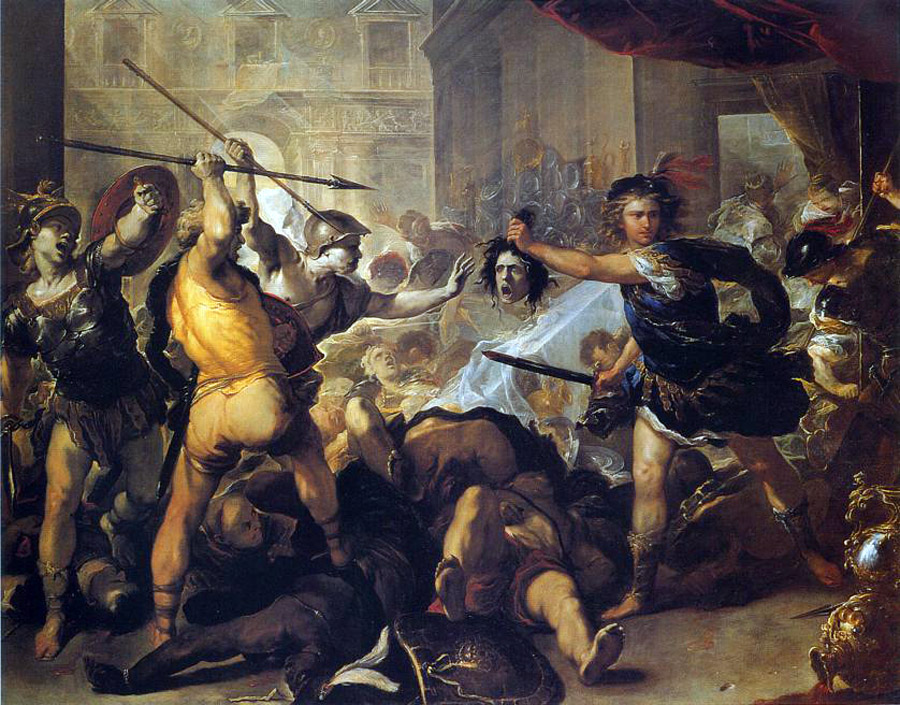
Perseus turns Phineus and his followers to stone (early 1680s)
Luca Giordano
source Wikipedia

In the middle of the wedding feast, uproar rises and it is Phineus, the brother of King Cepheus, coming to revenge himself on Perseus for stealing his bride. Curiously King Cepheus chastises his brother for not saving his bride himself and says that he has given her to Perseus for his deeds.  Not certain whether to aim his shaft at the king or Perseus, Phineus chooses the latter, but Perseus hurls it back, killing Rhoetus, and the wedding feast turns into a brawl.  Perseus battles nearly everyone at the feast until he is backed against a pillar and his strength is beginning to ebb.  He holds up his old, trusty weapon, the head of Medusa, which turns his enemies to marble statues and his one friend, Aconteus, into stone.  Phineus repents, but too late, as he too is transformed into marble.

Continue reading

The Time Machine by H.G. Wells

“The Time Traveller (for so it will be convenient to speak of him) was expounding a recondite matter to us.”

I read this book for the Classics Club Spin #11.  Was it my spin book?  No, it was Mockingbirds, Looking Glasses, and Prejudices spin book but I decided to read along with her.  Why?  Well, her book was much shorter than my Spin book, and I couldn’t imagine getting through God in the Dock in the allotted time frame.  Yes, I’m breaking the rules, but it’s on my Classics Club list, AND at least I read something!

Continue reading