Metamorphoses ~ Book XI

Book XI


Orpheus / The Bacchantes / Midas / Troy / Peleus & Thetis / Ceyx / Daedalion The Wolf / Ceyx & Alcyone / Aesacus

Orpheus charms the beasts and trees with his songs, and even the stones pause to listen.  But the Thracian women, the Bacchantes, are enraged, accusing Orpheus of scorning them.  They hurl staffs and rocks at him, intent on murder but when a stone is flung,


“….it cleaved the air, it yielded to the spell
of his enchanting voice and lyre: it fell
at Orpheus’ feet as if compelled to seek 
forgiveness for its mad audacity …… “

Circling him, the women attack, and all of their weapons would have been tamed by his sweet music, if their “shrieks and caterwauls” had not drowned it out, and they murder and dismember him.  Mournful sounds fill the air as his body is carried by the Hebrus river to the coast.  There, a snake attempts to attack the head, but before it can, Phoebus turns it into stone.  As the Shade of Orpheus descends to the Underworld, he meets Eurydice.  Side by side, they walk and they can now gaze at each other without fear.
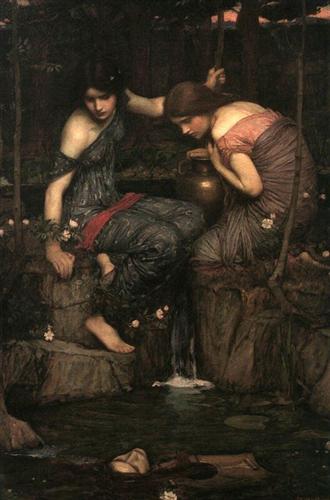
Nymphs finding the head of Orpheus (1900)
John William Waterhouse
source Wikiart
Bacchus intends to punish the criminals for their profane act, and the Bacchantes find themselves bound to the ground.  Roots spread from their feet, bark begins to cover their bodies, as they are transformed into oak trees.
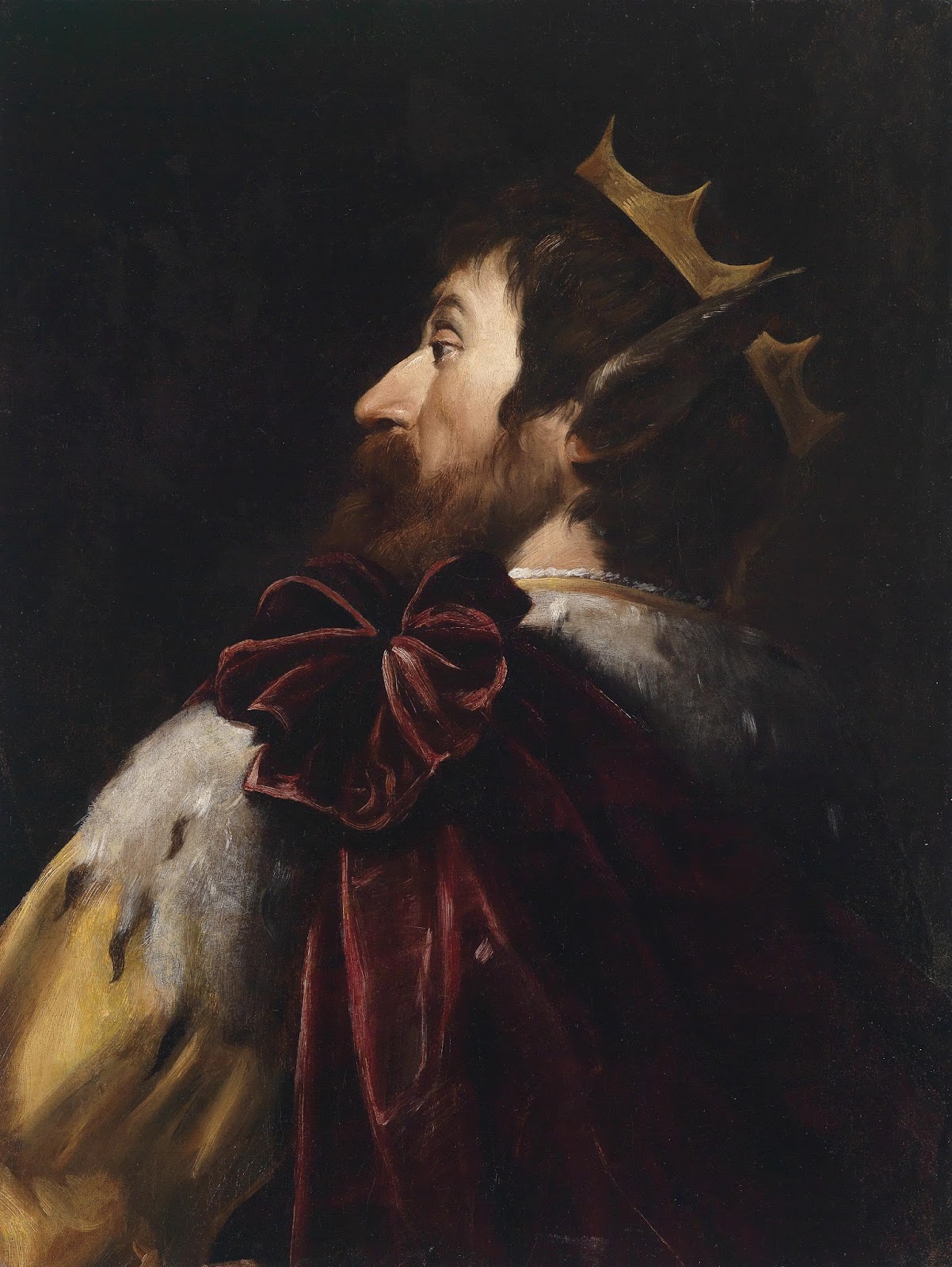
König Midas (1670)
Andrea Vaccaro
source Wikimedia Commons
Bacchus leaves Thrace for his Lydian land and own vineyards in Tmolus.  His satyrs and bacchantes crowd around him, but Silenus (his tutor) is missing, yet he finds him with King Midas who has him in his care.  Bacchus rewards Midas with one wish, and the king requests that everything he touches will turn to gold.  Delighted, Midas begins to touch everything, but soon realizes the curse of his request, repents, and Bacchus instructs him to go to a river near Sardis to wash his sin away.  Midas complies and even today, as Ovid tells us, the Pactolus’ shores can be streaked with gold.  Midas, however, now hates riches and roams the hillside, but his wits were never clever and he continue to seek stupid things which will bring harm.  While watching a musical contest between Pan and Phoebus, upon Tmolus judging Phoebus Apollo the winner, Midas disagrees and for his ill-judgement, Phoebus turns Midas’ ears into those of an ass.  He wraps those ears to his head with a purple turban and when his slave discovers his secret, the slave whispers it into a hole in the ground.  But when the reeds there grow tall, they whisper the secret to the winds, betraying the servant.
Apollo departs for Troy where Laomedon had accepted the offered of Phoebus and Neptune to build the walls of Troy for payment in gold and then reneged on his debt. The sea god caused a flood to bury the fields of Troy.  In payment, they demanded the daughter of the king, Hesione, who was chained to a reef for the prey of monsters, but Hercules saved her.  For his payment, he was promised horses, but again Troy was faithless and Hercules razed its walls.
Apollo and Poseidon Punishing Troy (c. 1590)
Paolo Fiammingo
source Wikimedia Commons
Hercules gives Hesione to Telamon as a royal bride but he is busy fighting with his brother, Peleus.  Peleus is famous for his goddess wife, and we learn of his “courtship”. Zeus had an ardent desire fot Thetis, the goddess of the waves,” but it was prophesied by Proteus that her son would be greater than his father, so Zeus blessed his grandson, Peleus, to pursue her.  Peleus attempted to rape her in her grotto but Thetis transformed into a bird, a tree and then a spotted tigress, so Peleus wisely abandoned his plans.   He prayed to the gods for success and was counselled by Proteus, who rose from the sea, to tie her up, which he did and made her pregnant with Achilles.
The Feast of Peleus (1872-81)
Edward Burne-Jones
source Wikimedia Commons
Peleus accidentally kills his half-brother, Phocus, and for this treachery he is exiled to the land of Trachin, recounting a lie as to his crime.  Ceyx, the king of Trachin, welcomes him, then weeps, whereupon Peleus and his men ask the cause of his sadness.

Ceyx tells of his brother, Daedalion, who had a lovely fourteen-year-old daughter, Chione.  She was raped by both Phoebus and Mercury, bearing twin sons but one from each god: Autolycus, “a connoisseur of wiles and guiles”, and Phillamon, Apollo’s son, “famed for lyre and song.”  Chione, because of this glory bestowed on her, now considered herself surpassing Diana’s beauty, and, for her insult, she was killed by an arrow of the goddess.  At her funeral (burning), Daedalion overcome with grief, ran senselessly around, finally leaping from Parnassus’ peak, where Apollo changed him into a hawk, and “aggrieved, he makes all others mourn.”

As Ceyx relates this story, Peleus’ Phocian cowherd rushes in to announce that a wolf is ravaging the herds of oxen and terrifying the people.  Peleus silently believes this event to be his penance for his crime.  As they prepare to leave to deal with the wolf, Alcyone, the wife of Ceyx, begs him not to go, foreseeing his death.  Thetis intervenes to pardon Peleus and helps him, changing the wolf into a marble statue.  But the fates cause Peleus to travel to the land of Magnesia and King Acastus, where he is cleansed of his guilt.

Meanwhile Ceyx is still puzzled by his brother’s fate and these strange happenings, so he decides to consult an oracle on the isle of Clarus.  Alcyone begs him not to go, but, while trying to calm her fears, he departs and his boat encounters a momentous storm. Before he drowns, he prays that his body will return to his wife for burial, and she finally spots it floating in the water, confirmation of her husband’s death that she had received in a dream conducted by Morpheus.  As she tries to reach the body, she is changed into a bird (a kingfisher), and when she tries to cover her husband with her wings, he too changes:

“…… Their love remained; they shared one fate.
Once wed, they still were wed: they kept their bond.
They mate; they rear their young; when winter comes,
for seven peaceful days Alcyone — 
upon a cliff that overlooks the sea —
broods on her nest.  The surge is quiet then,
for Aeolus won’t let his winds run free;
he keeps them under guard, so that the sea
maintain the peace his fledgling grandsons need.”
 
Halcyone seeking her husband Ceyx (1914)
Herbert James Draper
source Wikimedia Commons

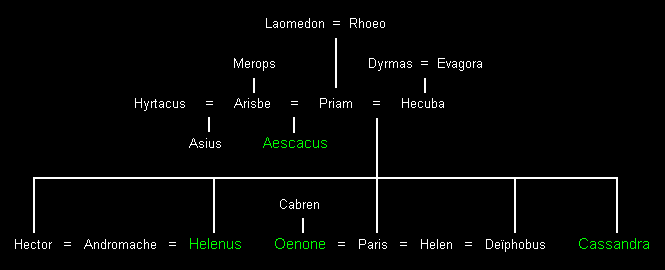
An old man, as he watches the pair of birds, is reminded of another bird, a swift merganser.  The bird is of the line of Ilus and Assaracus, then Ganymede, then Laomedeon, and finally Priam, who was the last king of Troy.  Aesacus, half-brother of Hector (son of Priam) pursued the nymph, Hesperie, who was bitten by a serpent as she fled.  Distraught, Aesacus offered his life for hers.  As he leapt into the sea, Thetis pitied him and clothed him in feathers, but Aesacus so diligently sought death, he continually attempts to plunge in the sea, only to rise again.  He is the diving bird, the merganser.
source


❀ ❀ ❀ ❀ ❀ ❀ ❀ ❀ ❀ ❀ ❀ ❀ ❀ ❀  ❀ ❀ ❀ ❀ ❀

In this book, I noticed varying motifs on music, sound and hearing.  Orpheus communicates by music, yet is drowned out by the Bacchantes’ shrieks; Apollo and Pan have a musical contest; Mt Tmolus must brush away the forest to hear; Midas for hearing ‘incorrectly’ has his ears changed to those of an ass; Proteus’ words are stopped/finished as he sinks into the sea; on Ceyx’s ship, the captain’s voice in drowned out by the “blustering winds”; Ceyx’s words are impeded by the waves; and the Cimmerian cave is a place of complete silence yet for the Lethe.

While the stories often seem random, we can experience a non-linear telling of some of the history of Troy and its heroes.  The scattering make up a puzzle, if we can only pick up the pieces and fit them into the whole.

Metamorphoses

Snake  ❥  stone
Thracian women  ❥  oak trees
Midas’ touch  ❥  gold
Midas’ ears  ❥  ears of an ass
Thetis  ❥  bird/tree/spotted tigress
Thetis  ❥  various shapes  ❥ Thetis
Daedalion  ❥  hawk
Wolf  ❥  marble statue
Ceyx & Alcyone  ❥  birds (kingfishers)
Aesacus  ❥  merganser (“diving bird”)

Continue reading

Top Ten Book on My Spring TBR

It’s been awhile since I participated in a Top Ten Tuesday post and this particular Tuesday, the topic caught my eye.  I started off 2016 with a bang, but since the year is progressing, I’ve lost some of my reading focus.  A post like this will be a good motivator to pull it all together and target my important reads.

Still Life Vase with Flowers (1881)
Paul Gauguin
source Wikiart

I have a number of challenges and read-alongs going on, including my Shakespeare challenge, my Greek challenge, my Reading England challenge, Back to the Classics, etc., along with a group read of The Faerie Queene motivated by O at Behold the Stars, my read of The Lord of the Rings with Cirtnecce of Mockingbirds, Looking Glasses and Prejudices, and I know not what (that last phrase is good to use when your head is going to explode with the possibilities! 😉  ).  Will my list be longer than 10 books?  Let’s find out!

1.

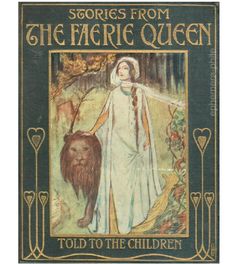
The Faerie Queene:  The whole complete unabridged poem (although I liked the above book cover best).  I’m terrified and also kind of excited.
2.    
The Pickwick Papers:  For the Behold the Stars read-along in publication order.  A very unique and illuminating experience to read Dickens as his first readers would have read his works ….. spanning about a year and a half!
3.   
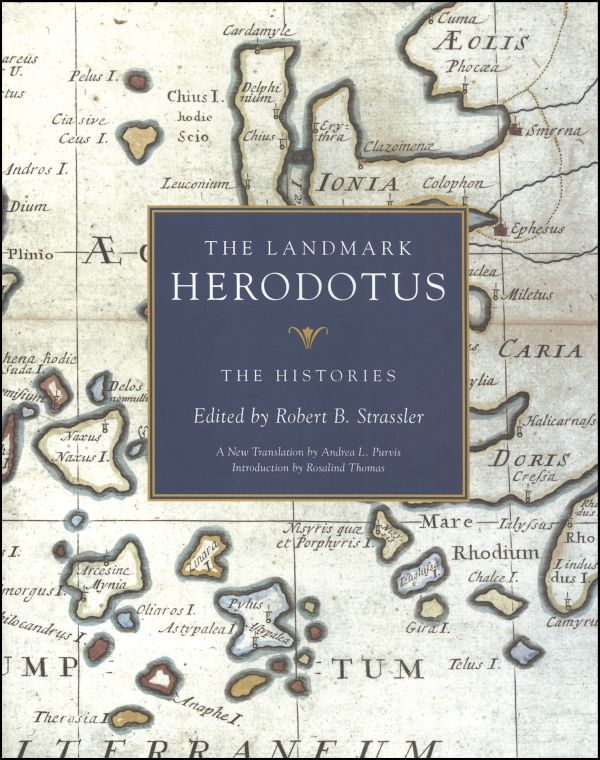
The Histories by Herodotus:  I’ve place it at the top of the list because I’m determined to get to it sometime this year, and I’d like to start it soon.  Hopefully, the fact that I’ve been looking at it for the last month without reading it, isn’t a dire premonition!
4.   
To Kill A Mockingbird:  I’m reading this with one of my Goodreads groups.  I haven’t read it since high school and it’s on my Classics Club list, so I’m looking forward to it.
5.   
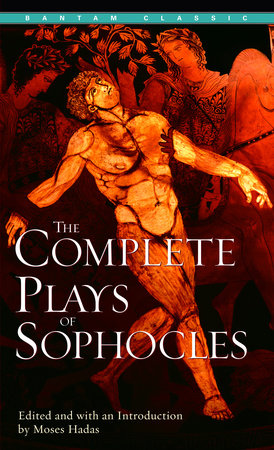
Sophocles:  I should be finishing up the plays of Aeschylus soon and then I’ll begin on those by Sophocles.  I’ve read his Theban Plays twice already and can’t wait to re-visit them, but I’m also looking forward to reading the rest of his works.
6.   
Twelfth Night:  This play is being performed at our local university, so I thought I should support locally, read a book for a challenge, and make another attempt at this play.  I’ve read it twice already and wasn’t enthused, but perhaps the third time will be a charm. 
7.   
My Father’s Dragon:  This is such a great book!  If you haven’t read it, I guarantee you’ll love it.  I’m adding it for Amanda @ Simpler Pastimes’ Children’s Literature Event in April.
8.   
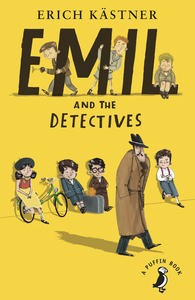
Emil and the Detectives:  Another book for Amanda’s event.
9.   
The Cloud of Unknowing:  I’m trying to get through this one.  Very mystical, which normally I like, but this time I’m not connecting.  Perhaps it has to do with the fact that the anonymous author at the beginning of the book says it is not to be read by anyone but a contemplative.  And I didn’t listen to the warning! :-Z
10.   
Framley Parsonage:  Oh my goodness, do I owe an enormous apology to Trollope!  Do you know how many years ago I started to read through his Barsetshire Chronicles? Two!  Do you know how many books I’ve managed to read?  Three!  It’s pitiful, especially considering that I really have enjoyed each book.  Sigh!  I just don’t know why I have no desire to pick the next one up.  In any case, I got this book for my latest Classics Club Spin and Cirtnecce has kindly offered to read-along with me.  Do you think with a Spin hanging over my head and a blogging friend to hold my hand, that I can get it finished?  We’ll see …….

Spenser’s Images of Life by C.S. Lewis

Normally, I don’t read introductions or commentaries on books or poetry that I plan to read, until after I’ve finished the work.  I prefer to experience the art from a point of innocence (or perhaps, ignorance is a better word!), forming my own opinions without influence, even if I struggle with my first read through. However, this time I threw all my ideals to the winds and called for help.

In April I’m reading The Faerie Queene with OCirtnecce, JeanRuth, and Consoled Reader, and considering the length and complexity of this poem, I confess that it was wiser to admit my complete ineptitude and look for someone who was very familiar with this type of poem and era to give me a little boost.  Since C.S. Lewis’ expertise was in Medieval and Renaissance literature, I suspected that he would be a good place to start.  His book, Spenser’s Images of Life is a compilation of lectures notes, put together by Alastair Fowler, to give students a deeper insight into The Faerie Queene.

Continue reading

Metamorphoses ~ Book X


Book X


Orpheus and Eurydice / Cyparissus / Orpheus’ Prologue / Ganymede / Hyacinthus / The Cerastes / The Propoetides Pygmalion / Myrrha & Cinyras / The Birth of Adonis / Venus and Adonis / Atalanta & Hippomenes / The Fate of Adonis

 
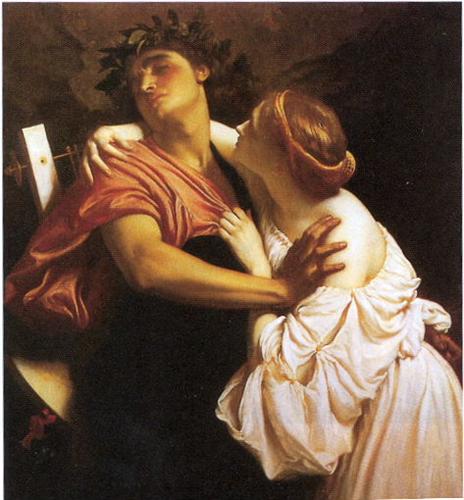
Orpheus & Eurydice (1864)
Frederic Leighton
source Wikiart

Hymen did not bless the wedding of Orpheus, and what a mess! (I’m losing my narrative tone, aren’t I?) His bride, Eurydice, while crossing the meadow with her Naiad friends, stepped on a viper and died.  After his weeping ceased, he travelled to the Underworld to seek his cherished wife.  Playing sweetly on his lyre, he begged the gods to restore her to life, and so beautiful his song that even the bloodless shades shed tears and the Furies wept. By his skill and love, Orpheus won his wife back, but was warned as he was leading her out, to only look straight ahead or she would be reclaimed by the dead.  Nearly in the upper world, Orpheus could not resist looking at her, and as his eyes fell upon her, he watched her sink back into the abyss.  Frantic, he ranged the banks of the Styx like a shade, then finally left the Underworld.
Continue reading

Classics Club Spin # 12 ……….. And The Winner Is ……………

 Number 8

Well, this was a very good choice for me.  I’ve been trying to read through Anthony Trollope’s The Barsetshire Chronicles for about two years, and am at the halfway point. Number 8 for me is Framley Parsonage, book number 4 in the series.

For some reason, I’ve had a Trollope-block in the last year, and I really needed a push, so perhaps this is it.  Now I just need to buckle down and read!

The Classic Children’s Literature Event IV

Amanda at Simpler Pastimes has hosted a Classic Children’s Literature event every year for the past three, and as April rolls around it’s time to pull out any classic children’s book and read, read read!

I have had no time to really target the specific books I’m going to read, but I do have a few in mind.

  • A Triumph for Flavius – Caroline Dale Snedecker
  • Three Greek Children – Alfred J. Church
  • All Alone – Claire Huchet Bishop
  • My Father’s Dragon – Ruth Stiles Gannet
  • Blue Willow – Dorothy Gates
  • When Hilter Stole Pink Rabbit – Judith Kerr
  • Carry On, Mr. Bowditch – Jean Lee Latham
  • Number the Stars – Lois Lowry
  • With Pipe and Paddle Song – Elizabeth Yates
  • The Sprig of Broom – Barbara Willard    
The read-along for the event will be Emil and the Detectives by Erich Kastner, which I have had on my shelves for ages, but haven’t read yet.
So come one, come all, to read some children’s literature with us as a pleasant introduction to the spring season.  Just pop over to Amanda’s blog to sign up.

Classics Club Spin #12

I really wasn’t certain whether I wanted to participate in the new Classics Club spin.  My last spin was a fail; I read the first essay of God in the Dock and then realized that I wouldn’t do it justice with a quick read and a quicker post, so away it went back onto the list for when I have more time. However, I did read Cirtnecce’s spin book, The Time Machine, so all was not lost.  At the moment though, I have so many reads going that adding another book just didn’t appeal to me ………….  Until I told myself that I am trying to concentrate on paring down my Classics Club list this year, and gave myself the permission to tweak the spin list a little.  I hope something good comes of it.  If I don’t succeed with this spin, it will be my third fail, or almost fail,  in a row and my self-esteem just couldn’t take it.  😉  

The Rules for the spin are:
  1. Go to your blog.
  2. Pick twenty books that you’ve got left to read from your Classics Club list.
  3. Post that list, numbered 1 – 20, on your blog by next Monday.
  4. Monday morning, we’ll announce a number from 1 – 20.  Go to the list of twenty books you posted and select the book that corresponds to the number we announce.
  5. The challenge is to read that book by May 2nd.


I used the random list organizer here to choose the 20 books from my master list.  Then I tweaked them, so my list ended up looking like this:
  1. Richard III (1592) – William Shakespeare
  2. Villette (1853) – Charlotte Brönte 
  3. The Robe (1942) – Lloyd C. Douglas 
  4. Twenty Years After (1845) – Alexandre Dumas
  5. The Histories (450-420 B.C.) – Herodotus
  6. Metamorphoses (8) – Ovid
  7. Dead Souls (1842) – Nikolai Gogol 
  8. Framely Parsonage (1860 – 1861) – Anthony Trollope
  9. Gargantua and Pantagruel (1532 – 1564) – François Rabelais 
  10. The Faerie Queene (1590-96) – Edmund Spenser
  11. The Republic (380 B.C.) – Plato 
  12. Huckleberry Finn (1884) – Mark Twain
  13. Henry V (1599) – William Shakespeare
  14. A Doll’s House (1879) – Henrik Ibsen
  15. The Waves (or other) 1931) – Virginia Woolf 
  16. Bondage of the Will (1525) – Martin Luther
  17. Tevye the Dairyman and Motl the Cantor’s Son (1894) – Sholem Aleichem
  18. The Hunchback of Notre Dame (1831) – Victor Hugo 
  19. Fear and Trembling (1843) – Soren Kierkegaard
  20. The Pilgrim’s Progress (1678) – John Bunyan
Since I’ve completely manipulated my list (well, not completely ….. I changed out about 6 books)  I don’t really have any that I’m dreading.  All the ones I’d dread, such as Metamorphoses, The Faerie Queene and The Histories, I’m already reading or have plans to read, so I’m really fine with anything on the list.  I will admit to removing Augustine’s City of God; I’d love to read it but my time is so limited that if it was chosen, I’d be breathing in a paper bag. 😉

As for books that I’m anticipating with eagerness …..  I will say Metamorphoses because I’m already more than half way through!  How’s that for manipulation?

Oh Muse, sing of my spin choice ……….

Metamorphoses ~ Book IX


Book IX


Achelous & Hercules / Hercules, Deianira, Nessus / Hercules & Deianira / Alcmena / Dryope / Iolaus / Byblis & Caunus Iphis & Ianthe


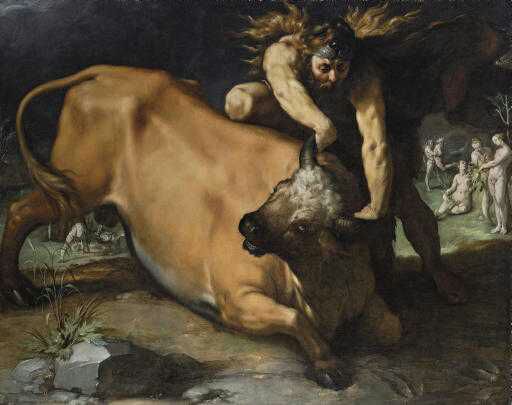
Hercules and Achelous
Cornelius van Haarlem
source Wikimedia Commons

Achelous relates how he lost his horn in a fight with Hercules when they both contended for the hand of Deianira.  First he had attempted to persuade the girl’s father by disparaging Hercules, but Hercules discounted words, instead wanting to fight.  Finally overpowered, Achelous first attempted to transform himself into a snake and then a bull, but his enemy tore off his horn, which the Naiads took and filled with fruit and flowers, now called a sacred Cornucopia.  Sophocles’ play, The Women on Trachis, recalls this battle between Achelous and Hercules.


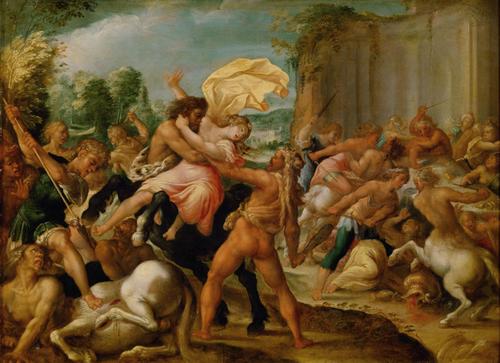
While Hercules was journeying back to Tiryns with his bride, Deianira, a rushing river stopped their path.  Nessus, a centaur, offered to take the lovely bride safely to the other shore, while Hercules swam over.  Once on the other side, Hercules hears cries and sees that the centaur is attempting to kidnap the girl.  Yelling threats, he threaded his bow and shot the arrow which hit the centaur in the spine coming out on the other side.  Knowing that Hercules had dipped the arrow in the venom of the Hydra, as life ebbed from him, Nessus gave his envenomed, blood-soaked tunic to Deianira, promising that it would kindle the love of Hercules.  

Nessus kidnaps Deianeira (c. 1600)
Hans Rottenhammer
source Wikimedia Commons

Juno hated Hercules for his mighty deeds and while he was away, she had Rumor go to his loving wife, whispering lies of his love of Iole.  Deianira, being a sister of Meleager (I thought they were all turned into guinea hens – see Book VIII), devises a plan of revenge: to cut the throat of her rival, but meanwhile, she will send Hercules the tunic of Nessus to rekindle his love.  As he wears it, the venom courses through Hercules’ body, bringing searing pain, but when he tries to take it off, he tears his flesh with it.  Before he perishes in agony, he hurls his attendant, Lichas, into the sea, blaming him for bringing the gift and the man becomes a stone in the Euboean Sea.  The gods are dismayed at what will happen to the earth’s defender and Jove decides to deify him,  riding down in his chariot to cloak him in a cloud and then place him in the sky.
 
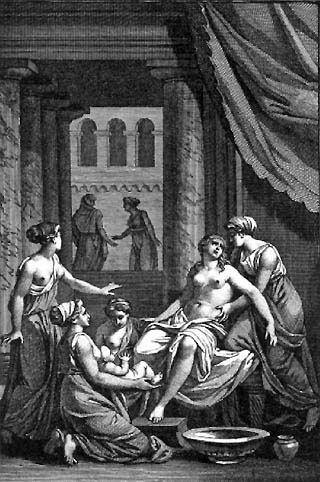
Birth of Heracles
Jean Jacques François de Barbier
source Wikipedia

Because of his father’s wishes, Hyllus, the son of Hercules, wed Iole who is now pregnant. Hercules’ mother, Alcmena gives the girl advice and tells her of her own birth pangs.  Cruel Juno, angry at Jove’s impregnating Alcmena, sits outside, crosses her legs and her fingers to block the birth.  But Galanthis, the servant girl, cleverly recognizes the goddess and announces that Alcmena has given birth.  Juno is astounded, leap up and with the unlinking of her knees and fingers, the knot was undone and Alcmena finally gave birth.  Yet Galanthis makes the mistake of jeering at Juno who turns her into a weasel.

Iole tells of her half-sister, Dryope, who was raped by Delphi’s deity (Phoebus), nevertheless Andraemon happily married her.  One day, as she was walking with her infant son and Iole, she picked the purple blossoms of a lotus, which dripped blood with her plucking.  The lotus was a nymph who had transformed herself after being chased by Priapus, but from Dryope’s innocent carnage, the lotus begins to transform her as well.  Sister, husband and father, all rush to the scene just in time to hear Dryope’s final plea for her son to visit and know her, then she gives the boy a final kiss before her lips are sealed forever.

Iolaus appears in the doorway, this nephew of Hercules having his youth restored by his uncle’s request to Hebe, the wife he married when he was placed in the sky.  Hebe wishes never to perform the task again, but her vow is stopped by Themis, the prophetess, telling of many times this similar event would take place in different ways. Even the gods wish for such favours for their favourites but through examples of Minos, Rhadamanthus and Aeacus, Jove demonstrates all are not so blessed and the deities settle down.

Old Minos is concerned about an overthrow by young Miletus, but Miletus sails away and starts his own city at the mouth of the Meander.  He finds a Cyanee, is lured by her body and she gives birth to twins, Byblis and Caunus.  Byblis develops an unsisterly love for Caunus, pining for him with a startling intensity.  Finally, she sends him a letter confessing her love, which he receives with a burgeoning rage.  He escapes, leaving the land and her obscene love, but she follows him in a frenzy of passionate despair, travelling all over until completely insane, she collapses, her tears transforming her into a fountain.

Byblis turning into a spring (1866)
Jean-Jacques Henner
source Wikimedia Commons

In Phaestus, Crete, there lived a freeborn man called Ligdus with a pregnant wife, Telethusa.  He wishes only two things for his “dear” wife (please, sense the beginning of sarcasm here):  that she suffers little pain in childbirth and that the child may be a boy, because if it turns out to be a girl, he will put her to death.  Both distraught over his decision, as Telethusa is about to give birth she sees the (Egyptian) gods, Anubis, Bubastis, Apis, Osiris’ son, Isis, Osiris, and the Egyptian snake who tell her to let the child live.  So Telethusa is able to fool everyone into thinking that the child is a boy, and thirteen years later the boy, Iphis (really a girl), is betrothed to the lovely Ianthe.  Now Iphis actually longs for Ianthe, but is distraught over her sex, thinking that nothing can come of the union.  The girl prays to Isis, and behold!  On the day of the marriage Iphis is transformed into a young man and gets his/her desire.

❈ ❈ ❈ ❈ ❈ ❈ ❈ ❈ ❈ ❈ ❈ ❈ ❈ ❈ ❈ ❈ ❈ ❈ ❈ ❈ ❈ ❈ ❈ ❈ ❈ ❈ ❈

I must say that in spite of the distastefulness of some of these tales, Ovid has outdone himself.  His metamorphoses are not just simply humans changing to bulls, birds and whatnot, but a broader transformation of gender, alliances, and even unnatural love.


Metamorphoses
Lichas ❥  hard stone
Hercules  ❥  a god
Galanthis  ❥  weasel
Nymph  ❥  lotus
Dryope  ❥  lotus tree
Iolaus  ❥  youth
Boys  ❥  men
Byblis  ❥  fountain
Iphis  ❥  young man


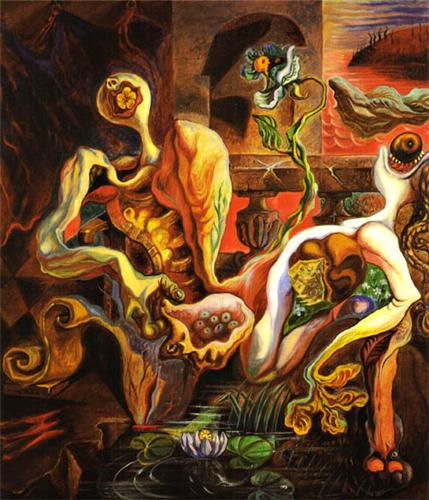
The Metamorphosis of the Lovers (1938)
Andre Masson
source Wikiart


The Pickwick Papers Read-Along ( A Long Read-Along! )

O at Behold the Stars is hosting a read-along of The Pickwick Papers beginning March 1, 2016.  Now, this is not just any read-along, but a read-along with a twist.  We are actually going to be reading along with the same serial publication schedule in which the book was published, which means that this read-along is going to take about a year and a half to finish.  Does that sound too long?  I challenge you to try it.  Not only will you get the real Pickwick Papers experience, it’s not too heavy of a commitment, so it won’t interfere very much with other reads.  I’ve also found it beneficial to read a bit of a book and then let it percolate in your mind; you can often get more out of it that way.  In any case, I’m really excited about this read-along!  Here’s the schedule:

I – March 2016 (chapters 1–2)
II – April 2016 (chapters 3–5)
III – May 2016 (chapters 6–8)
IV – June 2016 (chapters 9-11)
V – July 2016 (chapters 12–14)
VI – August 2016 (chapters 15–17)
VII – September 2016 (chapters 18–20)
VIII – October 2016 (chapters 21–23)
IX – November 2016 (chapters 24–26)
– December 2016 (chapters 27–29)
XI – January 2017 (chapters 30–32)
XII – February 2017 (chapters 33–34)
XIII – March 2017 (chapters 35–37)
XIV – April 2017 (chapters 38–40)
XV – June 2017 (chapters 41–43)
XVI – July 2017 (chapters 44–46)
XVII – August 2017 (chapters 47-49)
XVIII – September 2017 (chapters 50–52)
XIX – October 2017 (chapters 53–55)
XX – November 2017 (chapters 56–57)

So, if this read-along appeals to you, grab your Pickwick Papers and join us for a realistic reading experience!

Metamorphoses – Book VIII


Book VIII
Scylla, Nisus, Minos / Daedalus, the Minotaur, Theseus & Ariadne / Daedalus & Icarus / Daedalus & Perdix / The Calydonian Hunt / Althaea & Meleager / Theseus & Achelous The Echinades & Perimele / Baucis & Philemon / Erysichthon’s Sin / Erysichthon & FamineErysichthon’s DaughterAchelous
  
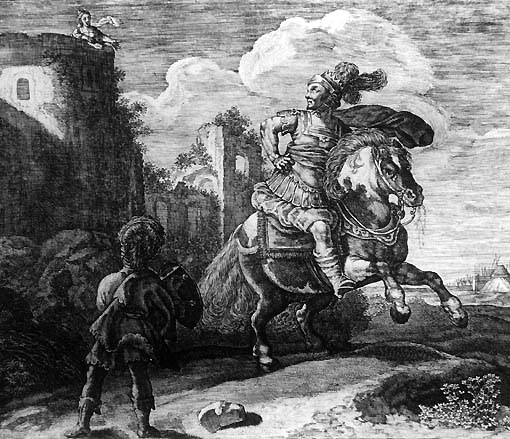
Minos & Scylla
17th century etching
source Wikimedia Commons
Minos, the son of Europa and king of Crete, besieges Alcathous and the coast of Megara, and its king, Nisus, amid his grey hairs, has a gleaming purple tuft which holds the security of his kingdom.  Now, his daughter, Scylla, climbs to the top of the tower of the king to watch the siege and falls madly in love with Minos.  She convinces herself that if she is taken hostage, the war will end. With such thoughts, she sneaks into her father’s bedroom, tears off his tuft, and hurries out to find Minos.  King Minos, however is appalled at her present, and claiming her a disgrace, calls for her banishment.  Imposing just wars on the Megarians, Minos set sail for home, leaving lovelorn Scylla spewing poison and lamenting her fate.  Finally, she decided to follow Minos, diving into the waves and holding fast to his ship.  Yet, her father now is a tawny osprey, and he dives at her, dislodging her from the stern.  Scylla transforms into a bird, called the Ciris, meaning to cut, for she had shorn her father’s tuft.
The Minotaur (1884)
George Frederick Watts
source Wikimedia Commons
Minos arrives home and sacrifices to Jove, but there is a shame lurking in Crete.  The adulterous liaison of Mino’s mother and a bull, has produced an hideous offspring which must be concealed.  Minos gets the famed builder, Daedelus, to construct a labyrinth that is so intricate, the monster will never get out.  In this maze, the Minotaur is imprisoned, but Theseus kills it three years later, with the help of Ariadne, the daughter of Minos, who gives him a thread to find his way out.  While Theseus took Ariadne with him, he left her on Naxos, but in her desolation and tears, Bacchus gave her a place in the constellations as the Northern Corona, her crown a diadem of stars.
Daedalus, weary of his sojourn in Crete, decides to escape, and “at once he starts to work on unknown arts to alter nature”.  Constructing wings make of reeds, twine, feathers and wax, he cautions his son, Icarus, that he must follow him and not fly too high nor too low to avoid being wetted by the ocean or scorched by the sun.  At first, the boy flies right behind his father but then, delight and audacity come upon him and he soars up into the open sky.  The wax on the wings melt and he plunges to the sea and to his death.  Daedalus finally discovers his son’s plight and builds a tomb for him on an island now called Icaria.
 
Lament for Icarus (1897)
Herbert James Draper
source Wikimedia Commons
 
As Daedalus builds the tomb, an irate partridge comes out of a muddy ditch to scold him.  This bird is Perdix, his nephew, who at twelve years old was trusted to his care and teaching.  But the boy proved too clever and bright, and in his envy of the child, Daedalus threw him from Minerva’s sacred citadel, lying and saying that he’d fallen.  Minerva, however, scooped the child up in mid-air and transformed him into a partridge.  Now Daedalus, spent and ragged, arrives as a suppliant near Aetna (Sicily) where King Cocalus gives him refuge but wisely prepares his troops for an invasion by Minos.
The Calydonian Boar Hunt (1611-12)
Peter Paul Reubens
source Wikimedia Commons
Because of Theseus’ bravery and success, Athens is relieved of paying tribute to Crete and all lands praise him and ask for his assistance in peril.  Oenus, king of Calydon requires his assistance when a massive boar is sent by the goddess Diana, who is incensed because all the gods had been given a gift of the harvest, yet her alter lay bare.  A legion of men gather, some of whom are familiar, including Achilles’ father (Peleus), Jason, Telamon, and wise Nestor in his youth (from The Iliad), and the Calydonian hunt begins.  The men charge the boar who becomes enraged and nothing seems to be able to slow his frenzy. Finally, Atlanta, the only woman in the hunt, manages to draw blood, and Meleager praises her bravery.  The rest of the men, however, are angered at being bested by a woman, and rather forcefully, yet thoughtlessly, attempt to kill the animal.  Finally Meleager kills the massive beast, and all applaud him, but when he gives part of the his glory to Atlanta, dissent rumbles through the hunters.  His uncles emerge to reclaim his gift, angering Meleager who kills them both.
Althaea, Meleager’s mother, is in the process of giving gifts to the gods for his victory, when she sees the bodies of her brothers being borne into the city. Agonized over their deaths, she recalls a prophecy where the Fates assigned the same life to a log as to Meleager.  His mother had secreted the log away, but with this murder she resurrects it.  Her agony as to whether or not to burn it is riveting:
” ……Within Althaea, mother wars with sister;
those two names tear apart her single heart.
First she grows pale with fear of what she plans,
a crime so foul; but then her seething wrath
inflames her eyes with its own color, red.
Now she appears to be most menacing —
a horrid thing —- and now you’d swear that she
was merciful.  When savage frenzy dries
her tears again.  Althaea cries.  She’s like
a ship that, driven by the wind and by
a current running counter, is the prey
of both and — in uncertainty — obeys
two forces ……”
After a Gollum-like conversation with herself, finally she calls on the Furies to witness her deed, hurling the log into the fire.  As the log burns, so does Meleager until he is only ash.  His sisters are distraught, his father is agonized, his mother commits suicide and Diana is content.  She turns his sisters into guinea hens.
Theseus, sailing away from Calydon and the carnage, is warned by the river-god Achelous, to take refuge in his house.  Heavy rains have swelled the Achelous river and he is in danger if he attempts to cross.  Aegus’ son accepts the hospitality and he is given a feast.  
Theseus asks Achelous about an island that he sees far off and the river god informs him that it is not one, but five islands.  They used to be five Naiads, but when they sacrificed ten bulls for a festival dance and forgot to invite Achelous, he swelled with rage, sweeping the nymphs away and tearing away a piece of land to form five parts, now called the Echinades.  There is yet another island, Perimele, named for his love, who he, by force, took her virginity.  Her father threw her from a cliff into the sea, however Achelous bore her up, calling on Neptune, who changed her into an island.
Mercury & Jupiter in the House of Philemon & Baucis (c. 17th century)
Jacob an Oost
source Wikimedia Commons
Pirithous, the son of Ixion, scoffed at the river god’s tale, feeling that the gods were given too much power, but Lelex countermands his profession with a story to tell.  In the Phrygian hills, there once was a devolted old couple named Baucis and Philemon.  One day, the gods Jupiter and Mercury came seeking shelter in the guise of men.  The poor doddering couple gave them lodging and the best of the food they had to offer.  When they saw that their wine bowl was magically being replenished they were frightened that their food was not good enough and went to kill their only goose who guarded their land.  But the poor goose gave them a chase and they gave up exhausted, when finally the gods revealed themselves.  They took the couple on a long walk and when they looked back, their house was turned into a temple.  When asked for their desire, they asked to become priests of the temple and die together when their time came.  All came to fruition, but as their lives faded, one was transformed into an oak tree and the other, a linden.
Theseus is quite stirred by these tales and wishes to hear another.  Achelous tells of the transformations of Proteus, then relates a story of Erysichthon, who scorned the gods, chopping down a sacred grove of Ceres, including a sacred oak, causing the tree to bleed as the nymph inside is killed.  She utters a prophesy of punishment for Erysichthon’s sin, but still Erysichthon is heedless.
 
In punish for Erysichthon’s heartless deed, Ceres sends her nymph to Famine (as she cannot go herself for their purposes are opposed), and Famine pays the sinner a visit, breathing on him until he dreams of gnawing, burning hunger, but he can only eat air.  
 
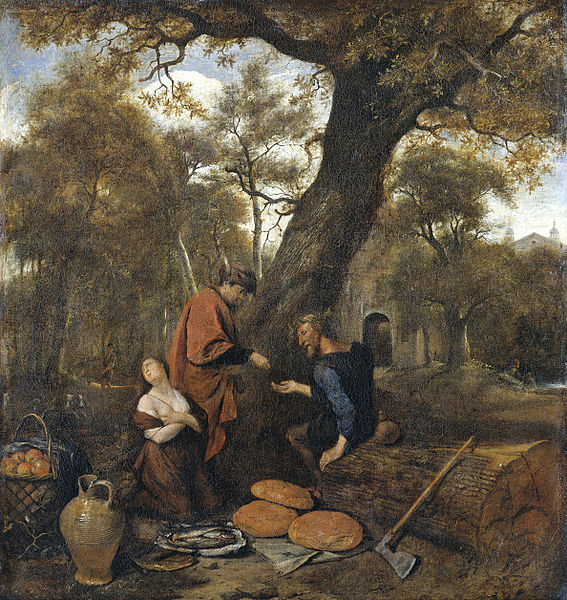
Erysichthon Sells His Daughter (1650-60)
Jan Havicksz Steen
source Wikimedia Commons
Erysichthon’s hunger becomes so unbearable that he sells his daughter, but she escapes her master by changing herself into the shape of a man.  When father sees daughter again, he sells her to master after master, all of whom she eludes by changing form.  Finally, the ravenousness of Erysichthon causes him to eat all he has and, in desperation, he “began to rend his flesh, to bite his limbs, to feed on his own body.”
 
Achelous wonders why he tells of the metamorphoses of others when he, too, has undergone many changes.  In fact, he removes his head-wreath showing not two, but one horn upon his head.  Then he groans.


Metamorphoses
King Nisus  ❥  osprey
Scylla  ❥  bird
Ariadne  ❥  Northern Corona constellation
Perdix  ❥  partridge
Meleager’s sisters  ❥  guinea hen
Five Naiads  ❥  the Echinades islands
Perimele  ❥  island
Baucis & Philemon  ❥  oak and linden trees
Proteus  ❥  boar, serpent, bull, stone, plant, stream, fire
Erysichthon’s daughter  ❥  man, mare, bird, deer, etc.
Achelous  ❥  river, snake, bull