Poetry Month Tag

The Poetry Month celebration has begun at The Edge of the Precipice, and Hamlette has posted a tag with a few questions to answer.  Poetry and I aren’t close friends yet, but we’ll see how I do …..  Fortunately the first questions is easy!

What are some poems you like?
The Lady of Shallot by Alfred Lord Tennyson
The Highwayman by Alfred Noyes
Annabel Lee by Edgar Allan Poe
Ode to a Nightingale by John Keats
What are some poems you dislike?
Since I’m a rank amateur when it comes to poetry, I’m trying to concentrate on poems which I think I’ll enjoy. I haven’t come across any I particularly dislike as of yet.  As for poets whom I’m hesitant to read because I think that I might not like their works, I can guess perhaps Lord Byron and William Blake.  But I could read them and love them for all I know!  
Are there any poets whose work you especially enjoy?  If so, who are they?
I’m very excited to read more Keats.  His ability with words and images is magnificent!  Then I’d also like to read more of Tennyson, Hilaire Belloc, and Oscar Wilde.  Curious list, isn’t it? 🙂
Do you write poetry?
I used to write a little long ago when I was in high school.  I remember that I wrote a haiku that my teacher loved, so I’m going to try to find it and post it.
Have you ever memorized a poem?
Yes!  A few:  Jabberwocky by Lewis Carroll,  My Shadow by Robert Louis Stevenson, Celery by Ogden Nash,  and Ooey Gooey by Unknown.
Do you prefer poetry that rhymes and had a strict meter, or free verse?  Or do you like both?
I don’t enjoy rhyming for the sake of rhyming, but with poems such as The Canterbury Tales, the rhyming forms part of the tone of the stories and it’s wonderful!  Free verse has been less enjoyable for me, but again, I haven’t had much experience with it and my opinion could certainly change.
Do you have any particular poetry movements you’re fond of?  (Beat poets, Romanticism, Fireside poets, etc?)(If you haven’t got any idea what I’m talking about, that’s fine!  You can check out this listfor more info, if you want to.)

I have no idea what Hamlette is talking about!  Just kidding. 😉   I actually enjoy epic poems best, such as The Iliad, The Odyssey, Beowulf, etc.  As for eras, I think I’d like the Romantics, but again, I’m not sure. 

For my first poem of the month, I’m going to read Narnian Suite by C.S. Lewis because I’d never heard of it before and surprisingly it seems very Tolkien-ish.  Since they were part of the Inklings, a group that met together and read their writings to each other, it’s perhaps expected that certain styles and tones of writing, might have rubbed off on each other.

The Oresteia ~ The Libation Bearers by Aeschylus

The Return of Orestes (1785)
Anton von Maron
source Wikimedia Commons

The Libation Bearers by Aeschylus
“Hermes, lord of the dead, who watch over the powers
of my fathers, be my saviour and stand by my claim.
Here is my own soil that I walk.  I have come home;
and by this mounded gravebank I invoke my sire
to hear, to listen …..”

Continue reading

Metamorphoses ~ Book XIII

Book XIII


Ajax and Achilles’ Armor / Ulysses and Achilles’ Armor / Ajax / The Fall of Troy / Polymestor and Polydorus / Polyxena / Polyxena & Hecuba / Hecuba, Polydorus, Polymestor / Aurora & Memnon / The Voyage of Aeneas / The Daughters of Anius / The Daughters of Orion / The Voyage of Aeneas / Galatea & Acis / Glaucus & Scylla


Ajax and Ulysses contend for the armour of the fallen hero, Achilles.  In spite of proclaiming himself a man of action and not one for florid speech, Ajax commences a rhetorical banquet, listing all his ancestors and spewing vitriol against Ulysses.  Ajax’s father is Telamon, who was friend to Hercules as he destroyed Troy’s walls, sailed in the ship with Jason and was born of Aecus.  In fact, he is a descendant of Jove, a honour he shares with Achilles, etc., etc.  Ulysses is nothing but a smooth talking, lily-livered, cowardly, sneaky, dishonest fraud.  Oh, and all his feats are minor.  In fact, he, Ajax, should be the winner of the armour because his own shield is so damaged with fighting, yet Ulysses’ shield is so little used.  He suggests that the armour be thrown among the Trojans and whoever reclaims it, be it him or Ulysses, will be the victor.

Continue reading

Amoretti LXVIII ~ Most Glorious Lord of Life by Edmund Spenser


Amoretti LXVIII: Most Glorious Lord of Life
Edmund Spenser (1552–1599)
Most glorious Lord of life, that on this day,
Didst make thy triumph over death and sin:
And having harrow’d hell, didst bring away
Captivity thence captive, us to win:
This joyous day, dear Lord, with joy begin,
And grant that we for whom thou diddest die,
Being with thy dear blood clean wash’d from sin,
May live for ever in felicity.
And that thy love we weighing worthily,
May likewise love thee for the same again:
And for thy sake, that all like dear didst buy,
With love may one another entertain.
So let us love, dear love, like as we ought,
Love is the lesson which the Lord us taught.
 
 
Jesus and Mary Magdalene (c. 1534)
Antonio da Corregio
source Wikimedia Commons
The Three Marys at the Tomb of Christ (c.1603)
Adam Elsheimer
source Wikimedia Commons


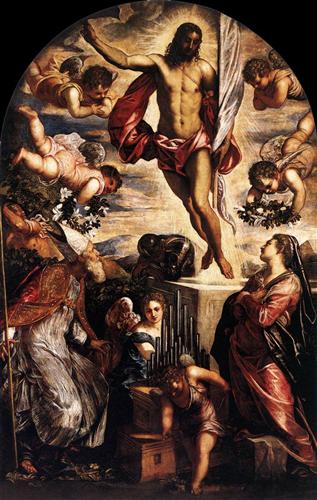
** paintings above are The Resurrection of Christ (1565) by Tintoretto & Resurrection of Christ (1875) by Carl Bloch, both on Wikiart.  I had so much trouble with this post —- Blogger deleting whole posts, etc. that I’m terrified to touch anything else!  Happy Easter everyone!

Thanks to Amanda, here’s the poem in song!


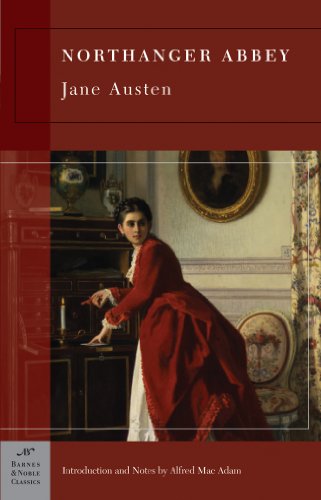
Northanger Abbey by Jane Austen

“No one who had ever seen Catherine Morland in her infancy would have supposed her born to be an heroine.”

While Northanger Abbey was the first novel written by Jane Austen and sold to a publisher by her brother, Henry, in fact it was repurchased by the author and not published until six months after her death in December 1817.  Austen’s parody of 17th century Gothic novels is told with a good-natured humour, but a valuable lesson lies beneath the surface of its narrative.

Continue reading

Metamorphoses ~ Book XII

Book XII


Iphegenia / Rumor / Achilles & Cycnus / Caenis/Caenus / Lapiths & Centaurs / Cyllarus / Caenus / Hercules & Periclymenus / The Death of Achilles


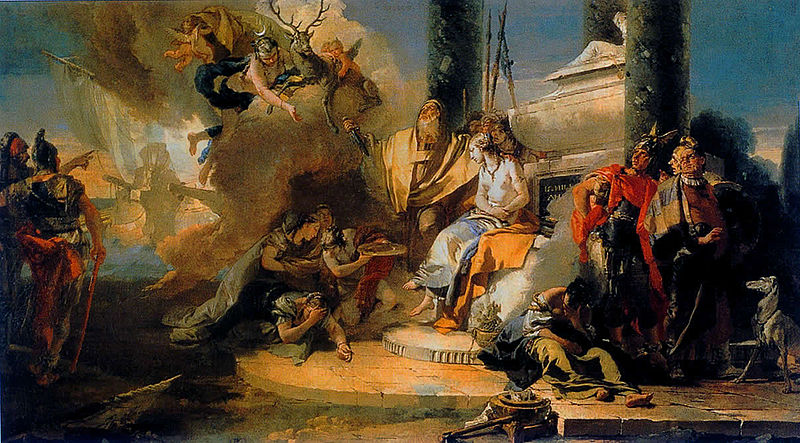
The Sacrifice of Iphigenia (1770)
Giovanni Battista Tiepolo
source Wikimedia Commons
While Priam doesn’t realize that his son has been changed to a bird, and mourns his death with Hector, Paris is missing from the funeral rites, as he has gone to Greece, stolen a wife and returned with a war behind him.  But the Greeks chasing Paris, become bound by storms at Aulis, so they kindle fires for Jove in hopes of smooth sailing.  However, a blue-green serpent climbs a sycamore tree, seizing eight fledglings and their mother, and swallowing them in his greedy jaws.  Calchus, the augur, son of Thestor, claims it is a sign that the Greeks will be victorious but only after a long war.  Nereus’ rage though is unrelenting and Calchus claims Diana is aggrieved that Agamemnon slew her sacred stag.  He requires payment in virgin’s blood, and so Agamemnon’s daughter, Iphigenia is sacrificed.  The girl does not die, however, as Diana covers the altar with a dark cloud, exchanging Iphigenia for a hind.  Her wrath appeased, the thousand ships are able to sail for Phrygian shores (Troy).  (For a somewhat different story of Iphigenia’s sacrifice, see Agamemnon).

Continue reading

The World of Tomorrow by E.B. White


the world of tomorrow

I seem to be getting mostly essays lately for my Deal Me In Challenge.  This week, I read The World of Tomorrow by E.B. White, the famed author of Charlotte’s Web.  White wrote this essay about the 1939 World’s Fair in New York, where visions of the future abounded and a bright tomorrow was laid before eager and credulous eyes.

“The eyes of the fair are on the future —- not in the sense of peering toward the unknown nor attempting to foretell the events of tomorrow and the shape of things to come, but in the sense of presenting a new and clearer view of today in preparation for tomorrow; a view of the forces and ideas that prevail as well as the machines.

To the visitors the Fair will say, ‘Here are the materials, ideas and forces at work in our world.  These are the tools with which the forces of the World of Tomorrow must be made.  They are all interesting and much effort has been expended to lay them before you in an interesting way.  Familiarity with today is the best preparation for the future.”
( ~ official New York World’s Fair pamphlet)


british pavillion
British Pavilion
source Wikipedia

Someone is obviously trying to sell something grand, and it was enlightening to read about White’s experience at the Fair.  Right from the start, we sense a disconnect between the two, as he personifies the event.  His first sentences read:  “I wasn’t really prepared for the World’s Fair last week, and it certainly wasn’t prepared for me. Between the two of us there was considerable of a mixup.”  White informs the reader that upon his visit, he had a cold and that “when you can’t breath through your nose, Tomorrow seems strangely like the day before yesterday.”  He then gives a catalogue of the exhibitors with strangely impersonal names such as Kix, Astring-O-Sol, Textene, Alka-Seltzer and the Fidelity National Bank. White’s impressions do not inspire awe or a trust in Tomorrow.

“It is all rather serious-minded, this World of Tomorrow, and extremely impersonal.  A ride on the Futurama of General Motors induces approximately the same emotional response as a trip through the Cathedral of St. John the Divine.  The countryside unfolds before you in $5-million micro-lovliness, conceived in motion and executed by Norman Bel Geddes. The voice is a voice of utmost respect, of complete religious faith in the eternal benefaction of faster travel ……..  When night fall in the General Motors exhibit and you lean back in the cushioned chair (yourself in motion and the world so still) and hear (from the depths of the chair) the soft electric assurance of a better life — the life which rests on wheels alone — there is a strong, sweet poison which infects the blood.  I didn’t want to wake up.  I liked 1960 in purple light, going a hundred miles an hour around impossible turns ever onward toward the certified cities of the flawless future.  It wasn’t till I passed an apple orchard and saw the trees, each blooming under its own canopy of glass, that I perceived that even the General Motors dream as dreams so often do, left some questions unanswered about the future.  The apple tree of Tomorrow, abloom under its inviolate hood, makes you stop and wonder.  How will the little boy climb it?  Where will the bird build its nest?”

White makes a few other observations which are very powerful statements:

“In Tomorrow, people and objects are not lit from above but from below”


“Rugs do not slip in Tomorrow, and the bassinets of newborn infants are wired against kidnappers.  There is no talking back in Tomorrow.  You are expected to take it or leave it alone.” 


“In Tomorrow, most sounds are not the sounds themselves but a memory of sounds, or an electrification.”

At the end of the essay, instead of remembering the Fair itself, White’s recollections are quite different:  the trees at night, eerie shadows, fountains in the light, a girl, remembered not just as passing impressions, but in generous detail.  The last line of the essay stabs home his point:

“Here was the Fair, all fairs, in pantomime; and here the strange mixed dream that made the Fair: the heroic man, bloodless and perfect and enormous, created in his own image, and in his hand (rubber, aspetic) the literal desire, the warm and living breast.”

After my first read of this essay, I was left completely unmoved.  I had no interest in the 1939 World’s Fair, and White’s ramblings about his cold, standing in line, etc. which I found annoyingly pointless.  It was only when I read the essay for a second time, that his consummate skill as a writer drummed me over the head.  Though not stating his views outright, with each sentence White was building his case, having the reader experience the loss of humanness and empathy that the rapid rise of technology was moving towards.  When one places the value of machines and progress above the people they are supposed to be serving, you lose the human qualities of life and the simplicity, the wonder and human connection in life that make it so fulfilling.

Perhaps it’s telling that White moved from New York to Maine that very year.

Deal Me In Challenge #8


deal me in challenge

The Faerie Queene in Poetry Month ~ Two Events!

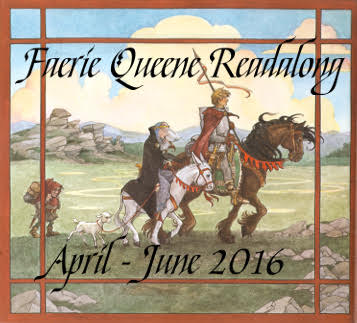
As you’re probably aware from both my On Reading the Faerie Queene and Spenser’s Images of Life posts, I’m gearing up to read The Faerie Queene in late April.  But instead of sliding quietly into the read-along, I thought it might be nice to give it an official announcement!

O at Behold the Stars was the instigator of this event and Jean, Cirtnecce, RuthConsoled Reader and I quickly followed her lead.  We will be attempting to stick to this schedule:

April 25 – May 1st ~  Book I
May 2 – May 8th ~  Book II
May 9 – May 15th ~  Book III
May 16 – May 22nd ~  Book IV
May 23 – May 29th ~  Book V
May 30 – June 5th ~  Book VI
June 6 – June 12th ~  Mutability

Thanks to O for the prod, and to Jean’s husband for creating a rather awesome button! Anyone else who would like to join us is very welcome!  Reading this tome among friends will make it much less intimidating!

And, coincidentally corresponding with the above read, in April Hamlette from The Edge of the Precipice is going to be hosting a Poetry Month Celebration in honour of National Poetry Month.

We’ll be starting The Faerie Queene read-along near the end of the month, but I hope to be able to read a few more poems, at least one per week, for this event.  It’s a good chance to focus on that category for my Deal Me In Challenge.

So if either of these events interest you, I hope you’ll join us for a very busy April, and ring in the spring with poetry!

The Oresteia ~ Agamemnon by Aeschylus

The Sacrifice of Ipheginia by Agamemnon (1671)  Jan Steen
The Sacrifice of Ipheginia by Agamemnon (1671)
Jan Steen
source


Agamemnon by Aeschylus
 
“Dear gods, set me free from all the pain,
the long watch I keep, one whole year awake …
propped on my arms, crouched on the roofs of Atreus like a dog.”

Agamemnon is the first of a trilogy of plays called The Oresteia, the next two plays being The Libation Bearers and The Eumenides, all performed in 458 B.C., only two years before the death of Aeschylus.  This surviving unified trilogy allows the reader to experience the development of these three-part stories and to observe the common strands of informatiion and enlightenment winding throughout.  Each play would have built support and framework for the others.  However, even though we have all three plays of this trilogy, the satyr play Proteus is lost, as it would have been a type of comic epilogue to finish The Oresteia.

Continue reading