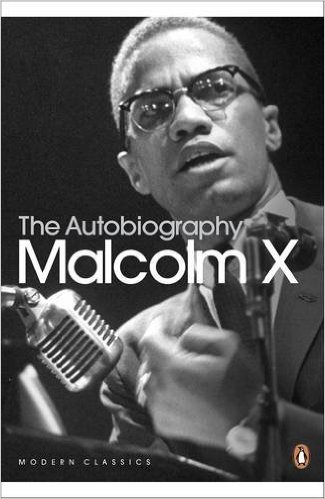
“When my mother was pregnant with me, she told me later, a party of hooded Ku Klux Klan riders galloped up to our home in Omaha, Nebraska, one night.”
Malcolm X was born Malcolm Little on May 19, 1925. He was the fourth of seven children, his father being an outspoken Baptist speaker. The family relocated to Lansing, Michigan where they were targets of attacks of the Black Legion, a racist group led by whites. Before Malcolm’s seventh birthday, his father was killed in a streetcar accident, but rumours of the Black Legion’s involvement were rife. When a relationship with a man she was dating deteriorated, Malcolm’s mother had a breakdown and was placed in a mental asylum where she remained for 24 years. At fourteen, he began to get involved in all sorts of illegal activity, from gambling, hustling, drug dealing, racketeering, pimping, etc in New York City. He became a thug and a criminal, hanging out at music halls and smoking “reefers”, living a wild life on the edge:
“Looking back, I think I really was at least slightly out of my mind. I viewed narcotics as most people regard food. I wore my guns as today I wear my neckties. Deep down I actually believed that after living as fully as humanly possible, one should then die violently. I expected then, as I still expect today, to die at any time. But then, I think I deliberately invited death in many, sometimes insane ways.”
Finally at 20 years old, an attempted robbery landed the young man in prison, where he finally discovered through one of his brothers, the “natural religion of the black man”, the Nation of Islam. Through their prophet Elijah Muhammed, a new history of the black man was revealed: 600 years ago everyone was black but a “Mr. Yacub”, a scientist with a large head decided to break the peace. Exiled to Patmos (the same island were the Apostle John lived when he wrote Revelations), Yacub, embittered towards Allah, made a race of “bleached-out white people” through his followers. In two hundred years the black people were eliminated, two hundred more and the brown people followed, then two hundred each for the red people and the yellow people (yes, the math doesn’t add up, but I’m just repeating the story). The new white people were like animals, walking on all fours and living in trees and it was two hundred years before they returned to civilization and made it a living hell. All the black people’s problems stemmed from this “devil white race”. History had been completely rewritten by the white man. X also figured out that because the King James Bible was considered the ultimate in English and the King had poets write it, Shakespeare must have written it. So in Malcolm X’s mind, King James used the alias of Shakespeare and wrote the Bible to “enslave the world”. And thus, Malcolm X began to correspond with his siblings & Elijah Muhammend, read any book he could to support his position and to recruit for the NOI (Nation of Islam). He was successful with converting some followers, but the majority thought their tenants strange, to say the least, and rejected his overtures.
 |
| Malcolm X before a press conference (1954) source Wikipedia |
Malcolm X despised the white race, but he also showed extreme antipathy towards the black elite, or any black person who did not agree with him, calling them brainwashed by the white people, including Martin Luther King, Jr. whom he labelled a puppet of the white establishment.
“Why you should hear those Negroes attack me, trying to justify, or forgive the white man’s crimes! These Negroes are people who bring me nearest to breaking one of my principal rules which is never to let myself become over-emotional and angry. Why, sometimes I’ve felt I ought to jump down off that stand and get physical with some of those brainwashed white man’s tools, parrots, puppets.”
Yet with his evangelizing, NOI numbers slowly grew. His met his wife, Sister Betty X, at his temple and after they were married, she became a good Muslim wife to him, caring for their children and supporting his ministry. When questioned about his religious philosophy and its proclivity for spreading hatred, the people questioning him would immediately become “breathing living devils” and X would immediately go on the attack, claiming the white man was in no moral position to accuse anyone else of hatred, or he would accuse them of attacking his people because they were black. As an artist might work in oils, Malcolm X worked in logical fallacies, painting his rhetorical and philosophical landscapes with circular reasoning, ad hominem attacks, red herrings, appeals to fear, tu quoque, and the straw man.
After years of working as Elijah Mohammed’s front man and “minister”, Malcolm X began to act more independently. Praise was always given to Mohammed, but there were suspicions that his actions were not always pleasing to his superior and that the NOI head resented his subordinate’s popularity. When Mohammed was accused of sexual impropriety with NOI secretaries, a serious breach of the rules of Islam, Malcolm X attempted to justify his behaviour. However, with Malcolm X releasing inappropriate comments after John Kennedy’s assassination, in spite of a NOI ban on commenting, the leader felt X had become too independent and prohibited his public speaking for 90 days. Malcolm X finally left the organization, founding Muslim Mosque, Inc. and in 1964 made a pilgrimmage to Mecca where he was astounded to see believers of all colours. It was the beginning of a change within the charismatic leader and when he returned to the States, there was tone moderation in some of his discourses.
“Yes —- I wrote a letter from Mecca. You’re asking me ‘Didn’t you say that now you accept white men as brother?’ Well, my answer is that in the Muslim World, I saw, I felt, and I wrote home how my thinking was broadened! Just as I wrote, I shared true, brotherly love with many white-complexioned Muslims who never gave a single thought to the race, or to the complexion, of another Muslim ……. In the past, yes, I have made sweeping indictments of all white people. I never will be guilty of that again — as I know now that some white people are truly sincere, that some truly are capable of being brotherly toward a black man. The true Islam has shown me that a blanket indictment of all white people is as wrong as when whites make blanket indictments against black ….. (it) was the first time I ever had been able to think clearly about the basic divisions of white people in America, and how their attitudes and their motives related to, and affected Negroes.”
He finally saw that it wasn’t “the American white man who is a racist, but … the American political, economic, and social atmosphere that automatically nourished a racist psychology in the white man.” His inclusion now did not only cross the boundaries of race but also religion and political philosophy. Suddenly Malcolm X began to get an inkling that his previous experiences which formed his views might have been based on ignorance, and he strove for a change. Finally, we see a man struggling with new ideas that perhaps are trying to kick the old ones aside, as he tried to merge his new identity with the old one. And we get a glimpse of some perhaps insightful self-examination:
“For the freedom of my 22 million black brothers and sisters here in America, I do beliee that I have fought the best that I knew how, and the best that I could, with the short-comings that I have had. I know that my shortcomings are many.”
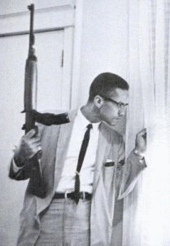 |
| Malcolm X defends his house Photo from Ebony magazine source Wikipedia |
In spite of his new outlook and more moderate thinking, Malcolm X’s rhetoric did not noticably change, other than the added sprinkling of more impartial comments. It would have been interesting to see where this new-wakening would have taken him but it was not to be. He knew his time was running out, as his divide with NOI had stirred a pot of vipers.
“Every morning when I wake up, now, I regard it as having another borrowed day. In any city, wherever I go, making speeches, holding meetings of my organization, or attending to other business, black men are watching every move I make, awaiting their chance to kill me. I have said publicly many times that I know that they have their orders. Anyone who chooses not to believe wht I am saying doesn’t know the Muslims in the Nation of Islam ….. each day I live as if I am already dead …..”
In an epilogue added by Alex Haley, we learn of Malcolm X’s demise. At a conference in Manhattan’s Audubon Ballroom, while addressing the Organization of Afro-American unity, Malcolm X was shot multiple times by three men rushing the stage. He was pronounced dead shortly after arriving at the hospital with 21 bullet holes in his body. The three men, Nation of Islam members, were arrested and imprisoned for his murder.
This book is brutally appalling and without encouragement from Ruth, I would probably not have finished it. The vicious hatred and counter-disease of racial prejudice was so palpable it was nearly unbearable, being very similar to Hilter’s discourses in Mein Kampf. Personally, while I could never condone hatred, I could at least understand animosity against a person who had perpetrated an horrible act against him. But I couldn’t understand the savage hatred against people who had never done a thing to him but only shared the same colour of skin as those who had oppressed his people. As I read his speeches and invectives, I did not feel like Malcolm X was speaking for his people; he was simply mentally creating a situation that he wanted to believe and acted on it, his own philosophy being more important than the people he was trying to vindicate. It was only in the latter part of the book that his views began to be adjusted, and it would have been interesting to learn if they would have become even more moderate and inclusive with time. Sadly, we will now never know.
The most interesting part of the biography was the epilogue written by Alex Haley. Through him we get a sense of Malcolm X, a man who was distrustful of everyone around him, including himself. Even his friends were seen a partial enemies and his whole life was spent like a hunted animal, either from his own internal expectations, or real threatening circumstances. Constant drama surrounded X and he appeared to need to feed on it, as one would food for sustenance. His moods would swing from jubilant to sullen and back again. Haley had often to lead and coax the black leader to tell about himself, luring him away frominstead of resorting to diatribes against whomever he felt conflicted with him or his views. Yet even with the often unbalanced raving tirades and untenable attacks, there is no doubt Malcolm X had a compelling magnetism that garnered attention.
The violence through which Malcolm X lived and appeared to advocate, did not only culminate in his death but resonated throughout his family. In 1995, his daughter Qubilah was arrested and tried for plotting the murder of Louis Farrakhan, then the leader of the Nation of Islam whom she felt bore the responsibility for her father’s murder. Two years later, her twelve-year-old son set fire to his grandmother’s house (Betty, Malcolm X’s wife) which caused burns to over 80% of her body and caused her death. In his 28th year he was found beaten to death in Mexico.
Perhaps Malcolm X did give a type of pride to black Americans but the stain of violence he contributed and left in his wake cannot be seen as a value to anyone as far as I’m concerned. If those who are advocates for the oppressed act exactly the same as the oppressors, no one benefits and the prejudices and hatred are simply perpetuated. If it is simply a matter of anger and revenge, we learn nothing.