
“It befell in the days of Uther Pendragon, when he was king of all England, and so reigned, that there was a mighty duke in Cornwall that held war against him long time.”
Well, thanks to Jean at Howling Frog Books and her read-along, I finally finished Le Morte d’Arthur. This book was the longest feeling book I’ve ever read ….. not the longest in pages, but the stories were so long and drawn out and interweaving that reading it felt like a perpetual task. But I’m very glad I read it and would like to revisit it at a later date, as I feel that their is more depth to this book than I discovered with my first read of it.
While reading, I posted some updates of my impressions and so I’ll list them here:
Le Morte d’Arthur Update #1 / Le Morte d’Arthur Update #2 / Le Morte d’Arthur Update #3 / Le Morte d’Arthur Update #4
Written by a Thomas Malory from prison in 1470 (scholars have not directly determined which Thomas Malory wrote it), Le Mort d’Arthur is the largest compilation of Arthurian legends from both England and France, presented in a chronological arc. From King Arthur’s conception to his seeming death, in between we read about Arthur’s birth, his kingship, the formation of the Round Table and his campaigns. The reader also is introduced to his knights, such as Gawaine, Galahad, Percival, Tristan, etc. as well as his most famous, Sir Lancelot. The quest for the Holy Grail is the central adventure and is of the utmost importance for the knights.
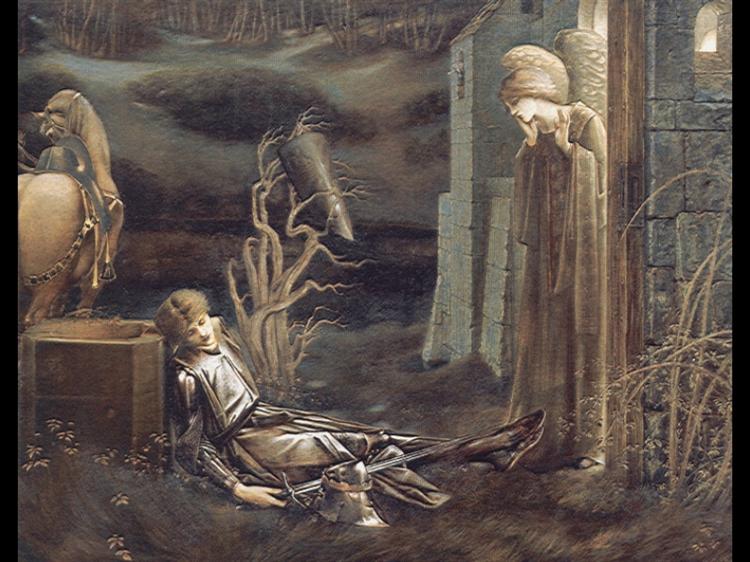
The Dream of Lancelot at the Chapel of the San Graal (1895-96) Edward Burne-Jones ~ source Wikiart
To the modern reader, some of the adventures that knights experience may seem like something of a parody. There are angry knights, sorcerers, dangerous damsels, damsels in danger, numerous fights and the hacking of limbs, but there is also a seriousness note that runs throughout the stories.
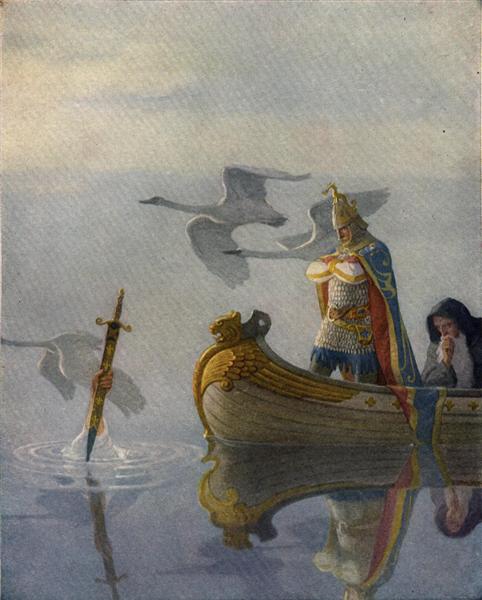
And when they came to the sword which the hand held, Arthur took it up (1922) N.C. Wyeth ~ source Wikiart
Arthur’s court is established with the highest standards. Camelot is represented almost as an utopia on earth, but the reader follows the cracks that begin to break apart the unity and brotherhood. Lancelot’s romance with Guinevere presents a moral sin and a betrayal of his king. Even though he has great strength and honour, his weakness for Guinevere not only destroys his reputation but helps to destroy Camelot.
The quest for the Grail, while originally started with a spiritual standard of reverence, the means of acquiring it brings about battles and discord and death. The humility and purity and faith required by the Grail is not possibly for these earthly knights with their many spiritual imperfections, and so the quest fails.
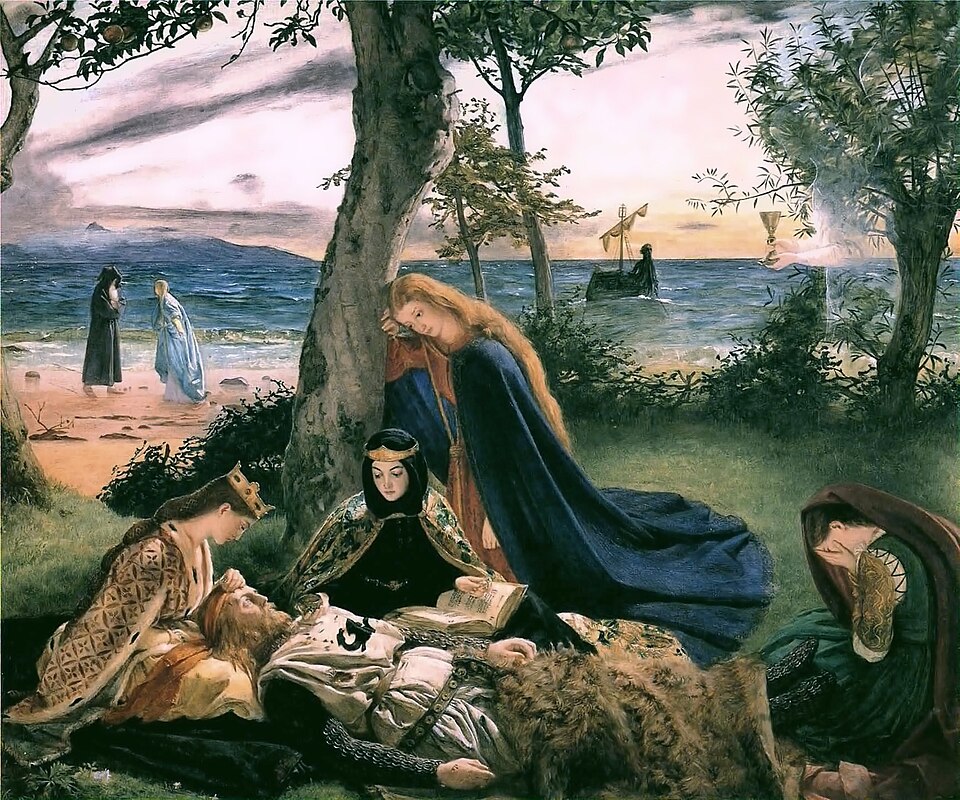
Death of King Arthur (1860) James Archer ~ source Wikimedia Commons
There are other conflicts within these tales, as well as an uncertainty surrounding the death of Arthur. Deliberately ambiguous, the reader is left to wonder, did Arthur really die? Or will he return? And thus, will be a Once and Future King?
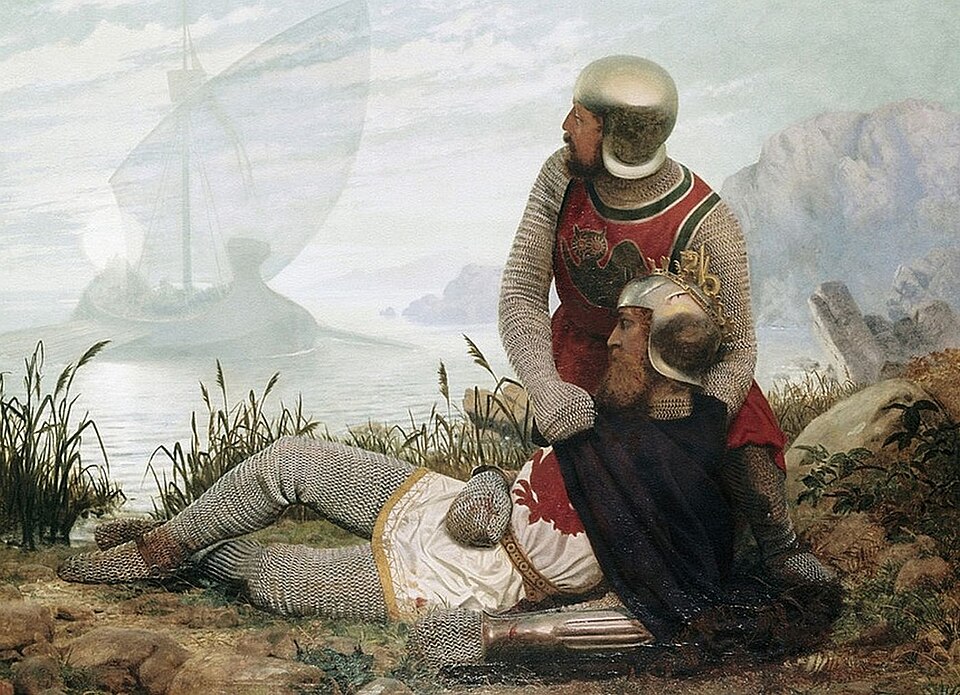
The Death of King Arthur – John Garrick ~ source Wikimedia Commons
“Yet some men say in many parts of England that King Arthur is not dead, but had by the will of our Lord Jesu into another place; and men say that he shall come again, and he shall win the holy cross.”
