A Haunted House by Virginia Woolf

Virginia Woolf is both predictable and unpredictable.  First, with any of her works she is not a writer that is easily deciphered or labelled, and conversely, one never knows when reading her works, precisely what one is going to discover.  In the short story, A Haunted House, Woolf delivers a narrative that is only 10 paragraphs long, yet manages not only to convey a story, but make it perplexingly obscure and delightfully poetic.

The story begins, “Whatever hour you woke, there was a door shutting.”  A rather conventional beginning for a ghost story, but Woolf soon begins to weave other nebulous possibilities into its framework.  Two old ghosts appear to be moving through this house, searching for something.  Hundreds of years ago, the woman had died and the husband had left the house only to return to it later.  A young couple sleeps while they hunt always for the treasure that appears either to be lost or just out of their grasp. The ghosts visit the narrator and her husband sleeping in their room and appear to find the treasure in their quiet repose, in their love, and all is “Safe, Safe, Safe.” ……..

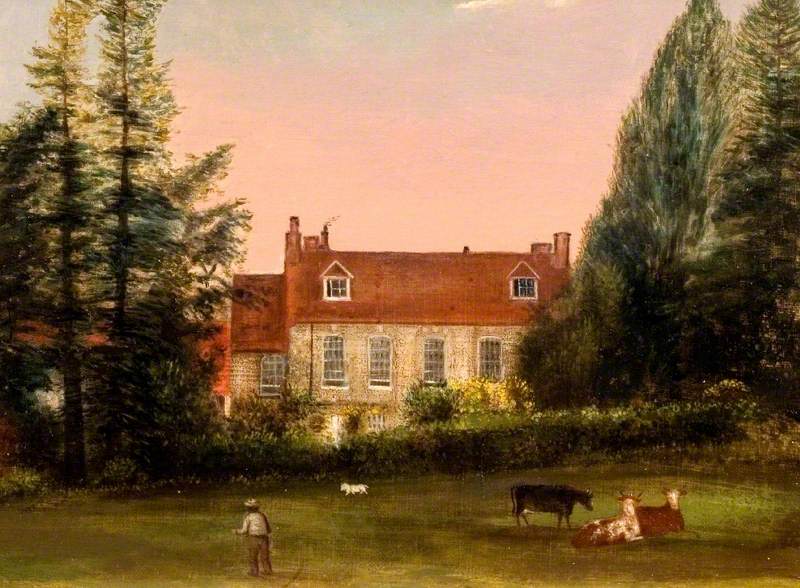
The Haunted House
source ArtUK

Most analyses of this short story categorize it as juxtaposition between the dead and living couple, the dead couples’ loss of the “treasure” and their apparent finding of it again in the living couple, as the reader finally realizes the theme of love threaded throughout the story.  Well, yes, I’m certain that’s an accurate analysis, but I had another less discernible thought flit through my mind while I was reading:  some of the descriptions and tone reminded me of an author’s search for words or meaning to imbue their writing with a sense of life.  The ghostly couple could have represented the writer and the rooms of the house compartments in the mind.  Here’s an example:

“….. “They’re looking for it; they’re drawing the curtain,” one might say, and so read on a page or two. “Now they’ve found it,” one would be certain, stopping the pencil on the margin. And then, tired of reading, one might rise and see for oneself, the house all empty, the doors standing open, only the wood pigeons bubbling with content and the hum of the threshing machine sounding from the farm. “What did I come in here for? What did I want to find?” My hands were empty. “Perhaps it’s upstairs then?” The apples were in the loft. And so down again, the garden still as ever, only the book had slipped into the grass.”

The allusions to reading, pencil, margin, and book, and the references to the house being empty and the doors open and the search, reminded me of a writer struggling to find the precise words to bring his/her story to vivid life, to make something living from something dead.  Am I crazy?  Perhaps, but with Woolf, the very act of writing always seems to be a part of the writing itself, so closely incorporated that it is difficult to separate the two.  In any case, it was an interesting story, as only Woolf could make a story a page long.  The complete text of the story can be found HERE.

Next week, I’ve drawn a short story by Edgar Allen Poe, The Tell-Tale Heart.  I remember reading this one in elementary school and being quite scared by it.  We’ll see how effective it remains from an adult reading.

Week 8 – Deal Me In Challenge – Nine of Clubs


Classic Children’s Literature Event

Amanda @ Simpler Pastimes is hosting the 5th Annual Classic Children’s Literature Event and I am all in!  I love this event and will have participated in four of the five years. It has encouraged me to read such books as Emil and the Detectives, The Forgotten Daughter (an unbelievably good story), The Cabin Faced West, The Adventures of Pinocchio, The Lion, the Witch and the Wardrobe, Prince Caspian, and The Wizard of Oz.

Event Basics

  • During the month of April, read as many Children’s Classics as you wish and post about them on your blog and/or leave a comment on the event page on this blog. I will have a link page starting the first of April to gather posts so that we may share as we go.
  • The optional RAL title: Alice’s Adventures in Wonderland by Lewis Carroll. (Optional: also read Through the Looking-Glass. I’m guessing I won’t get through both.) I plan on discussion the weekend of April 21-23.
  • I’m not going to be the “children’s classics” police. Use your own judgement for what fits the category but if you want some guidelines, these are what I’m going by:
  • I think many of us have read more recent children’s books that we may already deem “classics” (for example, many people feel that way about the Harry Potter books), but for this event, I’d prefer if we read books that were written prior to 1967. This will still allow a lot of options, and will hopefully avoid the “but what is a classic” dilemma! (And yes, 1967 is rather arbitrary. Rebel if you wish, but 50 years old seems a good age).
  • Defining “children’s,” especially prior to 1900 or so can be a challenge as some books we think of as “children’s” today may not have been intended that way at the time. Personally, I’d say books appropriate for approximately an elementary-school aged child or preteen (to read or to have read to them) should be fine. I’d personally also count the various fairy tales, even though some of the earliest versions were not exactly family friendly.
  • Feel free to include books from any country, in translation or not. I have limited exposure to non-American children’s lit, so I’d love to learn about books from other countries myself.
  • Feel free to double up with other events or challenges if you wish.
  • And if you need ideas I posted
  • A suggestion list in 2013
  • Some more ideas in 2014
  •  There is no deadline for joining or participating (other than, of course, the end of April).

Most important: Have fun!


This year’s read-along will be Alice’s Adventures in Wonderland, one of my favourites. As for other books I might choose, I’m still mulling over the possibilities.  Some titles might include:

  • My Father’s Dragon – Ruth Stiles Gannett
  • Finn Family Moomintroll – Tove Jansson
  • A Triumph for Flavius – Caroline Dale Snedeker
  • Red Sails to Capri – Ann Weil
  • Roman Ransom – Henry Winterfeld
  • The Princess and Curdie – George MacDonald

Please join us for the month of April if you feel so inclined!

Herodotus’ The Histories ~ Book VI


Book VI (Erato)

“Thus Aristagoras met his end after inciting Ionia to revolt.”

 
Histiaios, the tyrant of Miletus arrives at Sardis after Darius released him in Susa and Artaphrenes inquired his opinion of the Ionian revolt.  Loathsome worm that he is, Histiaios disavows any knowledge of the altercation and bats his eyes in innocence (well, not really, but you know what I mean).  However Artaphrenes already knows his part and is not fooled by his duplicity.  His response arouses fear in Histiaios: “Well, then let me tell you how and why it happened, Histiaios: you stitched up the shoe, and Aristagoras put it on.”  In fear for his life, Histiaios escapes towards the coast, now an enemy of the Persians.  Fleeing to Chios, Histiaios is taken in by the Chians which is a big mistake as he lies to them too about his part in the Ionian revolt, saying Darius wanted to uproot them to Phoenicia and vice versa.  Still using underhanded tactics, he writes to Sardis urging revolt, but Artaphrenes intercepts the letters, so in a last ditch attempt, Histiaios begs the Chians to help restore him as tyrant of Miletus, however the people of Miletus do not want the return of his tyranny and repulse him.  Still working his machinations, he seized ships sailing out of the Pontus.

Meanwhile, the Persian army and navy is approaching Miletus with help from the Phoenicians, Cilicians, Egyptians and the recently re-enslaved Cyprians.  When the Ionian ships arrives at Miletus, the Persians are awed by the size of the fleet and get the Ionian tyrants to try to turn the Ionians traitors, but they disdainfully resist.  A Phoceaean general named Dionysios is able to rally the undisciplined troops but soon their laziness overtakes them and as they engage the Persians, one group after another abandons the fight except for the Chians who perform great feats in battle in spite of their fleeing comrades.  Dionysios, when he realizes what is happening, seizes three enemy ships and sails off to Phoenicia to become a pirate.  Herodotus himself is “unable to record precisely which Ionians proved themselves to be cowards or brave and valiant men in this encounter, for now they all reproach one another.”  Miletus is overcome by the Persians, their men killed and the women and children taken off to Susa as slaves.  The Athenians were so upset at the city’s capture that when Phrynikos composed his play about its seizure, the audience wept and he was fined 1,000 drachmas for reminding them of this evil.  And thus, there were no Milesians in Miletus and other Ionians left to form new colonies so as to not be subject to the Persians.

Captive with rose (1943)
Nicolas Roerich
source Wikiart

In Byzantium and hearing of the battle, Histiaios returns, falling on Chios with an army and capturing it before moving on to other areas.  But the Persian general, Harpagos, is able to halt his advance, butchering most of his army and capturing Histiaios alive.  Yet his reprieve does not last for long.  Worried that Darius would pardon Histiaios if the man was given over to him, Harpagos and Artaphrenes, the governor of Sardis, decide to hang him from a stake and decapitate him, sending the head to Darius who is distressed and orders the head buried as Histiaios had been a benefactor to him.

Quite fascinating …….. as the Persians conquered islands, they would “net” people in that they would have a line of men that stretched from sea to sea and, holding hands, they would move forward, combing every inch of ground for people.  The handsome boys they castrated and the virgins they sent to the king, burning the Ionians cities so the Ionians were subjugated to slavery for a third time, first by the Lydians and then twice by the Persians.  The Phoenicians continued to sail towards Hellespont, conquering almost all the territory for the Persians as they went.  Yet in spite of their merciless domination, the Persians brought laws and process to the Ionians, which promoted peace between peoples.
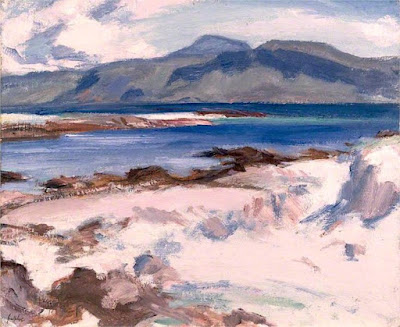
Blue Sea, Iona (1927)
Samuel Peploe
source Wikiart

King Darius dispatches his son-in-law, Madronios to depose the Ionian tyrants and form democracies before he moves on toward Athens, intending the same, but encounters resistance from the Thracian Byrgoi and after the navy’s wreck around Athos, they are forced to return to Asia.

The next year, crafty Darius tests if the Hellenes plan war against him by sending out heralds asking for earth and water (which signify subjection) from various cities in Hellas.  They give what is asked by the Persians but the Athenians take umbrage at the Aeginetan’s gift and accuse them of conspiring against them.  The Spartan king, Kleomenes, crosses over to Aegina, intending to arrest the guilty Aeginetans but Krios defies him.  Meanwhile in Sparta, the lesser king, Demaratos, remains behind, proceeding to malign Kleomenes.

Thus, Herodotus launches into a lengthy digression about the Lacedaemonian lineage that produced two kings, which includes twin sons, yet one being honoured above the other.  Still, Herodotus says the Hellenic story traces the lineage back to Perseus and the Greeks, however he believes before Perseus they must have been Egyptian by direct descent.  Bascially, no one really knows.  In war, he lists the privileges of the kings, in times of peace, and also the traditions practiced when the king dies.  As to their professions, they inherit them from their fathers regardless of inclination or talent.

Three Spartan Boys Practicing Archery (1812)
Christoff Wilhelm Eckersberg
source Wikimedia Commons

Returning to Sparta, Kleomenes plots to rid himself of Demaratos by claiming that he is not the rightful son of Ariston, his father, as Ariston had taken his mother from his friend, and Demaratos’ birth was too soon after the marriage.  Deposed of his kingship, Demaratos becomes a magristrate for the Persians but is insulted by Leotychidas who was part of the plot to disgrace him and is now king in his place.   Demanding the story of his birth from his mother, she tells him he is either the son of Ariston, or the dead hero Astrabakos, who looked like Ariston but left her with garlands from his shrine as he visited her bedroom as a spirit.  Happy with the answer, Demaratos escapes, pursued by the Lacedaemons but manages to reach the court of Darius where he is furnished with land and cities.  Leotychidas, on the other hand, leads an army into Thessaly but is caught receiving a bribe, is exiled and dies in disgrace but that happens much later.  At the moment, with the two kings against them, the Aeginetans surrender and Krios is taken as hostage along with nine other wealthy Aeginetans.  Fearing Spartan justice, Kleomenes escapes to Thessaly and then Arcadia where he tries to stir up dissent against Sparta and eventually the Lacedaemonians bring him back to Sparta to rule, apparently thinking he would be less of a danger close by.  But Kleomenes proceeds to go mad and his relatives have to confine him to a wooden pillory.  Yet the king is craftier than all and, convincing a guard to give him a knife, he proceeds to multilate himself, beginning at his shins until he has disemboweled himself.  Ugh!  The Argives claim he went mad because of an oracle at Delphi predicting that he would capture Argos which did not come to fruition because of circumstances, but the Spartans say that he was addicted to strong drink because of the Scythians and that was the reason for his madness.   
        

Upon the death of Kleomenes, the Aeginetans demand justice for the treatment of them by the two kings and the Lacedaemon people hand Leotychidas over to them in payment for the Aeginetan hostages taken to Athens.  However, worried of later reprisal, they take Leotychidas to Athens where he asks for return of the hostages and when the Athenians prevaricate, they are told a story of just Glaukos who thought of not returning money entrusted to him and, even though he eventually made the just decision, was punished for pondering evil by having no descendants left to carry on his name. 

Thus the Aeginetans become incensed with the Athenian behaviour and the two wage war on each other, bringing other kingdoms into their dispute and most showing a stubborn implacability that brings about many deaths.

Drawing of a Greek Vase depicting Darius I
source Wikimedia Commons


Meanwhile, Darius is planning to revenge himself on Athens for those who had previously refused to give him earth and water.  Removing the unsuccessful Mardonios from command, he appoints the son of his brother Artaphrenes, Datis, as general who proceeds to sweep through kingdoms, starting with Naxos and making his way to Delos where he promises not to harm the site of the two gods or the people.  After he makes a sacrifice and leaves, an earthquake thunders through Delos and Herodotus supposes it was a portent of evils that were to befall them:

“For in three successive generations, during the reigns of Darius son of Hystapes, Xerxes son of Darius, and Artaxerxes son of Xerxes, more evils befell Hellas than in all the other generations prior to that of Darius.”


In Greek, Darius means “Achiever,” “Xerxes,” Warlike, and Artaxerxes, “Extremely Warlike.”

The Battlefield at Marathon (c.1849)
Carl Rottman
source Wikimedia Commons


The Persians conquer and burn Eretria, then depart for Athens, expecting full victory.  Realizing the Persians are headed for Marathon, the Athenian general, Miltiades (son of Kimon and named after the Miltiades who settled the Chersonese) along with nine other generals send a message to Sparta by the runner Philippides asking for assistance against their foe.  Philippides arrives in Sparta the day after he leaves Athens, assisted by the god, Pan.  After a vote, the Athenians engage the Persians in battle, having spread their army as long as the Persians, but as they are fewer, are not as deep and the Persians begin to prevail in the middle, whereas the Athenians and Plataeans are succeeding in the wings whereupon they come together to fight the Persians in the centre.  Meanwhile,  the Persian fleet heads for Athens and is signaled by a shield from the shore.  At the Battle of Marathon, 6,400 Persians die and 192 Athenians. 

source Wikimedia Commons


The Spartans arrive in Athens too late for battle, travel to Marathon to view the dead Persians and then return home again.  Back to the question of the shield signal, where the Alkmeonids are blamed, but Herodotus speaks of their hate of tyrants and cannot believe that they would commit such a treacherous act.  He gives further history of the Alkmeonids, including a story of the judgement of the suitors, leading to the birth of Pericles.

After the Battle of Marathon, Miltiades gains even greater fame and convinces the Athenians to give him money and ships to lead against a country he will not reveal, to win great fortune.  Given it, he sails for Paros but after besieging it for 26 days, he is thwarted by injuring his thigh and returns home in disgrace to be tried and fined, but eventually he dies from gangrene in his thigh.

Information on the conflict between the Athenians and Pelasgians follow, the Pelasgians finally carrying off Athenian women but find that the sons born of them are displaying an unusual unity between them, so they kill both the sons and wives, causing the ground to cease bearing crops and the women to cease bearing children.  Ordered to offer reparation to Athens, the Pelasgians agree to the Athenian request for their land with a string attached: they will give it when a ship sails with the north wind and completes the journey from Athens to Lemnos in one day, knowing the task impossible.  But one day in the future, Miltiades completes the journey in the indicated time and the Pelasgians have to give possession of Lemnos to the Athenians, although part has to be subjugated through battle.

⇐ Book V (Terpsichore)                                                           Book VII (Polymnia) ⇒


March ~ A Little of Everything or From the Unexpected to the Strange, to …..??

Snowy Fields
© Cleo @ Classical Carousel

Well, after a very cold January, then a warming period, it was back to snow for the beginning of February.  Lots of it.  Lots and lots of it.  Seriously.  We had about two feet of it in two days, and I can’t stress how highly unusual this is. Usually we might get a day of snow, but then it quickly melts.  In this case, it stayed for about five days, but with the curiously cold weather last month, this winter has been an unique experience!  And now, as I write this during the last couple of days of February, it is snowing again, about 5 inches in less than 24 hours!  The good news is that it’s the wet snow of temperatures hovering around 0 C and it looks like rain is in the forecast, so it won’t last long.  I must say I’ve enjoyed it but with a couple of days in February with temperatures looking rather spring-like, I won’t be sad to see it disappear!

Continue reading →

The Life You Save May Just Be Your Own by Flannery O’Connor

Farmhouse and Car (1933)
Prudence Hayward
source Wikiart

Imagine a small town in the southern United States on a hot day.  An old woman and her daughter sit on the front porch of their house, the woman suddenly alert while the daughter plays vacantly with her fingers. Down the road, a man materializes, a young man but by his appearance obviously a drifter.  He has “a look of composed dissatisfaction as if he understood life thoroughly.” The woman and man greet each other, each eyeing the other with a hesitant speculation and a mutually concealed distrust.  After an introduction, the woman tries to find out more about Mr. Shiftlet but the man adeptly avoids answering, speaking of cars, hearts, lying and the definition of man. With more talk, it becomes clearer that the man is interested in the old car in the yard that had belonged to the woman’s deceased husband, and the woman is interested in a suitor for her mentally disabled daughter. Agreeing to stay on for board and food, the man begins to spruce the place up and soon it looks much improved.

As time passes, the woman continues to subtly bargain for a husband for her daughter, as Shiftlet counters, bargaining for the car.  Finally a deal is struck, the two marry and the car becomes his. Yet the material desire of his heart is at war with the obligation to his new unwanted wife.  Shiftlet finds himself with a choice and the struggle within himself is powerfully displayed.

This story was perplexing, and although I haven’t read any of O’Connor’s other works, I have a feeling that she regularly creates confusion with readers.  While reading The Life You Save May Just Be Your Own, I was struck with impressions rather than feelings, as if I was following an incohesive story.  The story is there, but O’Connor inserts so many phrases that are pregnant with meaning, that you simply can’t help analyzing them, wondering if there is some sort of secondary communication.  Let’s see what I can make of it.

The Farmer’s Daughter (1945)
Prudence Heward
source Wikiart

First of all, does Mr. Shiftlet’s name imply that he is a “shifty” character, or does it indicate a possibility of shift or change within him?  Or both?  Initially, he is presented swinging “both his whole and his short arm up slowly so that they indicated an expanse of sky and his figure formed a crooked cross.”  There is definitely religious connotations here, but notice the “crooked cross.”  There is certainly something very imperfect about this man.  He is also a carpenter, which was the profession of Jesus — does that mean anything or not?  When the woman tells him that he must sleep in the car, Shiftlet answers, “Lady, the monks of old slept in their coffins.”  Here is another allusion to religion and death (although monks slept in their coffins so they would get used to not fearing death, but that’s another story).

O’Connor also employs colour imagery in profusion, from the bright colours around Lucynell, the daughter, indicating innocence, purity and happiness, to the black, brown and grey colours worn by the man and woman, from the sun shining forth at the beginning of the story, only to be covered by a cloud at the end.

Portrait of a Man (1911)
Albert Bloch
source Wikiart

There is much speculation as to what O’Connor wanted to convey with this story, and there certainly appears to be deeply imbedded layered meaning.  When writing, O’Connor applied a type of analogical technique that allowed to reader “to see different levels of reality in one image or situation ….. (having) to do with the Divine life and our participation in it ….. was also an attitude towards all creation, and a way of reading nature which included most possibilities and I think that it is this enlarged view of the human scene that the fiction writer has to cultivate if he is every going to write stories that have any chance of becoming a permanent part of our literature.”

For me, the impression that stood out was the subtle change in the man.  Initially, he is a tramp, someone who is disconnected to the material, content to wander and take odd jobs.  His exchange with the woman borders on the philosophical on his side and he is likened to a Christ-like figure.  Yet as soon as he espies the car, a possessive desire begins to simmer inside him, causing him to abandon his ideals, and he is satisfied to barter with the mother for Lucynell as if she were an animal or possession.  Because his attention is fixed on a worldly goal, Shiftlet becomes blind to simple pleasures and human empathy.


Portrait of a Boy
Albert Bloch
source Wikiart

If nothing else, O’Connor gives the reader a multitude of possibilities and honestly, this short story was a compelling and intriguing experience.

Next week, for my Deal Me In Challenge, I’ll be reading the short story by Virginia Woolf, A Haunted House.

Week 7 – Deal Me In Challenge – Six of Clubs


Herodotus’ The Histories ~ Book V

Book V (Terpsichore)


“The Persians whom Darius had left in Europe under the command of Megabazos proceeded now to subdue the inhabitants of the Hellespont.”

 
Megabazos began to march through Thrace conquering as he went.  In Herodotus’ opinion, if the Thracians could only unite, they would be the strongest nation of all, but they cannot due to their constant arguments and disagreements.  He outlines many of their customs, that are often common but can differ in certain distinctions from nation to nation.  They export their children abroad, allow their daughters unrestricted sex, have tattoos to indicate nobility, respect leisure but find working the soil degrading, and honour those who make a living through war and plunder.

When Darius had crossed the Hellespont and finally reached Sardis, there he decided to honour Histiaios for his good judgement in keeping the bridge, and the sound advice of Koes of Mytilene.  Yet there were two Paionians in Sardis who wanted to rule as tyrants over their people.  Parading their beautiful sister in front of Darius, they convinced him that all women in Paionia were as beautiful and hard-working, so Darius commanded Megabazos to gather all the Paionian women and children and deliver them to him. When the Paionians heard of the Persian army’s advance, they went to meet them along the coast, but the crafty Persians came from inland surprising cities that were devoid of their fighting men.  With the cities captured, the Paionian men scattered and that is how the Paionians were driven from their homeland and moved to Asia.

Greek Builders
Victor Noble Rainbird
source ArtUK

The Persians arrive at the court of Amyntas of Macedon and make themselves very unwelcome by demanding that the concubines and wives sit with them, whereupon they proceed to fondle them.  Enraged, Alexandros, son of Amyntas, craftily replaces the women with warriors dressed as them and a battle ensues where all the Persian envoy is murdered and the Macedons are able to keep the means of their deaths a secret.

From there follows many stories that intertwine and weave through each other, yet we are always brought back to the Persians.  Herodotus’ employs a rather hectic style in this section, and his penchant for digressions is exaggerated, taking quite a lot of brainpower to follow:

  • The Macedons are Hellenes and he will demonstrate in a latter account.
  • Megabazos convinces Darius to stop Histiaios from becoming more powerful so the king takes him with him on his journeys to Susa as a counsellor.
  • Otanes is appointed to command forces along the coast near the Hellespont and captures many cities.
  • Factional strife intensifies in Miletus and is adeptly handled by the Parians
  • Naxian exiles, who had fled to Miletus, along with Aristogoras its ruler, plan to attack Naxos with the help of Artaphrenes, the friend of Aristogoras and the Persian army’s commander.  The king approves the plan and they set out, but Aristagoras and Megabates (a Persian of the Achaimenid clan) quarrel and so furious is Megabates that he warns the Naxians of the attack and after a four month siege, the attackers return home unsuccessful
  • Since Aristigoras has failed to fulfil his promise of money and land to Artaphenes, as well as failed in his venture, he is worried about his position and when a messenger arrives from Histiaios urging revolt from King Darius, he complies, capturing Ionian cities yet claiming to renounce tyranny to foster friendly relations to aid his cause.  He attempts to enlist the aid of Sparta
The Mountains of Thermoplyae (1852)
Edward Lear
source ArtUK
  • Now we learn of the Spartan king Anaxandridas, who refused to give up his first wife becuse of his fondness for her when she did not bear children, but was convinced to take a second wife, which was completely unheard of in Spartan custom.  The second wife gave birth to Kleomenes, yet suddenly the first wife bore three sons, Dorieus, Leonidas and Kleombrotos.  Dorieus expected the kingship would pass to him but was livid when it went to Kleomenes, so he asked for a colony to rule but did not consult the oracle so his quest for a colony was fraught with trouble and he eventually dies.
  • Kleomenes died without an heir but when Aristagoras arrived in Sparta, he was still ruling.  Aristagoras pleads for the rescue of the Ionians from their plight as slaves, relying on their Hellenic ancestry for sympathy.  He describes the wealth of the area but when Kleomenes learns the trip means three months at sea, he says forget it.  Trying bribery, Aristagoras is unsuccessful and is admonished by Kleomenes’ nine year old daughter: “Father, your guest-friend is going to corrupt you unless you leave and stay away from him”.
  • Now Herodotus gives us a painstakingly detailed description of the King’s Road from Sardis to Susa before circling back to the conflict.
  • Aristagoas now travels to Athens which has freed itself of its tyrannical rule from Hipparchos, son of Peisistratos and brother of the tyrant Hippias, being killed by two men descended from the Gephyraians.  The Phoenicians first introduced the alphabet which was adapted by the Hellenes.  Hippias, embittered from the death of his brother, continued to rule but unbeknownst to him the Alkmeonids, an exiled clan, was planning an attack.  After bribing the Pythia at Delphi to urge all Spartans to assist them, they receive help from the Lacedaemonians (Spartans) and the Peisistratids are beseiged. With their children captured, the Peisistratids surrender and are exiled.
Argos from Myceneae (1884)
Edward Lear
source ArtUK
  • After the expulsion of the tyrants, Athens becomes greater as Kleisthenes (an Alkmeonid) divides the people into ten tribes.  With the Argives, he stopped the bards singing, for most of the Homeric poems praised the Argives and Argos, and he also stopped the veneration of the hero Adrastos and replaced him with Melanippos.  With these actions and more he gained increased political power but Isagoras emerges to attempt to get Kleisthenes banished by implicating him in murder.  When Kleomenes (the king of Sparta) moves to place Isagoras in power, he is thwarted and Kleisthenes is recalled. Realizing that the Spartans are now their enemies, Kleisthenes endeavours to become allied with the Persians.  The messengers agree to Persian rule over Athens (this is not good) but meanwhile Kleomenes attacks again trying to establish Isagoras as ruler once more.  But there is dissent within the Spartan army and they break up whereupon the Athenians successfully wage war against other nations.  Herodotus is certain their success lies in the equality of government.  Tyrants oppressed the people but as soon as they tasted freedom, they enthusiastically began to work for their achievements.
Ruined Temples at Thebes
William James Müller
source ArtUK
  • More war ….. now the Thebans attack the Athenians based on an oracle.  I wonder who generally interpreted the oracles from the Pythia and what would happen to them if they were wrong.  It must have been a nerve-wracking task.  The Thebans enlisted the help of the Aeginetans which had a long-standing enmity with Athens, for they stole statues made from Athenian olive wood from the Epidaurians, who then refused to fulfil their payment to the Atheians for the wood.  Enraged, the Athenians sent a trireme to steal the statues but as they were dragging them off, thunder and an earthquake shook the earth and the crew began to kill each other as though enemies until only one remained.  The Aeginetans discount this story saying that there were many ships and as the statues were being dragged off they fell to their knees.  The Argives then came to their assistance and defeated the intruders.  Herodotus simply does not believe this latter story.  The one returning man did not survive long either, as, when he returned to Athens, the wives of his crew stabbed him to death with their dress pins for being the only survivor.  The women’s act was seen as even more egregious than the loss of the army and in punishment, they were forced to dress as Ionian women (okay, is it just me, or does this seem nutty?  Apparently they would no longer have pins, but are they so agonized over their mode of dress that this would be adequate punishment?  Really???!)
  • Back to the Theban invasion … which began with the help of the Aeginetans, but then Athens receives an oracle instructing them to wait thirty years for vengeance against Aegina.  What to do, especially with Sparta knocking at the proverbial Attic door?  Sparta does not wish for a more powerful Athens and, intending to return it to tyrannical rule to weaken its position, recalls Hippias.  The Spartan allies dislike their plan, however, yet it is only Sokleas of Corinth who speaks against it, showing Herodotus’ emphasis of democracy over tyranny:

“Well, heaven will be under the earth, and the earth above heaven; human beings will dwell in the sea, and fish will take over the former abodes of men, when you, Lacedaemonians, destroy systems of political equality and prepare to restore tyrannies to the cities — there is nothing among men more unjust or bloodstained than tyranny.  If you really believe it to be a good policy to have cities ruled under tyrannies, then you should be the first to install a tyrant among yourselves before seeking to do so for everyone else.  But as it is, you have no experince of tyrants, and in fact take the most dire precautions to prevent them from arising in Sparts, while you mistreat your allies.  If you had experienced tyranny the way we have, you would be able to come up with better policies concerning it than you have now.”

  • Quite an impassioned and insightful speech for the leader and a beautiful use of metaphors.  I wish we used more metaphors in conversation; they are so powerful.  In any case, Sokleas continues to express his experience of tyranny with Corinthian tyrants and most of the allies side with him, averting war.
Zorobabel Devant Darius
Nikolaus Knüpfer
source Wikiart
  • Hippias returns to Asia and slanders Athens to the Persians (despicable troublemaker!) who demand they take him back to ensure peace.  When the Athenians refuse, they become enemies of the Persians.  At this time, Aristogoras arrives in Athens after being booted out of Sparta trumpeting the ease of a takeover of Persia, and the Athenians are convinced by his declarations and promises.  With Sardis burned by the Ionians, the Persians pursue them and decimate their numbers whereupon the Athenians abandon the Ionians in spite of pleas from Aristogoras, but the Ionians continue the battle, assisted by a revolt of Cyprians.  Darius, however, realizes that he will punish the Ionians, but he is more concerned with revenge against the Athenians.  First he sends Histiaos of Miletus to Ionia to quell the rebellion begun by his Miletian governor, Aristogoras.  Meanwhile, the Ionians engage the Phoenicians at sea and the Cyprians engage the Persians on land, yet although the Ionians win, the Cyprians because of desertions, are routed. The Ionians decide to return to Ionia but are overtaken by the Persians and captured.  Darius now turns to subdue cities near the Hellespont, including the Carians, whom he defeats at first, but they return and ambush the Persian army.  Panicked, Aristagoras decides to retreat to Myrkinos in Thrace rather than face the wrath of the Persians, but he is killed in the battle with the Thracians.
This was a challenging book, full of numerous historical figures and events, not to mention various different cities and kingdoms, and it was an exercise to keep all of them straight.  Probably my least favourite book yet, but still interesting.  Book Six is short but that means nothing with Herodotus, as the content seems to depend on how much he decides to contract into short spurts of information, or extend into detailed narrative.  He always keeps you guessing!

⇐ Book IV (Melpomene)                                                                Book VI (Erato) ⇒


Reading All Around the World Challenge

Jean from Howling Frog Books is hosting a Reading All Around the World Challenge and with some trepidation, I’m jumping into the fray.

Why do I want to be part of another challenge?  I don’t know.  But since this one is so open-ended, the pressure is minimal and the benefits ……… well, hopefully it will get me reading in countries that I normally don’t visit book-wise.  In any case, the outline for the challenge is as follows:

    • Pick 50+ countries or go for the gold with all of them! The number depends on you. 
    • Sign up at the project page here. 
    • Read either fiction by a writer living in/from the country, OR a non-fiction book about it, such as memoir, history, culture, language. 
    • Tweet your posts with #readingallaround 
    • There are no time constraints. You can decide on a timeline, but don’t worry if you don’t make it. If you’re going for the full list, I’d recommend five years at least to complete it. 
    • Keep track of your reading. Maybe fill in a list or build a Google map of all your books and countries. Maintain it at your blog and post about the books you read. 
    • When you reach your goal, celebrate!

    So here I go!  Please check out my Reading All Around the World page in progress. I’m not sure at this point how many countries I’ll read so I’ve listed a number of them, and then I’ll chop and change as the mood hits me.  Wish me luck!

    Framley Parsonage by Anthony Trollope

    “When young Mark Robarts was leaving college, his father might well declare that all men began to say all good things to him, and to extol his fortune in that he had a son blessed with so excellent a disposition.”

    In Framley Parsonage, the fourth book in the Chronicles of Barsetshire, Trollope gives us a lively romp through the lives of the inhabitants of East Barsetshire, introducing us not only to their whims and follies, but through their actions, the culture and society of a 19th century English town. 

    Mark Robarts, a parson of the village of Framley, and a beneficiary of Lady Lufton whose son was his schoolmate, is married to Fanny, a genteel lady of respectable birth.  Yet his patroness is at times difficult to please, and Robarts must navigate the storms of friendship, duty, and financial matters, often muddying the waters that he is trying desperately to clear.  When his father dies and his sister, Lucy, comes to live at the parsonage, an unexpected complication develops that was unforeseen by all and upsets the carefully calibrated balance of societal acceptance.  Robarts encounters further obstacles when he embroils himself with a member of parliament, Nathaniel Sowerby, and his financial dealings.  His trusting, artless, clerical nature is in sharp contrast to the Machiavellian intrigue of men of enterprise, and it appears nothing good will come of the connection.

    The Parsonage Farm, Rickmansworth (c. 1840)
    John White
    source ArtUK

    In Mark Roberts financial dealings with Sowerby, one wonders if Trollope was offering a subtle indictment as to the interactions and associations of church and state.  The innocent perceptions of one is unable to account for the devious machinations of the other and, because of Robarts’ influence on those around him, they are affected by the imprudent alliance as well.  Add to that Lady Lufton’s displeasure at the Duke of Omnium’s vulgar societal group and a possible marriage between a peer and a commoner, and you have class conflict at its finest, a subject of which Trollope is most adept at exploring with a light-heartedness that often belies the deeper implications.

    Trollope reintroduces characters from the previous Barsetshire books: The Warden, Barchester Towers and Dr. Thorne.  Miss Dunstable displays her wily financial prowess, Dr. Thorne his ability to be influenced, the Grantley’s are in top form with not one, but two suitors in their daughter’s wake, and even gentle old Septimus Harding makes a brief appearance.


    The Houses of Parliament (c. 1844?)
    George Chambers II
    source ArtUK

    Two years it took me to complete this novel.  Isn’t that ridiculous?  For some reason, the first part of it just dragged, but as soon as I hit the half-way point, I was completely hooked and drawn in to the characters and their stories.  Next in line is A Small House at Allington, which I’ve heard is excellent.  It won’t take me two years to read through this one, I promise!


    Herodotus’ The Histories ~ Book IV

    Book IV (Melpomene)


    “Following the capture of Babylon, Darius led an army against Scythia.”

    Not content with overrunning Babylon, Darius turns his attention to Scythia, wanting to revenge himself on them for an earlier attack on Media.  The Scythians had been absent from their country for 28 years and upon returning, found their wives had taken slaves to their beds and now the off-spring had raised an army against them.  At first, the battle was difficult but when the Scythians decided to treat the slaves as slaves, dropping their weapons and advancing with whips, the slaves abandoned their positions and fled. Herodotus now begins a detailed history of the Scythians, revealing a curious observation: the north of the land is not open to view because both the land and air are full of feathers! The Hellenes claim that the Scythians are descendents of Herakles (Hercules), but Herodotus prefers the theory that they migrated from Asia and took over the land from the Cimmerians who did not fight them, as the people fled and the royal Cimmerians divided into two groups and battled each other until all lay dead so they could be buried in their own land.

    Aristeas, the poet of Proconnesus, died in a fuller’s shop but as news of his death spread, one man claimed to have just spoken with him.  When they went to retrieve his body, it was missing and seven years later he turned up in Proconnesus, composing verses, and at their completion, disappeared again.  Two hundred and forty years later he appeared in Metapontines, Italy, instructed them to build an altar to Apollo, disappeared again (of course), and to this day in the agora a statue of Aristeas stands beside one of Apollo.

    Genius of Greek Poetry (1878)
    George Frederick Watts
    source Wikiart

    More descriptions of the Scythian people, the territory, and their customs follow, including an interesting area of bald-headed men who claim that goat-footed men inhabit the mountains and beyond that, a people who sleep for six months of the year. Herodotus completely discounts the latter declaration.  As for the Issedones, when their fathers die, they eat them and keep their hair as a momento, and the women wield power equally with the men.  Scythian winters can be severe and Herodotus believes the feathers thought to fall in the north must be continuous snowfall.

    Herodotus moves on now to describe the Hyperboreans and their customs, then scorns contemporary map makers:

    “And it makes me laugh when I see so many people nowadays drawing maps of the earth and not one of them giving an intelligent representation of it.”

    Herodotus will give his account, starting with the four nations between the two seas, then describing the Asian peninsula.  Nechos, king of Egypt, sent Phoenicians to sail around Libya, back through the pillars of Herakles, into the Mediterranean  and back to Egypt.  Later, Sataspes, an Achaimenid Persian, raped a girl who was the granddaughter of Megabyzos but since his mother was sister to Darius, King Xerxes granted her request for her son to sail from Egypt all the way around Libya until he encounted the Gulf of Arabia instead of being impaled, as was the penalty.  The man did not complete his task and was speared. 
     
    Tripoli, Libya
    Jennens & Bettridge
    source ArtUK
     
     
    Darius discovered most of Asia.  As for boundaries, Herodotus gives theories for the names of the areas of Libya, Asia and Europe.  Scythian rivers now become Herodotus’ focus and he gives details of many of them, from their size to the direction of their flow.  A list of the Scythian gods is now provided and he expounds on the sacrifices of which only those to Ares are different. 
     

    The Scythian practices in war are quite disgusting.  When a man first kills, he drinks some of his victim’s blood; he decapitates and recovers the heads of those he’s killed and takes them to the king to receive his share of the plunder.  He elaborately removes the skin from the head and works it into a handkerchief which he displays on the bridle of his horse; the more “handkerchiefs” he has, the more esteem he receives (Ugh!).  They can make cloaks by stitching the “handkerchiefs” together.  They will also take the hands from their victims and use them as quiver covers.  They can also take skins from whole bodies, stretch them over frames of wood and then carry them on their horses.  As for the skulls of his most hated enemies, he saws them below the eyebrows, cleans them out, stretches oxhide over them, and for the more wealthy Scythian, he gilds the inside and uses it as a drinking cup (how absolutely repulsive!).  If a man has a dispute with a relative, he does the same and then brings the cup out for visitors, explaining their conflict, and that is how valour is earned.  If one has not killed a man within a year, he is a disgrace.

    Battle Scene
    Italian School
    source ArtUK

    When the king falls ill, they blame one of the townspeople for swearing falsely on the royal hearth.  Either the man is condemned by groups of soothsayers or if he is eventually absolved, the first group of soothsayers who condemned him is put to death by being burned in oxcarts.  Information on how the Scythians swear oaths, and bury their kings and each other, is now offered. The Scythians do not like foreign customs, as exemplified by the story of Anacharsis who was shot dead by the king for practicing them.  Likewise, a Scythian king called Skyles took up Hellenistic rites, worshiping the god Bacchus.  For his betrayal, the people revolted and Skyles fled to Thrace where he was eventually handed over and beheaded by his brother, Octamasades, the new ruler.

    Back we go to Darius’ impending invasion of Scythia, where a Persian, Oiobazos, requests that Darius release one of his three sons from military duty as a favour, and Darius releases all three, but then proceeds to cut all their throats.  Darius travels from Susa to Chalcedon and sails to the Kyaneai Rocks (through which Jason and the Argonauts sailed) to view the magnificent Pontus bridge, which Herodotus describes in detail.  Finally Darius crosses the Hellespont and continues his journey leaving pillars to commemorate his advance as he goes.  Next, he conquers the Getai and Herodotus tells a tale about a man or divinity, he’s not sure which, named Salmoxis who might be a contemporary of Pythagoras and whom the people believe they go to when they die. Herodotus does not believe all he hears of him.

    Bosphorus (1829)
    Maxim Borobiev
    source Wikiart

    As Darius crosses the river Ister, the Scythians begin to get nervous and attempt to enlist nearby kingdoms for assistance in the coming confrontation.  The kings of the Gelonians, Boudinoi and Sauromatai agree to help but the kings of the Agathyrsoi, Neurians, Maneaters, Black Cloaks, and Taurians decline on the basis that the Scythians had first been the aggressors towards the Persians.  If the Persians attack them, they will fight but until then will remain neutral.  Thus, when the Persians advance, the Scythians first retreat into the Black Cloaks territory, then the Maneaters, then the Neurians, picking up allies on their way, however the Agathyrsoi refuse to allow the Scythians into their territory, forcing them back to Scythian land.  The Scythians continue to retreat, always keeping ahead of the Persians until Darius is driven to distraction.  He sends a message to them demanding they either fight or give gifts to their “master”.  In reply, the Scythians are unimpressed, stating that they were not fleeing, rather they always behaved so and if the Persians could find their ancestral graves, then they would fight, but in response to Darius’ claim of master, they reply, “Weep.”

    Scythian emissaries meeting with Darius
    Victor Vasnetsov
    source Wikimedia Commons

    They then begin incursions against Darius’ calvary when they go for provisions, always sending them running.  However, they encounter a problem when attacking on horseback for as there are no mules or donkeys in Scythia, when their horses hear the Persian mules and donkeys braying, they are thrown into confusion with the noise.  Yet the Scythians are exceptionally crafty and decide to draw the Persians further into their territory by leaving some herds behind, in hopes that their army will experience severe infliction from the lack of food available.  Seizing these stray animals, the Persians would be encouraged with their gain.  When Darius eventually finds himself in a predicament, the Scythians send gifts of a bird, a mouse, a frog and five arrows saying that if the Persians are clever, they will be able to decipher the message.  Darius thinks it means that the Scythians will surrender to him, but Gobryas, one of the seven who had deposed the Magus, thinks that unless they fly like the wind, the Scythians will overcome them.  Meanwhile the Scythians return to Ister and order the Ionians to abandon the bridge after the 60 days which Darius had commanded.  Darius, however, sees the Scythians chasing a hare and immediately accepts Gobryas’ prophecy (what? Does anyone know why on earth the hare would change his mind?)  Being the crafty person that he is, and completely devoid of empathy, Darius leaves behind his weaker soldiers with the donkeys, under the pretext that the rest of the army is leaving to attack the Scythians when, in fact, they’re retreating.  The Scythians pursue the fleeing Persians and, knowing the land better, arrive at the bridge at Ister before them.  They order the Ionians to depart immediately with their freedom after demolishing the bridge. Athenian general Miltiades and Histiaios of Miletus confer, the former counselling withdrawal, the latter loyalty to Darius.  The tyrants of the various kingdoms cast lots and Histiaios’ plan is accepted in that they will pretend to be acting on the advice of the Scythians, but only dismantle the bridge until they are out of arrow range.  Content, the Scythians leave to search for Darius and his army, but miss him, allowing the king to reach Ister, rebuild the bridge and escape, leaving in Europe Megabazos as his general.

    Libyan Sybil – Sistine Chapel (1510)
    Michelangelo Buonarotti
    source Wikiart

    Herodotus now relates stories of how the Minyans settled in Lacedaemon (Sparta) and how their arrogance sparked discontent, their imprisonment and escape.  From there, he offers a lengthy commentary on how Libya was founded by a descendent of Theras, and then the city of Cyrene in Libya by Battos, the dividing of the Cyrenians into three tribes and then details of the various Libyan nations. From the Nasamones who have many wives and swear oaths and obtain prophecies, to the Psylloi who made war on the south wind and were buried by it (Herodotus is only repeating what he was told by the Libyans), to the Garamontes who avoid “all human contact and social interaction,” Herodotus introduces the reader to these many nations, customs, native animals and crop production. In summary, there are four general nations in Libya, the Libyans and Ethiopians who are indigenous, and the Phoenicians and Hellenes who have immigrated.

    Lastly follows the story of the Cyrenian queen Pheretime’s march to Barke with the Persian army loaned to her by Aryandes, the governor or Egpyt, to avenge the death of her son, Arkesilaos. The Barkians successfully repel the army until finally Amasis, leader of the army, devises a plan to capture the city.  He meets with negotiators to agree to peace which would last “for as long as this earth stays in place.”  Little does the Barkians know that the army had built trenches under them and covered them with planks and dirt.  After breaking the planks (and therefore moving the earth and nullifying the oath), the Persians overrun the city putting those responsible for the murder to death, and enslaving the others. Thus Pheretime extracts her revenge on Barke.  Yet hatred without comes from hatred within, and in the final days of her life, worms infest her body, teeming within it and crawling out of it.

    “Thus the gods manifest their resentment against humans who execute vengeance violently and excessively.”

    ⇐ Book III (Thalia)                                                                   Book V (Terpsichore) ⇒


    The Wolves of Willoughby Chase by Joan Aiken

    “It was dusk —- winter dusk.”

    I’d been waiting to read this book for almost my whole life — no exaggeration — so I was pleased when I drew it for this week’s Deal Me In challenge.  Wolves …… children left under the care of a ominous governess and imprisioned …. escape …..  What could be more suspenseful and exciting?  Or so I thought ………

    Bonnie lives with her parents, Lord and Lady Willoughby, in a grand house called Willoughby Chase which is surrounded by woods populated by wolves.  One must take care in travelling at night as the risk of attack is quite real. As the story begins, Bonnie’s parents are preparing to leave on a trip because of her mother’s ill health, and her small cousin, Sylvia, arrives to keep her company in their absence.  Sylvia lives with Aunt Agatha, Lord Willoughby’s sister, who is really too old to properly care for her anymore, so she journeys by train to her new home.  On her way, she encounters a strange man, Josiah Grimlock, who attempts to befriend her, although his manner makes Sylvia uncomfortable.  When they arrive at the station and a suitcase knocks her companion over the head, stunning him, the man is taken with her to Willoughby Chase for his convalescence.  To the house also comes Mrs. Slighcarp, who is a distant relative and governess arrived to look after the girls. Neither child is taken with Mrs. Slighcarp, who immediately appears harsh, dictatorial and mysteriously assertive.  When Bonnie’s parents leave, enigmatic conferences begin between Slighcarp and Grimlock, and while all the servants except James the coachman and Pattern the maid are dismissed, the two girls are put to work as servants.

    Bradley Manor, Devon (1830)
    source ArtUK

    However, Bonnie’s spirit, at least, is not in the least daunted and she attempts to get a message to the local doctor pleading for assistance.  The message intercepted, the girls are moved to an industrial village nearby to inhabit a school for orphans run under the watchful eye of a Mrs. Brisket.  When Slighcarp informs Bonnie that her parents have perished during their voyage at sea, all seems bleak and hopeless.  How could the help of a boy gooseherd and a sickly old woman be of assistance in their desperate plight?  One must read the novel to imagine how the fabulously implausible and unexpected are brought into order again.

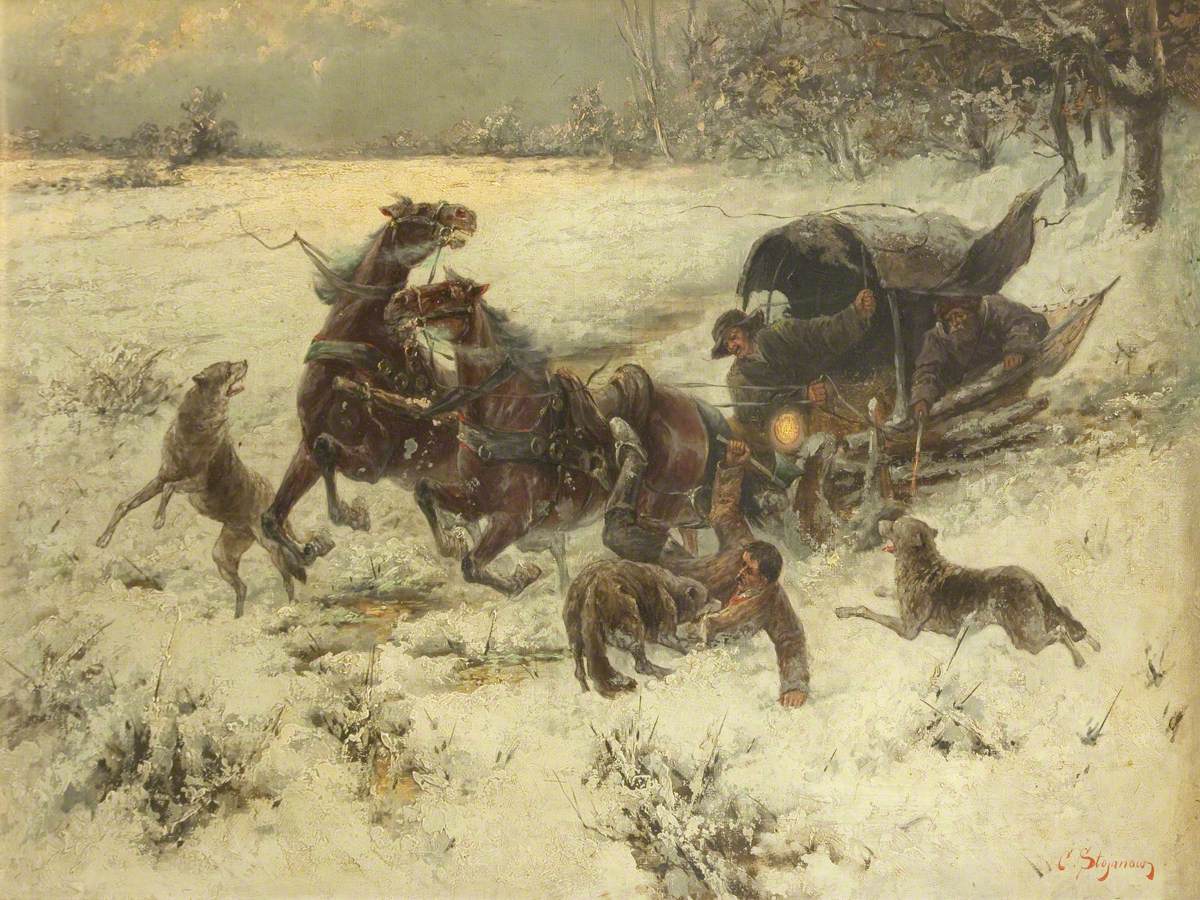
    Fighting Off the Wolves
    Piotr Stojanov
    source ArtUK

    I’m sorry …… I tried to like this novel, I really did.  As a plot, it has some interesting characteristics, but while at times suspenseful, the writing held together about as firmly as stringy taffy.  Actions were related with a tone of practicality, yet sometimes those actions were highly improbable.  From a complete stranger being engaged to run your estate and watch your beloved daughter for months on end without any investigation or anyone to check on her while you’re away (even if she is a long lost relative — hello!  Warning bells!), to leaving your elderly sister completely alone again without anyone to check on her, to an area that produces blue geraniums.  Not to mention there were certain characters that appeared to simply be thrown into the story willy-nilly, without any true connection to the plot. Then to top it off, the wolves themselves were sprinkled here and there without much effect other than a slight bit of tension now and then.  Okay, I do understand the wordplay in that the wolves could be referring to the actual wolves or the human “wolves” of Willoughby Chase, but the intermeshing of the two was still rather sloppy.  Yet in spite of all my issues with the novel, I suspect your average reader would like this story a little bit more than I did.  I’m a connoisseur of children’s novels and have read some truly excellent ones.  In comparison, The Wolves of Willoughby Chase pales beside them, but overall it wasn’t a terrible novel.  It does deserve to be read once.

    Wow, I have two children’s classics already finished for the year!  A short story is on schedule for the next Deal Me In choice, The Life You Save Might Be Your Own by Flannery O’Connor.

    Week 6 – Deal Me In Challenge – Seven of Hearts