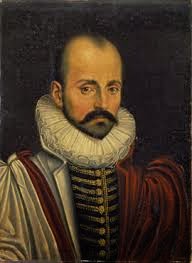
The Autobiography of Benjamin Franklin

“Dear Son, I have ever had a Pleasure in obtaining any little Anecdotes of my Ancestors.”

Known as one of the founding fathers of the United States, Benjamin Franklin grew up in Boston, but after being apprenticed as a printer to his brother, they had a heated disagreement and Franklin ran away to Philadelphia.  Single-handedly, he built his own printing business and later became recognized for organizing the first lending library, starting a volunteer fire department and inventing the Franklin stove, along with numerous other sterling accomplishments.  His autobiography ends in 1757 with his involvement in the French-Indian Wars but, as most people know, Franklin went on to great feats, being involved in the Revolutionary War, and helping draft the Declaration of Independence, the Constitution and the Treaty of Paris, which ended the war.

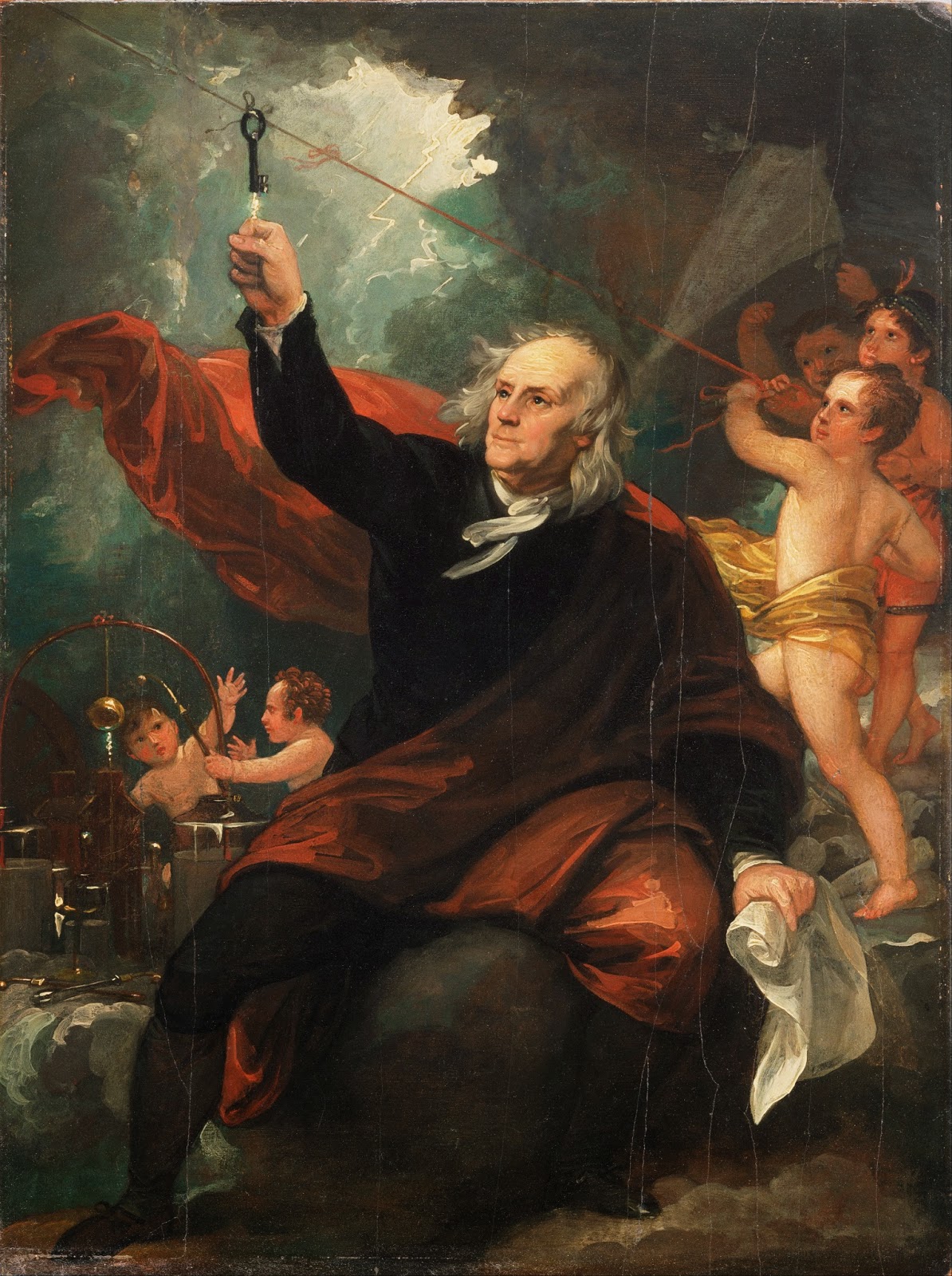
Benjamin Franklin drawing electricity
from the sky (1816)
Benjamin West
source Wikipedia

I particularly enjoyed the first part of this autobiography, as Franklin describes his boyhood, his apprenticeship to an overbearing brother and his flight to Philadelphia where he eventually lands a job as a printer and later runs his own company.  His ability to examine a situation thoroughly and quickly and then be able to proceed with aptitude and insight into any challenges, was his trademark, and the reader can understand how he rapidly won the respect of the community and his fellow businessmen.  Being self-educated, Franklin had a love of good literature and along with that, good discussion, which led him to found the Junto club where he, along with other like-minded young men, hoped that by improving their minds through reading, they could better their community around them.

The main emphasis of Franklin’s discourse was on “Wealth and Distinction” through accomplishment, employing “Industry and Frugality” to meet his goals. He noticed everything to the minutest detail and had an idea for the betterment of everything, including housekeeping, the communicating of instruction, virtue, personal growth, and even religion.  Virtue was a particular focus of Franklin’s, as he was convinced that “vicious Actions are not hurtful because they are forbidden, but forbidden because they are hurtful, the Nature of Man alone consider’d: That it was therefore every one’s Interest to be virtuous, who wish’d to be happy even in this World.”  He set up a system to eradicate his faults and instil virtue, by working on one shortcoming at a time and moving to the next, only when the former was perfected.  His list read as follows:

1.  Temperance
Eat no to Dullness
Drink not to Elevation

2.  Silence
Speak not but what may benefit others or yourself.
Avoid trifling Conversation.

3.  Order
Let all your Things have their Places.
Let each Part of your business have its Time.

4.  Resolution
Resolve to perform what you ought.
Perform without fail what you resolve.

5.  Frugality
Make no Expense but to do good to others or yourself: ie. Waste Nothing

6.  Industry
Lose no Time.  Be always employ’d in something useful.  Cut off all unnecessary Actions.

7.  Sincerity
Use no hurtful Deceit.
Think innocently and justly; and, if you speak, speak accordingly.

8.  Justice
Wrong none, by doing Injuries or omitting the Benefits that are your Duty.

9.  Moderation
Avoid Extremes.  Forbear resenting Injuries so much as you think they deserve.

10.  Cleanliness
Tolerate no Uncleanness in Body, Clothes or Habitation.

11.  Tranquility
Be not disturbed at Trifles, or at Accidents common or unavoidable.

12.  Chastity
Rarely use Venery but for Health or Offspring; Never to Dullness, Weakness, or the Injury of your own or another’s Peace or Reputation.

13. Humility
Imitate Jesus and Socrates.

Through using this method, Franklin expressed himself surprised at his numerous faults.  Though it did not have the success he had expected, at least through application he was able to temper his faults to a greater degree than if he had never attempted the experiment.

Benjamin Franklin (center) at work on printing press
Reproduction of Charles Mills painting
source Wikimedia Commons

Franklin’s style is rather continuous and so often muddled that it required effort to follow his train of thought.  He states that he’s writing the biography for his son, but it was almost as if he was writing for himself, in that he had all the experiences and all the information in his head, and therefore didn’t need to give additional details, which would have been useless for him, but perhaps helpful to the uninformed reader.  He sounded like quite a character though, rather impressed with himself and his achievements in spite of the feeble dose of humility that he attempted to add as an ingredient to his narrative.

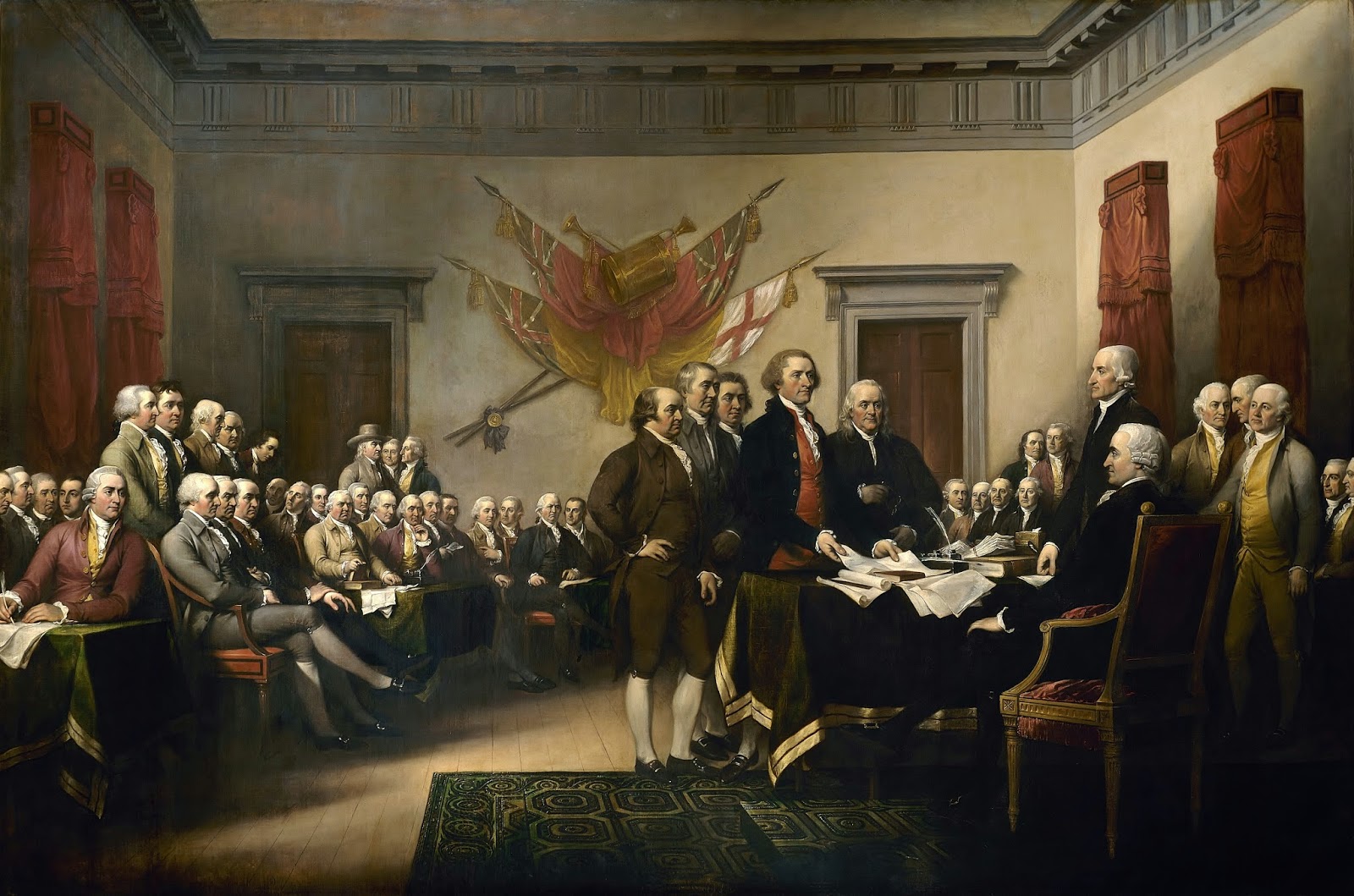
The Declaration of Independence (1818)
John Trumbull
source Wikipedia

In fact, from the recent biographies that I’ve read, I’ve been struck by the pride and almost cavalier self-esteem of some of the authors.  While there can be a humbleness to their communication, it appears to be a forced diffidence that still smells of a hubris that they can’t quite shake.  Perhaps this type of arrogance is needed in all great men, but, as I travel chronologically through these biographies, I certainly sense less of a reliance on external sources (respectable mentors, family and God/religion) and more of a sole reliance on self and philosophical ideas.

The next biography is Walden by Henry David Thoreau, an appropriate read for the month of May!

Confessions by Jean-Jacques Rousseau

“I am resolved on an undertaking that has no model and will have no imitator.”

Have you every felt so completely sorry for someone that that emotion eclipses any others that he might stir up inside you?  Have you ever encountered someone who simply is a unique soul, a person who, no matter what they do, does not fit in easily with society?  Have you ever been charmed by someone and then repelled at the same time?  All these thoughts and emotions were boiling up, mixing together, as I read Rousseau’s Confessions, the autobiography of his life.


Rousseau was born in 1712 in Geneva in the Republic of Geneva, a city-state in the Protestant Swiss Confederacy.  He was born to a watchmaker named Isaac Rousseau and his wife, Suzanne Bernard, his mother dying tragically mere days following Rousseau’s birth.  He described her death as, “the first of my misfortunes.”  


Reading his mother’s romance books at such a young age, with his father, appeared to shape Rousseau’s character in an unusual way:

“By this dangerous method I acquired in a short time not only a marked facility for reading and comprehension, but also an understanding, unique in one of my years, of the passions.  I had as yet no ideas about things, but already I knew every feeling.  I had conceived nothing; I had felt everything.  This rapid succession of confused emotions did not damage my reason, since as yet I had none; but it provided me with one of a different temper; and left me with some bizarre and romantic notions about human life, of which experience and reflection have never quite managed to cure me.”

Curiously, Rousseau’s experience with books and their  affect on human character are echoed by themes in other classics including, Madame Bovary, Eugene Onegin, and Anna Karenina.
Les Charmettes where Rousseau lived
with Mme Warens
source Wikipedia

From the age of 10 on, Rousseau saw little of his father, who had moved away to avoid prosecution by a wealthy land owner. The boy was eventually apprenticed to an engraver, but at 15 ran away and began a rather nomadic lifestyle.  In Savoy, he would be introduced to Madame Francoise-Louise de Warens, a woman 13 years his senior, whom he would forever call “Maman.”  She would be his Muse and surrogate mother for the greater part of Rousseau’s life, as well his lover for a short period of time.  Later, his obsessive interest in music would be used to earn money as a teacher, as well as gain him subsequent notoriety as a writer of opera and various other articles and works on the subject.  

In 1742, Rousseau moved to Paris and became close friends with Denis Diderot, another enlightenment thinker, and his renown as a philosopher was born.  His first major-philosophical work, Discours sur les Sciences et les Arts was presented to the Academy of Dijon in response to the question, “…whether the Restoration of the arts and sciences has had the effect of purifying or corrupting morals.”  In it, Rousseau offered a thorough critique of civilization, seeing it not as a chronicle of progress, but instead as a history of decay.  For Rousseau, no one is innately good, but instead must cultivate a rational knowledge to gain control of nature and therefore, self.  
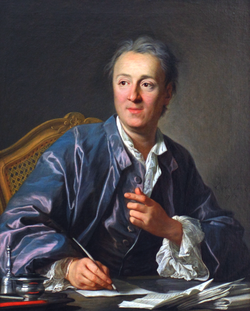
Denis Diderot (1767)
par Louis-Michel van Loo

Upon returning to Paris, after a posting in Venice as a secretary to the Comte de Montaigue, Rousseau took Thérèse Levasseur as a lover, eventually having 5 children with her, all of whom he placed in a foundling hospital, being unwilling to bring them up due to the lack of education and undesirable social class of his in-laws whom he was supporting.  With his later books on education and child-rearing, these callous actions made him the target of vicious ad hominem attacks from some contemporaries, in particular Voltaire and Edmund Burke.  

Through most of his life, Rousseau dealt with various health issues including being unable to urinate without the use of a probe, odd romantic attachments, including a passionate unconsummated obsession with Sophie d’Houdetot, who inspired his novel, Julie, breaks with various friends and acquaintances upon his retirement to the country, and various and numerous attacks of persecution and threats.  When Rousseau wrote that all religions had value, in that they all encouraged men to virtue, an intense uproar exploded against him, and he was finally forced to flee to England with the help of the Scottish philosopher, David Hume.  In 1767, he returned to France under an assumed name and finally in 1770, he was officially allowed to return.  
While the tone of Confessions often oozed of lament and discontent, especially during the latter half, Rousseau also showed a rather mischievous sense of humour:

“As we became better acquainted, we were, of course, obliged to talk about ourselves, to say where we came from and who we were.  This threw me into confusion; for I was very well aware that in polite society and among ladies of fashion I had only to describe myself as a new convert and that would be the end of me.  I decided to pass myself off as English:  I presented myself as a Jacobite, which seemed to satisfy them, called myself Dudding and was known to the company as M. Dudding.  One of their number, the Marquis de Taulignan, a confounded fellow, ill like me, old into the bargain, and rather bad-tempered, took it into his head to engage M. Dudding in conversation.  He spoke of King James, of the Pretender, and of the court of Saint Germain in the old days.  I was on tenderhooks.  I knew about all of this  only of what little I had read in Count Hamilton and in the gazettes; however I made such good use of this little knowledge that I managed to get away with it, relieved that no one had thought to question me about the English language, of which I did not know one single word.” 

One cannot talk about Rousseau’s life without mentioning his passion for nature.  Once removed to the country, he was in his element, his retirement not only giving him an escape from the petty intriguing of Parisian society, but also gratifying his love of long rambles in the woods, his eventual interest in botany and his joy of solitutde.

“Two or three times a week when the weather was fine we would take coffee in a cool and leafy little summer-house behind the house, over which I had trained hops, and which was a great pleasure to us when it was hot; there we would spend an hour or so inspecting our vegetable plot and our flowers, and discussing our life together in ways that led us to savour more fully its sweetness.  At the end of the garden I had another little family:  these were my bees.  I rarely missed going to visit them, often accompanied by Maman; I was very interest in the arrangements, and found it endlessly entertaining to watch them come home from their marauding with their little thighs sometimes so laden that they could hardly walk.”


Rousseau méditant dans un parc (1769)
par Alexandre Hyacinthe Dunouy
source Wikipedia

Rousseau was a man of numerous contradictions.  On one hand, he was self-absorbed, petty-minded, overly sensitive, idealistic, peculiar, selfish, out of touch with reality, yet on the other, he was also rather lonely, at times generous, unique, creative, self-aware, and inquisitive.  He is a puzzling conundrum bottled up in one person.  Yes, he would have been hard to bear at times.  He is one of those people with whom one could never be comfortable, as you would always be wondering if you were living up to his standards.  He had a short fuse, yet also a generous heart. 

How did I come to these conclusions?  Well, you certainly get a sense of Rousseau’s perceived persecution that appeared expanded to gigantic proportions in his mind.  Many reviewers call this obsession his “paranoia,” an imagined grand plot with machinations designed by numerous former friends, ready to invest years of their lives to bring about his downfall.  Yet perhaps this behaviour is not so surprising in a man who had been raised mostly without family, obviously needing the intimacy of human companionship, yet who had never really learned or accepted the proper manners to fit easily in society; French society, in particular, follows certain constructs that do not allow for individuality.  

In spite of Rousseau’s various eccentricities, I couldn’t help feel profound sympathy for him.  With no one to shape his character and with his unwillingness to temper his idiosyncrasies and become homogeneous with his surroundings, Rousseau became a victim of himself, a plight for me that only excites pity.

The Narrative of the Captivity and Restoration of Mrs. Mary Rowlandson

“The sovereignty and goodness of GOD, together with the faithfulness of his promises displayed, being a narrative of the captivity and restoration of Mrs. Mary Rowlandson, commended by her, to all that desires to know the Lord’s doings to, and dealings with her.”

On February 10, 1675 in the Massachusetts Bay Colony, the Lancaster settlement was attacked by Indians and Mrs. Mary Rowlandson was taken captive along with a number of other settlers, including other members of her family.  This short book chronicles the events of her capture, her travels with her captors and finally her release after 11 weeks.

For almost 50 years, the colonists and Indians had lived in relative peace, but increasing settlement and demand for Native land caused tension that eventually exploded in attacks on American settlements by the Indians and resulting retaliations.  Indian raids were often violent and by the attack on Lancaster, the comfortable life that Mary had known with her husband and three children, was abruptly torn apart.

Mary turned to God in her fear and suffering and instead of lamenting her situation, she looked for lessons to learn from it.  Her Puritan faith was rather rigid and the narrative comes across as very unemotional at times, but the religious and historical weight of her experiences are a valuable tool in understanding the people of those times.  The book follows the traditional framework of the captive narrative, focusing on suffering, exile and redemption.

For more extensive information, Ruth at A Great Book Study has produced an excellent review of The Narrative of the Captivity and Restoration of Mary Rowlandson.    I had plans to write an extensive review but in the end, I just couldn’t.  Then I planned to answer the WEM questions as I did in my review of Saint Augustine’s Confessions …. but when I looked at them, I just couldn’t. I have only a basic knowledge of the Puritans and of conflicts between the Indians and colonists, so I hesitate to give even an uneducated judgement on Rowlandson’s narrative.  When I finished, I hadn’t really connected with Mary or her narrative.  Excepting what she communicated about her faith, there was an enormous gap in my understanding of her outlook and her judgements. This book left me feeling rather off-balance.  Normally I hate reading a book from a modern perspective and ALWAYS put myself, or attempt to put my mindset, into the times about which I’m reading.  For the first time, I had difficulty.

What I do know is that I need a “palate cleanser” with regard to Colonist-Indian relations, and so I’ve chosen to read The Journal of William Sturgis, a primary source document about a 17 year old boy who goes on his first voyage to trade furs with the Pacific Coast Indians.

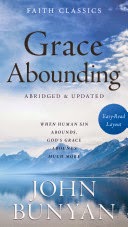
Grace Abounding to the Chief of Sinners by John Bunyan

“In this my relation of the merciful working of God upon my soul, it will not be amiss, if, in the first place, I do, in a few words, give you a hint of my pedigree, and manner or bringing up; that thereby the goodness and bounty of God towards me, may be the more advanced and magnified before the sons of men.”

John Bunyan was born in Elstow, a village near Bedford in Bedfordshire, and was baptized on November 28, 1628, the first son of Thomas Bunyan and his second wife.  In 1644, he joined the Parliamentary army as a soldier and was active until 1647.  The year 1655 saw him joining the congregational church at Bedford and the following year he was actively disputing with the Quakers, out of which was born his first book, Some Gospel Truths Opened.  With the death of Oliver Cromwell in 1658 and the restoration of the monarchy, the persecution of Non-Conformists began. Bunyan was given every opportunity to conform by the surprisingly tolerant Royalists, but he was staunchly resistant to a compromise of principles that could weaken the faith of his followers.  Prevented from preaching by various imprisonments, Bunyan turned to writing.  Grace Abounding is a record of his spiritual experiences from his first meaningful encounter with God to his life of preaching.

Bunyan admits to having a lack of religion in his upbringing and it was only later, with some the influence from his wife, that he came to entertain thoughts of spirituality:

“But I observe, though I was such a great sinner before conversion, yet God never much charged the guilt of the sins of my ignorance upon me; only he showed me I was lost if I had not Christ, because I had been a sinner; I saw that I wanted a perfect righteousness to present me without fault before God, and this righteousness was nowhere to be found, but in the person of Jesus Christ.”

After hearing a sermon preached from the Song of Songs, Bunyan was struck by the love of God and came to the following conclusions:

That the church and so every saved soul, is:

  1. Christ’s love, when loveless
  2. Christ’s love without a cause
  3. Christ’s love when hated to the world
  4. Christ’s love when under temptation, and under desertion
  5. Christ’s love from first to last

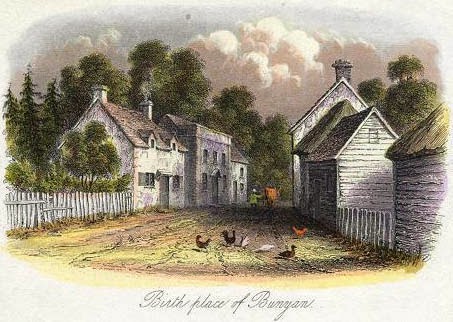
Birthplace of John Bunyan
source Wikipedia

Though Bunyan had moments of euphoric revelation and joyful epiphanies, his conversion was still fraught with doubts and fears.  Had he abused God too much for forgiveness?  Was forgiveness given to others but not to him?  Like Esau, had he sold his birthright and would never be able to regain it?  His agonies leapt off the page with a startling clarity:

“Yet I saw my sin most barbarous, and a filthy crime, and could not but conclude, and that with great shame and astonishment, that I had horribly abused the holy Son of God; wherefore, I felt my soul greatly to love and pity him, and my bowels to yearn toward him; for I saw he was still my Friend, and did reward me good for evil; yea, the love and affection that then did burn within to my Lord and Saviour Jesus Christ did work, at this time, such a strong and hot desire for revengement upon myself for the abuse I had done unto him, that, to speak as then I thought, had I a thousand gallons of blood within my veins, I could freely then have split it all at the command and feet of this my Lord and Saviour.”

Bunyan eventually is able to reason his way through his doubts and come to peace with his faith.  He realizes that while he prayed fervently when he was in the midst of troubles, he neglected to pray for himself to avoid the pitfalls and temptations.  The sense of being a sinner did not ever leave him completely, but as he grew, so did his understanding of the depth and breadth of the grace of God, and he was finally at peace.

Stained glass of Bunyan in prison
source Wikimedia Commons

At the end of the book, Bunyan explains the cause of his imprisonment, which appears to be directly related to his refusal to use the Book of Common Prayer.  When questioned by the justices, Bunyan stated that he would be pleased to use the Book, if the justices could so kindly point to him in Scripture where the particular book was referenced.  The justices, however, viewed the Book of Common Prayer as second only to the Bible.  Bunyan was stubborn, the justices unyielding, and so began Bunyan’s time in the gaol. When released from prison in 1672, on a declaration of indulgence issued by the king under a new wave of religious tolerance, Bunyan returned to preaching, this time legally, and continue as the pastor of the Bedford Meeting, a position he had been given while languishing in prison a year before.  In 1688, while visiting London, he contracted a fever and passed away on August 31st.

The title Grace Abounding to the Chief of Sinners comes from two Biblical scripture references:

“Moreover the law entered that the offence might abound.  But where sin abounded, grace abounded much more, so that as sin reigned in death, even so grace might reign through righteousness to eternal life through Jesus Christ our Lord”  Romans 5: 20-21

“This is a faithful saying and worthy of all acceptance, that Christ Jesus came into the world to save sinners, of whom I am chief.”  1 Timothy 1: 15

My absolute favourite part of this book was when Bunyan realized the impact of conversion.  His fellow men and women were suddenly lovely to his eyes and he viewed them “like a people that carried the broad seal of heaven about them.”  What a transformative experience!  Instead of being irked, or disdainful, or petty, or indifferent toward our fellow man, if we could see them as beloved children of God, how differently we might treat them!

John Bunyan at the Gates of Heaven
William Blake
source Wikimedia Commons

I must say that while I liked this read, so far I’m finding the biography list rather quirky.  Taken separately, the books have been enjoyable, but when taken together, they don’t strike me as a concise, chronological order of biographies that perhaps expand ideas or give insight into changes in societies or thought.  Ruth, I’d love to know what you thought of the novel list as a whole.  The other remaining lists (plays, history and poetry) look much better, but I’m not that impressed with this one.

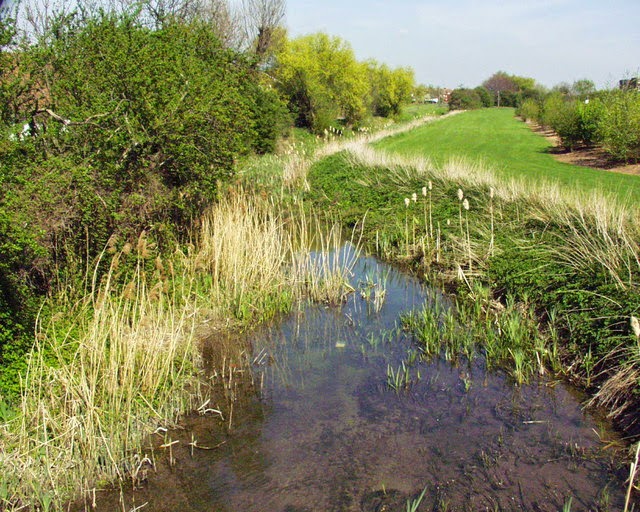
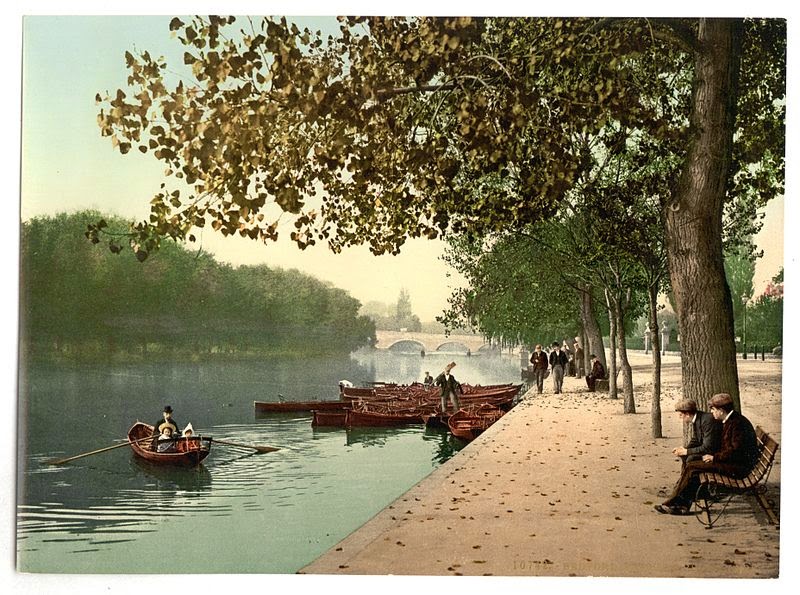
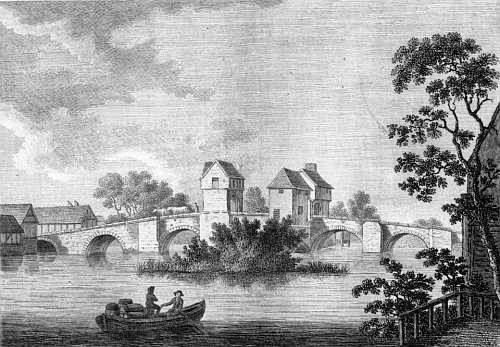
This book counts towards my Reading England Challenge and since Cat at Tell Me A Story has been doing such a wonderful job with educating us as to the English counties along with her novels, I thought that I should add at least a few photos of Bedfordshire, where the narrative takes place.

Elstow

Elstow Stream

Bridge and Promenade

Bedford Bridge

Meditations by René Descartes

“My reason  for offering you this book is very persuasive, and I am confident that you will have an equally strong reason for defending it once you understand why I wrote it; thus the best way of commending it to you is to say a few words about my objective in writing it”

Descartes set out to examine how “everything that can be known about God can be shown by reasons that derive from no other source but our own mind, …. and how God can be known more easily and more certainly than worldly things.”  However even as he claims his investigations as “certain and evident,” he is concerned that not everyone has the ability to grasp them.  Right then, I knew I was in for a philosophically dense read.  Yet while I trembled, I soon began to realize that Descartes splits his meditations into manageable chunks and, if you employ your brain for short periods, his explanations and arguments can penetrate.  I also realized that the title of the book could be of assistance.  These thoughts of Descartes were ideas that were probably products of hours and days and years of pondering and questioning and seeking.  If it took him that long to produce the ideas, I’d have to be willing to meditate on them if I wanted to develop a basic understanding.  And so I went on ….
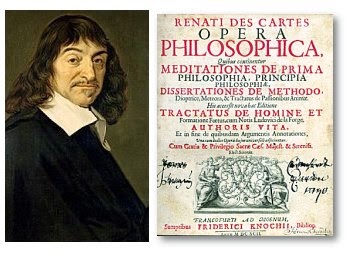
First Meditation:  Things which can be called into Doubt

Descartes explores false knowledge, which he distinguishes from the unknowable: “there is nothing among my former beliefs that cannot be doubted and that this is so not as a result of levity or lack of reflection but for sound and considered reasons.”  It is necessary to discard all beliefs that aren’t absolute to determine what is known for certain.  There are many comparisons to thought while asleep and thought while dreaming.  He concludes with:

“I am like a prisoner who happens to enjoy an imaginary freedom in his dreams and who subsequently begins to suspect that he is asleep and, afraid of being awakened, conspires silently with his agreeable illusions.  Likewise, I spontaneously lapse into my earlier beliefs and am afraid of being awakened from them, in case my peaceful sleep is followed by a laborious awakening and I live in future, not in the light, but amid the inextricable darkness of the problems just discussed.”

Second Meditation:  The Nature of the Human Mind, and that it is better known than the Body

Descartes thoughts continue from his supposition from his first meditation and he decides that everything is false.  Yet if all he believes is false, he does conclude that one thing is true:  he exists.  His reasoning is something like this:

  1. He exists if he is not being deceived.
  2. He exists if he is being deceived.
  3. Therefore, if he is being deceived or not being deceived, he exists
  4. He is either being deceived or not being deceived.

Interestingly, St. Augustine also argued “fallor ergo sum”, or “I am being deceived, therefore I exist”.

I think here Descartes arguments are of a personal and not necessarily a general nature:  his mind exists because his thoughts exist.  However, he still hasn’t proven that he exists.
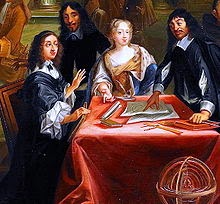
Rene Descartes with Queen
Christina of Sweden
source Wikipedia


Third Meditation:  The Existence of God

Descartes starts to lose me here.  He examines the dream state and questions how we can know it from reality and then he discusses the all-powerful God which we know and how we could be deceived in our perception of him (I think).  Very logically he states that if he is being deceived, that very fact proves his existence.  He comes to the conclusion that God is not a deceiver but leaves the door open to accept that there is something that is.

I was fascinated by Descartes exploration into ideas.  There are ideas which come to us that do not originate with us and, in fact, sometimes impose themselves on us.  If they are not products of our will, does that not point to there being something other than us?

“But if I derived my existence from myself, there would be nothing that I would either doubt or wish for, nor would I lack absolutely anything.  For I would have given myself every perfection of which I have some idea and thus I would be God himself.”

Whew, that’s certainly something to think about!

Fourth Meditation:  Truth and Falsehood

Yikes, and even deeper we go ……..  Descartes concludes that God exists and his existence depends on Him.  God cannot deceive because deception involves some sort of imperfection and God is perfect.  When Descartes focuses on God he finds no error in himself, but when he focuses on himself, he is full of errors.  He calls himself an intermediate being between God and nothingness.

With regard to errors, he proposes that two faculties come into play:  the faculty of knowledge and the faculty of choosing from his own free will, in other word, intellect and will.  Through his intellect he perceived ideas but through his will he can make judgements.  There is a problem though:  his intellect is limited —- it cannot perceive all ideas and it does not always perceive clearly and distinctly —– whereas his will is unlimited —- it can make, deny or suspend judgements on anything.  Yet as long as he does not make wrong judgements in his will, he is safe …… if he simply suspends judgement on ideas he’s not certain of, he cannot be wrong.

Descartes at Work
source Wikipedia


Fifth Meditation:  The Essence of Material Things, Another Discussion of God’s Existence

Descartes provides a new argument for the existence of God, in that if he thinks that he exists, existence in inseparable from God and therefore He exists …… or at least, I think that’s what he’s saying.  Such as:

1.  God is a being that has all perfections
2.  Existence is a perfection
——>   God exists

There are three famous arguments about Descartes’ position (one of them being Kant’s argument that existence isn’t a perfection) but none hold up to logical examination, so I guess Descartes is still the winner.

Sixth Meditation:  The Essence of Material Things, and the Real Distinction Between Mind and Body

Wow, this is getting challenging!  To argue for a material world, Descartes examines what is contained in his own soul.   There is a delineation between imagining and pure understanding.  He concludes he could exist without imagining, therefore imagining must be outside his mind and connected to the body.  Next he examines the senses, which he feels come involuntarily and therefore connect ideas to the mind.  The next puzzle is why the mind is connected to the body ………  With all these quite impressive logical acrobatics, he begins to believe material objects exist but perhaps not in the way he has always believed.  There are a number of other investigations into our senses and their role, why we make unwise decisions, and that the body is divisible, yet the mind is not.  He ends by stating:

” For from the fact that God is not a deceiver it follows that, in such cases, I am completely free from error.  But the urgency of things to be done does not always allow us time for such a careful examination; it must be granted, therefore, that human life is often subject to mistakes about particular things, and the weakness of our nature must be acknowledged.”

As much as it completely strained my brain, the Sixth Mediation really resonated with me.  I remember as a small child wondering why I was me. How was it that I felt contained in this particular body and not another?  Why was I chosen to be me?  How?  Why was I a soul living in Canada and not somewhere else?  I think this was the start of realizing that I had a soul and was something more than just a mechanical shell or a biological entity.  And if that was true, then where did I come from and who made me?  Perhaps not original questions, but ones that I think we should think about more in life.  Yes, we should all be philosophers!
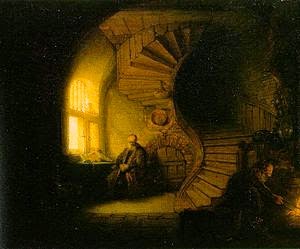
Philosopher in Meditation
Rembrandt (1631)
source Wikipedia

Getting back to the book, it continues with “objections” or responses from Johan de Kater, a Catholic theologian from Holland; Fr. Marin Mersenne; Antoine Arnauld, a Jansenism theologian; Thomas Hobbes; and Pierre Gassendi, a priest, scientist, astronomer and mathematician.  I really had to laugh reading some of these objections.  In fact, the Catholics were the ones who questioned the logic Descartes used to prove the existence of God.  So curious from a modern prospective but it appears that the church was willing to ask tough questions during these times and wasn’t afraid of searching for the truth.  So interesting!

Descartes’ Replies to the Objections are also very enlightening but so very deep.  A course in logic would have been very useful before reading this book, however, I think I’ve covered enough for now.  Descartes obviously liked to think and had alot of time to do it.  It was mental gymnastics to try to follow him but good for the brain.  To really understand it though, you need to have read Aristotlean philosophy along with a number of other more recent philosophies, as Descartes thoughts sprung from that already anchored base.  At least my understanding, while minuscule, is more than when I started.  Thanks, Descartes!

Montaigne’s Essays – Part Two

Oh, Montaigne!  The more of his essays that I read, the more I like him.  He’s inquisitive, does not let anything get in the way of giving his opinion on absolutely any subject, has a clever but disordered mind, and because of the last point, really makes you engage your brain as you read.  I would have loved to meet him in real life, but, I get the impression that we’d probably have occasionally annoyed each other.  

Some of the readings for this section were:

On The Vanity of Words:  After reading Montaigne’s essay On Education, I suppose this attack on rhetoricians can’t come as much of a surprise.  To be eloquent is to foster a type of deception, and Montaigne is scathing in his condemnation of it.

Cicero & the magistrates disovering the
tomb of Archimedes
Benjamin West
source Wikiart

On the Inconsistancy of Our Actions:  This one is very interesting. Montaigne laments the inconsistency of men, stating that instead of following a path to wisdom throughout their lives, they are ruled solely by their appetites, living for the here-and-now and are merely motivated by opportunity, very much like animals. They blow with the winds.  He gives various examples on inconstancy, leading us to believe that consistency as Montaigne defines it, is virtually impossible.  One must plan one’s life to the utmost and follow the course, not being swayed by emotions or outside forces to be consistent and, as Cicero says, “For nothing can be consistent that has not reason for its foundation.”  Therefore, in Montaigne’s eyes, everyone is lacking true reason.  This is one of the few essays that I’ve read so far where Montaigne actually managed to keep on track with his subject.  Bravo!  This is certainly one of my favourites.

On Conscience:  Even if one finds pleasure in their vices, their conscience will always convict them, says Montaigne.  With one of his usual unexpected leaps of thought, he discusses the futility of torture, labelling it a means of testing endurance rather than a means to ferret out truth.  He uses some fun examples in this one, my favourite being Scipio tearing up his account books before the court when accused of dishonesty with regard to the money entrusted to him.  According to Montaigne, his actions declared him an honest man because his big heart could not bear to be accused of such a vulgar crime. Perhaps one should be grateful that Montaigne did not choose to be a judge as his profession.

Portrait d’un homme portant un exemplaire des
Essais de Montaigne
Johann Anton de Peters
source Wikiart

On Rewards for Honour:  Basically I understood that Montaigne feels that rewards should not be given out too liberally or their value is decreased. He’d rather not give out rewards at all, than have too many people get them.  Not a very modern viewpoint, Montaigne, when we presently strive to give everyone a reward for anything.  I tend to side here with Montaigne.

On Books:  Montaigne employs a coyness in this essay, stating that he reads books for pleasure only and has little desire to truly exercise his brain.  His goals in reading are to learn to know himself, and to learn to live and die well. His self-deprecation is quite startling as he confesses to having little knowledge and once again admits to having a poor memory.  Elaborating on his poor memory, he ends by giving a number of examples of literary criticism (not his title for it) that he has written at the ends of books, so if he picks them up again, he is able to ascertain why he liked them or not, and if he would read them again.

On Presumption:  It is not good to think too highly of ourselves, nor is it beneficial to think of ourselves worse than we are.  Montaigne advocates for balance and a practical self-knowledge.  Yet Man has such a variety of differing opinions, there is a “maze of obscurity” which makes the school of Wisdom uncertain, and this gets on Montaigne’s nerves.  He then meanders through a lovely forest of subjects, from self-deprecating statements to mediocre poetry to appearances of famous men, etc., finally ending with his disdain for modern education, in that it teaches learning instead of wisdom and goodness.

” It seems to me that the nursing mother of the most erroneous ideas, both of men in general and of the individual, is the exaggerated opinion man has of himself.”


On Giving the Lie:  Montaigne indulges in more modesty (false-modesty?) and finally gets to the title of the essay, lamenting that lying has been turned into a virtue by modern society.  He strongly condemns it:

“Lying is an ugly vice, which is painted in its most shameful colours by an ancient writer (Lysander) when he says that ‘to lie is evidence that we despise God and at the same time fear men.'”

To be honest, I feel that Montaigne could have benefited highly from the type of education that he despised, however, then he wouldn’t have been Montaigne and only another highly intellectual rhetorician with the same habits as all other rhetoricians.  And our Montaigne is unique, that is certain!  Not always simple to follow, but unique!


The Life of Saint Teresa of Avila by Herself

“As I have been commanded and left at liberty to describe at length my way of prayer, and the workings f the grace of our Lord within me, I could wish that I had been allowed at the same time to speak distinctly and in detail of my grievous sins and wicked life.”

Teresa was a Spanish mystic born in 1515 in Avila, Spain.  Early on, she showed a zealously pious nature but in her teens she began to be pulled in by worldly temptations and could not find peace, considering herself a miserable sinner.  When her father sent her to a convent school to be educated, she began her contemplative life.  Sickly throughout her life, Teresa used her discomfort as a means of shedding worldly cares and drawing closer to God.

This autobiography delves into Teresa’s prayer life (the four stages of prayer), union and trance, visions, temptations, the founding of the convent of St. Jospeh and the mercies of God.

I honestly have very little to say about this book.  Uncharacteristically I found my attention wandering numerous times while reading.  Was it because I dislike mystics?  Not at all.  Was it because the vocation of a nun is tedious.  No.  Was it Teresa’s writing?  Well …. perhaps …….  When reading a book, I usually look for an author to connect with the reader.  Some author’s are more successful than others in this area, but there has to be some connection to bring the writing to life.  In this case, Teresa’s prose remained lifeless on the page and while I could read about her experiences, it was very difficult for me to enter into them with her.  Because of her rather solitary life, she appeared no only to have little contact with outside cares and people, she also actively renounced both.  It was very challenging to understand someone who often stood in judgement of others.  I’ve never felt this attitude from other religious figures whom I’ve read about and I found it off-putting.  I also found Teresa seemed to write for herself rather than anyone else, so again, it was problematic establishing contact and therefore, any interest.

In spite of this rather lackluster read, I would still like to read her Interior Castle, which I’ve had on my list for awhile.  I can only hope that I’ll enjoy it more than this one.

translated by J. Cohen (I’ve heard that E. Alison Peers is a better translation)

Montaigne’s Essays – Part One

Oh, Montaigne!  What a character!  I’m reading a series of recommended essays, and my plan is to split them into three posts.  So far my introduction to Montaigne has been pleasurable, but taxing to the brain.  His language and progression of ideas, examples and testimonies are not for the faint of heart.  In hindsight, it was wise to take him in measured doses.


On Sadness:  I felt that Montaigne was saying that the deepest sorrows often could not be expressed with outward emotions.  But then he ended by saying that he is little bothered by such violent passions;  I then wonder what gives him the authority to speak on sorrow if he knows nothing of it.  Hmmmm ……..

Our Fortune Must Not Be Judged Until After Death:  Well, this was not an uplifting little essay.  Montaigne believes, drawing from the tale of Croseus and Solon in the stories of Herodotus, that a man cannot be judged as fortunate until his death, because various calamities and suffering can plague him until the end.  Your final day tells all.  Nice.  Fortunately he appears to have amended his views on this subject later in life.

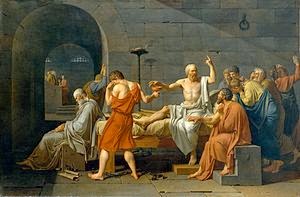
The Death of Socrates
Jacques-Louis David
source Wikipedia

To Think As A Philosopher Is To Learn To Die: Yikes!  Another death essay.  Montaigne emphasizes the need to learn to lose the fear of death.  Death is inescapable and it is a piteous error to try to avoid it by any means, as the hour is determined for everyone.  He tosses in Socrates rather wise and pithy remark:  to the man who said “The thirty tyrants have sentence you to death,” Socrates replied, “And Nature to them.”

Of The Powers of Imagination:  I’m somewhat perplexed as to where to begin with this one.  This essay is supposed to (I believe) explore the relationship of imagination to the mind and body, but Montaigne rather vividly gets into a discussion of the “male member” and “passing wind”.  I was laughing so hard I was crying at the end of the “passing wind” section.  I don’t think hilarity was intended by the author.  😉  Apparently though, people in Montaigne’s time wouldn’t have blinked an eye at these references, showing that they were much more mature and less sensitive than modern people. And since I was very surprised by his frankness given the era, it also demonstrates that our preconceived ideas can be less than accurate.

On Educating Children:  I have an interest in education, so this essay was perhaps the most interesting for me, if not the most amusing (see above).  Montaigne felt that an instructor of good moral character and sound understanding was much more valuable than one with founts of knowledge.  He emphasized the value of knowledge for its own sake, and was repelled by the thought that learning should be used to earn profit. The ancient Greeks would understand his dismay; only slaves were schooled to work, not free men.  Montaigne proceeds to say that he does not wish for an educational system that makes children parrot back what they have learned but rather that they are taught to make ideas their own.  He then expands his argument to suggest tossing out the classical education model in place of simply teaching children to philosophize.  He seems to forget that the classical model contains the building blocks that give the student the tools to be able to discuss topics philosophically, not to mention that young minds have to mature to be able to understand the abstract concepts which are required in philosophy.  He supports, as well, exercise and entertainment, but suggests training peculiarities and eccentricities out of people, as they are “a foe to intercourse and companionship of others”. Well, okay …….  I do understand Montaigne’s main point though.  He is advocating for the teaching of a virtuous character over that of intellectual learning.  In fact, this should be the goal of every teacher, however I believe that there should be a balance between the two, whereas Montaigne seems to want to throw the baby out with the bathwater.

The Return of the Prodigal Son
Bartolome Esteban Murillo
source Wikiart

On the Affection of Fathers for Their Children:  In this case, Montaigne means male children but he does share some good advice. A man should not marry too early and responsible thought should be given to the purpose of having children, realizing that they will owe you much more than they can ever pay back.  Instead of forcing the son to be dependent on him when he comes of age, the father should share his wealth and guide him in the use of it, teaching the son to run the estate.  Now Montaigne claims if this is not done, the sons have no other recourse than to become thieves, a habit that will be nearly impossible to break.  I’m not sure I follow his rationale in this case, and cannot agree with it as an excuse, but hey, it’s Montaigne, right?  It just doesn’t feel normal if he doesn’t hit you with some sort of idiosyncratic reasoning.

In spite of some peculiarities, Montaigne has a charm that cannot be denied.  Perhaps Madame de Sévigné characterizes best what his readers experience:  “I have found entertainment in a volume of Montaigne that I did not think I had brought with me.  Ah, the charming man!  What good company he is!  He is an old friend of mine, but by dint of being old, he is new to me. …….. Mon Dieu!  how full this book is of good sense!”

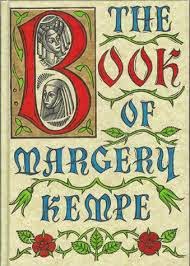
The Book of Margery Kempe

“When this creature was twenty years of age, or somewhat more, she was married to a worshipful burgess [of Lynn] and was with child within a short time, as nature would have it.”

The second book of my Well-Educated Mind Biographies Project took me to the turn of the fifteenth century when the Late Middle Ages was morphing into the Early Renaissance.  Margery Kempe, a married women with 14 children decides that her devotion to God eclipses everything else in her life, and embarks on a mystical journey to get as close as she can to His Love and Grace, and to conform her life to His will.  While the narrative is somewhat disjointed, springing back and forth between different episodes in Margery’s life, the reader must decide:  does Margery have a special relationship with God and are her actions spiritually beneficial, or is she somewhat unbalanced emotionally and do her actions have a negative impact on those around her?

While Margery speaks of her devotion to God and of the special protection and attention he sends her way, a repeated theme runs through this book of her unusually shocking weeping and crying, and how her behaviour alienates the people around her.  In story after story, Margery weeps and wails in loud outbursts, a person or the people get irritated with her and, at the least, want her to stop and, at the most, want her imprisoned.  Margery does show a comprehension that her behaviour sows discord with those around her, and does try to moderate her reactions, but is unable to because of the force of feeling for God in her heart; she simply cannot control her response.

At first, like many people Margery met, her weeping and sobbing drove me crazy.  I think in this book she described every incident that she wailed and moaned, and I was soon in complete sympathy with the people who wanted her either run out of town or put in prison.  Yet about mid-way through the book I began to think ………..  How did Margery conduct herself as a person?  What were her traits and how did she interact with other people whom she met in life?  Yes, her life was completely given to God and he was her primary source of love and care and motivation, but the result of that love was her willingness to help and care for people, her desire to see people saved and experience God’s grace like she had, and, surprisingly, her meek yet powerful words that she used against her accusers. Rarely did she respond in kind to their recriminations, intimidation or threats, but with an honest and sincere demeanour, that often would disarm them.  Did she ever hurt anyone with her behaviour?  No, she was simply annoying and, therefore, was it right to ostracize her, berate her and throw her in prison for being bothersome?

Ultimately I felt that this book said as much about the society around Margery, as Margery herself.  Their intolerance for anyone different than themselves, their impatience at her benign behaviour and their lust for vengeance was quite startling, yet when I compared it to our society today, how different was it really?  Don’t we display the same intolerance, the same prejudice and the same narrow-mindedness as the people of Margery’s time?   Are we exasperated or offended by people with different ideas or bothered when people behave differently than we expect?  I think, if we’re honest, we’d be compelled to answer “yes”.

The book also gives fascinating details of medieval life.  While we, as moderns, always tend to think women were oppressed and had no say in how they lived their lives, Margery chose to live apart from her husband, traveled around Europe often in the company of men, and quite forcefully made her own choices about the path her life would take.  Certainly she was occasionally reprimanded by priests or given advice by townspeople that she should behave like a “normal” woman, but the vast majority of people appeared to accept her lifestyle without comment and are much more concerned or annoyed with the quantity of her weeping and emotional distress.

Margery’s amazing perseverance in her beliefs, and her ability to remaining faithful when she is imprisoned, ostracized, mocked and threatened, are what impacted me while reading this biography.  Her lack of anger and her tolerance towards her persecutors is truly heroic.  While I wouldn’t want to be Margery Kempe, and I didn’t agree with all her decisions, I can certainly see traits within her that would be beneficial in my own life, and for that, I have a reluctant admiration for her single-minded faithfulness and unquenchable spirit.

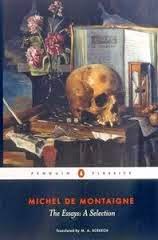
The Essays of Montaigne – Introduction

My third book of my Well-Educated Mind Biographies Project is Essays by Michel de Montaigne.  He wrote these essays over the period of 1570 – 1592.  Why?  Well, the man himself tells us:  “I have dedicated this book to the private benefit of my friends and kinsmen, so that, having lost me (as they must do soon) they can find here again some traits of my character and of my humours.”  His writing is honest and unpretentious, as he only sought to dissect his mind for a greater understanding of human nature.

Born on the last day of February 1533 at the Chateau de Montaigne, his families’ wealth did not breed arrogance or vanity; for the first three years of his life Montaigne was sent to live with a peasant family, in order to, as his father said, “draw the boy close to the people, and to the life conditions of the people, who need our help.”  While his father ensured that he associated with people of lower social status, he also provided him a rigorous education for the purpose of cultivating his mind.  He studied all the classic languages and at fourteen, was destined for law school.  In 1554 he was appointed councillor in the Parliament of Bourdeaux and later married.  Yet in his thirty-eighth year, tired of court life he retired, intending to spend the remainder of his life in tranquil seclusion.  Sequestering himself in a tower on the grounds of Chateau de Montaigne, he began to write his Essays.

La tour de Montaigne
source Wikipedia

Interesting tidbits:

Upon his retirement he commissioned a medal that read, “Que scay-je?”, which means “What do I know?”, echoing Pliny’s reminder that “In these matters, the only certainty is that nothing is certain.”

The profundity of his thoughts introduces his readers to ideas, presented in a way that is unique and innovative. “He who had never actually seen a river, the first time he did, so took it for the ocean, since we think that the biggest things that we know represent the limits of what Nature can reproduce in that species.”

His humility, charm, and uncomplicated spirit echoes through much of his writing:  “When I play with my cat, how do I know that she is not passing time with me rather than I with her?”

Notable Quotes:

  • “I prefer the company of peasants because they have not been educated sufficiently to reason incorrectly.”
  • “I am afraid that our eyes are bigger than our stomachs, and that we have more curiosity than understanding. We grasp at everything, but catch nothing except wind.”
  • “When I am attacked by gloomy thoughts, nothing helps me so much as running to my books. They quickly absorb me and banish the clouds from my mind.”
  • “On the highest throne in the world, we still sit only on our own bottom.”
  • “To compose our character is our duty, not to compose books, and to win, not battles and provinces, but order and tranquility in our conduct. Our great and glorious masterpiece is to live appropriately. All other things, ruling, hoarding, building, are only little appendages and props, at most.”
  • “To begin depriving death of its greatest advantage over us, let us adopt a way clean contrary to that common one; let us deprive death of its strangeness, let us frequent it, let us get used to it; let us have nothing more often in mind than death… We do not know where death awaits us: so let us wait for it everywhere.” 
  • “To practice death is to practice freedom. A man who has learned how to die has unlearned how to be a slave.”

With regard to translations of this work, I came across this quote by William Hazlitt:

“The besetting sin of both Montaigne’s translators seems to have been a propensity for reducing his language and phraseology to the language and phraseology of the age and country to which they belonged, and, moreover, inserting paragraphs and words, not her and there only, but constantly and habitually, from an evident desire and view to elucidate or strengthen their author’s meaning.  The result has generally been unfortunate; and I have, in case of all these interpolations on Cotton’s part, felt bound, where I did not cancel them, to throw them down into the notes, not thinking it right that Montaigne should be allowed any longer to stand sponsor for what he never wrote; and reluctant, on the other hand, to suppress the intruding matter entirely, where it appeared to possess a value of its own.”

In any case, forward on to The Essays of Montaigne!

Further reading: