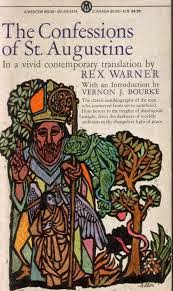
Confessions by Saint Augustine

“You are great, Lord, and highly to be praised: great is your power and your wisdom is immeasurable.”

Book No. 1

Book:  The Confessions of Saint                   Augustine
          
          Oxford World Classics
            Translation:  Henry Chadwick

I’m starting my Well-Educated Mind Biography Project with possibly the first biography ever written, Confessions by St. Augustine.  Born in 354 A.D. in Thagaste, which is modern day Algeria, Augustine reveals his time as a boy growing up in North Africa, his profession as a teacher of rhetoric, his travels to Rome, his connections with the Manicheans*, and finally his conversion to Christianity.  We, as a reader, are privileged to have a window into his life and internal struggles, as he asks questions about life and God.

*Manicheanism:  a quasi-religion that taught a dualism of everything that is material is evil, and everything that is spirit is good.  Their beliefs caused them to take rather bizarre views of Christian teachings such as:  because God created a material world, he cannot be good; Jesus did not become man because all material is evil, etc.

First Stage of Reading:

What historical events coincide-or merge-with these personal events?
Augustine lived in the Roman Empire during a time of political, social and religious turmoil, which helped him to produce prolific amounts of writing addressing these situations.  

Augustine was born in a century where at the beginning, Christianity was a persecuted religion, yet at the end of the century most people of the Roman Empire were at least ostensibly Christian and Christianity was the official religion of the Empire.  As the church attempted to determine its nature,  there were many disputes among Christians and much of Augustine’s writing deals with these issues.  He also endeavoured to reconcile pagan thought with Christian values, one of the first Latin writers to explore the benefits of pagan ideas as well as assessing their limitations.
Who is the most important person (or people) in the writer’s life?

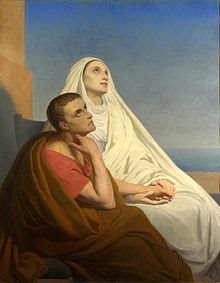
Perhaps the most important person in Augustine’s life was his mother, Monica.  Her prayers and petitions for him were unceasing and what a wonderful thing for her to see him eventually become a believer.  

Ambrose, the archbishop of Milan, was instrumental in Augustine’s journey away from Manichean belief and towards a belief in God.  Augustine respected his intellect and his influence on Augustine was unequivocal, as he encouraged him to look beyond the literal into the substance of the Bible, and asserted that a deeper meaning could be found there, contrary to what Augustine had learned from his Manichean teachers.  
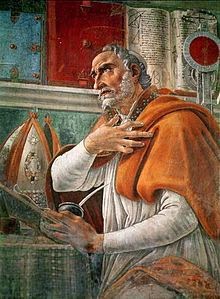
Saint Augustine in his study (1480)
Sandro Botticelli
source Wikipedia


The Second Stage of Reading:


What is the theme that ties the narrative together?
Confession is the most important word in this work.  It is as if Augustine must confess to make his journey complete. 
What is the life’s turning point?  Is there a conversation?

Well, of course, Confessions is a very long conversation of Augustine’s with God.  But in reference to his conversion, I believe it was more a process.  Augustine himself said that he believed that God was with him and guiding him even when he was living with sin and recriminations.  He also makes reference to not being ready to hear or act on certain convictions, so in retrospect, while Confessions is a conversation with God, it is also the story of his life.  I like this presentation because it makes his life meaningful; even though Augustine at times made poor choices and employed wrong-thinking, none of his life, in effect, was “wasted.”

The Confessions of Saint Augustine
source Wikipedia

The Third Stage of Reading:


What are the three moments, or time frames, of the autobiography?
1.        As a child, forming a poor character by stealing and valuing things that were superficial .  He grew up accepting the social value of using knowledge as an end, rather than as a means to forming good character, yet he could see that there was no fruit in this approach to life.

2.        As a young man, being influenced by friends and being draw into the Manichean beliefs as he searched for meaning in the world.  Augustine seemed to straddle the life of worldly pleasures and the search for a life of  abiding faith.

3.       As a more mature man, finding a way of reconciling God to his intellect, converting to Christianity, discovering joy and peace, and writing his confessions.
Do you agree with what the writer has done?

I absolutely love that Augustine kept searching.  We all get pulled into the world to a certain extent, by technology, materialism, etc. and we all struggle with our human nature.  Augustine’s search for God ended not only in finding Him, but by learning that God had been search for him all-along.  And in the end, Augustine was no longer living for himself but for God, a manner of living that brought such joy and contentment to his spirit.

Saint Augustine & Saint Monica (1846)
Ary Scheffer
source Wikipedia

This book is broken up into two section, the first being Augustine’s autobiography (the first 9 books) and the second being theological & philosophical works (the last 4 books).  With regard to the latter, Augustine’s curiosity and quite astounding intellect can leave his reader going “huh?” as we try to navigate with him through the quite confusing realms of memory & senses, the meaning of time, and the book of Genesis and how it intersects with the Trinity.  In retrospect, the change in tone between these two sections are perhaps not as unusual as they first appear.  In the first nine autobiographical books, Augustine is dealing with the past, yet with the second section, he deals with the present and some of the thoughts that he is reflecting on during his life as a bishop.  These subjects also tie into the material he has already presented:  memory affects his presentation of his past experiences, time relates to the existence of his past recollections, and the chapters on Genesis and the Trinity are reminiscent of his earlier inquiries on how to read the Bible and how to view God.

During my first reading of Confessions, the last few chapters honestly went over my head, but with this second reading, I was able to follow Augustine’s train of thought at least now and then.  I will definitely re-read this book in the future.  There is so much to draw from this great intellect and I still feel that I have only scratched the surface.

Portrait by Phillipe de Champaigne
17th century
source Wikipedia

Favourite Quotes:

“If anyone find your simultaneity beyond his understanding, it is not for me to explain it.  Let him be content to say ‘What is this?’ (Exod. 16:15).  So too let him rejoice and delight in finding you who are beyond discovery rather than fail to find you by supposing you to be discoverable.”

In our present time, where progress counts for so much, how many people would be content with not knowing?  And how paradoxical that a desire for discovery of something unknowable, actually brings less knowledge than “not knowing”.

“There is never an obligation to be obedient to orders which it would be pernicious to obey.”

Further reading: 

http://www.college.columbia.edu/core/node/1759 


The Well-Educated Mind Biographies Project

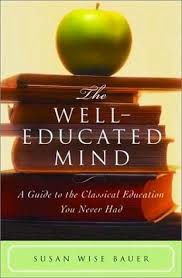
Ruth of A Great Book Study has been making her way through the book, The Well-Educated Mind, a book that inspires and instructs readers on how to read and analyze novels, autobiographies, histories, plays and poetry.  At her invitation, I’ve decided to join her as she begins the biography section.

(the above image is used courtesy of Thomas Baker, Thomas Baker Oil Painting)

The biography section contains twenty-six autobiographies, listed in chronological order:

  1.  Augustine – The Confessions

  2.  Margery Kempe – The Book of Margery Kempe

  3.  Michel De Montaigne – Essays

  4.  Teresa of Àvila – The Life of Saint Teresa of Àvila by Herself 

  5.  René Descartes – Meditations

  6.  John Bunyan – Grace Abounding to the Chief of Sinners

  7.  Mary Rowlandson – The Narrative of the Captivity and
                                              Restoration

  8.  Jean-Jacques Rousseau – Confessions

  9.  Benjamin Franklin – The Autobiography of Benjamin Franklin

10.  Henry David Thoreau – Walden

11.  Harriet Jacobs – Incidents in the Life of a Slave Girl, Written 
                                    By Herself

12.  Frederick Douglass – Life and times of Frederick Douglass

13.  Booker T. Washington – Up from Slavery

14.  Friedrich Nietzsche – Ecce Homo

15.  Adolf Hitler – Mein Kampf

16.  Mohandas Gandhi – An Autobiography: The Story of My 
                                Experiments with Truth

17. Gertrude Stein – The Autobiography of Alice B. Toklas

18.  Thomas Merton – The Seven Storey Mountain

19.  C.S. Lewis – Surprised by Joy: The Shape of My Early Life

20.  Malcolm X – The Autobiography of Malcolm X

21.  May Sarton – Journal of a Solitude

22.  Aleksandr I. Solzhenitsyn – The Gulag Archipelago

23.  Charles W. Colson – Born Again

24.  Richard Rodriguez – Hunger of Memory: The Education of 
                                       Richard Rodriguez

25.  Jill Ker Conway – The Road from Coorain

26.  Elie Wiesel – All Rivers Run to the Sea: Memoirs


From the list I’ve already read, The Seven Storey Mountain, thanks to my Classics Club Spin, Augustine’s Confessions, and from my C.S. Lewis Project, I will have read Surprised by Joy, when we get to it.  As for what I’m looking forward to, probably Montaigne’s Essays, the Gulag Archipelago and Mein Kampf top the list, yet I must admit autobiographies are not a genre with which I’m widely familiar, so I’m a little hesitant as well.  Gertrude Stein and Malcolm X are perhaps the biographies I feel the most “meh” about, but with this list and my lack of exposure, I fully expect I will be pleasantly surprised with at least two books that I am less than enthusiastic about reading.  We’ll see when we complete the list.

Ruth has listed some questions on A Great Book Study that will help us as we read, and I am going to post them here for easy access:

During the first stage of reading (find out what happened):
What are the central events in the writer’s life?

What historical events coincide-or merge-with these personal events?

Who is the most important person (or people) in the writer’s life?

What events form the outline of the story?

In the second stage of reading:
What is the theme that ties the narrative together?

What is the life’s turning point?  Is there a conversation?

For what does the writer apologize?  In apologizing, how does the writer justify?

What is the model-the ideal-for this person’s life?

What is the end of the life: the place where the writer has arrived, found closure, discovered rest?

Now revisit your first question: What is the theme of this writer’s life?

In the final stage of reading:
Is the writer writing for himself, or for a group?

What are the three moments, or time frames, of the autobiography?

Where does the writer’s judgment lie?

Do you reach a different conclusion from the writer about the pattern of his life?

Do you agree with what the writer has done?

What have you brought away from this story?

I was a little surprised at the last question in the second stage of reading: “What is the theme of the writer’s life.”  I’ve always been familiar with books having themes, but not lives.  Has anyone ever asked themselves, “What is the theme of my life?”  A fascinating question.  I wonder if we viewed our lives as having themes, would we choose to live them differently or live them “better”?  I wonder ……

In any case, I’m excited to start this project and I anticipate it will inspire me on to deeper and more thoughtful reading.  Please join us for the project, or even a book or two, if you feel so inclined.  We begin June 1st.