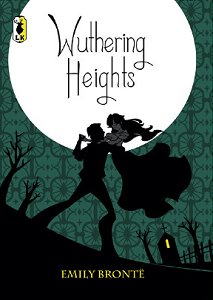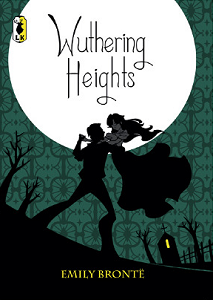
Wuthering Heights by Emily Brontë

“1801 – I have just returned from a visit to my landlord – the solitary neighbour that I shall be troubled with.”

Read-along posts:  Chapters 1-9 / Chapters 10-17 / Chapters 18-26 / Chapters 27-34

I didn’t expect to love this book.  I had been avoiding it for years with just a vague feeling that it wouldn’t live up to expectations.  Then Maggie came along with her January Read-Along and I knew it was the impetus I needed to read it.  Honestly, I am glad I did read it but it turned out pretty much as I expected.  It’s certainly not a terrible book, far from it …… it has high drama, passion, tension, shock and best of all, it is very well-written.  Yet on the other hand, it is romanticized and highly sentimental with dialogue such as:

“Oh!” he sobbed, “I cannot bear it!  Catherine, Catherine, I’m a traitor, too and I dare not tell you!  But leave me and I shall be killed!  Dear Catherine, my life is in your hands; and you have said you loved me — and if you did, it wouldn’t harm you.  You’ll not go, then?  kind, sweet, good Catherine!  And perhaps you will consent —- and he’ll let me die with you!”


Family Tree
(source Wikipedia)

The plot is highly suspect with coincidence after coincidence, happenings such as Nelly giving in to Catherine or Heathcliff’s whims, time after time, when there is really no reason to, and in spite of the fact she is often worried about losing her position if she does.  Yet I think its worst defect is the insufficient human depth in many of the characters, as they often acted as if they were automatons with emotional buttons that get pushed whenever the authoress needed that particular emotion to drive the plot along.  Catherine swings wildly from willfulness to thoughtfulness, from vicious teasing, to caring empathy, traits that do not meld together to form a believable character.  Many of the characters suffer the same fate.

Emily Brontë was one of the three Brontë sisters who wrote under the pseudonyms Currer, Ellis and Acton Bell.  Wuthering Heights was her only novel, published a year before her death of tuberculosis at the age of thirty.  She would never learn of its success.


Emily Brontë
by Bramwell Brontë
source Wikipedia

While Wuthering Heights is certainly compelling and captures the reader’s attention, it does so by using devices such as twisted emotion, shocking circumstances and profoundly dramatized situations, techniques not worthy of a well-composed classic.  The writing is excellent yet the content reflects an immaturity in construction, perhaps the innocence of a sheltered young girl relating what is imagined about life without actually having the experience of living it.  Relatively juvenile plot devices were employed with perhaps a charming innocence.  Heated emotions do not necessarily mean an increase in love; and claims of sentiment which lack corresponding action are meaningless.  Is it an exciting read?  Absolutely!  Do you want to know what happens next?  Of course.  But to compare this novel to Jane Eyre is like comparing a diamond to crudely cut glass.  They are not in the same sphere.

 

The climb to Top Withens, thought
to have inspired the Earnshaw home
in Wuthering Heights
(source Wikipedia)

Now before I am too hard on poor Emily, I think her sister had brilliant insight into her sibling and the novel’s birth.

“I am bound to avow that she had scarcely more practical knowledge of the peasantry amongst whom she lived, than a nun has of the country people who sometimes pass her convent gates.  My sister’s disposition  was not naturally gregarious; circumstances favoured and fostered her tendency to seclusion; except to go to church or take a walk on the hills, she rarely crossed the threshold of home.  Though her feeling for the people round was benevolent, intercourse with them she never sought; nor, with very few exceptions, ever experienced.  And yet she knew them; knew their ways, their language, their family histories; she could hear of them with interest and talk of them with detail, minute, graphic, and accurate; but with them she barely exchanged a word.  Hence it ensued that what her mind had gathered of the real concerning them, was too exclusively confined to those tragic and terrible traits of which, in listening to the secret annals of every rude vicinage, the memory is sometimes compelled to receive the impress.  Her imagination, which was a spirit more sombre than sunny, more powerful than sportive, found in such traits material whence it wrought creations like Heathcliff, like Earnshaw, like Catherine.  Having formed these beings, she did not know what she had done.  If the auditor of her work, when read in manuscript, shuddered under the grinding influence of natures so relentless and implacable, of spirits so lost and fallen; if it was complained that the mere hearing of certain vivid and fearful scenes banished sheep by night, and disturbed mental peace by day, Ellis Bell (Emily Brontë) would wonder what was meant, and suspect the complainant of affectation.  Had she but lived, her mind would of itself have grown like a strong tree; loftier, straighter, wider-spreading, and its matured fruit would have attained a mellower ripeness and sunnier bloom; but on that mind time and experience along could work: to the influence of other intellects, it was not amenable.”

Charlotte Brontë says it so well.  Wuthering Heights is a well-written novel, but the components are but mere twigs and undeveloped buds, showing promise of growth, but not yet ready to burst into the splendour of full form.  And sadly, they never would.


Wuthering Heights Read-Along Week #4

Read-Along hosted by Maggie at An American in France

Chapters 27 – 34 (end)

Such a few chapters but chock full of drama, intensity and characters acting with wild impracticality.  It is now certain that Edgar Linton will die, the question is only when.  Catherine, accompanied by Ellen/Nelly, meets Linton Heathcliff.  When his father appears, Linton combines temper tantrums and manipulative coersion by appealing to his sickly state, to convince her to return with him to Wuthering Heights.  Upon their arrival, Heathcliff imprisons Catherine and Nelly, physically abusing Catherine when she crosses him.  Curiously, although Nelly is liberated after five days, through various coincidences her applications of assistance for Catherine do not work and Catherine must escape herself to reach her father’s bedside minutes before his death.  Yet the brief freedom means nothing, as Heathcliff eventually forces her to marry Linton, so his heir gets both Wuthering Heights and the Grange, avenging himself finally on both the Earnshaws and Lintons.  Linton is a smaller, yet weaker copy of his father and while he does not perpetrate violence upon Catherine because he is hampered by his health, he relates the cruel treatment he would subject her to if he was able.  Soon afer, Linton succumbs to his weak health.  Time passes and Catherine, who has throughout the whole novel despised, taunted and depricated Hareton, decides to be nice to him.  He returns her advances and they “fall in love”, much to the annoyance of Heathcliff who has other problems churning his mind.  It appears Cathy is haunting him; he feels her presence along with a feeling of elation and, for once is distracted from his machinations, neither eating nor sleeping until he dies and is buried, according to his wishes, near Cathy and Edgar Linton.  Hareton and Catherine marry and, at the end of the book, decide to live at Thrushcross Grange.

Yorkshire Dales
photo courtesy of Greg Neate
source Flickr

It was a real struggle to finish this novel.  Thus far, it had been reasonably interesting, if not well-constructed, but for the last quarter of the read, the wild flights of improbable drama often made me want to close the book and go on to something else.  I could not find one redeeming feature in Heathcliff, his nature entirely vicious, base and twisted.  His love for Cathy was more an obsession, his desires at times blinding him to both her health and well-being, his actions done with complete disregard for future consequences.  Yet overall, I am glad that I read this novel.  Emily Brontë writes well and there are hints that if she had lived, her writing would have matured, honed by practice and life’s experiences.

Read-along posts:  Chapters 1-9 / Chapters 10-17 / Chapters 18-26 / Chapters 27-34 / FINAL REVIEW


Many thanks to Maggie who hosted this wonderful challenge!

Wuthering Heights Read-Along Week #3

Read-Along hosted by Maggie at An American in France

Chapters 18 – 26

Twelve years pass, for housekeeper Ellen (Nelly), a delightful time as, with Cathy’s death, the passionate drama has disappeared and she is only left to look after Catherine, the daughter of Edgar Linton and Cathy.  Within the realm of Thrushcross Grange, Catherine grows up very sheltered and protected.  In spite of being a caring and gregarious child, she exhibits her mother’s reckless willfulness and waits until her father’s has left to visit his dying sister, Isabella before sneaking away from home.  Inadvertently, she finds herself at Wuthering Heights where she meets Hareton, her cousin, the son of Cathy’s brother Hindley.  Shocked at this display of headstrong behaviour, Ellen drags Catherine home, yet imbedded in Catherine’s head is the idea of returning to meet the uncle whom she has never met.  Edgar returns home after Isabella’s funeral, bringing her boy, Linton, whom Catherine pets and cosets, yet Heathcliff will not allow him to remain and, reluctantly Edgar instructs Ellen to deliver the sickly boy to Wuthering Heights.  Years later Catherine and Ellen encounter Heathcliff on a walk and he encourages them to visit.  Catherine and young Linton get along well, in spite of his peevish nature, yet it is apparent that Heathcliff’s desire is for them to marry so his heir will become heir to Thrushcross Grange.   There is foreshadowing as to the deaths of both Edgar Linton and his nephew Linton.

Yorkshire Autumn
Photo courtesy of Tejvan Pettinger
(source Flickr) Creative Commons License

Did this novel get darker during these chapters or does the black, wicked oppressiveness of Heathcliff’s corruption cast a shroud over the whole novel, leaving nothing but negative obscurity?  Will Catherine and Linton marry or will he even survive that long?  We pretty much know what will physically happen to her after her father’s death, but how will her new circumstances affect her character?  Yet the question that is screaming at me is:  Is there any hope in this novel?  Everyone, from the first character to the last, all seem pawns in Heathcliff’s lust for vengeance and what is most annoying is that everyone conveniently seems to play into his hands.  He drains the life from anyone he comes into contact with, yet with receiving life, only seems to move further from it.  I can’t imagine how this is going to end ……. well, I can imagine it, but I don’t want to think about it.

Read-along posts:  Chapters 1-9 / Chapters 10-17 / Chapters 18-26 / Chapters 27-34 / FINAL REVIEW


Paradise Lost Read-Along Books III and IV

Paradise Lost by John Milton – Books III & IV

Paradise Lost Read-Along Hosted by Carolyn at Rosemary and Reading Glasses

Book III

God gazes down on Adam and Eve from the Heaven, the Son at his right hand.  While demonstrating foreknowledge of their fall, he provides a defence that, for their behaviour, the blame cannot be shouldered by him; he created them as free souls and will not change the eternal:

“I formed them free, and free they must remain
Till they enthrall themselves; I else must change
Their nature, and revoke the high decree
Unchangeable, eternal, which ordained
Their freedom; they themselves ordained their fall.”

Paradise Lost
by Gustave Doré

There are a number of theological themes that could be explored here, one the concept of God in time, which Boethius in his Consolation of Philosophy explains and Anslem in his work Cur Deus Homo, delves into the Satisfaction Theory.  Both are interesting, but since I am neither a theologian, nor equipped to deal with these ideas in an intelligible manner, I’ll leave it for braver souls to investigate. 🙂

While one of aspect of free will, is freedom to choose ill as well as good, I, personally, would rather be free to make bad choices than forced or coerced to make good ones.  But the main emphasis in these passages is clearly grace and mercy:

“By the other first:  Man, therefore, shall find grace,
The other, none; in mercy and justice both,
Through Heaven and Earth, so shall my glory excel,
But mercy, first and last, shall shine brightest shine.”

While justice is necessary for teaching, God is more concerned with giving mercy to the “first parents”.

Yet a transgression will be made and atonement must follow.  God asks who will redeem man his crime, “The rigid satisfaction, death for death.  Say Heavenly Powers, where shall we find such love?”

And the Son answers, breathing “immortal love to mortal men”:

“Behold me, then:  me for him, life for life,
I offer; on me let thine anger fall;
Account me Man:  I for his sake will leave
Thy bosom, and this glory next to thee
Freely put off, and for him lastly die
Well pleased; on me let Death wreak all his rage.”

Meanwhile, Satan prepares to descend to earth.  He first makes himself of comely appearance and then approaches the Angel Uriel, one of the seven angels nearest to God’s throne.  Presenting himself as a good angel while weaving a web of gross lies, he explains how he desires to visit earth to admire God’s creation and to praise the Universal Maker. Surprisingly Uriel believes him and sends him on his way to Paradise.

Book IV

Satan comes closer to Eden but despair and remorse trouble his thoughts:

“And like a devilish engine back recoils
Upon himself; horror and doubt distract
His troubled thoughts, and from the bottom stir 
The Hell within him, for within him Hell
He brings, and round about him, nor from Hell
One step, no more than from himself, can fly
By change of place.  Now conscience wakes despair
That slumbered, wakes the bitter memory
Of what he was, what is, and what must be
Worse; of worse deeds worse sufferings must ensue.”

“Till pride and worse ambition threw me down,
Warring in Heaven against Heaven’s matchless King —-
Ah wherefore?  he deserved no such return
From me, whom he created what I was
In that bright eminence, and with his good
Upbraided none, nor was his service hard.
What could be less than to afford him praise,
The easiest recompense, and pay him thanks,
How due!  Yet all his good proved ill in me,
And wrought but malice …….”

Even though his existence in Heaven was easy, in his dark, rebellious, ambitious spirit there is no room for love or “praise” for his Creator.

“Be then his love accursed, since, love or hate,
To me alike it deals eternal woe.
Nay, cursed be thou, since aginst his thy will
Chose freely what it now so justly rues.
Me miserable!  which way shall I fly
Infinite wrath and infinite despair?
Which way I fly is Hell; myself am Hell;
And, in the lowest deep, a lower deep
Still threatening to devour me opens wide,
To which the Hell I suffer seems a Heaven.”

His self-hatred is like a blow and it is hard to catch your breath.  Hell is torment and Satan is a very tortured angel, filled with such conflicting emotions that you can almost hear a visceral tearing inside of him.

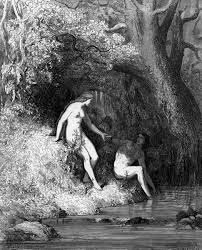
Leaping into the garden, he alights on the Tree of Life.  How effective; what creepy, nefarious images that fill the mind.  And another paradox:  Death and Life.  We get an amazing verbal painting of the garden of Eden, its lushness, richness and beauty alive to the senses ……. close your eyes and you are there.  Satan himself views the garden “with new wonder”.

Adam and Eve in the Garden
by Gustave Doré

Knowing Milton’s religious background, I did not take offense at his description of Eve’s “submission”, “subjection” and yielding to Adam.  The whole poem is saturated with hierarchy.  God, the Creator, over all; angels in submission to God;  Adam created by and subject to God; the fallen angels subject to Satan …… it is understandable and perhaps practical that Eve is in submission to Adam.  But it is not a negative submission when you read how Adam addresses her:

“Sole partner and sole part of all these joys,
Dearer thyself than all ……”

“To prune these growing plants, and tend these flowers;
Which, were it toilsome, yet with thee were sweet.”

However, while the lovers discuss Eve’s creation and God’s prohibition on them from eating from the Tree of Knowledge, Uriel has discovered Satan’s false disguise and flies down on a sunbeam to warn Gabriel, who is guarding the gate.  They send out guardian angels on patrol.  While Satan slingshots from remorse, despair, anger, and envy, his evil nature ever acts king and, he is found “squatting like a toad” by Adam and Eve as they sleep, whispering foul dreams into her ear.  When he is brought before Gabriel, he attempts deception to wiggle out of his predicament and another war between God’s angels and the fallen angels nearly ignites but, at a sign from God, Satan flees.

Thoughts:

While I enjoyed these books somewhat less than the previous ones, Milton’s cadence and rhythm are still mesmerizing.  Satan’s character becomes even more intricate and fascinating. To get out of the realms of Hell and to find the Garden, Satan is guilty of fraud and treachery, interestingly the worst sins that are represented in Dante’s Inferno.  His internal conversations with himself remind me exactly of Gollum in The Lord of the Rings, although his duplicity and malice are even more dreadful to hear.  I loved the visions of Adam and Eve and their relationship towards each other …….. harmony is the word that comes to mind, in perfect synchronicity with the Garden.  The Son’s gentle sacrifice for these first humans is very moving.

Eugene Onegin Read-Along – Chapters 3 and 4

Chapters 3 & 4

Chapter 3

Lensky takes Onegin to meet his beloved Olga, and Onegin voices his preference for Tatyana, complaining of Olga’s dullness.  The neighbourhood gossip, combined with Tatyana’s dreamy idealistic yearning, provides a spark to ignite her infatuation with Onegin.

“Tatyana listened with vexation 
To all this gossip; but it’s true
That with a secret exultation,
Despite herself she wondered too;
And in her heart the thought was planted …..
Until at last her fate was granted:
She fell in love.  For thus indeed 
Does spring awake the buried seed.
Long since her keen imagination,
With tenderness and pain imbued,
Had hungereed for the fatal food;
Long since her heart’s sweet agitation
Had choked her maiden breast too much:
Her soul awaited ….. someone’s touch.”

Retreating to reading books filled with dramatic love, Tatyana pines away for her unaware lover until, in the throes of passionate frustration, the innocent young girl decides to write a letter.  The narrator digresses briefly to comment on how the flexibility of Russian in writing has been lost with the trend of communicating in French.  How does this relate to the story?  Well, let’s wait and see.  Tatyana paints her letter with great emotions coursing through her, begging Onegin to relieve her romantic sufferings with an indication of his feelings.  When he arrives at the Larin estate, she attempts to hide in the garden but Onegin waits for her.  There is a confrontation BUT …… bless Pushkin, as he chooses at this point to play with the reader, stating he is too tired to go on and will tell us what happened later.  Cheeky guy!

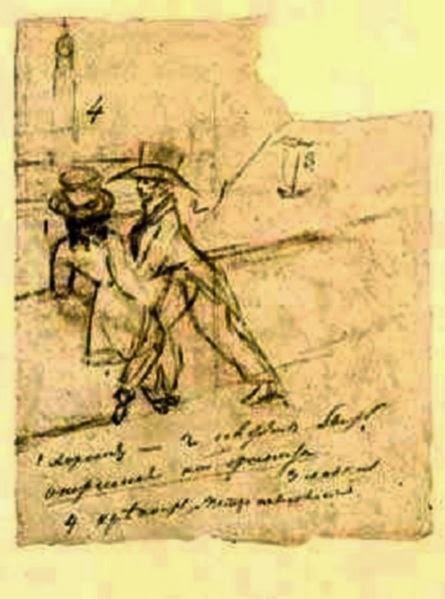
A Sketch by Pushkin of himself and Eugene Onegin
lounging in St. Petersburg
(source Wikipedia)

Chapter 4

Onegin is very candid with his feelings, telling Tatyana that even if he loved her now, he would make her quite miserable later and bring her great grief.  He shows a surprising understanding of both their natures.  In spite of his cynicism, he has great depth of human understanding.  The neighbourhood is unhappy with his treatment of her and then Pushkin leaps off into a rollicking discursion on friends who abuse us and how one should trust oneself, the truest companion.  Tatyana descends deeper into apathy upon her disappointment.  We further learn how ga-ga Lensky is over Olga and the narrator sets up a mock debate with himself over poetic forms which mirror the arguements between the archaists and the modernists of his time (at least I think that’s what he’s doing).  Tatyana’s name day party approaches and Onegin is invited.  Curiously, he agrees to go.  Oh, what mischief will he get up to?  Why does he agree to further expose himself to Tatyana after his refusal of her love?  Does he care so little about her feelings?  Does he dare the neighbours’ disapproval?  Or is there another reason?

In these sections, I was struck by Onegin’s almost tender treatment of Tatyana.  His response was very gentlemanly and he appeared to have an honest regard for her feelings.  He exhibits similar consideration towards Lensky when he controls his cynicism and does not tarnish his innocent, romantic view of the world.

Something that also comes to mind is the comparison I have heard of between Onegin and Mr. Darcy from Pride and Prejudice.  What????  I still don’t see it ……. but I will keep an open mind …….

Wuthering Heights Read-Along Week #2

Read-Along hosted by Maggie at An American in France

Chapters 10 – 17

The tension builds, a number of occurrences adding to the heightened drama.  Heathcliff returns after three years, apparently richer although he will not reveal how his fortunes changed.  On the outside he appears more worldly and dapper, as though he can now stand among equals, yet we can glean from certain clues that his character may even be darker and more perverted than before.

Catherine has a break-down due to a conflict between her husband, Edgar and Heathcliff.  I had a hard time reconciling her stubborn willfullness to her fragile state of health and I really wasn’t sure what precipitated her collapse.  At one time she screams at both men that neither would listen to her and that nobody exhibited the proper concern for her, so perhaps it was simply spleen that she was not getting her own way.  In any case, her condition grows serious and the outcome is her death.  At times she appears to want it, to relish the thought, because of the effect it will have on other people.

Yorkshire View
Photo courtesy of Paul Stevenson (sourced Flickr)
Creative Commons License

Heathcliff himself is an enigma.  I had expected him to take a darker road, but thought that his descent would still be held in tension with his love and/or devotion to Catherine, however his behaviour belies an almost severing of his soul from humanity.  His seduction of Edgar’s sister, Isabella, is despicable, his intent only to torture and humiliate her, an act of deliberate vengeance upon Edgar.  His wild carousing with Hindley and dark prowling about, only serve to underline the depravity of his character.  His concern for Catherine’s health is evident, but he does not or refuses to exhibit any conception of how his actions influence her for good or ill.  I was actually quite perplexed by Brontë’s sketching of his character.

Where is this book going?  We have finished slightly more than half of it and Catherine is dead, so I have to question whether the main theme of the novel is enduring love, which you often hear people speak of when referring to Wuthering Heights.  To be honest, I’m finding Heathcliff quite repellent; I cannot find one glimpse of a redeeming feature or even something to draw from him that is a teachable moment.  Hmmm ……

Well, I shall keep reading …….

Eugene Onegin Read Along – Chapters 1 & 2

This is my second reading in two months of Eugene Onegin, this time for Marian’s Read Along at Tanglewood.  For the read-along, I am reading the James Falen translation (the first time I read the Charles Johnston translation) and I really wish I had read this one first.  It is more readable and clear, its simplicity charming for an initial introduction to Onegin.

First impressions of Onegin?


The shallowness of Onegin is even more apparent the second time round.  He enjoys his rounds of the parties and, of course, his pursuit of women:

“I have no leisure for retailing
The sum of all our hero’s parts,
But where his genius proved unfailing
The thing he’d learned above all arts,
What from his prime had been his pleasure,
His only torment, toil, and treasure,
What occupied, the livelong day,
His languid spirit’s fretful play
Was love itself, the art of ardour …….”

Sadly though, in spite of his incessant pursuit of pleasure, its golden sheen soon begins to tarnish and Onegin not only gets bored, but completely disgusted with his manner of living:

“We still, alas, cannot forestall it —-
This dreadful ailment’s heavy toll;
The spleen is what the English call it,
We call it simply Russian soul ……”

I really enjoyed the description of his friendship with Lensky.  They appear complete opposites yet they are drawn together.  Does Onegin see his younger self in Lensky?  He observes him with an almost teasingly sceptical eye, a patient condescension.

In spite of the flawed nature of Onegin’s character, Pushkin presents him in a playful manner and you can’t help but feel he would be an interesting companion.  However, even when he tires of his pleasure-seeking ways, he still cannot seem to find this soul, in spite of a cursory search through books, endeavouring to “make his thoughts the thoughts of others.”  Interestingly, Pushkin turns this perception on its head stating:  “He who has lived as a thinking being Within his soul must hold men small; …..,” as if Onegin thinks he is too great — his mind or stature — to be fully appreciated by ordinary men.

Alexandrinsky Theater, St. Petersburg
photo courtesy of Edmund Gall (sourced Flickr)
Creative Commons License

What do you make of the narrator’s commentary?


I’ve always found that the commentary sounds almost split.  It’s as if Puskin is speaking, yet also another, perhaps wiser, soul.  You sense a playful teasing tone at some times and a more mature introspection at others.  It’s something I’m trying to make note of and examine as I read.

Thoughts on the characters sketched out in Chapter 2?


I really enjoyed meeting Lensky in this translation.  His youthful joie-de-vivre and idealism really shine through.  Strangely, I think he made me like Onegin even more.  Perhaps it was due to Onegin’s restraint towards him.  He did not attempt to destroy Lensky’s untarnished view of life, which was certainly a possibility as it would have given Onegin something to do.

As for Tatyana, so far she appears to be a sheltered country girl, who lives in her books.  She has too much idle time on her hands and the time she spends staring out the window only seems to serve to increase her illusions.  I found it perhaps telling that, in my translation, it says that she never learned to show affection.  I wonder if this will be pertinent in an occurrence coming up in the poem??

Olga, Tatyana’s sister, seems quite one-dimensional but perhaps this is deliberately done, since the spotlight is not meant to shine upon her.

While I prefer the Falen translation over the Johnston translation, I bought it on my Kindle and the fact that it contains no stops between chapters is driving me nuts.  A small price to pay for increased enlightenment, I guess.  😉

Paradise Lost Read-Along – Books I and II

Paradise Lost by John Milton Books I & II

Lost, did someone say LOST?  Well, actually I’m not as lost as I thought I would be while reading this magnificent epic poem written by John Milton for my Paradise Lost Read-Along.

Wow, where do I begin?  I absolutely love this poem.  Why?  I love the compellingly beautiful and haunting imagery; how each word is not superfluous but enhances the story; the ideas that are both obvious and subtle; the development of the characters which Milton paints with a fine-pointed brush; the echoes of other great poets and great ages, Biblical images mixed with classical ones …….  I could go on and on.

To give a short summary for Books I & II, Milton calls upon his classical and spiritual Muse to introduce the poem, relating the disobedience of man, and then dives right into Satan’s fall from Heaven after a battle, the Consult in Pandemonium where Satan and his angels decide their next tactic and Satan’s journey to earth with the purpose of ascertaining whether they can exert their influence there to revenge themselves on God.

Interestingly, Milton creates a Satan that is both appealing and evil, a fascinating and unsavory character, so I’m going to concentrate my comments on his and his minions machinations!

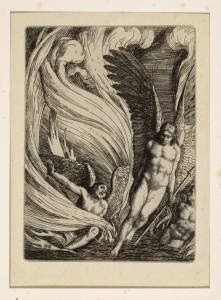
Satan rising from the Burning Lake (1896)
by William Strang
(sourced NYPL)

If we listen to the words of Satan and his angels describing their plight, they sound compelling, at times even justifiable, and perhaps one could even feel a sympathy for them.

“What though the field be lost?
All is not lost; the unconquerable will,
And study of revenge, immortal hate,
And courage never to sumit or yield:
And what else is not to be overcome?
That glory never shall his wrath or might
Extort from me…”  (105-111)

Yet there is a delusional quality to their reasoning and, if we listen to the poet, we see that their hope is futile against the power of God.  Even Belial, the fallen angel, seems to confirm this premise.

“They dreaded worse than Hell, so much the fear
Of thunder and the sword of Michael
Wrought still within them, and no less desire
To found this nether empire …”   (293-296)

And:

“What if the breath that kindled those grim fires,
Awaked, should blow them into sevenfold rage,
And plunge us in the flames ……”  (Belial: 170-172)

The poet also gives us consistent glimpses of Satan’s true persona and the fallen angels’ perception of their fate:

By falsities and lies, the greatest part
Of mankind they corrupted to forsake
God their Creator, and the invisible
Glory of him that made them to transform
Oft to the image of a brute, adorned
With gay religions full of pomp and gold,
And devils to adore for deities …..” (367-373)

And:

“……. All our glory extinct, and happy state 
Here swallowed up in endless misery …”  (141-142)

Though they admit they have lost happiness and prestige, the hatred they harbour towards God is like a putrefying emination, and their diabolical desire for vengeance is at once powerful and terrifying.  There is a sense of a lack of humanity, a disconnect to any emotion other than overwhelming enmity towards the Creator.  Satan even exhibits a curious impersonal indifference to man, seeing him only as a vehicle to play out his revenge.  In spite of evidence to the contrary, Satan and his followers are certain of victory, and plan to work relentlessly towards that goal.

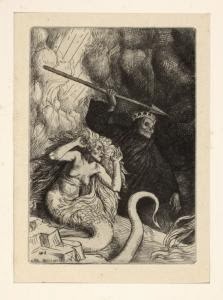
Sin and Death at the Gates of Hell (1896)
by William Strang
(sourced NYPL)

Milton does not make Satan an horrific, evil monstrosity; his Satan is articulate, calculating and, in the eyes of the other fallen angels, has admirable artifice.  While the Satan of Dante (The Divine Comedy) is gruesome, hideous and quite terrifying, our Satan in this poem has a more pleasing guise.  And so he should have.  Dante’s Satan was in Hell, evil personified, there to enlighten inmates as to the horrors of their fate.  On the other hand, it is important for Milton’s Satan to be appealing.  He travels to earth with the design to tempt men; his deviousness and evil require cloaking in order for him to succeed in his mission.  But for us as readers, it pays to be diligent in recognizing the true qualities of Satan and the fallen angels.  They value power, might, ill, revenge, war, strength, vice, hatred, death, and they despise weakness, goodness and virtue.  In fact, they don’t simply despise good; they seek to pervert it, and far from wishing to do ill to a specific person or for a specific wrong, they desire “ever to do ill.”  The trick is to see behind the facade.  To trust anything presented or said by Satan and his angels would be unwise.

Book I and II were ripe with an incongruous tension between the grandeur of Satan, and his evil scheme of vengeance, paired with the futility of his actions.  I cannot wait to see what transpires in Books III and IV!

Wuthering Heights Read-Along Week #1

Wuthering Heights is one of the few Brönte novels that I have not read and, in spite of previously feeling somewhat ambivalent towards this book, I’m looking forward to it for this read-along hosted by Maggie at An American in France blog.

Chapters 1 – 9

Wuthering Heights begins in media res, with Mr. Lockwood visiting his landlord, Heathcliff at his home, Wuthering Heights.  While initially curious about Heathcliff’s strange means of living and intrigued by his caustic manner, his second visit arouses a much altered response.  Treated to disrespectful treatment by the servants, occupants and master alike, he is dismayed to find himself an overnight guest courtesy of a snowstorm.  While in his room that night, Lockwood has a horrifying dream that ends with a young girl named Catherine Linton (yet he has also seen her name scratched on the windowsill as Catherine Earnshaw and Catherine Heathcliff) grasping his hand through the window and begging to be let in.  His cry summons Heathcliff who, pale as death, agrees with Lockwood’s decision to leave early and as Lockwood leaves the room, Heathcliff calls out in despair to his “Cathy”.  Later Lockwood is told the story of the Earnshaw family: how Heathcliff was brought home by Master Earnshaw from the streets of Liverpool and brought up within the family, although both the wife and brother hated his presence, while Catherine, the daughter, eventually chose him for a constant companion.  We learn of Heathcliff’s dark, silent suffering that perhaps conceals more than we have yet seen, and of Catherine’s willful, selfish spirit, each negative quality of these characters, nurtured by the lonely, loveless environment in which they live, and the harsh or indifferent treatment they receive from the father, mother and especially Hindley, Catherine’s brother, who becomes their guardian after the parents’ deaths.  At the end of chapter 9, Catherine has agreed to marry Edgar Linton, a son of a respectable family, yet she vows a lifelong faithfulness to Heathcliff and a desire to enhance his life by her new respectable and influential position.  Given Heathcliff’s sullen pride, dark brooding tempers and possessive inclinations towards her, one wonders how she can justify her decision using such an untenable explanation.

YORKSHIRE
Photo courtesy of Steve Calcott (source Flickr)
Creative Commons License

What connects the reader to the two main characters of the novel?  So far neither have engaged my admiration but I think we can all feel a silent sympathy for their plight.  Their sheltered lives, amongst people who failed to nurture even a sentiment of human feeling in either character, evoke a tentative compassion, as their choices seem to have already been made for them, instead of being products of stable, empathetic temperments.  The tension at the end of the chapter is palpable, as a shocking car wreck that we cannot look away from, the foreshadowing of intensity of the coming situation evident.

And so we continue ………… can Catherine convince Heathcliff of the merits of her marriage?  Will she be happy?  Or will Heathcliff instead chose a destructive path that will affect more people than just himself?  ………  


Read-along posts:  Chapters 1-9 / Chapters 10-17 / Chapters 18-26 / Chapters 27-34 / FINAL REVIEW


A Paradise Lost Read-Along

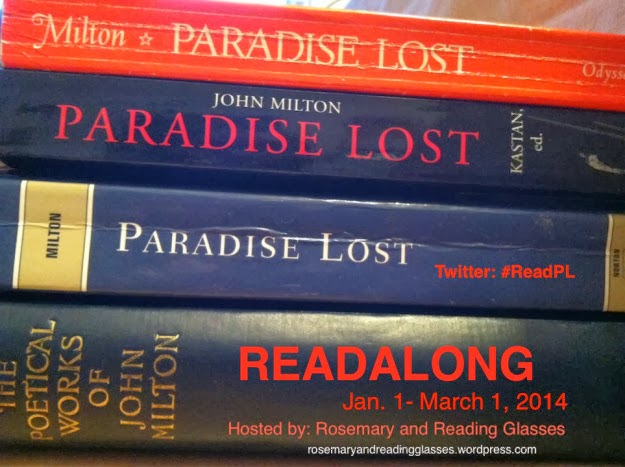
Carolyn at Rosemary and Reading Glasses is hosting a Paradise Lost Read-Along that will happen over the months of January and February.  Since I have always wanted to read this poem but have been too scared to read it by myself AND because I have had a great start to my reading for 2014, I’m in!

Here’s the scoop:

January 1st will mark this blog’s one-year birthday, and what better way to celebrate than with an epic (literally) readalong?  I’m hosting a Paradise Lost readalong from January 1 to March 1, and I hope you’ll come along to brighten up the winter doldrums.  I’ll be tweeting with the tag #ReadPL if you want to follow along.

January 1:  Introductory post

January 10:  Books I & II reaction

January 20:  Books III & IV reaction

January 30:  Books V & VI reaction

February 10:  Books VII & VIII reaction

February 20:  Books IX & X reaction

March 1:  Books XI & XII; Wrap-up

I’m so excited about this read-along that I’m not even feeling guilty in the least.  Please join us if you can fit it in!