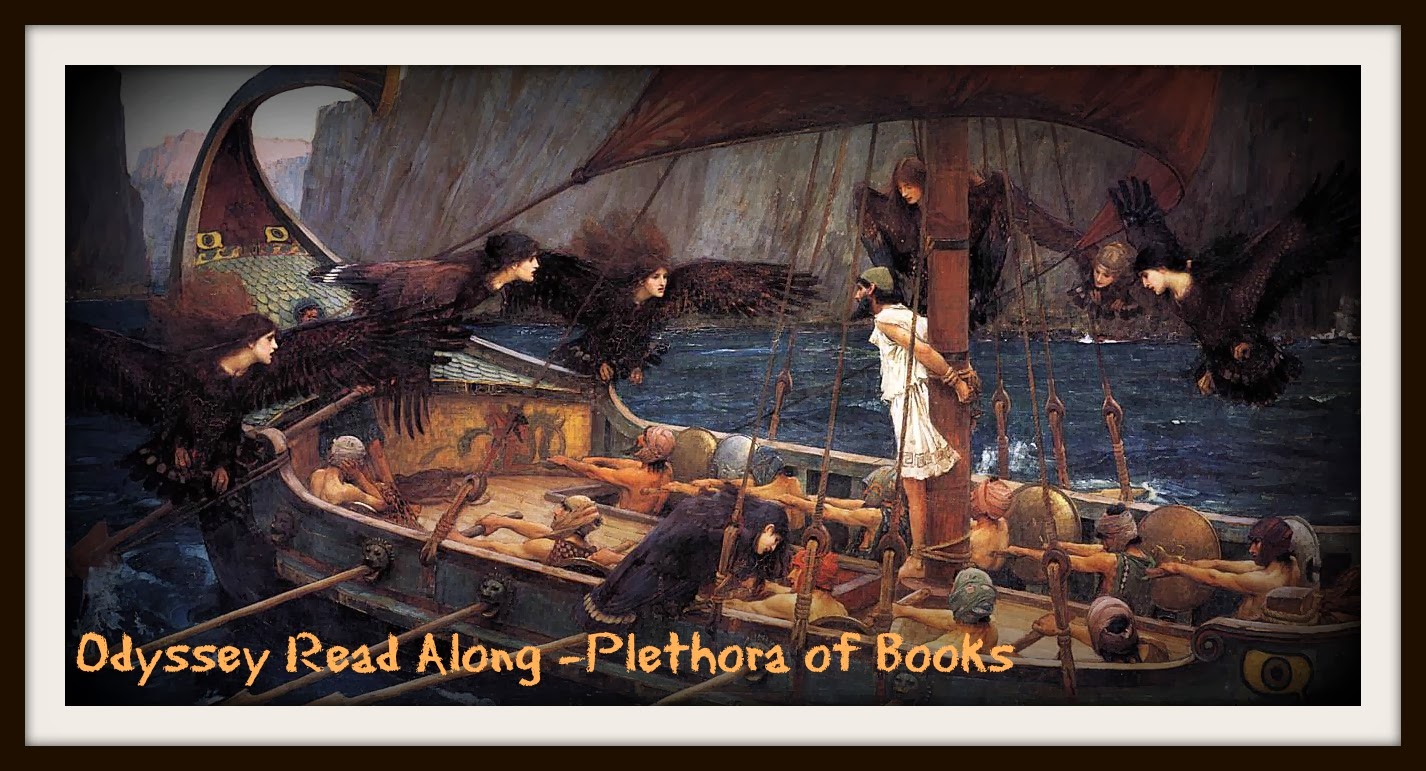
The Odyssey Read-Along Book V & VI

The Odyssey Read-Along @ Plethora of Books

Book V

Hermes Argeiphontes is sent to Kalypso’s island to inform the nymph that her hold on Odysseus is broken and that she must let him go.  Reluctantly, she agrees but only because she knows resisting the will of Zeus would be fruitless.  Yet when she tells Odysseus that he is a free man, he suspects her of subterfuge but she assures him of her sincerity.  She takes him to a grove of trees where he constructs a raft and loads it full of supplies before he departs.  Eighteen days out on his journey, he is spotted by Poseidon who, angered by the sight of him, causes a great storm to blow up and Odysseus is eventually forced to swim for land.  After swimming for nearly three days, he finally nears a coast, only to find the shoreline rimmed with jutting rock and jagged cliffs.  Poor Odysseus nearly drowns in the surf but, with some help from Athene, he finds a mouth of a river where he finally makes land.  Exhausted with his struggles, he decides to brave the wild animals and finds shelter in the forest to rest and sleep.

Fidelity

It appears that Odysseus initially stayed willingly with Kalypso, living with her as a husband.  Yet as time passed, her charms wore off until he was sorrowfully pining to return home to his wife and country.  In Greek culture, a man who had an affair with a foreigner or slave was not viewed as being unfaithful.

The Assistance of the Gods

Curiously, though the gods choose to help certain mortals, in most cases their assistance is deliberately limited.  They appear to offer just enough help to allow the person to use their ingenuity, strength and perseverance to get themselves out of a dire situation or to learn a specific lesson.

Observations

Odysseus has been shipwrecked by Poseidon twice; he has had two monologues; he has had two helpers; and he climbs back into his boat twice.  What does this mean?  I have no idea ….. 😉

Hermes Ordering Calypso to Release Odysseus
by Gerald de Lairesse (1670)
Wikimedia Commons

Book VI

As Odysseus sleeps on remote Phaiakia, Athene comes to Nausikaa, the daughter of king Alkinoös, in a dream, urging her to carry the washing in her father’s wagon down to the river to wash.   When she obeys the next day, Odysseus himself emerges from the bushes, naked but for a branch.  All her handmaidens scatter in terror, yet Nausikaa bravely questions him and finds he is a stranger to their country.  Employing his admirable tact and intelligence, Odysseus charms the girl.  She lends him some garments, waits while he washes and then instructs him to go to the palace of her parents, to grasp her mother’s knees in supplication and thus will he get assistance for his journey.  He prays to Athene that the reception of the Phaiakians will be favourable.

Feasting

There are numerous scenes of feasting throughout the poem.  If a stranger arrives, a feast is prepared, often before his name is learnt or his circumstances; if he stays, there is more feasting; there is feasting upon his departure; when the gods visit each other, they feast, such as the preparations made by Kalypso for Hermes when he arrived with his message.  In the case of mortals, the feasting is accompanied by sacrifices to the gods.

Hospitality

I am beginning to wonder if the hospitality and reverence offered to guests are not necessarily out of the goodness of the heart of the host.  Whenever a stranger appears, they are never completely certain if they are entertaining a mortal or a god.  It seems like good sense to treat everyone like a god and therefore be certain that they haven’t offended one and that no dreadful punishment will follow for lack of generosity.

The Meeting of Odysseus and Nausicaa
by Jacob Jordaens
Wikimedia Commons
(How Nausicaa and her handmaidens were able to get
ahold of 19th century clothing is a mystery!)

The Odyssey Read-Along Book III & IV

The Odyssey Read-Along @ Plethora of Books

Book III

Telemachos and Athene arrive at Pylos, the home of Nestor.  After Telemachos asks Nestor for news of his father, Nestor describes their homecoming; how a quarrel between Agamemnon and Menelaos sprang up and how half of the forces left with Menelaos, including Nestor and Odysseus.  However, another quarrel began and Odysseus turned back, while Nestor continued on the windswept ocean and, with many prayers and sacrifices, made it home safely without knowing what happened to the other Achaians.  As Athene showed favour towards Odysseus in Troy, so Nestor hopes she will show favour towards his son by helping him rid his house of the unwanted suitors.  When Telemachos states that even the gods couldn’t help him with that problem, he is scolded by Athene whereupon he reveals that he believes his father dead.  Nestor then relates the stories he has learned later of the homecoming of the Achaians who had been with him: Agamemnon was killed by Aigisthos, the lover of his wife, Klytaimestra, upon reaching home, yet 8 years later Aigisthos was killed by Orestes, the son of Agamemnon; Menelaos was blown to Egypt by the gods and there lived many years before recently returning to his kingdom.  Nestor counsels Telemachos to find Menelaos who will speak the truth to him. Offering horses and his sons as guides on the morrow, he gives Telemachos a bed in the palace in which to sleep.  When dawn arrives, another sacrifice is made to the gods and Telemachos departs by chariot for Lakedaimon, the home of Menelaos.
A King and His Kingdom
While the Kings of Greece appear to be well-respected by their people, in Ithaka there is a lack of loyalty and devotion.  Respect comes with a price, and if a king is no longer able to benefit his subjects, they often will look somewhere else for either leadership, or conversely, seek power themselves.

Piety

During the short time Telemachos and Athene spend on Pylos, Nestor has two sacrificial feasts to the gods.  The detailed explanation of these offerings shows Nestor’s piety and generosity.  His devoted worship of the gods is perhaps one of the reasons he was able to return home from Troy with very few delays, unlike the rest of the Achaians.

Telemachus departing from Nestor
by Henry Howard
source Wikipedia

Book IV

Telemachos and Athene arrive at the house of Menelaos in Lakedaimon. The couple show hospitality to their guests, bringing them into the palace to feast.  Menelaos tells of their 8 year delay in Egypt before returning home and laments the death of his brother, Agamemnon, at the hands of his wife’s lover.  When he begins to reminisce about the Trojan War, he brings everyone to tears.  Helen relates how Odysseus came to her from out of the Trojan horse, extracting a promise of silence about their presence, yet Menelaos contradicts her, accusing her of trying to lure the Achaians out of the horse and to their deaths.  The next morning Telemachos shares his troubles with Menelaos, whereupon Menelaos tells him the story of the Old Man of the Sea, Proteus, who revealed the death of two of the Achaians, Aias and Agamemnon, but acknowledged that Odysseus was alive, though a captive of Kalypso (which means “I cover” or “I conceal” in ancient Greek) on her island.  Meanwhile, on Ithaka, the suitors discover that Telemachos has sailed and are stupefied at his daring.  Antinoös recovers and plots to take a ship to set an ambush upon Telemachos’ return, to take his life.  Penelope learns of the journey of Telemachos and of the suitors plans, and while initially distraught, she has a dream that all will be well because Athene is with him.  When she asks if Odysseus still lives, she is told: “I will not tell you the whole story whether he still lives and looks upon the sun’s shining, or whether he has died and is in the house of Hades.”

Fame and Glory

Menelaos states that he would gladly be happy with one-third of the riches he returned with, if only it would bring back the fallen heroes of the war. Spoils and riches are equated with glory in this culture and it is interesting that he would not give up everything for his fallen comrades.  Fame and glory can often be more important than life itself.

Trust and Betrayal

The interaction between Menelaos and Helen seems at once, comfortable and strained.  Each tell a conflicting story about Helen’s actions during the end of the war, and it is apparent that her husband does not believe her rendition.  After 10 years, they have learned to live together but trust is certainly lacking.  Is Helen telling the truth?   After such a long time, Helen’s character is still elusive.

A King and His Kingdom

Penelope, half pleading with, half scolding the suitors says:

“…….. Nor have you listened to what you heard from your fathers before you, when you were children, what kind of man Odysseus was among your own parents, how he did not act and spoke no word in his own country that was unfair …..”

Odysseus has been gone so long that the suitors have never known him personally, and this is partly from where their disrespectful attitudes stem. Their king is like a myth or dream, and there is nothing to tie their allegiance to him, except stories passed down from their elders.

Piety

Menelaos, when recounting his adventures in Egypt, reveals that the reason for his long detour was that he had neglected to render complete hecatombs (offerings) to the gods, angering them.  This is in contrast to Nestor, who made the proper sacrifices and arrives home quickly and safely.

Telemachus in the Palace of Menelaos
1886
source Wikimedia Commons

Paradise Lost Read-Along Book IX & X

Paradise Lost Read-Along

Book IX

The poet changes images from scenes of harmony to “tragic, foul distrust, and breach disloyal on the part of man, revolt and disobedience ……” and makes a reference to a “celestial patroness” who visits him at night to inspire him to verse, as he is perhaps too old to have the words come to him without divine help.

Meanwhile Satan rises with the mist in the Garden and finds the perfect creature to inhabit for his deception;  the snake, who is crafty and can easily move around without arousing suspicion.  Again he railing his discontent and spewing evil:

“………. and the more I see
Pleasures about me, so much more I feel
Torment within me, as from the hateful siege
Of contraries; all good to me becomes
Bane, and in Heaven much worse would be my state.” (119 – 123)

“For only in destroying do I find ease
To my relentless thoughts……..” (129 – 130)

Still he wishes to best God in any way possible, boasting that he will tarnish creation in less time than it took the Almighty to create it:

“In woe then, that destruction wide may range:
To me shall be the glory sole among
The Infernal Powers, in one day to have marred
What he, Almighty styled, six nights and days
Continued making, and who knows how long 
Before had been contriving? …….”  (134 – 139)

Then “in at his mouth The Devil entered” the serpent and waited until morning.

Adam and Eve wake, but when it is time to perform their duties in the garden, curiously Eve suggests that they part and each work separately, thus accomplishing more work.

“For, while so near each other thus all day
Our task we choose, what wonder if so near
Looks intervene and smiles, or object new
Casual discourse draw on, which intermits
Our day’s work, brought to little, though begun
Early, and the hour of supper comes unearned.” (220 – 225)

Adam cautions his spouse that they have been warned that there is evil lurking in the Garden and they would be safer if they remained united, but Eve relates her hurt at his mistrust of her judgement.  Yet still Adam persists:

“But God left free the Will; for what obeys,
Reason is free, and Reason he made right,
But bid her well beware, and still erect,
Lest, by some fair appearing good surprised,
She dictate false, and misinform the Will
To do what God expressly hath forbid.
Not then mistrust, but tender love, enjoins
That I should mind thee oft; and mind thou me.” (351 – 358)

Stubbornly resistant, Eve states that she is going alone with his permission and warning, confident that a proud foe would not seek the weaker victim, and “thus saying, from her husband’s hand her hand soft she withdrew …..”

Satan in the guise of the Serpent, finds Eve and is initially disarmed:

“Her graceful innocence, her every air
Of gesture or least action, overawed
His malice, and with rapine sweet bereaved
His fierceness of the fierce intent is brought.
That pace the Evil One abstracted stood
From his own evil, and for the time remained
Stupidly good, of enmity disarmed,
Of guile, of hate, of envy, of revenge.” (459 – 466)

But not for long:

“But the hot hell that always in him burns,
Though in mid Heaven, soon ended his delight,
And tortures him now more the more he sees
Of pleasure not for him ordained: then soon
Fierce hate he recollects, and all this thoughts
Of mischief, gratulating, thus excites: …….” (467 – 472)

Astounded at the Serpent’s ability of speech, Eve ponders what this could mean, but when Satan commends her beauty and appeals to her vanity, she readily accepts his story that he gained speech and wisdom by eating from the Forbidden Tree.  Immediately she sees herself gaining stature until she is above Adam.  Of course, she would not actually die, but simply die to being Human, while becoming a god herself.  And the Serpent ate of the tree and he still retains life.  And so:

“Forth-reaching to the fruit, she plucked, she eat;
Earth felt the wound, and Nature from her seat;
Sighing through all her works, gave signs of woe
That all was lost …………”  (781 – 784)

Immediately she wonders if she should share the knowledge/fruit with Adam or keep it all to herself.  But thinking that she may actually die for her transgression and jealous of the possibility of Adam marrying again, she chooses to take it to her partner so he will share her same fate, whatever that might be.

Adam, when she tells him of her actions, is horrified:

“………. Adam, soon as he heard
The fatal trespass done by Eve, amazed
Astonied, stood and blank, while horror chill
Ran through his veins, and all his joints relaxed.
From his slack hand the garland wreathed for Eve
Down dropped, and all the faded roses shed.”  (888 – 893)

What an effective image!  Adam had brought a wreath of flowers to Eve, expecting to crown his Queen and he is met by a creature “defaced, deflowered and now to death devote!”. Distraught, he contemplates the implications of obeying God’s command, but decides he cannot live without his partner.  With Eve’s coaxing, he eats of the fruit.  Immediately inflamed and drunk with lustful desire, they retire into the woods for sexual play and later sleep overcomes them.  Yet they wake:

“As from unrest, and, each the other viewing,
Soon found their eyes how opened, and their minds
How darkened; innocence, that as a veil
Had shadowed them from knowing ill, was gone;
Just confidence, and native righteousness,
And honour, from about them, naked left
To guilty shame ……” (1051 – 1057)

They have gained knowledge, but it is the knowledge of the good they have lost and the evil that they have gained.  Each blames the other for their transgression, bickering for hours on end as to who is culpable.
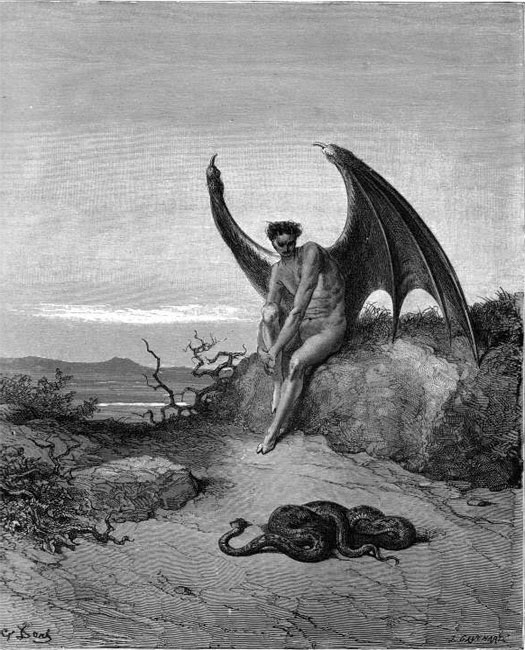
Satan finds snake to inhabit
by Gustave Doré (1866)

Book X

The Angels hear of Adam and Eve’s grievous sin, and are filled with sorrow and compassion.  Returning to Heaven, God holds them blameless:

“I told ye then he should prevail, and speed
On his bad errand —- Man should be seduced
And flattered out of all, believing lies
Against his Maker, no decree of mine
Concurring to necessitate his fall,
Or touch with lightest moment of impulse
His free will, to her own inclining left
In even scale………”  (40 – 47)

God visits Adam and Eve in the Garden, where they confess their sin and he asks Adam, “was she thy God, that her thou didst obey before his voice?”  He pronounces judgement on the pair, yet with judgement comes mercy as the Son:

” …… pitying how they stood 
Before him naked to the air, that now
Must suffer change, disdained not to begin
Thenceforth the form of servant to assume,
As when he washed his servants’ feet so now,
As father of his family, he clad
Their nakedness  ……….” (211 – 217)

Meanwhile, Sin and Death are at the gates of Hell and “found a path over this main from Hell to that new World where Satan now prevails ….”.  Meeting Satan on their way their congratulate him on his victory, and he tells them:

“All yours, right down to Paradise descend;
There dwell, and reign in bliss; thence on the Earth
Dominion exercise and in the air
Chiefly on Man, sole lord of all declared;
Him first make sure your thrall, and lastly kill ….” (398 – 403)

When Satan arrives in Pandemonium and relates his Triumph, he expects “their universal shout and high applause to fill his ear, when contrary, he hears, on all sides, from innumerable tongues a dismal universal hiss, the sound of public scorn ……”, then “His visage drawn he felt to sharp and spare, his arms clung to his ribs, his legs entwining each other, till supplanted, down he fell, a monstrous serpent on his belly prone …..”  His followers experience the same phenomenon and, “thus was the applause they meant turned to exploding hiss, triumph to shame…”  A tree grows in Hell similar to the Tree of Knowledge but when they try to eat the fruit, it turns to ash in their mouths.

Sin and Death begin to move through the world.  In Heaven, God instructs the angels to change the universe, causing cold and hot climates, producing winds, thunder and snow and various other effects that alter the paradisiacal conditions of the Earth.  Adam, hiding in the gloomy shade, laments his miseries and when Eve comes to comfort him he replies:

“Out of my sight, thou serpent; that name best
Befits thee with him leagued thyself as false 
And hateful: nothing wants, but that thy shape
Like his, and colour serpentine, may show
Thy inward fraud, to warn all creatures from thee.”  (866 – 871)

He berates her, laying all the blame for their condition at her feet but, instead of acting with like animosity, she responds with a wonderful contriteness, asking for his forgiveness and fully accepting blame.  She suggests that if Death does not find them, they should seek him out themselves.  Her humbleness and lack of pride have a surprising affect on Adam. Claiming God’s punishment just, he encourages her to accept their fate and go forward with hope.  Some of the punishments they have so far experienced (ie. childbirth) have brought forth joy as well as pain and that is a comfort.

“No more mentioned, then, of violence 
Against ourselves, and wilful barrenness,
That cuts us off from hope, and savours only
Rancour and pride, impatience and despite,
Reluctance against God and his just yoke
Laid on our necks……..”  (1041 – 1046)


“What better can we do than, to place 
Repairing where he judged us, prostrate fall
Before him reverent, and there confess
Humbly our faults, and pardon beg, with tears
Watering the ground, and with our sighs the air
Frequenting, sent from hearts contrite, in sign
Of sorrow unfeigned and humiliation meek?
Undoubtedly he will relent, and turn
From his displeasure, in whose look serene
When angry most he seemed and most severe
What else but favour, grace, and mercy shone?” (1086 – 1096)

Thoughts:

Wow!  There was so much information, action and images packed into these two books, particularly book IX.

At the beginning of book IX, Milton mentions his celestial patroness or Muse, telling of her impartations of inspired verse and that he is not skilled enough on his own to create such poetic display.  There are certain scholars who feel that Milton’s brilliance is not as apparent in the latter parts of the poem as the beginning (I am not noticing this, but, of course, I’m not a scholar), so I wondered if he is setting up this humble claim as a reason for a decrease in poetical ability……??

Again Satan’s torment is palpable and his personification of deception alarming.  Occasionally he still feels joy, peace, happiness and knows what they mean, yet with any positive emotion felt, his rage, self-loathing and malice return at even greater strength.

I had to wonder while I was reading this, whether Adam and Eve were familiar with deception.  They would have had no exposure to it, but God did mention that they were completely equipped to meet their deceiver.  I imagine, that while Adam and Eve had a certain sense of wonder and innocence, that they were not created as children.  They were created as full-grown beings with sense and reason.  It was their free-will that gave them the right to choose, and they made an horrendous mistake.

I had to shudder at the speech Satan gave his minions.  Once again, he is only concerned with power and prestige: “Thrones, Dominations, Princedoms, Virtues, Powers —“.  He gives the image of an army: “a broad way is now paved, to expedite your glorious march” and says that man’s disgrace is “worth their laughter”.  Chilling.

The most poignant lines of the poem:

“O much deceived, much failing, hapless Eve,
Of thy presumed return!  event perverse!
Thou never from that hour in Paradise
Found’st either sweet repast or sound repose;
Such ambush, hid among sweet flowers and shades,
Waited, with hellish rancour imminent,
To intercept thy way, or send thee back
Despoiled of innocence, of faith, of bliss.”  (404 – 411)

And whomever has read through this whole post, deserves some type of award!!! 🙂

Chronicles of Barsetshire Read-Along

Yes, another read-along, and this time hosted by Melissa at Avid Reader and Amanda of Fig and Thistle.  We will be reading through the Barsetshire Chronicles by Anthony Trollope.

The novels are scheduled as follows:

March:  The Warden
April:  Barchester Towers
May:  Doctor Thorne
June:  Framely Parsonage
July:  The Small House at Allington
August:  The Last Chronicle of Barset  

Now before everyone thinks that I’ve lost my mind, I had already planned to read all these novels beginning in May along with some friends in my Dead Writers Society group, so while I will participate in the read-along, I will be two months behind schedule.

If anyone else cares to join in the fun, please pop over to Avid Reader or Fig and Thistle to sign up!

The Odyssey Read-Along Book I & II

The Odyssey Read-Along @ Plethora of Books

And so we start our journey with Odysseus in his quest to find his way home after the long Trojan War, to be reunited with his wife and son, and to re-establish his reputation as the king of Ithaka.  Plethora of Books is kindly hosting this read-along and has done a wonderful introductory post overflowing with important background information to better understand and enjoy The Odyssey, so please check it out!

I’m going to be posting two books at a time, in spite of the four-books-a-week pace, because I have a strong feeling that my posts will get too long, trying to fit four books into one post.

Greek text of The Odyssey’s opening passage
source Wikipedia

Book I

Homer invokes his Muse to tell the story of “a man of many ways” who after the sack of Troy, spends much time fighting for his life and those of his companions to accomplish their homecoming.  Yet Homer quite handily and conveniently makes Odysseus a lone hero by relating the story of his companions’ fateful actions as they foolishly abuse the hospitality of Helios the Sun God by eating his cattle and, therefore, meet their death.

On Olympus, Athene pleads with Zeus to remember the struggles of Odysseus, in spite of the anger of Poseidon, kindled after Odysseus blinded his son, Polyphemus, the Cyclops.  Zeus agrees to send Hermes to him and Athene departs for Ithaka, the home of Odysseus, where his wife is being beseiged by suitors and his son, Telemachos, stands helpless.  Announcing herself as a man named Mentes, Athene counsels Telemachos to take a ship and search for his father, who is being held captive on a sea-washed island.  Her instructions will send him first to visit Nestor on Pylos and then Menelaos at Sparta.  Before leaving, she reprimands him for his childish acceptance of the raucous disrespectful behaviour in his household.  A transformed Telemachos returns home to lightly scold his mother, Penelope, and admonish the suitors for their behaviour, astonishing both parties with his newly acquired forcefulness and strength of mind.  We find later that Telemachos has ascertained that it was Athene in the form of Mentes, then he retires to bed, deliberating the upcoming voyage.


Thoughts:


Hospitality

The guest-host relationship is an important aspect of Greek culture.  In The Iliad, we get an example of how complex this social ritual is when we see Diomedes of the Achaean (Greek) warriors and Glaukos of the Trojan warriors, not only refusing to fight each other, but exchanging armour simply because the grandfather of Diomedes had hosted Glaukos in the past and they had exchanged gifts.  Their actions demonstrate that the guest-host relationship is sacred.  Perhaps this example makes it easier to understand why the Sun God would slaughter all of Odysseus’s men, and it also makes the behaviour of the suitors in the home of Odysseus that much more appalling.  Odysseus was/is the king of Ithaka, yet it is obvious by his absence, the island is completely lacking leadership and the societal rules and traditions have degraded into a type of anarchy.

Fame & Glory

It appears that if Odysseus would have died the death of a warrior during the Trojan War, his namesake would have been respected and the problems with the suitors would probably have not existed.  The glory he would have won in death would have been passed to Telemachos:

“…….. I should not have sorrowed over his dying
if he had gone down among his companions in the land of the Trojans,
or in the arms of his friends, after he had wound up the fighting.
So all the Achaians would have heaped a grave mound over him,
And he would have won great fame for himself and his son hereafter.” (236 – 240)

Telemachos

When we first meet him, he is a boy, without any power or prestige.  The suitors have taken over his house and, in fact, his inheritance, as they make free use of his goods.  While he complains to third parties about the mens’ insolence and discourtesy, he does not seem to have made any resistance against them in word or deed.  Yet after his conversation with Mentes (Athene), she imbues him with courage and spirit, which he immediately puts to use and attempts to establish himself as the power in the household, first by demonstrating control over his mother, and then by threatening the suitors with consequences if they don’t return to their own homes.

Telemachos & Mentor
source Wikipedia

Book II

Telemachos calls a meeting of the men of Ithaka, where he castigates them for abusing his home and provisions, and for pressuring his mother to marry yet not being willing to take the proper steps of asking her father for her hand.  Yet Antinoös contests his views, agreeing to allow Penelope and her father to choose one of them, and accuses her of the ultimate deception: conceiving of a ploy to delay her marriage, she begins weaving a shroud, agreeing she will marry one of the suitors when it is finished, yet she unravels the shroud each night.  Countering the charge by avoiding the issue, Telemachos states he cannot make his mother marry against her will without invoking the rage of the furies and the displeasure of the people.  Hmmmm ……. some of his father’s wiliness seems to be springing up in his character …..

As they are speaking, two eagles overhead tear at each other, and wise Halitherses, reading the omen, warns the suitors that Odysseus will return and that they will suffer great pains.  Scorning his words, Eurymachos states that they will continue their harassment, whereupon Telemachos requests a ship and men to journey to find his father, promising that if he learns of his death, he will return and give his mother in marriage.  Mentor, the steward of Odysseus, then accused the people of Ithaka of not speaking up against the suitors’ ignoble actions.  Leokritos, scoffing, dares anyone to go against them, even Odysseus himself, and the meeting breaks up accordingly.

In response to Telemachos’ prayer, Athene appears in the form of Mentor and promises him a ship.  When Telemachos arrives home, Antinoös attempts to persuade him to feast with them, but he replies that he will work towards their destruction and, as he leaves, the suitors ponder if he is going to seek a way to bring about their murders, or if perhaps, he may perish on his upcoming voyage.

Meanwhile, Athene secures men and a ship, returns to place a “sweet slumber over the suitors”, which allows them to leave unseen.

Thoughts:


Ithaka Without A King

It’s apparent that without a king, the island kingdom has fallen into a sorry state of disorder and rebellion.  The suitors, by abusing the code of hospitality, are acting in a way that they would never act if there had been proper leadership.  Aigyptios mentioned that the meeting called by Telemachos was the first since Odysseus had gone away (nearly 20 years before!), more evidence of a lack of government which allows the suitors free license in their conduct.

Telemachos

He still needs to rely on leadership from Athene, but if she gives him a task, he is ready to complete it.  The suitors still aren’t taking him seriously …… yet …..

Men Crying

“So he (Telemachos) spoke in anger, and dashed to the ground the scepter
in a stormburst of tears; and pity held all the people
Now all the rest were stricken to silence, none was so hardy
As to answer, angry word against word, the speech of Telemachos.” (80 – 83)

This scene occurred in the middle of Telemachos’ speech to the suitors at the meeting.  Is this a childish tantrum?  I’m not sure.  The corresponding emotions felt by the people were pity and restraint.  I know from reading The Iliad, that tears from a Greek warrior are not unusual, and a crying man was not viewed by the ancient Greeks in the negative light that we would view one today.  Yet hurling the sceptre to the ground with tears perhaps shows a youthful frustration and petulance …?  What does everyone else think?

Penelope & the Suitors
by John William Waterhouse (1912)
Public Domain

Paradise Lost Read-Along Book VII & VIII

Paradise Lost Read-Along

Book VII

The poet invokes the Muse of astronomy, Urania, as he recalls “evil days” into which he fell (I assume this refers to his blindness), after which Adam requests Raphael to describe the creation of the world after the fall of the rebel angels.   Raphael agrees but notes “to recount almightly works what words or tongue of Seraph can suffice, or heart of man suffice to comprehend.”  He also cautions Adam as to his pursuit of knowledge:

“But Knowledge is as food, and needs no less
Her temperance over appetite to know
In measure what the mind may well contain,
Oppresses else with surfeit, and soon turns
Wisdom to folly, as nourishment to wind.” (126 – 130)

The account of Genesis is then recounted by the angel.  Such music and singing, sweet and soft, “choral and unison”, that greeted creation in a symphony of praise to the Creator.

Creation of the Birds
by Gustave Doré (1866)
source Wikipaintings

Book VIII

Again, this part was difficult to understand but I believe Adam questions Raphael as to why Earth is so small compared to the rest of the universe.  Eve, listening thus far, decides to leave at this point.  Raphael then goes into copious detail about Heaven, Earth, the Cosmos, the Sun, etc.

“And for the Heaven’s wide circuit, let it speak
The Maker’s high magnificence, who built
So spacious, and his line stretched out so far,
That Man may know he dwells not in his own —
An edifice too large for him to fill,
Lodged in a small partition, and the rest 
Ordained for uses to his Lord best known.” (100-106)

Yet he ends with another caution about he curiosity of man:

“Solicit not thy thoughts with matters hid:
Leave them to God above; him serve and fear.
……….
Think only what concerns thee and thy being;
Dream not of other worlds, what creatures there
Live, in what state, condition or degree,
Contented that thus far hath been revealed
Not of Earth only, but of highest Heaven.”  (167-178)

Grateful for the chance to learn from Raphael, Adam reciprocates by relating the story of his creation to the angel.  Milton’s verse is enchanting as he describes Adam waking from a sound sleep in the garden, his discovery of himself and the world around him and the creation of a companion, Eve.  Leading her to their “nuptial bower”, there he first feels a passion that transports him beyond power and even beyond reason.  Raphael reminds him that he shares the carnal nature of beasts and not to get carried away with sexual pleasure:

“But, if the sense of touch, whereby mankind 
Is propagated, seems such dear delight
Beyond all other, think the same vouchsafed
To cattle and each beast; which would not be
To them made common and divulged if aught
Therein enjoyed were worthy to subdue
The soul of man and passion in him move.” (579 – 585)

This carnal pleasure is not in itself true love.  True love elevates, whereas passion lowers the soul.

“What higher in her society thou find’st
Attractive, human, rational, love still:
In loving thou dost well, in passion not,
Wherein true love consists not.  Love refines
The thoughts, and heart enlarges, hath his seat
In Reason, and is judicious, is the scale
By which to heavenly love thou may’st ascend,
Not sunk in carnal pleasure, for which cause
Among the beasts no mate for thee was found.” (586-594)

Adam assures the angel there is a union of minds between them, “in us both one soul,” then he prods on tender ground, inquiring if angels share love by “looks only.”  Blushing a “celestial rosy hue”, Raphael reveals that when angels embrace there is no need for “flesh to mix with flesh,” and with one last warning for our curious first man, he ascends back to Heaven.

Thoughts:

Well, the reading is certainly getting harder and I am having to re-read in parts to get the gist of what is happening, especially when Raphael begins to talk about the universe, mixing Ptolemaic and Copernican theories.  Whew!

I’m not sure yet how I feel about Milton’s portrayal of Adam and Eve.  Their literary creation must have been a difficult task to accomplish.  On one hand it’s necessary to make them appear innocent and pure before the Fall, yet they also need to be capable of being tempted, so in reality he needs to give them some sort of flaw (is that the word I’m searching for?).  Perfect and yet not perfect.  I’m not sure if it’s possible to do this task well.

Honestly, I don’t have much to add with regard to these books.  Once again, very enjoyable, yet not as easy to assimilate as at the beginning of the poem, on more levels than just understanding.  I’m interested to see how Milton will handle the temptation of Eve and the Fall, because we all know who is still watching the Garden!

Satan Views Eden
by Gustave Doré 

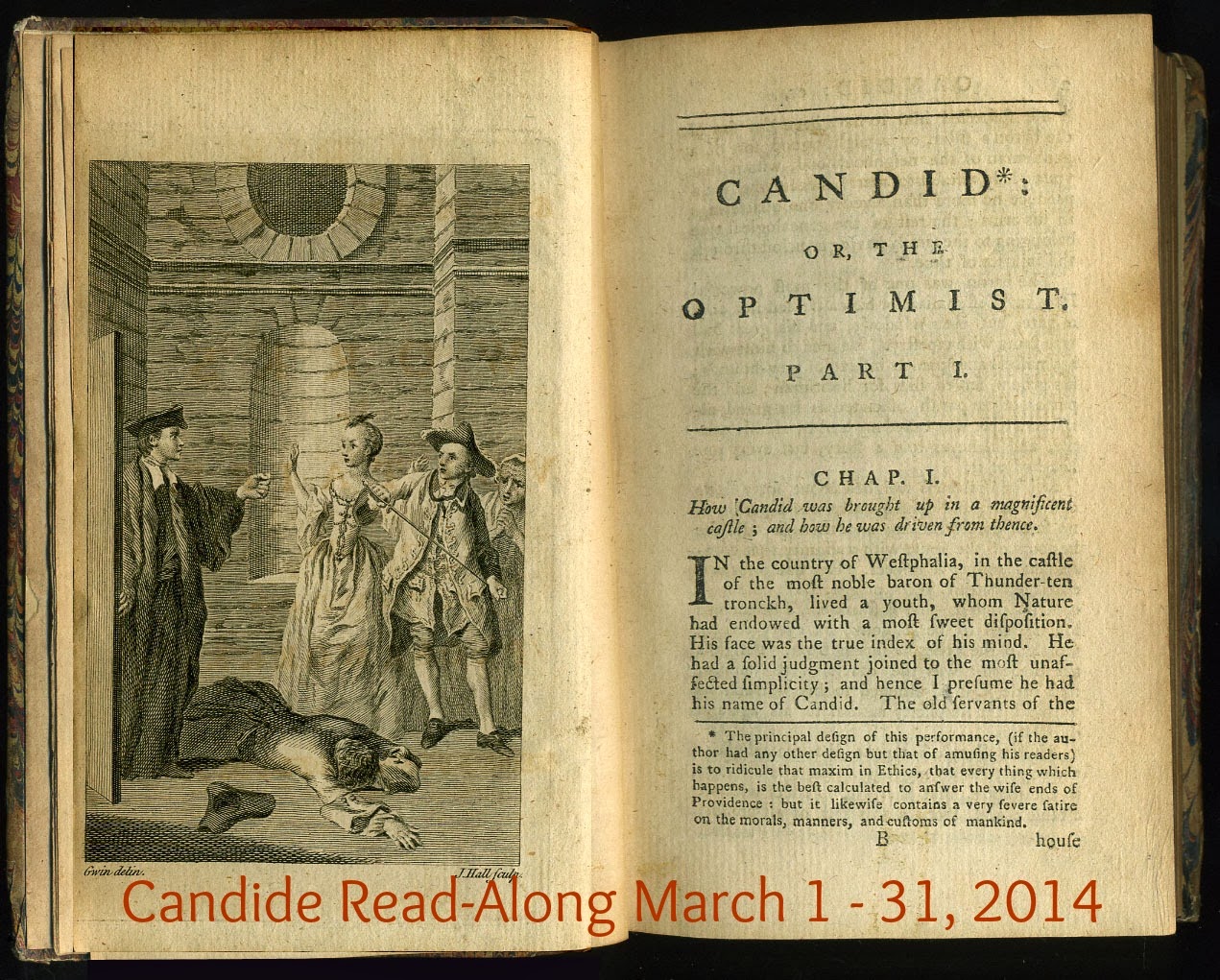
Candide Read-Along

Fariba from Exploring Classics is doing a read-along of Candide by Voltaire in March and I have decided to join.  My schedule should have eased somewhat by then and I should be able to fit it in relatively easily.

Here is the outline:

The event will be from March 1 – 31, 2014.

Fariba will be reading the work in the original language, but all posts will be in English.  Here is the posting schedule:

Monday, March 10:  chapters 1 – 8

Monday, March 17:  chapters 9 – 16

Monday March 24:  chapters 17 – 24

Monday, March 31:  chapters 25 – 30 (last post)

After she posts about a series of chapters, you have a whole week to comment on those chapters.

Depending on if I have enough time, I may tried to read the novel in the original French, or at the very least read some of it in French.  I don’t quite know what to expect from this novel but I’m looking forward to it!

Eugene Onegin Read-Along Chapters 7 & 8

Marian @ Tanglewood’s Read-Along

Chapters 7 & 8

Chapter 7


Spring comes, yet Onegin has fled the country and Lensky’s grave, while at first visited by the two young girls, soon remains alone and forgotten.  In fact, soon after his demise, Olga marries, showing her attachment was rather a tenuous one.  With Olga’s marriage, Tatyana is now alone and spends her time walking throughout the countryside.  One day she comes upon Onegin’s estate, gains entrance and begins to pour through the books he has left behind and the notes he has made inside them.  Perhaps reality began to materialize with Lensky’s death, but now she really begins to search for the true Onegin and perhaps does not like what she finds:

“And modern man himself portrayed
With something of his true complexion —
With his immoral soul disclosed
His arid vanity exposed,
His endless bent for deep reflection,
His cold, embittered mind that seems
To waste itself in empty schemes.”

“And so, in slow but growing fashion
My Tanya starts to understand
More clearly now — thank God — her passion
And him for whom, by fate’s command …”

Tatyana’s mother, Dame Larin is concerned that she has turned down marriage proposals and decides to take her to Moscow and the marriage mart.  Tatyana laments their going, saying good-bye to all her woodland haunts.  We are treated to a grand show of Moscow, but Tatyana does not like her new surroundings or the people in them.  Will she be able to adjust to this new reality?

Chapter 8

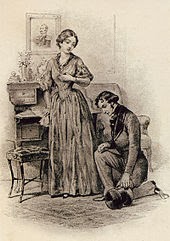
Onegin turns up in town and it appears he has been travelling, perhaps trying to forget the tragic circumstances that caused his flight from the country.  Tatyana has married a general, who is much older than her, and Onegin spies them at a party.  Astounded by Tatyana’s poise and regal demeanour, he begs an introduction by the general who is a friend of his.  While Tatyana is polite, she treats him with no particular regard, which drives Onegin mad with love for her.  Eventually, after dogging her like a puppy, he writes her a letter, exposing his feelings.  He expected to touch Tatyana’s heart, as he had in her youth, but surprise! she was furious at what he had done.  When he finally confronts her at her house, she chastizes him and tells him, though she loves him, she is married and will remain faithful to her husband for life.

Onegin proposes to Tatyana
late 19th century illustration
by Pavel Sokolov (source Wikipedia)

Thoughts:

In chapter 7, Tatyana finally begins to grow up.  The duel appears to precipitate the change, but reading Onegin’s books in a slow thoughtful manner, in direct contrast to her initial quick infatuation, demonstrates a maturing of soul.  Having to leave the comfort of her childhood home, also forces her to go down the path towards womanhood.

Chapter 8 certainly gives us a sense of how Tatyana’s view of Onegin has altered.  While she still retains the emotion of girlish love, she sees his character clearly.

The second reading of this poem (with a different translation) has certainly made specific situations and the sentiments of the characters come more alive for me.  I’ll write a review soon to summarize my discoveries!

Paradise Lost Read-Along Book V and VI

Paradise Lost Read-Along

Book V

Eve awakes, disturbed by the dream she had experienced and relates it in detail to Adam, who tries to comfort her by minimizing its importance.  The reader is left with this beautiful and poignant image:

“So cheered he his fair spouse, and she was cheered
But silently a gentle tear let fall
From either eye, and wiped them with her hair;
Two other precious drops that ready stood,
Each in their crystal sluice, he, ere they fell,
Kissed as the gracious signs of sweet remorse
And pious awe, that feared to have offended.”

God sends the angel Raphael to the bower of Adam and Eve to warn them of the treacherous foe near them and to remind them of their freedom as human beings to choose right from wrong.  Raphael arrives in great splendour:

“A Seraph winged.  Six wings he wore, to shade
His lineaments divine:  the pair that clad
Each shoulder broad came mantling o’er his breast
With regal ornament; the middle pair
Girt like a starry zone his waist, and round
Skirted his loins and thighs with downy gold
And colours dipped in Heaven; the third his feet
Shadowed from either heel with feathered mail,
Sky-tinctured grain.  Like Maia’s son he stood,
And shook his plumes, that heavenly fragrance filled 
The circuit wide ……”

Eve begins to prepare choice delicacies for their visitor and the reader gets more evidence of the hierarchical structure of the poem:

“Nearer his (Raphael’s) presence, Adam, though not awed,
Yet with submiss approach and reverence meek,
As to a superior nature, bowing low ..”

Potent images of the delightful beauty of the garden abound.  Raphael takes a moment to caution Adam with regard to his obedience.  Again free will is emphasized:

“…….. That thou art happy, owe to God;
That thou continuest such, owe to thyself.”

God has given man happiness, but it is in man’s power to keep it or lose it based upon his choices.

Raphael then begins to relate the story of the war of the angels in Heaven, telling of Satan’s jealousy of the Son’s elevation.  Satan counsels his followers to “cast off the yoke”, stating that “if not equal all, yet free, equally free.”  But Abdiel, a Seraphim, abhors Satan’s “counterfeited truth” and delivers a heated speech condemning his evil words.  When mocked by the rebel angels, “with retorted scorn his back he turned on those proud towers, to swift destruction doomed.”

Raphael conversing with Adam and Eve
by John Martin (1826)

Book VI

Civil war rages in Heaven.  Satan and Abdiel have a battle of words, Satan stating that it is liberty that he is fighting for, and mocking those who are lazy and choose only to serve, whereupon Abdiel retorts:

“……………. This is servitude
To serve the unwise, or him who hath rebelled
Against his worthier, as thine now serve thee,
Thyself not free, but to thyself enthralled;
Yet lewdly dar’st our ministering upbraid.
Reign thou in Hell, thy kingdom …….  ” (178-183)

The battle scenes reminded me so clearly of the battle scenes in The Iliad.  Satan has “all his right side” sheered by the sword of Michael and “first knows pain.”  His removal from the field is modelled on the rescue of Hector during one of the battles in The Iliad.  Then:

“Gnashing for anguish, and despite, and shame
To find himself not matchless, and his pride
Humbled by such rebuke, so far beneath
His confidence to equal God in power.”

Michael & Satan
by Guido Reni (c. 1636)
source Wikipedia

Like all Spirits, he is soon healed and withdraws to make a huge machine (a cannon?) to enable them to gain “honour, dominion, glory and renown.”  Honestly, the next part I had a difficult time figuring out what was going on.  It sounded like Heaven’s angels were easy targets, so they retreated into the mountains, lifted up the very same mountains and hills, and flung them onto the rebel angels & their war weapon, burying them beneath the mountains’ flinty bases, and making their escape labourious and painful.  On the third day, God sends the Son into battle but Satan will not give over:

“Insensate, hope conceiving from despair.
In Heavenly Spirits could such perverseness dwell?
But to convince the proud what signs avail,
Or wonders move the obdurate to relent?
They, hardened more by what might most reclaim,
Grieving to see his glory, at the sight
Took envy, and, aspiring to his height,
Stood re-embattled fierce, by force or fraud
Weening to prosper, and at length prevail
Against God and Messiah, or to fall
In universal ruin last ………”

Satan prefers destruction; he will not comprise one iota!  Yet the Son of God routs the evil forces with little effort:

“Yet half his strength, he put not forth, but checked
His thunder in mid-volley, for he meant
Not to destroy but root them out of Heaven.”

Ejected from Heaven in disgrace, Satan and his angels fall nine days before being buried in the pit of Hell.  At the end of Raphael’s story, he once again cautions Adam against disobedience.

“Of those too high aspiring who rebelled
With Satan; he who envies now thy state,
Who now is plotting how he may seduce
Thee also from obedience, that, with him
Bereaved of happiness, thou may’st partake
His punishment, eternal misery,
……………….
But listen not to his temptations; warn
Thy weaker, let it profit thee to have heard,
By terrible example, the reward
Of disobedience; firm they might have stood,
Yet fell; remember, and fear to transgress.”

Michael casts out the rebel angels
by Gustave Doré
source Wikipedia

Thoughts:

I really like Abdiel.  He was the only one to stand up to Satan and all his rebel angels, possibly endangering himself, yet confront them he did!  He also is the first to engage Satan during the battle and, speaking words of truth, certainly puts him in his place.

Milton gives us a beautiful image of Raphael, with his six wings almost singing a breeze, wafting a heavenly fragrance that must have been like pure spring.

Satan, as a character, is extremely interesting, yet not particularly complex.  Time after time he ignores the evidence in front of him and is certain of victory, or that his own wishes are impossible to deny.  Milton refers often to his “pride” but it is something much more nefarious and eternally damaged. Truth is simply inconceivable to him, he cannot even get close to it.  It is fascinating to watch in a rather unsettling way.

Eugene Onegin Read-Along – Chapters 5 an 6

Marian @ Tanglewood’s Read-Along

Chapters 5 & 6

Chapter 5

Ah, broken-hearted Tatyana!  Suffering from unrequited passion for Onegin, Tatyana takes up yet another romantic diversion of superstition. Cats, moons, cards, stars, monks and fleeting hares, all set her heart palpitating with a foreboding of calamity.   She dreams a dream in which a huge bear helps her cross a raging river and takes her to a hut in the woods, placing her inside before disappearing.  Numerous fantastical creatures are revelling and among them, Onegin, the master of the party.  He calls Tatyana ‘his’, Olga arrives with Lensky, yet soon a heated discussion begins between Onegin and Lensky.  Onegin produces a knife and Lensky falls.  Awakening, Tatyana wonders about the symbolism of her vision but it is her name day and time for the party!  Lenksy and Onegin arrive late.  Initially Tatyana’s girlish discomfort and pain irritate Onegin, but later he takes pity on her.  Yet boredom is his boon companion and he looks for something to alleviate his ennui.  Olga!  He flirts with her, Olga is receptive but Lensky is horrified and enraged.

Chapter 6

With bitter indignation, Lensky challenges Onegin to a duel.  Onegin accepts.  Yet when Lensky speaks with Olga there is evidence that she is reasonably oblivious to the importance he places on her actions with regard to Onegin and slight doubt fills his mind.  However, the challenge has been issued and the duel must go ahead.  They pace, aim and fire and Lensky is shot dead.  Sense returns to Onegin and he feels horror at what he had done.  Pushkin very skillfully puts the reader in the place of Onegin, allowing us to search his emotions upon this terrible act.  He then muses on Lensky’s fate and on some repercussions it will cause, closing with sorrow and regret over the unnecessary death of the young poet.

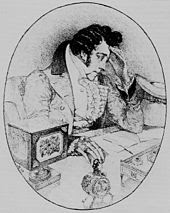
Onegin by Dmitry Kardovsky
1909
source Wikipedia

How do you interpret Tatyana’s dream?  Any ideas as to why it is usually omitted from major adaptations?

Tatyana’s dream is the foreshadowing of the duel.  My guess as to why it is usually omitted is that it is not really necessary to the story and, I think, visually may take away from it.  On paper though, it is effective and interesting.

Chapter 6 finds us in the middle of sudden disputes and high drama.  What might be the characters’ motivations for such extreme actions?  Is it substance, or superficiality?  Is anybody right or wrong — and if so, who?

The tragedy of the last chapter is that really no one wants the duel.  Tatyana, if she had known about it, would have been horrified and tried to stop it; the same with Olga.  After Lensky realized that Olga was innocent (or at least appeared innocent) in the seduction, his anger and resentment faded and there was a regret about his decision.  Onegin also mentally repented of his callous actions of the night before, yet even so, his pride demanded that he continue on the calamitous course that was set by Lensky’s youthful zeal.  The lack of maturity in both males characters lead to serious consequences.

Reactions or predictions?

I was a little puzzled during the duel scene.  My translation says:

“With quiet, firm and measured tread,
Not aiming yet, the foes took boldly
The first four steps that lay ahead —
Four fateful steps.  The space decreasing,
Onegin then, while still not ceasing
His slow advance, was first to raise
His pistols with a level gaze.
Five pace more, while Lensky waited
To close one eye, and only then,
To take his aim …… And that was when
Onegin fired ……”

They started off pacing boldly and equally, yet Onegin was the first to raise his pistol. And then there were five paces after that.  Why did Onegin have his pistol ready at four paces and Lensky had to still raise his after nine?  Was it a sign of Lensky’s ineptness with duelling?  In any case, I found it confusing and a little awkward.  I wonder if it’s just my translation.  Can anyone enlighten me?  Are there any duelling enthusiasts out there? 😉

Any quotes stand out?

He could have shown some spark of feeling
Instead of bristling like a beast;
He should have spoken words of healing,
Disarmed youth’s heart …… or tried at least.
‘Too late,’ he thought, ‘the moment’s wasted …..

It’s like a Greek chorus singing the upcoming tragedy.