Herodotus’ The Histories ~ Book II

Book II (Euterpe)


“When Cyrus died, the kingship was inherited by Cambyses.”

Upon the death of Cyrus, his son Cambyses took power and immediately led an expedition to Egypt, including the conquered Ionians whom he saw as slaves. Herodotus now falls into a long narrative about Egypt’s land and customs.

Architecture and Art of the great Temple of Karnak
David Roberts
source Wikiart

He claims the Phrygians are the oldest people, citing an experiment done with babies to see what the first word uttered would be, however the Egyptians were the first to discover the year by dividing it into twelve parts and adopt names for the twelve gods. Here begins a lengthy description of the land and terrain, the soil and the flooding of the Nile and its channels.  Herodotus claims the Hellenes have three theories about the Nile’s floods: 1) the Etesian winds cause the flooding, which Herodotus says is ridiculous; 2) the Nile flows from the Ocean and the Ocean surrounds the entire world, which Herodotus states is even more ludicrous, and; 3) the floods are caused by melting snow from Libya which pass through Ethiopia.  The last is the most believable explanation, yet the most erroneous.  Herodotus presents his own theory which has to do with the sun being pushed off course by storms, then in spite of Herodotus’ promise to be brief, he offers a rather complex explanation.

The Nile (1881)
Vasily Polenov
source Wikiart

Next, Herodotus launches into a description of Egyptian customs, claiming they are opposite to the customs of other peoples.  Here are a few for your enjoyment:


  • The women go to the market to sell goods, whereas the men stay home and do the weaving.
  • The men carry loads on their heads and the women on their shoulders.
  • Women urinate standing up; men sitting down.
  • They ease themselves (urinate & defacate, I believe he means) inside their houses but eat outside on the streets.
  • Sons do not have to support their parents, but women do.
  • Women cannot be priestesses, only men can be priests
  • They live together with their animals
  • They knead dough with their feet but lift up dung with their hands

….. and so on and so forth.

The Egyptians are pious and Herodotus explains in detail animal sacrifices, then moves on to their understanding of Herakles, which is very different from the understanding of the Hellenes.  In fact, Herodotus proves his dedication for discovering the truth by visiting Tyre in Phoenicia to discover how these people viewed the god, as well as a sojourn in Thaos.  Herodotus finally concludes that the Hellenes myths of Herakles are the most foolish.

The Sanctuary of Hercules (1884)
Arnold Böcklin
source Wikiart

A discussion about where the Hellenes derived the names for their gods follows, and Herodotus is certain most of the names came from barbarians, namely the Egyptians, although Poseidon seems to be borrowed from the Libyans.  As to their origin, Herodotus believes that Hesiod and Homer, who lived no more than 400 years before him (modern scholars believe 200 years before), composed the theogony of the gods along with bestowing them with their attributes, behaviours, skills and descriptions. From there we move to religious rituals and festivals, and the Egyptians care of their animals. Do not intentionally kill an animal or you are sentenced to death.  For the death of a cat, the household will shave its eyebrows, but for the death of a dog they shave their whole body and head.  Many animals get buried in sacred places or tombs.  The crocodile is sacred in some places as is the hippopotamus, and my favourite animal, the otter. Herodotus’s description of the hippopotamus is rather implausible:

” …. it has four feet with cloven hooves like an ox, a blunt snout, a mane like a horse, conspicuous tusks, and a horse’s tail.  It neighs.  It is the size of the largest ox, and its hide is so thick that once it is dried, spear shafts are crafted from it …”

There is a very impolitic footnote stating that obviously Herodotus has never seen a hippopotamus, but honestly who really knows?  I choose to believe him, or at least that he thought he saw one, as later he describes a phoenix but is very careful to reveal that he has never actually seen one.  From this evidence we can conclude that, at the very least, Herodotus is attempting to be accurate and transparent.  In any case, this phoenix carries the body of its father wrapped in an egg of myrrh from Arabia to the sanctuary of Helios when he dies, or so the legend goes.

Hatwell’s Gallopers’: Hippopotamus Hunt
Henry Whiting
source ArtUK

After, Herodotus discusses various themes such as fish, methods of embalming, Egyptian boats, and then begins to share some Egyptian history.  Priests told him that the first Egyptian king was named Min who founded the city of Memphis and dammed the Nile.  After him, 330 kings followed which included one Ethiopian and one woman (Nitokris – different than the Babylonian Nitokris of Book I) who avenged her brother by locking his numerous murderers in a chamber and drowning them before throwing herself into a chamber of ashes to escape retribution.  However, the Egyptians claim these kings were more or less useless except for the last, Moeris (king Amenemhet), who produced a memorial to himself and excavated a lake.  King Sesostris, who came after, marched all over Asia erecting pillars to commemorate his victories and would put on them the genitals of a woman for those whom he thought cowardly.  When his brother plotted his murder, Sesostris used two of his six children as a bridge to cross a flaming pyre, burning them up, and in this way, escaped with the rest of his family.  His son, Pheros, ruled Egypt after him and then came Proteus, with whom Helen and Paris stayed.  Herodotus calls into question Homer’s account of the Trojan War stating in his opinion that Helen was in Egypt the whole time of the war.  After all:

” … considering that if Helen had been in Troy, the Trojans would certainly have returned her to the Hellenes, whether Alexandros (Paris) concurred or not.  For neither Priam nor his kin could have been so demented that they would have willingly endangered their own persons, their children, and their city just so that Alexandros could have Helen.”


Thebes Colosseums, Memnon and Sesostris (1856)
Jean-Leon Gerome
source Wikiart

After Proteus, Rhampsinitos assumed kingship, amassing great amounts of silver for which he built a great vault.  But the builder made a secret entrance which he told to his sons upon his death and they began to borrow from the king.  The king discovered the theft and laid traps for the robbers whereupon one of them was caught, but he convinced his brother to behead him so their identity would not be discovered.  The king then took the headless body and hung it as bait but, upon the urging of his mother, the thief made the guards drunk and stole it.  The king then set his daughter up as bait in a brothel to attempt to identify the robber (Herodotus expresses his disbelief at the veractiy of this account), but although the thief confessed his sin while enjoying the daughter’s favours, he offered the arm of a corpse he had brought along with him when she tried to grab him, and once more eluded capture.  So impressed, the king pardoned the man and gave him his daughter in marriage, then King Rhampsinitos descended to Hades to play dice with Demeter. (Yes, seriously!)

While Egypt prospered under Rhampsinitos, the next king, Cheops (Khufu), laid the people under bondage, forcing the people to do labour for him, hauling stones to build causeways and his great pyramid.  His brother, Chephren (Kafre), was not much better and built his pyramid of coloured Ethiopian stone, however, his son, Mykerinos (Menkaure), disliked his father’s policies and enacted change.  He is liked more than any other king but at times his leniency caused him great trouble.  After sexually abusing his daughter who killed herself, an oracle told him that he only had 6 years left to live, therefore he stayed awake twice as long and extended his life to 12 years.  Asychis followed, who built his pyramid of bricks, then a blind king, Anysis, who fled the Ethiopian king who took over, who then fled himself after a dream, whereupon Anysis returned. The Egyptians believe that before the kings, the gods ruled over Egypt.
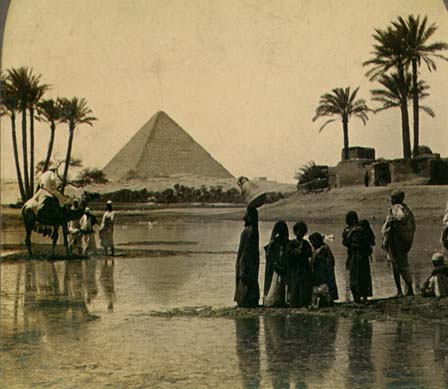
 

Great Pyramid of Giza
source Wikipedia

After Ethiopian rule, they divided the kingdom into twelve districts and kings ruled each, forming alliances but promising not to depose each other.  To commemorate them all, they had a marvellous labyrinth constructed that Herodotus claims eclipses the pyramids themselves and he would know as he was shown the upper chambers although denied the lower ones.  Yet even with their pact for peace, a mistake brought about dissent. While meeting together, only 11 golden cups were brought out for libation and Psammetichos had to use his helmet.  A horrified hush came over the rest of the kings as they realized the oracles proclamation was coming true: that the one who drank from a bronze vessel would reign over all the kingdoms.  They decided to exile instead of kill him but Psammetichos returned and with the help of the Ionians and Carians, became sole ruler of the kingdoms.  Nechos, the son of Psammetichos, reigned after, constructing a canal and leading military campaigns, before his son, Psammis took over, followed by his son, Apries.  Due to a failed military campaign, the people blamed his poor leadership and Apries had to send an envoy, Amasis, to quiet them, however they crowned Amasis king, so Apries sent Patarbemis to fetch his disloyal envoy.  Amasis (Ahmose II) refused to return, but Patarbemis was able to determine his intent to attack the king.  However, upon return, Apries was so furious that Patarbemis had returned empty-handed, he seized him to cut off his ears and nose before the man could relate his discovery.  Amasis with his foreign army of the Ionians and Carians who had settled in the land, met Apries’ Egyptian army in battle and Apries was eventually captured. Amasis treated him well, however, yet the citizens complained and Amasis turned him over to them at their request, whereupon they strangled and buried him.
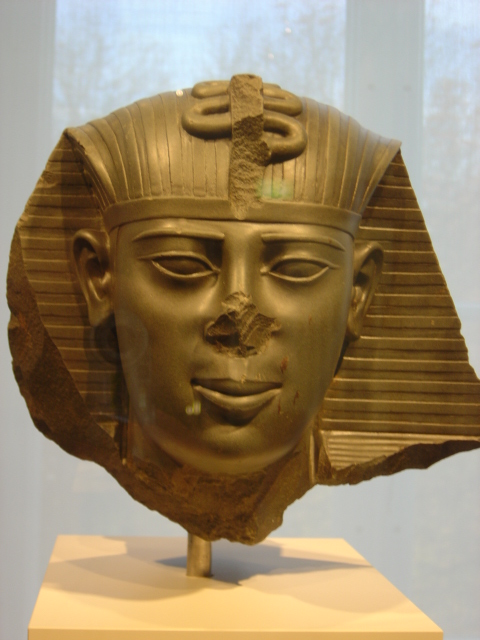
Amasis II
source Wikipedia

The people at first despised Amasis because he was merely a common man, but Amasis won them over.  Yet he was not a serious man and enjoyed drinking with his friends.  Concerned about his reputation, his close friends and family admonished him but Amasis answered:

“When archers need to use their bows, they string them tightly, but when they have finished using them, they relax them.  For if a bow remained tightly strung all the time, it would snap and be of no use when someone needed it.  The same principle applies to the daily routine of a human being: if someone wants to work seriously all the time and not let himself ease off for his share of play, he will go insane without even knowing it, or at the least suffer a stroke.  And it is because I recognize this maxim that I allot a share of my time to each aspect of life.”

Egypt prospered under Amasis and he was also friendly to the Hellenes.
⇐  Book I (Clio)                                                                                Book III (Thalia) ⇒

Herodotus’ The Histories – Book I


Book I (Clio)


“Herodotus of Halicarnassus here presents his research so that human events do not fade with time.  May the great and wonderful deeds — some brought forth by the Hellenes, others by the barbarians — not go unsung; as well as the causes that led them to make war on each other.”

Immediately Herodotus establishes who he is, that he is conducting an inquiry into events, and that he is an unbiased observer, treating both the Hellenes and barbarians alike, lauding each of their deeds.

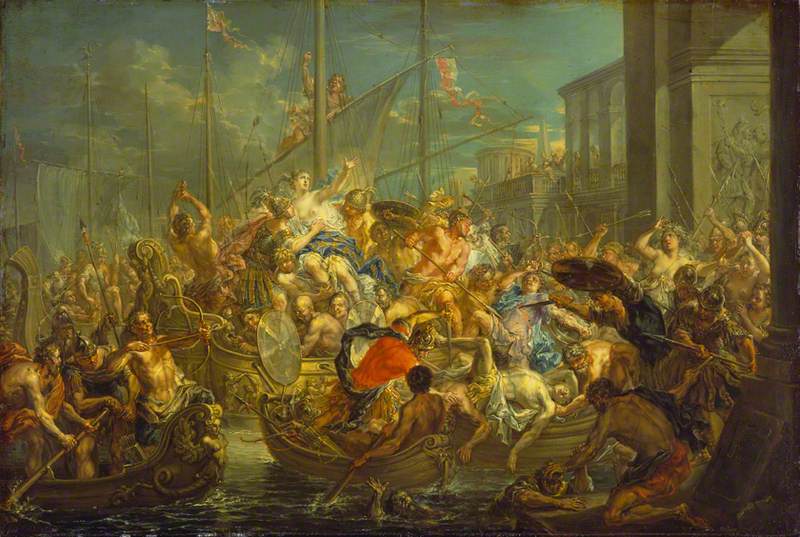
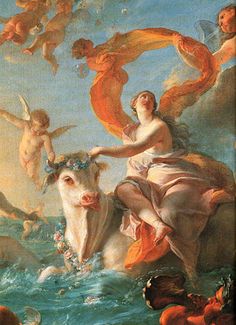
He goes on to deal with the cause of the enmity between them:  according to the Persians, those dratted Phoenicians started it all.  They sailed to Argos and kidnapped some women, Io, the daughter of the king being one of them, and that is how she arrived in Egypt.  This version is vastly different than the Io version told by Ovid in his Metamorphoses.  In retaliation, the Hellenes then kidnapped the king’s daughter, Europa, from the Phoenician city of Tyre, again a different version from Ovid’s recounting of Europa’s kidnapping.  Yet not being satisfied with one kidnapping, the Hellenes set out again, this time absconding with the king of Colchis’ daughter, Medea. Now, when Paris, the son of Priam, heard about these kidnappings, he thought nothing of stealing Helen.  Even though the Hellenes were seen as the aggressors who began the hostilities, the Persians thought it plain silly to be so concerned about these women, as they would not have been kidnapped unless they were willing.  Well, okay …..  But to add another twist, the Phoenicians disagree with the Persians, saying that Io had relations with the captain of the Phoenician ship and had to sail away to hide her pregnancy.  Heredotus will not say either way who was right, but he does know the first man to commit unjust acts towards the Hellenes …..

The Abduction of Helen (c.1740-60)
Johann Georg Platzer
source ArtUK

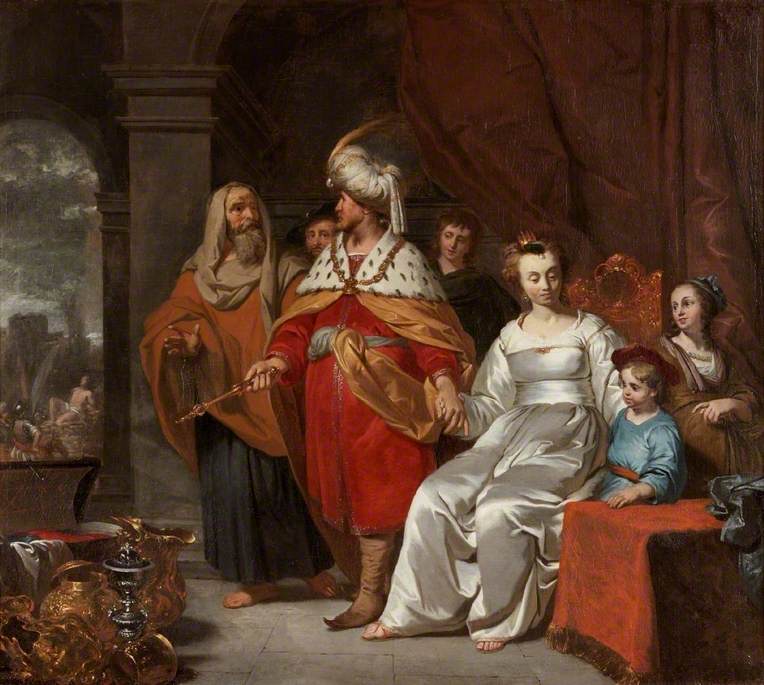
Croesus of Lydia was the first man to subjugate the Hellenes and his rule passed to Kandaules.  Now, Kandaules had a beautiful wife and he insisted on showing her, in all her nakedness, to his servant, Gyges, so he would confirm her loveliness.  Gyges is appalled, but what can he do?  He is told not to allow the queen to know that he has seen her naked, but she spies him slipping out the door and plots her revenge. Confronting Gyges, she says he must either slay Kandaules and become king, or die immediately.  Gyges chooses the former, dedicating much silver as an offering to Delphi, and therefore is able to invade Smyrna and Miletus. Thus runs a list of Lydian rulers and their deeds.

The Imprudence of Candaules (1830)
William Etty
source Wikipedia

Croesus, the son of Alyattes, attacked the Ephesians, the first of the Hellenes to be assailed.  He subdued city-state after city-state: the Lydians, Phrygians, Mysians, Carians, Ionians, Dorians, Aeolians, etc, etc.  At the pinnacle of his wealth, a man named Solon arrived in Sardis with many wise men of Hellas.  He had effected laws for the Athenians at their invitation, then travelled for the ten years the laws were in place so as not to be convinced to repeal any of them.  Croesus was curious as to who was the happiest and most prosperous man in the world, expecting the answer to be him, but Solon frustrated his expectations by naming two others.  When Croesus challenged his answers, he replied that to be considered for this title, it must be judged how a man ends his life; until then he can only be called “lucky”.  Croesus disparaged Solon’s wisdom and was sent a dream that his son, Aryes, would die by an iron spear.  He, with hesitation, allows his son to go on a boar hunt, commissioning Adastos, a slave who he had rescued, to ensure his safety.  Ironically, Adastos accidentally kills Aryes with his spear throw and though Croesus pardons Adastos, the slave kills himself on the tomb of Aryes.

Croesus Showing Solon His Riches (1655)
Casper Casteleyn
source ArtUK

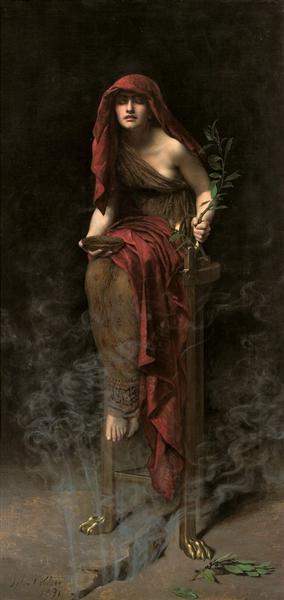
Herodotus relates more stories about Croesus and his ancestors, then returns to the worry of Persia and their possible aggression.  Croesus sends a delegation to Delphi where the god, Apollo, returns his answer, advising him to ally himself with Sparta, and Croesus understands this to mean victory. Finally, he and his Lydian army meet the Persians, led by Cyrus, at Sardis, but the Persians are victorious and Croesus is taken prisoner.  On his pyre, when Croesus recounts the words of Solon, Cyrus has a change of heart and commands his release, but the fire is already raging and only an unexpected storm of rain in answer to Croesus’ prayer to Apollo saves him.  Now friends with Cyrus, Croesus instructs him how to stop the plundering of his city and therefore rescue his army from corruption, then requests the right to question the oracle on his mistaken prophecies, yet he learns that he is the one who had misunderstood and accepts blame.

Priestess of Delphi (1891)
John Collier
source Wikiart

Thus runs more Lydian history and moves to the birth of Cyrus, whose grandfather plotted his death at his birth because of dreams he’d interpreted of Cyrus’ overthrow of him:  Grandfather Astyages discovered that Harpagos, his servant, disobeyed his orders to kill the boy (instead giving him to a herdsman to kill who ended up raising him as his own) under the guise of friendship he gets Harpagos to send him his son, and then serves his son for dinner to the father.  Harpagos unknowingly eats his son, and then all is revealed when Astyages has the son’s head, hands and feet brought in.  This was not a good decision, for, when the wisemen or Magi reveal to Astyages that Cyrus is no longer a problem to his rule and his grandfather allows Cyrus to live in Persia, Harpagos stirs up dissent among the populous who already dislike Astyages’ cruel reign.  The servant contacts Cyrus in Persia and Cyrus raises an army, who defeat the Medes who were not dedicated to fight for their despised leader.  This is how Cyrus became king and later deposed Croesus to rule all of Asia.

King Astyages of Media Orders Harpagos to Kill Young Cyrus (late 18th century)
Jean Charles Nicaise Perrin
source Wikimedia Commons

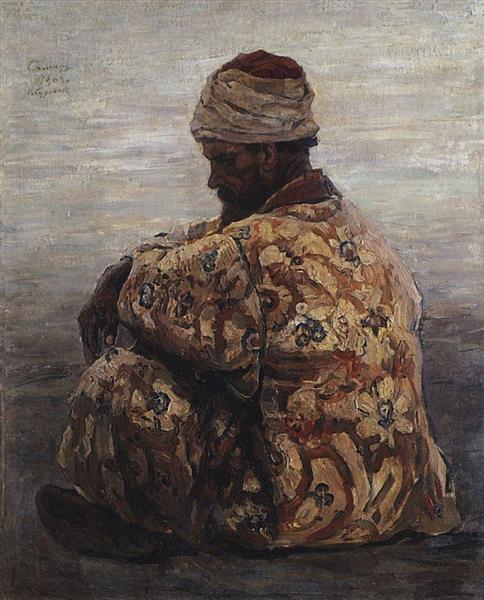
Herodotus now launches into a monologue of the customs of the Persians.  Fascinating to learn that the Persians will not vomit or urinate in front of anyone.  Good to know. Our sensibilities are all safe.  Fortunately, although they will make business decisions while drunk, they will reconsider the decisions the next day when they’re sober. Strangely though, the decisions they make when they are sober, they will also evaluate while they are drunk.

The Persian (1902)
Vasily Surikov
source Wikiart

Then we swing back to Cyrus: after he conquered the Lydians, the Ionians and Aeolians sent messages asking to be subject to his rule, but since they did not band with him is his battle with Lydia, Cyrus refuses.  Then follows a history of the Ionians, Dorians, etc.  It appears that although these areas are located on the coastline of Asia Minor, the peoples migrated from the Greek city-states, and in fact, Athens is considered an Ionian city although it does not like to be referred to as such.  Halicarnassus, the birthplace of Herodotus (although he does not mention that fact) used to be the sixth Dorian city but now there are only five.

Cyrus not only conquers the Lydians, but conquers all the Ionian coast and we are given more history of the surrounding area.  Next, Cyrus plans to advance on Assyria, and its city of Bablyon is described, including two queens that ruled it, Semiramis and Nitokris. Nitokris is particularly interesting as she made many clever improvements in infrastructure.  She built her tomb in “mid-air” above one of the city gates, saying that if ever a future king was in need of money, he need only open her tomb, but warned that it should only be opened in dire need.  No king dared disturb the tomb until Darius came to power, but instead of money he found a note:

“You would not open up the grave of the dead if you were not so insatiable and shamefully greedy.”

Back to Cyrus who went to war against the son of Nitokris, but before he reached Babylon, he was offended by the River Gyndes that swallowed one of his horses (yes, that’s right, a river) and he spent the whole summer dividing his army in work to destroy it, dividing the river into 360 channels.  Rather childish of him but I suppose he was quite enraged.  Then in spring he marched on Babylon.  He defeated the Babylonian army outside of the city, but many men returned to the city with great stockpiles of food, and Cyrus found himself at an impass.  However, with great guile, he diverted the Euphrates where it entered Babylon, and attacked by the riverbed, taking the inhabitants by surprise and conquering the city.  Herodotus now describes the Babylonian crops and their enormous yields, their boats, their shoes, and their means of marrying off their daughters in an auction for money but if the couple cannot get along, the money is repaid and supposedly the girl returned.  Sadly however, since the Persian capture, the Babylonians are impoverished and prostitute their daughters.  A fascinating custom is that instead of doctors, they carry the sick person to the square and allow others to advise him, very helpful if someone else has had the same sickness and knows of a cure.  Herodotus says that their most disgusting custom is that once per year every woman must sit in the sanctuary of Aphrodite and have intercourse with a stranger.


Cyrus the Great’s Siege of Babylon (1819)
John Martin
source Wikimedia Commons

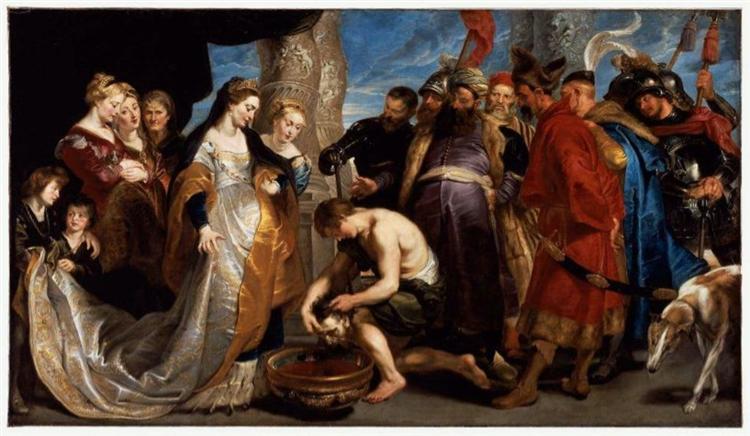
Cyrus now turned his battle-filled eyes to Massagetai which at this time was ruled by a woman named Tomyris.  Refusing his proposal of marriage, seeing it for what it was, she suggested that he return to rule his people and allow her to rule hers, but if he insisted on battle, either come into her territory or let her come onto his.  The generals of Cyrus suggest that they allow Tomyris onto Persian territory but Croesus convinces Cyrus otherwise.  After having a dream that Darius is plotting his overthrow (which is really an omen of his death), the two sides battle and eventually Cyrus is killed.  Tomyris defiles the corpse by placing his head in a wineskin filled with blood.

Head of Cyrus Brought to Queen Tomyris (1622-23)
Peter Paul Ruebens
source Wikiart

The Oresteia ~ The Eumenides

The Eumenides by Aeschylus
“I give first place of honor in my prayer to her
who of the gods first prophesied, the Earth; and next
to Themis, who succeeded to her mother’s place
of prophecy; so runs the legend; and in third
succession, given by free consent, not won by force, 
another Titan daughter of Earth was seated here. …..”

Time passes and Orestes arrives at the Temple of Apollo at Delphi, still pursued by the Furies.  His conflict continues in tormenting unrelief and he appeals to Apollo for alleviation from his guilt.  He has avenged his father, but in doing so has murdered his mother.  Divine command has clashed with divine decree, and he is helpless to navigate his way through the maze of paradoxical possibilities.  The priestess, Pythia, is shocked to find him in the suppliant’s chair with a sword dripping with blood and the sleeping Furies surrounding him.  A spell has been placed upon them by Apollo so Orestes can travel unhampered to Athens, which he does after Apollo absolves him of complicity in his murder of Clytaemestra. But now he must seek Athena for a possible resolution to his dilemma.

Continue reading

The Oresteia ~ The Libation Bearers by Aeschylus

The Return of Orestes (1785)
Anton von Maron
source Wikimedia Commons

The Libation Bearers by Aeschylus
“Hermes, lord of the dead, who watch over the powers
of my fathers, be my saviour and stand by my claim.
Here is my own soil that I walk.  I have come home;
and by this mounded gravebank I invoke my sire
to hear, to listen …..”

Continue reading

The Oresteia ~ Agamemnon by Aeschylus

The Sacrifice of Ipheginia by Agamemnon (1671)  Jan Steen
The Sacrifice of Ipheginia by Agamemnon (1671)
Jan Steen
source


Agamemnon by Aeschylus
 
“Dear gods, set me free from all the pain,
the long watch I keep, one whole year awake …
propped on my arms, crouched on the roofs of Atreus like a dog.”

Agamemnon is the first of a trilogy of plays called The Oresteia, the next two plays being The Libation Bearers and The Eumenides, all performed in 458 B.C., only two years before the death of Aeschylus.  This surviving unified trilogy allows the reader to experience the development of these three-part stories and to observe the common strands of informatiion and enlightenment winding throughout.  Each play would have built support and framework for the others.  However, even though we have all three plays of this trilogy, the satyr play Proteus is lost, as it would have been a type of comic epilogue to finish The Oresteia.

Continue reading

Metamorphoses Book VII

Book VII


Medea and Jason / Medea and Aeson / Medea and Pelias / The Flight of Medea / Theseus and Aegus / Minos / Cephalus / The Plague / The Myrmidons / Cephalus, Procris & Aurora


Jason and Medea (1907)
John William Waterhouse
source Wikiart

The twin sons of Boreas assist King Phineus, who aids them in their journey to Colchis, where Jason meets with King Aeëtes to claim the Golden Fleece. The king agrees to relinquish his prize upon Jason completing three horrendous tasks. Yet Medea, daughter of the king, has fallen madly in love with Jason.  In spite of Jason’s foreign origin and the loyalty she owes to her father, she agrees to help Jason succeed in his trials in exchange for his promise of marriage.  First, he tames the dangerous bulls with herbs of Hecate given to him by Medea, yoking them to plow a field that has never before been plowed.  As he drops snake’s teeth into the ground from a bronze helmet, each takes the shape of an armoured warrior who attacks Jason.  But the young man hurls a stone into their ranks and they turn on each other, perishing in a civil war.  In his last test, Jason puts to sleep a dragon with juices from a hypnagogic herb, gains the Fleece and sails home with his new wife.

Continue reading

Lysistrata by Aristophanes

“The War shall be women’s business …….”

Staged during the Peloponnesian War and a mere two years after the disastrous defeat of Athens during the Sicilian Expedition, Aristophanes wrote Lysistrata ( Λυσιστραταη), meaning “disbander of the army”, as a protest against the waste of both resources and lives caused by the acts of war.

The play begins in the year 411 B.C., the twentieth year of the Peloponnesian War between the city states of Athens and Sparta, and the women of the participating factions are becoming disaffected by the incessant fighting.  Lysistrata, a woman of Athens, gathers neighbouring women from the areas of Sparta, Bœotia, Corinth, Peloponnese, etc. in protest of this gratuitous war.

Continue reading

Seven Against Thebes by Aeschylus

“You citizens of Cadmus, he must speak home
that in the ship’s prow, watches the event
and guides the rudder, his eyes not drooped in sleep.”

Produced in 467 B.C. and winning first prize in the City Dionysia drama competition, The Seven Against Thebes is assumed to be the last of a trilogy of plays which dealt with the Oedipus cycle, the other two being called Laius, and Oedipus, both lost, as was the concluding satyr play, The Sphinx.  Driven mostly by dialogue, this play requires some background history to add some further insight.

Continue reading

The Suppliant Maidens by Aeschylus

“Zeus Protector, protect us with care,
From the subtle sand of the Nile delta
Our ship set sail …….”

Originally thought to be the earliest extant Greek tragedy, having been produced in 490 B.C., more recent evidence places it with a trilogy produced in 470 B.C., making it one of Aeschylus’ later plays. More primitive in style than The Persians, and using the archaic practice of having the protagonist as the chorus, it’s possible that Aeschylus kept it unseen for 20 years, but his motivation for this concealment would certainly be inexplicable.

Continue reading

The Persians by Aeschylus

“Of the Persians gone 
To the land of Greece
Here are the trusted:
As protectors of treasure …..”


Performed in Athens in  472 B.C., The Persians portrays the naval battle at Salamis between the Greeks and the Persians, which occurred seven years earlier.   It is unique from other tragedies, as it was without a prologue or exudos (final scene) of the chorus.  As it deals with contemporary history instead of the common mythic topics, it was not part of a unified triad of plays that Aeschylus appeared to favour, yet interestingly it was performed with two other “lost” mythic plays, Phineus and Glaucus Ponieus.  In comparing this play to later tragedies, these differences raise the possibility of tragedy developing out of an earlier form.

Battle of Salamis (1868)
Wilhelm von Kaulbach
source Wikimedia Commons
 
The play begins in 480 B.C., and at the palace of Xerxes at Sousa, the Persian elders are lauding the strength of Xerxes and his army as they are engaged in battle with the Greeks:
 
“And the furious leader the herd
Of populous Asia he drives,
Wonderful over the earth,
And admirals stern and rough
Marshals of men he trusts:
Gold his descent from Perseus,
He is the equal of god.”
 

Yet their tone of exhortation becomes tinged with concern over the question of victory in this battle, and the mother of Xerxes, the Queen, appearing, echoes their sentiments.  A herald arrives, bringing most unwelcome news:
 
“O cities of Asia, O Persian land,
And wealth’s great anchorage!
How at a single stroke prosperity’s
Corrupted, and the flower of Persia falls,
And is gone.  Alas!  the first herald of woe,
He must disclose entire what befell:
Persians, all the barbarian host is gone.”
 

The herald, an eyewitness, bitterly describes the Persians’ defeat at Salamis.  Momentarily speechless, the Queen finally asks about survivors.  Xerxes is still living, but the Herald lists the many dead heroes, casualties of the battle.  The survivors are scattered.


“Ship dashed against ship, till the Persian army
dead stewed the deep like flowers”
source Wikimedia Commons
While Xerxes is a great warrior, his errors in the battle are made apparent.  He harangued his captains publicly, “in ignorance of Greek guile and the jealousy of the gods” …. and, “he conned the future ill.”  In return for his pride and miscalculations:


“All the Persians, who were in nature’s prime,
Excellent in soul, and nobly bred to grandeur,
Always first in trust, met their death
In infamy, dishonor, and in ugliness.”


Lamenting that her dream of defeat has come to fruition, the Queen attempts to assuage her grief by offering prayers and gifts to the gods.  As she offers libations at the tomb of her dead husband, Darius, his ghost rises up, inquiring about the present woe.  When he hears of the tragic defeat, he appears to blame his son’s “youthful pride”, yet he counsels the Queen to receive her son gently when he returns.
 
Somber laments issue from the Persian council of elders until Xerxes arrives in grievous affliction.  He recounts more of his defeat, his words a song of sorrow until the end:
 
“Oh alas, woe,
The magic wheel of longing for my friends you turn, you tell
Me hateful sorrows.  Within my frame my heart resounds,

resounds ……”

Death of the Persian admiral (Ariabignes,
brother of Xerxes) early in the battle
source Wikipedia
Wow, this was a very powerful play.  By the Persians’ defeat, Xerxes has not only lost honour for himself, but he is responsible for the loss of honour of generations before him.  Yet the tragedy of the situation is in his overweening pride and his attempt to place himself in a position above the gods.  He ignored the wisdom of his elders, instead choosing to go his own way, and paid dearly for his folly.


Even though, Aeschylus was writing through Persians eyes, elements of a Greek mindset crept in here and there, as in Darius’ horror of the Persians plundering and burning the Greek temples.  And he counsels the Queen for the Persians not to invade Greece because “the Grecian soil is their own ally.”  Very convenient.  Yet there is also a sympathetic tone towards the Persians, as if the Greeks can empathize with the sufferings of battle and the woes of the aftermath of loss.  In fact, the sympathy is startling.  The great daring of such a play perhaps goes beyond both historical and contemporary understanding.  No playwright had risked presenting the enemy, not only from a sympathetic viewpoint, but also showing them as noble and heroic in battle.  The battle at Salamis was a recent event and it is a tribute to the rhetoric of Aeschylus that this play was so well-regarded.  Yet while his feat is indeed admirable, Aeschylus ensures that he remains in control of his creation.  Few names can be traced to real persons, hyperbole is employed and Persians adopt Greek tradition, preventing any person from drawing any concrete truth from his presentation.  His Persian War, while being historically based, is still in the realm of myth, as if he cannot escape it. 

Translated by Seth G. Bernardete