Confessions by Saint Augustine

“You are great, Lord, and highly to be praised: great is your power and your wisdom is immeasurable.”

Book No. 1

Book:  The Confessions of Saint                   Augustine
          
          Oxford World Classics
            Translation:  Henry Chadwick

I’m starting my Well-Educated Mind Biography Project with possibly the first biography ever written, Confessions by St. Augustine.  Born in 354 A.D. in Thagaste, which is modern day Algeria, Augustine reveals his time as a boy growing up in North Africa, his profession as a teacher of rhetoric, his travels to Rome, his connections with the Manicheans*, and finally his conversion to Christianity.  We, as a reader, are privileged to have a window into his life and internal struggles, as he asks questions about life and God.

*Manicheanism:  a quasi-religion that taught a dualism of everything that is material is evil, and everything that is spirit is good.  Their beliefs caused them to take rather bizarre views of Christian teachings such as:  because God created a material world, he cannot be good; Jesus did not become man because all material is evil, etc.

First Stage of Reading:

What historical events coincide-or merge-with these personal events?
Augustine lived in the Roman Empire during a time of political, social and religious turmoil, which helped him to produce prolific amounts of writing addressing these situations.  

Augustine was born in a century where at the beginning, Christianity was a persecuted religion, yet at the end of the century most people of the Roman Empire were at least ostensibly Christian and Christianity was the official religion of the Empire.  As the church attempted to determine its nature,  there were many disputes among Christians and much of Augustine’s writing deals with these issues.  He also endeavoured to reconcile pagan thought with Christian values, one of the first Latin writers to explore the benefits of pagan ideas as well as assessing their limitations.
Who is the most important person (or people) in the writer’s life?

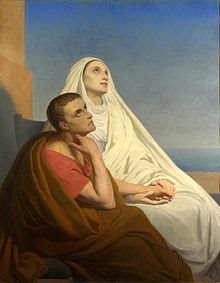
Perhaps the most important person in Augustine’s life was his mother, Monica.  Her prayers and petitions for him were unceasing and what a wonderful thing for her to see him eventually become a believer.  

Ambrose, the archbishop of Milan, was instrumental in Augustine’s journey away from Manichean belief and towards a belief in God.  Augustine respected his intellect and his influence on Augustine was unequivocal, as he encouraged him to look beyond the literal into the substance of the Bible, and asserted that a deeper meaning could be found there, contrary to what Augustine had learned from his Manichean teachers.  
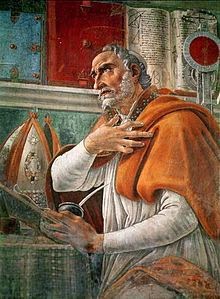
Saint Augustine in his study (1480)
Sandro Botticelli
source Wikipedia


The Second Stage of Reading:


What is the theme that ties the narrative together?
Confession is the most important word in this work.  It is as if Augustine must confess to make his journey complete. 
What is the life’s turning point?  Is there a conversation?

Well, of course, Confessions is a very long conversation of Augustine’s with God.  But in reference to his conversion, I believe it was more a process.  Augustine himself said that he believed that God was with him and guiding him even when he was living with sin and recriminations.  He also makes reference to not being ready to hear or act on certain convictions, so in retrospect, while Confessions is a conversation with God, it is also the story of his life.  I like this presentation because it makes his life meaningful; even though Augustine at times made poor choices and employed wrong-thinking, none of his life, in effect, was “wasted.”

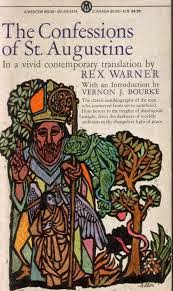
The Confessions of Saint Augustine
source Wikipedia

The Third Stage of Reading:


What are the three moments, or time frames, of the autobiography?
1.        As a child, forming a poor character by stealing and valuing things that were superficial .  He grew up accepting the social value of using knowledge as an end, rather than as a means to forming good character, yet he could see that there was no fruit in this approach to life.

2.        As a young man, being influenced by friends and being draw into the Manichean beliefs as he searched for meaning in the world.  Augustine seemed to straddle the life of worldly pleasures and the search for a life of  abiding faith.

3.       As a more mature man, finding a way of reconciling God to his intellect, converting to Christianity, discovering joy and peace, and writing his confessions.
Do you agree with what the writer has done?

I absolutely love that Augustine kept searching.  We all get pulled into the world to a certain extent, by technology, materialism, etc. and we all struggle with our human nature.  Augustine’s search for God ended not only in finding Him, but by learning that God had been search for him all-along.  And in the end, Augustine was no longer living for himself but for God, a manner of living that brought such joy and contentment to his spirit.

Saint Augustine & Saint Monica (1846)
Ary Scheffer
source Wikipedia

This book is broken up into two section, the first being Augustine’s autobiography (the first 9 books) and the second being theological & philosophical works (the last 4 books).  With regard to the latter, Augustine’s curiosity and quite astounding intellect can leave his reader going “huh?” as we try to navigate with him through the quite confusing realms of memory & senses, the meaning of time, and the book of Genesis and how it intersects with the Trinity.  In retrospect, the change in tone between these two sections are perhaps not as unusual as they first appear.  In the first nine autobiographical books, Augustine is dealing with the past, yet with the second section, he deals with the present and some of the thoughts that he is reflecting on during his life as a bishop.  These subjects also tie into the material he has already presented:  memory affects his presentation of his past experiences, time relates to the existence of his past recollections, and the chapters on Genesis and the Trinity are reminiscent of his earlier inquiries on how to read the Bible and how to view God.

During my first reading of Confessions, the last few chapters honestly went over my head, but with this second reading, I was able to follow Augustine’s train of thought at least now and then.  I will definitely re-read this book in the future.  There is so much to draw from this great intellect and I still feel that I have only scratched the surface.

Portrait by Phillipe de Champaigne
17th century
source Wikipedia

Favourite Quotes:

“If anyone find your simultaneity beyond his understanding, it is not for me to explain it.  Let him be content to say ‘What is this?’ (Exod. 16:15).  So too let him rejoice and delight in finding you who are beyond discovery rather than fail to find you by supposing you to be discoverable.”

In our present time, where progress counts for so much, how many people would be content with not knowing?  And how paradoxical that a desire for discovery of something unknowable, actually brings less knowledge than “not knowing”.

“There is never an obligation to be obedient to orders which it would be pernicious to obey.”

Further reading: 

http://www.college.columbia.edu/core/node/1759 


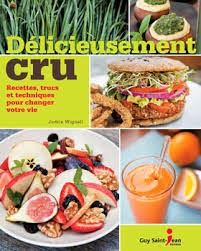
Délicieusement Cru par Judita Wignall

No, not a classic, but a book that can be added to my Summer Freak Language Challenge.  About four years ago, I went on a raw diet for about three weeks and felt the best that I’ve felt in a long time. So this summer I’ve been poking around raw cookbooks again, and this one just happened to be in French.

Délicieusement Cru, or Deliciously Raw in English, is a raw cookbook that takes raw food to a new level.  Using similar ingredients to other raw cookbooks, it adds new creative zest and additional ingredients and techniques which transform your common raw food recipes into something gourmet.

Stand-out recipes include:

  • Smoothie au piña colada
  • Crêpes aux petits fruits et à la crème
  • Salade vitaminée
  • Soupe verte énergétique
  • Hoummos de courgettes
  • Fromage de noix de cajou et de graines de chanvre
  • Sandwiches roulés aux légumes et au pesto
  • Pizza végétarienne
  • Mousse à l’orange et au chocolat
  • Tarte aux fruits d’été
  • Crème glacée à la vanille
  • Gâteau au fromage aux cerises et au chocolat blanc

An especially clever addition by the author, is a list of the soaking times, drying times and preparation times at top of the recipes.  Making raw food usually takes much less prep time than cooked food, but much more co-ordination.  By having the times listed, it makes this task less complicated.

As for the French used in this book, I was rather shocked to find out that I needed very little help with translation; I knew the majority of the words and those I didn’t know, I could accurately guess.  The one word that had me completely stumped was le chanvre, which my dictionary soon disclosed as “hemp”.   It was rather unsettling to discover that my French food vocabulary is rather large, but at least I’ve determined that if I want to increase my vocabulary, I need to stay away from French cookbooks. 🙂

Has anyone else tried raw foods or ever followed a raw food diet?  Please let me know!  I’d love to hear your experience!

Desiderata

 by Max Ehrmann


Allez tranquillement parmi le vacarme et la hâte
Go placidly amid the noise and haste


Et souvenez-vous de la paix qui peut exister dans le silence
Remember what peace there may be in silence


Swiss Landscape with Flowering Apple Tree (1876)
Gustave Courbet
source Wikiart


Sans aliénation, vivre autant que possible en bons termes avec toutes personnes

As far as possible without surrender, be on good terms with all persons


Dîtes doucement et clairement votre vérité; et écoutez les autres, même le simple d’esprit et l’ignorant, ils ont eux aussi leur histoire.
Speak your truth quietly and clearly; and listen to others, even to the dull and the ignorant; they too have their story.


Évitez les individus bruyants et agressifs, ils sont une vexation pour l’esprit.
Avoid loud and agressive persons, they are vexations to the spirit.


Ne vous comparez avec personne : vous risqueriez de devenir vain ou vaniteux.

If you compare yourselves with others, you may become vain and bitter.


Il y a toujours plus grand et plus petit que vous.
For there with always be greater and lesser persons than yourself.
Jouissez de vos projets aussi bien que de vos accomplissements.
Enjoy your acheivements as well as your plans.
Soyez toujours intéressé à votre carrière, si modeste soit-elle
Keep interested in your own career, however humble


C’est un véritable atout dans les prospérités changeantes du temps
It is a real possession in the changing fortunes of time.


Flower Seller at la Madeleine
Edouard Cortes
source Wikiart


Soyez prudent dans vos affaires car le monde est plein de ruses

Exercise caution in your business affairs for the world is full of trickery


Mais ne soyez pas aveugle en ce qui concerne la vertu qui existe ;
But let this not blind you to what virtue there is;


Plusieurs individus recherchent les grands idéaux ;
Many persons strive for by high ideals;


Et partout la vie est remplie d’héroïsme.
And everywhere life is full of heroism


Soyez vous-même. Surtout n’affectez pas l’amitié.
Be yourself. Especially, do not feign affection.


Non plus ne soyez cynique en amour
Neither be cynical about love


Car il est en face de toute stérilité et de tout désenchantement aussi éternel que l’herbe
For in the face of all aridity and disenchantment it is perennial as the grass
Portrait of an Old Man (1860)
Konstantin Makovsky
source Wikiart


Prenez avec bonté le conseil des années,

Take kindly to the counsel of the years


En renonçant avec grâce à votre jeunesse.
Gracefully surrendering the things of youth


Fortifiez une puissance d’esprit pour vous protéger en cas de malheur
Nurture strength of spirit to shield you in sudden misfortune


Mais ne vous chagrinez pas avec vos chimères.
But do not distress yourself with imaginings


De nombreuses peurs naissent de la fatigue et de la solitude.
Many fears are born of fatigue and loneliness


Au delà d’une discipline saine, soyez doux avec vous-même
Beyond a wholesome discipline, be gentle with yourself
Vous êtes un enfant de l’univers, pas moins que les arbres et les étoiles;
You are a child of the universe, no less than the trees and the stars;


Vous avez le droit d’etre ici.
You have a right to be here.


Et qu’il vous soit clair ou non, l’univers se déroule sans doute comme il le devrait
And whether or not it is clear to you, no doubt the universe is unfolding as it should.
Soyez en paix avec Dieu, quelle que soit votre conception de lui
Therefore, be at peace with God, whatever you conceive Him to be


Quels que soient vos travaux et vos rêves,

Whatever your labors and aspirations


Gardez, dans le désarroi bruyant de la vie, la paix de votre âme.
In the noisy confusion of life, keep at peace with your soul


Avec toutes ses perfidies, ses besognes fastidieuses et ses rêves brisés,
With all its sham, drudgery and broken dreams


Le monde est pourtant beau ;
It is still a beautiful world;


Prenez attention.
Be cheerful.


Tâchez d’être heureux.
Strive to be happy.

“Desiderata” in Latin means “desired things”  It is a poem that was written in 1927 by Max Ehrmann, a poet, writer and attorney, yet it’s popularity only spiralled after his death.  In 1956, a rector of St. Paul’s Church in Baltimore, Reverend Frederick Kates, included the poem in some devotional material that he planned to give to his congregation, starting the poem on a path of common recognition.  When U.S. presidential candidate Adlai Stevenson was found dead in his home in 1965, a copy of this poem was found by his bed which furthered its rising popularity.  Since then, numerous politicians, actors and musicians have either used the poem for their art or spoken of the effect that it has had on them in their lives.

A bronze statue of Ehrmann can be found in his hometown of Terre Haute, Indianna.

Max Ehrmann (1949)
source Wikipedia

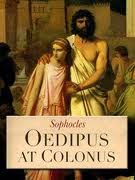
Oedipus at Colonus by Sophocles

“I am blind and old, Antigone, my child.”

Now blind and aged, Oedipus, with his daughter, Antigone, arrive at a place just outside of Athens called Colonus.  Though warned by a villager that this place in which they wish to reside is sacred, possessed by the all-seeing Eumenides (Furies), a land of Poseidon and Prometheus, and the founding stone of Athens, Oedipus refuses to leave.  A past prophecy has determined that the sacred grove of the Eumenides at Colonus, will be the site of his death, and here he is determined to stay.

Oedipus at Colonus
Jean-Antoine-Théodore (1788)
source Wikipedia

When a chorus of men of the city arrive and, upon learning the identity of Oedipus, they attempt to persuade him to depart from their city, fearing his curse will bring trouble to them.  Oedipus defends his position by agruing that because he had no knowledge of his crimes, he is therefore not responsible for the consequences, in particular, claiming self-defence in the murder of his father, Laius.

But lo, into the fray rides his daughter, Ismene, bringing news that Oedipus’ youngest son, Eteocles, has seized the throne of Thebes from the elder, Polynices, and both sons have heard from the oracle that the outcome of their conflict will depend entirely on the location of their father’s burial.  Yet there is more treachery!  Creon (brother-in-law to Oedipus) is, as she speaks, on his way to ensure that Oedipus will be buried at the border of Thebes, without the ceremony, in an attempt to negate the oracle’s proclamation.
Oedipus at Colonus
Fulchran-Jean Harriet (1798)
source Wikipedia

Denouncing them all as villains, Oedipus meets with Theseus, King of Athens who shows sympathy for his predicament, offering unconditional protection and making him a citizen of his country.  How Oedipus praises his saviour, and declares that his beneficent actions will ensure Athens victory in any altercation with Thebes!

When Theseus exits, Antigone announces the advent of Creon.  At first, he attempts to manipulate Oedipus using pity, but when he sees this tact will not bring him success, he admits to kidnapping Ismene, and grabs Antigone to forcibly take her away.  Theseus returns in kingly grandeur to scold Creon, then the Athenians overpower the Thebians, returning both girls to their father.

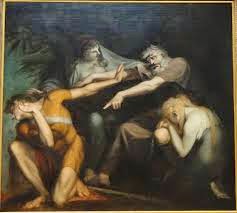
Oedipus Cursing Polynices (1786)
Henri Fuseli
source Wikipedia

One thinks that at last Oedipus might get some peace in his last hours, but it is not to be.  Informed by Theseus that a suppliant has arrived to speak with him, he learns it is his son, Polynices, who begs his father to release the curse he had placed on his sons for their part in his banishment from Thebes, knowing that their conflict is a result of the curse.  Oedipus, in complete disgust of his offspring, refuses and Polynices exits to meet his near-certain fate.

A thunderstorm ensues, which portends Oedipus’ passing.  Oedipus gifts Theseus with the promised gift of protection for Athens and then passes into Hades.  When Antigone wishes to see his tomb, Theseus refuses in response to a promise to Oedipus, never to reveal the location of his tomb.  Antigone departs to attempt to stop her brothers’ conflict.

There is a curious dichotomy in this play with regard to the character of Oedipus.  In spite of the fact he is an exiled, blind old man, with a terrible curse upon him, rarely do you find him subject to the other characters.  In fact, Antigone listens closely to his counsel, he has a command and influence over Theseus, he manages to overcome Creon, and also best his son by refusing to assist him.  On the outside, he is aged, infirm and at the mercy of his hosts, but in actuality, Oedipus is the master of each situation.

Yet Oedipus also places emphasis on his innocence with regard to his crimes.  Again and again, he proclaims to the chorus of Athenian men that he had no pre-knowledge of his transgressions and was, therefore, blameless.  This was a different reaction from Oedipus Rex, where he seemed to take the crimes on to himself, and punish himself for them.

The Death of Oedipus (1784)
Henry Fuseli
source Wikipedia

While on one level, the trials and sufferings born by Oedipus seemed somewhat random in Oedipus Rex, in Oedipus at Colonus we see a culmination of prophecy.  By his exile, Oedipus is brought to the sacred grove of the Eumenides (Furies), fulfilling prophecy, and although this exile was brought about by a curse, Oedipus is actually turned into a hero-type figure by bringing blessing and protection upon the important city of Athens.

Of the 123 plays that Sophocles wrote, only seven complete plays have survived.  That makes me want to cry.  However, parts of plays are still being discovered.  In 2005, additional fragments of a play about the second siege of Thebes, Epigoni, were discovered by employing infrared technology by classicists at Oxford University.  So there is hope that the ancients can still speak to us through time (and new technology) and, as Gandalf said, that is a very comforting thought, indeed!

The book was completed for my Classics Club Spin #6.

Translated by David Grene
Edited by David Grene & Richard Lattimore

⇐  Oedipus Rex  


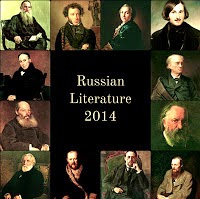
Russian Lit Challenge 2014 – Check-In

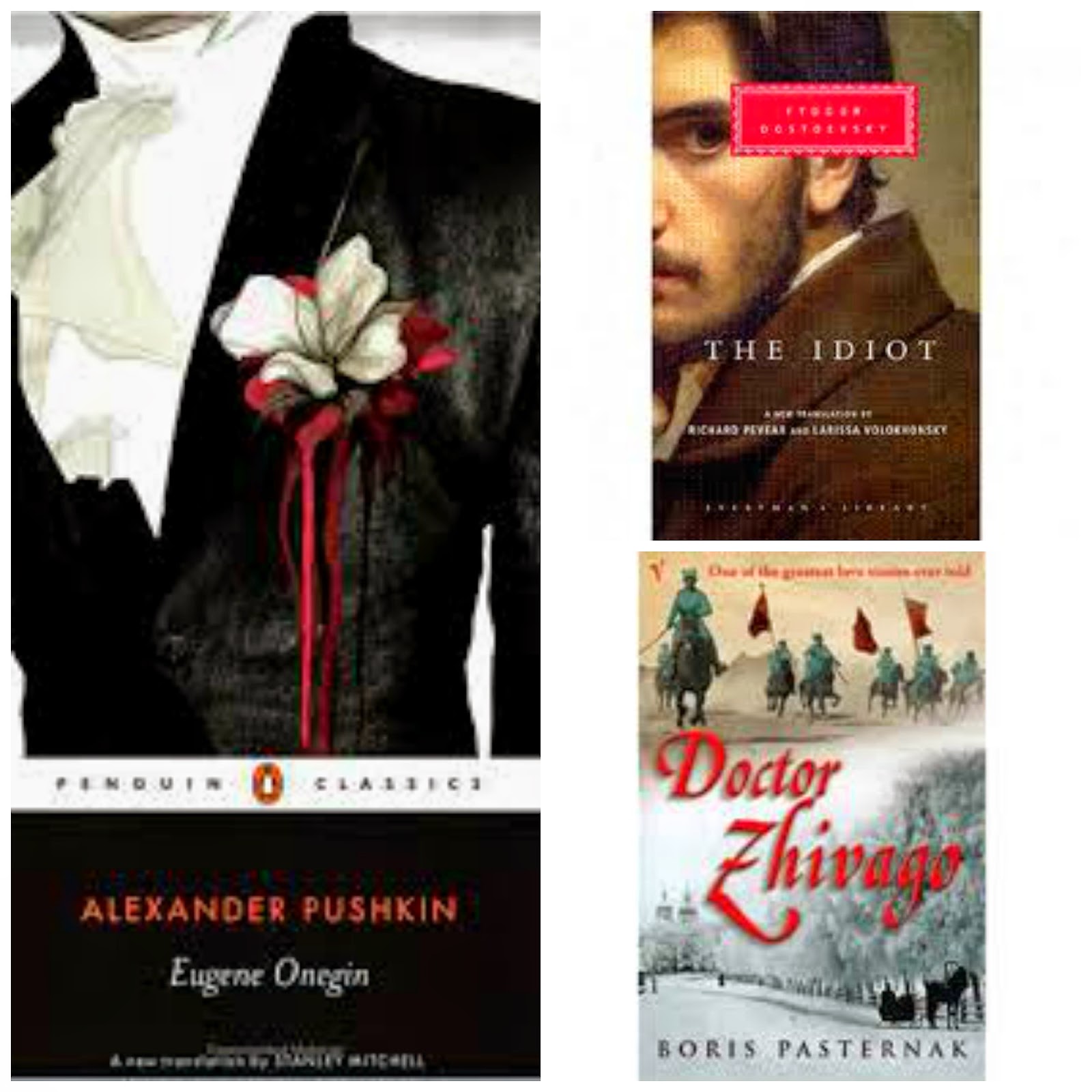
Another challenge check-in and another challenge going along well.  My, it’s nice to get these check-ins on near completed challenges instead of the ones I’m struggling through.  My challenge goal was to read three Russian novels and so far I have read three, so my challenge, theoretically is complete.

Both Eugene Onegin and Doctor Zhivago were re-reads.  I think I’m becoming a re-read advocate because each book that I’ve re-read has given me such a deeper understanding of the work, which, of course, increases my appreciation of it.  This quote pretty much sums up my experience:

“In truly good writing no matter how many times you read it you do not know how it is done. That is beacause there is a mystery in all great writing and that mystery does not dis-sect out. It continues and it is always valid. Each time you re-read you see or learn something new.”                ~ Ernest Hemingway

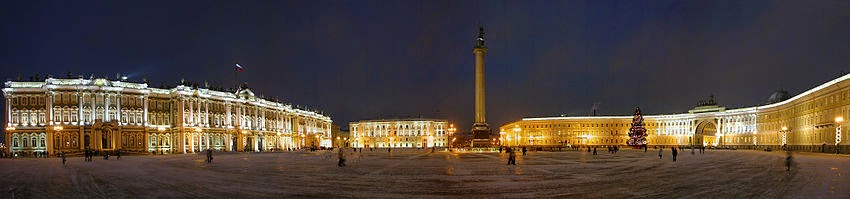
Palace Square in winter
source Wikipedia

But, of course, I’m not done; I’m going to continue with the challenge.  At least before the end of the year I have Fathers and Sons by Ivan Turgenev planned and in the summer I want to read Russian Thinkers by Isaiah Berlin.  The latter would count as a book for this challenge too ……. wouldn’t it ……????

Does anyone have any other suggestions of Russian books that I simply must read?  Any suggestions are welcome!

Mount TBR Checkpoint

According to Bev at My Reader’s Block, it’s time to report on my climb up the mountains!  Which mountains have I surpassed?   Which mountain have I reached?  Have I met my goals?  Well, let me investigate!

As far as my challenge goes, it appears that I quickly scaled Pike’s Peak (12 books), continued on to Mount Blanc (24 books) and have just started to ascend Mount Vancouver, which I’ll conquer if I reach 36 books.  It looks like I may be able to reach Mount Ararat this year at 48 books, but it will be a close call.  Can I do it?  Stay tuned to find out!

photo courtesy of Glenn
source Flickr
Creative Commons

Bev kindly posted a few questions that we may choose to answer in honour of our mid-year check-in.

A. Choose two titles from the books you’ve read so far that have a common link. You decide what the link is–both have strong female lead characters? Each focuses on a diabolical plot to take over the world? Blue covers? About weddings? Find your link and tell us what it is.

This one was particularly easy.  The Odyssey, Oedipus Rex and Oedipus at Colonus all explored the idea of fate, and, from an ancient Greek worldview at least, that you are helpless to escape it.  You’re in the hands of the gods and they control your destiny!

And because that question was so easy, I’ve chosen to answer another one:

 B. Tell us about a book on the list that was new to you in some way–new author, about a place you’ve never been, a genre you don’t usually read…etc.

Paradise Lost had been on my list for some time but I had very cleverly avoided it.  Seventeenth century poetry in blank verse is scary!!  Yet, when it came up in a read-along I knew that it was the perfect time to participate. And wow!  What an epic!  And how silly of me to wait so long.  I have plans to read Paradise Regained but I don’t think that it can even come close to the brilliance of the original so I’m a little hesitant to start it right away.  In any case, with hindsight, I wish I had read Paradise Lost years ago!

photo courtesy of @Doug88888
source Flickr
Creative Commons

So what have you read off your personal bookshelves this year?

New Blog – Old Books

Well, I’ve been blogging for about nine months at Classical Carousel, reviewing classic literature and a few other odds and ends.  Among those classics have been some wonderful children’s books, and reading them has made me realize that I’d like to make a project of reading many more.  Yet, rather than mix the adult classics with the children’s classics, I’ve decided to create a new blog specifically for the children’s literature that I read.  So, may I introduce:

Children’s Classic Book Carousel will not only include reviews of classic children’s books; I also plan to include some basic literary analysis techniques for those readers who may homeschool their children, or perhaps parents who simply want to have some basic guidance to encourage deeper reading.

Children’s Classic Book Carousel won’t be as active as Classical Carousel, but I will attempt to regularly post reviews as I get around to reading the various and sundry children’s classics that inhabit my bookshelves at home.  So please visit my new blog to discover some old, well-loved children’s classics and many others that may be new to you.  You’ll be very welcome!

Nuits de Juin by Victor Hugo

Photo courtesy of Mark J P
source Flickr
Creative Commons License
Nuits de Juin

L’été, lorsque le jour a fui, de fleurs couverte
La plaine verse au loin un parfum enivrant;
Les yeux fermés, l’oreille aux rumeurs entrouverte,
On ne dort qu’à demi d’un sommeil transparent.
Les astres sont plus purs, l’ombre paraît meilleure:
Un vague demi-jour teint le dôme éternel;
Et l’aube douce et pâle, en attendant son heure,
Semble toute la nuit errer au bas du ciel.
~~~~~~~~~~~~~~~~~~~~~~~~~~~~~~~~~~~~~~~~~~~~~~~~~~~~~

Well-known for his epic novel, Les Miserables, Victor Hugo was also a poet.  He produced volumes of poetry including, Les Orientales, Les Feuilles d’Automne, Les Chants du Créspecule, Les Voix Intérieures, and Les Rayons et Les Ombres.  Of course, this poem of Hugo’s that I’ve chosen is very month appropriate.  I’m getting good at this!

~~~~~~~~~~~~~~~~~~~~~~~~~~~~~~~~~~~~~~~~~~~~~~~~~~~~~

June Nights

In summer, when day has fled, the plain covered with flowers
Pours out an intoxicating perfume far off;
With closed eyes, with ears partially open to sounds,
One only half-sleeps with a transparent slumber.
The stars are purer, the darkness more inviting;
A vague half-light tints the eternal dome;
And the sweet and pale dawn, awaiting its time,
Seems to be wandering low in the sky all night.


Transparency
Photo courtesy of Louis Argerich
source Flickr
Creative Commons License

Back To The Classics 2014: Mid-Year Check-In

It is time for the mid-year check-in of my Back to the Classics Challenge 2014.  While it seems like this challenge started only a month ago, I can proudly say that I have managed to stay on top of it fairly well.  In fact, I have only one more book to go, before I’m finished it.  Here is my progress:

1.  20th Century Classic   
2.  19th Century Classic   David Copperfield by Charles Dickens
3.  A Classic By A Woman Writer  Mrs. Dalloway by Virginia Woolf
4.  A Classic In Translation   Son Excellence, Eugène Rougon by Émile
                                                  Zola
5.  A Wartime Classic  Doctor Zhivago by Boris Pasternak
6.  A Classic by an Author Who is New to You  The Warden by Anthony Trollope

Optional:

1.  An American Classic   The Old Man and the Sea by Ernest Hemingway
2.  A Classic Mystery/Suspense Thriller  The Big Sleep by Raymond Chandler
3.  A Classic Historical Fiction Book  The Once And Future King by E.B. White
4.  A Classic That Has Been Adapted into a T.V. or Movie Series  The Great
               Gatsby by F. Scott Fitzgerald
5.  Extra Fun Category – Write a Review of #4  The Great Gatsby Review


So, you see, one more book and I’m complete!  If only I could say that I was doing as well on all my challenges.  My History Challenge is sadly lacking books, my TBR Pile Challenge is struggling and my Shakespeare Challenge …….?  Well, the less said, the better.  At least when I clear off this challenge I can concentrate on some others.

Have you joined Back To the Classics 2014 Challenge and, if so, how are you progressing?  If you didn’t join the challenge, how many classics have you read this year?

Rotkäppchen (Little Red Riding Hood) by The Brothers Grimm

Little Red Riding Hood
George Frederic Watts
source Wikipedia

“Es war einmal eine kleine süße Dirne, die hatte jedermann lieb, der sie nur ansah, am allerliebsten aber ihre Großmutter ……….”

German is not the best of my multiple basic languages, but for this month, I decided to tackle Little Red Riding Hood.  I was hoping that my familiarity with the story would help my stumbling reading and I was right! The story begins with: There once was a sweet little girl who was loved by everyone who saw her, but was most of all loved by her grandmother, … … ”  

Even though this story is a version by Jacob and Wilhelm Grimm, the tale of Little Red Riding Hood has existed possibly since before the 10th century, and no one knows definitively where it originated.  There is evidence of it appearing in France in the 10th century, and Italy in the 14th century.  Not only do numerous versions exist but they occur in widely different areas:  La finta nonna (The False Grandmother) in Italy, The Story of Grandmother and even in Oriental tales like Grandaunt Tiger.  Although the first written version appeared in the 17th century (by Charles Perrault), scholars surmise that the tale did indeed originate in the 10th or 11th century in Europe and somehow spread to Asia.

Little Red Riding Hood (1881)
Carl Larsson
source Wikipedia

This German version, was somewhat different from the anglicized versions that I’d read as a child.  In this version, the wolf eats both the grandmother and Little Red Riding Hood, whereupon a huntsman arrives, cuts open the wolf’s stomach to free them and puts stones inside him before he sews him up.  The wolf awakes and dies from the weight of the stones.  This was similar to the versions that I read as a child, yet this present version ended with a slight twist:  Little Red Riding Hood meets another Wolf one day, who tries to lure her off the path but, with the wisdom of her first experience, she refuses and arrives at Grandmother’s house in one piece.  The wolf follows, climbs on the roof of the cottage, and plans to eat Little Red Riding Hood when she emerges to make her journey home.  Slyly the Grandmother instructs Little Red Riding Hood to put the water she had used to boil sausages in the trough outside.  The wolf, attracted by the wonderful smell, slides off the roof and drowns in the trough.

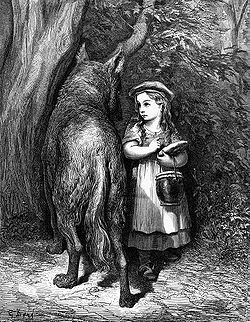
Little Red Riding Hood (1883)
Gustave Doré
source Wikipedia

Other tidier versions I’ve read as an adult, have Grandmother merely hiding in the closet to escape the wolf, or the huntsman rescuing Little Red Riding Hood before she is eaten.  Call me bloodthirsty, but I don’t care much for these sanitized versions.   These stories were meant to inculcate caution in children and the thought of being eaten would be much more effective than the possibility of having a little scare before you are rescued.  I imagine, during these times, a properly instilled caution could be the difference between life and death.

What fun to read Little Red Riding Hood in German!  Now I won’t be so intimidated to tackle another German tale!

Further reading: