The Odyssey Read-Along Book XIII & XIV

The Odyssey Read-Along @ Plethora of Books

Book XIII

The Phaiakians give Odysseus numerous gifts, store them in the ship and set off for Ithaka.  On the way, Odysseus falls into a deep sleep and does not even wake when the Phaiakians carry him on shore and leave him with his gifts on the beach.  They return home but Poseidon is angry that they have helped our hero and, as punishment, he turns their ship into a rock in their harbour for all the people to see.  A prophecy has been realized and, worried, Alkinoös vows they will never convey another man at the risk of making the gods angry.  When Odysseus awakes he is furious, not recognizing Ithaka because of a mist Athene has put around him, and he think the Phaiakians have dropped him on a foreign island.  Grumbling, his first thought is to check his treasure to make sure that they haven’t stolen anything.  When Athene approaches as a man, he at first does not recognize her and asks if she can rescue his possession and him.  She reveals to him that he has landed on Ithaka, whereupon he tells her a pack of lies about his journey and landing to cover his true intent, but then Athene turns herself into a woman and he recognizes the goddess.  She lightly chides him in almost an admiring tone for his crafty, devious words.  He reveals he still does not think himself in Ithaka, that she is teasing him but Athene confirms it again with words that are temperate, but speak poorly about Odysseus’ character.  She lifts the mists and he now sees Ithaka; rejoicing he promises her gifts.  They then hide his gifts within a cave, placing a stone over the door, and Athene transforms Odysseus into an old man for protection so no one will recognize him.  She then departs for Lakedaimon to fetch Telemachos while Odysseus goes on to find his swineherd.
Hero or Ruffian
As the story moves on, Odysseus’ character becomes more questionable.  His majestically contrived words earn him many gifts from the Phaiakians, yet when he thinks they have left him somewhere other than where he requested, he is quick to blame them and then suspect them of treachey.  He is the most consumate liar when he first meets Athene and even she, while appearing somewhat disgusted at his display, cannot help sounding impressed, telling him he could almost fool a god.  He even appears to disbelieve Athene when she confirms he is on Ithaka, and she chides him then as well:  “Anyone else come home from wandering would have run happily off to see his children and wife in his halls; but it is not your pleasure to investigate and ask questions, not till you have made trial of your wife ……”  Yet we must not forget that Odysseus is in the gravest danger from the suitors if they realize he has returned.  He must be intensely careful now in order to guard is life.  Deception and disguise are his weapons at this point, and no one wields them as well as Odysseus!
Gifts
I’m trying to find out where these fit into the story and the importance of them.  I do realize that they are connected to glory and honour and are therefore of the highest import, but Odysseus appears addicted to them, risking death at the hands of Polyphemus in the off-chance he could aquire some; in this chapter he is first of all worried that the Phaiakians have stolen some of what they’ve given him and when he meets Athene he says, “ ……. Rescue these possessions and me.”  His treasure comes even before himself.  Is this the normal Achaian love of fame and glory, in that wealth is directly proportional to status, or does Odysseus’ lust for goods contain something extreme and unusual for the culture?


Minerva (Athena)
Jacques-Louis Dubois (19th century)
source Wikimedia Commons


Book XIV

Odysseus finds his swineherd, Eumaios on the porch of an enclosure, but is attacked by his dogs.  Eumaois calls them off and then takes Odysseus in as a stranger, offering him food and wine.  While Odysseus eats, he tells him of the intemperate behaviour of the suitors and their lack of respect towards Penelope; as Odysseus listens, he contemplates the evil he will do these foul men.  The swineherd praises his master and Odysseus is so impressed by his xenia and the way he has handled his goods while he has been absent, he assures Eumaios that Odysseus is bound homeward, yet the old swineherd does not believe his words.  He gives further news of the suitors and how they plan to waylay Telemachos on his way home, with murder in their hearts.  When he asks Odysseus his identity and from where he comes, Odysseus weaves such shocking tales full of deceit that even Eumaios does not believe him, showing wisdom in his scepticism.  He laments that Odysseus had not perished in the war, for if he had, he would have won fame for his household.  Odysseus, then seems to play a game with his servant to get him to give him a mantle or tunic: when the first ploy of asking for one in exchange for his information of Odysseus’ return doesn’t work, he later employs another duplicitous story to aid his devices, yet Eumaois claims there are no extra mantles, then helps to put him to bed under thick sheep fleeces, covering him with a mantle.  Afterwards Eumaios goes out to watch the herds from a sheltered hollow of rock.
Vengeance
The reality of the suitors’ actions must be getting more real to Odysseus as he comes closer to home.  He now has from Eumaios a full account of their actions and while listening, he was devising their destruction.  When Eumaios tells him of their intent to ambush Telemachos and murder him, Odysseus then really has no choice but to kill them all.
Lies and Deceit
I do understand why Odysseus feels it is necessary to lie and deceive to conceal his identity (for protection in this case), but the elaborate, florid, dramatic lies that he weaves ………….. well, are they really necessary?  In this case, even Eumaios does not believe him.  Perhaps, subconsciously, from working for Odysseus before he left for the Trojan War, he has learned to recognize falsehoods told by his master …….??
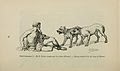

Uysses attacked by the dogs of Eumea
Louis-Frederic Schützenberger (1886)
source Wikimedia Commons


Candide Read-Along Intro & Chapters 1 – 8

And so begins our Candide Read-Along, hosted by Fariba at Exploring Classics.  I was slightly intimidated by this novel but, after doing some research, I feel much more confident that I’ll be able to understand the main points of the novel.  That said, this novel, because of it’s satirical nature and specific satirical targets, deserves an introduction.

Introduction

Published when Voltaire was 66 years old, Candide was expressly written to satirize the philosophy of Optimism.  This optimism was not simply the positive hope of better circumstances, but the belief that everything that happened was for the best, no matter if good or bad, happy or tragic.  This philosophy disgusted Voltaire because he felt that it left no facility for bettering oneself or one’s surroundings and that it supported fatalism and complacency.  The tragic earthquake in Lisbon in 1755 seemed to precipitated the writing of this novel, causing the author to question justice in such a calamity, and reflected in his poem, “Poem on the Disaster of Lisbon,” written weeks afterward.  Candide was further emphasis of Voltaire’s rejection of the attitude that life was the “best of all possible worlds” and that everything that happened in it was for the best.

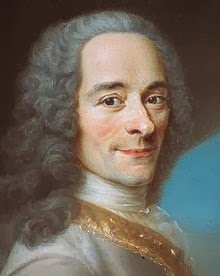
Voltaire
detailed portrait by Maurice Quenton de la Tour
source Wikipedia

Voltaire was an established writer and thinker by the time he wrote Candide, yet a controversial figure who by many was both admired and hated.  He  was continuously clashing with the government and the church, suffering two periods of incarceration, and most of his adult life was spent exiled from Paris, the city of his birth.  Much of his works were published under a pseudonym to avoid prosecution.  During a stint in exile, he spent three years in Great Britain and, impressed with the freedoms of England, particularly that of speech, his stay intensified his desire for reforms in his home country.  In 1758 he settled in Ferney in eastern France, spending his time farming, writing and supporting local business.  Candide was written here, not long after his move.

Satire:  the use of humour, irony, exaggeration, or ridicule to expose and criticize people’s stupidity or vices, particularly in the context of contemporary politics and other topical issues

Chapter 1

Candide, a young man with “sound judgement and great simplicity of mind,” lives in the household of the Baron Thunder-ten-tronckh.  It is suspected that he is a child of the baron’s sister and a neighbourhood nobleman.  With a innocent susceptibility, he accepts his tutor, Pangloss’ teaching of “everything is necessarily for the best purposes.”  Cunegonde, the baron’s daughter espies Pangloss dallying with a maid, decides she wants to repeat the experiment with Candide, but they are caught in the act of caressing by the baron and Candide is literally booted from the house.

Voltaire’s sarcasm is apparent in his treatment of the baron.  He gives his castle a pretentious name, makes the baron important merely because he has a castle with doors and windows and praises the baroness for her prodigious weight, equating it with esteem.

Chapter 2

Arriving in the nearest town, Candide meets two Bulgar soldiers who force him to come with him but due to Candide’s naiveté he innocently does their bidding.  After being conscripted into the army, he is trained, yet one day when out for a walk he is seized, taken back to the barracks and put on trial.  The sentence passed is that he can be beaten by the regiment 36 times (running the gauntlet) or have 12 bullets put into his brain.  He chooses the former but, after 3 times is near death.  Fortunately the king of the Bulgars happens along and pardons him, realizing that he is “a young metaphysician, utterly ignorant of worldly matters.”  The armies of the Bulgars and the Avars then clash in battle.

Voltaire explores army conscription; people were often tricked into serving and severely punished if they did not obey the rules.  He also brings in the question of free will:  “It did him no good to maintain that man’s will is free and that he wanted neither; he had to make a choice.”  I’m not quite certain his point in this; did he deny free will and feel that fate controlled circumstances or did he accept free will but feel that it was limited by our circumstances?

Chapter 3

The two armies meet and there are 30,000 deaths from cannons, rifle-fire and bayonets.  Candide decides to go away to reason about cause and effect.  He encounters a burned Avar village, with scenes of carnage and molestation, and littered with body parts.  In a Bulgar village he finds similar atrocities and decides to go to Holland where he would find Christians who would treat him as he was accustomed to be treated in the baron’s castle.  Yet when he begs for alms he is mocked and derided.  An orator who is speaking of love labels him a wretch and rejects him outright because he will not speak against the pope.  Fortunately he meets Jacques, an unbaptized Anabaptist who gives him shelter, a bath, food, money and offers to teach him to manufacture Persian  fabrics.  Candide assume this treatment confirms the “all is best in the world” theory.  On his walk the next day, he happens upon a diseased beggar.

Voltaire feelings of revulsion of the effects of war is apparent in this chapter.  He uses oxymorons to get across the absurdity of war: “….. a harmony whose equal was never heard in hell,” and ” ….. during the heroic carnage,” as well as horrific scenes of slaughter.  The hypocrisy of Christianity is also brought to the forefront, which is countered by Jacques, the Anabaptist.

Chapter 4

Candide discovers that the beggar is his old tutor, Pangloss, who gives him the horrific news of Cungonde’s death.  Candide faints and when he recovers, Pangloss tells him that the baron and his wife and son were killed, Cungonde was raped and disembowelled and the castle razed to the ground.  He blames his affliction on the baroness’ maid who infected him with syphilis, tracing the disease back to Columbus’ shipmate.  Jacques pays to have Pangloss cured, the tutor only losing an ear and an eye.  Two months later they must travel to Lisbon, and on the ship, Pangloss states it is all for the best but Jacques contradicts him, saying that men are not born bad but make choices that have direct bearing on their situations.  Pangloss counters that individual misfortunes are for the greater good.  They encounter a raging storm.

Pangloss’ reasoning with regard to him contracting the pox had some sort of weird psychological reasoning which I could not follow.  Pangloss rejects that his situation could be punishment for sin or caused by evil.  I did like how Jacques mentioned that, 

“Men must have a corrupted nature a little, because they weren’t born wolves, yet they’ve become wolves:  God didn’t give them twenty-four-pounders or bayonets, but they’ve made themselves bayonets and cannons with which to destroy each other.”

Another comment on the senselessness of war.

Chapter 5

The storm becomes perilous and Jacques is tossed into the sea (after saving a sailor who now does not attempt to save him) where he drowns.  Candide wants to jump in to save him but Pangloss prevents this heroic act, explaining the harbour was designed especially for the Anabaptist to drown in.  When they reach land, there is an earthquake and later, after getting dinner from some inhabitants that they assisted, an officer of the Inquisition argues with Pangloss that if all is for the best, there then can be no original sin or punishment.  Pangloss argues back and they discuss free will.  The officer ominously nods to his attendant.

Another instance of free will being mentioned and more of Pangloss’ philosophy.  The problem of evil is touched on.  Is man evil?  Are things like Pangloss’ recent condition and the earthquake punishment for evil?  What is purposeful and what is destiny?  What can be altered and what is fate?  The earthquake mentioned here is based on the real earthquake of 1755 in Lisbon.  

Chapter 6

After the earthquake, the “wise men of the country” decided to have an auto-de-fe (or a ritual of public penance, during the first part of which accused heretics were sentenced by the Inquisition), and they burn people to prevent another quake.  Pangloss and Candide are arrested, the former for having spoken and the latter for listening.  Candide and Pangloss are forced to wear miters, Candide’s with flames pointing down and devils with no claws or tails and Pangloss’ with the flames pointing upward and devils with claws and tails.  Candide was beaten to beautiful music, Pangloss was hanged and the earth trembled again.  Candide begins to question the “best of worlds,” thinking of the fate of Pangloss, Jacques and Cunegonde.  An old woman tells him to follow her.

Superstition seems to be a main theme of this chapter, exemplified by the auto-de-fe in hopes of avoiding another earthquake.  Along with Pangloss, two men who would not eat the pork were hanged, obviously two Jews.  Candide begins to question the “all is best” philosophy and he no longer has Pangloss to continually reinforce these views.  What will happen to his perceptions without his friend?

Chapter 7

The woman takes him to a hovel, feeds him and he sleeps.  The next evening she takes him to an isolated house where he finds Cunegonde.  He is ecstatic, falling at her feet.  Cunegonde tells him Pangloss’ report was true but she survived and will tell him more after he relates what has happened to him since he left the castle.  He does.

There is not much to say, except to note the air of mystery in the chapter.  It says Candide regards “his whole life as a nightmare, and the present moment a delightful vision.”  A flair for the dramatic.  Why would he regard is whole life a nightmare when he was completely happy up until the point he was evicted from the castle?  I suppose it’s a devise to emphasize his overwhelming happiness at discovering Cunegonde alive.

Chapter 8

Cunegonde recounts the horrors she experienced at the hands of the Bulgars.  The Bulgar captain sold her to a Jew and later, when she was noticed by the Grand Inquisitor they decided to share her, although she so far has resisted them both, as “a lady of honour may be raped once, but it strengthens her virtue.”  She saw both Pangloss and Candide at the auto-de-fe and suddenly realized that Pangloss’ theory of “all is for the best” is not true.  She gave her servant orders to find him and voilà!  But Don Issachar, the Jew has arrived home expecting his rights.

Discussion Questions

1)      Do you think Pangloss is a predatory figure or merely naive like Candide? In other words, is Pangloss deliberately trying to lead others astray or does he actually believe in the philosophy of optimism?

I think Pangloss truly believed in his philosophy.  Voltaire makes him almost blind to what is around him and his comments do not stem from what he actually sees (outward) but solely from what he believes (inward).

2)      How do you feel about Voltaire’s writing style? Do you find this book funny or disturbing?

So far I am keeping an open mind.  I have not consciously read a book as satire before, so I’m wondering if all satires are as overdone as this one is feeling.  I’m finding it mostly disturbing, yet it is so contrived and theatrical, I’m honestly having trouble taking it seriously to have a feeling either way.

3)      Who is your favorite character thus far?

Jacques is definitely my favourite character so far.  Actually, he is the only character who has seemed like a character; the rest have been more like caricatures.

The Odyssey Read-Along Book XI & XII

The Odyssey Read-Along @ Plethora of Books

Book XI

When Odysseus and his companions reach the city of the Kimmerian people, they make shore and find the place of which Circe had told them.  Digging a pit a cubit in each direction, Odysseus pours in honey-milk, sweet wine, water and then sprinkles barley over it all.  Promising a sacrifice when he returns home, he slit the throats of the sheep and lets the blood run into the pit as well.  Ghostly souls surrounded the pit, “up out of Erebos, brides, and young unmarried men, and long-suffering elders, virgins, tender and with the sorrows of young hearts upon them, and many fighting men killed in battle, stabbed with brazen spears, still carrying their bloody armour upon them.”  Odysseus gives the sheep to his men to finish the sacrifice, but he crouches with his sword by the pit, not allowing any of the ghostly apparitions to draw near until he has spoken with Teiresias.  The first soul to approach the pit is one of his men, Elpenor, who had falled off the roof of Circe’s palace just before they had set sail.  He laments that he was not buried or mourned, and pleads with Odysseus to return to Circe’s island to accomplish this task; Odysseus agrees.  

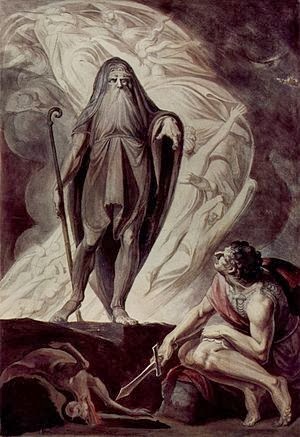
Tiresias appears to Odysseus
Johann Heinrich Füssli (1780-1785)
source Wikipedia


Next, he encounters the soul of his dead mother, before Teiresias the Theban appears before him and speaks a prophecy:  Poseidon will make his homecoming difficult.  If they do not eat the cattle & sheep of Helios, they may reach Ithaka, but if they do, only Odysseus will return, he will find troubles in his household and will have to punish with violence the men who have committed treachery there.  After Odysseus sets his household in order, he instructs him to go on a journey where he will meet unusual men and there make a sacrifice to Poseidon.  His death will be from the sea and “unwarlike” but in old age, and his people will be prosperous.  Odysseus, while he listens to the instructions, is more interested in gaining information about his mother, but Teiresias says any who he allows to drink the blood will give him answers and then he fades away.  When Odysseus inquires of his mother how she met her death, she reveals that it was from pining away for him and, greived, he tries three times to embrace her but is unable to do so because of her state in death.  After his mother, a catalogue of women come to him, Tyro, Antiope, Alkmene, Epikaste, etc. and the reader learns something of their history.  The end of this catalogue brings Odysseus out of his story and back to the court of Alkinoös and the Phaiakians, but they urge him to continue, completely enraptured with his tales.  He resumes his story of Hades, as Agamemnon steps up to the pool, lamenting the treachery of his wife and the untrustworthiness of women.  Yet he then compliments the virtue and loyalty of Penelope, but cautions Odysseus to go covertly to his homeland.  Achilles then comes, happy to receive information about his son.  The soul of Aias, however, will not speak or approach him, still angry over the loss of Achilles’ armour to Odysseus.  Odysseus tries to make restitution but Aias will have none of it and walks away.  There is another catalogue of souls of men such as Minos, Orion, Tityo, Tantolos, etc .  While Odysseus wishes to see more souls, a “green fear” comes upon him again and he returns to his ship.

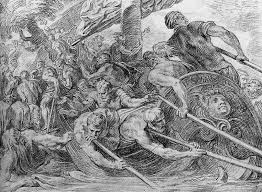
Odysseus lands at the beach of Hades
by Theodoor van Thulden
source Wikipaintings


Elpenor
In the scene in Hades, in order to speak with Odysseus the shades must drink the sacrificial blood first, all except for Elpenor: he is able to speak without drinking  Why is this?  Is it because Elpenor was not properly buried and mourned and he is no longer of the earth, yet not able to reach Hades until someone rectifies the error?  It would explain his plea to Odysseus.

Faithfulness and Treachery

Agamemnon goes to great lengths to explain his murder and how it was brought about.  He is particularly caustic towards his wife, vilefying her as “treacherous”, “sluttish”,  “deadly” and “vile” and claiming that she would not even allow him a proper death ritual.  He then goes on to praise Penelope, calling her “circumspect”, “virtuous”, and that her mind “is stored with good thoughts.”  The comparison is striking, yet even so he warns Odysseus to return to his own country in secret.
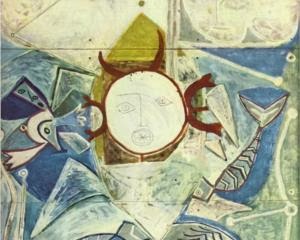
Ulysses and the Sirens
Pablo Picasso (1946)
source Wikipaintings

Book XII

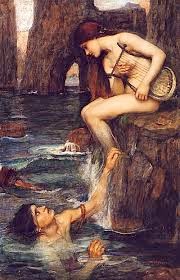
Leaving Hades, Odysseus and his men return to the island of Aiaia to give Elpenor a proper burial.  Circe’s addresses Odysseus, revealing all the struggles which he will face on the way home, and what he must do to have a successful journey; then she gives them a fair wind to set them on their way.  The first terror they face is the Sirens, “enchanters of all mankind”; no one can resist their song, yet the reward is to become part of the boneheaps of men on the beach.  As per Circe’s instructions, Odysseus stops the ears of his men with wax and gets them to lash him to the mast.  When the lovely Melody of the Sirens drift into his ears, he begs his companions to untie him, yet they only lash him tighter.  After the crisis passes, their next challenge is to get past Scylla, and as Circe described her, she is a six-headed, twelve-footed monster with three rows of teeth and is “full of black death.”  As Circe prophesied, she grabs six men with each head as they row by, and Odysseus reveals that he did not tell his men about Scylla because six men had to be sacrificed to her; had the men realized the danger, they would have stopped rowing and sought protection inside the ship. On the other side of the channel, the monster Charybdis is sucking and vomiting water, yet they make it through with the loss of six, and come in sight of the island of Helios, where Hyperion, the Sun God resides with his sheep and cattle.  Odysseus counsels that they keep going but the men, led by Eurylochos strongly protest and he submits to their whining, making them swear an oath that they will not touch the sheep or cattle, knowing that if they do, as Circe foretold, that they will never make it home.  But to their dismay, a South Wind blows for longer than a whole month, and as the men eat up the supplies, Eurylochos finally convinces them to take one of Helios’ cattle.  While Odysseus is away, they butcher a fat oxen, using the justification that they will kill it as a sacrifice and then build a temple to Helios when they return home.  Returning, Odysseus is horrified; his men all blame each other and, as Circe and the blind Teiresias prophecied, they are shipwrecked on their way out.  All the men perish but, as he is pulled towards Charybdis, Odysseus manages to hold onto a fig branch until she disgorges two long timbers and he rides on these until he reaches the island of Kalypso.

The Siren
John William Waterhouse (circa 1900)
source Wikipedia
Leadership

More and more examples of faulty or non-existent leadership abound.  Why did they leave Elpenor without a proper burial?  Odysseus is deceitful towards his men by not telling them that six of them will die while passing by Scylla.  Is this strong leadership; is it the only way they will be able to pass this area and arrive home?  Did Odysseus sacrifice six to save many?  Is this right?  And finally the men not only break their oath to Odysseus by eating the cattle of the Sun god, but they then blame each other when he finds out.  As they struggle to find their homeland and attempt to emerge unscathed after numerous clashes with gods, monsters and fantastical creatures, are they losing some of the qualities that make them human?  Are they becoming more like the world they are inhabiting?
A 19th century engraving of the Strait of Messina, site
associated with Scylla & Charybdis
source Wikipedia

(While copying my post to my Blog, my Blogger font caused me grief and, not having the patience or the resourcefulness of Odysseus, I couldn’t fix it without a struggle, so I apologize for the lack of uniformity in this post.)

The Odyssey Read-Along Book IX & X

The Odyssey Read-Along @ Plethora of Books

Book IX

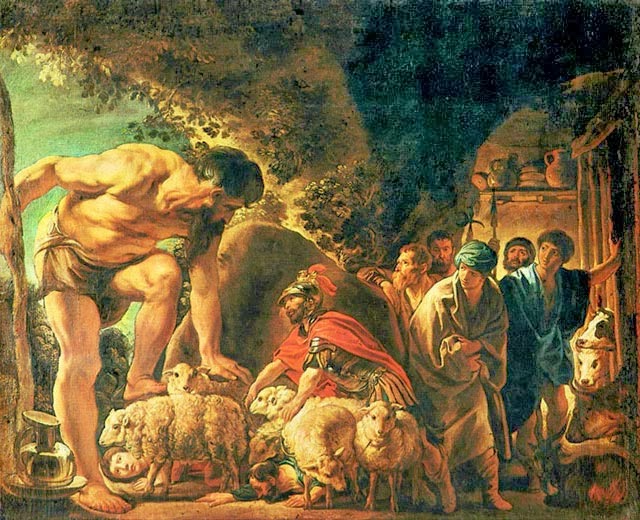
Odysseus finally reveals his identity and begins the story of his adventures on his quest to return to his homeland.  First Odysseus and his men sack the city of the Kikonians at Ismaros, killing the inhabitants and taking their wives and possessions, but when the Kikonians bring reinforcements, the Achaians are driven away.  Caught in the North Wind (caused by Zeus), they are swept along for ten days, finally landing in the land of the Lotus-Eaters.  When the scouts Odysseus sends out, return “drunk” on Lotus and without the desire to return home, he ties them in the ships and they escape immediately, sailing until they reach the land of the Cyclops.  After landing in an area far away from habitation, Odysseus takes his ship and men and goes to reconnoitre with a host of 12 companions.   They find the cave of Polyphemus and, although his companions beg him to take the stores and fly away, Odysseus refuses, believing that if he meets Polyphemus, that he will give him presents.  They are startled however, to see he is a monstrosity and they hide in the back of the cave until he spies them and asks their business.  Only Odysseus is brave enough to answer, asking, as supplicants, for “guest presents or others gifts of grace, for such is the right of strangers” with respect to the gods.  Polyphemus scorns the gods, stating, “we are far better than they,” and asks Odysseus after his ship.  With crafty words, Odysseus claims they were shipwrecked.  In response, Polyphemus grabs two of his men, “slapped them, like killing puppies, against the ground, and the brains ran all over the floor, and ate them.”  Odysseus realizes there is little chance of them being able to push away the boulder in front of the cave, so he begins to devise a plan.  They find a large olive branch and shave and shape it to a point, then draw lots to see who will attack the Cyclops.  Upon the return of Polyphemus, Odysseus identifies himself as “Nobody,” plies him with wine and when he is sleeping, they shove the spear into his eye, turning it, “like a man with a brace-and-bit who bores into a ship timber.”  The cries of Polyphemus bring the other Cyclops, who cannot get inside because of the boulder.  When they ask his troubles, he answers, “Nobody is killing me by force or treachery!”  Puzzled, they tell him he must be sick and return to their homes.

Odysseus in the cave of Polyphemus
by Jacob Jordaens (1635)
source Wikipaintings

Odysseus then concocts a brilliant plan to tie three sheep together and have one of men hang under each of the centre sheep.  In this way they all escape, but unwisely Odysseus chooses to taunt the Cyclops when they are at sea, and twice Polyphemus hurls pieces of mountains at them, causing them to be pushed back to shore.  Eventually they escape, but not before Polyphemus calls on his father, Poseidon, and prophecies death or troubles for Odysseus.

Ulysses deriding Polyphemus
by William Turner (1848)
source Wikipaintings

Hospitality

The Cyclops does not recognize the code of hospitality.  Is this because his father is a god and he does not have to worry about offending them?  I don’t think so, based on what has happened to other children of gods.  Are they reasonably remote and usually do not have to worry about visitors, because of their hideous appearance and deviant behaviour?  This is puzzling.

Crafty-Odysseus

Yet again, Odysseus proves his ingenuity and bravery in the face of huge odds and terrifying circumstances.  His speeches to the Cyclops were touched with manipulation, falsity and daring.  His quick thinking and careful planning were instrumental in their escape.  Considering his stubborn refusal to leave in the first place because he wanted presents, his actions were well considered, however he still caused the death of some of his men.

King or Leader

Originally I had thought of Odysseus as the king of Ithaka, but even if this term has been used, I’m beginning to conclude that it was a loose term.  As I read on, I wonder if he could be more accurately described as a type of leader.  There are instances of him refusing to listen to his men, such as the case of mocking the Cyclops and not leaving the island without gifts; yet there are also cases where his men don’t listen to him, as when he urges that they leave after the first battle with the Kikonians and, because of their stubbornness, end up in another battle and are subjected to casualties.  Does this behaviour make the suitors behaviour at home less surprising?  What was Odyssey’s role in his own country?

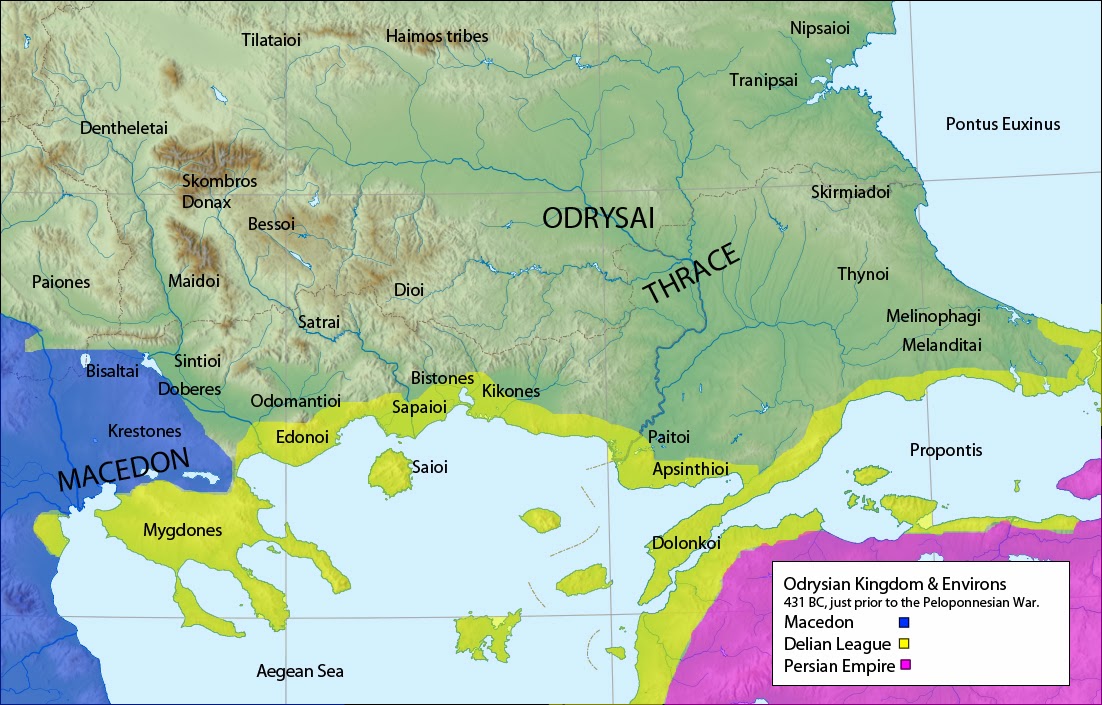
Approximate location of the Kikonians
source Wikipedia

Book X

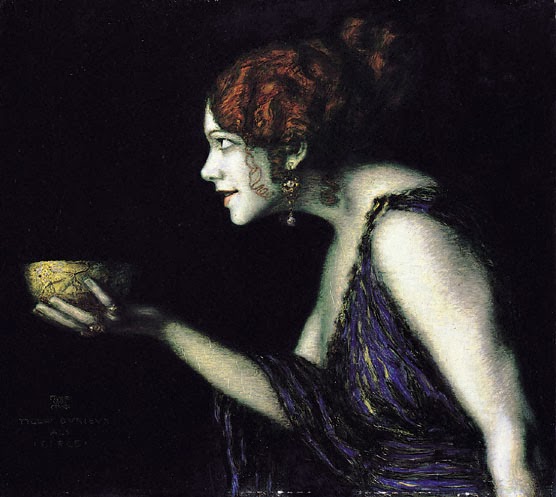
They arrive at the Aiolian island where Hippotas’ son, Aiolos lives.  For one month he entertains Odysseus and his men and then gifts him with a bag “stuffed full inside with the courses of all the blowing winds” upon his departure.  But lo, as the ships finally spy their homeland, the men begin to grumble about the greater portion of spoils that Odysseus has in his possession.  While Odysseus sleeps from exhaustion because he would not permit anyone but himself to handle the ship, the men unwittingly release the winds which wildly blow them back to the island of Aiolos.  In spite of Odysseus’ pleadings relating to the foolishness of his men, Aiolos is appalled to see them and sends them away, astounded that the gods are so much against them.  Sailing, on the seventh day, they reach the citadel of Lamos and three people are sent off to scout.  They encounter the daughter of Antiphates who sends them to her house, but there stands a woman as tall as a mountain, and when Antiphates materializes, he snatches up one man and prepares to eat him for dinner, while the rest flee back to the ships.  The king raises the alarm throughout the city and these giants begin to hurl boulders at the ships, and spear men like fish as they go.  Only Odysseus’ ship escapes and they reach the island of Aiaia, where Circe, the goddess who speak with royals and the daughter of Helios, lives.  Odysseus and Eurylochos draw lots to determine who will reconnoitre the island and Eurylochos sets off with his men.  When they find the house of Circe and she invites them inside; Eurylochos is the only one who refuses, suspecting treachery.  His surmise is correct as Circe proceeds to lead the men into pig pens and transform them into pigs.  Eurylochos hastens back to tell Odysseus of his mens’ sorry fate. Odysseus decides to face Circe on his own and on his way he meets Hermes who tells him how to best the goddess and gives him medicine to help counteract her potion.  When Circe hands him the drink, he swallows it and, leaping up, draws his sword and springs at her as if to kill her.

Tilla Durieux als Circe
by Franz von Stuck (1913)
source Wikimedia Commons

Astounded that the mixture has had no affect on him, she invites him into her bed, whereupon he forces her to swear that she will practice no more treachery upon him.  She washes him, yet he refuses to eat before she sets his men free, which she does with a command to go back to his camp to bring back the rest of his companions. They cry and weep for joy when they see Odysseus return, but Eurylochos attempts to prevent the men from visiting Circe; Odysseus contemplates killing him but is restrained by his men, and Eurylochos, afraid of being left behind, follows.

Circe
by Wright Barker (1889)
source Wikimedia Commons

For a year, they feast daily on “unlimited meat and sweet wine,” until Odysseus cannot bear it and clasps Circe’s knees, begging her to allow them to resume their journey.  She agrees but imparts a surprising stipulation:  Odysseus must visit the house of Hades and speak with the soul of Teiresias the Theban and blind prophet before his quest may continue.  She gives him directions and instructions for sacrifice when he arrives there, then sets him on his way.

Leadership

Is it my imagination or is the chain of command seriously compromised? First, upon sight of their homeland, the crew becomes jealous of Odysseus’ spoils, and secretly opens the bag of the winds, which blow them back to where they started.  Their envy of his treasures is palpable and their actions, mutinous.

Eurylochos, in spite of being elected leader of the reconnaissance expedition to Circe’s house, chooses not to go inside with his men.  Was that jettisoning his leadership responsibilities?  Did the men refuse to listen to his guidance?  And when he was the only one to make it back to the ship, he was a nervous wreck, refusing to return, even when Odysseus came for them, assuring them everything was alright and that Eurylochos’ men were restored to their origin form.  Odysseus wants to decapitate him for his insolence and has to be restrained.  Was this because Eurylochos attempts to influence the men directly, without speaking to Odysseus first?

Either they are suffering from a slow breakdown of leadership, or the society of Ithaka is sufficiently lawless that there is room made for actions that challenge the chain of command.

Hospitality

The breach of xenia, or the tradition of guest-host hospitality, continues. The Phaiakians disliked strangers and entertaining them, the Cyclops wanted to make meals of them and mocked that his “gift” to Odysseus was that he would eat him last, and now the Laistrygonians attempt to eat them, and Circe turns them into pigs.  Are these lands so far from mainland Greece that they don’t recognize this tradition?

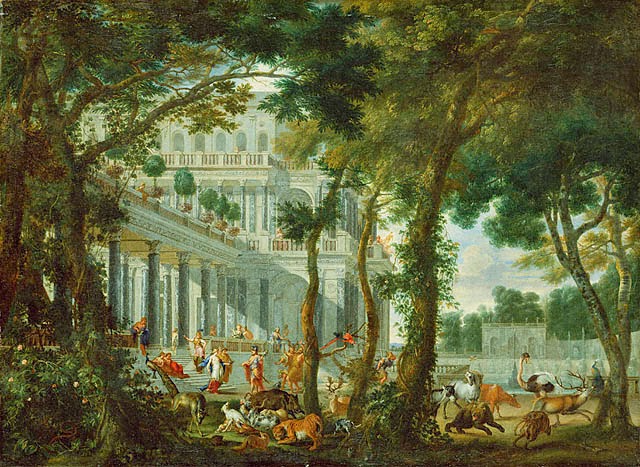
Ulysses at the Palace of Circe
by Wilhelm van Ehrenburg (1667)
source Wikimedia Commons

Paradise Lost Read-Along Books XI & XII

Paradise Lost Read-Along

Book XI


Heaven hears Adam and Eve’s prayers for restoration and the Son intercedes on their behalf with the Father:

” ……….. Now, therefore, bend thine ear
To supplication; hear his sighs, though mute;
Unskilful with what words to pray, let me
Interpret for him, me his advocate
And propitiation; all his works on me,
Good or not good, ingraft; my merit those
Shall perfect, and for these my death shall pay.” (30 – 36)

God accepts His Son’s sacrifice but divulges that they must leave Paradise as they are tainted with sin.  They have lost Happiness and Immortality which are replaced by the “final remedy,” Death.

” …………….. so Death becomes
His final remedy, and after life
Tried in sharp tribulation, and refined
By faith and faithful works, to second life.”  (61 – 64)

Sadly, man now knows both good and evil when he should have been content to know good only.

God commissions the angel Michael to take from among the Cherubim “flaming warriors” and return to to the Garden to evict the luckless couple, yet if they are obedient, he will reveal a new covenant to them.

As Michael prepares to descend, Adam tells Eve he anticipates that God will hear their prayers and that they will live instead of perish.  Though she feels herself unworthy of forgiveness, she is grateful for the pardon and suggests they live in the Garden “though in fallen state, content.”  Yet Adam anticipates that they have not understood all the changes that will arise from their fall and with his assumption, down comes Michael “from a sky of jasper,” “a glorious apparition.”  He indeed confirms that their humble prayers were heard and that “one bad act with many good deeds well-done may’st cover.”  However he cannot allow them to remain in Paradise.

Adam laments, “heart-struck, with chilling gripe of sorrow stood, that all his senses bound”; and Eve cries her protest.  But Michael gives her a response that is at once wise and universal:

“Lament not, Eve, but patiently resign
What justly thou hast lost, nor set thy heart
Thus overfond, on that which is not thine.”  (287 – 289)

Adam shares his fear that he will no longer be able to be close to God, yet Michael comforts him.

“Yet doubt not but in valley and in plain
God is as here, and will be found alike
Present, and of his presence many a sign
Still following thee, still compassing thee round
With goodness and paternal love …..”  (349 – 353)

Michael then takes Adam up the hill of Paradise to show him all the torment, tragedy, hatred, violence, misery and disease that will be a result of their sin. He sees Cain and Abel; death and sorrow.  Adam despairs, whereupon Michael gives him advice for living:  “the rule of not too much, by temperance taught,” “nor love thy life nor hate, but what thou liv’st live well; how long or short permit to Heaven.”  He relates the story of Noah and how God promises never to destroy the Earth again by flood.

Adam, Eve and the archangel Michael
by Gustave Doré

Book XII

Still revealing the future, Michael discourses on how the “second source of men” will have the judgement fresh in their minds and therefore will exist peacefully for a long time until Nimrod builds the Tower of Babel to reach to Heaven and God punishes him, visiting on the people a confusion of language and cacophonous din.  Appalled, Adam censures the attempt of man to dominate man, as it was never in God’s plan; birds, beasts, fish and fowl were to be in subjection of man, yet “man over men he made not lord” instead intending “human left from human free.”  Michael agrees, stating:

“……….. Justly though abhorr’st
That son, who on the quiet state of men
Such trouble brought, affecting to subdue
Rational liberty; yet know withal,
Since thy original lapse, true liberty
Is lost, which always with right reason dwells
Twinned, and from her hath no dividual being
Reason in Man obscured, or not obeyed,
Immediately inordinate desires
And upstart passions catch the government
From Reason, and to servitude reduce
Man, till then free.  Therefore, since he permits 
Within himself unworthy owers to reign
Over free reason, God, in judgement just,
Subjects him from without to violent lords,
Who oft as undeservedly enthral
His outward freedom.  Tyranny must be,
Though to the tyrant thereby no excuse.
Yet sometimes nations will decline so low
From virtue, which is reason, that no wrong,
But justice, and some fatal curse annexed,
Their inward lost …………..”  (79 – 101)

After Noah, men begin to worship idols and slavery ensues, yet God calls Abraham, the blessed patriarch, and through his line a “Great Deliverer” will come who will “bruise the Serpent’s head.”  Michael’s speech continues through Moses.  When Adam asks why “so many laws and so many sins among them; how can God with such reside?”, the angel explains “law was given them, to evince their natural pravity”.  His narrative progresses through the Old Testament to the Messiah whereupon Adam rejoices at the coming conqueror yet Michael corrects his misconception.  Salvation will not be obtained by battle but by “obedience and by love, through love alone fulfil the Law”; Christ will defeat Sin and Death, then Earth “shall all be Paradise, far happier place than this of Eden, and far happier days.”  Adam asks if he should repent of his sin or rejoice at the good that will spring from it and who will be the guide for God’s people.  Michael says God will send His Spirit and also there is the Church but he goes on to warn about false teachers full of ambition, superstitions and traditions that will “taint”, using the Church to gain wealth and secular power.  Corruption will reign:

“……….. Yet many will presume,
Whence heavy persecution shall arise
Of all who in the worship persevere
Of Spirit and Truth; the rest, far greater part,
Will deem in outward rites and specious forms
Religion satisfied; Truth shall retire
Bestuck with slanderous darts, and works of Faith
Rarely be found; so shall the World go on,
To good malignant, to bad men benign,
Under her own weight groaning ……”  (530 – 538)

…. until the return of the Lord.  Michael instructs Adam to:

“………………… Only add
Deeds to thy knowledge answerable; add faith;
Add virtue, patience, temperance; add love,
By name to come called Charity, the soul 
Of all the rest: then wilt thou not be loth
To leave this Paradise, but shalt possess
A Paradise within thee, happier far.”  (581 – 587)

Adam wakes Eve who has been consoled in her dream by the hope of her seed to come.  Michael takes one of their hands in each of his and then leads them from the Garden of Paradise:

“Some natural tears they dropped, but wiped them soon;
The world was all before them, where to choose
Their place of rest, and Providence their guide;
They, hand in hand, with wandering steps and slow,
Through Eden took their solitary way.”  (645 – 649)

The Explusion of Adam & Eve from Paradise
by Benjamin West (1791)
source Wikipaintings

Thoughts:

Wow, what a marathon ending!  These last two books appeared rushed to me; Milton packed nearly the whole Old Testament teachings into these two books/chapters.  Again, I’m not an expert in poetry, but the sound, tone and pacing of the poem did not feel as grand, as beautiful or as skilfully woven, when compared to the rest.  There were certainly brilliant moments, but only snacks here and there instead of the smorgasbord to which we’ve become accustomed.  In fact, it is certainly ironic that these two chapters were so packed with information, yet I’m having to think harder to find areas of the poem to comment on.

When Michael showed Adam the future, he gave him images in book XI but only narrative in Book XII. Was this because Adam would be overwhelmed by the visual evidence of the results of their sin?  Or is it simply the structure Milton chose for the poem?

For the first time, I noted a commentary on his own times inserted into the text, and his push for a “rational liberty.” (see above, Book XII, lines 79 – 101) However as interesting as it was, again I felt it was rushed or inserted before the poem end, a pet topic that Milton felt the need to bring to the forefront.

Historically, there are so many Paradise Lost paintings/engravings of stern angels pointing the way out of Heaven, and Adam and Eve running like stricken and tragic sinners, yet actually the angel gave them hope and then gently led them out of the Garden.  Within a destructive, disastrous, heartbreaking circumstance, Milton did a spectacular job of revealing hope and restoration without altering their condition, a lovely combination of encouragement, pathos and reality.

Not only can I not believe that I’ve come to the end of this read, I can’t believe that I waited so long to read it.  Milton’s verse is so grand and beautiful!  I will definitely read this again in the very near future. Final review to come ………….

Milton dictated to his daughters the (Paradise Lost)
Eugene Delacroix
source Wikipaintings

Zoladdiction – April 2014

I have begun reading through Émile Zola’s Rougon-Macquart series, already having completed The Fortune of the Rougons and Son Excellence, Eugène Rougon.  My next book is La Curée, which I had planned to start soon.  Well, imagine my surprise and delight when I stumbled upon Fanda Classiclit’s Zoladdiction challenge for April 2014!  Of course, I didn’t even have to think to decide to participate.

How to join?

  • You must have a blog or Goodread account to post your reviews
  • Register yourself in the link below (submit your blog or Goodreads’ profile URL).
  • Help me to spread the Zoladdiction, either by putting the Zoladdiction button on your sidebar, or by discussing the event on Twitter using hashtag #Zoladdiction.
  • Start reading Zola’s works when your calendar turns to April 1st, of course.
  • In addition to reading the books, you are welcome to post anything concerning Zola during April.
  • The master post would be up on April 1st with a link where you can put all your posts.
  • There’s no level or deadline, you can satisfy (or start, if you’re a new fan of Zola) your Zoladdiction by reading as many books as you like the whole month!
  • I encourage you to post a brief wrap up in the end of Zoladdiction (the link will be closed only on May 10), and let us know how do you feel/think after delving into Zola’s works for a month.  

So, how Zoladdicted are you?  Will you join? 😉

The Odyssey Read-Along Books VII & VIII

The Odyssey Read-Along @ Plethora of Books

Book VII

Athene puts a deep mist about Odysseus so the Phaiakians cannot see him and then meets him at the entrance to the city in the guise of “a young girl, a little maid, carrying a pitcher.”  She cautions him against drawing attention to himself as the people of this country do not like strangers or entertaining them, and also gives him some helpful background information with regard to Alkinoös and his wife, Arete.  When he reaches the palace, he finds the king and queen and, as Nausikaa instructed, grasps the queen by the knees.  It is at this point the mist is removed from him and all the people gathered gape at this stranger in a pose of supplication.  When he goes to sit in the ashes of the hearth, they raise him to a place of honour, feed him and he recounts generally of his suffering.  When they inquire as to how he acquired his garments (Arete recognizes them), Odysseus offers the truth of how they came into his possession, but honey-coats his explanation so that Alkinoös is impressed instead of offended, and actually offers him Nausikaa in marriage.

Silver-Tongued Odysseus

In the previous chapter, Odysseus charmed Nausikaa with his gallant words, causing her to wish for him as a husband over all Phaiakians, even though he is a foreigner in their land.  When he meets Alkinoös and Arete, he must take even greater care because he had earlier met their daughter, causing her to make “friends with a man without being formally married.”  Yet Odysseus tells them the truth, while sweetening his words with an irresistible charm that does not fail to enchant the king and queen.  The king offers Nausikaa’s hand in marriage, along with property and respect among the people

Identity & Crafty-Odysseus

Odysseus has yet to reveal his identity.  I wonder why he feels the need to conceal himself.  He also cleverly avoids answering Alkinoös’ offer of his daughter.

Themes:

  1. the divinity of Phaiakia
  2. the Phaiakian love of ships
  3. the Phaiakian’s knowledge of right and wrong
  4. Athene’s continuing care of Odysseus

Odysseus at the Palace of Alkinoös
Francesco Hayez (1814 – 1815)
source Wikipedia

Book VIII

Alkinoös takes Odysseus to an assembly and Athene, this time in the guise of a man, goes throughout the city encouraging people to come to learn about the stranger.  Alkinoös counsels the people to help Odysseus on his journey, and then calls for Demodokos, the singer, upon whom the Muse had visited both good and evil, removing his sight but gifting him with a sweet singing voice (is he modelled after Homer?).  He sings of the quarrel between Odysseus and Peleus’ son, Achilles, and how great Agamemnon was pleased, for the prophecy Apollo had spoken to him was fulfilled, signifying the beginning of evil for the Trojans.  Odysseus weeps uncontrollably, burying his head in his mantle and it seems Alkinoös understands his anguish.  He suggests that they have fulfilled their desire for lyre and feasting and now they should have contests to test speed and strength, so Odysseus can recount their prowess when he returns home. Laodamas, son of Alkinoös, at Euryalos’ urging, challenges Odysseus, who is offended at his intemperate words.  When Euryalos further angers him, he becomes rather heated and defends himself:

“Friend, that was not well-spoken; you seem like one who is reckless.
So it is that the gods do not bestow graces in all ways
on men, neither in stature nor yet in brains or eloquence;
for there is a certain kind of man, less noted for beauty,
but the god puts comeliness on his words, and they who look toward him
are filled with joy at the sight, and he speaks to them without faltering
in winning modesty, and shines among those who are gathered,
and people look on him as on a god when he walks in the city.
Another again in his appearance is like the immortals,
but upon his words there is not grace distilled, as in your case
the appearance is conspicuous, and not a god even
would make it otherwise, and yet the mind there is worthless.
Now you have stirred up anger deep in the breast within me
by this disorderly speaking …….”  (166 – 179)

Rising, he grabs a discus and far out throws anyone who has yet competed. He then boasts of other feats he is capable of, and mentions the Trojan country where he was; when he finishes his speech, all men are “stricken to silence.”  To lower the tension, Alkinoös suggests dancing with more story-telling, and Odysseus watches the performance, at the end conceding the superiority of their dancers with an eloquence and diplomacy that wins admiration.  Alkinoös promises gifts to Odysseus, and even Euryalos gives him a sword.  Nausikaa reminds him of her rescue of him, and wishes for his kind thoughts of her in his homeland, whereupon he charms her again with words and finally he offers Demodokos the best portion of his meat.  The singer, pleased, begins to sing of the Argives and their means of gaining the inner city of Troy inside the Trojan horse.  Once more Odysseus sobs his heart out in sorrow, and Alkinoös, watching, finally directly asks for his history.

Fame and Glory

The Phaiakians were looking to win the admiration of Odysseus with their contests but, when it becomes apparent he can best them at most sport, they then turn to dancing, an area in which they prove their supremacy. They want him to carry home a tale of an exploit in which they could impress foreigners.

Identity

Still Odysseus conceals his identity and, instead, strategically employs diplomatic and persuasive speech to win their respect.  His survival, in this case, perhaps does not depend on weapons, but tact and ingenuity.   His politeness reflects much more on his character than actions.  After hearing the Phaiakian songs of the Trojan War sung by Demodokos, will Odysseus feel more comfortable with revealing himself?

The Phaiakians

These are a curious people and are difficult to characterize.  Their kingdom is far away from others, and they do not seem to welcome strangers in the same manner as other countries.  They are not completely unsophisticated, yet there are clues that they are not as advanced as other nations.  A prime example of this is when Euryalos almost apologizes for his gift sword being merely made of bronze, but then points out that the handle is silver and the scabbard of ivory.  Could their possible inferiority also be the reason that they want Odysseus to carry home a story of their aptitude and excellence in a respected arena, such as sports or dancing?

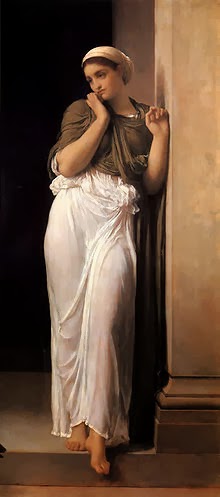
Nausicaa
Frederic Layton (1878)
source Wikipedia

Daniel Deronda by George Eliot

“Was she beautiful or not beautiful?”

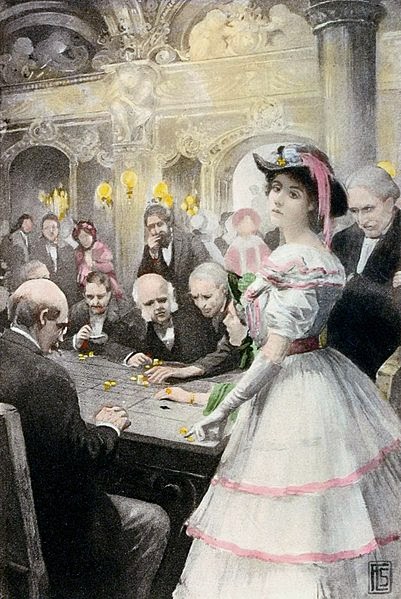
Gwendolyn Harleth is a “spoiled child”, a young woman with average prospects yet with high hopes of attaining respectable social standing and monetary comfort. While scorning the traditional avenues of marriage, she desperately wishes for a meaningful, vibrant life, even though she is unsure of how to attain it.  Gambling, parties and equestrian amusements, fill her time, with little thought of other peoples wants, needs or struggles.

Daniel Deronda is a respectable moral young man and the ward of Sir Hugo Mallinger.  When he first spies Gwendolyn, his disapproval of her gambling and later, the same quiet censure of some of her actions, leads her down a path of introspection and causes her to question the manner in which she is living her life.  Yet the changes in her character do not come soon enough and, due to her family’s sudden monetary troubles, she contracts a marriage to Henleigh Mallinger Grandcourt, the nephew and heir of Sir Hugo.  She views the marriage as an escape from poverty and a stepping stone to a life of leisure and a respectable position in society.  Instead she gets a husband with a twisted soul, bent on breaking her will as he would a horse or a wild animal.  He glories in her struggles, fear and his ability to control her actions.

Gwendolyn at the Roulette Table
(1910)
Wikipedia

A second plot winds itself through Gwendolyn’s, as Deronda internally questions the manner of his birth and the identity of his parents.  Not wishing to bring up a subject that may be uncomfortable for Sir Hugo, he suppresses his curiosity, yet aches for familial connections and history.  Upon saving a Jewish singer from drowning, his relationship with her takes him down the path of finding his true heritage.

Eliot forces the reader to examine some of the social issues of that time.  Without money, young women could only hope to find work in low paying positions, such as governesses or companions, or perhaps choose less respectful avenues as singers or actresses.  Without an inheritance or a family who was financially able to support them, an advantageous marriage was really the only protection for women of this time period.

She also treats the subject of Jewish identity and culture with surprising dexterity and perception.  While they are portrayed with an obvious sympathy, Eliot makes each character real, from the philosophic and idealistic Mordecai, to the money-loving pawnbroker, Cohen. The struggle of a people against prejudice and pre-judgement is plainly explored with touching sincerity and insight.  Mordecai’s longing to see the Zionist hopes for a Jewish homeland established adds a deeper more complex examination of an issue that was of particular interest to the author.

The Fair Toxophilites (Archers)
by William Firth (1872)
Wikimedia Commons

I found that certain parts of the novel dragged, and the plot suffered numerous bumps, but again Eliot tackled such diverse issues, making the writing of the novel an epic task, so I can forgive some of the inconsistencies. Her obvious intellectual curiosity, and her enlightened opinions made the read informative as well as enjoyable.  Daniel Deronda is a book that prods you to think and ponder even after the last page is turned.

“In the chequered area of human experience the seasons are all mingled as in the golden age: fruit  and blossom hang together,; in the same moment the sickle is reaping and the seed is sprinkled; one tends the green cluster and another treads the wine-press.  Nay, in each of our lives harvest and spring-time are continually one, until Death himself gathers us and sows us anew in his invisible fields.”

The Odyssey Read-Along Book V & VI

The Odyssey Read-Along @ Plethora of Books

Book V

Hermes Argeiphontes is sent to Kalypso’s island to inform the nymph that her hold on Odysseus is broken and that she must let him go.  Reluctantly, she agrees but only because she knows resisting the will of Zeus would be fruitless.  Yet when she tells Odysseus that he is a free man, he suspects her of subterfuge but she assures him of her sincerity.  She takes him to a grove of trees where he constructs a raft and loads it full of supplies before he departs.  Eighteen days out on his journey, he is spotted by Poseidon who, angered by the sight of him, causes a great storm to blow up and Odysseus is eventually forced to swim for land.  After swimming for nearly three days, he finally nears a coast, only to find the shoreline rimmed with jutting rock and jagged cliffs.  Poor Odysseus nearly drowns in the surf but, with some help from Athene, he finds a mouth of a river where he finally makes land.  Exhausted with his struggles, he decides to brave the wild animals and finds shelter in the forest to rest and sleep.

Fidelity

It appears that Odysseus initially stayed willingly with Kalypso, living with her as a husband.  Yet as time passed, her charms wore off until he was sorrowfully pining to return home to his wife and country.  In Greek culture, a man who had an affair with a foreigner or slave was not viewed as being unfaithful.

The Assistance of the Gods

Curiously, though the gods choose to help certain mortals, in most cases their assistance is deliberately limited.  They appear to offer just enough help to allow the person to use their ingenuity, strength and perseverance to get themselves out of a dire situation or to learn a specific lesson.

Observations

Odysseus has been shipwrecked by Poseidon twice; he has had two monologues; he has had two helpers; and he climbs back into his boat twice.  What does this mean?  I have no idea ….. 😉

Hermes Ordering Calypso to Release Odysseus
by Gerald de Lairesse (1670)
Wikimedia Commons

Book VI

As Odysseus sleeps on remote Phaiakia, Athene comes to Nausikaa, the daughter of king Alkinoös, in a dream, urging her to carry the washing in her father’s wagon down to the river to wash.   When she obeys the next day, Odysseus himself emerges from the bushes, naked but for a branch.  All her handmaidens scatter in terror, yet Nausikaa bravely questions him and finds he is a stranger to their country.  Employing his admirable tact and intelligence, Odysseus charms the girl.  She lends him some garments, waits while he washes and then instructs him to go to the palace of her parents, to grasp her mother’s knees in supplication and thus will he get assistance for his journey.  He prays to Athene that the reception of the Phaiakians will be favourable.

Feasting

There are numerous scenes of feasting throughout the poem.  If a stranger arrives, a feast is prepared, often before his name is learnt or his circumstances; if he stays, there is more feasting; there is feasting upon his departure; when the gods visit each other, they feast, such as the preparations made by Kalypso for Hermes when he arrived with his message.  In the case of mortals, the feasting is accompanied by sacrifices to the gods.

Hospitality

I am beginning to wonder if the hospitality and reverence offered to guests are not necessarily out of the goodness of the heart of the host.  Whenever a stranger appears, they are never completely certain if they are entertaining a mortal or a god.  It seems like good sense to treat everyone like a god and therefore be certain that they haven’t offended one and that no dreadful punishment will follow for lack of generosity.

The Meeting of Odysseus and Nausicaa
by Jacob Jordaens
Wikimedia Commons
(How Nausicaa and her handmaidens were able to get
ahold of 19th century clothing is a mystery!)

The Odyssey Read-Along Book III & IV

The Odyssey Read-Along @ Plethora of Books

Book III

Telemachos and Athene arrive at Pylos, the home of Nestor.  After Telemachos asks Nestor for news of his father, Nestor describes their homecoming; how a quarrel between Agamemnon and Menelaos sprang up and how half of the forces left with Menelaos, including Nestor and Odysseus.  However, another quarrel began and Odysseus turned back, while Nestor continued on the windswept ocean and, with many prayers and sacrifices, made it home safely without knowing what happened to the other Achaians.  As Athene showed favour towards Odysseus in Troy, so Nestor hopes she will show favour towards his son by helping him rid his house of the unwanted suitors.  When Telemachos states that even the gods couldn’t help him with that problem, he is scolded by Athene whereupon he reveals that he believes his father dead.  Nestor then relates the stories he has learned later of the homecoming of the Achaians who had been with him: Agamemnon was killed by Aigisthos, the lover of his wife, Klytaimestra, upon reaching home, yet 8 years later Aigisthos was killed by Orestes, the son of Agamemnon; Menelaos was blown to Egypt by the gods and there lived many years before recently returning to his kingdom.  Nestor counsels Telemachos to find Menelaos who will speak the truth to him. Offering horses and his sons as guides on the morrow, he gives Telemachos a bed in the palace in which to sleep.  When dawn arrives, another sacrifice is made to the gods and Telemachos departs by chariot for Lakedaimon, the home of Menelaos.
A King and His Kingdom
While the Kings of Greece appear to be well-respected by their people, in Ithaka there is a lack of loyalty and devotion.  Respect comes with a price, and if a king is no longer able to benefit his subjects, they often will look somewhere else for either leadership, or conversely, seek power themselves.

Piety

During the short time Telemachos and Athene spend on Pylos, Nestor has two sacrificial feasts to the gods.  The detailed explanation of these offerings shows Nestor’s piety and generosity.  His devoted worship of the gods is perhaps one of the reasons he was able to return home from Troy with very few delays, unlike the rest of the Achaians.

Telemachus departing from Nestor
by Henry Howard
source Wikipedia

Book IV

Telemachos and Athene arrive at the house of Menelaos in Lakedaimon. The couple show hospitality to their guests, bringing them into the palace to feast.  Menelaos tells of their 8 year delay in Egypt before returning home and laments the death of his brother, Agamemnon, at the hands of his wife’s lover.  When he begins to reminisce about the Trojan War, he brings everyone to tears.  Helen relates how Odysseus came to her from out of the Trojan horse, extracting a promise of silence about their presence, yet Menelaos contradicts her, accusing her of trying to lure the Achaians out of the horse and to their deaths.  The next morning Telemachos shares his troubles with Menelaos, whereupon Menelaos tells him the story of the Old Man of the Sea, Proteus, who revealed the death of two of the Achaians, Aias and Agamemnon, but acknowledged that Odysseus was alive, though a captive of Kalypso (which means “I cover” or “I conceal” in ancient Greek) on her island.  Meanwhile, on Ithaka, the suitors discover that Telemachos has sailed and are stupefied at his daring.  Antinoös recovers and plots to take a ship to set an ambush upon Telemachos’ return, to take his life.  Penelope learns of the journey of Telemachos and of the suitors plans, and while initially distraught, she has a dream that all will be well because Athene is with him.  When she asks if Odysseus still lives, she is told: “I will not tell you the whole story whether he still lives and looks upon the sun’s shining, or whether he has died and is in the house of Hades.”

Fame and Glory

Menelaos states that he would gladly be happy with one-third of the riches he returned with, if only it would bring back the fallen heroes of the war. Spoils and riches are equated with glory in this culture and it is interesting that he would not give up everything for his fallen comrades.  Fame and glory can often be more important than life itself.

Trust and Betrayal

The interaction between Menelaos and Helen seems at once, comfortable and strained.  Each tell a conflicting story about Helen’s actions during the end of the war, and it is apparent that her husband does not believe her rendition.  After 10 years, they have learned to live together but trust is certainly lacking.  Is Helen telling the truth?   After such a long time, Helen’s character is still elusive.

A King and His Kingdom

Penelope, half pleading with, half scolding the suitors says:

“…….. Nor have you listened to what you heard from your fathers before you, when you were children, what kind of man Odysseus was among your own parents, how he did not act and spoke no word in his own country that was unfair …..”

Odysseus has been gone so long that the suitors have never known him personally, and this is partly from where their disrespectful attitudes stem. Their king is like a myth or dream, and there is nothing to tie their allegiance to him, except stories passed down from their elders.

Piety

Menelaos, when recounting his adventures in Egypt, reveals that the reason for his long detour was that he had neglected to render complete hecatombs (offerings) to the gods, angering them.  This is in contrast to Nestor, who made the proper sacrifices and arrives home quickly and safely.

Telemachus in the Palace of Menelaos
1886
source Wikimedia Commons