The Canterbury Tales ~ The Miller’s Prologue and Tale

After the tale of courtly love by the Knight, the Host requests the Monk to recite his tale, however the churlish and boorish Robin the Miller interrupts, insisting on having his tale told first.  While he claims his tale is noble, he absolves himself of all responsibility for it, claiming drunkenness as his excuse.  Given his character and situation, one wonders what will proceed from his mouth.  In fact, Oswald, the Reeve, protests that the Miller’s tale about a carpenter, will insult carpenters, of which he is one, but the Miller begins to tell his tale, in spite of the Reeve’s objections.

Illustration of Robin the Miller
playing the bagpipes
source Wikipedia

The Miller’s Tale

A Carpenter named John lived in Oxford, and he had a student named Nicolas, as a boarder, who was poor, learned in Astrology, well-versed in the art of love, and knew how to conduct himself.  The Carpenter, though old, was newly wedded to a handsome eighteen-year-old girl, Alisoun, and while he appears a kind, simple man, he guards her jealously, afraid that another man will steal her affections.  Nicolas decides that he will have his way with her, and Alisoun is a willing accomplice.  Now to get the Carpenter out of the way. Yet not only does the Carpenter have this wily student plotting to steal his wife, but also Absolon, the parish clerk, has seen her, fallen in love and decides to woo her with music outside her window, but the miller’s wife is not interested.

Meanwhile Nicolas cooks up a plan to rid them of the Carpenter, so they can spend the night together.  He convinces him that a flood, second only to Noah’s, is coming and that he needs to acquire three large tubs to hang from the ceiling where the three of them can sleep, and when the waters arrive, they can cut the ropes and float away.  The Carpenter, convinced of the tale, spends a great deal of time collecting the tubs and doing the work.  He is so exhausted that he falls asleep immediately in his tub, and then Alisoun and Nicolas climb down to enjoy themselves in his bed.  Little do they know that Absolon is once again going to try to win Alisoun’s favours by wooing her from outside the window.  She agrees to a kiss but, to Absolon’s stupified surprise, what she stick out the window is her bare backside and not her head.  Ai-ya! Absolon is repulsed and leaves, but when he returns, he has a branding iron with him. This time Nicolas, to give the clerk further shock, decides to stick his rear end out the window for the next promised kiss, and does he get the surprise of his life!  His cry of “Water!” wakes up the Carpenter who thinks the flood is upon him and cuts his rope.  For his troubles, the poor Carpenter gets a broken arm and the ridicule of the whole town.

Alison and John (1913)
Russell Flint
source 

This tale seems a response and a parody to The Knight’s Tale, in that The Knight’s Tale was filled with chivalry, courtly love, honour and destiny, whereas in this tale, there is adultery, lust, and deception, depicted with obscenity and humour.  As in The Knight’s Tale, The Miller’s Tale also presents another love triangle, but in this case, it is one that is base and immoral, instead of the Knight’s illustration of courtly love.

In addition to turning the virtues of The Knight’s Tale on its head, the Miller seems to be offering a commentary on the church, and not a very pleasant commentary at that.  The Carpenter has the same trade as Jesus and Joseph, and is presented as a rather ingenuous, bumbling fool.  Absolon’s position of parish clerk appears to offer more negative criticism.  His dialogue seems to sometimes grow from Songs of Songs, as he uses some of the most beautiful biblical love poetry to seduce another man’s wife.  I’m unsure as to whether his name is a lampoon of the biblical character Absalom, King David’s son who was known for his ingratiating manners and pretentious love of pomp and show.  Everything meaningful about the biblical Absalom is portrayed on the outside, but there is no depth to his strength of character.  The Miller’s Absolon obviously has a faith that holds little meaning for him and has no effect on his actions.

These bawdy tales were favourites of Chaucer’s times and are categorized as a fabliau, originating in France and characterized as short merry tales, “generally about people in absurd and amusing circumstances, often naughty sexual predicaments. The stories frequently involve a betrayed husband (the cuckold), his unfaithful wife, and a cleric who is the wife’s lover. “ (1)

The next tale will be told by The Reeve, the pilgrim who protested the telling of The Miller’s Tale.  What shall we find in his tale, and how will it link to the two we have already heard?

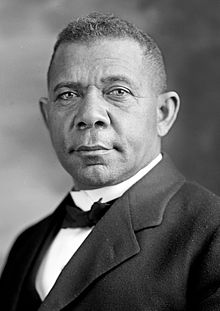
Up From Slavery by Booker T. Washington

“I was born a slave on a plantation in Franklin County, Virginia.”

This was my third book on slavery in succession that I’ve read for my WEM Project.  The Incidents in the Life of a Slave Girl and the Narrative of the Life and Times of Frederick Douglass were the first two, and while I enjoyed the history and information I gleaned on a subject of which I know little (I plead ignorance on the basis of being Canadian), I really did not feel touched by either book as a whole.  Really, I wondered if there was something wrong with me.  Yes, I felt sympathy for the plight of the slaves; just the thought of being owned and having stripped from you the many things that make one human, was horrifying.  The degradation and the suffering generated disgust. Yet there was something missing, for me at least.

In my Frederick Douglass review, Cirtnecce made a comment, and suddenly my mind opened up and I had it; the reason why I was left rather cold by the other two books.  This was my response to her:

What I’ve missed from these books so far, is a way to move forward in a human way. You can speak about practicalities and reason and that’s useful, but if one tries simply to protect one segment of the population or to legislate people’s behaviour, it almost seems as if nothing has truly changed. I’d love to read something that communicates ideas of how to make changes in the hearts and minds of people; imo, that’s the way to effect true change.”

That was it!  I was looking for a book that would precipitate a transformation, and in Booker T. Washington’s biography, I received more than I could ever hope for!

Washington briefly chronicled his experiences as a slave during the Civil War, where he gained his freedom through emancipation at the approximate age of ten.  Eventually he made his way to the Hampton Institute, earned an education through hard work, and because of his perserverance and a solid work ethic, Washington was chosen to become the first leading teacher of the Tuskegee Institute in Alabama, a school formed to promote the higher education of blacks in Confederate States.  Washington’s biography offers an in-depth history of his creation and formation of Tuskegee, which Washington built not only with his hands, but his rather creative mind and intellect.

This book is a fascinating portrait of not only a man who rose above slavery, but conquered the demons that it bred, to see a way forward for blacks and whites to live, not just in harmony, but in cooperation with each other to make a better community and a better world.  In spite of the racial prejudices he encountered, Washington never responded in anger, preferring to examine the issues and problems that caused the prejudice, and to respond in a way that was beneficial for both blacks and whites.  He never viewed himself as a victim and in his gracious and measured responses, won accolades and respect on each side of the divide, narrowing it with his quiet, yet determined, demeanour.

There are so many wonderful quotes in this book that I hardly know where to start.  I’m going to choose to concentrate mostly on the Tuskegee school, since it was such a large part of Washington’s life and therefore his existence, and it really exemplified his philosophy for social change in a manner that was visual and effective.


Tuskegee Univeristy Panorama (1916)
source Wikipedia

Washington structured the Tuskegee school not only to promote learning but to entrench something possibly even more valuable …… hard work.  The students were given preference, not only because of their academic abilities, but their willingness to work hard.

“No student no matter how much money he may be able to command, is permitted to go through school without doing manual labour …….  From the beginning, at Tuskegee, I was determined to have the students do not only the agricultural and domestic work, but to have them erect their own buildings.  My plan was to have them, while performing this service, taught the latest and best methods of labour, so that the school would not only get the benefit of their efforts, but the students themselves would be taught to see, not only utility in labour, but beauty and dignity; would be taught, in fact, how to lift labour up from mere drudgery and toil, and would learn to love work for its own sake.  My plan was not to teach them to work in the old way, bt to show them how to make the forces of nature —– air, water, steam, electricity, horse-power —- assist them in their labour …………  Mistakes I knew would be made, but these mistakes would teach us valuable lessons for the future.”

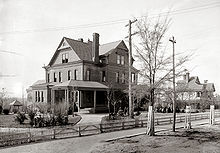
The Oaks – Washington’s home
on Tuskegee campus
source Wikipedia

However, while work and academia were important, Washington did not neglect the spiritual growth of his students including services and prayer, using a non-denominational model.  I know little about the times in this respect, but I can imagine that this was a revolutionary way of structuring an academic institution:

“If no other consideration had convinced me of the value of the Christian life, the Christlike work which the Church of all denominations in America has done during the last thirty-five years for the elevation of the black man would have made me a Christian.  In a large degree it has been the pennies, the nickles, and the dimes which have come from the Sunday-schools, the Christian Endeavour societies, and the missionary societies, as well as from the church proper that have helped to elevate the negro at so rapid a rate.”

And paramount to anything, Washington exemplifies forgiveness:

“It is now long ago that I learned this lesson from General Armstrong, and resolved that I would permit no man, no matter what is colour might be, to narrow and degrade my soul by making me hate him.  With God’s help, I believe that I have completely rid myself of any ill feeling toward the Southern white man for any wrong that me hay have inflicted upon my race.  I am made to feel just as happy now when I am rendering service to Southern white men as when the service is rendered to a member of my own race.  I pity from the bottom of my heart any individual who is so unfortunate as to get into the habit of holding race prejudice.”

“I early learned that it is a hard matter to convert an individual by abusing him, and that this is more often accomplished by giving credit for all the praiseworthy actions performed than by calling attention alone to all the evil done.”

History class at Tuskegee Institute 1902
source Wikipedia

Washington rather fell into public speaking, feeling that it was more important “to do things than merely to talk about doing them.”  He first went north with his friend and mentor, General Armstrong,  a white educator dedicated to the education of blacks and a founder of the Hampton Institute, and spoke at a series of public meetings.  In 1895, Washington was asked to speak at the Atlanta Exposition, an important exposition to showcase products and new technologies.  His speech was received with accolades from both whites and blacks alike, and afterwards, Washington became a highly sought after speaker about the benefits raising black ingenuity, hard work and resourcefulness to the level of white America.  He promoted the improvement of race relations where blacks and whites both stood on level ground.  There is a fascinating section of the book where Washington expounds on his manner of public speaking and it includes some gems of advice:

” ……. It seems to me that there is rarely such a combination of mental and physical delight in any effort as that which comes to a public speaker when he feels that he has a great audience completely within his control.  There is a thread of sympathy and oneness that connects a public speaker with his audience, that is just as strong as though it was something tangible and visible  …… I never tell an anecdote simply for the sake to telling one ……  I believe that one always does himself and his audience an injustice when he speaks merely for the sake of speaking.  I do not believe that one should speak unless, deep down in his heart, he feels convinced that he has a message to deliver …..”

At the close of the book, Washington first gives a schedule for his Tuskegee school which is rather interesting from the view of posterity:

5 am.          Rising bell
5:50            Warning breakfast bell
6 am.          Breakfast bell
6:20            Breakfast over
6:20 – 6:50 Rooms are cleaned
6:50            Work bell
7:30            Morning study hour
8:20            Morning and school bell 
8:25            Inspection of young men’s toilets
8:40            Devotional exercises in chapel
8:55            Five minutes in the daily news
9 am.          Class work begins
12 pm.        Class work closes
12:15          Dinner
1 pm.          Work bell
1:30            Class work begins
3:30            Class work ends
5:30            Bell to “knock off” work
6 pm.          Supper
7:10            Evening prayers
7:30            Evening study hours
8:45            Evening study hour closes
9:20            Warning retiring bell
9:30            Retiring bell

And his teaching philosophy, while appearing relatively simple, is designed to have far-reaching results.  Washington strove to empower his students, not only academically, but to give them skills to serve them well in life.

“In our industrial teaching we keep three things in mind:  first, that the student shall be so educated that he shall be enabled to meet conditions as they exist now, in the part of the South where he lives —– in a word, to be able to do the thing which the world wants done; second, that every student who graduates from the school shall have enough skill, coupled with intelligence and moral character, to enable him to make a living for himself and others; third, to send every graduate out feeling and knowing that labour is dignified and beautiful —- to make each one love labour instead of trying to escape it.”

During this time, the Tuskegee school had so many applicants that they were forced to turn away half and could only supply one half of the graduates that were requested.  A huge accomplishment from twenty years ago when Washington started the school from sweat, common sense, an empathy for all people, and a firm belief in industry.

A final quote by Washington which I think encompasses much of his philosophy:

“Before the end of the year, I think I began to learn that those who are happiest are those who do the most for others.  This lesson I have tried to carry with me ever since.”


The Canterbury Tales ~ The Knight’s Tale

As the pilgrims draw lots to determine who will be the first to tell their story, the first draw goes to the Knight.

              And when this excellent man saw how it stood,
              Ready to keep his promise, he said, “Good!”
              Since it appears that I must start the game,
              Why then, the draw is welcome, in God’s name
              Now let’s ride on and listen to what I say.”
              And with that word we rode forth on our way …

The first page of The Knight’s Tale
source Wikimedia Commons

The Knight’s Tale

After being appealed to by a number of deposed queens and duchesses from Thebes, King Theseus of Athens attacks the city and gains victory over Creon, King of Thebes.  During the fighting, two knights named Palamon and Arcite, are taken prisoner and thrown into a dungeon.  Left to rot there forever, Palamon one day spies Emelye, who is as fair as any damsel and the sister of Theseus’ wife Hippolyta, and he falls in love.  Arcite, wondering at this cousin’s lovelorn look, spots her too, claims his love of her, and acrimony is born within the love triangle of the cousins.

Portrait of a Knight (1510)
Vittore Carpaccio
source Wikiart

Years later, Arcite is released by Theseus upon request of a friend, but is sentenced to exile from which he laments Palamon’s better fate of prison, due to his being able to gaze upon Emelye, whereas Arcite has now been denied that pleasure. Eventually he risks returning to Athens in diguise as a page named Philostratus, who enters Emelye’s household.  One day he comes upon Palamon, who has escaped, they begin to fight but are stayed by Theseus who announces that he will set up a grand tournament of knights, and the one who is the victor will win Emelye’s hand in marriage.

Meanwhile, we find, that while Emelye has been the centre of this strife and turmoil, that she actually does not wish to marry either knight.  She relates to the goddess, Diana:

“To whom are open earth and sea and sky,
Goddess of maidens, well you know that I
Desire to be a maiden all my life,
And never to be a man’s love nor his wife.
Among your followers I have kept my place,
A maid, in love with hunting and the chase
And to go walking in the greenwood wild
And not to be a wife and be with child;
For nothing will I have to do with man.
Now help me, lady, since you may and can.”

But while Diana could help her, she refuses, stating that Emelye’s destiny has been ordained to marry one of the knights, but which, she will not tell.  Emelye submits to her fate with good grace.

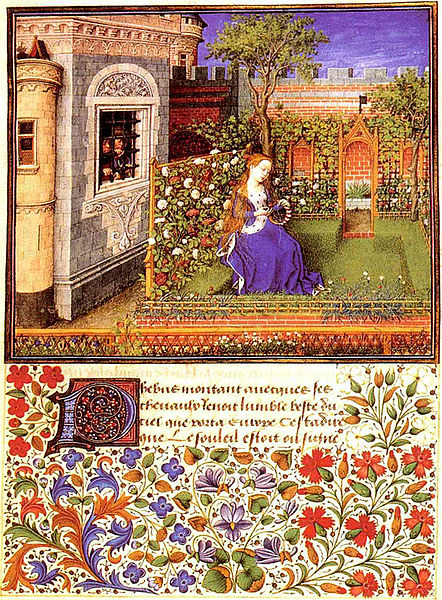
Emilie dans le jardin observée par
Arcitas et Palamon emprisonnés (1460)
source Wikimedia Commons

Palamon prays to Venus for victory, but we get a long description of Arcite in his battle attire before we hear of him offering sacrifices, and for him, it is to the god, Mars; so we have Palamon appealing to the goddess of Love, and Arcite appealing to the god of War.  Who do you think will win?

Ah, it appears that Arcite triumphs, bearing down Palamon and his knights, capturing him and taking him to the stake.  Venus is shamed with the outcome, but Saturn asssures her that she will also have her desire.  But how, with Palamon conquered and Arcite set to wed Emelye?

Well, Arcite has little time to enjoy his achievement.  Helmetless, he is pitched to the ground by his horse, landing on his head and receiving mortal wounds. He lasts a short time before succumbing, and Emelye and Palamon are in mourning.  But good King Theseus delivers a long speech about the Prime Mover and how all earthly beings must submit to the higher order of things. He blesses the wedding of Palamon and Emelye, and they live happily without jealousy and with extreme tenderness.

One can tell that there is much more to this tale than what is simple cloaking the surface.  First, there is the obvious emphasis on fate or destiny or a higher power:  Emelye, though she does not wish to marry, readily capitulates to Venus’ edict that she must; and, of of course, while it initially appears to all the people that Arcite will wed Emelye, there is a “blueprint” already in place for everyone’s destiny that man, in his puniness, cannot yet see.  A life lived well is to submit to the inevitable, yet take opportunities when they come to you.

Emilie à la chasse assistant au combat entre Arcitas et Palamon
Source: Wikimedia Commons

There is also an emphasis on nature and it’s interaction with man.  The General Prologue initially drew us right into Nature and Spring “Whan that Aprille with his shoures sote, The droghte of Marche hath perced to the rote, And bathed every veyne in swich licour, Of which vertu engendred is the flour.”  From the sky and nature, we are then taken to be introduced to the earthly pilgrims.  In The Knight’s Tale, in the building of the sepulcher for Arcite, there is an obvious battle between nature and man, as Theseus fells the “old oaks” to make a funeral bier:

“You will not hear from me how all the trees
Were felled, nor how the local deities,
Nymphs, fauns, and hamadryads and the rest,
Ran up and down, scattered and dispossessed,
Nor how the beasts and wood birds, one and all,
Fled terrified when the trunks began to fall;
Nor how the ground stood all aghast and bright,
Affronted with the unfamiliar light ….”

There is a continuous tension between man and his environment, again perhaps due to either his lack of foresight, or his inability to understand the grand plan of the Prime Mover.

And, of course, in the battle between Arcite and Palamon and their gods, in spite of the appearance of war winning over love, it is love which achieves the ultimate victory.

I’m certain there are many other themes included, such as pageantry, hierarchical Medevial structure, and not so much the capriciousness of the gods, but the uncertainty of destiny, but I’ve probably explored this tale as much as I can for the first read.  One curious point struck me though ….. although this story is set in Greece, the gods are all given Roman names, instead of their Greek ones.  I have no idea why, but it is a puzzling choice.

The next tale up, is The Miller’s Tale ……

The Canterbury Tales/ The Brubury TalesProject
The Knight’s Tale

The Narrative of the Life and Times of Frederick Douglass

“I was born in Tuckahoe, near Hillsborough, and about twelve miles from Easton, in Talbot county, Maryland.”

Born into slavery as Frederick Augustus Washington Bailey around 1817/1818, Douglass learned to read and write as a boy with the help of the wife of his master. In spite of his situation, he claims that he always had an implicit belief that he would not always be a slave.

“From my earliest recollection, I date the entertainment of a deep conviction that slavery would not always be able to hold me within its foul embarce; and in the darkets hours of my career in slavery, this living world of fath and spirit of ope departed not from me, but remained like ministering angles to cheer me through the gloom.  The good spirit was from God, and to him I offer thanksgiving and peace.”

At around twenty years old, he escaped to the north, married, and soon afterwards changed his name to Douglass.  Becoming involved in the abolitionist movement, Douglass was encourage to speak and tell the story of his experiences as a slave.

Yet while he was welcomed by the anti-slavery community, Douglass did not only find critics outside this movement, but also opposition from within.  He was limited by white abolitionists as to what he could say during speeches, attempting to avoid any reference to current issues or a way forward for black people as a race.  Yet upon the publication of his book, Douglass’ popularity soared and he gained a credibility he has not experienced previously.

Douglass elucidates on the cruelty of slavery that goes beyond the physical. He speaks of being shut up in a “mental darkness” by the refusal of masters to educate their slaves.  He relates how slaveholders would practice mental fraud on their slaves by allowing and encouraging them to drink to excess during their free holiday time, with the result that the conditions of slavery and liberty did not appear to have a decided difference.

Douglass also gives the recipe for making a content slave:

“…… I have found that to make a contented slave, it is necessary to make a thoughtless one.  It is necessary to darken his moral and mental vision, and, as far as possible, to annihilate the power of reason.  He must be able to detect no inconsistencies in slavery; he must be made to feel that slavery is right; and he can be brought to that only when he ceases to be a man.”

Douglass has some interesting insights into slave masters:

“……. and of all men, adopted slaveholders are the worst  …… He was a slaveholder without the ability to hold slaves.  He found himself incapable of managing his slaves either by force, fear, or fraud.  We seldom called him, “master;” we generally called him “Captain Auld,” and were hardly disposed to title him at all ……. He wished to have us call him master, but lacked the firmness necessary to command us to do so ……”

There are apparently two editions of this narrative, this one being a rather shorter narrative, and the Life and Times of Frederick Douglass, which is a third publication and expanded to give more detail about his life including some history of the period.

The next book in the WEM order is Up From Slavery by Booker T. Washington. While the first two slave narratives have been interesting, they certainly haven’t been gripping and I must admit I’m not really looking forward to this next book.  In any case, onward and upward!

The Cantebury Tales ~ The General Prologue

I’ve decided to join O at Behold the Stars in her reading of The Canterbury Tales.  Yes, it’s one of my projects for the year, my The Canterbury Tales/The Brubury Tales Project, but I’ve been really terrible at keeping up on my projects so I’m hoping someone else will give me that kick where I so desperately need it, or at the very least, drag me along.

I’m starting off reading from The Portable Chaucer with a translation by Theodore Morrison, but I suspect that it doesn’t include all the tales, so once the library book comes in, I’ll be reading The Penguin edition translated by Nevill Coghill.  O, the clever person that she is, is reading it in Middle English. Something to aspire to but not now. :-Z
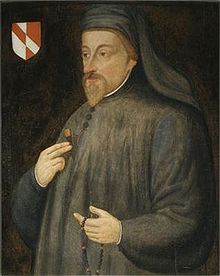
Portrait of Chaucer – 17th century
source Wikipedia

It is surmised that Chaucer met Bocaccio, who perhaps influenced this work, as it begins in a similar way to Bocaccio’s The Decameron.  In The Decameron, a number of lords and ladies escape the Black Death of Florence and begin a story-telling marathon in their exile, whereas in The Canterbury Tales, a group of pilgrims are on their way to Canterbury and on their journey, each tells a tale.  Originally Chaucer meant each pilgrim to tell four tales, two on the way there and two on the way back, but the manuscript breaks off with them still on their travels, so the final intent of Chaucer remains unknown.  The original order of the tales is also unclear, but going with O’s the Riverside Chaucer, we’ll be breaking the tales down as follows:

Week 1: General Prologue
Week 2: The Knight’s Tale
Week 3: The Miller’s Prologue and Tale, The Reeve’s Prologue and Tale, The Cook’s Prologue and Tale
Week 4: The Man Of Law’s Introduction, Prologue, Tale, and Epilogue
Week 5: The Wife of Bath’s Prologue and Tale
Week 6: The Friar’s Prologue and Tale, The Summoner’s Prologue and Tale
Week 7: The Clerk’s Prologue and Tale
Week 8: The Merchant’s Prologue, Tale, and Epilogue
Week 9: The Squire’s Introduction and Tale, The Franklin’s Prologue and Tale
Week 10: The Physician’s Tale, The Pardoner’s Introduction, Prologue, and Tale, The Shipman’s Tale
Week 11: The Prioress’s Prologue and Tale, The Prologue and Tale of Sir Thopas
Week 12: The Tale of Melibee
Week 13: The Monk’s Prologue and Tale, The Nun Priest’s Prologue, Tale, and Epilogue
Week 14: The Second Nun’s Prologue and Tale, The Canon’s Yeoman’s Prologue and Tale
Week 15: The Manciple’s Prologue and Tale, The Parson’s Prologue and Tale
Week 16: Chaucer’s Retraction. Conclusion.

If I haven’t finished by the beginning of November, you can all throw rotten tomatoes at me.

So let’s start off with The General Prologue.

Initially Chaucer describes the setting of the pilgrims’ starting point, in a beautiful poetic manner that establishes the ambiance of a lovely spring day.

“As soon as April pierces to the root
The drought of March, and bathes each bud and shoot
Through every vein of sap with gentle showers
From whose engendering liquor spring the flowers;
When zephyrs have breathed softly all about
Inspiring every wood and field to sprout,
And in the zodiac the youthful sun
His journey halfway through the Ram has run;
When little birds are busy with their song
Who sleep with open eyes the whole night long
Life stirs their hearts and tingles in them so,

Then people long on pilgrimage to go, …..”

Chaucer, himself one of the pilgrims, arrives at Southwark at the Tabard, and meets with twenty-nine other pilgrims, all ready to set out for Canterbury.  He introduces each, starting with The Knight, who is is honoured and respected and who has fought many battles in the name of Christ.  Yet in spite of his skill with a sword, he is deferential and temperate, embracing his code of chivalry.  His son, a Squire, is with him, a lad who is determined to have exploits to honour his lady.  He also has a Yeoman traveling with him, tidy and trim with a doughty demeanour, a strong bow and a St. Christopher’s medal.

A Nun, known as Madame Eglantine, carries the dignity of religion with her, showing a love and empathy for animals and a tidiness that becomes her. Nevertheless, this Prioress is attached to courtly ways and displays a pride in her accomplishments.  She is escorted by a Priest and an Attendant Nun who acts as her secretary.

Next, a Monk is introduced and while his description is an unexpectedly unusual description for a Monk, during Chaucer’s time the church was experiencing a degradation of religion and many of its adherents were infected with worldly desires.  This Monk much prefers fashion and hunting to the austerity of his order. It sounds like Chaucer, the narrator, approves of his designs and exploits.

The next in line is a Friar, who is gay and jolly. He is like a roving churchman who performs church services as he goes.  Yet, again, this Friar likes wealthy men, pretty women and money given as penance.  He prefers bars and barmaids to giving consolation and blessings to lepers.  Our rather unreligious Friar is christened Hubert.

The Merchant is very caught up in his business and enjoys the elevation of his station.  He knows his job well and is very full of himself, yet is he as rich as he seems?  Not only his financial acumen is highlighted, but his personal shrewdness, and the narrator confesses that he is never able to discover his name.

An Oxford Student shows his poverty by his shabby clothes, but exhibits a richness in learning and the value of philosophy.  He is willing to both learn and teach.

A crafty, yet diplomatic Lawyer or The Man of Law is one of the party.  He appears efficient and respected in his field.

The Franklin, or the “free man,” loves his food so much that there is always food at his table.

Five Guildsmen, a Weaver, a Dyer, a Carpenter, a Tapestry-maker and a Haberdasher are wealthy and respected in their crafts.  Their livery identifies their artistry. With them, they carry a Cook who ensures that they eat well.

The Skipper or Shipman is well-traveled and experienced at his job, but he is not shy about stealing from the wine casks.  He does not appear at home on a horse, riding it as if he were at sea.

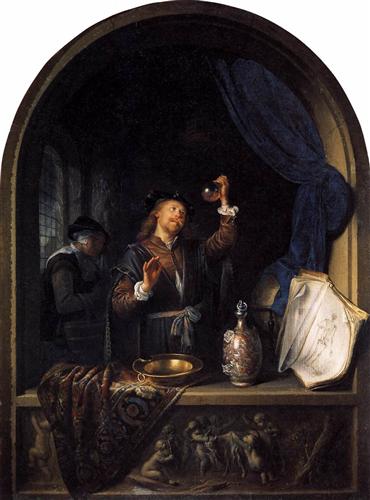
The Physician

The Physician is particularly interesting.  I sense a sarcasm within Chaucer’s description and though he seems to know his profession and be able to deal with a number of maladies, he takes advantage of his patients for financial gain, and his spiritual life is less than ideal.

“Of nothing in excess would he admit.
He gave but little heed to Holy Writ.
His clothes were lined with taffeta; their hue
Was all of blood read and of Persian blue ..”

Next, The Woman or Wife of Bath is a rather large, broad-beamed woman, but she is dressed well and has a skill at weaving that is unsurpassed.  She’s had many husbands and lovers and is well-versed in the art of love.  She is also well-travelled.

The Parson is given a long description praising his integrity, his sacrifice and his faithful adherence to his faith.  He is patient, gives offerings to the poor, and tries to teach by being a good example to others.  He is a wonderful illustration of a man of virtue, and a credit to his church flock.
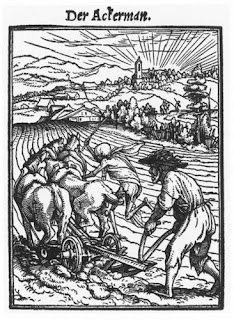
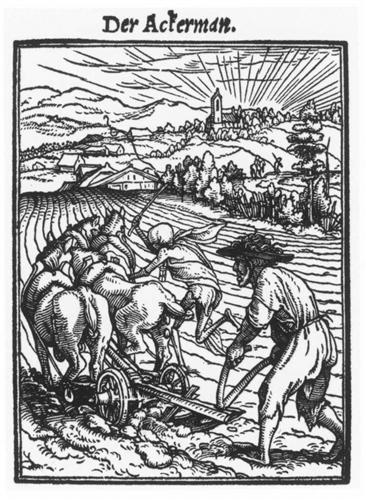
The Plowman  c. 1525
Hans Holbein the Younger

We meet the brother of The Parson, The Plowman.  He loves God with all his heart, and is in charity with everyone.  He tithes regularly and his clothes reflect his humble station.

A big beefy man is The Miller and his physicality is emphasized, along with his rather unpleasant countenance, and his proclivity for stealing corn and selling it at three times the price.  He leads the pilgrims out of town whilst blowing his bagpipes.

The Manciple, or officer who buys supplies for a college, monastery or other institution, is lacking a formal education but is, nevertheless, ingenious in his dealings and more adroit than his clients.  He is a master at deception.

Possessing a fiery disposition and a wiry frame, The Reeve, or steward of a manor, is of questionable character.  While he ensures that no one steals from his master, he himself avails himself of that which belongs to his employer.  He is so shrewd that no one can catch him in his dishonesty.

The Summoner, a man who brings those who are in violation of church law to ecclesiastical court, is a lecherous character with a fearsome leprous face.  He uses the little Latin he knows to cover his intellectual inadequacy.  He does not have a respect for his vocation.

The Pardoner, one who grants papal indulgences, is a waxy, greasy sort of fellow, who we are led to disbelieve.  He carries with him a number of fake relics, which he sells to unsuspecting, trusting people.  He is religious and respectable on the surface, but underneath, he is rotten.

The Host is a big, cheery man who appears to have control of the group.  He sets the rules out for the tales, four for each pilgrim, two going to Canterbury and two returning.  We will see that this plan does not pan out.

The Narrator:  is it Chaucer, or is it Chaucer but not really Chaucer?  We will see, as we go.

The portraits of these pilgrims show the social organization of Chaucer’s England.  First comes the Knight, the Squire and the Yeoman, which represent the nobility or the upper class.  Next comes the Clergy: a prioress with her attendent priest and helper, a Monk and a Friar.  After the clergy comes the pilgrims who represent the merchantiles and professions of the cities and towns of Chaucer’s England.  Finally we are introduced to a number of figures who perhaps don’t represent a particular group, but nevertheless have a firm identity in Chaucer’s time.

Chaucer’s depiction of the pilgrims follows the Medieval literary technique of description in that description can be accomplished in two ways: using both internal qualities and external attributes.  We can ask ourselves as we read, how these two means of description affect the reader; which might elicit a stronger response and how does one influence the other to create tension within a story.  Chaucer uses each to make a social commentary and his means of using this technique is quite fascinating.  You get a sense with Chaucer’s descriptions, that while he can appear to be praising and giving his characters good qualities, at times he is, in fact, doing quite the opposite.

The Canterbury Tales/The Brubury Tales Project
The General Prologue
The Knight’s Tale

Summer ~~ Books in my Bag

Source: Library of Congress

Yikes!  This is the longest that I’ve been AWOL since I started this blog.  I’ve been so busy in the month of June that I haven’t had time to read, let alone to blog.  And to top it off, I was bitten by the writing bug, so I’ve been letting whatever is inside my head, come out.  This can be a little scary.  Needless to say, this is not my usual modus operandi and somewhat disturbing. Fortunately, the busyness continues only until mid-July, but then ends (Yippee!!) and I can hopefully get back to normal — or as normal as I get.  Ha ha!

Soooo, as for the books that I have planned to read for summer ……..  I have a number that I have to finish up, from anywhere from a month ago, to a year ago.  I’ll be focussing on:

What is to Be Done?:  Chernyshevsky’s classic novel and response to Turgenev’s Father’s and Sons, advocating a socialist model through radicalism and social education.  I still have to get to Notes from the Underground by Dostoyevsky, which is his response to Chernyshevsky.

Gone With the Wind:  for Corinne’s read-along which, of course, has already ended.  I was enjoying the book so far, so I want to finish it.

The Essays of Montaigne:  I still have to finish up the recommended essays and I have one more blog post to compile.  I love Montaigne so this won’t be a chore.

Of Other Worlds: Essays and Stories:  I’ve read about ⅓ of this and love it. But I have to finish it.  This summer for sure.

The History of Napoleon Buonaparte:  I love this book and I don’t know why it’s taking me so long to finish.  This biography was written no more than 10 years after Napoleon’s death —- a very valuable viewpoint.

The Terror:  a nice gift from my blog friend, Andrea.  I read half last summer and I want to finish it this summer.

On the Coast at Trouville (1881)
Claude Monet
source Wikiart

Series and Challenges:

Framley Parsonage:  How embarrassing.  I really, really need to keep on reading The Barsetshire Chronicles.  I’m enjoying them, I’ve just stalled.  Such is life.

Sense and Sensibility & Pride and Prejudice:  I need to get moving on my Austen Project.

Up From Slavery:  I’ve started this one and it’s my favourite so far of the slave narratives.  For my WEM Project

Ecce Homo:  Another book from my WEM list.  I’m not sure how I feel about this one.

The Canterbury Tales and The Brubury Tales Project:  I really should get started on this if I want to finish it by the end of the year.

My Challenges: 

Classics Club List:  there doesn’t seem to be as many Classic Club Spins lately, so I’m going to choose a book from my list, as I think I’m dragging behind a little.  I’m going to take The Histories by Herodotus which is supposed to be a fun read (no, that’s not a joke.  I’m serious.)

My Shakespeare Project:  perhaps Henry V which I didn’t get around to reading for my reading of the Henriad.

Guardians 1000 List:  yes, the never-ending list that I won’t finish before I die. For this, I was thinking of reading A Confederacy of Dunces.  If anyone wants to take a quick look at the list, I’m open to recommendations!

Deal Me In Challenge:  Yipes!  I’m so behind.  I need to try to catch up at least a little.

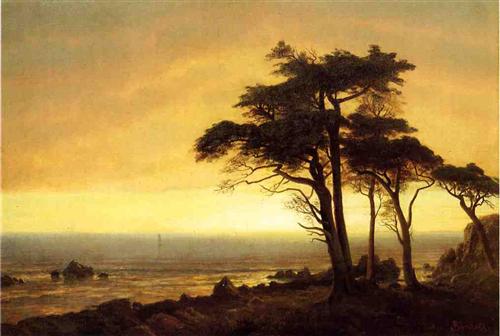
California Coast
Albert Bierstadt
source Wikiart

Should I Or Shouldn’t I?:

Ulysses:  I started this rather thick book, but I really dislike it.  Joyce is a pretentious, annoying …. grumble, grumble, grumble.  Well, enough said. Should I finish because I started?  Because I was silly enough to include this book in my TBR Pile Challenge?  I haven’t decided yet.

The Lord of the Rings:  I often choose to read this in the summer and I haven’t read it for about 4 years, but do I have too many other books going on?   Or do I throw caution to the winds?

Ovid’s Metamorphoses:  I have included this book in my reading list for the past two years and I just can’t seem to get into it.  I was going to delve into it this summer but somehow it doesn’t seem like a summer book.  Hmmm ……

Sanary Landscape (1937)
Moise Kisling
source Wikiart

I was going to list a few new books that I wanted to read, but you know what? I’m not even going to go there.  I have way too many listed already and I know I won’t read them all, but at least this post will give me some focus for summer.

In any case, I hope you all are having a great summer so far and are getting lots of reading in.  I just wanted you to know that I haven’t left forever and I should be back fairly soon!  À bientôt!

Incidents in the Life of a Slave Girl – Harriet Ann Jacobs

“Northerners know nothing at all about Slavery.  They think it is a perpetual bondage only.  They have no conception of the depth of degradation involved in that word, SLAVERY; if they had, they would never cease their efforts until so horrible a system was overthrown.”

Being Canadian, and unlike my U.S. counterparts, I have little knowledge of the details and intricacies of the history of slavery in the United States, so I was pleased to note that my The Well-Educated Mind Biographies Project has a few books that cover this important, yet disturbing, period.  Incidents in the Life of a Slave Girl is the first book of this ilk on the list.  A book written in the tradition of the slave narrative and the sentimental novel, Jacobs strives to give a voice to the thousands of black men and women, who suffered abuse, injustice and the theft of their true identities under the yoke of slavery.

Jacobs (in the book calling herself Linda Brent), chronicles her story, beginning with her idyllic life within her family who are well-off slaves of a kind owner.  At her mother’s death when Linda is six, she is sent to reside with her mistress who teaches her to read and write, but at the death of her owner, she is sold to the Flint family and her suffering begins.  Dr. Flint is harsh and cruel, developing a desire for Linda, and she is continually tormented by his sexual advances.  Thinking to save herself and her virtue, she begins a relationship with another white man and has two children with him in hopes Dr. Flint will cease his attentions.  Instead he is enraged and sends her and her children to do hard labour on one of his plantations.  The book further relates of her escape, her continuous concern about the fate of her children, seven years of her life in an attic so she is not discovered, and her final journey to the north and a relative freedom, although her expectations of her life there are perhaps somewhat disappointed.

Reward for notice for the return of
Harriet Jacobs by James Norcome (Dr. Flint)
source Wikipedia

Jacobs tells a touching and unique story from a woman’s point-of-view, highlighting not only all the brutality and abuse the negro people suffered at the hands of some of their masters, but also the degradation to their spirits. Yet although Jacobs shows her people in their suffering, she also is able to emphasis their greatness of spirit:

“Truly, the colored race are the most cheerful and forgiving peole on the face of the earth.  That their masters sleep in safety is owing to their superabundance of heart; and yet they look upon their sufferings with less pity than they would bestow on those of a horse or dog.”

While the book is full of horrid examples, Jacobs also strives to mention the white men and woman she met or observed in her life that showed kindness or compassion, and says of her benefactress, Mrs. Bruce:

“The noble heart!  The brave heart!  The tears are in my eyes while I write of her.  May the God of the helpless reward her for her sympathy with my persecuted people!”

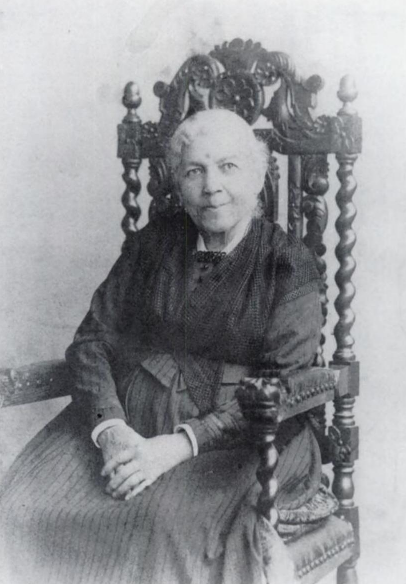
Harriet Ann Jacobs
source Wikipedia

While most of this book is at once both heartbreaking and wonderfully illuminating, there was an aspect of it that bothered me.  Jacobs was very clear and concise, and rightly so, with her denunciation of slavery and its assault on human dignity and the human spirit, but whenever a slave committed something from as small as a lack of good judgement to something as large as a crime, Jacobs excused their actions based on the treatment they had suffered under their masters.  For example, with regard to her decision to enter into a relationship and have children with Mr. Sands, she says:

“I feel that the slave woman ought to not to be judged by the same standards as others.”

Later she states:

“I like a straightforward course, and am always reluctant to resort to subterfuges.  So far as my ways have been crooked, I charge them all upon slavery.”

When she encounters a slave who has stolen money from his dead master, she declares:

“This is a fair specimen of how the moral sense is educated by slavery.  When a man has his wages stolen from him, year after year, and the laws sanction and enforce the theft, how can he be expected to have more regard to honesty than has the man who robs him?  I have become somewhat enlightened, but I confess that I agree with poor, ignorant, much-abused Luke, in thinking he had a right to that money, as a portion of his unpaid wages.”

I don’t disagree with Jacobs’ premise that slavery can drive people to excesses, but I do disagree about excusing wrong behaviour with it.  Because someone has committed a wrong against you, does that give one the right to return the same in kind?  Couldn’t this startling reasoning be as dangerous as the reasoning employed to bring the black people into slavery?  It reminded me of Aleksandr Solzhenitsyn’s words, words from a man who had been both a commander and a persecuted soul, effectively both a master and a slave, and who finally learned that: “If only it were all so simple!  If only there were evil people somewhere insidiously committing evil deeds and it were necessary only to separate them from the rest of us and destroy them.  But the line dividing good and evils cuts through the heart of every human being.  And who is willing to destroy a piece of his own heart?”  The seeds that began slavery and other atrocities are within us all, it’s important that man or woman, slave or free, persecuted or persecutor, that we are all aware of that piece and the danger it can do to ourselves and others.

In any case, it was a blemish on an otherwise excellent narrative.  Jacobs hatred of slavery in all its forms shows through as well as her overwhelming love and understanding for her fellow man.

The Club of Queer Trades by G.K. Chesterton

The Club of Queer Trades is a “society consisting exclusively of people who have invented some new and curious way of making money,” and Chesterton’s delightful collection of fantastical tales give us a view of these entrepreneurs who ply their trades in perhaps an unorthodox manner and often with surprising results.

The Tremendous Adventures of Major Brown: The subject of this title seeks out Rupert Grant, an amateur detective, and with the help of Swinburne, the narrator, and Grant’s brother, Basil, a former “mad” judge, they proceed to cleverly solve his dilemma.  Retired and living comfortably and quietly in a tiny picturesque villa, Major Brown has a mania for pansies.  One day while strolling down a lane, he meets a man pushing flowers in a wheelbarrow and is convinced to purchase the pansies among them.  Yet before departing, the man whispers that if the Major will only climb the garden wall, he will see the most admired pansies in the whole of England.  Against his nature, Major Brown accepts a boost up and is flabbergasted by what he sees.  It is not the pansies themselves that catch his attention but the arrangement of them, spelling out “Death to Major Brown.” Never one to quail in any situation, Brown introduces himself to the gardener of the house who takes him inside to meet a peculiar lady who is staring out the window, but he remembers to warn him beforehand not to mention the “jackal.”   They begin to converse but suddenly their conversation is cut short by a blood-curdling screech, “Major Brown, Major Brown, where does the jackal dwell?”  When the Major runs outside, he spies a coal-black decapitated head on the sidewalk, where apparently the screams are coming from.  What is going on?  Who is trying to kill the Major?  And why does idiosyncratic Basil seem unconcerned?   Chesterton ties up his story with his usual aplomb, and yet still leaves you wondering.  There is also a neat contrast between Basil and Rupert, the former using his intellect and the latter acting on impulse.  A very fun tale!

The Painful Fall of a Great Reputation:  Charles Swinburne, the narrator of the last tale, and Basil Grant are travelling on the top of a deserted tramcar, speaking philosophically about the plight of the poor and the perception of them.  Basil declares that in spite of their circumstances, the majority of the poor are good people and that “the very vileness of life of these ordered plebeian places bears witness to the victory of the human soul.”  No sooner has he uttered these words than he spies a man on the street and his astonishment is palpable.  He announces that he’s observing the most wicked man in the world.  When Swinburne requests to know the man’s sins, Grant admits that he has never seen him before this moment.  Swinburne is startlingly perplexed.  How has Basil made his assumption?  But there is no time to question as his friend grabs him and they are off on a chase after the most wicked man in the world.  In a world of fact versus impression and appearance versus reality, how are they to know whom to trust?

The Awful Reason of the Vicar’s Visit:  Swinburne is dressing to meet Basil Grant at a dinner party when suddenly the sound of the doorbell resounds through the house.  It is the Reverend Ellis Shorter who has heard of his friend, Major Brown’s adventures and has come to seek help.  Swinburne, impatient to be off to his engagement, gets impatient with the Vicar’s dodderings and prevaricating whereupon the Vicar gives him leave to go, but states if he does not hear him out before he does, a man will be dead!  He relates a queer story of being kidnapped by a women’s sewing club, and a subsequent photograph of himself that had never been taken.  Swinburne is perplexed and takes the vicar to Basil to sort out the mystery!

Reverend Oliver Maron, Vicar of Lancaster
George Romney 

The Singular Speculation of the House Agent:  Lieutenant Keith Drummond manages to excite Rupert’s suspicions and barely concealed contempt with his larger-than-life stories and exaggerated claims.  Upon Drummond requesting a loan from Basil and claiming a visit to a house-agent, Rupert near demands to accompany him in hopes of exposing sinister purposes.  All four men set off together, and after a curiously unintelligible conversation between the odd little house agent and Drummond, in which the agent presents a ferret, some lizards and a spider, Drummond escapes before the rest.  When they follow him, they come upon a commotion and find that there has been a brawl. Drummond has been part of it, with his clothes torn and his sword, which he commonly carries with him, drawn.  The police get his address, yet Swinburne, Basil and Rupert discover the next day that the address was a fake.  Rupert is exultant with the proof of his suspicions of Drummond’s disreputable character, but Basil merely laughs, claiming that Drummond his one of the most honest men and that truth can be stranger than fiction.  How can this be?  Is some of the mad judge’s madness finally showing through?  The truth will be discovered at the address that doesn’t exist.

Purley, Surrey (now south London)
source Wikipedia Commons

The Noticeable Conduct of Professor Chadd:  Basil Grant doesn’t have many friends, but the ones he does have are a motley collection of idiosyncratic characters.  One day, he is discussing with his friend, Professor Chadd, an eminent ethnologist and expert on the relation of language to savages, the impact of science on the observable knowledge of Zulus versus the knowledge gained by living like a Zulu.  Chadd, a stuffy academic, who has recently been appointed as curator of the Asiatic manuscripts at the British Museum, answers in stuffy, didactic prose.  The next morning, Basil receives a telegram from one of Chadd’s three sisters: Chadd has suffered a mental breakdown and Basil is entreated to come at once.  Upon his arrival, Basil discovers that the Professor will not communicate with anyone and, instead, will only move his legs in a kind of rigid, hopping dance.  The doctor is with him and when Basil approaches, he asks for a moment with his friend.  The observers are surprised to see the respectable Mr. Grant with a paper and pencil, following Chadd about and jotting notes as he goes.  They are further astounded when he begins to hop around in a parody of Chadd.  The situation is further complicated with the arrival of Mr. Bingham of the British Museum. Great Scots!  How can a lunatic be curator of the Asiatic manuscripts?!!  Yet Basil declares to Bingham that they need to pay Chadd £800 per year until he stops dancing.  What?  Has Basil gone mad as well?  Are there two lunatics, one or none?

Bedford Gardens, Bloomsbury
source Wikimedia Commons

The Eccentric Seclusion of the Old Lady:  Swinburne is walking with his friend, Rupert Grant, the amateur detective, when Grant spots a milkman walking ahead of them.  Suspicious because of the careless way the man carries his milk can, Grant swears that if they follow him, they will find a mystery at the end of the trail.  When the milkman disappears down area steps to a basement, Grant follows and emerges triumphant.  He has heard a cry for help in the downstairs room, repeating, “When shall I get out?  Will they ever let me out?”.  Determined to rescue the imprisoned lady, they enlist Basil’s help and with his usual aplomb, Basil gains entry to the house but when he emerges, he claims that the men inside are good chaps.  Incensed, both Rupert and Swinburne insist on entering the house themselves to find the victim.  The “chaps” allow them in but a fight ensues in which our three rescuers are pinned.  Will they get free to release the poor woman who’s been detained?  Yet with Basil Grant, nothing is every as it seems.

Milkman and cart 1900s
source Wikimedia Commons

In Basil Grant, Chesterton creates, not a scientifically brilliant detective like Sherlock Holmes, but one who is astute in the workings of human nature, which makes for truly fascinating cases.  Another fantastic effort by Chesterton who keeps the reader guessing, and never quite sure whether up is down or down is up in The Club of Queer Trades.

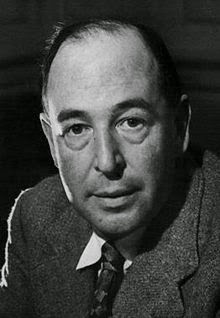
A Panegyric for Dorothy L. Sayers by C.S. Lewis

Dorothy L. Sayers is best known for her Peter Wimsey mysteries, but she was also a playwright, poet, essayist, and theologian, writing such books as The Man Born to Be King, Creed or Chaos?, The Mind of the Maker, and Are Women Human?  In her own eyes, her finest work was her translation of The Divine Comedy.

Both Lewis and Sayers completed their academic studies at Oxford University and their first meeting was through a fan letter that Sayers wrote to Lewis upon reading his The Screwtape Letters.

“She was the first person of importance who ever wrote me a fan letter ……..  I liked her, originally, because she liked me; later for the extraordinary zest and as edge of her conversation —- as I like high wind.  She was friend, not an ally.” (Lewis)

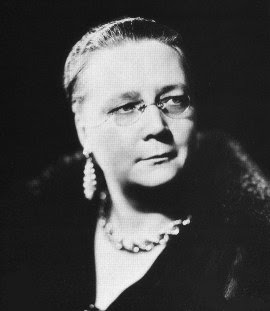
Dorothy L. Sayers
source The Dorothy L. Sayers Society

In this panegyric read at Sayers’ funeral, Lewis praises Sayers’ literary work. While he admits to not being a fan of detective fiction, he nevertheless respects their authors and explains that, contrary to rumours that Sayers was later ashamed of her “tekkies”, she had merely “felt she had done all that she could” with the genre.  He claims there is no “cleavage” between her detective work and her later theological works, citing Pascal’s quote, “One shows one’s greatness not by being at an extremity but by being simultaneously at two extremities.”  He discusses the writing of Christian works, the problems of the intrusion of self and the commonalities between detective fiction and religious writing.

With regard to the importance Sayers placed on the quality of writing, he quotes from her The Man Born to Be King, “Let me tell you, good Christian people, an honest writer would be ashamed to treat a nursery tale as you have treated the greatest drama in history: and this in virtue, not of his faith, but of his calling.”  The intention to behave piously was no excuse for a job poorly done.

Finally, he praises her work of the translation of Dante’s The Divine Comedy and goes on to say of her independent character:

” For all she did and was, for delight and instruction, for her militant loyalty as a friend, for courage and honesty, for the richly feminine qualities which showed through a port and manner superficially masculine and even gleefully ogreish —- let us thank the Author who invented her.”

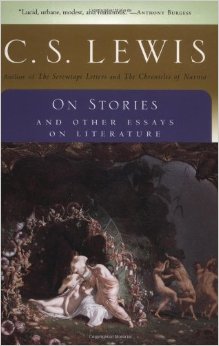
This essay can be found in:  


Deal Me In Challenge #14 – Five of Spades

Walden by Henry David Thoreau

“When I wrote the following pages, or rather the bulk of them, I lived alone, in the woods, a mile from any neighbor, in a house which I had built myself, on the shore of Walden Pond, in Concord, Massachusetts, and earned my living by labor of my hands only.”

Transcendentalist Henry David Thoreau wrote Walden, his magnum opus, during a two year stay on lands owned by his friend, Ralph Waldo Emerson.  Walden Pond, situated in Walden Woods, was an untouched centre of beauty among the agricultural lands of Concord, Massechusetts, and his sojourn there allowed Thoreau the peaceful reflection that he so earnestly sought.

“I went to the woods because I wished to live deliberately, to front only the essential facts of life, and see if I could not learn what it had to teach, and not, when I came to die, discover that I had not lived.  I did not wish to live what was not life, living is so dear; nor did I wish to practice resignation, unless it was quite necessary.  I wanted to live deep and suck out all the marrow of life, to live so sturdily and Spartan-like as to put to rout all that was not life, to cut a broad swath and shave close, to drive life into a corner, and reduce it to its lowest terms, and, if it proved to be mean, why then to get the whole and genuine meanness of it, and publish its meanness to the world; or if it were sublime, to know it by experience, and be able to give a true account of it in my next excursion.”

Thoreau’s reasons for retreating to the woods, his construction of a cabin, his pastoral descriptions of nature, and his philosophy surrounding interaction with nature and solitude, permeate the pages and take us into a world and perceptions that stretch our thinking and make us long for something simpler. Thoreau makes us face the realities of life and prods us to examine the value received from our choices.  Do we live according to our own hearts and convictions or by society’s dictates, and how are we changed by our choices?

Surprisingly, given its present popularity, Walden was rejected by eight publishers before being printed, and experienced only a negligible success during Thoreau’s lifetime, finally becoming popular during the 20th century with the advent of the Civil Rights era.

Walden Pond in late June
source Wikimedia Commons

There were parts of this book that I loved and could completely relate to.  I have my own version of Walden Pond in the summer.  I know the call of the eagle, the blue blur of a dragonfly, the slap of a beaver’s tail on the water.  I understand the workings of an isolated community, with close interactions, yet subtly observed personal boundaries.  I understand what silence means and the benefit of the education received through it.  Returning to a life unhampered by unnecessary busyness and useless striving certainly renews your spirit and allows you to become more synchronized with nature and with humanity.

My Walden Pond
© Cleo @ Classical Carousel

“We must learn to reawaken and keep ourselves awake, not by mechanical aids, but by an infinite expectation of the dawn, which does not forsake us even in our soundest sleep.  I know of no more encouraging fact than the unquestionable ability of man to elevate his life by a conscious endeavour.  It is something to be able to paint a particular picture, or to carve a statue, and so to make a few objects beautiful; but it is far more glorious to carve and paint the very atmosphere and medium through which we look, which morally we can do.  To affect the quality of the day, that is the highest of arts.”

“Live in each season as it passes; breathe the air, drink the drink, taste the fruit, and resign yourself to the influence of the earth.”

© Cleo @ Classical Carousel

Thoreau entreats us not only to strive to live simply but to be happy with little and therefore, recognize that as we grow poor in possessions, we grow rich in spirit.

“However mean your life is, meet and live it; do not shun it and call it hard names.  It is not so bad as you are.  It looks poorest when you are richest.  The fault-finder will find faults even in paradise.  Love your life, poor as it is.  You may perhaps have some pleasant, thrilling, glorious hours, even in a poorhouse.  The setting sun is reflected from the windows of the almshouse as brightly as from the rich man’s abode; the snow melts before its doors as early in the spring.  Cultivate property like a garden herb, like sage.  Do not trouble yourself much to get new things, whether clothes or friends.  Turn the old; return to them.  Things do not change; we change.  Sell your clothes and keep your thoughts …….  Superfluous wealth can buy superfluities only.  Money is not required to buy one necessary of the soul.”

“My greatest skill in life has been to want but little”

While Thoreau’s wilderness experience was unique, I’m not sure that he was recommending that everyone pack up and make for the woods.  In his words, I heard him entreat people to have some sort of experience with nature, to take the time to explore it, to open yourself up to it in a quiet, introspective kind of way and, within that experience, nature will teach you to know yourself better.

“For a week I heard the circling groping clangor of some solitary goose in the foggy mornings, seeking its companion, and still peopling the woods with the sound of a larger life than they could sustain.  In April the pigeons were seen again flying express in small flocks, and in due time I heard the martins twittering over my clearing, though it had not seemed that the township contained so many that it could afford me any, and I fancied that they were peculiarly of the ancient race that dwelt in hollow trees ere white men came.  In almost all climes the tortoise and the frog are among the precursors and heralds of this season, and birds fly with song and glancing plumage, and plants spring and bloom, and winds blow, to correct this slight oscillation of the poles and preserve the equilibrium of Nature.”

While I loved reading about Thoreau’s temporary experiment, this is not the easiest book to get through.  At times Thoreau overwhelms you with his spiritual philosophy and I found myself wondering at how he could become an expert with merely a two year stint in only comparative isolation, as he was near Concord and often had visitors to his abode.  However, these flaws did not diminish some rather obvious truths in Thoreau’s vision.  He allowed nature to be his Muse, simplicity his guide and he leads us on a soul-searching journey into the woods, opening our eyes to the world around us.

I found this video on YouTube and I think it echoes some of Thoreau’s thoughts beautifully ….. “and see if I could not learn what it had to teach, and not, when I came to die, discover that I had not lived.” 

 Figuring Life Out