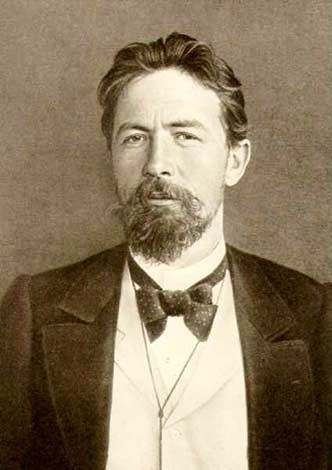
I’m trying to get back on track with my Deal-Me-In Challenge, and I finally drew the first short story of the year, The Runaway by Anton Chekhov.

I’m trying to get back on track with my Deal-Me-In Challenge, and I finally drew the first short story of the year, The Runaway by Anton Chekhov.
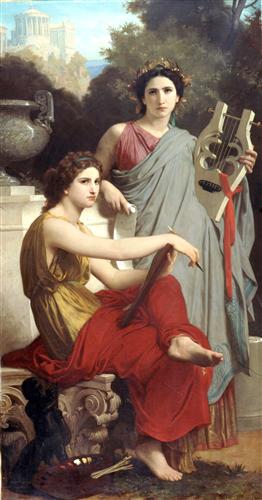 |
| Art and Literature (1867) William-Adolphe Bouguereau source Wikiart |
Is there good literature? Is there bad literature? How do we make the determination, and do we even have the criteria to judge? In his essay, Different Tastes in Literature, if Lewis does not directly answer these questions, he at least gives the reader criteria that makes it easier to judge, and challenges us to examine our reading experiences.

My ninth choice for my Deal Me In Challenge comes from “diamonds,” my poetry section. I have completely avoided my short story section so far, not out of design, but out of fate. I just haven’t chosen a club yet. In any case, for this choice we move to France and the poetry of Victor Hugo.
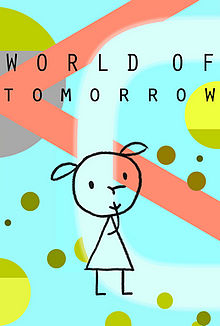
I seem to be getting mostly essays lately for my Deal Me In Challenge. This week, I read The World of Tomorrow by E.B. White, the famed author of Charlotte’s Web. White wrote this essay about the 1939 World’s Fair in New York, where visions of the future abounded and a bright tomorrow was laid before eager and credulous eyes.
“The eyes of the fair are on the future —- not in the sense of peering toward the unknown nor attempting to foretell the events of tomorrow and the shape of things to come, but in the sense of presenting a new and clearer view of today in preparation for tomorrow; a view of the forces and ideas that prevail as well as the machines.
To the visitors the Fair will say, ‘Here are the materials, ideas and forces at work in our world. These are the tools with which the forces of the World of Tomorrow must be made. They are all interesting and much effort has been expended to lay them before you in an interesting way. Familiarity with today is the best preparation for the future.”
( ~ official New York World’s Fair pamphlet)
 |
| British Pavilion source Wikipedia |
Someone is obviously trying to sell something grand, and it was enlightening to read about White’s experience at the Fair. Right from the start, we sense a disconnect between the two, as he personifies the event. His first sentences read: “I wasn’t really prepared for the World’s Fair last week, and it certainly wasn’t prepared for me. Between the two of us there was considerable of a mixup.” White informs the reader that upon his visit, he had a cold and that “when you can’t breath through your nose, Tomorrow seems strangely like the day before yesterday.” He then gives a catalogue of the exhibitors with strangely impersonal names such as Kix, Astring-O-Sol, Textene, Alka-Seltzer and the Fidelity National Bank. White’s impressions do not inspire awe or a trust in Tomorrow.
“It is all rather serious-minded, this World of Tomorrow, and extremely impersonal. A ride on the Futurama of General Motors induces approximately the same emotional response as a trip through the Cathedral of St. John the Divine. The countryside unfolds before you in $5-million micro-lovliness, conceived in motion and executed by Norman Bel Geddes. The voice is a voice of utmost respect, of complete religious faith in the eternal benefaction of faster travel …….. When night fall in the General Motors exhibit and you lean back in the cushioned chair (yourself in motion and the world so still) and hear (from the depths of the chair) the soft electric assurance of a better life — the life which rests on wheels alone — there is a strong, sweet poison which infects the blood. I didn’t want to wake up. I liked 1960 in purple light, going a hundred miles an hour around impossible turns ever onward toward the certified cities of the flawless future. It wasn’t till I passed an apple orchard and saw the trees, each blooming under its own canopy of glass, that I perceived that even the General Motors dream as dreams so often do, left some questions unanswered about the future. The apple tree of Tomorrow, abloom under its inviolate hood, makes you stop and wonder. How will the little boy climb it? Where will the bird build its nest?”
White makes a few other observations which are very powerful statements:
“In Tomorrow, people and objects are not lit from above but from below”
“Rugs do not slip in Tomorrow, and the bassinets of newborn infants are wired against kidnappers. There is no talking back in Tomorrow. You are expected to take it or leave it alone.”
“In Tomorrow, most sounds are not the sounds themselves but a memory of sounds, or an electrification.”
At the end of the essay, instead of remembering the Fair itself, White’s recollections are quite different: the trees at night, eerie shadows, fountains in the light, a girl, remembered not just as passing impressions, but in generous detail. The last line of the essay stabs home his point:
“Here was the Fair, all fairs, in pantomime; and here the strange mixed dream that made the Fair: the heroic man, bloodless and perfect and enormous, created in his own image, and in his hand (rubber, aspetic) the literal desire, the warm and living breast.”
After my first read of this essay, I was left completely unmoved. I had no interest in the 1939 World’s Fair, and White’s ramblings about his cold, standing in line, etc. which I found annoyingly pointless. It was only when I read the essay for a second time, that his consummate skill as a writer drummed me over the head. Though not stating his views outright, with each sentence White was building his case, having the reader experience the loss of humanness and empathy that the rapid rise of technology was moving towards. When one places the value of machines and progress above the people they are supposed to be serving, you lose the human qualities of life and the simplicity, the wonder and human connection in life that make it so fulfilling.
Perhaps it’s telling that White moved from New York to Maine that very year.
Deal Me In Challenge #8

This “essay” is set up in point-form with the sub-title, Twenty-seven Propositions About Global Thinking and the Sustainability of Cities. It’s going to be difficult to review, not only because of the structure, but also because Berry is such an original thinker and has so much of value to say. It is almost a shame to leave anything out.


This was one of my children’s books that I had scheduled for my Deal Me In Challenge, and I was planning to review it only on my children’s blog, yet it was such a wonderfully uplifting story that I decided to share it here too!
The book is initially set in England during the reign of King John. The main character, John, is a twelve year old boy, yet big for his age, who works on the manor of Sir Eustace as a villein. Old Marm, is an old woman who acts as his guardian, and through her we learn of John’s noble connections, of how she saved him from an attack on his father’s castle when he was a mere babe. With his father either dead, or missing, John’s heartfelt desire is to find him and wreak vengeance on the baron who attacked his family estate when his father fell afoul of the king.

 |
| Young Woman in a Straw Hat (1901) Pierre-Auguste Renoir source Wikiart |
Popular in medieval and renaissance times, this “complaint poem” is written in rhyme royal (ababbcc), with seven lines per stanza in iambic pentameter, which I just encountered while recently reading The Brubury Tales (in The Feet’s Prologue), a take on Chaucer’s The Canterbury Tales. Because this style was unusual for Shakespeare, some critics question his authorship, yet there are parts of the poem that certainly echo of Shakespeare, and coincidentially the first stanza is very close to the first stanza of The Rape of Lucrece.
As for figures of speech, the following are included in the poem: alliteration, anaphora, hyperbole, metaphor, paradox, personification and simile. Could I identify them all on the first read? No, but that means that I’ll have to read The Lover’s Complaint again!
Deal Me In Challenge #4

“In Moulmein, in Lower Burma, I was hated by large numbers of people — the only time in my life that I have been important enough for this to happen to me.”
Orwell tells of his stint in Burma as a police officer under British colonial rule. He was despised by the people as an agent of the perceived oppressors, but in spite of his job, his sympathies lay with the natives and he felt constant guilt because of his duties.
“A critic who makes no claim to be a true Shakespearian scholar and who had been honoured by an invitiation to speak about Shakespeare to such an audience as this, feels rather like a child brought in at dessert to recite his piece before the grown-ups.”
In the first case, if Hamlet is indeed a failure, we waste our time investigating why his actions were delayed. Yet, if this failure were indeed a reality, why does Hamlet touch us so? Why does it echo with “the sense of vast dignities and strange sorrows and teased ‘with thoughts beyond the reaches of our souls'”? If Hamlet is failure, then perhaps failure is better than success, and such a verdict could never be rendered with less certainty.
The last point seems to be the most logical, yet why then, in all three camps, does the play appear to hold each in thrall, enchanting the very critics who criticize it? Does the mystery and magical appeal of the play have little to do with Hamlet’s actual character, but instead is due to something entirely different?
 |
| Czachórski Actors Before Hamlet Wladyslaw Czachórski source Wikimedia Commons |
Lewis brings to light Aristotle’s definition of tragedy, which is an imitation not of men, but of action and life and happiness and misery, yet “action” by ancient standards means “situation.” Instead of always attempting to delineate a character, one should first “surrender oneself to the poetry and the situation.” It is through poetry and situation, and for their sake, that the characters exist.
 |
| Hamlet’s Vision (1893) Pedro Américo source Wikimedia Commons |
For Lewis, the ghost does not merely tell of the murder of Hamlet’s father. Instead, the ghost and Hamlet are inseparable, and indeed the spectre is different from most vile ghosts in Elizabethan drama; this ghost is willfully ambiguous. Its presence lends an enigmatic uneasiness to the play, filling Hamlet’s, and even other character’s, minds with doubt and uncertainty. ” ….. the appearance of the spectre means a breaking down of the walls of the world and the germination of thoughts that cannot be thought; chaos is come again.”
The subject of Hamlet is death. Lewis does not base the theme on the numerous deaths of the characters, rather the situations they find themselves contemplating. We read it in the ghost, in the line of “melting flesh”, in the rejection of suicide, in the graveyard, the skull …….. As we read Hamlet, we cannot escape it, which gives the play its quality of obscurity and apprehension. There are other elements to the play, but there is always this groping toward the final end and questions about the destiny of the soul or body.
Hamlet’s vacillations do not balance on his fear of dying, but instead a fear of being dead.
“Any serious attention to the state of being dead, unless it is limited by some definite religious or anti-religious doctrine, must, I suppose, paralyse the will by introducing infinite uncertainties and rendering all motives inadequate. Being dead is the unknown x in our sum. Unless you ignore it or else give it a value, you can get no answer.”
 |
| Hamlet and Ophelia (1858) Dante Gabriel Rossetti source Wikimedia Commons |
Yet Lewis says that Shakespeare’s own text does not confirm his theory, nor has Shakespeare given “us data for any for any portrait of the kind critics have tried to draw.” We enjoy Hamlet’s speeches “because they describe so well a certain spiritual region through which most of us have passed and anyone in his circumstances might be expected to pass, rather than because of our concern to understand how and why this particular man entered it”. And, in fact, Hamlet is an Everyman. He is a hero yet also a “haunted man — man with his mind on the frontier of two worlds, man unable either quite to reject or quite to admit the supernatural, man struggling to get something done as man has struggled from the beginning, yet incapable of achievement because of his inability to understand either himself or his fellows or the real quality of the universe which has produced him.”
The critics have never doubted the greatness or mystery of the play, but they simply put it in the wrong place, “in Hamlet’s motives rather than in that darkness which enwraps Hamlet and the whole tragedy and all who read and watch it.” It is the mystery of the human condition.
Lewis ends by acknowledging the weakness of his theory, only because his type of criticism does not have centuries of vocabulary to support it, as does the other type of criticisms. Yet he wishes that Hamlet could be played as “a dishevelled man whose words make us at once think of loneliness and doubt and dread, of waste and dust and emptiness, and from whose hands, or from our own, we feel the richness of heaven and earth and the comfort of human affection slipping away.” Perhaps his views are childish, yet children remember the details of stories. So, is Lewis a literary child?
“On the contrary, I claim that only those adults who have retained, with whatever additions and enrichments, their first childish response to poetry unimpaired, can be said to have grown up.”
Deal Me In Challenge #1
_01.jpg)

