L’Argent (Money) by Émile Zola

“The clock on the Bourse had just struck eleven when Saccard walked into Champeaux’s, into the white and gold dining-room, with its two tall windows looking out over the square.”

Aristide Saccard is on the move again. Brought low by ruinous business practices (see La Curée or The Kill), his wife dead, and his estate sold, Saccard winds calculatingly through Paris like a snake looking for an opportunity to strike. At first, he is certain that his brother, the government minister, Eugène Rougon, will come to his assistance, but when he hears that his sibling wishes to remove him from Paris for fear of embarrassment, Saccard makes a precipitative move, declaring he will open a bank that will be the financial success of Paris, a venture in which everyone will be clamouring to be involved.  His passion and sheer energy sweeps people along with him, including Lady Caroline and her brother, Hamelin, honest and respectable souls, who admire Saccard’s genius.  Yet in the world of big money and La Bourse (the French equivalent to Wall Street), allegiances can fluctuate, affiliations change, and behind every corner is the face of your own demise.

Celebration in the Streets of Paris (Montemarte) (1863)
Vasily Perov
source Wikiart

“The Bourse is a real forest, a forest on a dark night, in which people can only grope their way along.  In all that darkness, if you’re foolish enough to take heed of everything, however inept and contradictory, that you’re told, then you’re sure to break your neck.”

Zola paints an excellent representative portrait of Paris’ frantic and unscrupulous financial world of 1863-during the reign of Napoleon II of the Second Empire.  We see how alliances and loyalties are formed only on the basis of financial gain, yet human concern or family loyalties have little value.

“In these covert and cowardly financial battles, in which the weak are quietly disembowelled, there are no more bonds of any sort, no kinship, no friendship, only the atrocious law of the strong, those who eat so as not to be eaten.”

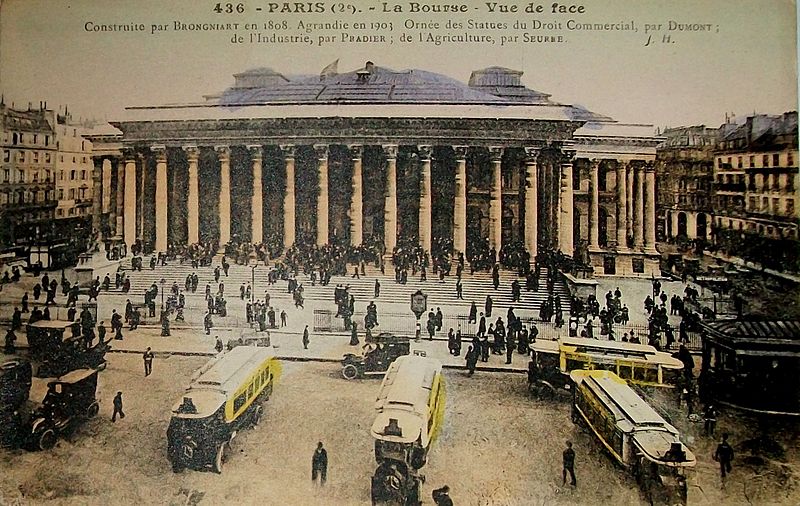
La Bourse (1900)
source Wikimedia Commons

Zola demonstrates through his narrative and his colourful characters, how the lust for money, greed and power are not merely promoted, but in fact, worshiped.

“His wife was never seen, being unwell, said the Marquis, and kept to her apartment by infirmity.  However, the house and furniture were hers, and he merely lodged there in a furnished apartment, owning only his personal effects, in a trunk he could have carried away in a cab; they had been legally separated ever since he started living on speculation.  There had been two catastrophes already, in which he had blankly refused to pay what he owed and the official receiver, having taken stock of the situation, had not even bothered to send him an official document.  The slate was simply wiped clean.  As long as he won, he pocketed the money.  Then, when he lost, he didn’t pay:  everyone knew it and everyone was resigned to it.  He had an illustrious name, he made an excellent ornament for boards of directors; so new companies, looking for golden mastheads, fought over him:  he was never unemployed.”

As Saccard cleverly constructs his colossal financial empire, he is captivated by money but he is captivated by power more.  The thrill of financial battle is as addicting as as drug, and he is high on the power and the ultimate campaigns fought to gain it.  It is a house of cards and each trade, each purchase, each decision, is perhaps the one that will cause its downfall.

“Wealth for him had always taken the form of that dazzle of new coins, raining down through the sunshine like a spring shower and falling like hail on the ground, covering it with heaps of gold that you stirred with a shovel just to see their brightness and hear their music ……… But he had always been a man of imagination, seeing things on too grand a scale, transforming his shady and risky deals into epic poems; and this time, with this really colossal and prosperous enterprise, he had moved into extravagant dreams of conquest, with an idea so mad, so huge, that he did not even formulate it clearly to himself.”

Panorama of Paris, 1865
Charles Soulier
source Wikimedia Commons

Also explored are the feelings on anti-Semitism prevalent during the time.  Jews were often seen as good for loans but with little else to their character or worth to recommend them.  In a world were humanity is held in so little regard, this racism is another head on the monster of greed, power and manipulation.

With his usual descriptive flair and creative technique, Zola allows the reader to skim along the surface of the narrative, to first get your bearings, before he draws you into the story and you are held captive by the machinations of the characters, the vivid depictions of Paris and the power of that elusive yet ever-coveted currency, money.

This book was not Zola’s favourite to write.  “It’s very difficult to write a novel about money.  It’s cold, icy, lacking in interest ……”  Zola said in an interview, but he declined to demonize it, instead choosing to show the effects of its worship in a work that would “praise and exalt it’s generous and fecund power, it’s expansive force.”  His technique certainly worked, as the reader becomes the observer of an inanimate object that effectively controls the lives of an empire.

Other Reviews of the Rougon-Macquart Series (Zola’s recommended order):

Further Reading:

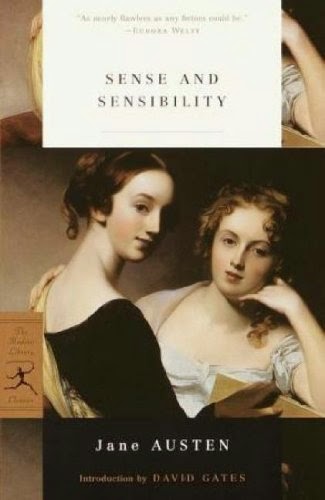
Sense and Sensibility by Jane Austen

“The family of Dashwood had been long settled in Sussex.”

Mr. Dashwood of Norland Park has passed away leaving his wife, Mrs. Dashwood, and three daughters, Elinor, Marianne, and Margaret to the mercy of their half-brother, John Dashwood, now owner of their ancestral home.  While John had promised his father to care for his step-mother and sisters and settle money on them for their comfort, he is quickly and deftly talked out of giving them anything by his mercenary wife. The Dashwood family is left to accept Barton Cottage, a small cottage in Devonshire, offered to them by a distant cousin, Mr. Sir John Middleton.  Yet before they leave Norland, Elinor forms an attachment with Edward Ferrars, the brother of her callous sister-in-law, a good-natured young man, who appreciates Elinor’s sense and temperance.

At Barton Cottage, the family meet their benefactor, Sir John, a rather buffoonish cordial man, with a wife with a character as warm as winter. Despite their reduced circumstances, the Dashwoods accept their new life with, more-or-less, a cheerful resignation and begin to move about in society, meeting the dour and grave Colonel Brandon.  Brandon is attracted to Marianne, but at thirty-five years old, he seems rather ancient to her, and his disposition does not exemplify all the sensitivity, feeling and passion that she considers essential in a man.  During an accident in the rain, Marianne is rescued by a young gentleman, Willoughby, and his nature, in contrast to Brandon’s, appears to be everything her heart desires.  His love of books, music and poetry correspond identically to hers; his impulsiveness and his carefree love of pleasure; his immoderate abandon in the face of love.  Their marriage soon appears to be a surety, but when Marianne learns of his engagement to another, her heart and all her preconceived ideals are damaged.

Meanwhile, Edward Ferrars pays a visit, yet while Elinor feels an ardent connection between them, Edward appears indecisive.  She soon learns of his engagement to a Miss Lucy Steele and, contrary to Marianne’s disposition, she is forced to suppress her natural feeling for the sake of convention, but also self-respect.

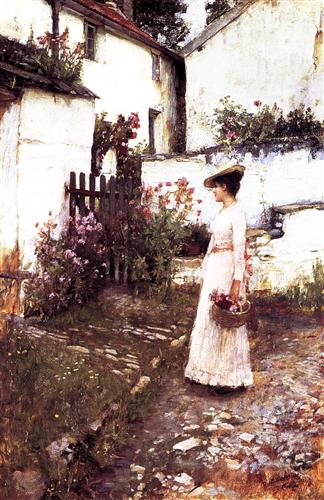
Gathering Flowers in a
Devonshire Garden
John William Waterhouse
source Wikiart

The juxtaposition of sense and sensibility is played out and embodied in the characters of Elinor and Marianne.  Elinor’s sense is soon made apparent.  “Elinor, the eldest daughter whose advice was so effectual, possessed a strength of understanding, and coolness of judgement, which qualified her, though only nineteen, to be the counsellor of her mother, and enabled her frequently to counteract, to the advantage of them all, that eagerness of mind in Mrs. Dashwood which must generally have led to impudence.  She had an excellent heart; her disposition was affectionate, and her feelings were strong: but she knew how to govern them: it was a knowledge which her mother had yet to learn, and which one of her sisters had resolved never to be taught.”

Marianne, in contrast, is all unbridled sensibility, and shows a contempt for those who are not as passionate.  While her sensibility is a sensation of passion induced by positive emotions and experience, such as love, poetry, music, and a response to beauty, it is a wild impulsive, unrestrained, vehement emotion, and Marianne allows herself to be governed by it entirely.  As young colt strains against the teaching rein, so Marianne pulls against the constraints that society places on her as a young woman in Georgian England.

London (1808)
William Turner
source Wikiart

Yet while Austen shows the differences and consequences of the two character traits, with her usual insights and character crafting she does not put either sister in a tidy box.  While Marianne is wild and impulsive, she also show glimmers of sense.  As her character develops, Willoughby’s true nature is revealed to her, and through him her own nature is reflected back into her eyes.  She recognizes her faults and strives for change.  Conversely, it is not that responsible, pragmatic Elinor doesn’t feel; she has similar strength of emotion and attachment as her sister, but her emotions are bridled.  Elinor’s sensibility is there, but it does not overpower her sense and therefore allows her to see situations in a clearer light, and from that she is able to govern her life in a way that not only brings respect and contentment to herself, but is beneficial for those people around her.

As usual, Austen gives us a kaleidoscope of characters and while there is strict delineation between the different levels of society, she also shows the colourful interactions that cross those boundaries between them.  She juxtaposes two situations, one were engagements are incorrectly assumed for both sisters, and then the turmoil of both sisters when it is known that Willoughby and Edward are engaged to other women.  Yet it is the characters that offer us a lesson, as their behaviour determines the outcomes of each situation, and gives us an intimate look at the correct balance of both “sense” and sensibility”.

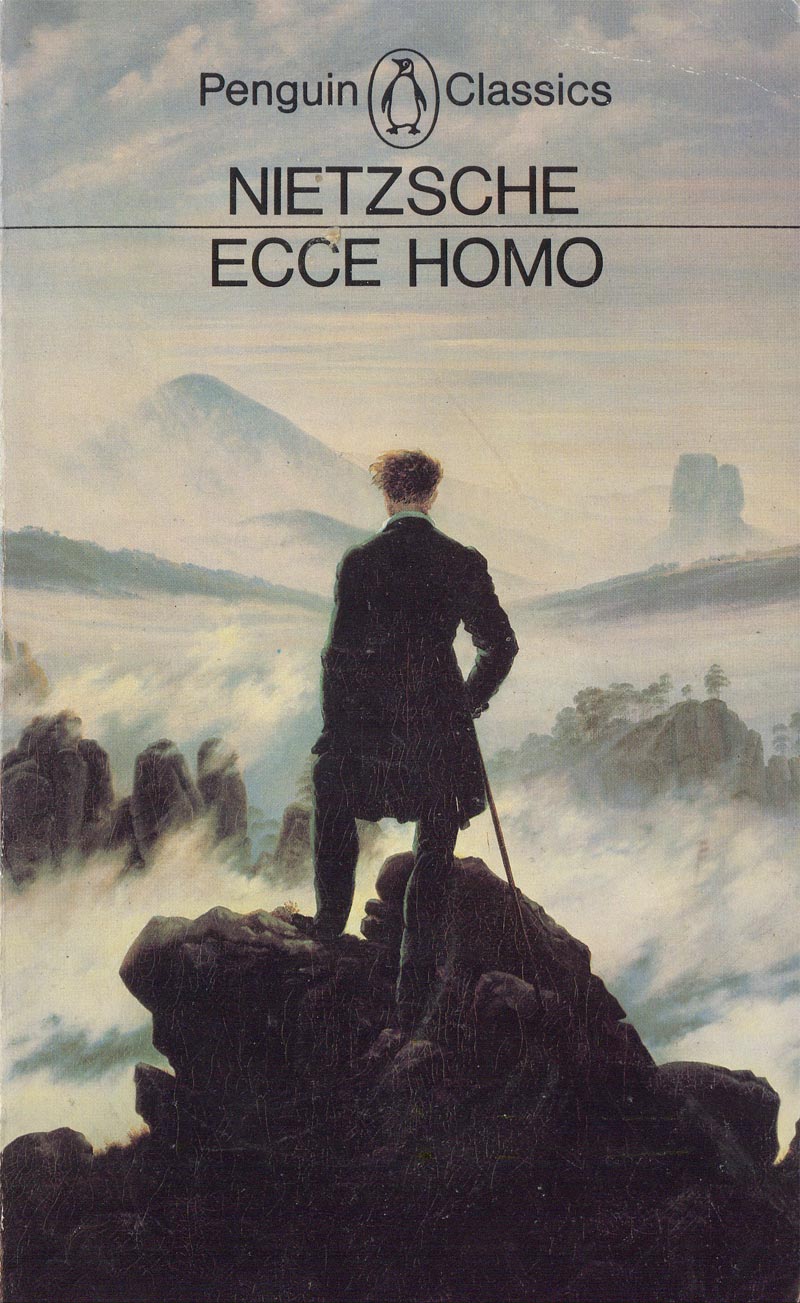
Ecce Homo by Friedrich Nietzsche

Ecce Homo

Ecce Homo: “In view of the fact that I will shortly have to confront humanity with the heaviest demand ever made of it, it seems to me essential to say who I am.”

I feel somewhat exhausted.  Approaching Ecce Homo with something akin to trepidation, it’s been proven that my expectations are often very accurate. Nietzsche was certainly a trial, but I’m glad that I read Ecce Homo, my first exposure to this singular German philosopher.  Wow, Nietzsche would hate that description.  He despised Germans and felt philosophy was a fraud.  In any case, he didn’t like most things, so any way I described him, I’d be in danger of his patronizing, scathing invective.

Ecce Homo, or How One Becomes What One Is (Wie Man Wird, Was Man Ist) was the last book that Nietzsche wrote before his death and gives insight into the man, his ideas and his works.  The words “Ecce Homo” are taken from the words Pontius Pilate used when he delivered Jesus, scourged and bleeding, to a riotous crowd right before he was taken to be crucified.  Nietzsche hated Christianity because he felt that it was the mechanism for the function of society and, therefore, was responsible for everything that was wrong with it.

Yet while the book gives enlightenment, it does so from Nietzsche’s perspective, words coming from a man who already seemed in the throes of the mental illness that would bring about his death.  It’s certainly helpful to see it in this light.


Ecce Homo
Ecce Homo (1558-60)
Titian
source Wikipedia

Why I Am So Wise

Nietzsche is better than everyone else in the world.  He is so incredibly wise and we are such small, insignificant beings compared to him, with nothing in particular to add to the benefit of humanity, that he can hardly stand to be in our presence.  Lest you think I’m being too hard on him, let Nietzsche speak for himself:

” ….. I have an instinct for cleanliness that is utterly uncanny in its senstivity, which means that I can physiologically detect —- smell —- the proximity or (what am I saying?) the innermost aspect, the ‘innards’ of every soul …… I am already conscious of the large amount of concealed dirt at the bottom of many a nature, perhaps occasioned by bad blood but whitewashed over by upbringing. ……. natures like this which are unconducive to my cleanliness feel the circumspection of my digust on their part, too; it does not make them smell any more pleasant ……. impure conditions are the death of me ………. This makes dealing with people quite a trial to my patience; my humaneness consists not in sympathizing with someone, but in putting up with the fact that I sympathize with them …… My humaneness is a constant self-overcoming …….”

Ecce Homo
Ecce Homo (1964-67)
Salvador Dali
source Wikiart

There is more blather stating that compassion, rather than being a virtue, is a weakness, and he references his work, Zarathustra, for proof (in this I believe Nietzsche misses making the distinction between false compassion and true compassion); and labelling rudeness as one of the foremost virtues (again, he muddles benevolent frankness with lack of resolution and fortitude to deal with issues).

He announces his penchant for war, or attack, and lists his rules of war:

  1. He attacks only causes which are victorious
  2. He attacks causes only when there are no allies to be found
  3. He never attacks people
  4. He attacks things only when all personal disagreement is ruled out

He claims that he can attack causes with impunity, and that there are no hard feelings from the victim, yet in his next chapter he states, “May I make bold as to intimate one last trait of my nature which causes me no little trouble in my dealings with people?,” indicating that his relationships are not so harmonious as he’d like to believe.

Why I Am So Clever

I seriously asked myself if I really wanted to know why Nietzsche thought himself so clever, but, foolish me, I decided to keep on reading.

Nietzsche lists the reasons for his cleverness at the beginning of this section:

  • he has not squandered himself
  • he has no personal experience with true religious difficulties
  • he is entirely at a loss to know how sinful he is supposed to be

Higher educations causes one to lose sight of realities and Nietzsche then begins to take pot-shots at the German education system, which regresses to insulting German culinary tradition.  How we got there, I’m uncertain.  He then conducts a detailed investigation into:

  • nutrition
  • place
  • climate
  • relaxation

Within these four topics, Nietzsche likens reading to letting an alien climb over your wall; claims he reads the same books because he is opposed to new books by instinct; states everywhere that Germany extends, it ruins culture; that we are all afraid of truth; and that Wagner to him, is like hashish.  It sounds bizarre and, quite frankly, is, but there are certainly some interesting ideas in Nietzsche’s convoluted onslaught of aberrant thought.

He claims that he now cannot avoid the question how to become what you are, but then digresses, and I can’t find anywhere where he answers it.

And asked why he concentrates so much on the small issues of above, Nietzsche alleges that to-date everything that man had deemed important is, in fact, lies because we have searched for divinity in human nature.  We must start relearning and therefore, we must begin with the basics.

Why I Write Such Good Books

“I am one thing, my writings are another.”

Nietzsche is resigned to the fact that no one will be able to understand his writing, feeling no ill-will towards anyone for their lack of intellect.

” …. in other words experiencing —- six sentences of it [Zarathustra] raises you up to a higher level of mortals than ‘modern’ men could ever reach ….”

Some day, there will be universities dedicated to understanding his works.  No one has experienced what Nietzsche has, and therefore is it not understandable that no one can comprehend his genius? Oh here, let me allow Nietzsche to speak for himself:

“I know my prerogatives as a writer to some extent; in certain cases I even have evidence of how much it ‘ruins’ people’s taste if they get used to my writings.  They simply can no longer stand other books, least of all philosophy books.  It is an unparalleled distrinction to step into this noble and delicate world — for which you must not on any account be a German; ultimately it is a distinction you need to have earned …… I come from the heights to which no bird has yet flown, I know abysses into which no foot has yet strayed.  I have been told it is not possible to let a book of mine out of one’s hands —- that I even disturb sleep …… There is definitely no prouder and at the same time more refined kind of book: here and there they achieve the highest thing that can be achieved on earth, cynicism; you must tackle them with the most delicate fingers as well as with the bravest fists.”

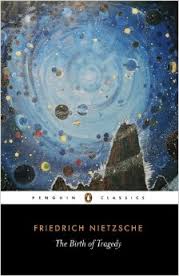
The birth of tragedy

Nietzsche then outlines each of his books, spending most of his time lauding their brilliance, mentioning the few geniuses who have enjoyed them, and condemning everyone who disliked them.

The Birth of Tragedy:  “It is politically indifferent  —– ‘un-German’ in today’s parlance —- it smells offensively Hegelian, and in just a few phrases it is tainted with the doleful scent of Schopenhauer.  An ‘idea’ — the Dionysian/Apollonian opposition —- translated into metaphysics, history itself as the development of this ‘idea’; in tragedy the opposition sublated to become a unity form this point of view things that had never looked each other in the face before suddenly juxtaposed, illuminated, and understood in the light of each other …..”

the untimelies

The Untimelies: The Untimelies can also be translated as “Thoughts out of Season”, “Unmodern Observations” or “Unfashionable Observations”.  In this writing, Nietzsche draws his rapier and launches four attacks:

First, an attack on the German education system.  I found that this was the first time I actually agreed with Nietzsche.  He purported that there was no evidence at all that Germany’s military success was a result of their education.  The school system in America is apparently an offshoot of this Prussia model.  I found an interesting article about it here.  One of my favourite authors, John Taylor Gatto, talks about this model in his book, The Underground History of American Education.  I highly recommend it.

The second attack is titled, On the Uses and Disadvantages of History for Life.  Nietzsche warns of the dangers of “our kind of scientific endeavour, what there is in it that gnaws away at life and poisons it —- life made ill by this dehumanized machinery and mechanism, by the ‘impersonality’ of the worker, by the false economy of the ‘division of labour’.  The end, culture, is lost — the means, modern scientific endeavour, barbarizes ….”  Hmmm ….. is it possible that I might again agree with Nietzsche?  That would be just too weird.

The third and fourth Untemelies, titled Schopenhauer as Educator and Richard Wagner in Bayreuth, give an impression of “a higher conception of culture, towards the restoration of the concept ‘culture'” in which two images are set, having the highest contempt for everything around them that is synonymous with the present culture.  I doubt that I’d side with him here.

Nietzsche appears to take great joy in upsetting everyone around him.

human all too human

Human, All Too Human: With Two Continuations:

Subtitled A Book For Free Spirits, Nietzsche claims in this writing that he liberated himself from idealism and is “a spirit that has become free, that has seized possession of itself again.”

I wasn’t quite clear as to what exactly this work was about, due to Nietzsche’s ambiguity and his habit of digression, but it appears that he mentions things favourable to Voltaire, and addresses his break with Richard Wagner.  Why am I not surprised that he extols the thoughts of Voltaire?

The work apparently evolved out of some mental crisis that Nietzsche experienced during the Bayreuth Festival when he felt a “profound sense of alienation” and went off into the forest before being coaxed back by his sister.

daybreak

Daybreak: Thoughts on Morality as Prejudice

Nietzsche states that this book commenced his war against morality.  Again, Nietzsche commends his work and genius, rather than getting to the meat of his ideas.

“Even now, if I encounter the book by chance, practically every sentence becomes a tip with which I can pull up something incomparable from the depths once again: its whole hide quivers with the tender shudders of recollection ….”

But finally Nietzsche gets to a description of what he believes is its value:

“In a revaluation of all values, in freeing himself from all moral values, in saying ‘yes’ to and placing trust in everything that has hitherto been forbidden, despised, condemned.  This yes-saying book pours out its light, its love, its delicacy over nothing but bad things, it gives them back their ‘soul’, their good conscience, the lofty right and prerogative of existence.”

Good grief!  You want to counter this statement but where do you start?  Does he think that there have been no societies that have tried to live without morality?  Is this morality-proper or Nietzsche’s type of morality?  Can one truly escape some sort of morality?

the gay science

The Gay Science:  This title is developed out of the Provençal expression which is used to describe the technical skill of writing poetry, as Nietzsche describes it, “almost every sentence here profundity and mischief go tenderly hand in hand.”  The quality of the Provençal style shows “unity of singer, knight, and free thinker which distinguishes the marvellous early culture of the Provençal people from all ambiguous cultures ….”

thus spoke zarathustra

Thus Spoke Zarathustra: A Book For Everybody and Nobody:  Again, it’s best for Nietzsche to describe this, in his often lovely prose ~ what it means, however, one is often left wondering ….

“Aphorisms quivering with passion; eloquence become music; lightning-bolts hurled on ahead towards hitherto unguessed-at futures.  The mightiest power of analogy that has yet existed is feeble fooling compared to this return of language to its natural state of figurativeness —- And how Zarathustra descends and says the kindest things to everyone!  How he tackles even his adversaries, the priests, with delicate hands and suffers from them with them!  —- Here man is overcome at every moment; the concept of ‘overman’ has become the highest reality here — everything that has hitherto been called great about man lies at an infinite distance below him.  The halcyon tone, the light feet, the omnipresence of malice and high spirits and everything else that is typical of the type Zarathustra has never been dreamed of as essential to greatness.  Precisely in this extent of space, in this ability to access what is opposed, Zarathustra feels himself to be the highest of all species of being; and when we hear how he defines it, we will dispense with searching for his like.”

I won’t sport with your intelligence in continuing to relate just how much more knowledgable and astute Zarathustra (and therefore, Nietzsche) is than you will ever be.

beyond good and evil

Beyond Good and Evil:  If Nietzsche doesn’t catch any “fish” with his works, what could that mean? The cause?  Is it perhaps because his arguments don’t make sense or people can’t relate to his delivery?  No!  According to Nietzsche, it means that there simply weren’t any fish to be caught.

This book is “a critique of modernity, not excluding the modern sciences, the modern arts, even modern politics, together with pointers towards an opposing type, as unmodern as possible, a noble, yes-saying type ….. refinement in form, in intention, in the art of silence is in the foreground; psychology is handled with avowed harshness and cruelty —- the books is devoid of any good-natured word …..”


geneology of morals

Genealogy of Morals: A Polemic:  

A book of three essays:

  1. the psychology of Christianity
  2. the psychology of conscience
  3. where the immense power of the ascetic ideal springs from

This actually sounds somewhat interesting to me.


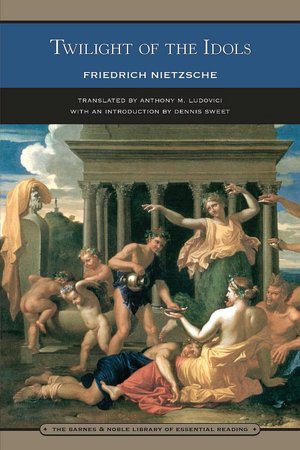
twilight of the idols

Twilight of the Idols: How to Philosophize with a Hammer:

Nietzsche recommends starting with this work.  It’s a short book but “there is nothing richer in substance, more independent, more subversive —- more wicked …”

Nietzsche is the first to have “the yard-stick of truths in his hand.”  He is the evangelist to truth, and everyone was lost before him.

the wagner case

The Wagner Case: A Musician’s Problem:  To read this properly, you need to feel as though music is the history of your own suffering.  I think that this writing deals with his split from his friend, Richard Wagner, a well-known German composer, but Nietzsche launches a scathing invective against, I’m assuming, the ideals that Wagner supported.  He castigates Germans for many things, wrapping up his ire in their great cultural crimes.  He attacks Martin Luther along with Leibniz and Kant.  In fact, Germans have “robbed Europe of its meaning, its reason…”  

Why I Am A Destiny

Nietzsche is terrified that one day he will be called holy.  But, he admits, his “truth is terrifying, for lies were called truth so far.  —- Revaluation of all values: that is my formula for the highest act of self-reflection on the part of humanity, which has become flesh and genius in me.  My lot wills it that I must be the first decent human being, that I know I stand in opposition to the hypocrisy of millennia ….. I was the first to discover the truth, by being the first to sense — smell — the lie as a lie …..   My genius is in my nostrils.”

What follows is more exaltation of evil and lying, and conversely Nietzsche advocates war against the good, benevolent, the beneficent, and Christian morality.  More invectives against Christianity follow, the content of which makes me wonder if Nietzsche really had an issue with Christ, or simply with the way Christianity had been presented to him.  In any case, it really doesn’t matter.  At this point Nietzsche had drained me, and I predict that I’d have an issue reading any work longer than this book of his, which is only 138 pages. He signed this work  ~ Dionysus against the crucified one ~  Nietzsche aligned himself with the early Greek philosophers and thought of himself as a modern-day Dionysus.

bacchus
Bacchus (or Dionysus – 1596)
Caravaggio
source Wikiart

Never mind Dionysus —– Nietzsche is the consummate Narcissus.  He placed himself in the position of God; everything was measured by his own thoughts and emotions, and judged accordingly.  Since he was so much above everything and everyone, is it any surprise that all fall short of his ideal? Perhaps that is nothing, and for a great philosopher is understandable.  Yet the contempt and the disparagement that he exhibits towards nearly everyone, not only severely undermines much of his philosophy, but also twists his ideas into a mass of writhing snakes where one is at a loss to find the proper head and tail to each.

I found some of Nietzsche’s ideas fascinating, but as soon as I started to read his arguments that developed those ideas, he often lost my interest.  Not only were his disputations littered with self-praise, ambiguity and circumlocution, he often didn’t make sense, or perhaps I should say that, in this book, his explanations didn’t go far enough.  He also spoke from a very ethnocentric point-of-view.  Although he believed that he borrowed ideas from the ancient Greeks, almost everything he criticized was German, and everything he wanted to fix related to German society.  I’m not sure how well some of his arguments would hold up in other countries, but my brain is too done to wonder about this ——- no, my brain is not tired because it explored wonderfully deep amazing thoughts; it’s tired as if it’s had to put up with a recalcitrant child for the last couple of weeks.  And so ends my first experience with Nietzsche.

I am quite enjoying my WEM Project.  It’s forced me to read some books that I probably wouldn’t have touched otherwise.  I didn’t particularly enjoy Nietzsche but look at the length of my review!  He at least inspired something, even though it wasn’t admiration.


reading the biographies


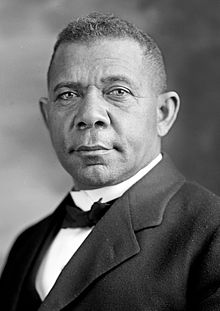
Up From Slavery by Booker T. Washington

“I was born a slave on a plantation in Franklin County, Virginia.”

This was my third book on slavery in succession that I’ve read for my WEM Project.  The Incidents in the Life of a Slave Girl and the Narrative of the Life and Times of Frederick Douglass were the first two, and while I enjoyed the history and information I gleaned on a subject of which I know little (I plead ignorance on the basis of being Canadian), I really did not feel touched by either book as a whole.  Really, I wondered if there was something wrong with me.  Yes, I felt sympathy for the plight of the slaves; just the thought of being owned and having stripped from you the many things that make one human, was horrifying.  The degradation and the suffering generated disgust. Yet there was something missing, for me at least.

In my Frederick Douglass review, Cirtnecce made a comment, and suddenly my mind opened up and I had it; the reason why I was left rather cold by the other two books.  This was my response to her:

What I’ve missed from these books so far, is a way to move forward in a human way. You can speak about practicalities and reason and that’s useful, but if one tries simply to protect one segment of the population or to legislate people’s behaviour, it almost seems as if nothing has truly changed. I’d love to read something that communicates ideas of how to make changes in the hearts and minds of people; imo, that’s the way to effect true change.”

That was it!  I was looking for a book that would precipitate a transformation, and in Booker T. Washington’s biography, I received more than I could ever hope for!

Washington briefly chronicled his experiences as a slave during the Civil War, where he gained his freedom through emancipation at the approximate age of ten.  Eventually he made his way to the Hampton Institute, earned an education through hard work, and because of his perserverance and a solid work ethic, Washington was chosen to become the first leading teacher of the Tuskegee Institute in Alabama, a school formed to promote the higher education of blacks in Confederate States.  Washington’s biography offers an in-depth history of his creation and formation of Tuskegee, which Washington built not only with his hands, but his rather creative mind and intellect.

This book is a fascinating portrait of not only a man who rose above slavery, but conquered the demons that it bred, to see a way forward for blacks and whites to live, not just in harmony, but in cooperation with each other to make a better community and a better world.  In spite of the racial prejudices he encountered, Washington never responded in anger, preferring to examine the issues and problems that caused the prejudice, and to respond in a way that was beneficial for both blacks and whites.  He never viewed himself as a victim and in his gracious and measured responses, won accolades and respect on each side of the divide, narrowing it with his quiet, yet determined, demeanour.

There are so many wonderful quotes in this book that I hardly know where to start.  I’m going to choose to concentrate mostly on the Tuskegee school, since it was such a large part of Washington’s life and therefore his existence, and it really exemplified his philosophy for social change in a manner that was visual and effective.


Tuskegee Univeristy Panorama (1916)
source Wikipedia

Washington structured the Tuskegee school not only to promote learning but to entrench something possibly even more valuable …… hard work.  The students were given preference, not only because of their academic abilities, but their willingness to work hard.

“No student no matter how much money he may be able to command, is permitted to go through school without doing manual labour …….  From the beginning, at Tuskegee, I was determined to have the students do not only the agricultural and domestic work, but to have them erect their own buildings.  My plan was to have them, while performing this service, taught the latest and best methods of labour, so that the school would not only get the benefit of their efforts, but the students themselves would be taught to see, not only utility in labour, but beauty and dignity; would be taught, in fact, how to lift labour up from mere drudgery and toil, and would learn to love work for its own sake.  My plan was not to teach them to work in the old way, bt to show them how to make the forces of nature —– air, water, steam, electricity, horse-power —- assist them in their labour …………  Mistakes I knew would be made, but these mistakes would teach us valuable lessons for the future.”

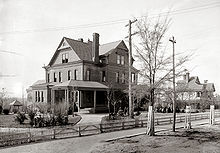
The Oaks – Washington’s home
on Tuskegee campus
source Wikipedia

However, while work and academia were important, Washington did not neglect the spiritual growth of his students including services and prayer, using a non-denominational model.  I know little about the times in this respect, but I can imagine that this was a revolutionary way of structuring an academic institution:

“If no other consideration had convinced me of the value of the Christian life, the Christlike work which the Church of all denominations in America has done during the last thirty-five years for the elevation of the black man would have made me a Christian.  In a large degree it has been the pennies, the nickles, and the dimes which have come from the Sunday-schools, the Christian Endeavour societies, and the missionary societies, as well as from the church proper that have helped to elevate the negro at so rapid a rate.”

And paramount to anything, Washington exemplifies forgiveness:

“It is now long ago that I learned this lesson from General Armstrong, and resolved that I would permit no man, no matter what is colour might be, to narrow and degrade my soul by making me hate him.  With God’s help, I believe that I have completely rid myself of any ill feeling toward the Southern white man for any wrong that me hay have inflicted upon my race.  I am made to feel just as happy now when I am rendering service to Southern white men as when the service is rendered to a member of my own race.  I pity from the bottom of my heart any individual who is so unfortunate as to get into the habit of holding race prejudice.”

“I early learned that it is a hard matter to convert an individual by abusing him, and that this is more often accomplished by giving credit for all the praiseworthy actions performed than by calling attention alone to all the evil done.”

History class at Tuskegee Institute 1902
source Wikipedia

Washington rather fell into public speaking, feeling that it was more important “to do things than merely to talk about doing them.”  He first went north with his friend and mentor, General Armstrong,  a white educator dedicated to the education of blacks and a founder of the Hampton Institute, and spoke at a series of public meetings.  In 1895, Washington was asked to speak at the Atlanta Exposition, an important exposition to showcase products and new technologies.  His speech was received with accolades from both whites and blacks alike, and afterwards, Washington became a highly sought after speaker about the benefits raising black ingenuity, hard work and resourcefulness to the level of white America.  He promoted the improvement of race relations where blacks and whites both stood on level ground.  There is a fascinating section of the book where Washington expounds on his manner of public speaking and it includes some gems of advice:

” ……. It seems to me that there is rarely such a combination of mental and physical delight in any effort as that which comes to a public speaker when he feels that he has a great audience completely within his control.  There is a thread of sympathy and oneness that connects a public speaker with his audience, that is just as strong as though it was something tangible and visible  …… I never tell an anecdote simply for the sake to telling one ……  I believe that one always does himself and his audience an injustice when he speaks merely for the sake of speaking.  I do not believe that one should speak unless, deep down in his heart, he feels convinced that he has a message to deliver …..”

At the close of the book, Washington first gives a schedule for his Tuskegee school which is rather interesting from the view of posterity:

5 am.          Rising bell
5:50            Warning breakfast bell
6 am.          Breakfast bell
6:20            Breakfast over
6:20 – 6:50 Rooms are cleaned
6:50            Work bell
7:30            Morning study hour
8:20            Morning and school bell 
8:25            Inspection of young men’s toilets
8:40            Devotional exercises in chapel
8:55            Five minutes in the daily news
9 am.          Class work begins
12 pm.        Class work closes
12:15          Dinner
1 pm.          Work bell
1:30            Class work begins
3:30            Class work ends
5:30            Bell to “knock off” work
6 pm.          Supper
7:10            Evening prayers
7:30            Evening study hours
8:45            Evening study hour closes
9:20            Warning retiring bell
9:30            Retiring bell

And his teaching philosophy, while appearing relatively simple, is designed to have far-reaching results.  Washington strove to empower his students, not only academically, but to give them skills to serve them well in life.

“In our industrial teaching we keep three things in mind:  first, that the student shall be so educated that he shall be enabled to meet conditions as they exist now, in the part of the South where he lives —– in a word, to be able to do the thing which the world wants done; second, that every student who graduates from the school shall have enough skill, coupled with intelligence and moral character, to enable him to make a living for himself and others; third, to send every graduate out feeling and knowing that labour is dignified and beautiful —- to make each one love labour instead of trying to escape it.”

During this time, the Tuskegee school had so many applicants that they were forced to turn away half and could only supply one half of the graduates that were requested.  A huge accomplishment from twenty years ago when Washington started the school from sweat, common sense, an empathy for all people, and a firm belief in industry.

A final quote by Washington which I think encompasses much of his philosophy:

“Before the end of the year, I think I began to learn that those who are happiest are those who do the most for others.  This lesson I have tried to carry with me ever since.”


The Narrative of the Life and Times of Frederick Douglass

“I was born in Tuckahoe, near Hillsborough, and about twelve miles from Easton, in Talbot county, Maryland.”

Born into slavery as Frederick Augustus Washington Bailey around 1817/1818, Douglass learned to read and write as a boy with the help of the wife of his master. In spite of his situation, he claims that he always had an implicit belief that he would not always be a slave.

“From my earliest recollection, I date the entertainment of a deep conviction that slavery would not always be able to hold me within its foul embarce; and in the darkets hours of my career in slavery, this living world of fath and spirit of ope departed not from me, but remained like ministering angles to cheer me through the gloom.  The good spirit was from God, and to him I offer thanksgiving and peace.”

At around twenty years old, he escaped to the north, married, and soon afterwards changed his name to Douglass.  Becoming involved in the abolitionist movement, Douglass was encourage to speak and tell the story of his experiences as a slave.

Yet while he was welcomed by the anti-slavery community, Douglass did not only find critics outside this movement, but also opposition from within.  He was limited by white abolitionists as to what he could say during speeches, attempting to avoid any reference to current issues or a way forward for black people as a race.  Yet upon the publication of his book, Douglass’ popularity soared and he gained a credibility he has not experienced previously.

Douglass elucidates on the cruelty of slavery that goes beyond the physical. He speaks of being shut up in a “mental darkness” by the refusal of masters to educate their slaves.  He relates how slaveholders would practice mental fraud on their slaves by allowing and encouraging them to drink to excess during their free holiday time, with the result that the conditions of slavery and liberty did not appear to have a decided difference.

Douglass also gives the recipe for making a content slave:

“…… I have found that to make a contented slave, it is necessary to make a thoughtless one.  It is necessary to darken his moral and mental vision, and, as far as possible, to annihilate the power of reason.  He must be able to detect no inconsistencies in slavery; he must be made to feel that slavery is right; and he can be brought to that only when he ceases to be a man.”

Douglass has some interesting insights into slave masters:

“……. and of all men, adopted slaveholders are the worst  …… He was a slaveholder without the ability to hold slaves.  He found himself incapable of managing his slaves either by force, fear, or fraud.  We seldom called him, “master;” we generally called him “Captain Auld,” and were hardly disposed to title him at all ……. He wished to have us call him master, but lacked the firmness necessary to command us to do so ……”

There are apparently two editions of this narrative, this one being a rather shorter narrative, and the Life and Times of Frederick Douglass, which is a third publication and expanded to give more detail about his life including some history of the period.

The next book in the WEM order is Up From Slavery by Booker T. Washington. While the first two slave narratives have been interesting, they certainly haven’t been gripping and I must admit I’m not really looking forward to this next book.  In any case, onward and upward!

Incidents in the Life of a Slave Girl – Harriet Ann Jacobs

“Northerners know nothing at all about Slavery.  They think it is a perpetual bondage only.  They have no conception of the depth of degradation involved in that word, SLAVERY; if they had, they would never cease their efforts until so horrible a system was overthrown.”

Being Canadian, and unlike my U.S. counterparts, I have little knowledge of the details and intricacies of the history of slavery in the United States, so I was pleased to note that my The Well-Educated Mind Biographies Project has a few books that cover this important, yet disturbing, period.  Incidents in the Life of a Slave Girl is the first book of this ilk on the list.  A book written in the tradition of the slave narrative and the sentimental novel, Jacobs strives to give a voice to the thousands of black men and women, who suffered abuse, injustice and the theft of their true identities under the yoke of slavery.

Jacobs (in the book calling herself Linda Brent), chronicles her story, beginning with her idyllic life within her family who are well-off slaves of a kind owner.  At her mother’s death when Linda is six, she is sent to reside with her mistress who teaches her to read and write, but at the death of her owner, she is sold to the Flint family and her suffering begins.  Dr. Flint is harsh and cruel, developing a desire for Linda, and she is continually tormented by his sexual advances.  Thinking to save herself and her virtue, she begins a relationship with another white man and has two children with him in hopes Dr. Flint will cease his attentions.  Instead he is enraged and sends her and her children to do hard labour on one of his plantations.  The book further relates of her escape, her continuous concern about the fate of her children, seven years of her life in an attic so she is not discovered, and her final journey to the north and a relative freedom, although her expectations of her life there are perhaps somewhat disappointed.

Reward for notice for the return of
Harriet Jacobs by James Norcome (Dr. Flint)
source Wikipedia

Jacobs tells a touching and unique story from a woman’s point-of-view, highlighting not only all the brutality and abuse the negro people suffered at the hands of some of their masters, but also the degradation to their spirits. Yet although Jacobs shows her people in their suffering, she also is able to emphasis their greatness of spirit:

“Truly, the colored race are the most cheerful and forgiving peole on the face of the earth.  That their masters sleep in safety is owing to their superabundance of heart; and yet they look upon their sufferings with less pity than they would bestow on those of a horse or dog.”

While the book is full of horrid examples, Jacobs also strives to mention the white men and woman she met or observed in her life that showed kindness or compassion, and says of her benefactress, Mrs. Bruce:

“The noble heart!  The brave heart!  The tears are in my eyes while I write of her.  May the God of the helpless reward her for her sympathy with my persecuted people!”

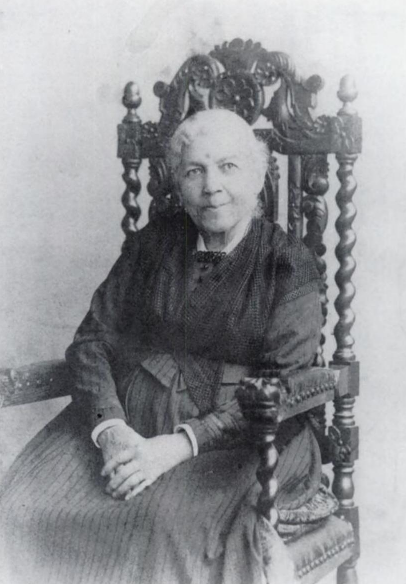
Harriet Ann Jacobs
source Wikipedia

While most of this book is at once both heartbreaking and wonderfully illuminating, there was an aspect of it that bothered me.  Jacobs was very clear and concise, and rightly so, with her denunciation of slavery and its assault on human dignity and the human spirit, but whenever a slave committed something from as small as a lack of good judgement to something as large as a crime, Jacobs excused their actions based on the treatment they had suffered under their masters.  For example, with regard to her decision to enter into a relationship and have children with Mr. Sands, she says:

“I feel that the slave woman ought to not to be judged by the same standards as others.”

Later she states:

“I like a straightforward course, and am always reluctant to resort to subterfuges.  So far as my ways have been crooked, I charge them all upon slavery.”

When she encounters a slave who has stolen money from his dead master, she declares:

“This is a fair specimen of how the moral sense is educated by slavery.  When a man has his wages stolen from him, year after year, and the laws sanction and enforce the theft, how can he be expected to have more regard to honesty than has the man who robs him?  I have become somewhat enlightened, but I confess that I agree with poor, ignorant, much-abused Luke, in thinking he had a right to that money, as a portion of his unpaid wages.”

I don’t disagree with Jacobs’ premise that slavery can drive people to excesses, but I do disagree about excusing wrong behaviour with it.  Because someone has committed a wrong against you, does that give one the right to return the same in kind?  Couldn’t this startling reasoning be as dangerous as the reasoning employed to bring the black people into slavery?  It reminded me of Aleksandr Solzhenitsyn’s words, words from a man who had been both a commander and a persecuted soul, effectively both a master and a slave, and who finally learned that: “If only it were all so simple!  If only there were evil people somewhere insidiously committing evil deeds and it were necessary only to separate them from the rest of us and destroy them.  But the line dividing good and evils cuts through the heart of every human being.  And who is willing to destroy a piece of his own heart?”  The seeds that began slavery and other atrocities are within us all, it’s important that man or woman, slave or free, persecuted or persecutor, that we are all aware of that piece and the danger it can do to ourselves and others.

In any case, it was a blemish on an otherwise excellent narrative.  Jacobs hatred of slavery in all its forms shows through as well as her overwhelming love and understanding for her fellow man.

The Club of Queer Trades by G.K. Chesterton

The Club of Queer Trades is a “society consisting exclusively of people who have invented some new and curious way of making money,” and Chesterton’s delightful collection of fantastical tales give us a view of these entrepreneurs who ply their trades in perhaps an unorthodox manner and often with surprising results.

The Tremendous Adventures of Major Brown: The subject of this title seeks out Rupert Grant, an amateur detective, and with the help of Swinburne, the narrator, and Grant’s brother, Basil, a former “mad” judge, they proceed to cleverly solve his dilemma.  Retired and living comfortably and quietly in a tiny picturesque villa, Major Brown has a mania for pansies.  One day while strolling down a lane, he meets a man pushing flowers in a wheelbarrow and is convinced to purchase the pansies among them.  Yet before departing, the man whispers that if the Major will only climb the garden wall, he will see the most admired pansies in the whole of England.  Against his nature, Major Brown accepts a boost up and is flabbergasted by what he sees.  It is not the pansies themselves that catch his attention but the arrangement of them, spelling out “Death to Major Brown.” Never one to quail in any situation, Brown introduces himself to the gardener of the house who takes him inside to meet a peculiar lady who is staring out the window, but he remembers to warn him beforehand not to mention the “jackal.”   They begin to converse but suddenly their conversation is cut short by a blood-curdling screech, “Major Brown, Major Brown, where does the jackal dwell?”  When the Major runs outside, he spies a coal-black decapitated head on the sidewalk, where apparently the screams are coming from.  What is going on?  Who is trying to kill the Major?  And why does idiosyncratic Basil seem unconcerned?   Chesterton ties up his story with his usual aplomb, and yet still leaves you wondering.  There is also a neat contrast between Basil and Rupert, the former using his intellect and the latter acting on impulse.  A very fun tale!

The Painful Fall of a Great Reputation:  Charles Swinburne, the narrator of the last tale, and Basil Grant are travelling on the top of a deserted tramcar, speaking philosophically about the plight of the poor and the perception of them.  Basil declares that in spite of their circumstances, the majority of the poor are good people and that “the very vileness of life of these ordered plebeian places bears witness to the victory of the human soul.”  No sooner has he uttered these words than he spies a man on the street and his astonishment is palpable.  He announces that he’s observing the most wicked man in the world.  When Swinburne requests to know the man’s sins, Grant admits that he has never seen him before this moment.  Swinburne is startlingly perplexed.  How has Basil made his assumption?  But there is no time to question as his friend grabs him and they are off on a chase after the most wicked man in the world.  In a world of fact versus impression and appearance versus reality, how are they to know whom to trust?

The Awful Reason of the Vicar’s Visit:  Swinburne is dressing to meet Basil Grant at a dinner party when suddenly the sound of the doorbell resounds through the house.  It is the Reverend Ellis Shorter who has heard of his friend, Major Brown’s adventures and has come to seek help.  Swinburne, impatient to be off to his engagement, gets impatient with the Vicar’s dodderings and prevaricating whereupon the Vicar gives him leave to go, but states if he does not hear him out before he does, a man will be dead!  He relates a queer story of being kidnapped by a women’s sewing club, and a subsequent photograph of himself that had never been taken.  Swinburne is perplexed and takes the vicar to Basil to sort out the mystery!

Reverend Oliver Maron, Vicar of Lancaster
George Romney 

The Singular Speculation of the House Agent:  Lieutenant Keith Drummond manages to excite Rupert’s suspicions and barely concealed contempt with his larger-than-life stories and exaggerated claims.  Upon Drummond requesting a loan from Basil and claiming a visit to a house-agent, Rupert near demands to accompany him in hopes of exposing sinister purposes.  All four men set off together, and after a curiously unintelligible conversation between the odd little house agent and Drummond, in which the agent presents a ferret, some lizards and a spider, Drummond escapes before the rest.  When they follow him, they come upon a commotion and find that there has been a brawl. Drummond has been part of it, with his clothes torn and his sword, which he commonly carries with him, drawn.  The police get his address, yet Swinburne, Basil and Rupert discover the next day that the address was a fake.  Rupert is exultant with the proof of his suspicions of Drummond’s disreputable character, but Basil merely laughs, claiming that Drummond his one of the most honest men and that truth can be stranger than fiction.  How can this be?  Is some of the mad judge’s madness finally showing through?  The truth will be discovered at the address that doesn’t exist.

Purley, Surrey (now south London)
source Wikipedia Commons

The Noticeable Conduct of Professor Chadd:  Basil Grant doesn’t have many friends, but the ones he does have are a motley collection of idiosyncratic characters.  One day, he is discussing with his friend, Professor Chadd, an eminent ethnologist and expert on the relation of language to savages, the impact of science on the observable knowledge of Zulus versus the knowledge gained by living like a Zulu.  Chadd, a stuffy academic, who has recently been appointed as curator of the Asiatic manuscripts at the British Museum, answers in stuffy, didactic prose.  The next morning, Basil receives a telegram from one of Chadd’s three sisters: Chadd has suffered a mental breakdown and Basil is entreated to come at once.  Upon his arrival, Basil discovers that the Professor will not communicate with anyone and, instead, will only move his legs in a kind of rigid, hopping dance.  The doctor is with him and when Basil approaches, he asks for a moment with his friend.  The observers are surprised to see the respectable Mr. Grant with a paper and pencil, following Chadd about and jotting notes as he goes.  They are further astounded when he begins to hop around in a parody of Chadd.  The situation is further complicated with the arrival of Mr. Bingham of the British Museum. Great Scots!  How can a lunatic be curator of the Asiatic manuscripts?!!  Yet Basil declares to Bingham that they need to pay Chadd £800 per year until he stops dancing.  What?  Has Basil gone mad as well?  Are there two lunatics, one or none?

Bedford Gardens, Bloomsbury
source Wikimedia Commons

The Eccentric Seclusion of the Old Lady:  Swinburne is walking with his friend, Rupert Grant, the amateur detective, when Grant spots a milkman walking ahead of them.  Suspicious because of the careless way the man carries his milk can, Grant swears that if they follow him, they will find a mystery at the end of the trail.  When the milkman disappears down area steps to a basement, Grant follows and emerges triumphant.  He has heard a cry for help in the downstairs room, repeating, “When shall I get out?  Will they ever let me out?”.  Determined to rescue the imprisoned lady, they enlist Basil’s help and with his usual aplomb, Basil gains entry to the house but when he emerges, he claims that the men inside are good chaps.  Incensed, both Rupert and Swinburne insist on entering the house themselves to find the victim.  The “chaps” allow them in but a fight ensues in which our three rescuers are pinned.  Will they get free to release the poor woman who’s been detained?  Yet with Basil Grant, nothing is every as it seems.

Milkman and cart 1900s
source Wikimedia Commons

In Basil Grant, Chesterton creates, not a scientifically brilliant detective like Sherlock Holmes, but one who is astute in the workings of human nature, which makes for truly fascinating cases.  Another fantastic effort by Chesterton who keeps the reader guessing, and never quite sure whether up is down or down is up in The Club of Queer Trades.

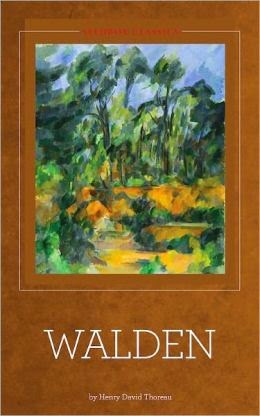
Walden by Henry David Thoreau

“When I wrote the following pages, or rather the bulk of them, I lived alone, in the woods, a mile from any neighbor, in a house which I had built myself, on the shore of Walden Pond, in Concord, Massachusetts, and earned my living by labor of my hands only.”

Transcendentalist Henry David Thoreau wrote Walden, his magnum opus, during a two year stay on lands owned by his friend, Ralph Waldo Emerson.  Walden Pond, situated in Walden Woods, was an untouched centre of beauty among the agricultural lands of Concord, Massechusetts, and his sojourn there allowed Thoreau the peaceful reflection that he so earnestly sought.

“I went to the woods because I wished to live deliberately, to front only the essential facts of life, and see if I could not learn what it had to teach, and not, when I came to die, discover that I had not lived.  I did not wish to live what was not life, living is so dear; nor did I wish to practice resignation, unless it was quite necessary.  I wanted to live deep and suck out all the marrow of life, to live so sturdily and Spartan-like as to put to rout all that was not life, to cut a broad swath and shave close, to drive life into a corner, and reduce it to its lowest terms, and, if it proved to be mean, why then to get the whole and genuine meanness of it, and publish its meanness to the world; or if it were sublime, to know it by experience, and be able to give a true account of it in my next excursion.”

Thoreau’s reasons for retreating to the woods, his construction of a cabin, his pastoral descriptions of nature, and his philosophy surrounding interaction with nature and solitude, permeate the pages and take us into a world and perceptions that stretch our thinking and make us long for something simpler. Thoreau makes us face the realities of life and prods us to examine the value received from our choices.  Do we live according to our own hearts and convictions or by society’s dictates, and how are we changed by our choices?

Surprisingly, given its present popularity, Walden was rejected by eight publishers before being printed, and experienced only a negligible success during Thoreau’s lifetime, finally becoming popular during the 20th century with the advent of the Civil Rights era.

Walden Pond in late June
source Wikimedia Commons

There were parts of this book that I loved and could completely relate to.  I have my own version of Walden Pond in the summer.  I know the call of the eagle, the blue blur of a dragonfly, the slap of a beaver’s tail on the water.  I understand the workings of an isolated community, with close interactions, yet subtly observed personal boundaries.  I understand what silence means and the benefit of the education received through it.  Returning to a life unhampered by unnecessary busyness and useless striving certainly renews your spirit and allows you to become more synchronized with nature and with humanity.

My Walden Pond
© Cleo @ Classical Carousel

“We must learn to reawaken and keep ourselves awake, not by mechanical aids, but by an infinite expectation of the dawn, which does not forsake us even in our soundest sleep.  I know of no more encouraging fact than the unquestionable ability of man to elevate his life by a conscious endeavour.  It is something to be able to paint a particular picture, or to carve a statue, and so to make a few objects beautiful; but it is far more glorious to carve and paint the very atmosphere and medium through which we look, which morally we can do.  To affect the quality of the day, that is the highest of arts.”

“Live in each season as it passes; breathe the air, drink the drink, taste the fruit, and resign yourself to the influence of the earth.”

© Cleo @ Classical Carousel

Thoreau entreats us not only to strive to live simply but to be happy with little and therefore, recognize that as we grow poor in possessions, we grow rich in spirit.

“However mean your life is, meet and live it; do not shun it and call it hard names.  It is not so bad as you are.  It looks poorest when you are richest.  The fault-finder will find faults even in paradise.  Love your life, poor as it is.  You may perhaps have some pleasant, thrilling, glorious hours, even in a poorhouse.  The setting sun is reflected from the windows of the almshouse as brightly as from the rich man’s abode; the snow melts before its doors as early in the spring.  Cultivate property like a garden herb, like sage.  Do not trouble yourself much to get new things, whether clothes or friends.  Turn the old; return to them.  Things do not change; we change.  Sell your clothes and keep your thoughts …….  Superfluous wealth can buy superfluities only.  Money is not required to buy one necessary of the soul.”

“My greatest skill in life has been to want but little”

While Thoreau’s wilderness experience was unique, I’m not sure that he was recommending that everyone pack up and make for the woods.  In his words, I heard him entreat people to have some sort of experience with nature, to take the time to explore it, to open yourself up to it in a quiet, introspective kind of way and, within that experience, nature will teach you to know yourself better.

“For a week I heard the circling groping clangor of some solitary goose in the foggy mornings, seeking its companion, and still peopling the woods with the sound of a larger life than they could sustain.  In April the pigeons were seen again flying express in small flocks, and in due time I heard the martins twittering over my clearing, though it had not seemed that the township contained so many that it could afford me any, and I fancied that they were peculiarly of the ancient race that dwelt in hollow trees ere white men came.  In almost all climes the tortoise and the frog are among the precursors and heralds of this season, and birds fly with song and glancing plumage, and plants spring and bloom, and winds blow, to correct this slight oscillation of the poles and preserve the equilibrium of Nature.”

While I loved reading about Thoreau’s temporary experiment, this is not the easiest book to get through.  At times Thoreau overwhelms you with his spiritual philosophy and I found myself wondering at how he could become an expert with merely a two year stint in only comparative isolation, as he was near Concord and often had visitors to his abode.  However, these flaws did not diminish some rather obvious truths in Thoreau’s vision.  He allowed nature to be his Muse, simplicity his guide and he leads us on a soul-searching journey into the woods, opening our eyes to the world around us.

I found this video on YouTube and I think it echoes some of Thoreau’s thoughts beautifully ….. “and see if I could not learn what it had to teach, and not, when I came to die, discover that I had not lived.” 

 Figuring Life Out

Erewhon by Samuel Butler

“If the reader will excuse me, I will say nothing of my antecedents, nor of the circumstances which led me to leave my native country; the narrative would be tedious to him and and painful to myself.”

I’ve been reading oodles of satirical fiction lately and entirely inadvertently, as this genre just seems to be dropping onto my lap.  My first taste of utopian satire was given to me by Voltaire’s Candide, which left me rather unsure if we were going to be good friends.  Then came Utopia by Thomas More and I was firmly hooked, only to have my enjoyment of it further strengthened with my read of Gulliver’s Travels.  My most recent Classics Club spin book landed me with Erewhon by Samuel Butler.  I was somewhat familiar with Butler from my skimming of some of his translation of The Odyssey (wouldn’t recommend it for a first read) so I wasn’t quite sure what to expect.  Would he be a Voltaire, or a Swift or somewhere happily in between?

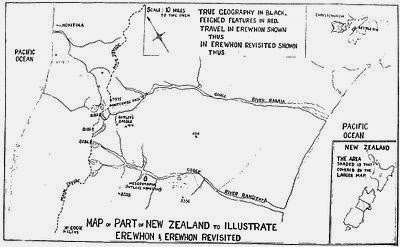
The narrator of Erewhon, Higgs, tells the reader of his journey to a fictional country, in fact, modelled on the country of New Zealand where Butler spent the early part of his life.  Higgs loses his native guide, Chowbok, on a trek into the wild, and manages to wander into a society who, while they resemble the human race, have completely different standards for managing their nation.

Map of part of New Zealand to illustrate
Erewhon & Erewhon Revisited
source Wikipedia

Butler explicates on some rather curious aspects of Erewhon society.  For a start, the Erewhons view machines as dangerous to their community and anyone caught with one can be at risk of being put to death.  Machines are regarded as having a greater ability than people in that they are growing and evolving at an exponential rate and thus, they have the capacity to enslave mankind.  The Erewhons also view immorality as a sickness and actual illness as a crime.  For example, a man who has lost his wife to illness is tried as a criminal, yet is lauded for his action of raising her insurance premium immediately before her death and, therefore, benefiting from it before he’d paid even two premiums.  There are other curious idiosyncrasies to this society, such as the repellent manner with which they view birth, the rights of animals and vegetables, and their promotion of the idea of unreason, claiming that reason could not exist without it.

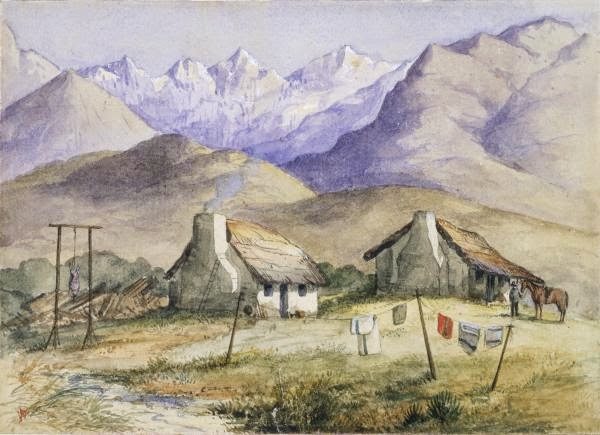
Samuel Butler’s Mesopotamian Homestead
New Zealand
source Wikimedia Commons

Butler claimed that Erewhon nearly wrote itself with some resistance from its author:

“I did not want to write Erewhon.  I wanted to go on painting and found it an abominable nuissance being dragged willy-nilly into writing it.  So with all my books — the subjects were never of my own choosing; they pressed themselves upon me with more force than I could resist.  If I had not liked the subjects I would have kicked and nothing would have got me to do them at all.  As I did like the subjects and the books came and said they were to be written, I grumbled a little and wrote them.”

Apparently it was Butler’s aim to make a commentary on the ills of Victorian society, but I had a difficult time finding Butler’s voice in the prose.  With Voltaire or Swift, it was easier to see the issues that they were targeting with their criticism, but Butler was more obscure.  He presented issues, but was less clear as to which side of the fence he stood, as some of the most ridiculous laws often had an element of truth to them.  In fact, in a second preface to the book, Butler had to correct some misconceptions with regard to his novel, stating that contrary to the assumption that he was showing Darwin’s theory of evolution as absurd, in fact, he had a healthy respect for it, and he goes on, quite charmingly, to blame the Erewhons for all the inconsistencies in the story. For me, the novel soon degraded into great swathes of philosophical narrative with little to prop it up.  I love philosophy, but to engage a reader one needs the background of a story to support it; Butler attempted the reverse in hoping that his philosophy would prop up his story.  This approach only served to weaken the novel as a whole.

In spite of the novel’s mediocrity, it is quite obvious that Butler was a great thinker who explored some fascinating ideas that remain with us in the 21st century.  His analogy between crime and disease, the over-emphasis on appearance of an individual, and the especially significant topic of how humans interact with technology and their enslavement to it are all powerful issues that still resonate with us through the centuries.

” …. so ingrained in the human heart is the desire to believe that some people really do know what they say they know, and can thus save them from the trouble of thinking for themselves, that in a short time would-be philosophers and faddists became more powerful than ever, and gradually led their countrymen to accept all those absurd views of life …… I can see no hope for the Erewhonians till they have got to understand that reason, uncorrected by instinct, is as bad as instinct uncorrected by reason ….”

Ethan Frome by Edith Wharton

Ethan Frome Edith Wharton

Ethan Frome: “I had the story, bit by bit, from various people, and, as generally happens in such cases, each time it was a different story.”

I was so pleased to finish my Wharton book, Ethan Frome, for Brona’s The Wharton Review well ahead of time!  Fortunately the 150-ish pages of the book made it a relatively easy task, as I was really looking forward to reading another Wharton.  I class her The House of Mirth as one of my top favourites.

This story is told from an omniscient point of view by a narrator whose name we never learn.  His job as an engineer brings him to the town of Starkfield, Massachusetts, and there he meets the taciturn Ethan Frome.  Through his interaction with Frome and later through stories of the townspeople, he learns Ethan Frome’s tragic and rather startling story.

While he was a young man, Ethan Frome had set off for college with little money but big dreams, however he had to return to Starkfield because of the illness of his father.  Since then, he had remained in Starkfield to run the family farm, acquitting his duties with a stoic determination.  Reserved by nature, Ethan is captivated by his cousin Zeena’s cheerful demeanour and marries her, but her cheer soon turns to sickness, discontent and bitterness.  After years of her maladies, Zeena’s cousin Mattie arrives to help with the housework and other duties, and Ethan, discouraged with the drudgery of an unproductive farm and the burden of an unhappy marriage, allows himself to be drawn into her spell.  The story begins here, in media res, and we see the culminating tragedy of two passions, one rather innocent and untried, and the other, bottled up so long in duty and silence, that is verging on the explosive.

New England Road Mary Cassatt
New England Road
Mary Cassatt
source

It is surmised that Wharton’s own discontented marriage was the model for Frome’s, communicating the helpless imprisoned feeling of a relationship all but dead through apathy and selfishness of the two participants.  Wharton uses the frigid bleakness of the Starkfield winter in her story to communicate the same desolation that permeates the characters and their situations in life. No one can escape their fate.

Did I enjoy this book?  Well, yes, in a way ……….  Wharton is a good writer and I doubt that she could craft a bad story.  However this story, while compelling, lacked the maturity of her better known novels.  She tended to rely too much on drama to carry the story off, instead of working more within the characters, instilling subtleties that would speak to the reader on a deeper level.  As for the frame story, this aspect of the book reminded me of Wuthering Heights, and I still haven’t met an author who can employ this device with capable proficiency.  I know it’s supposed to allow the writer more leeway in the way he/she presents the story, but in my experience it merely tends to weaken it. Ethan Frome was a fine effort by Wharton but perhaps clouded with a little too much personal emotion to allow her the distance needed to craft a superior novel.

Other Wharton books reviewed here:  The Age of Innocence


The Wharton Review