Classics Club Spin #8 ……… And the Winner Is ……………

Number 13 !

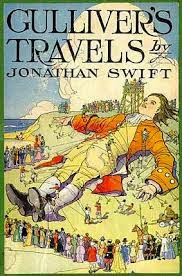
Yipes!  That means I’ll be reading:

I’m not quite sure how I feel about that.  I’m happy to read it but I think there is a deeper message, a commentary on government or society, or something like that ……..???

Curiously, I’m reading Utopia by Thomas More at the moment so it might be interesting to do a comparison.

For anyone who has read Gulliver’s Travels, can you offer any advice or let me know what to expect?  Should I do some research beforehand?

Okay,  a deep breath, and happy reading everyone!

Le Morte d’Arthur Read-Along: Update #2

Books VI through IX

Okay, this book just keeps getting stranger and stranger.  In this section, the reader first gets the honour of following Lancelot on his journeys.  We have more incidents of kidnapped knights, devious damsels, murderous giants, prison escapes and vengeance.  It always amazes me that these knights can be in the middle of a fight to the death but still manage to hold polite conversation with one another.   I’m still unclear as to the chivalric rules of when you kill a knight and when you let him live.  Do you only let him live if he’s honourable?  What if he’s honourable, yet he’s offended you?  I’m not sure.  And why, for heaven’s sake, do Knights of the Round Table fight each other?  Because there’s no one else handy?  Well, back to Lancelot …… our trusty knight further spent his time cutting cloth and stealing swords from corpses; refusing to kiss ladies who perished from their sorrow, and suffered foiled attempts at rescuing ladies from their murderous husbands who finally manage to lop off their heads.  Ay me, what fun!
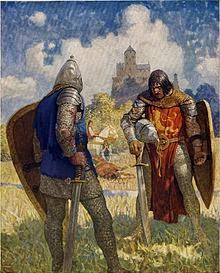
Lancelot du Lac
N.C. Wyeth
source Wikiart

Beaumains arrives at court and has a fight with the greatest knight Sir Lancelot.  He nearly defeats Lancelot and only gives over when Lancelot promises to knight him.  He does this without Arthur’s knowledge, nor does he reveal that Sir Beaumains is actually Sir Gareth, the younger brother of Gawaine and Gaheris.  I have given up asking why in this book.

Sir Beaumains, with his hidden identity, proceeds to have his own adventures, attaching himself to a maiden who want nothing to do with him, and defeating everyone he meets.  Thankfully there is little killing, all due to the maiden who pleads for his rivals’ lives.  But, good gracious, does she have a tongue on her! She abuses and belittles him at every opportunity, yet Beaumains will only confess that Linet’s debasement of him makes him fight better.  O-kay ……  

Sir Gareth
source

Eventually Beaumains announces that he loves the lady’s sister, Liones, which doesn’t seem to bother Linet, but apparently the lack of knowledge of Beaumains’ identity does bother them, so, with their brother’s help, they decide to steal his dwarf.  That’s right. Beaumains’ dwarf.  Why they didn’t just ask Beaumains who he was, remains a mystery.  Well, our good Beaumains arrives at the castle to demand the return of his dwarf and the culprits comply since they have discovered that Beaumains is Gareth, son of a king and nephew to King Arthur.  The sparks fly between Liones and Gareth and they pledge their love to each other.  Are you with me?  Good, because it gets better …… or worse, as the case may be ……..  That night while sleeping in the hall on a couch (apparently knights need no better sleeping arrangements) a mysterious knight appears, he does battle with Gareth, and Gareth, even though severely wounded in the thigh, lops off his opponents head. Disgusting, yes, but there’s more.
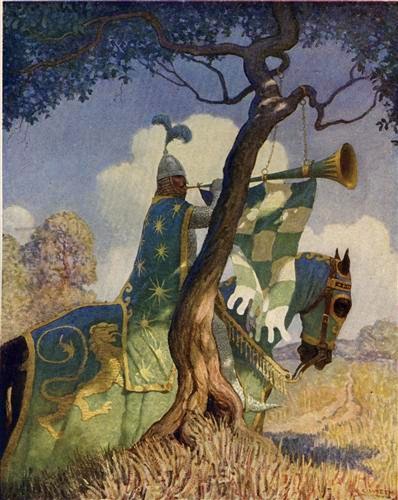
The Green Knight preparing to battle
Sir Beaumains
N.C. Wyeth
source Wikiart

The lady Liones arrives, then her brother, but when Linet appears she immediately plucks up the head, smothers it with ointment, does the same to the neck, and then sticks the two together, whereupon the knight pops up and Linet takes him to her chamber.  Enough, right? Malory could not possibly continue the comedy.  But he does.  The next night, the knight with the re-attached head attacks again and this time Gareth takes no chances.  Once again, beheading him, he chops the head into hundreds of pieces and tosses his fleshy confetti out of the window.  Does this faze Linet?  Not one bit; she runs outside, gathers up the pieces and once again, by some sort of sorcery, re-assembles the hacked up knight.  One wonders what would happen if she missed a piece ……..   In any case, does this sound like a family you would want to marry into?  Well, Gareth does eventually marry the Lady Liones.  I guess it could come in handy having a healing sorceress as a sister-in-law.  As to the benefits of a rouge dwarf-stealing brother-in-law, I’m not sure …….
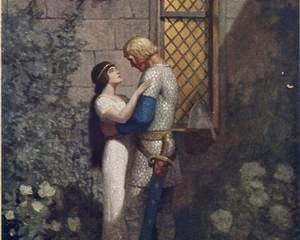
Tristram and Isolde
N.C. Wyeth
source Wikiart

Sir Tristram is also introduced to the reader in the last book and we learn of his love for La Belle Isould.  Again, it’s rather confusing and this post is getting long so we’ll perhaps save their shenanigans for next time!

So, all in all, an interesting read and I must say I’m enjoying it better than when I started.  My favourite story of this section is, as you can tell, the story of Sir Gareth.  My favourite name?  Definitely King Anguish of Ireland.  His name brings a sort of brotherly emotion to the spirit of the read!

Classics Club Spin #8

Oh, no.  When I saw it was spin time at the Classics Club, I stopped breathing. I’m swamped beneath a pile of books for online book groups AND courses. For one course, I’m actually required to read Dante’s Inferno and Vita Nuova three times in six weeks!  Help!  So the sane thing to do would be to let this spin pass, right?  …….. Are you kidding?  I wouldn’t miss it!

For my last spin I finished The Importance of Being Earnest (review still in progress) and Moonlight Readers spin book, Summer by Edith Wharton.  This time I’m not going to be attempting double spins, I promise!

As per usual, the rules for the spin are:

  1. Go to your blog.
  2. Pick twenty books that you’ve got left to read from your Classics Club list.
  3. Post that list, numbered 1 – 20, on your blog by next Monday.
  4. Monday morning, we’ll announce a number from 1 – 20.  Go to the list of twenty books you posted and select the book that corresponds to the number we announce.
  5. The challenge is to read that book by October 6th.

I used the random list organizer here to choose the 20 books from my master list.  So my list ended up looking like this:

  1. Ivanhoe (1820) – Sir Walter Scott
  2. Tevye the Dairyman and Motl the Cantor’s Son (1894) – Sholem Aleichem
  3. Twenty Years After (1845) – Alexandre Dumas
  4. Tom Sawyer (1876) – Mark Twain
  5. King Lear (1603 – 1606) – William Shakespeare
  6. 1984 (1949) – George Orwell
  7. Bondage of the Will (1525) – Martin Luther
  8. Henry V (1599) – William Shakespeare
  9. The Cherry Orchard (1904) – Anton Chekhov
  10. The Hunchback of Notre Dame (1831) – Victor Hugo
  11. Hamlet (1603 – 1604) – William Shakespeare
  12. Pensées (1669) – Blaise Pascal
  13. Gulliver’s Travels (1726) – Jonathan Swift
  14. The Time Machine (1895) – H.G. Wells
  15. The Civilization of the Renaissance in Italy (1860) – Jacob Burckhardt
  16. Dead Souls (1842) – Nikolai Gogol
  17. Animal Farm (1945) – George Orwell
  18. L’Argent (1891) – Emile Zola
  19. The Interpretation of Dreams (1899) – Sigmund Freud
  20. The Prince (1513) – Niccolo Machiavelli
Five Books I’m Hesitant to Read
1.  The Interpretation of Dreams – Sigmund Freud (uh, why did I include this
           on my list???)
2.  The Prince – Niccolo Machiavelli (but it’s short so that’s not too bad)
3.  Ivanhoe – Walter Scott (only because it’s so long)
4.  ——
5.  ——
Five Books I Can’t Wait to Read
1.  Ivanhoe – Walter Scott (I’ve been wanting to read it for ages!)
2.  L’Argent – Émile Zola (I can’t wait to visit Zola again)
3.  The Cherry Orchard – Anton Chekhov (I think I’m hooked on Russian lit)
4.  Tevye the Dairyman and Moti the Cantor’s Son – Sholem Aleichem
           (looks like fun)
5.  King Lear – William Shakespeare (loved it the first time, what about the
            second?)

This list is a fantastic draw.  My only concern is the length of the book chosen. Reading anything extra in November is impossible, so that will only leave me one month to finish.  Ivanhoe, as much as I’m dying to read it, is probably not the best choice.

So now all I have to do is hold my breath, cross my fingers and wait.

Are you excited about this spin?  Which titles do you hope to see chosen?

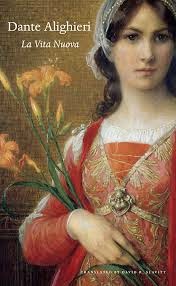
Vita Nuova by Dante Alighieri

“In my Book of Memory, in the early part where there is little to be read, there comes a chapter with the rubric: Incipit vita nova.  It is my intention to copy into this little book the words I find written under that heading —- if not all of them, at least the essence of their meaning.”

Beatrice was eight years old and Dante, nine, the first time they set eyes on each other. Instantly, he felt an abiding connection with her, even though it was nine years after that before he finally saw her again, and she greeted him, her words entwining through his heart.  Lovely Beatrice, who became Dante’s love, his obsession and his Muse.   Never a conversation was had between them, only greetings, yet his life was filled with her presence, her goodness and grace, her being so angelic that she filled his heart until he wondered if it could contain her.  All thoughts revolved around his beautiful Beatrice; she was his life and through her, his poetry gained a new vitality.

Continue reading

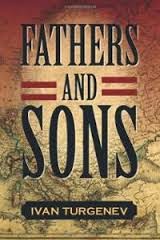
Fathers and Sons by Ivan Turgenev

“Well, Piotr, not insight yet?” was the question asked on May the 20th, 1859, by a gentleman of a little over forty, in a dusty coat and checked trousers, who came out without his hat on to the low steps of the posting station at S—–.”

What sort of relationship do you have with your father?  Is it one of respect, deference, and honour, or do you think his ways too traditional, his thought process too archaic, and to keep a tentative understanding between you, do you have to employ a somewhat forced amiability, while underneath feeling an impatient scorn?

In Fathers and Sons, Turgenev examines the ideas of the new and old, progress and stagnation, and generational differences.  Yet while Turgenev portrays these conflicts within families and people, the themes echos the struggles that were occurring in Russia itself, between the common liberals and a nihilism movement that was growing and expanding at an alarming rate. Immediately the reader is tossed into the battle and while you expect to be buffeted to-and-fro between the two forces, one is surprised to find a more gently tossing, a disturbing reminder of how subtly, yet how pervasively this new philosophy could spread into the ideas and actions of the people.

Arkady Nikolaitch returns home from university with his good friend, Bazarov, a self-confessed nihilist, who issues a dripping contempt for most people around him.  Arkady maintains a good relationship with his father Nikolai Petrovitch and his uncle Pavel Petrovitch, yet through Bazarov’s influence he begins to question what he values about their antiquated thought and primitive ways.

With Bazarov’s nihilistic charm and new trendy ideas, his challenging of the status quo makes him a hero of the younger generation, while the older regard him either as dangerous, or rather like an unusual specimen that they can’t quite figure out.  Yet, in spite of renouncing life and its perceived useless order, we find that Bazarov is unable to escape it.  While visiting the house of a widowed woman, Anna Sergyevna Odintsov, he becomes enamoured of her, his emotion overriding his philosophy and eroding some of its immutable strength.

Ivan Turgenev hunting (1879)
Nikolai Dmitriev-Orenburgsky
source Wikipedia

Turgenev does a masterful job of having nature interplay with the characters, their ideas and emotional struggles.  For example, Bazarov is blind to the beauty around him  He merely uses nature, as he engages in his hobby of dissecting frogs,  pulling Nature itself apart to examine its inner workings.  He can only appreciate the slaughtered bits, but is unable to interact with the whole, Nature as life and beauty.

I don’t believe that Bazarov’s nihilism was a true nihilism.  He obviously wanted to reject the status quo and, in fact, had a quarrel with it, which is apparent in his simmering anger when he speaks about it.  He doesn’t just want to contradict it, he longs to disparage it.  His philosophy is a quasi-nihilism that supports his self-importance and that he uses more as a crutch. He is passionate about it but appears to use it merely as a play for power.  He has developed a philosophy, which is truly an anti-philosophy that prevents him from interacting with life itself.

While with Tolstoy and Dostoyevsky you often feel buffeted by the high emotion or deep philosophy, Turgenev’s approach is more gentle, lulling his ideas into the reader’s head with his pastoral description, and lyric pace.  Yet for being gentle, it is no less powerful.  Turgenev has conducted a true masterpiece!

Translated by Constance Garnett


“In these days the most useful thing we can do is to repudiate – and so we repudiate …”

(Note:  Nikolai Chernyshevsky wrote a response to Fathers and Sons with his What is To Be Done? and Dostoyevsky wrote a response to What Is To Be Done?in his Notes From the Underground.  Further explanation of this triple conversation is contained in the reviews below.)


Trilogy:


Top Ten Tuesday – Series I Want To Start

My brain is so fried from my courseload/bookload lately that my reviews are progressing a sentence at a time, so I thought I’d participate in another Top Ten Tuesday!

Well, when I first read the title post, I recoiled.  I do not like series because EVERYTHING is a series now, and because this format is so popular, it makes me immediately not want to read anything remotely like a series (do you sense a little stubborness in my character?  I prefer to call it non-conformity.  😉  )   In any case, I then started to remember some series from a time when series weren’t a sheep-flocking event (don’t worry, I do know that there are some worthwhile series out there), and when I started to add some children’s series, my list started to form:

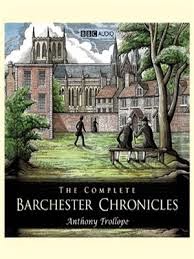
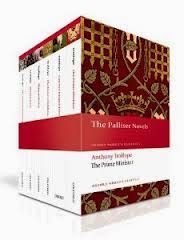
1.  The Barsetshire Chronicles by Anthony Trollope

I’ve read the first three books in the series and have three to go


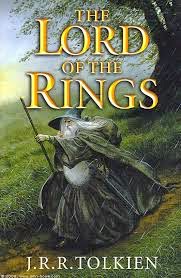
2.  The Lord of the Rings by J.R.R. Tolkien

a planned re-read for 2015.  I think that I’ve read this series about 6 times already!


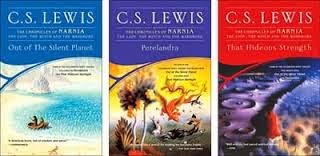
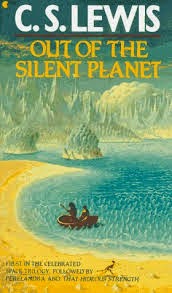
3.  The Space Trilogy by C.S. Lewis

I’m reading it at the moment and trying my best to figure it out!

4.  The Pallisers by Anthony Trollope

I’ll wait a little while after his Barsetshire series to read this parliamentary series.


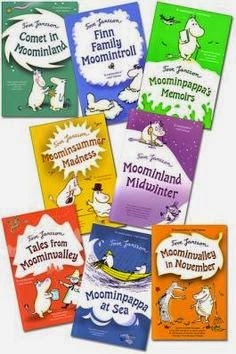
5.  Finn Family Moonmintroll series by Tove Jansson

Finn Family Moomintroll was either my 1st or 2nd favourite children’s book.  A great series!


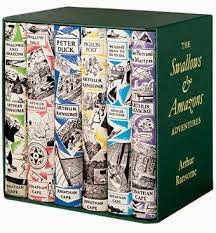
6.  The Swallows and Amazons series by Arthur Ransome

Swallows and Amazons was my 1st or 2nd favourite children’s book.  A series that takes you away!

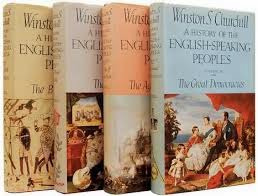
7.  The History of the English Speaking Peoples by Winston Churchill

I don’t know when I’ll get to this but I’d love to read it!

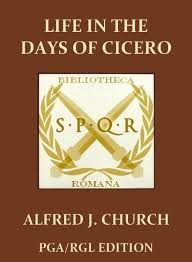
8.  Books by Alfred J. Church
     

Not actually a series but books for children set in ancient and medieval times

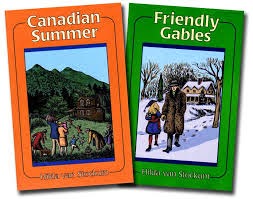
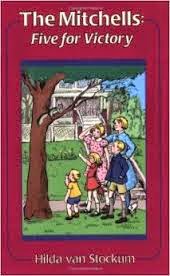
9.  The Mitchells Series by Hilda van Stockum

This series sounds like a fun one and comes highly recommended!
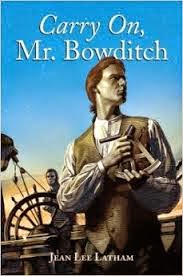
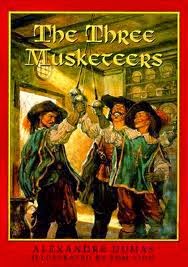
10.  The Musketeers books by Alexandre Dumas

I LOVED The Three Musketeers, so I’m looking forward to reading the others.

Hmmm …… interesting how my bent has run to quite a few children’s series.  I think that’s proof that my brain is overloaded and needs a break.  Now to get through the next few months before that need can become a reality!
Out of the Silent Planet by C.S. Lewis

“The last drops of the thundershower had hardly ceased falling when the Pedestrian stuffed his map into his pocket, settled his pack more comfortably on his tired shoulders, and stepped out from the shelter of a large chestnut tree into the middle of the road.”

During a hike in the English hills, Elwin Ransom stumbles across a boyhood acquaintance, Devine, and his friend Weston, a scientist.  Secretly these two men drug Ransom and take him in a spaceship to the planet, Malacandra, known in earth language as Mars.  When he revives, Ransom overhears that he is to be offered as a human sacrifice for an alien race called the Sorns, and he plans his escape.  Finding himself alone on this strange planet, he eventually encounters creatures called the Hrossa.  Initially very simple and traditional in their ways, Ransom begins to realize that they have an intelligence that may surpass earthly intelligence.  Quickly he learns their language and begins to value their ways, yet all too soon he is sent on a mission to the Oyarsa, the ruling being of Malacandra.  His adventures not only throw him once again into conflict with Devine and Weston, where blind scientific ardour and unconscionable greed clash with humanity’s better nature, but Ransom is finally able to discover why Earth is considered the “silent planet”.

Malacandra is presented as a rather simple society, with the Hross being like shepherds and poets, and the Sorns the intellectuals, imparting wisdom to the community.  Yet, in spite of the obvious higher intellect of the inhabitants, Devine and Weston perceive them as being primitive and unintelligent because they do not have the scientific advances of Earth.  Weston, in particular, grasps onto his pre-conceptions like a drowning man, refusing to believe that such primitive appearance could ever understand or grapple with his vision of a new type of man.  His ingrained perceptions, that have been formed by science, make him blind to the beauty and intricacies of Malacandrian culture, and even worse, his grandiose plans for the needs of man, allows him to view the Malacandrians as sub-human and therefore, expendable.

source Wikipedia

Lewis wrote Out of the Silent Planet as a deliberate critique of Evolutionism, in particular in response to two written works, one by Olaf Stapledon, Last and First Men, and an essay by J.B. Haldane, published in a volume titled Possible Worlds.  Both saw men evolving into a divinity that could jump from planet to planet, a being stripped down to pure intelligence.  Lewis felt that each, while on one hand portrayed man as a fascinating and beautiful creature, nevertheless showed man’s littleness.  To him these views held a potential danger, opening the door to options of experiments on humans and animals. (Interestingly, Lewis was a firm anti-vivisectionist and he would never set traps for the mice who inhabited his rooms at Oxford.)  He stated that the trilogy was less a tribute to earlier science fiction than a kind of exorcism of some of its ideas.  At its heart, the trilogy is anti-Wellsian and to its conception, Lewis credited a one-of-a-kind novel, David Lindsay’s Voyage to Arcturus.  To his friend, Ruth Pitter, he wrote:  “From Lindsay I learned what other planets in fiction are really good for: for spiritual adventures.  Only they can satisfy the craving which sends our imaginations off the earth.  Or putting it in another way, in him I first saw the terrific results produced by the union of two kinds of fiction hitherto kept apart: the Novalis, G. MacDonald, James Stephens sort and the H.G. Wells, Jules Verne sort.  My debt to him is very great.”  Lewis was trying something new!

A wonderful start to The Space Trilogy.  When I first read the trilogy, this book was my favourite, probably because it was the least complex.  Even so, Lewis weaves in views of how medievals saw the universe and angels, as well as sprinkling elements of classicism throughout.  The next book is Perelandra. Hang on to your seats because “you ain’t seen nothing yet”!

“The weakest of my people does not fear death.  It is the Bent One, the lord of your world, who wastes your lives and befouls them with flying from what you know will overtake you in the end.  If you were subjects of Maledil you would have peace”

Dante’s Similes – In Preparation for a Visit to Hell

In preparation for starting my MOOCs course, Dante’s Journey to Freedom Part I, I thought it might be a good idea to do some pre-reading about Dante, his world and the poem itself, and it took me less than a second to decide who I wanted to take me there.  In spite of being known for his children’s and theological books, C.S. Lewis’ specialty was actually Medieval and Renaissance Literature.  In fact, his knowledge was so respected that Magdalene College at the University of Cambridge created a chair especially for him.

I’m not sure how interesting this post will be for people who aren’t interested in Dante, but I thought it would be a good reference for myself as Lewis’ lecture contains some very detailed information.  If anyone makes it to the end you win a prize of a virtual pat on the back and my enduring gratitude! 😉

Dante’s Simile’s

by C.S. Lewis

The simile is a poetic device that is used for illustration.  It can fall into three categories:

  1. Homeric type – the simile of Tennyson, Arnold, Wordsworth, Milton and Spenser which is derived through Virgil from Homer
  2. the unhappily named ‘metaphysical’ simile
  3. the Dantesque simile, which warrants a category of its own, being surprisingly almost confined to Dante

______________________________________________________________

Dante’s Similes

four classes

1.  Virgilian or Homeric Similes

         >  straight similes built on ancient principles
         >  a state or action in the story is compared to a state or action that can
                    be observed in external nature, whether animate or inanimate
        >  short by Virgilian standards

2.  Pictorial Simile

        >  illustrations of a traveler
        >  introduced in plain, business-like manner, simply in order to make the
                  meaning of the writer as clear to the reader as it is to himself
       >  a vividness that produces the maximum of illusion
       >  immediate impact on the senses
       >  connections purely pictorial
       >  eg.  ”  As frogs confronted by their enemy, 
                   the snake, will scatter underwater till
                   each hunches in a heap along the bottom.” 
                      Inferno IX, line 76 (Mandelbaum)

3.  Psychological Simile

       >  one emotion is compared with another
       >  Homer and Virgil rarely used this form (Homer only once)
       >  eg. #1  “so-and-so feels in this situation just like I would feel in that
                            situation in ordinary life”
       >  eg. #2  ”  At that he turned and took the filthy road
                        and did not speak to us, but had the look 
                        of one who is obsessed by other cares” 
                        Inferno IX, line 101-103 (Mandelbaum)
                   ** illustrates psychological and pictorial simile combined **

4.  Dantesque Metaphysical Simile

        >  things are linked together by a profound philosophical analogy or even
               identity
        >  “like” in these similes turn into “same”
        >  relation between things is one of response or correspondence, like that
               of a mirror image to a real object or, (as Dante says) of shadow to
               body
        >  “… in the greatest Dantesque similes, the longer you look the greater
                  the likeness becomes and the more fruitful in thoughts that are
                  interesting as long as you live.” p. 72
        >  eg.  In Paradiso, Beatrice gazes at the sun and Dante, who was gazing
                     at Beatrice, imitates her and also gazes at the sun.  The process
                     whereby Beatrice’s gaze produces Dante’s is compared to the
                     process of reflexion by which one beam begets a second.  And
                     this second beam is in its turn compared to a pilgrim desirous of
                     return.  Dante and Beatrice are literaliter [literal] to the sun (and
                     allegorice [allegorical] to God) what all reflected beams are to the
                     original source of light and what Dante is literaliter to Beatrice
                     and the human understanding allegorice to Wisdom and the
                     whole universe is to the Unmoved Mover.  The whole of
                     Christian-Aristotelian theology is brought together.  The image
                     reverberates from that one imagined moment over all space and
                     time, and further.

Other interesting notes:

  • Anglo-Saxon poetry uses no similes
  • popular song uses about the same amount of simile as ordinary conversation
  • Homer’s similes are not poetical, used more to convey or illustrate information than for an emotional response
  • Virgil at his best uses simile for purposes both good and new
  • Dante’s similes are “less poetical” than Virgil’s, because Virgil’s could not exist outside of poetry


Definitions:
   ectype – copy from an original

Quotes:

“There is so much besides poetry in Dante that anyone but a fool can enjoy him in some way or other ….” p. 75

“If bees were associated only with honey and not with stings, I should say that Dante every now and then wakes up a whole beehive, by giving us some image which seems to focus all the rays of his universe at a single point or touching some wire which sets the whole system vibrating in unison.” p.73


On the Virgilian simile:  “Clearly, when it has reached this stage, the original purpose of illustration has become a mere excuse, though an excuse still necessary to lull the logical faculty to sleep, and the real purpose of simile is to turn epic poetry from a solo to an orchestra in which any theme the poet chooses may be brought to bear on the reader at any moment and for any number of purposes” p. 66


“It is hard for a translator to ruin the great passages in Dante as every translation ruins Virgil.” p. 76


“I think Dante’s poetry, on the whole, the greatest of all the poetry I have read:  yet when it is at its highest pitch of excellence, I hardly feel that Dante has very much to do.  There is a curious feeling that the great poem is writing itself, or at most, that the tiny figure of the poet is merely giving the gentlest guiding touch, here and there, to energies which, for the most part, spontaneously group themselves and perform the delicate evolutions which make up the Comedy.” p. 76


” ….. I draw the conclusion that the highest reach of the whole poetic art turn out to be a kind of abdication, and is attained when the whole image of the world the poet sees has entered so deeply into his mind that henceforth he has only to get himself out of the way, to let the seas roll and the mountains shake their leaves or the light shine and the spheres revolve, and all this will be poetry, not thing you write poetry about ……….  We are made to dream while keeping awake at the same time.” p. 76-77

From:

Le Morte d’Arthur Read-Along: Update #1

Books 1 to 5 are now read and I’m on track, but only because I’d started this book ages ago and had already read to Book 4.  I may fall behind but I’ll do my best not to.

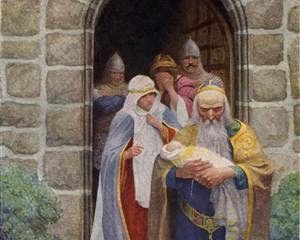
Merlin Taking Away The Infant Arthur
N.C. Wyeth
source Wikiart

I may have said before in some of my comments that this book was not what I expected.  And what did I expect?  Well probably something more similar to Sir Gawain and the Green Knight, where there is a quest, but an element of seriousness to it.  Arthur’s knights seem to meander around looking for a quest, often stumble onto some odd happenings, hack and stab and kill some other knights or perhaps spare their lives.  I’m not sure what has unsettled me about this read.  Is it because Malory tells and tells and tells, but never shows? Is it the very ignoble behaviour mixed in with the gracious knightly behaviour? Is it because the story is related in a very serious tone but somehow it metamorphizes into something that is somewhat comical?  I’m not really sure yet.

In any case, the story begins with Uther Pendragon coveting the Duke of Cornwall’s wife, Igraine.  Pendragon makes a bargain with Merlin that if he will give him Igraine, he, in turn, will give over their first born child to Merlin.  Of course, that child is Arthur, the one who pulls the sword from the stone and becomes King of all Britain, and also creates the order of The Kings of the Round Table.

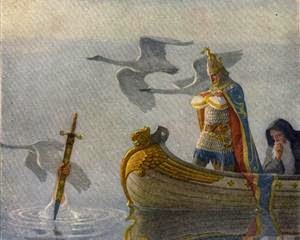
” … and when they came to the sword that the hand held,
King Arthur took it up …”
N.C. Wyeth 1922
source Wikiart

What follows is the various adventures of his knights, with Arthur making appearances here and there.  Other knights, especially wicked, dark knights, grumpy knights and average day-to-day knights, play prominent roles in the tales, where Arthur’s knights usually kill, maim or become friends with their opponents.  Various ladies make appearances as well.

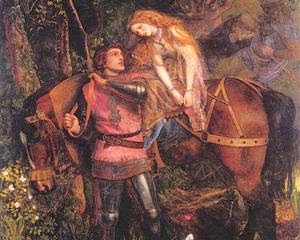
The Beautiful Lady Without Pity
Arthur Hughes 1863
source Wikiart

It was rather disturbing when Sir Gawaine managed to behead a lady while she was trying to protect her knight, but perhaps more shocking was Arthur’s slaughter of the innocent children born on May Day because of a prophecy that one born on that day would be the cause of his death.

Encouragingly, the plot began to pick up in Book 5.  Emperor Lucius of Rome has come to demand tribute from Arthur.  After a long and bloody battle, Arthur is victorious.  As he prepares to send the bodies of Lucius and many of his senators back to Rome, his words to them sent shivers down my spine:

And I suppose the Romans shall be ware how they shall demand any tribute of me.  And I commend you to say when ye shall come to Rome to the Potestate, and all the Council and Senate, that I send to them these dead bodies for the tribute that they have demanded.  And if they be not content with these, I shall pay more at my coming, for other tribute owe I none, nor none other will I pay.  And me thinketh this sufficeth for Britain, Ireland, and all Almaine, with Germany.  And furthermore I charge you to say to them that I command them upon pain of their heads never to demand tribute of me ne of my lands.

Just thrilling!

What Ho! For a Lunatic!

Yes, I am insane.  I have so many books on the go now, I can hardly remember my own name.  I have two MOOCs courses that I’ve recently started, I’m leading a two book discussions on Goodreads, trying to keep afloat on my WEM Project because I’m participating with others, and am desperately trying to participate in a discussion in another group, which I’m certain I’m going to fall behind in.  And I’m taking deep breaths ……..  So, in order to see how I’m desperately in need of professional help going to get all these books completed on time, let’s take a look.

1.

For my Shakespeare On Page and Performance course (2 of the 6 plays that need to be read by December)
2.  
For my read along.  Yes, I’m doing okay with this so far, Jean!
3.  
I’m leading the discussion in my Dead Writer’s Society group.  It’s great fun, but it takes some research.  And research takes time ……..
4.  
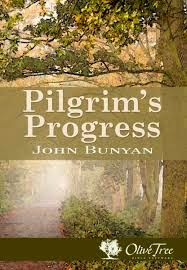
For my WEM Project.  I was not looking forward to this book, but have been pleasantly surprised!  Montaigne is certainly an interesting character.
5.  
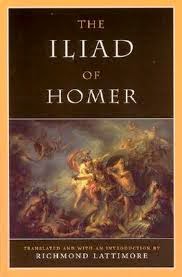
I just love this book.  If I had the time I’d read it once per year.  I’m reading it with someone at the moment and am having to rush a little so it’s not the best reading experience.  You can’t rush this epic.  Like a good wine, it must be sipped, tasted, swallowed, enjoyed, and then ruminated upon, before taking another sip.  Pure bliss!
6.  
A buddy read with my Dead Writer’s Society group.  It is so interesting!
7.  

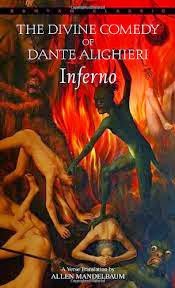
For my MOOCs Dante course.  I’ve just found that I need to read the complete book before the course begins in one week.  Help!  Anyone?
8.  
Someone would like me to read this book with them as part of the Well-Educated Mind novel list.  So I said, “yes”.  Is that the right answer ……….. yes …………..??
9.  
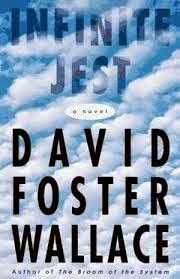
I’m reading this book with another group on Goodreads, just to help me get through it.  So far I hate it.  Hate, as in I want to tear it into tiny shreds and trample on it and use if for the bottom of my rabbit’s litter tray.  Yet, I’m persevering.  I know I’m going to fall behind the read, but I figure that if I can read at least 10 pages a day, eventually I’ll get through it.  After all, I don’t want to miss one of the greatest and most ingenuous novels of all time, do I?  Excuse me, while I make choking noises …….
10.  
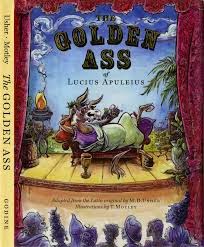
In spite of the childish cover, this is an ancient Roman novel and the only one to survive in its entirety!  I want to read it ……… or do I?  Yes, I do ………… no, I don’t ………… yes, I do ………… no, I don’t ………… yes, I do ……………..??
Just let me know when the little men will arrive with the white jacket with the joined arms.  At least this post is a reminder to keep focused and keep reading.  I can do this, I must do this …….