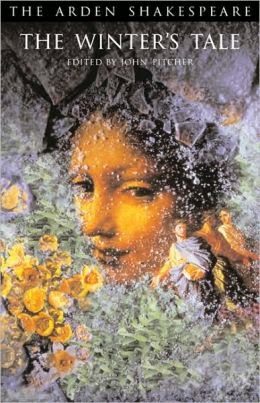
The Winter’s Tale by William Shakespeare

“What’s gone and what’s past help, should be past grief.”

Leontes, King of Sicilia and Polixenes, King of Bohemia, grew up together in a type of idyllic paradise, becoming as close as brothers.  At the opening of the play, Polixenes has been visiting Leontes and his queen, Hermoine, and is ready to return home after his nine-month stay.  Leontes begs his friend to remain longer, yet when he refuses, the king employs the queen’s pleading to try to change his mind.  And change his mind, Polixenes, does, unwittingly sparking a torrential storm of jealously within Leontes, as he, with Gollum-like psychosis, convinces himself that Hermoine has been unfaithful to him with his friend, and that the child she is about to give birth to does, in fact, belong to Polixenes.    Attempting to gain the sympathy of a Sicilian nobleman, Camillus, Leontes reveals his plot to poison the Bohemia king, but Camillus’ sensible and gentle nature will not allow him to commit such an atrocity and instead, he warns Polixenes and they both escape to the kingdom of Bohemia. Yet their escape leaves Hermoine at the mercy of her husband’s wrath and, against all the protests of his noblemen and, in particular, the wife of Antigonus, Paulina, Leontes tries Hermoine with the intent to condemn her to death.  While imprisoned she bears the child, a girl, who Leontes entrusts to Antigonus to abandon it in the wild, whereupon Antigonus leaves the child in the kingdom of Bohemia.  But tragedy strikes when part way through the hearing, Leontes learns of the death of his only son, Maxmillus.  Hermoine faints, then dies and Leontes suddenly realizes his foolish behaviour and repents.

Act II, Scene III
John Opie/Jean Pierre Simon
source Wikipedia

The child of Hermoine, Perdita, grows up in Bohemia as the daughter of a shepherd and we meet her again when she is sixteen and the love of Florizel, the son of Polixenes.  Through a quarrel with his father, Florizel and Perdita seek sanctuary in Sicilia, where Leontes has been spending the last 16 years doing penance for his harsh actions.  Paulina, in control of the situation as ever, makes Leontes promise not to marry unless a women in the likeness of Hermoine is approved by her, and he consents.  She then takes him to see a statue of his dead wife but lo!  This statue moves and Hermoine is alive again! There is much rejoicing and more when the identity of Perdita is discovered.  Winter has melted away from Sicilia and spring has come once again!

Perdita
Anthony Frederick Augustus Sandys
source Wikipedia

I really felt that this was certainly a weaker play of Shakespeare’s.  The audience was asked to immediately accept Leontes intemperate jealousy without any back-story or obvious proof of unwise behaviour on either the part of Hermoine or Polixenes.  What would cause a person who has always trusted and had the best relation with this friend, to suddenly question his character and honesty?  No other character believed in Hermoine’s guilt, yet Leontes persists in his delusion.

I also was taken aback by some of the staging of the play.  One senses that much of the important action takes place off stage:  the reason or backstory for Leontes’ jealousy; a reason for his immediate contrition; and shockingly, the climax with the reunion and reconciliations is not shown to us but told to us through a third party medium.  I’m still trying to grasp Shakespeare’s purpose in this structure.  The lack of all these critical ingredients cries lack of development and therefore, a lack of impact.  It’s not sensible, it’s not plausible and it’s certainly far from Shakespeare’s usually masterly grasp of his material and his audience.  I remain, puzzled.

I read this play for my Shakespeare: From the Page to the Stage course.
Othello ~ the Movies

I don’t usually do movie reviews on my blog, but it was necessary that I complete one for my Back to the Classics Challenge for 2014.  So I moved the books on my list around a bit to target a movie that I’d want to watch and came up with Othello.  And instead of watching only one DVD version, I watched four!

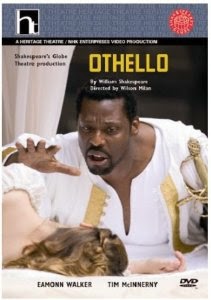
Play/Performance:  The first one was a 2008 production by Shakespeare’s Globe Theatre, starring Eamonn Walker as Othello and Tim McInnerny as Iago.  While I liked this production, I would probably term it as adequate.  In Othello, Iago is the hub of the story and I have to admit, McInnerny’s performance was not outstanding.  His lines were delivered with a good amount of monotonal yelling (this could be because the production was performed at the Globe and the actors needed to project), but overall, he acted on one level with very few nuances or investigation into the character. Walker’s performance of Othello was more engaging as he embodied an intensity of character which added to the play.  With a better Iago, I would have given it four stars.

Rating:  ★★★

______________________________


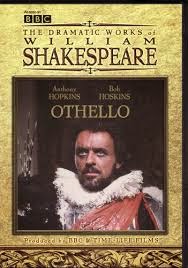
Movie:  Next I watched the 1981 BBC Production starring Anthony Hopkins as Othello and Bob Hoskins as Iago.  Needless to say, it was a little hard to see Hopkins as Othello.  He’s quite slight and came across more dainty than I was expecting.  The personality of a forceful Moorish military commander didn’t quite break through and the darkened face was sometimes distracting rather than credible.  However, Hoskins as Iago was fantastic.  He lent just the right charm, teasing, roughness and pathological bent to a character that is as varied as he is hateful.  His performance made the play for me.  Without him, I would have only given it 3 stars.  The character of Emilia was also well performed and her speech to Othello at the end of the play is truly electrifying. In fact, most of the lesser characters gave great performances.

Rating:  ★★★

_____________________________

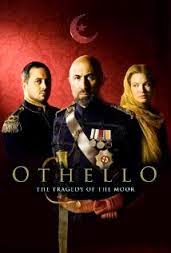
Movie:  Put me out of my misery.  Honestly, I couldn’t finish this 2008 movie adaptation.  No one gave a stellar performance and the actor who played Iago was atrocious!  Is there a worse word than “atrocious”?  If so, I’d use it.  Carlo Rota played Othello and Matthew Deslippe was Iago.  Too bad they didn’t give him “de-slip” right out of the movie.  Ha ha! …… Okay, that was a bad joke!  In any case, he delivered his lines woodenly, yet also like he was struggling to fit them into a comfortable syntax.  I’d never heard of him before as an actor, and now I perhaps know why.  It just wasn’t worth my time to complete watching this one.

Rating:  ★★

______________________________

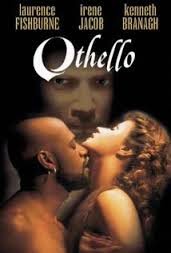
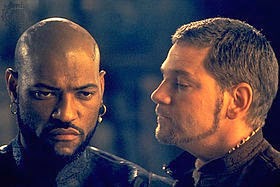
Movie:  And the last performance watched was the 1995 movie production of Othello starring Laurence Fishburne as Othello and Kenneth Branagh as Iago.  How can you go wrong with Branagh?  Seriously, you just can’t.  There is slight embellishment, or perhaps interpretation is a better word, and, of course, there was the prerequisite sex scene where in the play it is uncertain whether Othello and Desdemona have consummated their marriage, but really, it’s a solid performance by all. Bravo!

Rating:  ★★★


Le Morte d’Arthur Read-Along Update #4

Books XVI – XXI

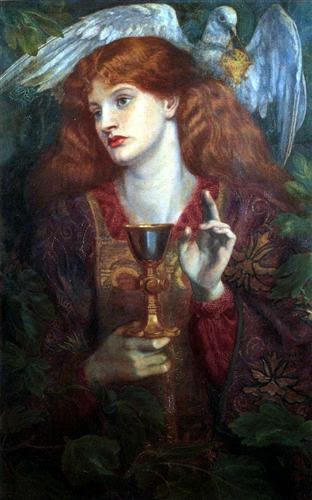
This section was a lovely mystical part of the book, the first time where the prose means something more profound, something beyond ourselves.

In these sections the stories take a rather abrupt turn.  Gawain decides to declare a search for the Holy Grail (Sangreal) at the drop of a hat, and while all the knights are rather enthused, Arthur is upset ……. somehow he knows that this will be the end of his Round Table as many knights go forth to die in the quest.

The Damsel of the Sanct Grael
Dante Gabriel Rossetti
source Wikiart

There are a number of interesting adventures, but these battles and odd happenings are no longer light-hearted and gay, but instead are coloured with a kind of melancholy air.  Visions permeate everyone’s thoughts, everyone’s sleep, and hermits abound with dire warnings, wise advice, or noble sayings.  Lancelot learns that all his endeavours and all his fame has been won for Queen Guinever instead of for God, and our worthy knight is sorrowful, realizing the littleness of his human achievements without a greater vision.

We get stories about Sir Percival, Sir Gawain, Sir Bors, and, of course, Sir Lancelot.  Poor Gawain.  His sense of honour had never been strong, and least of all his perseverance.  He soon becomes fatigued with searching for the Sangreal —- even though it was his idea in the first place —– and is somewhat petulant because he’s met with hardly any adventures.  When he meets an old hermit and inquires as to the cause of his bad luck, the hermit proceeds to enlighten him:  he’s a no-good, despicable murderer who is a dishonourable knight and full of sin, therefore he will never find the Sangreal.  I kind of like these old hermits ……. they don’t mince words.

Guinevere rescued by Lancelot
Edward Burne-Jones
source Wikiart

There are a great many temptations, along with a greater emphasis on purity and chastity, and many a knight regrets their previous behaviour.  In fact, it becomes known that the only three people who will succeed in the Grail quest is two virgin knights and one who is chaste, Sir Galahad.

Moving along, Guinever is falsely accused of murdering a knight with a poisoned apple, and Lancelot once again acts as her champion. You can sense the unravelling of the court, as the queen no longer seems to be revered as of old, but is held in deep suspicion by some.

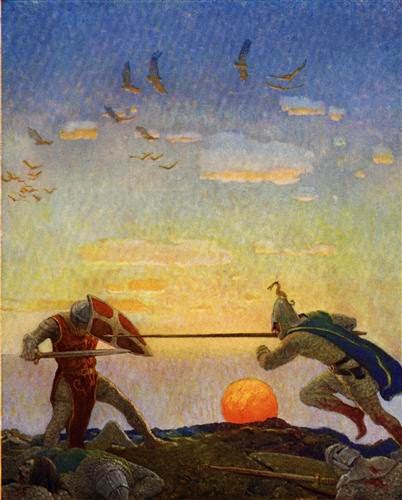
The Death of King Arthur
by N.C. Wyeth
source Wikiart

Finally the relationship between Guinever and Lancelot is exposed by Mordred, Arthur’s son, for completely nefarious purposes.   Lancelot returns to France but Arthur follows to do battle, leaving the kingdom in the hands of Mordred.  What myopic reasoning for a great king!  Mordred immediately plots to take over, Arthur returns and both he and Mordred kill each other in battle.  Lancelot attempts to reach the kingdom in time to assist Arthur but is, of course, too late.

And so the kingdom of Camelot, once known as great throughout the world, crumbles into tragedy.  Nothing lasts forever in this world, even the court of a king as renown as King Arthur.

Classic Children’s Literature Event 2015

Another year and another Classic Children’s Literature Event for the month of January, hosted by Amanda at Simpler Pastimes! I’m going to pledge to read two classic children’s books for this event, probably Carry On, Mr. Bowditch and My Father’s Dragon or The Trumpet of the Swan.  Amanda’s chosen read-along is Pinocchio, so I will try to fit that one in too.

Event Basics

  • During the month of January, read as many Children’s Classics as you wish and post about them on your blog and/or leave a comment on the event page on this blog. I will have a link page starting the first of the year to gather posts so that we may share as we go.
  • The optional RAL title: The Adventures of Pinocchio by Carlo Collodi. I plan on discussion the weekend of January 23-25.
  • I’m not going to be the “children’s classics” police. Use your own judgement for what fits the category but if you want some guidelines, these are what I’m going by:
  • I think many of us have read more recent children’s books that we may already deem “classics” (for example, many people feel that way about the Harry Potter books), but for this event, I’d preferif we read books that were written prior to 1964. This will still allow a lot of options, and will hopefully avoid the “but what is a classic” dilemma! (And yes, 1964 is rather arbitrary. Rebel if you wish, but 50 years old seems a good age.)
  • Defining “children’s,” especially prior to 1900 or so can be a challenge as some books we think of as “children’s” today may not have been intended that way at the time. Personally, I’d say books appropriate for approximately an elementary-school aged child or preteen (to read or to have read to them) should be fine. I’d personally also count the various fairy tales, even though some of the earliest versions were not exactly family friendly.
  • Feel free to include books from any country, in translation or not. I have limited exposure to non-American children’s lit, so I’d love to learn about books from other countries myself.
  • Feel free to double up with other events or challenges if you wish.
  • And if you need ideas I posted
  • A suggestion list in 2013
  • Some more ideas in 2014
  • There is no deadline for joining or participating (other than, of course, the end of January).

Most important: Have fun!

Last year I was able to complete The Wizard of Oz, The Lion, the Witch and the Wardrobe, Once and Future King and Prince Caspian.  Wow!  I’m not so ambitious this year so we’ll see how many I can complete.  And please join us if you feel in a children’s books mood!

1.

2.

Richard II by William Shakespeare

” For God’s sake, let us sit upon the ground
And tell sad stories of the death of kings ….”

Why do they call this play a “history”?  It was an absolutely tragedy …. gut-wrenchingly tragic, and I still feel depressed about the outcome.  Dare I say this is my favourite Shakespearean play so far?  Isn’t that weird?  An historical play about a king of whom I knew little about ……..  Yet Shakespeare’s verse is astonishingly beautiful.  The words flow around you like a bubbling river, conveying the anguish, terror, loss, loyalty, courage, deception, abandonment and hopelessness.  Not only is the play alive, but the story is alive and the words have a life of their own.

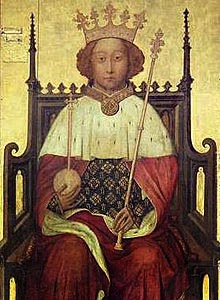
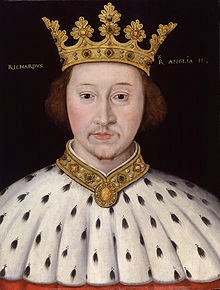
Richard II, King of England
portrait at Westminster Abbey (mid-1390s)
source Wikipedia

The play begins with a dispute between Henry Bullingbrook (Bolingbroke), cousin to King Richard, and Thomas Mowbray, Bullingbrook accusing Mowbray of misappropriating money and claiming that he was part of the murder of the Duke of Gloucester (which was probably orchestrated by Richard), yet before either can accomplish a duel, King Richard decides to banish both, Bullingbrook for 6 years and Mowbray for the term of his life.  John of Gaunt, is broken hearted at the exile of his son, Bullingbrook, and soon becomes sick with grief.  Upon Gaunt’s death, Richard decides to expropriate his estates and money, thereby defrauding Bullingbrook of his inheritance.  As Richard leaves to deal with the wars in Ireland, Bullingbrook gathers supporters and lands in England for the purpose, it appears, of regaining what is rightfully his.  Because Richard has taxed his subjects without remiss, and has fined the nobility for errors of their ancestors, most of the nobles rise up against him.

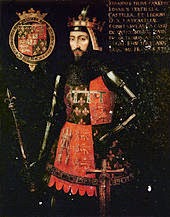
John of Gaunt
father of Henry IV
source Wikipedia

When Richard returns to England he is left with a small contingent of supporters including his cousin Aumerle, the Duke of York’s son, and lords Salisbury and Berkeley and other retainers.  Upon meeting with Bullingbrook, Richard relinquishes the throne to him, and Bullingbrook wastes no time in appointing himself King Henry IV.  Immediately, Richard is placed in prison.  When an uprising by Aumerle is discovered by his father and vehemently exposed, Aumerle is graciously pardoned by Henry IV, yet with dire threats towards the other conspirators.  In prison, Richard attacks his warden in frustration and is killed by Exton; when Henry hears about the murder, he is distressed and the play ends with his sad lament.

When I finished this play, I was so anguished by Richard’s sad end and how he’d been treated, yet reading some pre-history would have perhaps measured my emotions, as the good king was not entirely as innocent as he is made out.  Richard inherited the title of king when he was 10 years old and spent many years of his reign under the control of counsellors and advisors.  It wasn’t until later on, that he appeared to throw off their power and come into his own.  However, the fact that he taxed the populous to such extreme extents to finance his wars and royal coffers, contributed to the fact that he was not well loved or respected.  He was a king who ruled by impulse and without a justness that would have connected him to the people.  In fact, in the play, when he is walked through the streets, people dump garbage on his head, not a very fitting display for a monarch who truly believed that he was anointed by God.

Richard being taken into custody
by the Earl of Northumberland
source Wikipedia

Another consideration is that Shakespeare is writing drama.  He is known for taking the framework of history and then chopping and changing and perhaps, speculating for dramatic and political effect.   It is interesting that at the end of the play, Richard is seen as a pitiful figure who has voluntarily given up his kingship, and Bullingbrook condemns his murder, leaving the new king innocent of the crime and helpless to stop its culmination.  A very safe and uncontroversial tact on both sides for our playwright!

My favourite speech of Richard’s pulses with foresight, nostalgia and lament:

“For God’s sake let us sit upon the ground 
And tell sad stories of the death of kings:
How some have been deposed, some slain in war,
Some haunted by the ghosts they have deposed,
Some poisoned by their wives, some sleeping killed.
All murdered.  For within the hollow crown
That rounds the mortal temples of a king
Keeps Death his court and there the antic sits,
Scoffing his state and grinning at his pomp,
Allowing him a breath, a little scene,
To monarchize, be feared and kill with looks,
Infusing him with self and vain conceit,
As if this flesh which walls about our life,
Were brass impregnible.  And humoured thus,
Comes at the last and with a little pin
Bores through his castle walls, and farewell king!”

As Richard begins to realize the possible outcome of the circumstances and tries to reconcile them with his belief that a king is sanctioned by God, we see his syntax begin to break down, with his pronouns of “we”, being reduced to “I”.  It is truly pitiful.

Richard II
Anonymous impress from the 16th century
source Wikipedia

On a political note, this play was used to stir up populous support for Robert, earl of Essex, Queen Elizabeth I’s one-time favourite, during his rebellion against her.  On the eve of the uprising, his supporters paid for the play, Richard II, to be performed at the Globe Theatre, but Essex’s attempt to raise a coup against her failed. Retaliation was swift, however.  On February 25, 1601, Essex faced his execution and was beheaded on the Tower Green.  His was the last beheading at the Tower of London.

This was another wonderful experience with one of Shakespeare’s historical plays.  I had expected to like them least in the canon, but they are certainly quickly becoming by far my favourites!

Watched:  The Hollow Crown:  Richard II

The Canterbury/The Brubury Tales Project 2015

I’ve been meaning to read The Canterbury Tales for years but have been too intimidated to attempt them by myself.  I’ve looked for read-alongs and buddy reads but to no avail.  Then suddenly in one of my Goodreads’ groups, a new member joined who has written a book called The Brubury Tales, which is based on Chaucer’s The Canterbury Tales.  Voilà …… inspiration, and a person who can give me more insight into both reads!  Works for me.

Woodcut from William Caxton’s
second edition of The Canterbury Tales
source Wikipedia

The Brubury Tales, written by Frank Mundo, is a modern version of The Canterbury Tales, and for his work Mr. Mundo won the Poet Laureate Award Nomination from UCLA and CAL, Reader Views 2011 Reader’s Choice Award for Poetry Book of the Year, and the 2011 Bookhitch Award for the Most Innovative Poetry Book of the Year.  The LA Book Examiner said about his work, “a unique and powerful new book, The Brubury Tales draws upon Chaucer’s Canterbury Tales and classic stories by Mark Twain, Edgar Allan Poe and Charles Dickens, to name a few.  Frank Mundo takes risks with his writing, which is sensitive, thoughtful, and gritty.” 

I have received nothing from Mr. Mundo in exchange for reading his book.  He has been a very valued member in the discussions in my Goodreads group and has never once even mentioned that he was an author, which increased my respect for him.  I can’t wait to start this paired read, probably around April or May of this coming year!


Back to the Classics Challenge 2015

For the second year in a row, Karen from Books and Chocolate is hosting the Back to the Classics Challenge.  This is probably my easiest challenge; as I read so many classics, my categories fill up quickly.

Here are the categories and rules:

1.  A 19th Century Classic — any book published between 1800 and 1899.
2.  A 20th Century Classic — any book published between 1900 and 1965.  Just like last year, all books must have been published at least 50 years ago to qualify as a classic.  The only exception is books that were published posthumously but written at least 50 years ago.)
3.  A Classic by a Woman Author.
4.  A Classic in Translation. As in last year’s category, this can be any classic book originally written or a published in a language that is not your first language.  Feel free to read it in its original form if you are comfortable reading in another language.  
5.  A Very Long Classic Novel — a single work of 500 pages or longer.  This does not include omnibus editions combined into one book, or short story collections.  
6.  A Classic Novella — any work shorter than 250 pages.  For a list of suggestions, check out this list of World’s Greatest Novellas from Goodreads.
7.  A Classic with a Person’s Name in the Title.  First name, last name, or both, it doesn’t matter, but it must have the name of a character.  David Copperfield, The Brothers Karamazov, Don Quixote — something like that. It’s amazing how many books are named after people!
8.  A Humorous or Satirical Classic.  Humor is very subjective, so this one is open to interpretation.  Just tell us in the review why you think it’s funny or satirical.   For example, if you think that Crime and Punishment and funny, go ahead and use it, but please justify your choice in your post. 
9.  A Forgotten Classic.  This could be a lesser-known work by a famous author, or a classic that nobody reads any more.  If you look on Goodreads, this book will most likely have less than 1000 reviews.  This is your chance to read one of those obscure books from the Modern Library 100 Best Novels or 1001 Books to Read Before You Die.  Books published by Virago Modern Classics, Persephone, and NYRB Classicsoften fall into this category.  
10.  A Nonfiction Classic.  A memoir, biography, essays, travel, this can be any nonfiction work that’s considered a classic, or a nonfiction work by a classic author.  You’d be surprised how many classic authors dabbled in nonfiction writing — I have nonfiction books by Dickens, Trollope, Twain, and Steinbeck on my shelves. 
11.  A Classic Children’s Book.  A book for your inner child!  Pick a children’s classic that you never got around to reading.  
12.  A Classic Play.  Your choice, any classic play, as long as it was published or performed before 1965.
And now for the rest of the rules:  
  • All books must be read in 2015.  Books started prior to January 1, 2015, are not eligible.  Reviews must be linked by December 31, 2015. 
  • All books must have been published at least 50 years ago; therefore, 1965 is the cutoff date.  The only exception is books published posthumously, but written before 1965. 
  • E-books and audiobooks are eligible!  Books may also count for other challenges you may be working on.  
  • Books may NOT cross over categories within this challenge.  You may NOT count the same book twice for different categories in this challenge.  One book per category — otherwise, they won’t count.  
  • If you do not have a blog, you may link your review from Goodreads or other publicy accessible online format.  
  • Please sign up for the challenge using the linky below BEFORE MARCH 31, 2015.  If possible, please link to your sign-up announcement post, if possible or applicable.
  • You do NOT have to list your books prior to starting the challenge, but it’s more fun if you do!  You can always change your list at any time.  Books may be read in any order.
  • Please identify the categories you’ve read in your wrap-up post so that I can easily add up your entries for the prize drawing!  Adding links within the post would be greatly appreciated.
  •  The prize will be awarded the first week of January, 2016.  All qualifying participants will receive one or more entries, based on the categories completed, and will receive a $30 (US) gift card from Amazon.com or The Book Depository, as long as they live in a country that can receive shipment.  See herefor list of countries.  

As usual, I don’t have particular books planned for each category but I have a few in mind:

  1. The Plague – Albert Camus
  2. Orlando – Virginia Woolf
  3. one of Jane Austen’s works
  4. Ulysses – James Joyce (we’ll see — it makes me quake ….)
  5. Notes from the Underground – Fyodor Dostoyevsky
  6. Framley Parsonage – Anthony Trollope
  7. Confessions – Jean Jacques Rousseau
  8. Hamlet – William Shakespeare

It’s entirely possible that my list will be completely different at the end of the year, but it will be fun to compare!

List COMPLETED!!!:

  1.  Persuasion – Jane Austen
  2.  East of Eden – John Steinbeck
  3.  Orlando: A Biography – Virginia Woolf
  4.  The Plague – Albert Camus 
  5.  Confessions – Jean-Jacques Rousseau
  6.  Ethan Frome – Edith Wharton
  7.  The Narrative of the Life and Times of Frederick Douglass
  8.  Gulliver’s Travels – Jonathan Swift
  9.  The Club of Queer Trades – G.K. Chesterton
10.  Meditations – René Descartes
11.  The Adventures of Pinocchio – Carlo Collodi
12.  Hamlet – William Shakespeare

Persuasion Read-Along

Beginning January 5, 2015, a read-along of Jane Austen’s Persuasion begins and, in keeping with my Austen Project for 2015, I’m one of the participants! Hosted by Heidi at Literary Adventures Along the Brandywine, this will be one of two read-alongs that I’ll be doing for the month of January.

Persuasion is the only Austen work that I’ve never read and I hear that I’m in for a treat.  I’d watched the movie years ago and wasn’t particularly fond of it and therefore had avoided the book.  It just shows that you can’t judge a book by its movie!

If you’re interested in joining us, please pop over to Heidi’s blog and sign up!

The Pre-Printing Press Challenge 2015

For the second year in a row, I’m going to participate in The Pre-Printing Press Challenge hosted by Elena at All Booked Up.  I believe books written before 1440 are largely under-read, so anything I can do to support these works, I will.

Last year I planned to read 4-6 books and I’ve made it to 12.  My success makes me want to branch out but, knowing that I have challenges that will keep me reading newer books —- Reading England Challenge, Jane Austen Project, etc. ——, I’ll reign myself in and aim for the trusty 4-6 books, hoping to read more.  What do I have in mind?  Well, from my Classics Club list, I hope to get to Herodotus’ Histories, The Republic by Plato and The Cantebury Tales.  Otherwise, I’d like to read Ovid’s Metamorphoses and Plutarch’s Lives, but these are two chunksters that I don’t see myself being able to fit in this coming year.  However, one never knows ………

The rules of the Pre-Printing Press Challenge:
  1. All books must have come out before 1440, when the printing press was first invented.
  2. Books chosen for this challenge can overlap with other challenges.
  3. Books can be translated into the language of your choice.
  4. All the books you’ve chosen must be read by December 31, 2015.
  5. You can read 1-3 books, 4-6 books, 7-9 books or 10 or more books if you’re feeling particularly ambitious.
  6. The choice of books is up to you. There are no set reading lists, and you don’t have to set one when you join.
  7. Post your blog address where you’ll be posting your comments on your choice of books in the comments of this post when you join, and tell me how many books you’ve chosen. I’ll set up a link to participating blogs from here.
  8. Above all, Have fun.

The challenge starts January 1st.

Are there any other ancient and early medieval literature enthusiasts out there who are planning to join this challenge?

Othello by William Shakespeare

“O, beware, my lord, of jealousy;
It is the green-ey’d monster, which doth mock
The meat it feeds on.”

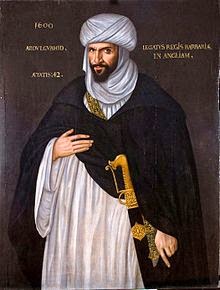
Othello the Moor is lauded over Venice for his help in attempts to rid them of the pesky Turks in their battle over Cyprus.  Yet when Othello weds the beautiful Venetian Desdemona in secret, some opinions of his prowess change, notably those of Desdemona’s father.  And unbeknownst to Othello, Iago, his third-in-command, is plotting a dastardly revenge for being passed over for promotion, the position being given to Othello’s loyal lieutenant, Cassio.  Hence proceeds perhaps the most shocking example of manipulation in literature, as Iago takes possession of Othello’s mind and emotions, like a beast taking possession of its prey, transforming our noble Moor from a honest, straightforward, respected man into an enraged, vengeful monster who believes every evil of his innocent wife, including her unfaithfulness with his second-in-command, Cassio.  Othello’s jealousy manages to eclipse anything within our understanding.

Abd el-Ouahed ben Messaoud
ben Mohammed Anoun,
Moorish ambassador to Elizabeth I
suggest inspiration for Othello
source Wikipedia

Iago reveals that, as well as the injury of being passed over for promotion, he also harbours a suspicion that Othello has been sleeping with his wife, Emilia, who is Desdemona’s lady-in-waiting.  There is no proof of this accusation in the play, and it is likely that Iago is expecting people to act with the same lack of integrity and base bestial urges, that he himself would, in the same circumstances.

How does a gentle and admired military leader allow himself to be reduced to a maddened beast, his fury leading him to commit the worst atrocity against a perfectly innocent human being, and one who has loved and supported him through their short marriage?  What hidden button inside Othello’s psyche has Iago discovered and pushed, knowing that it will make him snap?

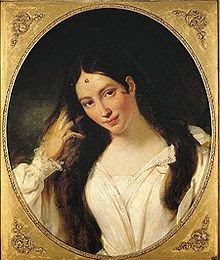
Maria Malibran as Rossini’s
Desdemona
Françoise Bouchot
source Wikipedia

Certainly there are various issues that come into play and work against Othello.  He is used to being a commander, yet is unused to being a husband and obviously, when in love, is out of his depth.  Perhaps he sees Desdemona as a possession that he has conquered and, instead of being able to relax in his marriage, he, like a military leader, feels that he must wage battle to keep her.  And when difficulties do arise, instead of trying to search out the truth, he acts like a military leader and attempts to “conquer the enemy”.  He has insecurities that lead to him being a willing pawn of Iago’s machinations. The jealousy that Iago is able to set aflame within him, corrupts his normal good sense and his actions become intemperate.  I certainly have compassion for his state, as I believe these aspects have severely affected his decison-making and emotional state, but, that said, he is still human and he still has the option of choice.  He knows right from wrong, yet he decides to allow his emotions to rule and himself to be led down the tragic path of mindless jealousy.  In reality, he allows himself to turn into a beast.

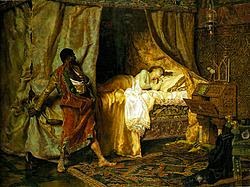
Othello & Desdemona
Antonio Muñoz Degrain
source Wikipedia

Shakespeare’s exhibits an uncanny ability to weave endless possibilities into a Gordian knot of drama and draw the reader into his poetic spell.  Will we ever know exactly what motivated Othello and his spiral from an honourable man to a madly jealous murderer.  Will we ever understand why he believed Iago without any “ocular proof”?  What happened to the military commander that must have been used to exhibiting self-control?  Do intense emotions subvert our ability to act as a human beings?  There are so many avenues to explore and no obvious or set answers.

Of all the characters in the play, my favourite character was Emilia.  While she remains surprisingly unaware of the plotting and intrigues of her husband, upon realizing the truth, she becomes the voice of the audience, who has until this point been mute in horror, and satisfyingly spews vile recriminations on the head of Othello.

T.S. Eliot had a different view of the last actions of Othello than many older critics:

“I have always felt that I have never read a more terrible exposure of human weakness — of universal human weakness — than the last great speech of Othello.  I am ignorant whether any one else has ever adopted this view, and it may appear subjective and fantastic in the extreme.  It is usually taken on its face value, as expressing the greatness in defeat of a noble but erring nature. What Othello seems to me to be doing in making this speech is cheering himself up. He is endeavouring to escape reality, he has ceased to think about Desdemona, and is thinking about himself. Humility is the most difficult of all virtues to achieve; nothing dies harder than the desire to think well of oneself. Othello succeeds in turning himself into a pathetic figure, by adopting an aesthetic rather than a moral attitude, dramatising himself against his environment. He takes in the spectator, but the human motive is primarily to take in himself. I do not believe that any writer has ever exposed this bovarysme, the human will to see things as they are not, more clearly than Shakespeare.”

I read this play as part of a Shakespeare: From the Page to the Stage course that I’m taking online, and it’s definitely moved in among my favourites!

Laurence Fishburne & Kenneth Branaugh
Othello 1995
source Wikipedia