How To Think About the Great Ideas Project

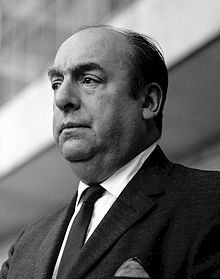
I’ve been having some wonderfully deep conversations with friends lately about life, but have been frustrated because I’ve felt that I’ve lacked the depth of understanding to communicate certain ideas and insights to them.  Pablo Neruda says in one of his love poems:  “Between the lips and the voice something goes dying,” and I’ve felt very much this way.  Somehow inside I know what I want to say, only when I attempt to articulate it, I’m left with a discouraging feeling of the inadequacy of my communication.  So with these experiences in mind, I’ve decided to resurrect a project that I’ve had on the back-burner for some time now.

Drawing from Mortimer J. Adler’s classic TV series, How to Think About the Great Ideas takes 52 great ideas —- ideas that stem from the ancient world —- and examines them from a philosophical viewpoint.  Adler, a philosopher and educator, taught that we are all philosophers and to ignore that which stimulates our minds, diminishes us to the level of ants; ants do not require the medium of choice but humans do, and, therefore, it is important to always choose “in terms of ideas.”  In the world of ideas there are always new frontiers to explore and I think I’m ready to take that journey.

There are 52 ideas in all, so I’m thinking of posting one idea each week for one year. The first idea is “How To Think of Truth”.  Yikes, not a light topic to start with but here I go, adding another project to my set of unfinished ones.  Wish me luck and please feel free to join me if the impulse so moves you!!


The Death of Ivan Ilyich by Leo Tolstoy

“Inside the great building of the Law Courts, during the interval in the hearing of the Melvinsky case, the members of the judicial council and the public prosecutor were gathered together in the private room of Ivan Yegorovitch Shebek, and the conversation turned upon the celebrated Krasovsky case.”

Wow!  My last Tolstoy novel read was War and Peace over two years ago and I’d forgotten the depth that Tolstoy could create within his stories with a clear, straight-forward narrative.  The Death of Ivan Ilyich appears to be merely a tale of the last days of a Russian court judge, yet Tolstoy brings the human condition into vivid and startling colours.

Continue reading

Jane Eyre ~ Chapters XX, XXI & XXII

Chapter XX

Jane hears a blood-curdling wail in the middle of the night and then frantic calls for Rochester’s assistance.  He comes to assure his guests, and Jane retreats back into her room, dresses and waits.  Somehow, she simply knows that she’ll be needed.  Sure enough, Rochester fetches her to a room where Mr. Mason is lying in bed obviously injured, his blood-soaked linens nearby and a bandage covering his arm and shoulder. Rochester’s request is for Jane to remain with the wounded man while he leaves to fetch a surgeon, and when Mr. Mason is finally patched up, he is dispatched ……. no, not killed but sent quickly away in a carriage at the break of dawn.  Rochester asks Jane to walk with him and then asks her obscure yet leading questions with regard to a mistake he may have made, and her judgement on it.  He then teases her about his impending marriage and departs.

Continue reading

Here I Love You (Aquí Te Amo) by Pablo Neruda

I anticipate summer every year because when it arrives I have weeks where I’m able to read, read, and then read again.  I usually get at least 7 books finished during summer. This summer I finished 2 books.  Usually this outcome would frustrate me but books were replaced with people this summer and everything was as it should be.  We made some wonderful new friends, re-connected with old ones, and hopefully helped everyone’s summer be a little more meaningful, as they did ours.  It was one of the best summers in a long while.  However, now that the blissful time is over, and life is beginning again, the feeling of frustration is looming because I have so many books on-the-go, none nearly finished, and on top of it all, I feel unfocussed.  Not to mention, because of both situations, my reviews have been dwindling.

So today, I’ve decided to step back into the enchanted summer memories and share a poem, that I discovered on vacation, by the Chilean poet, Pablo Neruda.  So many of his poems bring in evocative images of the sea and nature, which are irresistible to me. And, of course, I spend most of the summer by the sea and nature, so it’s no wonder I feel an affinity with his poetry.
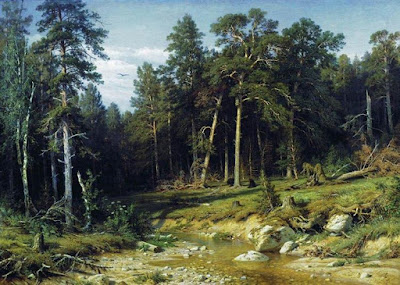
 

Pine Forest in Vyatka Province (1872)
Ivan Shishkin
source Wikiart


Here I Love You by Pablo Neruda
 
Here I love you.


In the dark pines the wind disentangles itself.
The moon glows like phosphorous on the vagrant waters.
Days, all one kind, go chasing each other.
The snow unfurls in dancing figures.
A silver gull slips down from the west.
Sometimes a sail. High, high stars.
Oh the black cross of a ship.
Alone.
Sometimes I get up early and even my soul is wet.
Far away the sea sounds and resounds.
This is a port.
Here I love you.

Here I love you and the horizon hides you in vain.
I love you still among these cold things.
Sometimes my kisses go on those heavy vessels
that cross the sea towards no arrival.
I see myself forgotten like those old anchors.
The piers sadden when the afternoon moors there.
My life grows tired, hungry to no purpose.
I love what I do not have. You are so far.
My loathing wrestles with the slow twilights.
But night comes and starts to sing to me.
The moon turns its clockwork dream.
The biggest stars look at me with your eyes.
And as I love you, the pines in the wind
want to sing your name with their leaves of wire.


Pablo Neruda
trans. W.S. Merwin
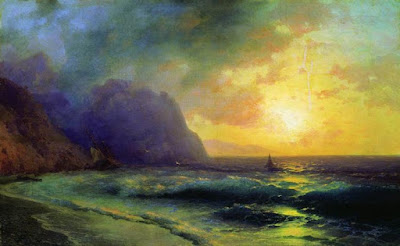
 

Sunset At Sea (1853)
Ivan Aivazovsky
source Wikiart
Aquí te amo by Pablo Neruda
Aquí te amo.
En los oscuros pinos se desenreda el viento.
Fosforece la luna sobre las aguas errantes.
Andan días iguales persiguiéndose.
Se desciñe la niebla en danzantes figuras.
Una gaviota de plata se descuelga del ocaso.
A veces una vela. Altas, altas, estrellas.
O la cruz negra de un barco.
Solo.
A veces amanezco, y hasta mi alma está húmeda.
Suena, resuena el mar lejano.
Este es un puerto.
Aquí te amo.
Aquí te amo y en vano te oculta el horizonte.
Te estoy amando aun entra estas frías cosas.
A veces van mis besos en esos barcos graves,
que corren por el mar hacia donde no llegan.
Ya me veo olvidado como estas viejas anclas.
Son más tristes los muelles cuando atraca la tarde.
Se fatiga mi vida inútilmente hambrienta.
Amo lo que no tengo. Estás tú tan distante.
Mi hastío forcejea con los lentos crepúsculos.
Pero la noche llena y comienza a cantarme.
La luna hace girar su rodaje de sueño.
Me miran con tus ojos las estrellas más grandes.
Y como yo te amo, los pinos en el viento,
quieren cantar tu nombre con sus hojas de alambre.
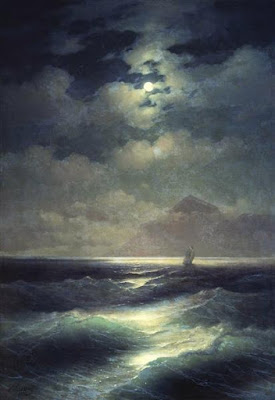
 

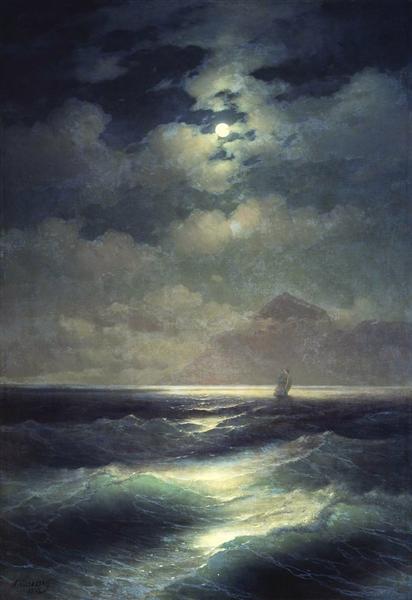
Sea View By Moonlight (1878)
Ivan Aivazovsky
source Wikiart

I absolutely love the image of the wind disentangling itself.  Neruda uses so few words but conveys the intricacy and greatness of the ocean ……..  the desolate feeling of not only the landscape, but of the absence of his lover.  Whom of us hasn’t know the ache of either unrequited love or the anguish that comes from the separation of love?  Yet he doesn’t leave the reader without encouragement:  still the night sings to him and he loves on.

My favourite line in this poem?  “Sometimes I get up early and even my soul is wet.”  I can’t describe it, but I can feel it.  Amazing.

So this lovely poem was part of my minuscule summer reading, and I thought I’d share it, wrapping up a memory of the past to take into the future …..


The Oresteia ~ The Eumenides

The Eumenides by Aeschylus
“I give first place of honor in my prayer to her
who of the gods first prophesied, the Earth; and next
to Themis, who succeeded to her mother’s place
of prophecy; so runs the legend; and in third
succession, given by free consent, not won by force, 
another Titan daughter of Earth was seated here. …..”

Time passes and Orestes arrives at the Temple of Apollo at Delphi, still pursued by the Furies.  His conflict continues in tormenting unrelief and he appeals to Apollo for alleviation from his guilt.  He has avenged his father, but in doing so has murdered his mother.  Divine command has clashed with divine decree, and he is helpless to navigate his way through the maze of paradoxical possibilities.  The priestess, Pythia, is shocked to find him in the suppliant’s chair with a sword dripping with blood and the sleeping Furies surrounding him.  A spell has been placed upon them by Apollo so Orestes can travel unhampered to Athens, which he does after Apollo absolves him of complicity in his murder of Clytaemestra. But now he must seek Athena for a possible resolution to his dilemma.

Continue reading

Jane Eyre ~ Chapters XVII, XVIII & XIX


Chapter XVII

Jane feels Rochester’s absence keenly and disappointment bubbles up at the speculation he could be gone indefinitely.  But she gathers her senses and fights her emotions, bringing them under practical reign, and by the time they receive a letter from Mr. Rochester a fortnight later announcing his intent to return with a large party, she is composed.

Continue reading

Jane Eyre ~ Chapters XIV, XV & XVI


Chapter XIV

At first Jane sees little of Rochester, except in passing, but learns not to be offended at his cool acknowledgements, as she is clever enough to realize these funks are independent of her.  One day, he summons her and Adèle, and while the child opens her cadeaux with Mrs. Fairfax, Rochester and Jane begin a deep conversation.  Rochester claims that he was once as good as Jane, but circumstance and fate worked together to corrupt his nature.  Since fate has denied him goodness, he will do what he can to seize any happiness available to him.  Concerned, Jane counsels repentance but her employer is only willing to concede that he might reform.  Surprisingly, he shows tremendous insight  into Jane’s character, and when Jane feels the hour late, Rochester wishes to continue the conversation.  It is an important and illuminating first extended meeting between the two, where they connect on more than just a superficial basis.

Continue reading

Henry V by William Shakespeare

“From this day to the ending of the world,
But we in it shall be remembered –
We few, we happy few, we band of brothers;
For he to-day that shed his blood with me
Shall be my brother.”

Written in the Second Period of Shakespeare’s development, Henry V is the eighth of his dramas, and part of the Henriad, his historical tetralogy which also includes Richard II, Henry IV Part 1 and Henry IV Part 2.  The play is thought to be composed late in 1598, as it was produced between March 17 and September 28th of 1599.

The earliest known volume is the first Quarto printed in 1600, which was followed by Q2 and Q3, reprints of the first edition, published in 1602 and 1608 respectively.  The first Folio edition differs extensively from the Quartos, as it is twice the length of the latter, which omits the first scenes of Acts I and III, the second scene of Act IV, the choruses and the epilogue, as well as some of the characters.  Prose is also transformed into metrical form, it can only be supposed to effect an increased length of the play.

Continue reading

Jane Eyre ~ Chapters XI, XII & XIII


Chapter XI

Brontë begins this chapter by likening the novel to a play and encourages the reader to not only read the story, but “see” it in their mind’s eye, as if it is being acted out on stage. It is a chilly October day as she waits for someone to meet her, feeling small and forgotten.  But soon a conveyance arrives and she is taken the six miles to Thornfield at a frustratingly slow pace.  Taken inside, she makes the acquaintance of Mrs. Fairfax and clears up her mistaken assumption that her pupil is Mrs. Fairfax’s daughter, instead learning the lady is only a servant, and Miss Adèle Varens is the ward of the owner of Thornfield, Mr. Edward Rochester.  As Jane wakes the following morning with risen spirits, the reader finally gets a description of Thornfield, not overly grand, but picturesque in its location.  Jane meets her student, Adèle, finding her pleasing, yet undisciplined towards work.  As to Thornfield’s owner, Mr. Rochester, she is told that he is frequently absent and is “peculiar”, but is unable to discover his peculiarities.  And near the end of the chapter while she is being given a tour of the house, Jane hears a loud laugh that chills her to the bone.  Mrs. Fairfax claims it is the laugh of a servant, Grace Pool, but those who have read Jane Eyre before know better, don’t we?

Continue reading