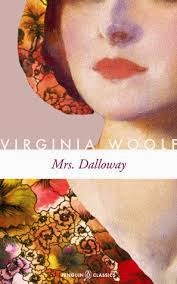
Mrs. Dalloway by Virginia Woolf

“Mrs. Dalloway said she would buy the flowers herself.”

After reading Woolf’s To The Lighthouse I was excited to dive into Mrs. Dalloway.  Following the lead of James Joyce’s Ulysses, Woolf used the same writing style, and, in a loose imitation of Joyce, chronicles a day in the life of a prestigious middle-aged woman in London. Woolf critiqued Joyce’s Ulysses, calling it “illiterate” and “under-bred,” finding the graphic sexual fantasies and the foul language base, and saying it reeked of a “queasy under-graduate scratching his pimples.”  Was Mrs. Dalloway Woolf’s attempt to get this style of writing right?

Using her signature “stream-of-consciousness” style, Woolf chronicles one day in the life of Mrs. Richard Dalloway, the wife of a respectable, wealthy gentleman.  Set in post-World War I London, on this particular day she is preparing for a party she will host that evening, an unusual party whose guests will span the ages of her life, past and present.  As she performs her tasks, her mind wanders back through days gone by, unearthing ghosts of earlier loves, regrets, irritations, ever-present worries and satisfaction.  The reader is also privy to the thoughts of many of her friends who will be present at this party, as they perform their daily business.

As a secondary plot, we meet Septimus Warren Smith, a surviving soldier of the war, yet a hollow shell of a man, his mind barely touching reality.  In spite of the persistent yet useless intervention of his wife and doctors, he gradually is sucked into a whirlpool of despair, seemingly of his own making, and suffers a very poignant and pathetic fate.  Or does he?

Julia Stephen
Virginia Woolf’s mother
source Wikipedia
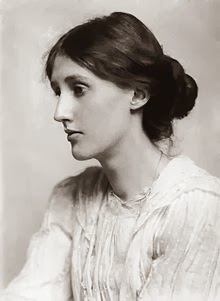
Virginia Woolf, Age 20
source Wikipedia

I’m going to go out on a limb here and offer a very unusual interpretation of at least one theme in the novel.  Woolf’s treatment of Septimus, in contrast with Mrs. Dalloway and her social peers, was very intriguing.  If we examine the thoughts of Mrs. Dalloway and her friends and acquaintances, they touch upon parties, flower-shows, scholarships, the family business, Bartlett pears, gossip and cricket.  In comparison, Septimus’ musings revolve around human nature, the truth, Evans (his friend who was killed in the war), aloneness, meaning, and the beauty of words.  Septimus is presented on the surface as a character who is emotionally unbalanced, while Mrs. Dalloway’s circle is the respected rational group.  Has Woolf turned appearance on its head?  Is the perceived deranged person really the one who is sane, and are the ones who appear “normal” actually the group who is not?  It’s an irony that’s inescapable.

For Septimus, the only liberation from a world turned upside-down was death.  Is his escape from a materialistic world concerned with trivialities an heroic act?  Woolf makes it appear so:

“…… Death was defiance.  Death was an attempt to communicate, people feeling the impossibility of reaching the centre which, mystically, evaded them; closeness drew apart; rapture faded; one was alone.  There was an embrace in death.”

Ironically, sixteen years after the writing of Mrs. Dalloway, Woolf followed Septimus into the murky fog of depression and, placing stones in the pockets of her overcoat, walked into the River Ouse near her home, drowning herself, a sad fate for one of the most respected female literary writers of the time.

Virginia Woolf – Romanian Stamp
Source Wikipedia

I just loved Woolf’s To The Lighthouse and I really wanted to like Mrs. Dalloway.  There are certain aspects I do like about it, such as the character of Septimus Warren Smith, the relentless passage of time, the allusions to various literary works of different eras, the exploration of the lingering impact of the first World War and the diminishing influence of the British empire.   The prose is lovely, light and lyrical, each sentence a candy you can pop into your mouth and taste a burst of spring.  Yet I found the story meandering and disjointed.  In To The Lighthouse, the stream-of consciousness  flowed towards one main character, Mrs. Ramsey, wrapping her in a warm glow, even while each character retained their own lively identity.  In Mrs. Dalloway, the streams flow out from Mrs. Dalloway and a host of other characters, at times to alight on each other, but many times to float out into the atmosphere, leaving the reader confused or adrift.  The lack of cohesiveness was like an irritating burr in my britches and no matter how much I tried, it was hard to ignore.  Yet, in spite of the persistent irritation, I will probably re-read this book sometime in the future.  Woolf’s books are like a deceptively packed suitcase where you’re never quite certain if you have even removed half of what is contained.
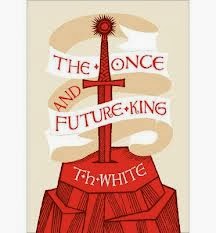
Once and Future King by T.H. White

“On Mondays, Wednesdays and Fridays it was Court Hand and Summulae Logicales, while the rest of the week it was the Organon, Repetition and Astrology.”

The Once and Future King encompasses five books written by author T.H. White about the legend of King Arthur.  In The Sword and the Stone, we meet Wart, a young boy who is the ward of Sir Ector and who lives with his guardian and his guardian’s son, Kay, near the Forest Sauvage.  By an unexpected set of circumstances, he encounters the wizard, Merlyn, who becomes his and Kay’s tutor, although we can see from the beginning that Merlyn favours Wart and there is obvious foreshadowing that we should expect something extraordinary from him later in the tale.  This book concludes with Wart unknowingly pulling the sword from the stone, a clear indication that he is England’s next king.  The book The Witch in the Wood (re-written as The Queen of Air and Darkness and apparently with little resemblance to the original) follows, chronicling the establishment of Arthur’s court under the political idea of right instead of might, and, of course, the love affair between Lancelot and Guinever receives the most attention.  The third book, The Ill-Made Knight, gives primary focus to Lancelot, his quests to purge his thoughts of Guinever, his relationship to Elaine who bears him a son, the development of a odd love-triangle, the quest for the Holy Grail, and Lancelot’s fight to defend Guinever’s honour.  A Candle in the Wind waxes philosophically about the metamorphosis of England into its present condition and the ideologies of war.  The height of tension appears in this book as Lancelot and Guinever’s relationship is revealed by a dastardly plot of Arthur’s Orkney clan, a war begins and the throne is seized by a usurper.  The death of Arthur and his son, Mordred are foreshadowed.   The Book of Merlyn, published posthumously, is added at the end and sets an aged Arthur amongst Merlyn and his animal friends from Book I, as they discuss the evils of war, why men want it, and how can it be avoided.

Photo courtesy of Moyan Brenn
(source Flickr)
Creative Commons License

I’m really stumped as to where to start with reviewing this book.  My idea of the Knights of the Round Table was woven with nobility, courage, daring, self-sacrifice, self-denial and chivalric actions.  While the Arthur of this tale professes to have started the Round Table with the idea that might does not equal right, White makes Arthur a rather weak character.  In his youth, he is quite simple; Merlyn plants the social and political ideas into his head and as a reader, I never got the feeling that Arthur intrinsically believed in them himself.  He knowingly allows Lancelot and Guinever to have an illicit relationship and is often paralyzed in moments when it is necessary for a king to show his strength and decisiveness.  He is a simple, loving old soul who calls everyone “my dear” but it is a hard task to imagine him as the legendary King Arthur.  Lancelot for a good part of the book is a brooding morass of insecurity and dark thoughts.

“The boy [Lancelot] thought that there was something wrong with him.  All throughout his life — even when he was a great man with the world at his feet — he was to feel this gap:  something at the bottom of his heart of which he was aware, and ashamed, but which he did not understand ….  We do not have to dabble in a place which he preferred to keep secret.”

 However after Lancelot’s quest for the Grail and his encounter with God, he at least develops into a man with a sense of what is important in life and an internal code of conduct that he believes is worth following.  Guinever is a moderately believable character, professing her loyalty and love to both men, but White puts her through a period of womanly jealously that is almost embarrassing to read and certainly not worthy of her.  With Arthur’s half-relatives from Orkney, the devious and twisted brothers who become not only knights of the Round Table but are the poison that festers inside Arthur’s kingdom, White does a satisfying job with crafting their personalities.  At times they can be quite appalling …… perfect villains to fit the story.  Also, King Pellinore and his Questing Beast should receive an appreciative nod, adding delightful humour to the first book.

Lancelot and Guinevere (1890s)
Herbert James Draper
source Wikimedia Commons

T.H. White was a rather tortured soul.  He was beset with fears of nearly everything, except, apparently, God.  After holding the position of head of the English Department at Stowe School, he retreated to a game-keeper’s cottage at Stowe Ridings on the Stowe Estate and, with hawks, owls and a setter bitch as his only companions, he began to write.  As war loomed over England in 1938, White’s fear almost choked him.  He declared himself a conscientious objector and in February 1939 found himself lodging in a farmhouse in Doolistown, Ireland, out of harm’s way.  He remained there for the next six and a half years.  In a December 1940 letter to L.J. Potts, a former tutor at Cambridge, he wrote: “….. [The Candle in the Wind] will end on the night before the last battle, with Arthur absolutely wretched.  I am going to add a new 5th volume in which Arthur rejoins Merlyn underground ….. and the animals come back again, mainly ants and wild geese.  Don’t squirm.  The inspiration is godsent.  You see, I have suddenly discovered that (1) the central theme of Morte d’Arthur is to find an antidote for war, (2) that the best way to examine the politics of man is to observe him, with Aristotle, as a political animal …….”

The above information perhaps explains White confusing re-crafting of the legend, and the plethora of social and political philosophical concepts that twist the characters into a means of furthering the development of these ideas.  Instead of White employing creativity to show the reader various themes in the novel, he simply tells us, which leaves a very weak effect.  As one of my reading buddies stated, instead of cleverly weaving his opinions into the story, White attempts to weave the story into his opinions.  The result is sloppy and, in effect, he actually strips these noble characters of the dignity they had been given by previous writers.

The Sword in the Stone, by itself is an appealing read, a nice story about the young Arthur and his upbringing.  By the second book, the story takes a turn for the worst.  I only have two words:  very disappointing.

The Wizard of Oz by L. Frank Baum

“Dorothy lived in the midst of the great Kansas prairies, with Uncle Henry, who was a farmer, and Aunt Em, who was the farmer’s wife.”

Whether first introduced to the book or the movie, which one of us is not familiar with the story of The Wizard of Oz?  As I child, I remember feeling dizzy as Dorothy was whirled away in the cyclone to the land of Oz; those shoes she inherited from the dead Wicked Witch of the East, just dazzled; the Scarecrow who wanted a brain, the Tin Man who wanted a heart, and the Lion who wanted courage stirred my sympathies, and I was as in awe of Oz as Dorothy and her companions, until I found out, as they did, that his persona was all a hoax.  All throughout Dorothy’s adventures with the Munchkins, the Flying Monkeys, and  the Wicked Witch of the West, I cheered for Dorothy to find a means to return safely to Uncle Henry and Aunt Em and her home in Kansas.

Dorothy meets the cowardly Lion
from the first edition
(source Wikipedia)

Re-reading this book as an adult, I admit I’ve lost the delight of the childhood experience, yet I found if I focused on the story’s simplicity, there was charm in it.  Both Dorothy and her companions were straightforward, uncomplicated personalities, trusting, honest and unquestionably sincere.  In spite of the dangers they encountered, somehow their innocence and naiveté helped them pass through their trials and realize their dreams.  While the Scarecrow, the Tin Man and the Lion each desire a quality that they perceive they lack, their actions in situations of danger, show that they already possess these qualities, and that they simply had to employ them, in order for them to be revealed.  Perhaps this shows that we all have special qualities within us that only rise to the surface in the face of adversity.  
All in all, I found this a short and pleasing read, a chance to travel back to a childhood favourite and revisit memories that still linger in spite of childhood left behind.

Eugene Onegin Read-Along

Marian at Tanglewood is having a Eugene Onegin Read-Along for 5 weeks beginning January 7, 2014.  Pushkin was seen as setting the foundation for Russian literature so if you are looking for an introduction, this work is a wonderful place to start.

Here is the schedule:

Ch. 1 & 2 – January 7 to 16
Ch. 3 & 4 – January 16 to 25
Ch. 5 & 6 – January 25 – February 3
Ch. 7 & 8 – February 3 to 12

She has decided to allow 1 1/2 weeks per every two chapters, which seems like a decent balance between going at a regular clip and dragging on too long.

Please see the Tanglewood blog for further instructions and also a lovely calendar for a visual schedule of the read.

Since I just finished reading Eugene Onegin, I am very excited to be participating in the discussion of Pushkin’s “untranslatable” poem.  Thanks for organizing the read, Marian!

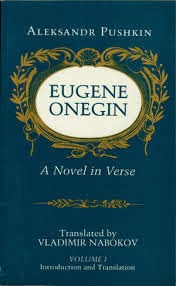
Eugene Onegin by Alexander Pushkin

“My uncle – high ideals inspire him;
but when past joking he fell sick,,
he really forced one to admire him –
and never played a shrewder trick.”

Eugene Onegin is a fun-loving, rakish young man who lives carelessly among fashionable society and cares nothing for any of the responsibilities of life.  Yet soon his wild living becomes stale and, desperately bored, he moves to an estate in the country inherited from his uncle, to recapture the zest in life.  Onegin’s lack of growth and a stable character causes him to return to his constant feelings of ennui and he passes his days in careless endeavours.  Enter, Tatyana, a sheltered girl who falls passionately in love with Onegin.  Finally, amid her torments of love, she composes a letter to Onegin, confessing her devotion.  Giving her a surprisingly gentlemanly refusal, he then, on a whim, proceeds to seduce his friend, Vladimir Lensky’s, future wife, Olga, who is the sister of Tatyana.  Lensky, in a fit of poetic rage, challenges Onegin to a duel, where Lensky is shot through the heart.  A number of years later, Onegin spies a married Tatyana at a party and is immediately drawn to her.  He pursues her to the point of exhaustion and finally writes her a letter acknowledging his love and eternal devotion.  Tatyana, in spite of still harbouring tender feelings for Onegin, spurns him from the outset, and eventually declares that she would never be unfaithful to her husband.  Because Onegin has never made any effort to develop into anything other than an empty man, he is left with a bleak future ahead of him.

I’ve hear it mentioned that Tatyana is the true hero of this novel, and her strength and effect is certainly evident.  While she shows a naivety and a juvenile infatuation with Eugene when she first meets him, years later when they meet again, she exhibits the poise and maturity of a sophisticated and experienced young woman.  In the magnificent finale, she admits her love for him but says, “… but I’ve become another’s wife — and I’ll be true to him for life.”   Onegin has spent his whole life blowing around like a leaf in the wind, consumed by ennui, driven by precipitate decisions and self-absorption, while Tatyana grows and blossoms into a strong woman with firm convictions.  She became a truly admirable character.

One wonders at the commonalities between this work and Pushkin’s life story.  Pushkin, himself, was no stranger to duelling.  He was involved in many contests before being killed in a duel while defending his wife’s honour, echoing his poet Lensky’s fate in an ironic prophesy. And, of course, there was the question of Pushkin’s wife being unfaithful, as Olga was untrue to Lensky, which one can also contrast with Tatyana remaining true to her vows of marriage at the end of the tale.

In one way, the poem is an eerie premonition of future events, while on the surface it takes many forms; playful, romantic, humorous, mocking, tragic.  It’s a tribute to Pushkin’s genius that he was able to artfully blend a myriad of themes and emotions into a introspective classic that examines the human condition and began a Russian literary tradition.

(translated by Sir Charles Johnston)


Mount TBR Reading Challenge 2014

Straight from Howling Frog Books and originally from My Reader’s Block, it’s the 2014 Mount TBR Reading Challenge!

Challenge Levels:

Pike’s Peak: Read 12 books from your TBR pile/s

Mount Blanc: Read 24 books from your TBR pile/s
Mt. Vancouver: Read 36 books from your TBR pile/s
Mt. Ararat: Read 48 books from your TBR piles/s
Mt. Kilimanjaro: Read 60 books from your TBR pile/s
El Toro: Read 75 books from your TBR pile/s
Mt. Everest: Read 100 books from your TBR pile/s

Mount Olympus (Mars): Read 150+ books from your TBR pile/s

~  Once you choose your challenge level, you are locked in for at least that many books.  If you find that you’re on a mountain-climbing roll and want to tackle a taller mountain, then you are certainly welcome to upgrade.  All Books counted for lower mountains may carry over toward the new peak.

~  Challenge runs from January 1 to December 31, 2014

~  You may sign up anytime from now until November 30, 2014

~  Books must be owned by your prior to January 1, 2014.  No ARCs (none), no library books.  No rereads.  Audiobooks and E-books may count if they are yours and they are one of your primary sources of backlogged books.

~  You may count any “currently-reading” book that you begin prior to January 1st, provided that you had 50% or more of the book left to finish in 2014.

I am going to go for the Mount Blanc challenge.  I’ve read this many at least for the last couple of years and, if I’m fortunate, I might get to Mount Vancouver.  Wish me luck!

TBR Challenge – Checking In

2013 TBR CHALLENGE

I don’t know why it is so hard for me to read books which are sitting on my bookshelves.  They stare at me as if begging me to read them.  I am continually reminded of their presence.  Almost all of them are well-written classics or near-classics, yet I often choose a book that I don’t own.  Enter the TBR challenge.

Last year I read 34 books from my shelves; this year I have no idea how many I’ve read so I thought it would be a good idea to check in with myself!  This is the list so far:

  1.  The Divine Comedy – Dante
  2.  Cautionary Tales for Children – Hillaire Belloc
  3.  Sir Gawain & the Green Knight
  4.  Pride and Prejudice – Jane Austen
  5.  At the Back of the North Wind – George MacDonald
  6.  Anne of Green Gables – L.M. Montgomery
  7.  Anne of Avonlea – L.M. Montgomery
  8.  I Capture the Castle – Dodie Smith
  9.  Middlemarch – George Eliot
10.  Moonfleet – John Meade Faulkner
11.  Anne of the Island – L.M. Montgomery
12.  Anne of the Windy Poplars – L.M. Montgomery
13.  Anne’s House of Dreams – L.M. Montgomery
14.  Vanity Fair – William Makepeace Thackeray
15.  Anne of Ingleside – L.M. Montgomery
16.  The Black Tulip – Alexandre Dumas
17.  Rainbow Valley – L.M. Montgomery
18.  Dombey and Son – Charles Dickens
19.  Beowulf

Hmmmm ……….. not quite the same pace as last year but I am glad I’m getting through all the “Anne” books, of which previously, I had only read the first two.  In any case, it’s a much better pace than the approximately 4 per year which I used to cover.  I’m impressed!