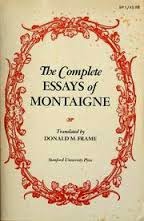
Montaigne’s Essays – Part Two

Oh, Montaigne!  The more of his essays that I read, the more I like him.  He’s inquisitive, does not let anything get in the way of giving his opinion on absolutely any subject, has a clever but disordered mind, and because of the last point, really makes you engage your brain as you read.  I would have loved to meet him in real life, but, I get the impression that we’d probably have occasionally annoyed each other.  

Some of the readings for this section were:

On The Vanity of Words:  After reading Montaigne’s essay On Education, I suppose this attack on rhetoricians can’t come as much of a surprise.  To be eloquent is to foster a type of deception, and Montaigne is scathing in his condemnation of it.

Cicero & the magistrates disovering the
tomb of Archimedes
Benjamin West
source Wikiart

On the Inconsistancy of Our Actions:  This one is very interesting. Montaigne laments the inconsistency of men, stating that instead of following a path to wisdom throughout their lives, they are ruled solely by their appetites, living for the here-and-now and are merely motivated by opportunity, very much like animals. They blow with the winds.  He gives various examples on inconstancy, leading us to believe that consistency as Montaigne defines it, is virtually impossible.  One must plan one’s life to the utmost and follow the course, not being swayed by emotions or outside forces to be consistent and, as Cicero says, “For nothing can be consistent that has not reason for its foundation.”  Therefore, in Montaigne’s eyes, everyone is lacking true reason.  This is one of the few essays that I’ve read so far where Montaigne actually managed to keep on track with his subject.  Bravo!  This is certainly one of my favourites.

On Conscience:  Even if one finds pleasure in their vices, their conscience will always convict them, says Montaigne.  With one of his usual unexpected leaps of thought, he discusses the futility of torture, labelling it a means of testing endurance rather than a means to ferret out truth.  He uses some fun examples in this one, my favourite being Scipio tearing up his account books before the court when accused of dishonesty with regard to the money entrusted to him.  According to Montaigne, his actions declared him an honest man because his big heart could not bear to be accused of such a vulgar crime. Perhaps one should be grateful that Montaigne did not choose to be a judge as his profession.

Portrait d’un homme portant un exemplaire des
Essais de Montaigne
Johann Anton de Peters
source Wikiart

On Rewards for Honour:  Basically I understood that Montaigne feels that rewards should not be given out too liberally or their value is decreased. He’d rather not give out rewards at all, than have too many people get them.  Not a very modern viewpoint, Montaigne, when we presently strive to give everyone a reward for anything.  I tend to side here with Montaigne.

On Books:  Montaigne employs a coyness in this essay, stating that he reads books for pleasure only and has little desire to truly exercise his brain.  His goals in reading are to learn to know himself, and to learn to live and die well. His self-deprecation is quite startling as he confesses to having little knowledge and once again admits to having a poor memory.  Elaborating on his poor memory, he ends by giving a number of examples of literary criticism (not his title for it) that he has written at the ends of books, so if he picks them up again, he is able to ascertain why he liked them or not, and if he would read them again.

On Presumption:  It is not good to think too highly of ourselves, nor is it beneficial to think of ourselves worse than we are.  Montaigne advocates for balance and a practical self-knowledge.  Yet Man has such a variety of differing opinions, there is a “maze of obscurity” which makes the school of Wisdom uncertain, and this gets on Montaigne’s nerves.  He then meanders through a lovely forest of subjects, from self-deprecating statements to mediocre poetry to appearances of famous men, etc., finally ending with his disdain for modern education, in that it teaches learning instead of wisdom and goodness.

” It seems to me that the nursing mother of the most erroneous ideas, both of men in general and of the individual, is the exaggerated opinion man has of himself.”


On Giving the Lie:  Montaigne indulges in more modesty (false-modesty?) and finally gets to the title of the essay, lamenting that lying has been turned into a virtue by modern society.  He strongly condemns it:

“Lying is an ugly vice, which is painted in its most shameful colours by an ancient writer (Lysander) when he says that ‘to lie is evidence that we despise God and at the same time fear men.'”

To be honest, I feel that Montaigne could have benefited highly from the type of education that he despised, however, then he wouldn’t have been Montaigne and only another highly intellectual rhetorician with the same habits as all other rhetoricians.  And our Montaigne is unique, that is certain!  Not always simple to follow, but unique!

Montaigne’s Essays – Part One

Oh, Montaigne!  What a character!  I’m reading a series of recommended essays, and my plan is to split them into three posts.  So far my introduction to Montaigne has been pleasurable, but taxing to the brain.  His language and progression of ideas, examples and testimonies are not for the faint of heart.  In hindsight, it was wise to take him in measured doses.


On Sadness:  I felt that Montaigne was saying that the deepest sorrows often could not be expressed with outward emotions.  But then he ended by saying that he is little bothered by such violent passions;  I then wonder what gives him the authority to speak on sorrow if he knows nothing of it.  Hmmmm ……..

Our Fortune Must Not Be Judged Until After Death:  Well, this was not an uplifting little essay.  Montaigne believes, drawing from the tale of Croseus and Solon in the stories of Herodotus, that a man cannot be judged as fortunate until his death, because various calamities and suffering can plague him until the end.  Your final day tells all.  Nice.  Fortunately he appears to have amended his views on this subject later in life.

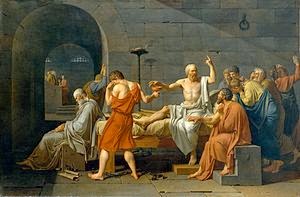
The Death of Socrates
Jacques-Louis David
source Wikipedia

To Think As A Philosopher Is To Learn To Die: Yikes!  Another death essay.  Montaigne emphasizes the need to learn to lose the fear of death.  Death is inescapable and it is a piteous error to try to avoid it by any means, as the hour is determined for everyone.  He tosses in Socrates rather wise and pithy remark:  to the man who said “The thirty tyrants have sentence you to death,” Socrates replied, “And Nature to them.”

Of The Powers of Imagination:  I’m somewhat perplexed as to where to begin with this one.  This essay is supposed to (I believe) explore the relationship of imagination to the mind and body, but Montaigne rather vividly gets into a discussion of the “male member” and “passing wind”.  I was laughing so hard I was crying at the end of the “passing wind” section.  I don’t think hilarity was intended by the author.  😉  Apparently though, people in Montaigne’s time wouldn’t have blinked an eye at these references, showing that they were much more mature and less sensitive than modern people. And since I was very surprised by his frankness given the era, it also demonstrates that our preconceived ideas can be less than accurate.

On Educating Children:  I have an interest in education, so this essay was perhaps the most interesting for me, if not the most amusing (see above).  Montaigne felt that an instructor of good moral character and sound understanding was much more valuable than one with founts of knowledge.  He emphasized the value of knowledge for its own sake, and was repelled by the thought that learning should be used to earn profit. The ancient Greeks would understand his dismay; only slaves were schooled to work, not free men.  Montaigne proceeds to say that he does not wish for an educational system that makes children parrot back what they have learned but rather that they are taught to make ideas their own.  He then expands his argument to suggest tossing out the classical education model in place of simply teaching children to philosophize.  He seems to forget that the classical model contains the building blocks that give the student the tools to be able to discuss topics philosophically, not to mention that young minds have to mature to be able to understand the abstract concepts which are required in philosophy.  He supports, as well, exercise and entertainment, but suggests training peculiarities and eccentricities out of people, as they are “a foe to intercourse and companionship of others”. Well, okay …….  I do understand Montaigne’s main point though.  He is advocating for the teaching of a virtuous character over that of intellectual learning.  In fact, this should be the goal of every teacher, however I believe that there should be a balance between the two, whereas Montaigne seems to want to throw the baby out with the bathwater.

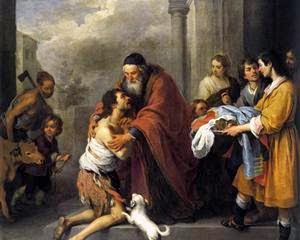
The Return of the Prodigal Son
Bartolome Esteban Murillo
source Wikiart

On the Affection of Fathers for Their Children:  In this case, Montaigne means male children but he does share some good advice. A man should not marry too early and responsible thought should be given to the purpose of having children, realizing that they will owe you much more than they can ever pay back.  Instead of forcing the son to be dependent on him when he comes of age, the father should share his wealth and guide him in the use of it, teaching the son to run the estate.  Now Montaigne claims if this is not done, the sons have no other recourse than to become thieves, a habit that will be nearly impossible to break.  I’m not sure I follow his rationale in this case, and cannot agree with it as an excuse, but hey, it’s Montaigne, right?  It just doesn’t feel normal if he doesn’t hit you with some sort of idiosyncratic reasoning.

In spite of some peculiarities, Montaigne has a charm that cannot be denied.  Perhaps Madame de Sévigné characterizes best what his readers experience:  “I have found entertainment in a volume of Montaigne that I did not think I had brought with me.  Ah, the charming man!  What good company he is!  He is an old friend of mine, but by dint of being old, he is new to me. …….. Mon Dieu!  how full this book is of good sense!”

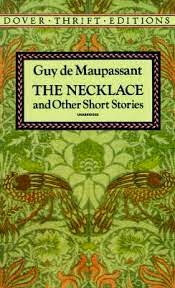
La Parure (The Necklace) par Guy de Maupassant

“C’etait une de ces jolies et charmantes filles, nées, comme par une erreur du destin, dans une famille d’employés.”

Yes, she certainly was a pretty and charming girl who was born by a mistake of destiny into a family of office workers.  Mathilde would dream of riches and fame and jewels, covering her life of drudgery in a tapestry of fantasies and longings.  Finally, one day, her husband arrives with an invitation to a party.  Mathilde manipulates this honest, hard-working man into purchasing a new elegant dress for her, but when she complains of a lack of jewels, he has the answer: borrow some from her wealthy friend Madame Forestier!  A lovely diamond necklace of Madame’s catches Mathilde’s eye and she must have it.  Her friend, generous to the end, gladly loans it and the evening of her dreams begins.  She is admired, she is catered to, she is wrapped in a heavenly realm of blissful wealth and prestige.  Late do she and her husband return home, reluctant to leave the party until the end but, oh no!  The necklace has disappeared and she is sure that she left it in the taxi.  Days of searching yield nothing and finally there is only one thing to do.  Withdrawing their life savings and taking out a loan, they replace the necklace, hoping that Madame will not notice.  But this painful action causes them ten years of needless toil and suffering.  Why is it needless?  Well, you will have to read the tale to find out!

This short story was really a gem and, in spite of having an inkling of the final twist, it still held my attention to end.  In fact, I had expected to get fatigued by reading such a long (for me) story in French and I had planned to take a break, but instead, I was held rapt until the end.

I did wonder at the title of this story.  In the tale, the necklace is mostly referred to as “la rivière“, yet the title is “la parure“.  When I looked up “la rivière” in my French dictionary it says “river“, and “la parure“means “finery” or “jewelry“.  So then I looked up necklace and it had “le collier“.  What?  Do any of you Francophiles understand the distinction between these terms? Help!

In any case, this story has definitely been a huge incentive to read more of Maupassant.  His short stories are very readable and a good way to keep improving my French.  I certainly struggled here and there in parts of it and learned a number of new words, yet I was also pleased with my progress.

This will probably be the last book for my Summer Freak Language Challenge, unless I can squeak in a short children’s book before the end. Thanks Ekaterina, for holding this wonderful challenge.  It’s given me a chance to practice languages that I wouldn’t normally read in.  I’m already looking forward to next year’s challenge!