Doodles in the Dictionary by Aldous Huxley

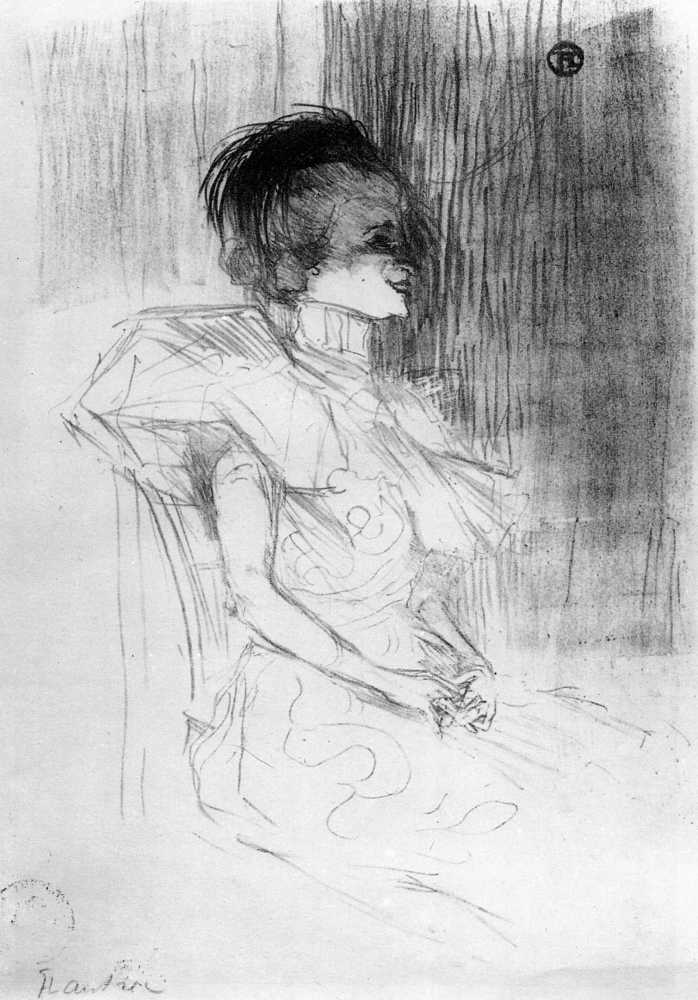
Henri Toulouse-Lautrec
source Wikimedia Commons

Ah, my first essay by Aldous Huxley and I didn’t know what style to expect.  He first begins by lamenting the insufferable boredom experienced by having to learn Greek and Latin in school.  Even the mention of these subjects he still finds tedious and can only find one benefit of having been forced through hours of searching for words in his Lexicon:

“I hate to think of all that wasted time.  And yet, in view of the fact that most human beings are destined to pass most of their lives at jobs in which it is impossible for them to take the slightest interest, this old-fashioned training with the dictionary may have been extremely salutary.  At least it taught one to know and expect the worst of life.  Whereas the pupil in a progressive school, where everything is made to seem entertaining and significant, lives in a fool’s paradise.” 

When his bookseller friend requested his presence to view an item that he was extremely thrilled to purchase, Huxley was dismayed to find that it was a Latin dictionary. However, when he found it wasn’t just any Latin dictionary, but the one owned by the famous painter, Henri Toulouse-Lautrec, his interest was piqued.
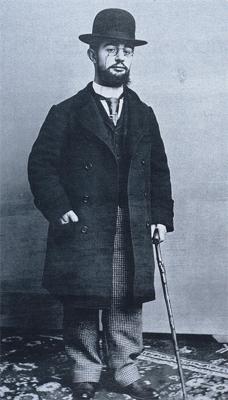
source Wikipedia

Toulouse-Lautrec created these “doodles in the dictionary” when he was sixteen years old, a mere two years after two accidents which would change his life forever.  First, he broke one leg, and then the other, and neither leg grew again, therefore upon adulthood, he had the legs of a fourteen year old and the body of a man.  Having to live as a “dwarfish monster”, Lautrec immersed himself in his drawing and painting.

Aristide Bruant on His Bicycle (1892)
Henri Toulouse-Lautrec
source Wikiart

Huxley muses that up to the age of ten, the muse of genius is within every child, but with instruction that muse disintegrates until only one in four thousand people have any talent for art.  He calls this fact an “unsolved riddle” and hopes one day to learn the answer, whereupon education will be able to be transformed into a “social and individual reconstruction”.  Hmmm …….  who would decide what needed to be reconstructed and why?  Who would be doing the reconstructing and under what premise?  It’s all very vague and rather disturbing.
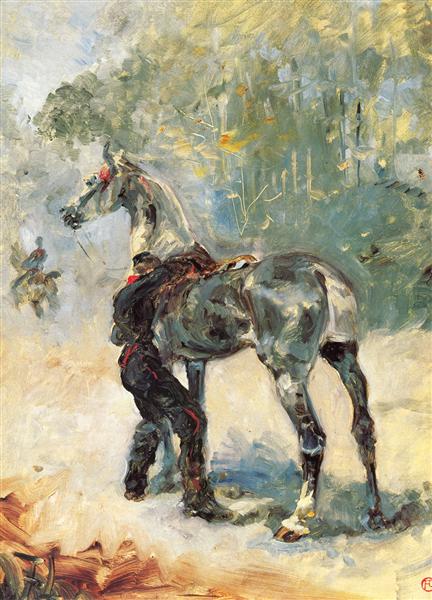
Artilleryman Saddling His Horse (1879)
Henri de Toulouse-Lautrec
source Wikiart

In any case, early on it was evident that Toulouse-Lautrec had rare talent for drawing and he was also proficient in Latin, earning prizes for translation and composition.  While his drawings at sixteen showed a maturity and flair that was unsurpassed for his age, his first master Bonnat was lukewarm with his praise.  In a letter to his Uncle Charles, Toulouse-Lautrec communicated his teacher’s comments:  “Your painting isn’t bad; it’s clever, but still it isn’t bad.  But your drawing is simply atrocious.”  Judging from a comment from another student, Huxley believes Toulouse-Lautrec had a propensity to exaggerate his subjects, to “prettify” them in a way that was perhaps not pleasing.  Yet Huxley believes that facts are perhaps not so immutable as we perceive them, and that everyone can view each reality differently.  And facts can also cover a variety of disciplines: for example, he says, the H-bomb can at once be involved in physics, chemistry, physiology, medicine, genetics, psychology, politics, economics, ethics and even be an aesthetic fact, as the cloud it makes is quite beautiful.  Toulouse-Lautrec simply chose to communicate in his art the aspects that preoccupied him and “found no incompatibility between truth to nature and distortion.” His exaggeration perhaps brought life to his art, which would align with Hsieh Ho, the fourth dynasty Chinese artist who stated that the First Principle of Chinese Painting “…. is that, through a vitalizing spirit, a painting should possess the movement of life,” and the sinologist, Osvald Siren agreed, “that the First Principle refers to something beyond the material form, call it character, soul, or expression. It depends on the operation of the spirit, or the myserious breath of life, by which the figures may become as though they were moving or breathing.”
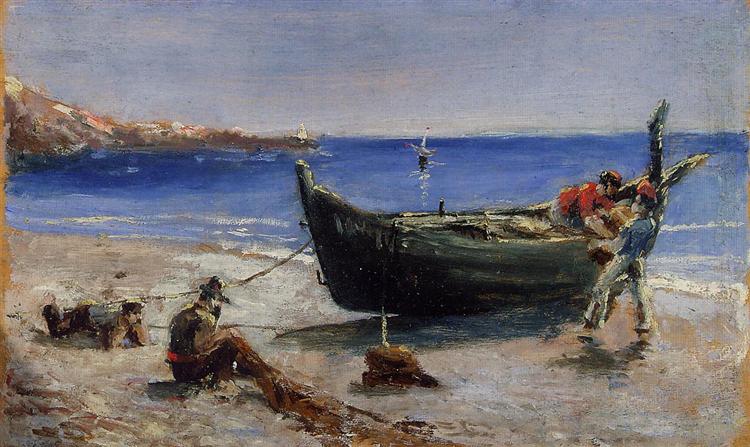
Fishing Boat (1880)
Henri de Toulouse-Lautrec
source Wikiart

Huxley brings the subject of the horse into his essay, lamenting its passing into the history of transport and surmising that it was heading towards extinction.  It embodied the expression of life from its splendid grace, from the thoroughbred down to the old hack; in modern times we are only left with man who is a graceless uninteresting creature.  The advent of the automobile, and in fact all technology, detracts from life and therefore from our enjoyment of it.  Lautrec’s father had advocated for the health of the outdoors but sadly, Lautrec was not destined for such a life because of his accident and became, instead, fascinated by the race-track, Montmartre known for its public dancing and cabarets, alcohol and prostitutes.

“The drunks and tarts, the lecherous gentlemen in top hats, the sensation-hunting ladies in feather boas, the stable boys, the lesbians, the bearded surgeons performing operations with a horrifying disregard of the first principles of asepsis ……. these became the subject matter of most of Lautrec’s pictures, the environment in which he liked to live.  He portrayed them simply as curiosities, passing no moral judgment, but simply rendering the intrinsic oddity of what he saw around him.”

His interest in the theatre grew, of which sketches can be seen in the dictionary of jesters, actors and actresses.  He did not portray women in a sexual way nor with any discrimination, only executing them as he would any other subject, “from memory and with appropriate distortions, rendered their life-movement, now graceful, now grotesque, and the underlying rhythm of the mysterious spirit that manifests itself within that movement.”

And so concludes an essay that I thought would be an educational treatise and ended up being about the creation of art, and secondary the sad demise of a creative talent. Huxley did not reveal that Lautrec died from the effects of alcoholism and syphilis at the age of 36 years old.

Next up is classic children’s book, The Finn Family Moomintroll.  I absolutely love this book; it is tied for my all-time favourite children’s classic.  I can’t wait to read it again and share some unique Moomintroll adventures!

Week 9 – Deal Me In Challenge – Two of Spades


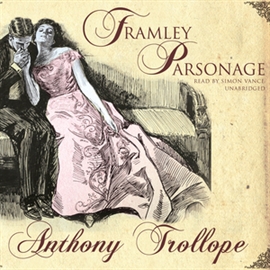
Framley Parsonage by Anthony Trollope

“When young Mark Robarts was leaving college, his father might well declare that all men began to say all good things to him, and to extol his fortune in that he had a son blessed with so excellent a disposition.”

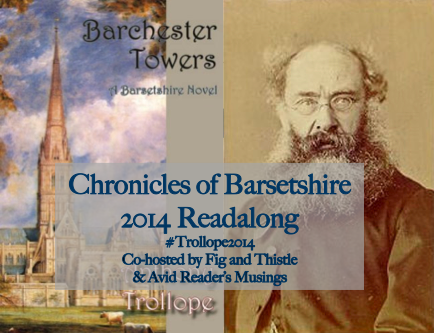
In Framley Parsonage, the fourth book in the Chronicles of Barsetshire, Trollope gives us a lively romp through the lives of the inhabitants of East Barsetshire, introducing us not only to their whims and follies, but through their actions, the culture and society of a 19th century English town. 

Mark Robarts, a parson of the village of Framley, and a beneficiary of Lady Lufton whose son was his schoolmate, is married to Fanny, a genteel lady of respectable birth.  Yet his patroness is at times difficult to please, and Robarts must navigate the storms of friendship, duty, and financial matters, often muddying the waters that he is trying desperately to clear.  When his father dies and his sister, Lucy, comes to live at the parsonage, an unexpected complication develops that was unforeseen by all and upsets the carefully calibrated balance of societal acceptance.  Robarts encounters further obstacles when he embroils himself with a member of parliament, Nathaniel Sowerby, and his financial dealings.  His trusting, artless, clerical nature is in sharp contrast to the Machiavellian intrigue of men of enterprise, and it appears nothing good will come of the connection.

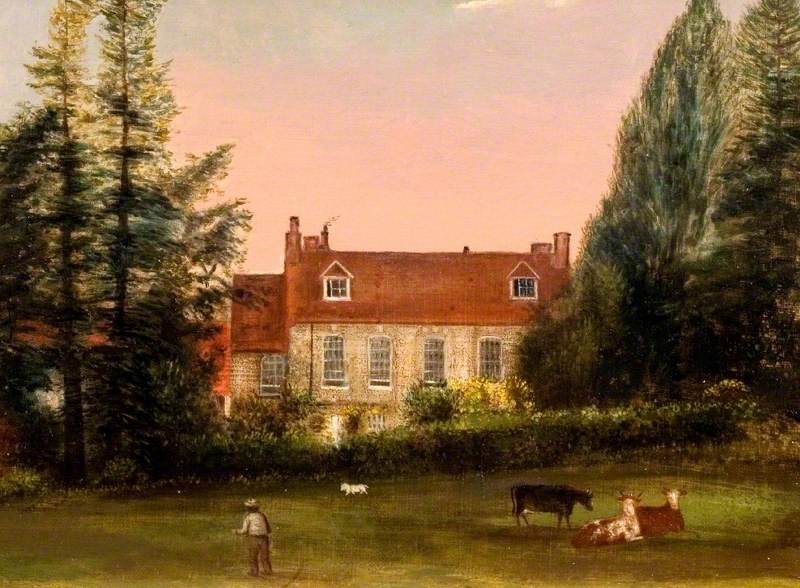
The Parsonage Farm, Rickmansworth (c. 1840)
John White
source ArtUK

In Mark Roberts financial dealings with Sowerby, one wonders if Trollope was offering a subtle indictment as to the interactions and associations of church and state.  The innocent perceptions of one is unable to account for the devious machinations of the other and, because of Robarts’ influence on those around him, they are affected by the imprudent alliance as well.  Add to that Lady Lufton’s displeasure at the Duke of Omnium’s vulgar societal group and a possible marriage between a peer and a commoner, and you have class conflict at its finest, a subject of which Trollope is most adept at exploring with a light-heartedness that often belies the deeper implications.

Trollope reintroduces characters from the previous Barsetshire books: The Warden, Barchester Towers and Dr. Thorne.  Miss Dunstable displays her wily financial prowess, Dr. Thorne his ability to be influenced, the Grantley’s are in top form with not one, but two suitors in their daughter’s wake, and even gentle old Septimus Harding makes a brief appearance.


The Houses of Parliament (c. 1844?)
George Chambers II
source ArtUK

Two years it took me to complete this novel.  Isn’t that ridiculous?  For some reason, the first part of it just dragged, but as soon as I hit the half-way point, I was completely hooked and drawn in to the characters and their stories.  Next in line is A Small House at Allington, which I’ve heard is excellent.  It won’t take me two years to read through this one, I promise!


Politics and the English Language by George Orwell

I haven’t yet read enough of Orwell’s works to decide whether I like him or not, but one thing I have learned in our short acquaintance is that he’s not one to prevaricate or candy-coat his ideas.  If you don’t want his opinions, don’t read him, and if you do, get ready to duck!

Orwell begins his essay, Politics and the English Language, by speculating on the impending collapse of the English Language. Is its demise a mirroring of society’s cultural suicide, simply an innocuous descent that is only natural given the state of our world?  Yet Orwell believes that there is not just a natural cause, but more pointedly, political and economic ones, and even the effects themselves can become causes that reinforce the original cause.  For example:

“A man may take to drink because he feels himself to be a failure, and then fail all the more completely because he drinks.  It is rather the same thing that is happening to the English language.  It becomes ugly and inaccurate because our thoughts are foolish, but the slovenliness of our language makes it easier to us to have foolish thoughts.”

There is a remedy though: if we clean up our bad habits when applying language to thoughts, our thoughts will become clearer.

A Song Without Words (1919)
John William Godward
source Wikiart

Orwell now gives five writing examples exemplifying problems with how people use language:

  1. an essay by Professor Harold Laski (who uses 5 negatives in 53 words)
  2. a paragraph from Interglossa by Professor Lancelot Hogben (mixed metaphors)
  3. an essay on psychology in Politics (meaninglessness)
  4. a Communist pamphlet (stale phrases)
  5. a letter in the Tribune (words and meaning part company)

The two main problems in all these examples are a “staleness of imagery” and a “lack of precision”.  Modern English prose is ripe with these issues, but they crop up continuously in political writing.   Instead of sticking with concrete thoughts, the abstract creepy in, melting away the valuable meaning of ideas, instead consisting of a stringing together of hackneyed phrases.  He then lists examples of the ways that the adequate construction of prose is habitually avoided.

Dying Metaphors:  These are metaphors between the good and bad, a garbage dump of metaphors that have lost all expressive power and are used only to avoid the trouble of creating new evocative phrases.  Whenever inconsistent phrases are mixed or the original meaning is convoluted, it is evidence that the person is not particularly interested in what they are saying.

Operators of Verbal False Limbs:  Used to avoid choosing correct verbs and nouns but give the appearance of a harmony by expanding the sentence with the use of extra syllables.  Examples of such are: make itself felt, exhibit a tendency to, etc.  In addition, the passive voice is preferred instead of the active, noun constructions are employed instead of gerunds (by examination instead of by examining), verbs are cut down by -ize and de- formations, clichéd statements are presented as intelligent by the not un- formation, clean conjunctions and prepositions are replaced by phrases such as, with respect to, the fact that, etc, and sentence completions are made to sound mundane by such phrases as deserving serious consideration, etc.

Pretentious Diction:  Catch words are used to adorn simple statements to give biased judgements an appearance of scientific authority.  He goes on to describe specific words used in political writings, claiming the result is slovenliness and vagueness, to obscure the real issues.

Meaningless Words:  Passages with a complete dearth of meaning abound in many areas of writing, but principally in art and literary criticism.  Orwell gives a few examples, such as:

“The word Fascism has now no meaning except in so far it signifies ‘something not desirable.’  The words democracy, socialism, freedom, patriotic, realistic, justice, have each of them several different meanings which cannot be reconciled with one another.  In the case of democracy, not only is there no agreed definition, but the attempt to make one is resisted from all sides.  It is almost universally felt that when we call a country democratic we are praising it: consequently the defenders of every kind of régime claim that it is a democracy, and fear that they might have to stop using the word if it were tied down to any one meaning.  Words of this kind are often used in a consciously dishonest way.  That is, the person who uses them has his own private definition but allows his hearer to think he means something quite different.”

In an attempt to show that modern writing does not choose words for meaning nor does it evoke powerful images for clarity, Orwell gives first an example from Ecclesiastes, and then his own modern translation.  His experiment is quite fascinating:

Ecclesiastes:

I returned and saw under the sun, that the race is not to the swift, nor the battle to the strong, neither yet bread to the wise, nor yet riches to men of understanding, or yet favour to men of skill; but time and chance happeneth to them all.

Modern English:

Objective consideration of contemporary phenomena compels the conclusion that success or failure in competitive activities exhibits no tendency to be commensurate with innate capacity, but that a considerable element of the unpredictable must invariably be taken into account.

He then analyzes them to show the weakness of the translation and claims modern writing is lazy, borrowing ideas and phrases and “gumming” them together in order to use minimal mental effort; also there is often an attempt to convey emotional meaning without attention to detail nor the actual point.

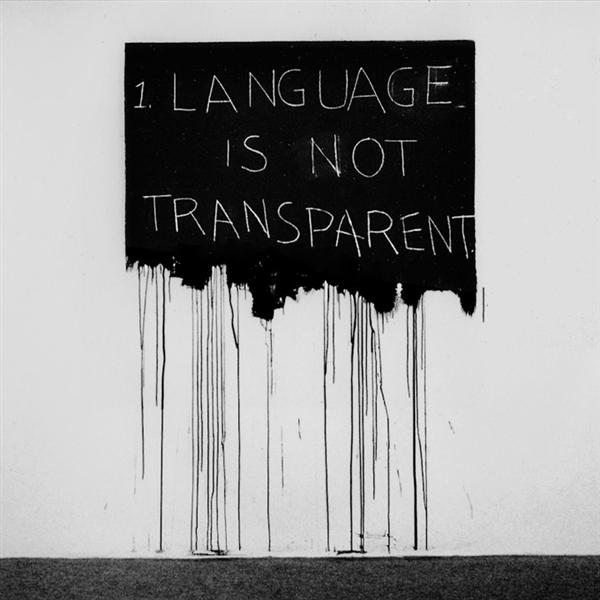
Language is Not Transparent
Mel Bochner
source Wikiart

A responsible writer will ask himself the following questions when writing:

What am I trying to say?
What words will express it?
What image or idiom will make it clearer?
Is this image fresh enough to have an effect?
Could I put it more shortly?
Have I said anything that is avoidably ugly?

However, Orwell says, most writers are contend to string together cliches, obscuring their meaning even to themselves.

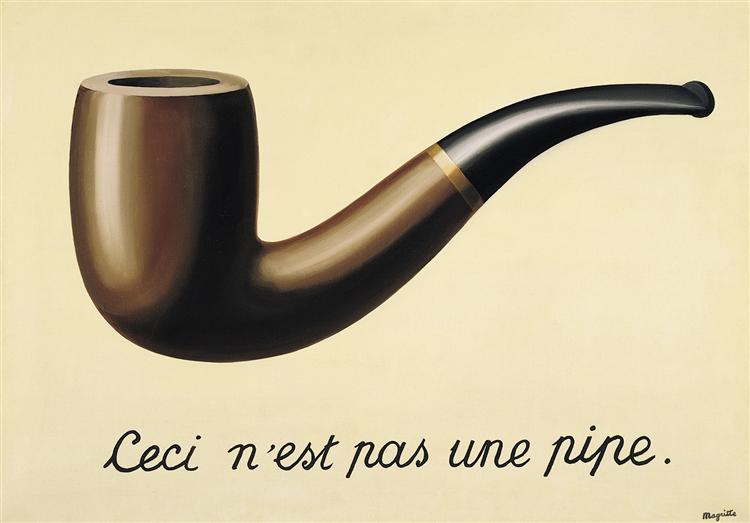
In politics, the writing is particularly dreadful, all the literary mistakes converging and causing the viewers to feel that “one is not watching a live human being but some kind of dummy,” who is being transformed into a machine by the very words he speaks.  By the constant bombardment of meaningless jargon, people’s consciousness becomes sleepy and allows atrocities to be labelled as pacification, or transfer of population, or elimination of unreliable elements.  This particular phraseology has no metaphor content and therefore images are lacking, allowing the reader/listener to easily dismiss the human connection and thus controlling our emotional response to it.  Inflated euphemisms are used to justify cruelty.

The Treachery of Images (1948)
Rene Magritte
source Wikiart

Yet while thoughts are able to corrupt language, the reverse is also true.  You can catch this impoverished writing, like a disease, and have your mind affected by it.  Orwell admits that in his essay he has committed some of the literary crimes he is attempting to reveal.  The only way to avoid these faults is to continually be on guard against them. We can start by eradicating worn-out phrases and metaphors, but the change must go deeper.  He goes on to explain what these changes do not imply, then gives the reader rules to follow when intuition fails:

  1. Never use a metaphor, simile or other figure of speech which you are used to seeing in print.
  2. Never use a long word where a short one will do.
  3. If it is possible to cut a word out, always cut it out.
  4. Never use the passive where you can use the active.
  5. Never use a foreign phrase, a scientific word or a jargon word if you can think of an everyday English equivalent.
  6. Break any of these rules sooner than say anything outright barbarous.

By applying these rules, one could still write badly, but one could not write the drivel of which he has been speaking or using as examples.  His goal with his essay is not to consider “the literary use of language, but merely language as an instrument for expressing and not for concealing or preventing thought.”

For:

“Political language — and with variations this is true of all political parties, from Conservatives to Anarchists — is designed to make lies sound truthful and murder respectable, and to give an appearance of solidity to pure wind.”

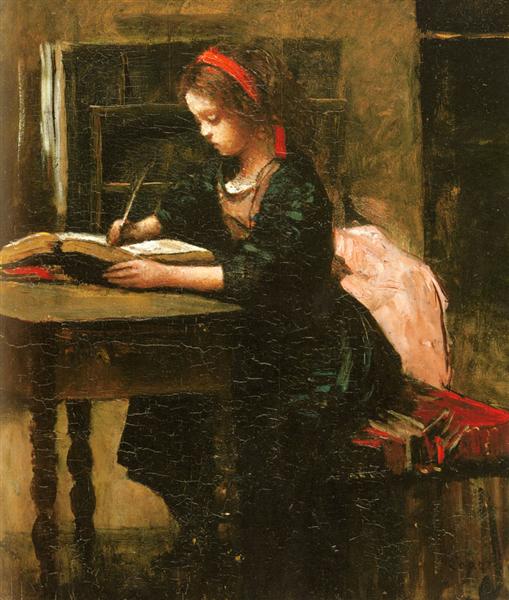
Young Girl Learning to Write
Camille Corot
source Wikiart

A very powerful essay by Orwell and one that requires time and deep thought to digest. On most points, I agree with him wholeheartedly, but there are a few minor claims that poke at my passion for words.  To use less words that have Greek or Latin roots, seems overly particular.  These words have been in use for centuries and add to the language instead of detracting from it.  And while Orwell didn’t directly say that he takes offence at larger more complex words, the appearance in his examples was to severely diminish them (sorry, if I misread you, George, but that was my impression).  While I certainly do not advocate using complex words to diminish meaning or cloak intent, I do think that they are valuable for enjoyment in reading.  Would one rather have a French seven course dinner, or MacDonald’s?  If one is discerning in the culinary arts, certainly the former.  However, just as the ingredients for the seven course dinner would have to be used with style and attention, so must complex words be, when writing.

My next choice for my Deal Me In Challenge is suppposed to be a children’s classic, The Wolves of Willoughby Chase by Joan Aitken, but I’m having some trouble finding it (yes, those of you who know of my “issue” of losing my DMI choices can laugh at me), so next week might find a different post appearing.  Time shall reveal!

Week 5 – Deal Me In Challenge – Eight of Spades


The Comedy of Errors by William Shakespeare

“A wretched soul, bruised with adversity,
We bid be quiet when we heart it cry.
But were we burdened with like weight of pain,
As much or more we should ourselves complain.”

In a quest to focus on my Shakespeare Project for 2017, I’m reading through some of the plays following the schedule of the A Bard a Month group on Goodreads.  They have The Comedy of Errors listed as the first play of Williams Shakespeare yet my The Life and Works of William Shakespeare has it listed as the 5th.  From the evidence, the only thing that’s certain is that no one knows for sure, right?  In any case, it definitely shows in its structure and method a rather simple presentation of a budding farce that nevertheless manages to capture the audience’s interest and tickle their humour.

Continue reading

Jane Eyre by Charlotte Brontë

“There was no possibility of taking a walk that day.”

An orphan child badly treated by rich relatives.  A grim and lonely school for girls where pestilence hangs in the air.  A Gothic mansion that houses a she-demon and a brooding and sardonic man who, underneath his caustic demeanor, hides a heart that waits to be awakened.  Who could resist such a story?

Well, not I, that’s for sure, and I jumped right into Hamlette’s Jane Eyre read-along that began in June 2016.  It was probably my fifth read of this enduring story, and this time it particularly captured my imagination and heart.  A tale of enduring love and a crossing of the class boundaries was particularly compelling in a time when no one seems to be getting along and division is rife between those would could easily be friends given more tolerance and grace for each other.

Richmond, Yorkshire
Edmund John Niemann
source ArtUK

My read along posts follow:

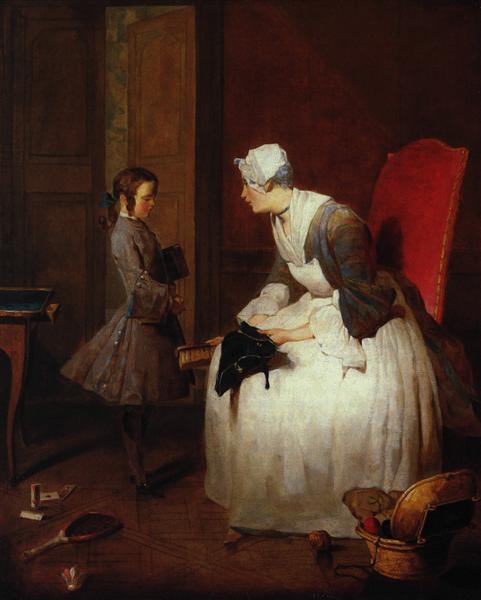
The Governess (1739)
Jean-Baptiste-Simeon Chardin
source Wikiart

Chapters I & II
Chapters III & VI
Chapters V – VII
Chapters VIII – X
Chapters XI – XIII
Chapters XIV – XVI
Chapters XVII – XIX
Chapters XX – XXII
Chapters XXIII – XXV
Chapters XXVI – XXVIII
Chapters XXIX – XXXI
Chapters XXXII – XXXIV
Chapters XXXV – XXXVIII

We first meet Jane as an orphaned child, living on the charity of her relatives who heap upon her verbal abuse.  Finally, she is shipped off to a disreputable girls school, Lowood, and though the abuse continues from the head administrator, Mr. Brocklehurst, Jane forms a dear friendship with another girl, Helen, who teaches her quiet perseverance, mercy and forgiveness, while exemplifying a steadfast faith in God.  Upon reaching womanhood and taking a post as a governess at Thornfield, Jane encounters the master, a dark, taciturn, mysterious man, Edward Rochester.  Although her heart is awakened, Jane does not waver from her ideals, knowing with a certain wisdom that behaving with dignity and moral principles is the only way to inner peace and true happiness.

While the beginning of the book, chronicling Jane’s childhood, appears to have little to do with the later plot, it plays an important role in understanding the development of her character and her place in society.  As a reader, we are always reminded of her struggles to be treated with respect and dignity, to be treated as an equal, as a soul created by God instead of as a product of a social hierarchy.

“Do you think I am an automaton? — a machine without feelings? and can bear to have my morsel of bread snatched from my lips, and drop of living water dashed from my cup?  Do you think because I am poor, obscure, plain, and little, I am soulless and heartless?  You think wrong!  — I have as much soul as you —- and full as much heart!  And if God had gifted me with some beauty and much wealth, I should have made it as hard for you to leave me, as it is now for me to leave you.  I am not talking to you now through the medium of custom, conventionalities, nor even of mortal flesh: it is my spirit that addresses your spirit; just as if both had passed through the grave, and we stood at God’s feet equal — as we are!”

My most treasured memories of Jane Eyre is Brontë’s amazing ability to make the characters so intrinsically human, instead of perfect, implausible characters.  While Rochester’s machinations can be rather shocking, you can understand how a man who has had little chance to develop a good steady character and is used to giving free reign to his passions could end up a slave to them.  His emotions drive him without finer moral values to guide him.  Jane, on the other hand, while falling deeply in love with the man she sees he can become, can clearly recognize the pitfalls of ungoverned behaviour. While her heart cries out for him, she is mature and sensible enough to see where wrong actions would take them.  Instead of increasing their love, they would be left with nothing but emptiness.  She would rather remember the depths of the love that they shared in its purest form than degrade herself by being guided solely by passion.

Once again, thanks to Hamlette for this most excellent and measured read-along that allowed me to soak up the story and to spend time with two of my most favourite characters in the pages of literature!

C.S. Lewis on Jane Eyre: “(I) have also re-read Jane Eyre from beginning to end — it is a magnificent novel.  Some of those long, long, dialogues between her and Rochester are really like duets from a splendid opera, aren’t they?  And do you remember the description of the night she slept on the moor and of the dawn?  You really lose a lot by never reading books again.” ~ Letter to Arthur Greeves February 1 1916

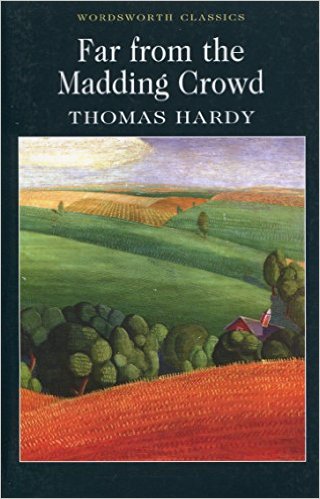
Far From the Madding Crowd by Thomas Hardy

“When Farmer Oak smiled, the corners of his mouth spread till they were within an unimportant distance of his ears, his eyes were reduced to chinks, and diverging wrinkles appeared round them, extending upon his countenance like the rays in a rudimentary sketch of the rising sun.”

Would you like to read a book with the setting in southern rural England, populated by stoic farmers, simple and often comical peasants, one that explores complex relationships between men and women of that time?  It sounds like a wonderful beginning doesn’t it?

Continue reading

The Well at the World’s End by William Morris

“Long ago there was a little land, over which ruled a regulus or kinglet, who was called King Peter, though his kingdom was but little.”

King Peter of Upmeads has four sons, Blaise, Hugh, Gregory and Ralph.  All resolve to set out to seek great adventures but the youngest, Ralph, decides to do so against his father’s wishes.  Encouraged by Dame Katherine, a newly married lady to the chapman, she gives him a beaded necklace of blue and green stones and inspires him to find the Well at the World’s End.

“Son, true it is that the water of that Well shall cause a man to thrive in all ways, and to live through many generations of men, maybe, in honour and good-liking; but it may not keep any man alive for ever; for so have the Gods given us the gift of death lest we weary of life ……


Of strife and of war also we know naught: nor do we desire aught which we may not easily attain to.  Therefore we live long, and we fear the Gods if we should strive to live longer, lest they should bring upon us war and sickness, and over-weening desire, and weariness of life.  …..


…. ye wear away your lives desiring that which ye may scarce get; and ye set your hearts on high things, desiring to be master of the very Gods.  Therefore ye know sickness and sorrow, and oft ye die before your time, so that ye must depart and leave undone things which ye deem ye were born to do; which to all men is grievous.  And because of all this ye desire healing and thriving, whether good come of it, or ill.  Therefore ye do but right to seek to the Well at the World’s End, that ye may the better accomplish that which behoveth you, and that ye may serve your fellows and deliver them from the thralldom of those that be strong and unwise and unkind, of whom we have heard strange tales.”


Ralph’s youth and inexperience are apparent at the beginning of the story, as he travels first to Bourton Abbas and then through the Wood Perilous, meeting up with various adventures and challenges on his journey.  He encounters two women, both of whom he loves, yet one whom he is not destined to keep.  Finally, with Ursula, his love, and with the help of the Sage of Sweveham, they manage to attain their quest, finding the Well and drinking of its bounty.  Their return home is also fraught with danger and intrigue, as Ralph learns the value of perseverance and the rewards of loyalty.


The Vision of the Holy Grail tapesty (1890)
Sir Edward Burne-Jones (design and figures)
William Morris (design and execution)
source Wikipedia

Born in Essex, William Morris had a number of accomplishments and careers during his life, including that of a textile designer, a poet, a novelist and a social activist.  Though classically trained at Oxford, Morris became an architect, and with his friends, the well-known artists Edward Burne-Jones, Dante Gabriel Rossetti, and archtitect Philip Webb, they formed a decorative arts firm that became the rage of the Victoria era.  His renown as a poet followed, and he further exercised his literary talents as a novelist.    His interest in Marxism and concern for social issues developed an appetite for activism which lasted throughout his life.  He died in 1896 of tuberculosis at the age of 62.

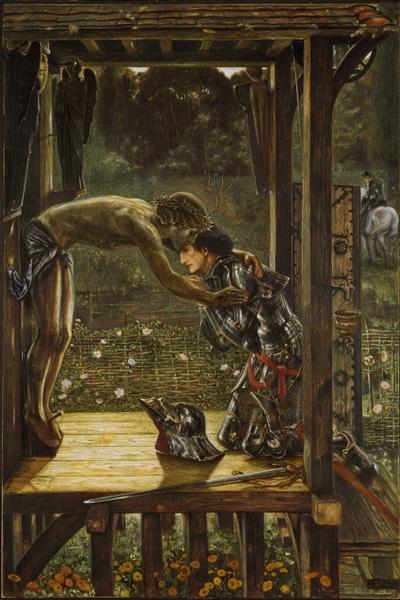
The Merciful Knight (1863)
Edward Burne-Jones
source Wikiart

The Well at the World’s End is a very curious mix of fairy tale, adventure, and rather risque scenes and actions for the time period of Victorian England.  While it reminded me very much of Le Morte d’ArthurThe Faerie Queene, and Sir Gawain and the Green Knight, Morris was not reluctant to reveal the physical attraction between Ralph and the women he encountered, nor did he prevaricate about their physical relationship, however, he did so in rather a romantic knightly way.  Morris was a muse for writers like C.S. Lewis and J.R.R. Tolkien who admired his pioneering work in the genre of fantasy fiction, and the names “Gandolf” and “Silverfax” which appear in The Well at the World’s End, are echoed also in The Lord of the Rings.


Danaë (The Tower of Brass) 1887-88
Edward Burne-Jones
source ArtUK

This book was a wonderfully rich and exciting read, full of heroic exploits, peril and satisfying resolutions.  Morris was indeed a talented writer and his love for the Medieval is apparent in every word of the story.  I own his book, The News From Nowhere, which I hope to read soon as a follow-up.  Being compared to Gulliver’s Travels and Erewhon, it’s a complete deviation from this story —an utopian novel of a libertarian socialist bent. In any case, his story telling abilities solidified themselves for me with this novel and I’m looking forward to exploring more works from Morris.

Lamia and the Soldier (1905)
John William Waterhouse
source Wikiart


Henry V by William Shakespeare

“From this day to the ending of the world,
But we in it shall be remembered –
We few, we happy few, we band of brothers;
For he to-day that shed his blood with me
Shall be my brother.”

Written in the Second Period of Shakespeare’s development, Henry V is the eighth of his dramas, and part of the Henriad, his historical tetralogy which also includes Richard II, Henry IV Part 1 and Henry IV Part 2.  The play is thought to be composed late in 1598, as it was produced between March 17 and September 28th of 1599.

The earliest known volume is the first Quarto printed in 1600, which was followed by Q2 and Q3, reprints of the first edition, published in 1602 and 1608 respectively.  The first Folio edition differs extensively from the Quartos, as it is twice the length of the latter, which omits the first scenes of Acts I and III, the second scene of Act IV, the choruses and the epilogue, as well as some of the characters.  Prose is also transformed into metrical form, it can only be supposed to effect an increased length of the play.

Continue reading