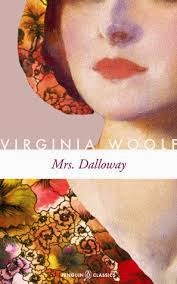
Mrs. Dalloway by Virginia Woolf

“Mrs. Dalloway said she would buy the flowers herself.”

After reading Woolf’s To The Lighthouse I was excited to dive into Mrs. Dalloway.  Following the lead of James Joyce’s Ulysses, Woolf used the same writing style, and, in a loose imitation of Joyce, chronicles a day in the life of a prestigious middle-aged woman in London. Woolf critiqued Joyce’s Ulysses, calling it “illiterate” and “under-bred,” finding the graphic sexual fantasies and the foul language base, and saying it reeked of a “queasy under-graduate scratching his pimples.”  Was Mrs. Dalloway Woolf’s attempt to get this style of writing right?

Using her signature “stream-of-consciousness” style, Woolf chronicles one day in the life of Mrs. Richard Dalloway, the wife of a respectable, wealthy gentleman.  Set in post-World War I London, on this particular day she is preparing for a party she will host that evening, an unusual party whose guests will span the ages of her life, past and present.  As she performs her tasks, her mind wanders back through days gone by, unearthing ghosts of earlier loves, regrets, irritations, ever-present worries and satisfaction.  The reader is also privy to the thoughts of many of her friends who will be present at this party, as they perform their daily business.

As a secondary plot, we meet Septimus Warren Smith, a surviving soldier of the war, yet a hollow shell of a man, his mind barely touching reality.  In spite of the persistent yet useless intervention of his wife and doctors, he gradually is sucked into a whirlpool of despair, seemingly of his own making, and suffers a very poignant and pathetic fate.  Or does he?

Julia Stephen
Virginia Woolf’s mother
source Wikipedia
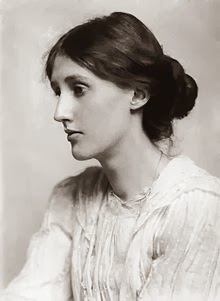
Virginia Woolf, Age 20
source Wikipedia

I’m going to go out on a limb here and offer a very unusual interpretation of at least one theme in the novel.  Woolf’s treatment of Septimus, in contrast with Mrs. Dalloway and her social peers, was very intriguing.  If we examine the thoughts of Mrs. Dalloway and her friends and acquaintances, they touch upon parties, flower-shows, scholarships, the family business, Bartlett pears, gossip and cricket.  In comparison, Septimus’ musings revolve around human nature, the truth, Evans (his friend who was killed in the war), aloneness, meaning, and the beauty of words.  Septimus is presented on the surface as a character who is emotionally unbalanced, while Mrs. Dalloway’s circle is the respected rational group.  Has Woolf turned appearance on its head?  Is the perceived deranged person really the one who is sane, and are the ones who appear “normal” actually the group who is not?  It’s an irony that’s inescapable.

For Septimus, the only liberation from a world turned upside-down was death.  Is his escape from a materialistic world concerned with trivialities an heroic act?  Woolf makes it appear so:

“…… Death was defiance.  Death was an attempt to communicate, people feeling the impossibility of reaching the centre which, mystically, evaded them; closeness drew apart; rapture faded; one was alone.  There was an embrace in death.”

Ironically, sixteen years after the writing of Mrs. Dalloway, Woolf followed Septimus into the murky fog of depression and, placing stones in the pockets of her overcoat, walked into the River Ouse near her home, drowning herself, a sad fate for one of the most respected female literary writers of the time.

Virginia Woolf – Romanian Stamp
Source Wikipedia

I just loved Woolf’s To The Lighthouse and I really wanted to like Mrs. Dalloway.  There are certain aspects I do like about it, such as the character of Septimus Warren Smith, the relentless passage of time, the allusions to various literary works of different eras, the exploration of the lingering impact of the first World War and the diminishing influence of the British empire.   The prose is lovely, light and lyrical, each sentence a candy you can pop into your mouth and taste a burst of spring.  Yet I found the story meandering and disjointed.  In To The Lighthouse, the stream-of consciousness  flowed towards one main character, Mrs. Ramsey, wrapping her in a warm glow, even while each character retained their own lively identity.  In Mrs. Dalloway, the streams flow out from Mrs. Dalloway and a host of other characters, at times to alight on each other, but many times to float out into the atmosphere, leaving the reader confused or adrift.  The lack of cohesiveness was like an irritating burr in my britches and no matter how much I tried, it was hard to ignore.  Yet, in spite of the persistent irritation, I will probably re-read this book sometime in the future.  Woolf’s books are like a deceptively packed suitcase where you’re never quite certain if you have even removed half of what is contained.
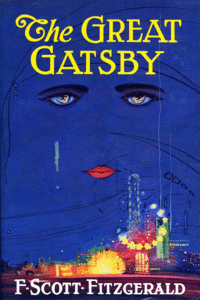
The Great Gatsby by F. Scott Fitzgerald

First edition 1925 (sourced Wikipedia)

“In my younger and more vulnerable years my father gave me some advice that I’ve been turning over in my mind ever since.”

Decadence, adultery, narcissism, vast wealth, idealistic love, betrayal, death, revenge, murder; a vast array of scope for a novel, and Fitzgerald delivers an impacting tale in The Great Gatsby.  Nick Carraway, a young man from the Midwest, begins to form a relationship with his neighbour, the wealthy Jay Gatsby and eventually learns of Gatsby’s connection to his cousin, Daisy.  Daisy, who is married to Tom Buchanan, while casually enduring her husband’s adulterous relationships, has led a very vapid and frivilous life amongst the society scene of the 1920s.  When Gatsby reappears in her life, their rekindled romance sets off a series of tragic events, the repercussions reverberating through the lives of all the characters.

Gatsby, the created man; Gatsby, the idealist, a man who is love with an image that formed five years earlier, and that he has nurtured through time.  Did I understand his infatuation with Daisy?  No, but I sympathized with it.  He had grown up isolated, broke relations with his parents reasonably early on and had no one in his life to set a good example that he could draw from.  Daisy was perhaps the only person whom he had loved, and so he loved her passionately, unrealistically and terminally.  And he realized, that he would need money to keep her love.  When Nick Carraway says to him, “She’s [Daisy’s] got an indiscreet voice …. It’s full of —-“, Gatsby answers, “Her voice is full of money.”  Even though he knows what she is like, and has known from the beginning, is he desperately trying to hold on to his fantasy of her —- this illusion of perfection — because he has nothing else?  Gatsby fails to examine any of the decisions he makes in his life ……… perhaps he truly believes that money can buy him happiness and cannot see the superficiality of the life and people with whom he surrounds himself.  His life is built on illusion and throughout the novel we hear the faint ticking of the bomb that will shatter his misperceptions.

The Plaza Hotel in the early 1920s
(source Wikipedia)

As for Nick Carraway, I felt uncomfortable with him as the narrator.  He went to unusual lengths at the beginning of the novel to establish his credibility with the reader, and if his observations are to be believed, he was the only one in the novel with any compassion, discernment or standards.  While the society he moves in is portrayed in a harsh, decadent, unforgiving light, he is the angel that hovers above it, the star that shines through it.  He is the only one who cares for Gatsby, the only one with a moral compass.  I had a difficult time buying into his golden-boy image.

The tragedy of this novel is a wasted life.  In spite of the grandeur, in spite of his fame and money, Gatsby left no real lasting effect on anyone, other than perhaps Nick Carraway.  He buried himself behind a persona, only emerging to be drawn towards the flame of Daisy and then perishing, as his wings brushed the heat of her consuming light.

“So we beat on, boats against the current, borne back ceaselessly into the past.”

Back to the Classics Challenge 2014

Here it is!  The challenge I have been waiting for!  Back to the Classics Challenge 2014 is being hosted this year by Books and Chocolate.  She has taken over for Sarah at Sarah Reads Too Much and has already done a wonderful job organizing this challenge.

The rules for this year are as follows, including a few changes:

This year there are six required categories and five optional categories.

1.  20th Century Classic   The Man Who Was Thursday by G.K. Chesterton
2.  19th Century Classic   David Copperfield by Charles Dickens
3.  A Classic By A Woman Writer  Mrs. Dalloway by Virginia Woolf
4.  A Classic In Translation   Son Excellence, Eugène Rougon by Émile
                                                  Zola
5.  A Wartime Classic  War and Peace by Leo Tolstoy
6.  A Classic by an Author Who is New to You  The Warden by Anthony Trollope

Optional:

1.  An American Classic   The Old Man and the Sea by Ernest Hemingway
2.  A Classic Mystery/Suspense Thriller  The Big Sleep by Raymond Chandler
3.  A Classic Historical Fiction Book  The Once And Future King by E.B. White
4.  A Classic That Has Been Adapted into a T.V. or Movie Series  Othello by William Shakespeare
5.  Extra Fun Category – Write a Review of #4  Othello movie reviews

She also has made another rule:  All classics must be published 50 years ago or earlier, so nothing before 1964 will be considered a classic.

Please check out her blog for information on prizes and additional explanations.

Even without a blog, I participated in this challenge every year.  It is my easiest challenge and probably the most fun for me.  So if this challenge sounds like fun to you too, pop over to Books and Chocolate to check it out.  And good luck to everyone!