
“No seaside town in the south of England is, I think, as attractive as St. Loo.”
Detective: Hercule Poirot
Published: 1932
Length: 270 pages
Setting: St. Loo(e), Cornwall

“No seaside town in the south of England is, I think, as attractive as St. Loo.”
Detective: Hercule Poirot
Published: 1932
Length: 270 pages
Setting: St. Loo(e), Cornwall
 “Major Burnaby drew on his gum boots, buttoned his overcoat collar around his neck, took from the shelf near the door a hurricane lantern, and cautiously opened the front door of his little bungalow and peered out.”
Originally Published as: The Murder at Hazelmoor
Detective: Emily Trefusis with Inspector Narracott
Published: 1931
Length: 228 pages
Setting: Sittaford & Exhampton, Dartmoor
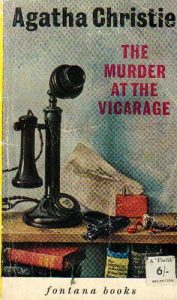 Murder At The Vicarage: “It is difficult to know quite where to begin this story, but I have fixed my choice on a certain Wednesday at luncheon in the Vicarage.”
Detective: Miss Marple (first appearance)
Published: 1930
Length: 285 pages
Setting: St. Mary Mead, Downshire (fictional)
 Giant’s Bread: “It was New Year’s Eve.”
Main Character: Vernon Deyre
Published: April 1930 (14th published book)
Length: 437 pages
Setting: various: Abbots Puisannts, London, Germany, Holland, Moscow, New York, etc.
My chronological Agatha Christie read continues with Giant’s Bread, her first novel published under the pseudonym, Mary Westmacott. There is no detective work in this story, as Christie/Westmacott treats her readers to a very modern novel. In any case, it must have been a much needed break from the detective novels Christie was expected to write.
Covering a vast number of characters and spanning a few decades of years, this first contemporary novel written under a pseudonym, proves Christie wanted this genre of her writing judged on its own merits instead of being buoyed up by her previous successes.
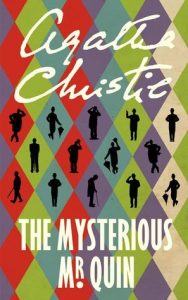 The Mysterious Mr. Quin: “It was New Year’s Eve.”
Detective: Mr. Satterthwaite (aided by Mr. Quin)
Published: 1930 (Christie’s 13th published book)
Length: 288 pages
Setting: various: London, Monte Carlo, Corsica, etc.
Oh, what an odd little Christie novel. Yet I suppose I shouldn’t call it a novel. The Mysterious Mr. Quin is a compilation of a collection of short stories by Agatha Christie, published in various magazines over the course of approximately 5 years. One expects customary mysteries from Christie, complete with complex plots but this book is definitely different. There are murders to solve but there are also problems of human choices and consequences. Christie once again attempts something unique.

Partners In Crime: “Mrs. Thomas Beresford shifted her position on the divan and looked gloomily out of the window of the flat.”
Detective: Tommy and Tuppence Beresford
Published: 1929 (Christie’s 12th published book)
Length: 277 pages
Setting: The International Detective Agency, 118 Haleham St. W.C.

The Seven Dials Mystery: “That amiable youth, Jimmy Thesiger, came racing down the big staircase at Chimneys two steps at a time.”
Detective: Superintendent Battle, Lady Eileen Brent (Bundle)
Published: January 24, 1929 (10th published book)
Length: 282 pages
Setting: Chimneys, London
 The Mystery of the Blue Train: “It was close on midnight when a man crossed the Place de la Concorde.”
Detective: Hercule Poirot
Published: March 1928 (9th published book)
Length: 317 pages
Setting: St. Mary Mead, England; Nice, France
Coming off the terribly constructed, overdramatized plot of The Big Four, I was very hesitant to continue my chronological Christie reads, but continue I have with The Mystery of The Blue Train. Fortunately, Christie redeemed herself somewhat in my eyes and I did quite enjoy this mystery.
 The Big Four: “I have met people who enjoy a channel crossing; men who can sit calmly in their deck chairs and, on arrival, wait until the boat is moored, then gather their belongings together without fuss and disembark.”
Detective: Hercule Poirot
Published: January 1927
Length: 282 pages
Setting: London, Southampton, Devon, Surrey, Paris, Hatton Chase (fictional), Worcestershire, Belgium, South Tyrol (Italy)
Returning from Argentina after an 18-month absence, Hasting finds his old friend, Detective Hercule Poirot ready to depart for South American himself. He has been summoned by a client, Abe Ryland, who is a powerful man and in urgent need of his services. But when Poirot finds a dishevelled, emaciated man in his bedroom with no clue as to how he got there, his departure is delayed. As the man mutters Poirot’s name, while writing the number 4, Hastings speculates on a crime syndicate named The Big Four, whereupon the man reveals the possible players: