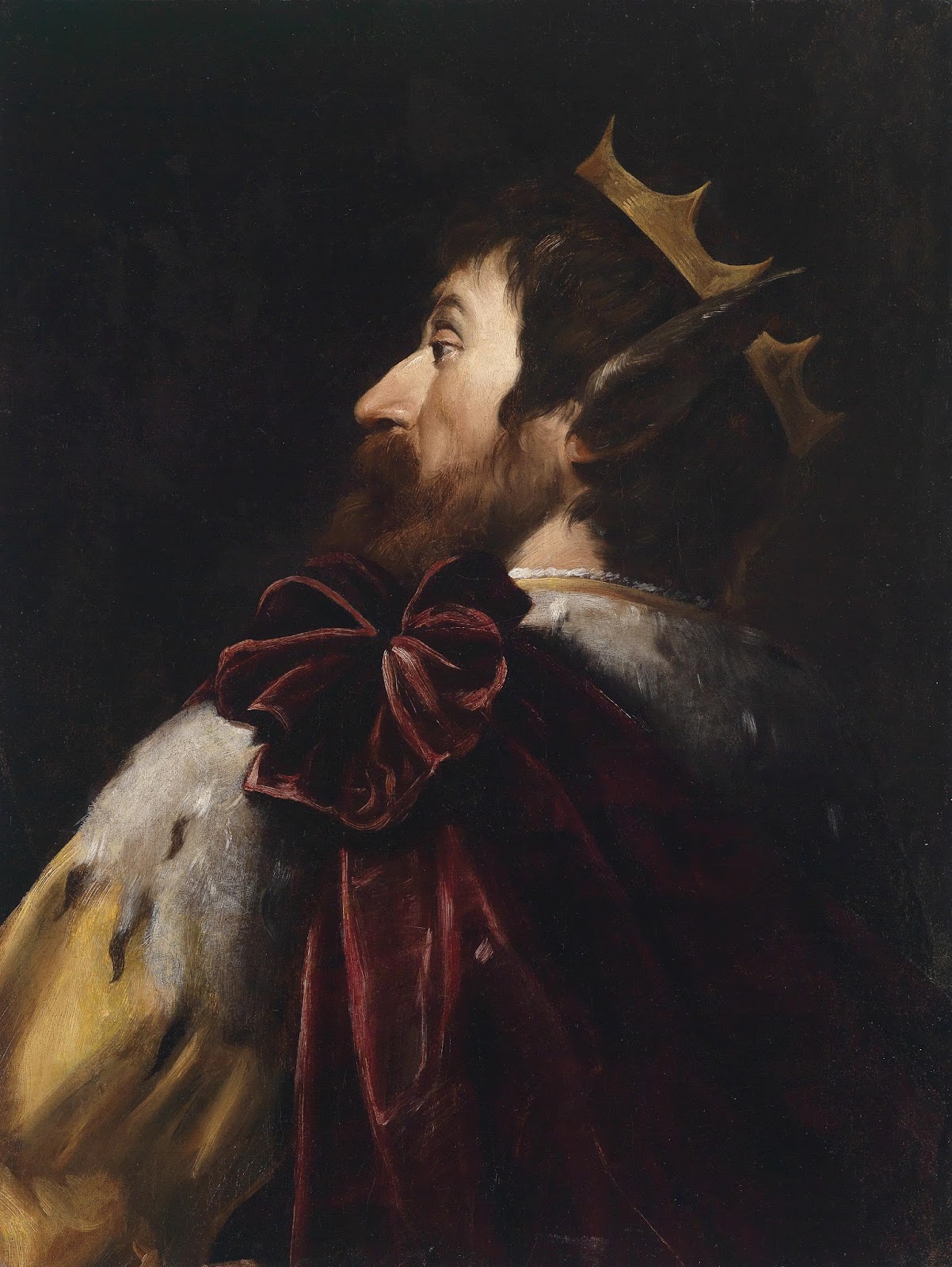
Bacchus leaves Thrace for his Lydian land and own vineyards in Tmolus. His satyrs and bacchantes crowd around him, but Silenus (his tutor) is missing, yet he finds him with King Midas who has him in his care. Bacchus rewards Midas with one wish, and the king requests that everything he touches will turn to gold. Delighted, Midas begins to touch everything, but soon realizes the curse of his request, repents, and Bacchus instructs him to go to a river near Sardis to wash his sin away. Midas complies and even today, as Ovid tells us, the Pactolus’ shores can be streaked with gold. Midas, however, now hates riches and roams the hillside, but his wits were never clever and he continue to seek stupid things which will bring harm. While watching a musical contest between Pan and Phoebus, upon Tmolus judging Phoebus Apollo the winner, Midas disagrees and for his ill-judgement, Phoebus turns Midas’ ears into those of an ass. He wraps those ears to his head with a purple turban and when his slave discovers his secret, the slave whispers it into a hole in the ground. But when the reeds there grow tall, they whisper the secret to the winds, betraying the servant.
Apollo departs for Troy where Laomedon had accepted the offered of Phoebus and Neptune to build the walls of Troy for payment in gold and then reneged on his debt. The sea god caused a flood to bury the fields of Troy. In payment, they demanded the daughter of the king, Hesione, who was chained to a reef for the prey of monsters, but Hercules saved her. For his payment, he was promised horses, but again Troy was faithless and Hercules razed its walls.
 |
Apollo and Poseidon Punishing Troy (c. 1590)
Paolo Fiammingo
source Wikimedia Commons |
Hercules gives Hesione to Telamon as a royal bride but he is busy fighting with his brother, Peleus. Peleus is famous for his goddess wife, and we learn of his “courtship”. Zeus had an ardent desire fot Thetis, the goddess of the waves,” but it was prophesied by Proteus that her son would be greater than his father, so Zeus blessed his grandson, Peleus, to pursue her. Peleus attempted to rape her in her grotto but Thetis transformed into a bird, a tree and then a spotted tigress, so Peleus wisely abandoned his plans. He prayed to the gods for success and was counselled by Proteus, who rose from the sea, to tie her up, which he did and made her pregnant with Achilles.
Peleus accidentally kills his half-brother, Phocus, and for this treachery he is exiled to the land of Trachin, recounting a lie as to his crime. Ceyx, the king of Trachin, welcomes him, then weeps, whereupon Peleus and his men ask the cause of his sadness.
Ceyx tells of his brother, Daedalion, who had a lovely fourteen-year-old daughter, Chione. She was raped by both Phoebus and Mercury, bearing twin sons but one from each god: Autolycus, “a connoisseur of wiles and guiles”, and Phillamon, Apollo’s son, “famed for lyre and song.” Chione, because of this glory bestowed on her, now considered herself surpassing Diana’s beauty, and, for her insult, she was killed by an arrow of the goddess. At her funeral (burning), Daedalion overcome with grief, ran senselessly around, finally leaping from Parnassus’ peak, where Apollo changed him into a hawk, and “aggrieved, he makes all others mourn.”
As Ceyx relates this story, Peleus’ Phocian cowherd rushes in to announce that a wolf is ravaging the herds of oxen and terrifying the people. Peleus silently believes this event to be his penance for his crime. As they prepare to leave to deal with the wolf, Alcyone, the wife of Ceyx, begs him not to go, foreseeing his death. Thetis intervenes to pardon Peleus and helps him, changing the wolf into a marble statue. But the fates cause Peleus to travel to the land of Magnesia and King Acastus, where he is cleansed of his guilt.
Meanwhile Ceyx is still puzzled by his brother’s fate and these strange happenings, so he decides to consult an oracle on the isle of Clarus. Alcyone begs him not to go, but, while trying to calm her fears, he departs and his boat encounters a momentous storm. Before he drowns, he prays that his body will return to his wife for burial, and she finally spots it floating in the water, confirmation of her husband’s death that she had received in a dream conducted by Morpheus. As she tries to reach the body, she is changed into a bird (a kingfisher), and when she tries to cover her husband with her wings, he too changes:
“…… Their love remained; they shared one fate.
Once wed, they still were wed: they kept their bond.
They mate; they rear their young; when winter comes,
for seven peaceful days Alcyone —
upon a cliff that overlooks the sea —
broods on her nest. The surge is quiet then,
for Aeolus won’t let his winds run free;
he keeps them under guard, so that the sea
maintain the peace his fledgling grandsons need.”
 |
Halcyone seeking her husband Ceyx (1914)
Herbert James Draper
source Wikimedia Commons |
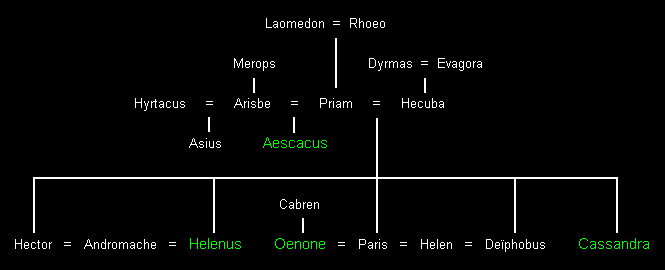
An old man, as he watches the pair of birds, is reminded of another bird, a swift merganser. The bird is of the line of Ilus and Assaracus, then Ganymede, then Laomedeon, and finally Priam, who was the last king of Troy. Aesacus, half-brother of Hector (son of Priam) pursued the nymph, Hesperie, who was bitten by a serpent as she fled. Distraught, Aesacus offered his life for hers. As he leapt into the sea, Thetis pitied him and clothed him in feathers, but Aesacus so diligently sought death, he continually attempts to plunge in the sea, only to rise again. He is the diving bird, the merganser.
❀ ❀ ❀ ❀ ❀ ❀ ❀ ❀ ❀ ❀ ❀ ❀ ❀ ❀ ❀ ❀ ❀ ❀ ❀
In this book, I noticed varying motifs on music, sound and hearing. Orpheus communicates by music, yet is drowned out by the Bacchantes’ shrieks; Apollo and Pan have a musical contest; Mt Tmolus must brush away the forest to hear; Midas for hearing ‘incorrectly’ has his ears changed to those of an ass; Proteus’ words are stopped/finished as he sinks into the sea; on Ceyx’s ship, the captain’s voice in drowned out by the “blustering winds”; Ceyx’s words are impeded by the waves; and the Cimmerian cave is a place of complete silence yet for the Lethe.
While the stories often seem random, we can experience a non-linear telling of some of the history of Troy and its heroes. The scattering make up a puzzle, if we can only pick up the pieces and fit them into the whole.























.jpg)


#/media/File:Jean-Jacques_Henner_-_Byblis_turning_into_a_spring.jpg)