The Christmas Child by Hesba Stretton

“Along some parts of the coast in South Wales the mountains rise abruptly from the shore, with only a narrow shingle between them and the sea.”

Miss Priscilla Parry is a farm leaseholder, the last of three generations before the farm will revert to its landlord.  She ekes out a living on the craggy, unfertile land, selling butter, cheese and mutton to manage a poor living.  Her life’s work is epitomized in her determination to make her teenage ward and niece, Rhoda, independent, so she will never be forced to marry, the biggest misfortune, in Priscilla’s eyes, that a woman could face.

When another niece dies and leaves a child, Joan, an orphan, Priscilla grudging agrees to take her in, yet in her concern that the plans for Rhoda not be compromised, she gives the child rather a lukewarm welcome and questionable care.  Little does she need another girl to worry and fret about her future.  Rhoda, however, adores young Joan, and they quickly become fast friends.  When Christmas arrives, they play a game of looking for the Christ child in their manager, but on the second Christmas Rhoda disappears and the household is thrown into mourning.  Old Nathan, the servant, is the only one to comfort Joan, as Priscilla withdraws into a cold demeanour of disappointed hopes.

However, the next Christmas, a child is discovered sleeping in the manager, a child that will bring hope, restoration and joy back into the lives of Priscilla, Joan and old Nathan, echoing the mission of that first manger child long, long ago.

This is a wonderful story of love, mistakes, forgiveness and reconciliation. Coincidentially, I found this article when searching for pictures for my blog post.  Hopefully the life of this little one will bring joy into this world as well.

View north into Cwm Llwch from Corn Du
source Wikipedia

Classics Club Spin #11

Well, my last spin was a fail, so I was humming-and-hawing over whether I should do this one, but …….. I really need to start concentrating on my Classics Club list, if I want to finish it on time.  So, I’m in.

As per usual, the rules for the spin are:

  1. Go to your blog.
  2. Pick twenty books that you’ve got left to read from your Classics Club list.
  3. Post that list, numbered 1 – 20, on your blog by next Monday.
  4. Monday morning, we’ll announce a number from 1 – 20.  Go to the list of twenty books you posted and select the book that corresponds to the number we announce.
  5. The challenge is to read that book by February 1st.


I used the random list organizer here to choose the 20 books from my master list.  So my list ended up looking like this:
  1. She Stoops to Conquer (1773) – Oliver Goldsmith
  2. Dead Souls (1842) – Nikolai Gogol 
  3. Kidnapped (1886) – Robert Louis Stevenson
  4. The History of the Pelopponesian War (431 B.C.) – Thucydides 
  5. Huckleberry Finn (1884) – Mark Twain 
  6. The Rime of the Ancient Mariner (1798) – Samuel Taylor Coleridge
  7. One Day in the Life of Ivan Denisovitch (1962) – Alexander Solzhenitsyn
  8. Brideshead Revisited (1945) – Evelyn Waugh
  9. The Lord of the Flies (1954) – William Golding
  10. On the Imitation of Christ (1418-27) – Thomas à Kempis
  11. Moby Dick (1851) – Herman Melville
  12. The Pilgrim’s Progress (1678) – John Bunyan
  13. On the Social Contract – Jean-Jacques Rousseau
  14. The Silver Chalice (1952) – Thomas Costain
  15. A Distant Mirror: The Calamitous Fourteenth Century (1978) – Barbara Tuchman 
  16. The Custom of the Country (1913) – Edith Wharton
  17. Fear and Trembling (1843) – Søren Kierkegaard
  18. The Small House at Allington (1864) – Anthony Trollope
  19. God in the Dock (1970) – C.S. Lewis
  20. Au Page d’Amour (1878) – Émile Zola
Well, my last spin was a fail, so I was humming-and-hawing over whether I should do this one, but …….. I really need to star concentrating on my Classics Club list, if I want to finish it on time.  So, I’m in.

I don’t know why, but I’m not excited about this list.  Is it because it seems unbalanced?  I’m not sure. Perhaps it’s because there is no book that really pops out at me and give me an anticipatory thrill.

Five books that I’m dreading to read:

1.  Moby Dick (no explanation necessary, right?)
2.  Brideshead Revisited (I’m not sure why this is on my list)
3.  A Distant Mirror (for length)
4.  God in the Dock (not in the mood to do it justice)
5.  On the Imitation of Christ (only because I have no idea what to expect)


Five book that I’m reasonably curious about:

1.  The History of the Pelopponesian War
2.  On the Social Contract
3.  Moby Dick
4.  God in the Dock
5.  Custom of the Country

Yes, I’m both excited and dreading Moby Dick and God in the Dock.  With A Small House at Allington, if I get it, I’ll switch it out for Framley Parsonage, which is the next book on schedule for my Barsetshire read.  Similarly with Zola, I would switch Au Page d’Amour to La Révè, which again is next in the Rougon-Marquart series.
Spin away, oh, Classics Club and I will accept my fate!

Hamlet ~ Act IV Scene IV

Hamlet  ~  Act IV  Scene IV

Hamlet comes upon the captain of Fortinbras’ army who has arrived to pass through the kingdom on their way to Poland.  Upon questioning the captain, Hamlet discovers that the piece of Polish land being fought over is really worthless, and Hamlet laments the loss of money and lives over such a trivial thing.

Hamlet then sinks into a fantastic soliloquy, comparing Fortinbras’ venture to his own poor inaction.  Fortinbras’ is prepared to go to his death with an army of twenty thousand over an illusion, yet Hamlet has cause to fight, but is so far showing himself a coward.  He spurs his thoughts on to violence.

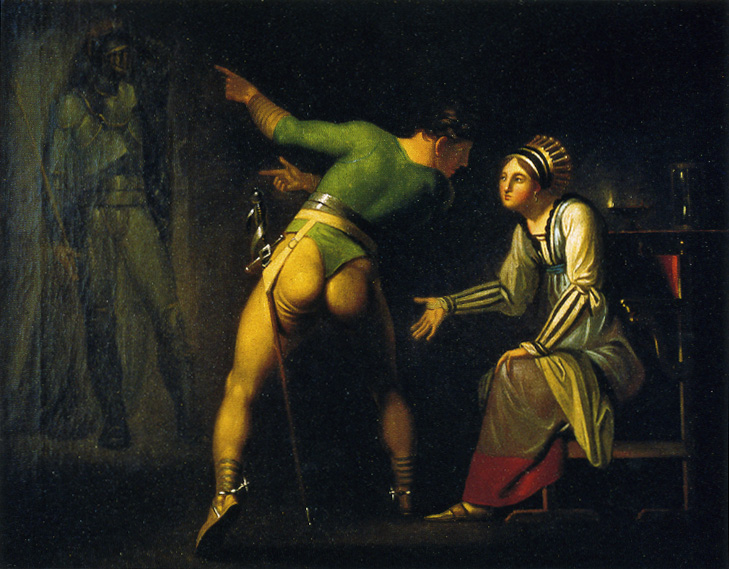
Hamlet tries to show his mother, Gertrude, his
father’s ghost (1778)
Nicolai A. Abildgaard
source Wikipedia

Thoughts:

Hamlet is still appearing very sane and reasonable.  He questions the captain with great astuteness and judges the situation with a rational insight.

His soliloquy is quite wonderful.  I wonder however …….. at the beginning of his speech, he ridicules over-thinking without action, yet at the end he says, “From now on, if my thoughts aren’t violent I’ll consider them worthless.” Hamlet is still focused on his thoughts, and for all his blustering for action, again appears unprepared to act.  However, by concentrating on violence, perhaps he is slowly moving towards the culmination of his desire.  All in good time, Hamlet.

Hamlet Read-Along Posts

Hamlet ~ Act IV Scene III

Hamlet  ~~  Act IV  Scene III

No one knows where Hamlet has placed Polonius’ body, and Rosencrantz and Guilderstern’s efforts at discovery have been fruitless, therefore Claudius calls Hamlet before him.  Hamlet plays with him a little, a cat and mouse type of game, increasing Claudius’ horror of his act until he divulges the location. Claudius reveals that he is sending Hamlet to England, and Hamlet receives the information with a calm disinterestedness.  Out of Hamlet’s hearing, Claudius urges speed and reveals that he has commissioned the English king to execute Hamlet.  He hopes that the fear of Denmark’s past deeds to England will secure this edict.

Thoughts:

Ah, Hamlet quite cleverly, advises Claudius to look in Hell for the body of Polonius:

“In heaven.  Send hither to see.  If your messenger find him 
not there, seek him i’ th’ other place yourself…..”

It’s quite appalling how Claudius can transform from a dear, doting, sympathetic figure to a cold-blooded murderer.  It’s becoming more apparent how he could have disposed of King Hamlet.  He sees the present Hamlet as a disease affecting himself and one that needs to be eradicated.

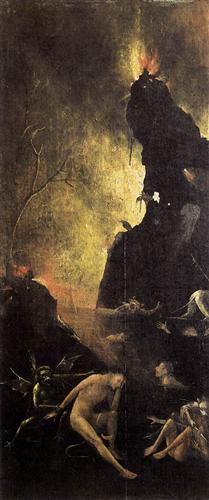
Hell (1500-04)
Hieronymus Bosch
source Wikiart

Bear ~~ October 7, 2003 – November 21, 2015

Crossing the Bar
By Alfred, Lord Tennyson
Sunset and evening star,
    And one clear call for me!
And may there be no moaning of the bar,
    When I put out to sea,
But such a tide a moving seems asleep,
    Too full for sound and foam,
When that which drew from out the boundless deep
    Turns again home.
Twilight and evening bell,
    And after that the dark!
And may there be no sadness of farewell,
    When I embark;
For tho’ from out our bourne of Time and Place
    The Flood may bear me far,
I hope to see my Pilot face to face
      When I have crost the bar.

Music
By Ralph Waldo Emerson
Let me go where’er I will
I hear a sky-born music still:
It sounds from all things old,
It sounds from all things young;
From all that’s fair, from all that’s foul,
Peals out a cheerful song.
It is not only in the bird,
Not only where the rainbow glows,
Nor in the song of woman heard,
But in the darkest, meanest things
There always, always, something sings.
‘Tis not in the high stars alone,
Nor in the cups of budding flowers,
Nor in the redbreast’s mellow tone,
Nor in the bow that smiles in showers,
But in the mud and scum and things
There always, always, something sings.


Hamlet ~ Act IV Scene II

Hamlet  ~  Act IV  Scene II

Rosencrantz and Guildenstern turn up to question Hamlet about the body of Polonius.  Hamlet again speaks very insightful nonsense to them, which they do not appear to understand.  Finally he agrees to be taken to the king.

Gather Ye Rosebuds, or Ophelia (1908)
John William Waterhouse
source Wikiart

Thoughts:

I wonder …… are Rosencrantz and Guildenstern dense?  They are carrying out Claudius’ orders without question, and the copious insults that Hamlet flings at them, seem to pass right over their heads.

What exactly did Hamlet mean when he said “The body is with the king, but the king is not with the body …”  Is this a reference to his father’s murder, in that his dead body the responsibility of Claudius, but Claudius is not physically with it?  Or what he hinting that Claudius was actually to blame for the death of Polonius, even though he wasn’t physically with the body?

Hamlet Read-Along Posts

The Canterbury Tales ~~ The Parson’s Prologue and Tale

When The Manciple’s Tale ends, the party is approaching the edge of a village. The Host declares that they have almost heard a tale from each “social class,” pegs the Parson as someone long-winded and begs a tale of fiction, but the Parson refuses.  To tell fiction, one must abandon truth.  He will tell a tale based on morality and virtue but, because he’s a Southern man, he does not have the ability to speak in verse, so prose it must be.  They all agree to his terms, thinking that a virtuous tale would be a good ending, but the Host begs him to hurry, as the sun is soon to set.

The Triumph of Virtue over Vice (1556)
Paolo Veronese
source Wikiart

The Parson’s Tale

Part I

The Parson declares that although there are many ways to lead people to Christ, one most noble way is Penitence, and knowing everything about Penitence will do a man good.  Penitence is “the lamentation of man who sorrows for his sin and punishes himself because he has done wrong”; yet this penitence must be sincere.  His sermon continues, covering the effects and species of Penitence, and what constitutes true Penitence.

With regard to Contrition, there are six causes that move a man to it:

  • a man must remember his sins with shame
  • sin puts man in greater slavery
  • a dread of the “day of doom”
  • remembrance of the good that man has failed to do on earth, and the good works that he has lost
  • a remembrance of the depth of Christ’s suffering for our sins
  • the hope of 1) forgiveness of sin; 2) the gift of grace, and 3) the glory of heaven

    Contrition needs the stalwart purpose of confession to destroy the hold of the devil and restore the gifts of the spirit.  Sin severs us from communion but confession restores broken bonds.

    The Parson’s Tale (1913)
    W. Russell Flint
    Source

    Part II

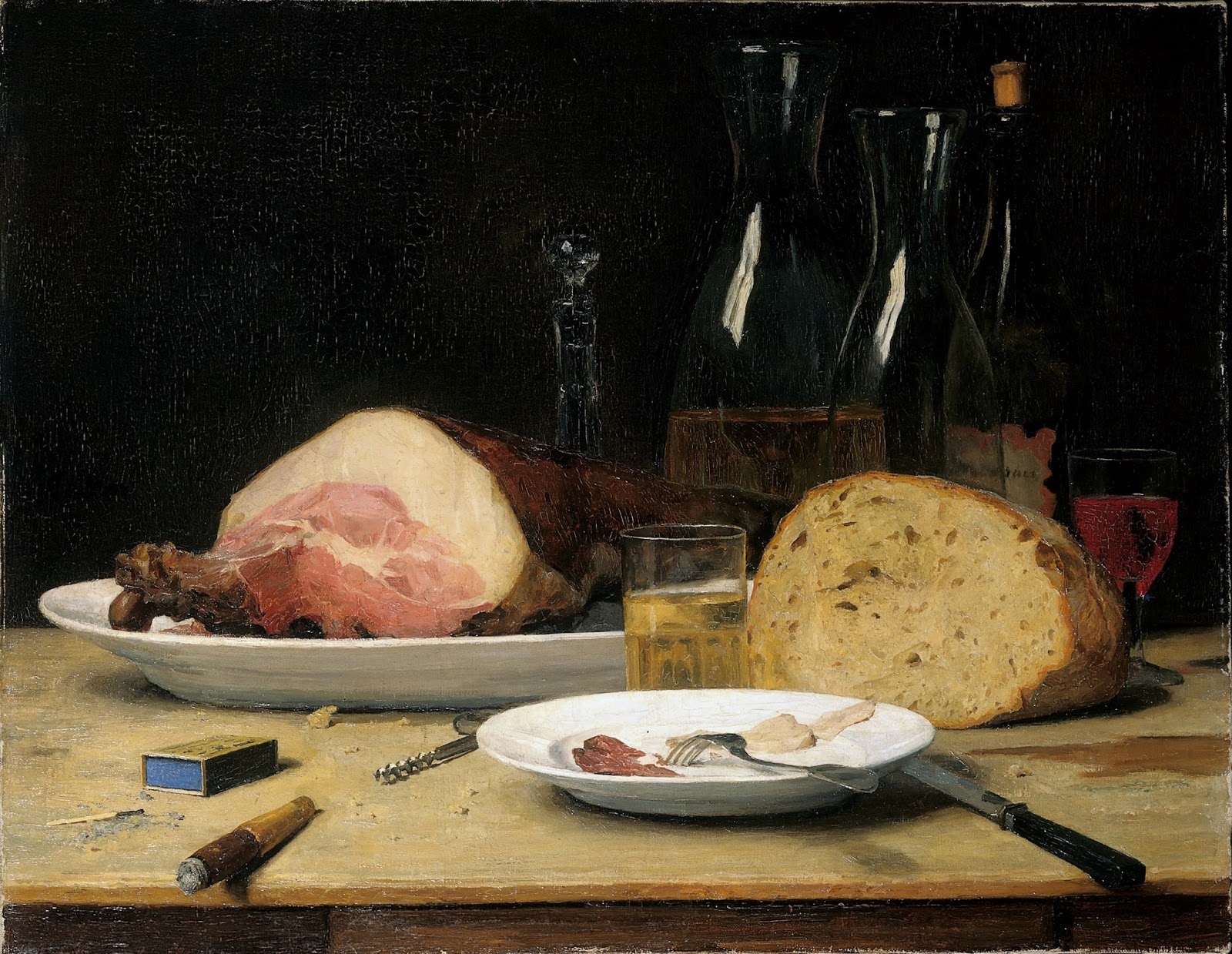
    Excess (1896)
    Albert Anker
    source Wikimedia Commons

    Confession is the second part of Penitence, which includes a true revealing of sins to the priest.  If a man opens himself to covetousness (concupiscence), he is open to sin.  There is either venial sin, in which man loves Christ not as much as he ought, or deadly sin in which man loves something more than Christ.  The more a man “burdens his soul with venial sins”, the more likely he is to fall into deadly sin.  There are also venial sins which are not so obvious, and the Parson lists those things, such as eating more than is necessary for sustenance, not caring for the sick or the poor, speaking idle words of villainy or folly,  slandering your neighbour, etc., etc.  No man can avoid venial sins but all men can restrain themselves, or be restored by prayers, confession, good works, and other church traditions.

    The Seven Deadly Sins
    Pieter Bruegel the Elder
    source Wikimedia Commons

    The Seven Deadly Sins

    Pride:  Pride is the chief deadly sin, and from it spring all other sins.  The Parson lists a number of prideful behaviours, but then introduces another form of pride, a type of self-righteous holiness.

    The Seven Deadly Sins & the Four Last Things
    Pride {Superbia} (1485)
    Hieronymus Bosch
    source Wikimedia Commons

    Two manners of Pride exist, one within the heart of man and one without. Pride of outside appearance in clothing is frowned upon, and the Parson appears particularly scandalized at the display of the male member and buttocks in fashion.  As for women, one can read their character in their appearance, despite how they may behave.  It is not that he eschews decent clothes, only attire that displays the sin of Pride.

    Pride can spring from blessings of body or soul, knowledge, good memory, riches, etc., etc.  We can hold these things to our detriment or to our profit, depending on how we use them.  He also emphasized grace in power, in that a lord should treat his servants well, and warns that he could have fortune one day and captivity the next.

    Humility and meekness are remedies against Pride, yet there are three types of humility: humility of heart, humility of mouth, and humility of deeds.

    The Seven Deadly Sins & The Four Last Things
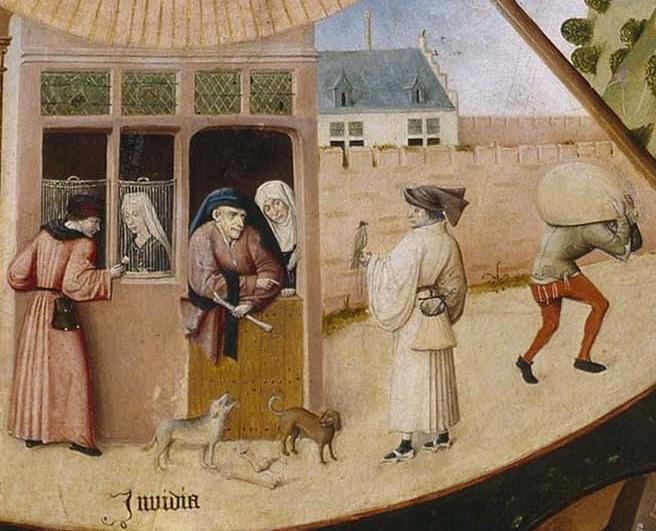
    Invidia {Envy} (1485)
    Hieronymus Bosch
    Source Wikimedia Commons

    Envy:  A sin of sorrow for others’ wellbeing and a delight in their struggles.  Envy springs from malice but there are two kinds of malice: 1) hardness of heart in evil, and; 2) the blindness of man. Envy is loathsome because it is against all virtues and not just one.  There are many manners of envy with many sub-categories and the Parson covers every one.

    Remedies against envy: 1) love God & your neighbour as yourself and; 2) love your enemy.

    The Seven Deadly Sins & the Four Last Things
    Anger {Ira} (1485)
    Hieronymus Bosch
    source Wikimedia Commons

    Anger:  Anger arises from Envy which issues from Pride. Augustine describes Anger as a wish to be avenged by word or deed, but the Parson claims that there is a good anger and a bad anger.  The good anger is the anger against wickedness, not angry with the man but against the misdeed of the man. Bad anger can be either a sudden anger, or a planned anger, the first a venial sin, the second a deadly sin.  Anger destroys spiritual things.

    Treating people unfairly, such as charging excess rents or taxes, or withholding care from the poor is, interestingly, called homicide, for “unless thou feedest him, thou slayest him.”  Do not swear, or lie, or flatter, or reproach, or sow discord, etc.  There are copious examples and sub-examples of anger, which go on for a looooong time.

    The remedy for anger is humility, or meekness, and patience, or suffering.

    The Seven Deady Sins & The Four Last Things
    Sloth {Accidia} (1485)
    Hieronymus Bosch
    source Wikimedia Commons

    Sloth:  This sin makes a man “heavy, thoughtful and fretful,” and prevents him from doing good works.  Sloth is soooo delicate and careless that he cannot tolerate any firmness or punishment, so therefore everything one does comes to naught.  “Wanhope” is a type of sloth that comes from despair in the goodness of Christ, thinking that one is too sinful for his forgiveness, culminating in defeat.  Next is idleness, which opens the door to other sins such as evil thoughts, gossip, etc. Tardiness follows, where a man thinks that he has all the time in the world to return to God, and lastly, laziness.  A lazy man will do a poor job and stint on his work, if he comes upon difficulty or becomes frustrated.

    The remedy for sloth is building up a fortitude to abhor destructive behaviours and things.  The species of fortitude are: 1) magnaminity, or great valor; 2) faith and hope in God and his saints; 3) security and self-confidence; 4) magnificence, and; 5) constancy.

    The Seven Deadly Sins & The Four Last Things
    Avarice {Avaricia} (1485)
    Hieronymus Bosch
    source Wikimedia Commons

    Avarice: Avarice is the root of all evil because it seeks wordly things instead of heavenly things. Greed is not only an inordinate desire for material goods, but for knowledge, fame, etc.  It is coveting things you do not have, but also keeping things that you do not truly need. The greedy man has more hope in his possessions than in Christ, and his desires put him in bondage.  Thus follows extreme detail on bondage.

    Mercy and pity, relieve the sin of avarice.  Reasonable generosity is also a remedy.

    The Seven Deadly Sins and The Four Last Things
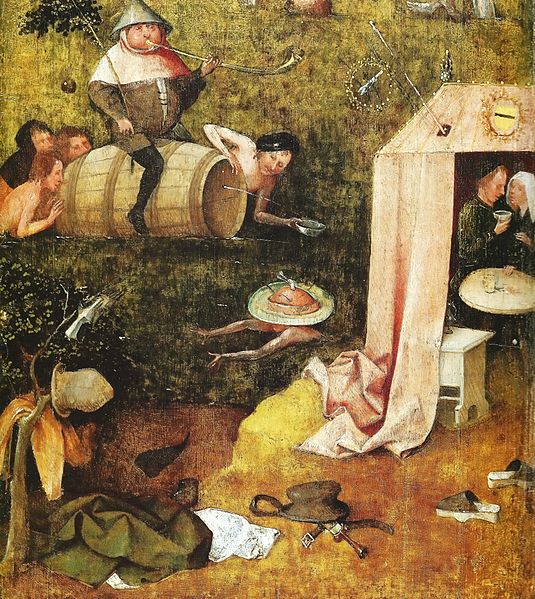
    Gluttony {Gula} (1485)
    Hieronymus Bosch
    source Wikimedia Commons

    Gluttony:  The overindulgence in food or drink, where a man makes his belly, his god. Drunkenness begets loss of reason.  Otherwise all his descriptions of gluttony sound startlingly like the manner in which we eat nowadays.

    • Eating before it is time to eat
    • Eating too delicate food and drink
    • Eating more food than is necessary
    • Elaborate adornment and preparation of food
    • Eating too greedily

    The remedy of gluttony is abstinence, along with its fellow-remedies of temperance, shame, satisfaction, moderation, soberness, and frugality.

    The Seven Deadly Sins and the Four Last Things
    Lechery {Luxuria} (1485)
    Hieronymus Bosch
    source Wikipedia Commons

    Lechery:  A cousin to gluttony is the sin of lechery, or lust. Adultery is a “stinking sin”, where not only the deed is forbidden, but the desire also. By this sin, the devil wins most of the world.  Do not:

    • Look, for “the desire of the eyes, follow the desire of the heart.”
    • Touch
    • Use foul words
    • Kiss
    • Act lecherously

      A precise description of all levels of lechery follows.  

      To remedy this sin, one must employ chastity and continence (self-control). True marriage makes two hearts united, as well as bodies.  A man should be patient with his wife and revere her.  Woman is subject to man, but a man should love his wife so much that he would die for her.  Other remedies are (get ready!) the withdrawal of ease, withdrawal of eating and drinking, sleeping long and in great quiet, and shunning that by which he/she is tempted.

      The Confession (1838)
      Guiseppe Molteni
      source Wikimedia Commons

      The Parson declares that it is good to understand the circumstances which provoke sin, and gives us, again, numerous examples.  The more one sins, the easier it is to sin, and the more adverse one is to confessing them.

      For a man to make a sincere confession, it must be with: 1) a sense of shame; 2) a humility in confession; 3) a presence of tears, if not in the eyes, then in the heart; 4) no hesitation for feeling shame, and; 5) an obedience to accept the penance dealt out.  A confession also must be hastily sought, of free will, lawful, free of lies, and have no hypocrisy.

      Communion should be taken at least once per year, because everything renews itself annually.

      St. Jerome in Penitence (c. 1525)
      Bernardino Luini
      source Wikimedia Commons

      Part III


      The third part of Penitence is Satisfaction, which involves alms and bodily pain.

      Of alms, there are three types: 1) contrition of the heart; 2) pity on the sins of his neighbours, and; 3) giving to those in need, such things as counsel, comfort, food and drink, clothing, lodging, etc.

      Concerning bodily pain, it consists of prayers, fasting, keeping vigil and the teaching of orisons.  One may not think these things very painful, but the Parson seems to be referring to the pain of discipline and self-control …… doing things we perhaps do not wish to do for the good of ourselves or others. He mentions having discipline in the case of being whipped, in tribulations, sickness, in the loss of a wife or child, or worldly possessions.

      He covers the consequences of not making a sincere confession, and other things that impede confession.

      The fruit of penance is the bliss of heaven.

      The Parson’s Tale (1913)
      W. Russell Flint
      source

      I must say that in simply reading this sermon, I clearly understood penance and bodily pain.  Could this have been the Parson’s purpose?  This tale was sooooooo long, so detailed, and it read like a legal brief, without say, any dry Ciceronian wit.  I actually quite loved it for the first half, but soon it was just too much, and I admit that I was glad when it ended.  Yet for all that, it had some very good points.

      I must say I quite liked how some of the church Fathers explained hell:

      “To wretched caitiffs shall be death without death, and end without end, and lack without end.  For their death shall always live, and their end shall evermore begin, and their lack shall not cease.”  Saint Gregory

      “They shall follow death, and they shall not find him; and they shall desire to die, and death shall flee from them.”  John the Evangelist

      I was surprised at the emphasis placed on the order of things   Reason is also highlighted.  Each sin is explained in copious detail, yet the Parson shows expert insight into human nature, and his words are often convicting.  His advocation includes compassion, grace, lords to treat their servants well, as well as admonishing “unworthy priests and ignorant curates,” so much of his talk was edifying.  However, looking at this tale from a non-Catholic viewpoint, the heavy emphasis on penance and sin became startling, not necessarily for the content, but for the length.  Jesus came to take men’s sin on himself, and we are saved by grace, yet I think the Parson loses much of that in his worldview.  Certainly we should be aware of everything that he touched on, and confession and repentance are necessary, but the fear and the shame that comes with it are out of my scope of understanding.

      The Parson’s Tale is the last of the tales before the final Chaucer’s Retraction, and is perhaps very fitting in its placement.  The characters are going on a pilgrimage, each probably ruminating on their lives and the different paths they have taken or would like to take.  The Parson gives them a nudge, with his sermon, on the path of salvation.  He also, with great acumen, touches on a number of sins that plague his fellow travellers, giving them a way to escape them if they so choose.


      Hamlet ~ Act IV Scene I

      Hamlet  ~  Act IV  Scene I


      Gertrude relates all to Claudius about her meeting with Hamlet, including the death of Polonius.  Claudius laments Hamlet’s state, his act and his own position.  He calls for Guildenstern, revealing Hamlet’s dreadful deed and commands him to bring the corpse to the chapel.  He then declares that he will tell their wisest friends of his planned action, hoping that the effects of this act, will not tarnish their reputation.

      Ophelia (1863)
      Arthur Hughes
      source Wikiart

      Thoughts:

      This scene is very short but still enlightening.  In spite of Gertrude’s promise of silence to Hamlet, she immediately reveals to Claudius everything that had passed between them.  Or does she?  She only reveals her opinion that Hamlet is mad, yet does not say that he is playing at being mad.  So, in effect, did she really keep her pledge?

      It’s fascinating that Claudius blames himself for Hamlet’s actions in the death of Polonius.  He claims his guilt is because he did not restrain his nephew, but is there other guilt that is affecting his feelings?

      Again, Claudius is calling on others to support his actions, making them at least partially responsible for the course on which he decides.  Is this a crafty political move, or does Claudius’ simply need emotional support in his new position?

      Hamlet Read-Along Posts

      The Canterbury Tales ~~ The Manciple’s Prologue and Tale

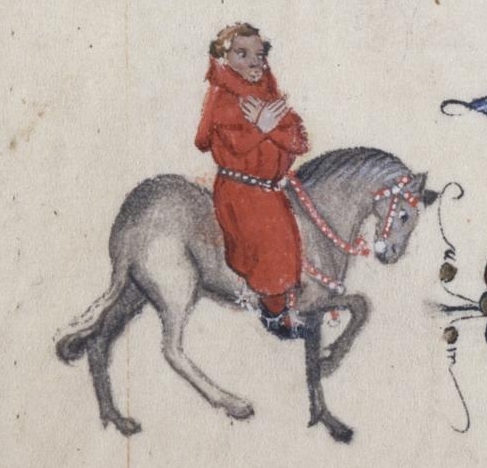
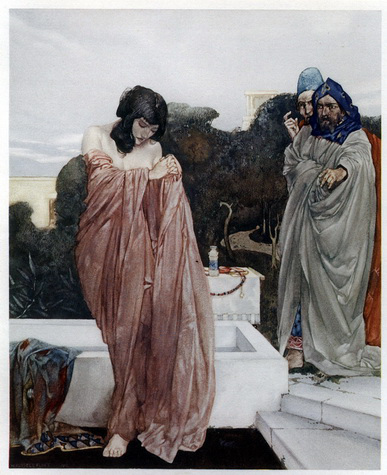
      Is it my imagination or, as we are nearly at the end of these tales, are the pictures of the pilgrims improving?  Or perhaps they are only better preserved. A Manciple, for those who don’t know (me!), is a purchasing agent for a college, monastery or other institution.

      The Host wishes the Cook to tell the next tale but, sadly, the Cook is dead drunk, and the Manciple offers to take his place, merrily deriding the Cook for his condition.  Enraged, the Cook attempts to strike the Manciple but ends up falling from his horse.  The pilgrims manage to remount him on his hack and the Manciple is scolded for chiding the Cook, and, to make up, the Manciple offers the Cook a drink.  He then begins his tale.
      The Manciple’s Tale

      Phoebus and Boreas (1879)
      Gustave Moreau
      source Wikiart

      Phoebus, renown for his nobility and skill with bow and arrows, had his dwelling on earth.  An artful singer in his own right, the handsome Phoebus had a crow which he kept in a cage.  Now this crow had snowy white feathers, a song that would rival the Sirens, and could mimic any sound that it heard.

      Phoebus also had a lovely wife, who he loved more than he loved his own life.  Jealous for his spouse’s love, he ensured that he acted toward her with kindness and manly conduct, confident that she would not stray from his affections.  But a caged bird, wishes for its freedom no matter what its treatment and:

      “(A good wife) Should not be checked and spied on, that is plain,
      And truly it is labour all in vain
      To check a wicked wife; it can’t be done.
      It’s imbecility, say I for one,
      For men to waste their labour checking wives,
      And so the ancients say who wrote their lives.”

      Middle English:

      Sholde nat been kept in noon awayt, certayn;
      And trewely the labour is in vayn
      To kepe a shrewe, for it wol nat bee.
      This holde I for a verray nycetee,
      To spille labour for to kepe wyves:
      Thus writen olde clerkes in hir lyves.

      One day, when Phoebus was away, his wife sent for her “bully”, and proceeded to deceive her husband, as the crow in its cage looked on.  When Phoebus returned, the crow trilled out the words, “Cuckoo!  Cuckoo!” and then informed Phoebus of his wife’s indiscretion.  In a towering rage, Phoebus slew his wife, yet immediately remorse came upon him for his deed.

      “O fainting trust, O prompting to suspect,
      Where was your thought and wisdom to direct?
      O every man, beware how you are moved,
      Never believe but what is strongly proved!
      Strike not too soon, ere you can reason why,
      Be soberly advised before you try
      To execute your justice and assuage
      Suspicion by the acting of your rage.
      Alas, a thousand in their hasty ire
      Have been undone and brought into the mire.”

      Middle English:

      O wantrust, ful of fals suspecion,
      Where was thy wit and thy discrecion?
      O every man, be war of rakelnesse!
      Ne trowe no thyng withouten strong witnesse.
      Smyt nat to soone, er that ye witen why,
      And beeth avysed wel and sobrely
      Er ye doon any execucion
      Upon youre ire for suspecion.
      Allas, a thousand folk hath rakel ire
      Fully fordoon, and broght hem in the mire.

      He verbally flayed the crow for its thoughtless revelation and placed on it a curse, that it would forever wear feathers of black, its powers of speech would be taken, and its lovely voice would be transformed to a croak.

      The Manciple conveys the moral of the story, instructing “his son” to hold his tongue, do not use words idly, refrain from superfluous thoughtless speech, guard his tongue, and not be a chatterbox.

      “Wherever you may be, with high or low,
      Refrain your tongue and think upon the crow.”

      Middle English:

      Whereso thou come, amonges hye or lowe,
      Kepe wel thy tonge and thenk upon the crowe.

      The Manciple’s Tale (1913)
      W. Russell Flint
      Source

      This tale was perhaps the most confusing of all of the tales.  Of course, Phoebus’ wife didn’t deserve death for her infidelity, but why was it so terrible for Phoebus to be advised of what she had done?  The crow only told the truth.  Was it the manner in which he told the truth?  Instead of having concern for the feelings of Phoebus and telling him privately, he blurted out the truth like a scandalmonger, with a sort of glee?  I’m really puzzled.  In any case, it is obvious from the start that the Manciple is a merry soul, who likes to tease and twist situations.  Can we even take him seriously?

      This story was taken from Ovid’s Metamorphoses, which I hope to read next year, so I will be able to do a comparison.

      Remembrance Day 2015

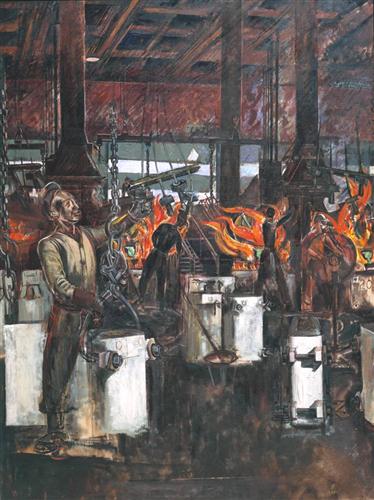
      A Canadian War Factory (1943)
      Wyndham Lewis
      source Wikiart

      I can’t forget to stop and honour all the men and women who have fought and lost their lives in wars past and present, so that we are able to have the freedom that we enjoy in Canada, and other countries in the world.  Heroes they remain, as they were willing to fight when their country needed them.

      Drummer Hodge
      Thomas Hardy
      They throw in Drummer Hodge, to rest
      Uncoffined — just as found:
      His landmark is a kopje-crest
      That breaks the veldt around:
      And foreign constellations west
      Each night above his mound.
      Young Hodge the drummer never knew —
      Fresh from his Wessex home —
      The meaning of the broad Karoo,
      The Bush, the dusty loam,
      And why uprose to nightly view
      Strange stars amid the gloam.
      Yet portion of that unknown plain
      Will Hodge for ever be;
      His homely Northern breast and brain
      Grow up some Southern tree,
      And strange-eyed constellations reign

      His stars eternally.