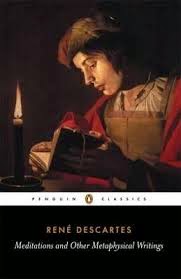
“My reason for offering you this book is very persuasive, and I am confident that you will have an equally strong reason for defending it once you understand why I wrote it; thus the best way of commending it to you is to say a few words about my objective in writing it”
Descartes set out to examine how “everything that can be known about God can be shown by reasons that derive from no other source but our own mind, …. and how God can be known more easily and more certainly than worldly things.” However even as he claims his investigations as “certain and evident,” he is concerned that not everyone has the ability to grasp them. Right then, I knew I was in for a philosophically dense read. Yet while I trembled, I soon began to realize that Descartes splits his meditations into manageable chunks and, if you employ your brain for short periods, his explanations and arguments can penetrate. I also realized that the title of the book could be of assistance. These thoughts of Descartes were ideas that were probably products of hours and days and years of pondering and questioning and seeking. If it took him that long to produce the ideas, I’d have to be willing to meditate on them if I wanted to develop a basic understanding. And so I went on ….
First Meditation: Things which can be called into Doubt
Descartes explores false knowledge, which he distinguishes from the unknowable: “there is nothing among my former beliefs that cannot be doubted and that this is so not as a result of levity or lack of reflection but for sound and considered reasons.” It is necessary to discard all beliefs that aren’t absolute to determine what is known for certain. There are many comparisons to thought while asleep and thought while dreaming. He concludes with:
“I am like a prisoner who happens to enjoy an imaginary freedom in his dreams and who subsequently begins to suspect that he is asleep and, afraid of being awakened, conspires silently with his agreeable illusions. Likewise, I spontaneously lapse into my earlier beliefs and am afraid of being awakened from them, in case my peaceful sleep is followed by a laborious awakening and I live in future, not in the light, but amid the inextricable darkness of the problems just discussed.”
Second Meditation: The Nature of the Human Mind, and that it is better known than the Body
Descartes thoughts continue from his supposition from his first meditation and he decides that everything is false. Yet if all he believes is false, he does conclude that one thing is true: he exists. His reasoning is something like this:
- He exists if he is not being deceived.
- He exists if he is being deceived.
- Therefore, if he is being deceived or not being deceived, he exists
- He is either being deceived or not being deceived.
Interestingly, St. Augustine also argued “fallor ergo sum”, or “I am being deceived, therefore I exist”.
I think here Descartes arguments are of a personal and not necessarily a general nature: his mind exists because his thoughts exist. However, he still hasn’t proven that he exists.
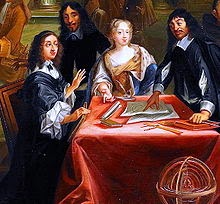 |
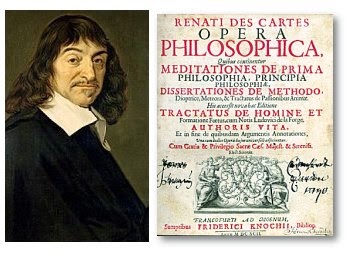
| Rene Descartes with Queen Christina of Sweden source Wikipedia |
Third Meditation: The Existence of God
Descartes starts to lose me here. He examines the dream state and questions how we can know it from reality and then he discusses the all-powerful God which we know and how we could be deceived in our perception of him (I think). Very logically he states that if he is being deceived, that very fact proves his existence. He comes to the conclusion that God is not a deceiver but leaves the door open to accept that there is something that is.
I was fascinated by Descartes exploration into ideas. There are ideas which come to us that do not originate with us and, in fact, sometimes impose themselves on us. If they are not products of our will, does that not point to there being something other than us?
“But if I derived my existence from myself, there would be nothing that I would either doubt or wish for, nor would I lack absolutely anything. For I would have given myself every perfection of which I have some idea and thus I would be God himself.”
Whew, that’s certainly something to think about!
Fourth Meditation: Truth and Falsehood
Yikes, and even deeper we go …….. Descartes concludes that God exists and his existence depends on Him. God cannot deceive because deception involves some sort of imperfection and God is perfect. When Descartes focuses on God he finds no error in himself, but when he focuses on himself, he is full of errors. He calls himself an intermediate being between God and nothingness.
With regard to errors, he proposes that two faculties come into play: the faculty of knowledge and the faculty of choosing from his own free will, in other word, intellect and will. Through his intellect he perceived ideas but through his will he can make judgements. There is a problem though: his intellect is limited —- it cannot perceive all ideas and it does not always perceive clearly and distinctly —– whereas his will is unlimited —- it can make, deny or suspend judgements on anything. Yet as long as he does not make wrong judgements in his will, he is safe …… if he simply suspends judgement on ideas he’s not certain of, he cannot be wrong.
 |
| Descartes at Work source Wikipedia |
Fifth Meditation: The Essence of Material Things, Another Discussion of God’s Existence
Descartes provides a new argument for the existence of God, in that if he thinks that he exists, existence in inseparable from God and therefore He exists …… or at least, I think that’s what he’s saying. Such as:
1. God is a being that has all perfections
2. Existence is a perfection
——> God exists
There are three famous arguments about Descartes’ position (one of them being Kant’s argument that existence isn’t a perfection) but none hold up to logical examination, so I guess Descartes is still the winner.
Sixth Meditation: The Essence of Material Things, and the Real Distinction Between Mind and Body
Wow, this is getting challenging! To argue for a material world, Descartes examines what is contained in his own soul. There is a delineation between imagining and pure understanding. He concludes he could exist without imagining, therefore imagining must be outside his mind and connected to the body. Next he examines the senses, which he feels come involuntarily and therefore connect ideas to the mind. The next puzzle is why the mind is connected to the body ……… With all these quite impressive logical acrobatics, he begins to believe material objects exist but perhaps not in the way he has always believed. There are a number of other investigations into our senses and their role, why we make unwise decisions, and that the body is divisible, yet the mind is not. He ends by stating:
” For from the fact that God is not a deceiver it follows that, in such cases, I am completely free from error. But the urgency of things to be done does not always allow us time for such a careful examination; it must be granted, therefore, that human life is often subject to mistakes about particular things, and the weakness of our nature must be acknowledged.”
As much as it completely strained my brain, the Sixth Mediation really resonated with me. I remember as a small child wondering why I was me. How was it that I felt contained in this particular body and not another? Why was I chosen to be me? How? Why was I a soul living in Canada and not somewhere else? I think this was the start of realizing that I had a soul and was something more than just a mechanical shell or a biological entity. And if that was true, then where did I come from and who made me? Perhaps not original questions, but ones that I think we should think about more in life. Yes, we should all be philosophers!
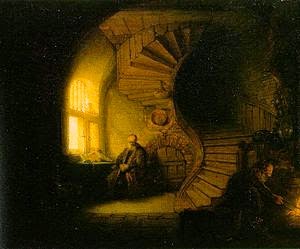 |
| Philosopher in Meditation Rembrandt (1631) source Wikipedia |
Getting back to the book, it continues with “objections” or responses from Johan de Kater, a Catholic theologian from Holland; Fr. Marin Mersenne; Antoine Arnauld, a Jansenism theologian; Thomas Hobbes; and Pierre Gassendi, a priest, scientist, astronomer and mathematician. I really had to laugh reading some of these objections. In fact, the Catholics were the ones who questioned the logic Descartes used to prove the existence of God. So curious from a modern prospective but it appears that the church was willing to ask tough questions during these times and wasn’t afraid of searching for the truth. So interesting!
Descartes’ Replies to the Objections are also very enlightening but so very deep. A course in logic would have been very useful before reading this book, however, I think I’ve covered enough for now. Descartes obviously liked to think and had alot of time to do it. It was mental gymnastics to try to follow him but good for the brain. To really understand it though, you need to have read Aristotlean philosophy along with a number of other more recent philosophies, as Descartes thoughts sprung from that already anchored base. At least my understanding, while minuscule, is more than when I started. Thanks, Descartes!