Daniel Deronda by George Eliot

“Was she beautiful or not beautiful?”
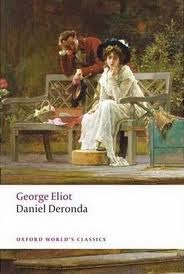
Gwendolyn Harleth is a “spoiled child”, a young woman with average prospects yet with high hopes of attaining respectable social standing and monetary comfort. While scorning the traditional avenues of marriage, she desperately wishes for a meaningful, vibrant life, even though she is unsure of how to attain it.  Gambling, parties and equestrian amusements, fill her time, with little thought of other peoples wants, needs or struggles.

Daniel Deronda is a respectable moral young man and the ward of Sir Hugo Mallinger.  When he first spies Gwendolyn, his disapproval of her gambling and later, the same quiet censure of some of her actions, leads her down a path of introspection and causes her to question the manner in which she is living her life.  Yet the changes in her character do not come soon enough and, due to her family’s sudden monetary troubles, she contracts a marriage to Henleigh Mallinger Grandcourt, the nephew and heir of Sir Hugo.  She views the marriage as an escape from poverty and a stepping stone to a life of leisure and a respectable position in society.  Instead she gets a husband with a twisted soul, bent on breaking her will as he would a horse or a wild animal.  He glories in her struggles, fear and his ability to control her actions.
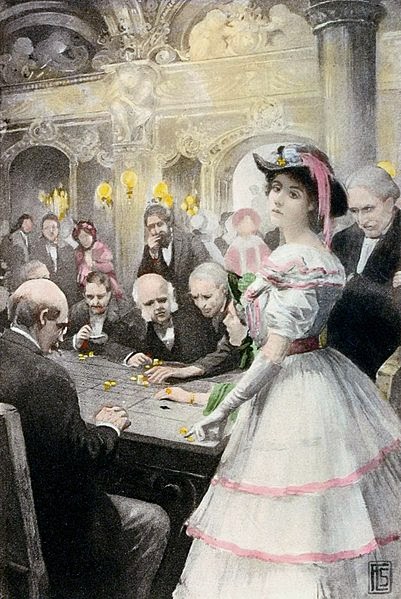
Gwendolyn at the Roulette Table
(1910)
Wikipedia

A second plot winds itself through Gwendolyn’s, as Deronda internally questions the manner of his birth and the identity of his parents.  Not wishing to bring up a subject that may be uncomfortable for Sir Hugo, he suppresses his curiosity, yet aches for familial connections and history.  Upon saving a Jewish singer from drowning, his relationship with her takes him down the path of finding his true heritage.

Eliot forces the reader to examine some of the social issues of that time.  Without money, young women could only hope to find work in low paying positions, such as governesses or companions, or perhaps choose less respectful avenues as singers or actresses.  Without an inheritance or a family who was financially able to support them, an advantageous marriage was really the only protection for women of this time period.

She also treats the subject of Jewish identity and culture with surprising dexterity and perception.  While they are portrayed with an obvious sympathy, Eliot makes each character real, from the philosophic and idealistic Mordecai, to the money-loving pawnbroker, Cohen. The struggle of a people against prejudice and pre-judgement is plainly explored with touching sincerity and insight.  Mordecai’s longing to see the Zionist hopes for a Jewish homeland established adds a deeper more complex examination of an issue that was of particular interest to the author.

The Fair Toxophilites (Archers)
by William Firth (1872)
Wikimedia Commons

I found that certain parts of the novel dragged, and the plot suffered numerous bumps, but again Eliot tackled such diverse issues, making the writing of the novel an epic task, so I can forgive some of the inconsistencies. Her obvious intellectual curiosity, and her enlightened opinions made the read informative as well as enjoyable.  Daniel Deronda is a book that prods you to think and ponder even after the last page is turned.

“In the chequered area of human experience the seasons are all mingled as in the golden age: fruit  and blossom hang together,; in the same moment the sickle is reaping and the seed is sprinkled; one tends the green cluster and another treads the wine-press.  Nay, in each of our lives harvest and spring-time are continually one, until Death himself gathers us and sows us anew in his invisible fields.”
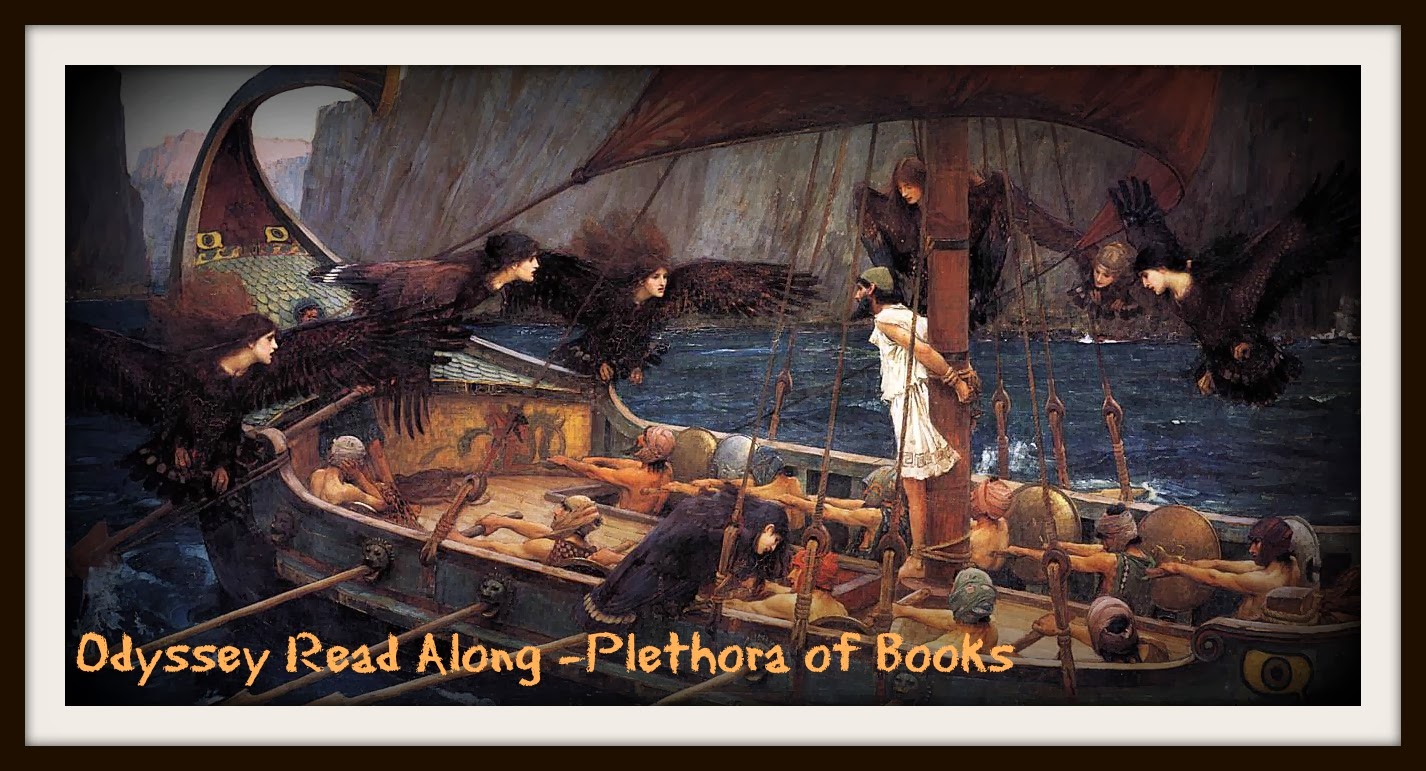
The Odyssey Read-Along Book V & VI

The Odyssey Read-Along @ Plethora of Books

Book V

Hermes Argeiphontes is sent to Kalypso’s island to inform the nymph that her hold on Odysseus is broken and that she must let him go.  Reluctantly, she agrees but only because she knows resisting the will of Zeus would be fruitless.  Yet when she tells Odysseus that he is a free man, he suspects her of subterfuge but she assures him of her sincerity.  She takes him to a grove of trees where he constructs a raft and loads it full of supplies before he departs.  Eighteen days out on his journey, he is spotted by Poseidon who, angered by the sight of him, causes a great storm to blow up and Odysseus is eventually forced to swim for land.  After swimming for nearly three days, he finally nears a coast, only to find the shoreline rimmed with jutting rock and jagged cliffs.  Poor Odysseus nearly drowns in the surf but, with some help from Athene, he finds a mouth of a river where he finally makes land.  Exhausted with his struggles, he decides to brave the wild animals and finds shelter in the forest to rest and sleep.

Fidelity

It appears that Odysseus initially stayed willingly with Kalypso, living with her as a husband.  Yet as time passed, her charms wore off until he was sorrowfully pining to return home to his wife and country.  In Greek culture, a man who had an affair with a foreigner or slave was not viewed as being unfaithful.

The Assistance of the Gods

Curiously, though the gods choose to help certain mortals, in most cases their assistance is deliberately limited.  They appear to offer just enough help to allow the person to use their ingenuity, strength and perseverance to get themselves out of a dire situation or to learn a specific lesson.

Observations

Odysseus has been shipwrecked by Poseidon twice; he has had two monologues; he has had two helpers; and he climbs back into his boat twice.  What does this mean?  I have no idea ….. 😉

Hermes Ordering Calypso to Release Odysseus
by Gerald de Lairesse (1670)
Wikimedia Commons

Book VI

As Odysseus sleeps on remote Phaiakia, Athene comes to Nausikaa, the daughter of king Alkinoös, in a dream, urging her to carry the washing in her father’s wagon down to the river to wash.   When she obeys the next day, Odysseus himself emerges from the bushes, naked but for a branch.  All her handmaidens scatter in terror, yet Nausikaa bravely questions him and finds he is a stranger to their country.  Employing his admirable tact and intelligence, Odysseus charms the girl.  She lends him some garments, waits while he washes and then instructs him to go to the palace of her parents, to grasp her mother’s knees in supplication and thus will he get assistance for his journey.  He prays to Athene that the reception of the Phaiakians will be favourable.

Feasting

There are numerous scenes of feasting throughout the poem.  If a stranger arrives, a feast is prepared, often before his name is learnt or his circumstances; if he stays, there is more feasting; there is feasting upon his departure; when the gods visit each other, they feast, such as the preparations made by Kalypso for Hermes when he arrived with his message.  In the case of mortals, the feasting is accompanied by sacrifices to the gods.

Hospitality

I am beginning to wonder if the hospitality and reverence offered to guests are not necessarily out of the goodness of the heart of the host.  Whenever a stranger appears, they are never completely certain if they are entertaining a mortal or a god.  It seems like good sense to treat everyone like a god and therefore be certain that they haven’t offended one and that no dreadful punishment will follow for lack of generosity.

The Meeting of Odysseus and Nausicaa
by Jacob Jordaens
Wikimedia Commons
(How Nausicaa and her handmaidens were able to get
ahold of 19th century clothing is a mystery!)