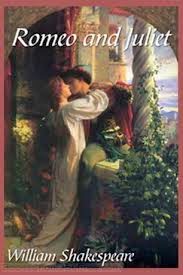
“O, Romeo, Romeo! Wherefore art thou Romeo?
Deny thy father and refuse thy name
Of, if thou wilt not, be but sworn my love,
And I’ll no longer be a Capulet.”
Of course, we all know the story. In Medieval Verona, the Capulets and Montagues are feuding, their hatred spilling over into battles in the streets; revenge and killings abound. Yet Romeo, the Montague, meets Juliet, a Capulet, and all thoughts of his former love, Rosaline, fly from his head as his heart is captured by her beauty. Will Romeo and Juliet’s love survive the heated rivalry and secret machinations of the houses of Montague and Capulet?
Well, no, of course not!
 |
| Juliet John William Waterhouse source Wikiart |
While Romeo and Juliet is certainly a story of young love, it is also a cautionary tale against letting one’s heart (and other body parts) rule one’s head with unhealthy intensity. Friar Lawrence cautiions Romeo during his effusive praise of Juliet after only one glance of her:
“These violent delights have violent ends
And in their triumph die, like fire and powder,
Which, as they kiss, consume. The sweetest honey
Is loathsome in his own deliciousness
And in the taste confounds the appetite.
Therefore love moderately. Long love doth so.
Too swift arrives as tardy as too slow.”
 |
| Romeo and Juliet the tomb scene (1790) Joseph Wright source Wikiart |
Later, when Romeo’s friend, Mercutio is slain by the Capulet, Tybalt, cousin to Juliet, love is forgotten in the passions of revenge and Tybalt’s life is forfeit under the steel of Romeo’s sword. A sentence of exile is pronounced as the lovers’ hopes spiral into a well of despair. A message gone astray, culminates in the deaths of these two lovers, echoing a tragic pathos that the reader can sense building throughout the play. Right from the beginning, when you view their impulsive, forbidden love, blossoming amongst the fields of vendettas, discord and enmity, you know that it cannot last. It’s like an explosion of fireworks that streak across the sky in a pattern of colours and textures and beauty. But eventually these grand passions burn themselves out and in place of the awe-inspiring spectacle, darkness remains.
Yet while there is tragedy in the fateful story, Shakespeare also shines rays of hope. With the deaths of the two heirs of both the Montagues and Capulets, all animosity melts away as the families share the pain of a double grief. So instead of Romeo and Juliet’s deaths being merely tragic, the lovers’ demise turn out to be a kind of sacrifice, two deaths that culminate in the saving fate of the two families. Is Shakespeare alluding to the belief that peace in society is more important than a passionate love of two individuals? Who knows, but it’s a thought that resonated with me long after I turned the last page …….
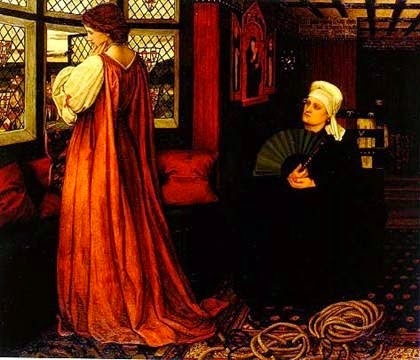 |
| Juliet and her Nurse (c. 1860) John Roddam Spencer Stanhope source Wikiart |
I read this play for my edX Shakespeare: On Page and Performance course, play 1 of 6.
Productions Watched:
Romeo & Juliet – Shakespeare Stratford Collection (★★★★☆)
Audiobooks:
Archangel Audiobook – Romeo & Juliet (★★★★★)