
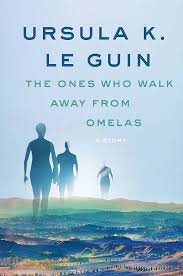
 “With a clamor of bells that set the swallows soaring, the Festival of Summer came to the city of Omelas, bright towered by the sea.”
And so with The Ones Who Walk Away from Omelas, I continue with my duo short story read which also included The Lottery by Shirley Jackson. Both stories have a similar theme and they are wonderful to pair for a comparison. The Lottery was written in 1948 and The Ones Who Walk Away From Omelas was written in 1973.
Le Guin sets up the story magnificently, imbuing the setting of the city of Omelas with descriptions of nature and bright colours and celebration. We also get a sense that Omelas has been there for a long time, as she mentions “old moss-grown gardens,” and “past great parks and public buildings.” There is music, and dancing, and races, and the “great Joyous clanging of the bells.” Her first paragraph is full of information for the reader.

Bells (1989) Victor Zaretsky
~ source Wikiart
As we move through the story, which initially is describing a joyous paradise, the reader slowly receives clues that all may not be as it seems. “All smiles have become old” and the naive innocence and happiness seem to be felt only by the children, where the adults are now “mature, intelligent and passionate …” LeGuin emphasizes many times that the citizens of Omelas are NOT simple folk and they are NOT less complex than “us”. They have no king, are not barbarians, they carry no swords and they don’t have slaves. These people place no emphasis on material happiness and technological progress is not prominent. Which then, to me, points so something much deeper that affects their civilization and culture. She then makes a curious statement:
“The trouble is that we have a bad habit, encouraged by scholars and philosophers, as considering happiness as a something rather stupid. Only pain is intellectual, only evil is interesting. This is the sin of the artist: a refusal to admit that evil is dull and pain is boring.”
But Omelas is like a paradise, a fairy tale. The people of Omelas celebrate life! Yet there is one thing that allows this city to be a paradise, the only thing that allows it to keep happiness and light and celebration. A small emaciated child lives in a tiny locked windowless room, being fed hardly enough to keep it alive and sitting in its own feces. No one is allowed to give it love or sympathy or even talk to it. But everyone knows that, without it, their city would lose the magic that lives within it.

The Sick Child (1844) François Joseph Navez
~ source Wikiart
Some people are anguished by this hideous secret that is known to all in the city. Some people attempt to justify the situation, saying that the child is so stunted that it couldn’t even appreciate a normal life, in any case.
But there are those who quietly leave, always at night and always alone …. the ones who walk away from Omelas. They don’t know where they are going and they don’t know what they will find. But they go ……

Italian Landscape – Jacob von Strij
~ source Wikiart
What an absolutely excellent short story from LeGuin. Each sentence builds the story by giving pertinent information. She also asks the reader questions throughout the story, which is an excellent device for getting engagement and prompting the reader to think about the story and its meaning.
Comparing the two stories, I much, much prefer this one to The Lottery. In The Ones Who Walk Away From Omelas, the fact that people choose to go against convention, and are willing to leave paradise because what is giving them the paradise is truly evil behaviour, is very effective. In The Lottery, people just mindlessly go along with the evil. While I can appreciate this behaviour (how many times in history have we seen this conduct? Lots!), I find the way LeGuin presents this situation gives humanity hope. We aren’t all lost in selfishness and captured by self-interest to the detriment and torture of a little child. And I really loved how she expressed that people left the city alone, on their own. This emphasized that it was their own decision …. they weren’t obviously influenced by anyone else. Their convictions were so important to them that they were willing to act independently, even without knowing the outcome.

The Man (1916) Odilon Redon
~ source Wikiart
It was said that the story came from Dostoyevsky and a quote from The Brothers Karamazov:
“I challenge you: let’s assume that you were called upon to build the edifice of human destiny so that men would finally be happy and would find peace and tranquility. If you knew that, in order to attain this, you would have to torture just one single creature, let’s say the little girl who beat her chest so desperately in the outhouse, and that on her unavenged tears you could build that edifice, would you agree to do it?”
But LeGuin claimed she’d forgotten about that quote and the idea for the story actually came from a quote from William James:
“Or if the hypothesis were offered us of a world in which Messrs. Fourier‘s and Bellamy‘s and Morris‘s utopias should all be outdone, and millions kept permanently happy on the one simple condition that a certain lost soul on the far-off edge of things should lead a life of lonely torture, what except a sceptical and independent sort of emotion can it be which would make us immediately feel, even though an impulse arose within us to clutch at the happiness so offered, how hideous a thing would be its enjoyment when deliberately accepted as the fruit of such a bargain?”
But regardless of what inspired The Ones Who Walk Away From Omelas, it is a simply excellent story!
