The Time Machine by H.G. Wells

“The Time Traveller (for so it will be convenient to speak of him) was expounding a recondite matter to us.”

I read this book for the Classics Club Spin #11.  Was it my spin book?  No, it was Mockingbirds, Looking Glasses, and Prejudices spin book but I decided to read along with her.  Why?  Well, her book was much shorter than my Spin book, and I couldn’t imagine getting through God in the Dock in the allotted time frame.  Yes, I’m breaking the rules, but it’s on my Classics Club list, AND at least I read something!

Continue reading

Metamorphoses – Book IV

Book IV


The Daughters of Minyas / Pyramus & Thisbe / Mars, Venus, Vulcan, the Sun / Leucothoe & Clytie / Salmacis & Hermaphroditus / The Daughters of Minyas / Athamas & Ino / Cadmus & Harmonia / Acrisius / Perseus & Atlas Perseus & Andromeda / Perseus & Medusa

Minyas’ daughter Alcithoe and her sisters disdain Bacchus’ revelries and deride the god. The daughters of Minyas sit at home during the festivities, and as they weave their cloth, they also weave stories as they work, carefully choosing their tales.

Continue reading

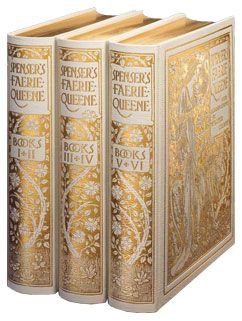
On Reading ‘The Faerie Queene’ by C.S. Lewis


“Beyond all doubt it is best to have made one’s first acquaintance with Spenser in a very large — and, preferably, illustrated — edition of The Faerie Queene, on a wet day, between the ages of twelve and sixteen; and if, even at that age, certain of the names aroused unidentified memories of some still earlier, some almost prehistoric, commerce with a selection of ‘Stories from Spenser’, heard before we could read, so much the better.”

A number of us are going to be reading The Fairie Queene beginning sometime in April and, considering the difficulty of the poem, I decided to do some pre-reading investigation.

Continue reading

A Lover’s Complaint by William Shakespeare


From off a hill whose concave womb re-worded
A plaintful story from a sistering vale,
My spirits t’attend this double voice accorded,
And down laid to list the sad-tuned tale;
Ere long espied a fickle maid full pale,
Tearing of papers, breaking rings a-twain,
Storming her world with sorrow’s wind and rain


This “fickle maid” relates her story, a story of love unrequited, but as she describes her inner conflict, we receive a vision of the maid, no longer young:


“Whereupon the thought might think sometime it saw
The carcass of a beauty spent and done;
Time had not scythed all that youth begun,
Nor youth all quit; but, spite of heaven’s fell rage,
Some beauty peept through lattice of sear’d age.”


Crying despondently and wiping her eyes with a handkerchief, the maid tells a respectable man, who is grazing his cattle nearby, of her troubles.


“Not age, but sorrow, over me hath power;
I might as yet have been a spreading flower, 
Fresh to myself, if I had self-applied
Love to myself, and to no love beside.”


She fell in love with a young man with a silken tongue and enchanting brown curls, who stole her heart in spite of other more questionable qualities.


“His qualities were beauteous as his form,
For maiden-tongued he was, and thereof free;
Yet, if men moved him, was he such a storm
As oft twixt May and April to see,
When winds breathe sweet, unruly though they be.
His rudeness so with his authorized youth
Did livery falseness in a pride of truth.”


She “gave him all my flower,” without being demanding of him like others.  She claimed that “mine honour shielded” but she became an “amorous spoil.” Even though she knew of his other women, of his “foul beguiling” and of his illegitimate children, still she is taken in by his false charm.  Yet, in spite of this sorrow that is a burden to her heart, she claims that she would be captivated by him all over again.


O, that infected moisture of his eyes,
O, that false fire which in his cheek so glow’d,
O, that forced thunder from his heart did fly,
O, that sad breath his spongy  lungs bestow’d,
O, all that borrow’d motion seeming ow’d,
Would yet again betray the fore-betray’d,
And new pervert a reconciled maid.
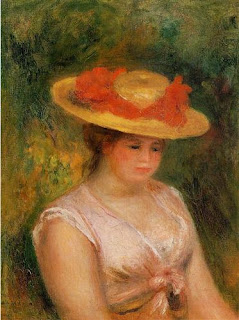
 

Young Woman in a Straw Hat (1901)
Pierre-Auguste Renoir
source Wikiart

Popular in medieval and renaissance times, this “complaint poem” is written in rhyme royal (ababbcc), with seven lines per stanza in iambic pentameter, which I just encountered while recently reading The Brubury Tales (in The Feet’s Prologue), a take on Chaucer’s The Canterbury Tales.  Because this style was unusual for Shakespeare, some critics question his authorship, yet there are parts of the poem that certainly echo of Shakespeare, and coincidentially the first stanza is very close to the first stanza of The Rape of Lucrece.

As for figures of speech, the following are included in the poem:  alliteration, anaphora, hyperbole, metaphor, paradox, personification and simile.  Could I identify them all on the first read?  No, but that means that I’ll have to read The Lover’s Complaint again!

Deal Me In Challenge #4 


The Suppliant Maidens by Aeschylus

“Zeus Protector, protect us with care,
From the subtle sand of the Nile delta
Our ship set sail …….”

Originally thought to be the earliest extant Greek tragedy, having been produced in 490 B.C., more recent evidence places it with a trilogy produced in 470 B.C., making it one of Aeschylus’ later plays. More primitive in style than The Persians, and using the archaic practice of having the protagonist as the chorus, it’s possible that Aeschylus kept it unseen for 20 years, but his motivation for this concealment would certainly be inexplicable.

Continue reading

Metamorphoses – Book III

Book III


Cadmus / Actaeon / Semele / Tiresias / Narcissus & Echo / Pentheus


Cadmus and Minerva (17th century)
Jacob Jordaens
source Wikimedia Commons

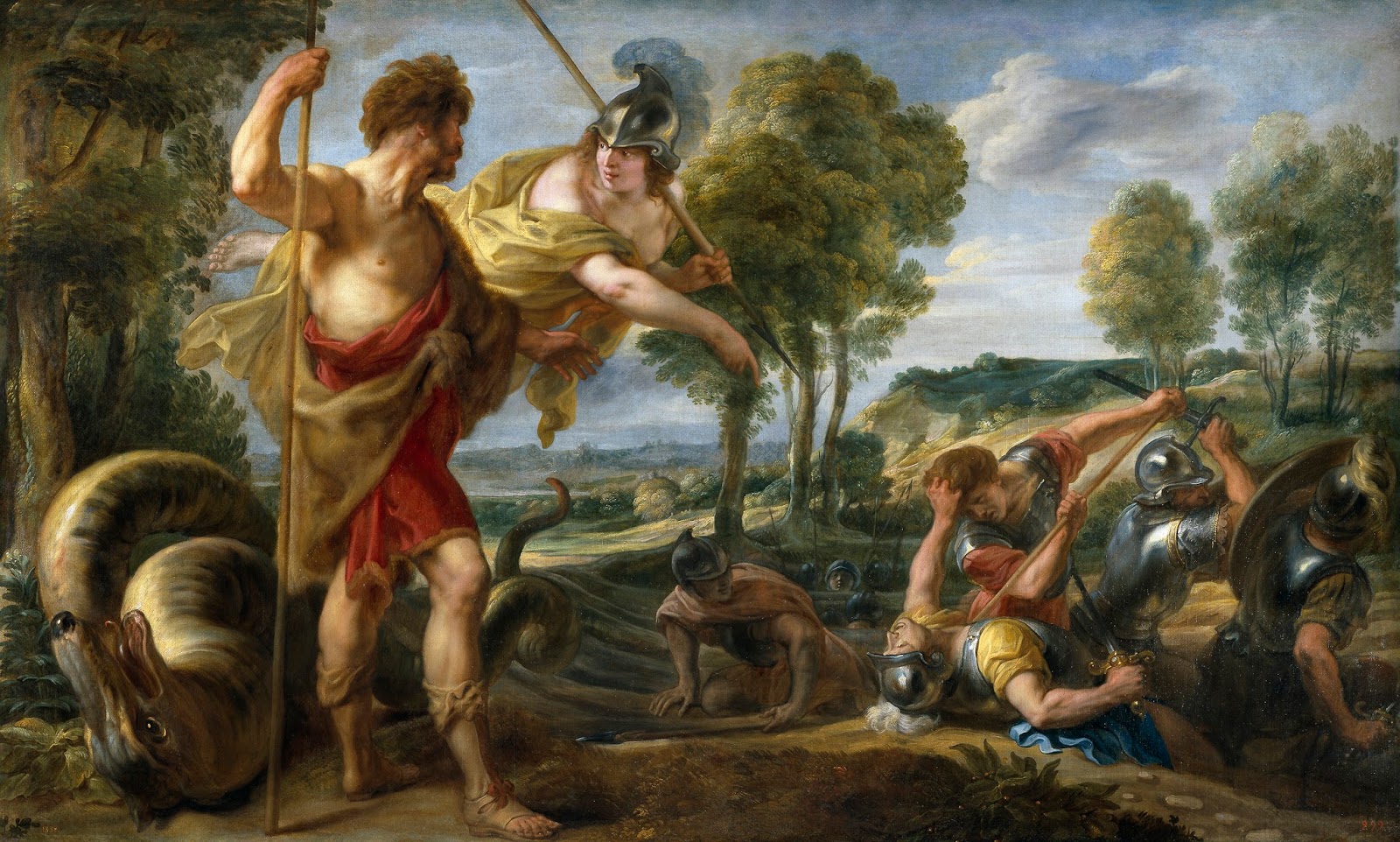
Agenor commands Cadmus to find his sister, Europa, yet while he wanders near and far, success eludes him, until the oracle of Apollo tells him to find a heifer who has never worn a yoke and there in Boeotia, he is to build his city, Thebes.  Cadmus kills a serpent and under Minerva’s orders, plants its teeth from which spring men, but warriors that, in their battle frenzy, kill each other until there are only five left: Echion and four others.  Together they build the walls of Thebes.

Continue reading

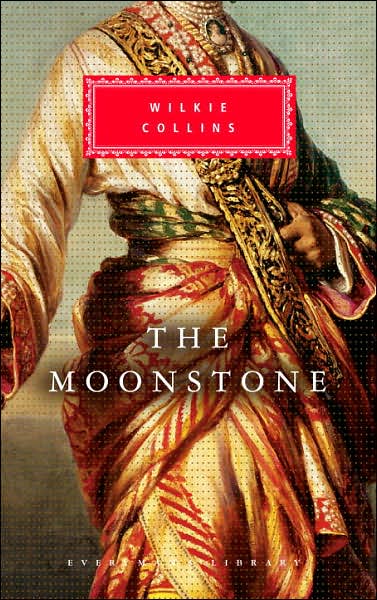
The Moonstone by Wilkie Collins

“I address these lines — written in India — to my relatives in England.”

The Moonstone …….. a yellow diamond, sacred to the Indian people, guarded over by an ancient curse and three Brahmins devoted to its preservation. Yet the revered diamond is stolen.  Time passes, and the Moonstone ends up in the hands of Colonel Hearncastle who returns to England with the ill-fated gem. Angry at the relatives who shun his advances, he leaves the Moonstone in his will to his niece, Rachel Verinder.  Did the Colonel leave the stone as a profitable legacy, or was it intended to wreak destruction on those who had earlier rejected his gruff overtures?

Continue reading

The Autobiography of Alice B. Toklas by Gertrude Stein

“I was born in San Francisco, California.”

Gertrude Stein was a Jewish-American writer who lived in France for over 40 years, becoming an intrinsic part of the Parisian art world in the early 1900s. Part of an avant garde artistic movement that thumbed its nose at past artistic structure, she was intimate with artists, both painters and writers, such as Pablo Picasso, Henri Matisse, Juan Gris, George Braque, Guillaume Appolonaire, Henri Rousseau, Ernest Hemingway, Mildred Aldrich  and many others, who were frequent visitors to her 27 rue de Fleurus location.  She attempted her own literary movement, writing many works that were deemed “incomprehensible”, but received a small following.  Her autobiography is perhaps a more gentle exposure to her “art”.

Portrait of Gertrude Stein (1906)
Pablo Picasso
source Wikiart

Although Stein presents this biography as being about her longtime companion, Alice B. Toklas, in fact it is Stein, speaking with the voice of Toklas about her own life and experiences.  She briefly chronicles her early life, then moves directly to France, going into great detail about her life there, yet revealing little about herself.  Her style is mostly observation and there is little depth to her words.  It is a matter of, “this happened, and that happened, and this happened,” without there being much of an internal interaction with occurrences, or an outward reaction to them.  The book was all about Stein, but on the other hand it wasn’t, and I never felt that I came to know much about the woman at all.  Of course, I now know about all the important people she knew and all about her writings, but it’s more like skating on top of a lake instead of diving right into it; you see a reflection that has echoes of reality, but somehow reality itself escapes you.

Nevertheless the book had some interesting information on the artists living in Paris during Stein’s residence there:

“The Matisses had had a hard time.  Matisse had come to Paris as a young man to study pharmacy.  His people were small grain merchants in the north of France.  He had become interested in painting, had begun copying the Poussins at the Louvre and become a painter fairly without the consent of his people who however continued to allow him the very small monthly sum he had had as a student …..”

And interesting things to say about different nationalities:

Americans and Spaniards

“Americans, so Gertrude Stein says, are like spaniards, they are abstract and cruel.  They are not brutal, they are cruel.  They have no close contact with the earth such as most europeans have.  Their materialism is not the materialism of existence, of possession, it is the materialism of action and abstraction. And so cubism is spanish …..”

Germans

“Gertrude Stein used to get furious when the english all talked about german organization.  She used to insist that the germans had no organisation, they had method but no organisation.  Don’t you understand the difference, she used to say angrily, any two americans, any twenty americans, any millions of americans can organise themselves to do something but germans cannot organise themselves to do anything, they can formulate a method and this method can be put upon them but that isn’t organisation.  The germans, she used to insist, are not modern, they are a backward people who have had a method of what we conceive as organisation, can’t you see.  They cannot therefore possibly win this war because they are not modern.”

French

“The french are so accustomed to revolutions, they have had so many, that when anything happens they immediately think and say, revolution.  Indeed Gertrude Stein once said rather impatiently to some french soldiers when they said something about a revolution, you are silly, you have had one perfectly good revolution and several not quite so good ones; for an intelligent people it seem to me foolish to be always thinking of repeating yourselves.  They looked very sheepish and said, bien sur mademoiselle, in other words, sure you’re right….”

There is always an underlying humour touched with a seriousness in her narrative; although life is somber business, one must not take it too seriously.

Stein with Ernest Hemingway’s son, Jack (1924)
source Wikipedia

Stein definitely has both fans and critics.  One enthusiast, Mabel Dodge, an American art patron, wrote, “In Gertrude Stein’s writing every word lives, apart from concept, it is so rhythmical and cadenced that if we read it aloud and receive it as pure sound, it is like a kind of sensuous music.”

However, Stein’s brother, who apparently had the eye of an art connoisseur and amassed an impressive collection of paintings, called the biography “a farrago of lies,” Hemingway declared it, “a damned pitiful book,” and critic F.W. Dupree denounced “Steinese” as being “gnomic, repetitive, illogical, sparsely punctuated …… a scandal and a delight, lending itself equally to derisory parody and fierce denunciation.”  

Perhaps the truth lies in the battlefield between the two factions, and American writer Sherwood Anderson, found the median between the two, saying, “As for Stein, I do not think her too important.  I do think she had an important thing to do, not for the public, but for the artist who happens to work with words for his material.”

Stein’s signature

Metamorphoses – Book II

Book II

Phaeton / The Heliades / Cycnus / Phoebus / Callisto / Arcas The Raven / Coronis, the Raven, the Crow, Nyctimene / Ocyrohoe / Battus / Mercury, Herse, Aglauros / Europa & Jove

The Fall of Phaeton (c. 1604-05)
Peter Paul Ruebens
source Wikimedia Commons

Phaethon reaches the gorgeous palace of Phoebus, where his father confirms his birthright.  Arrogantly, Phaeton requests to drive his chariot, and sadly Phoebus concedes, giving instructions to his son for his safe journey. Thetis unbars the way for her grandson and the horses leap high in the air, but it’s as if they have no rider and control is lost.  Phaethon regrets his decision, yet is paralyzed and the chariot finally plunges down to earth destroying large swaths of it with fire.  The earth cries out and “the Almighty Father” (Jove) hurls a thunderbolt, unseating Phaeton, yet combatting fire with fire.  Phaeton, consumed by the fire, is buried by the river Po by the Naiads, while his father in grief buries his face and shuts out the sun for a day.  Clymene laments with her daughters, the Heliades, at her son’s grave, but her daughters metamorphosize into trees in spite of her attempts to save them.

Cycnus, a king of Liguria and a relative of Phaeton’s, goes to pay his respects and is transformed into a swan, a bird who does not trust to seek the sky because of Jove’s lightning bolts.

Jove then inspects the heavens and earth for damage from the fire, but spots a nymph, Callisto and, disguising himself as the goddess Diana before reappearing in his normal form, rapes her in spite of her frantic struggles. Diana discovers her shame and sends her away, and when Juno learns of Jove’s crime and of the son born to Callisto, Arcas, she transforms Callisto into a bear.  Later, Arcas encounters his mother and nearly kills her, but Jove intervenes, grabbing both and placing them in the sky as Ursa Major and Minor.

Plate 101 Raven
John James Audubon
source Wikiart

As Juno is enraged at the compliment given to Callisto, she travels to heaven in her chariot which is drawn by the peacocks who have recently changed hue.  We hear of another bird, Phoebus’ sacred bird, the Raven, who also gets his colour changed from white to black, as punishment for his talkative chatter. He refuses to listen to the Crow’s warning, whose feathers were transformed as he informed on the three daughters of the bi-form Cecrops, Pandrosos, Herse and Aglauros, when they looked into a basket and discovered a baby that had been formed by the seed of Vulcan, after he attempt to rape Minerva.  Minerva, however, turns him black for his snitching, and the poor crow relates that before this incident, he had been a princess, but was transformed into a crow while escaping from the sea-god who attempted to ravish her.  Yet now he is supplanted in the affections of Minerva by Nyctimene, the owl, oh woe is he!  The Raven, however, declines to heed the crow’s wise wisdom, and instead reveals to Apollo (Phoebus) that his love, Coronis had lain beside a Thessalian youth. Inflamed with hot fury, Apollo kills Coronis yet before she is burned, he snatches their unborn son, Aesculapius, from her womb and gives him to the centaur, Chiron, to raise.  The Raven, however, receives his due and is banished.  We learned of this same story in Chaucer’s The Manciple’s Tale.

The daughter of Chiron, Ocyrhoe, prophesies over Aesculapius, saying that he will become a great healer and god.  Her father’s immortality will also change to mortality, but as she speaks she is transfigured into the form of a horse with a new name, Hippe.

Landscape with Mercury and Battus (1618)
Jacob Pynas
source Wikimedia Commons

Meanwhile, bereft with grief, Phoebus is roaming the hills in the guise of a shepherd, but in his mourning over the fate of Coronis, his cows wander off and are hidden by Mercury.  Yet an old man named Battus witnesses the theft, but Mercury buys off his silence with a choice cow from the herd.  Battus promises a stone would give more information than he.  To test the old man’s resolve, Mercury disguises himself and returns asking for “his cows” and offering Battus a cow from the herd for information on the theft.  Battus reveals all and Mercury changes him into a stone (now called a touchstone or tellstone) in payment for his betrayal.

Mercury spots Herse, daughter of Cecrops, and is determined to possess her. He enlists the help of her sister, Aglauros, but Envy, spurred by Minerva, poisons Aglauros.  Infected with resentment of her sister’s happiness, she attempts to prevent Mercury from entering her bedroom, and he turns Aglauros into a statue.

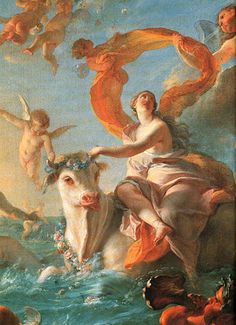
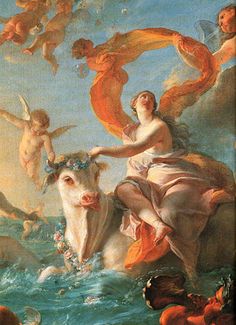
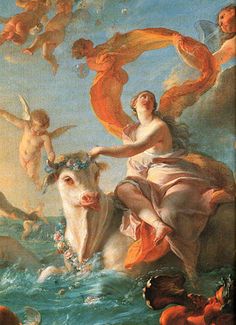
Returning to heaven, Mercury is directed by Jove to drive the king Agenor’s cattle down to the shore, yet unbeknownst to him, Jove is planning the capture of the daughter of the king, Europa.  He disguises himself as a perfect white bull, entices the girl, and then rides away into the ocean with her on his back.

The Abductiion of Europa (1715)
Jean-François de Troy
source Wikipedia

Metamorphoses

The daughters of Clymene  ❥  Trees
Cycnus  ❥  Swan
Jove  ❥  Diana  ❥  Jove
Callisto  ❥  Bear  ❥  Ursa Major
Arcas  ❥  Ursa Minor
Raven:  White feathers  ❥  Black feathers
Princess  ❥  Crow: White feathers  ❥  Black feathers
Ocyrhoe’s Prophecy:  
Aesculapius  ❥   god  ❥  corpse  ❥  god
Immortal Chiron  ❥  Mortal Chiron
Phoebus  ❥  Shepherd
Battus  ❥ Stone
Aglauros  ❥ Statue
Jove  ❥  White Bull

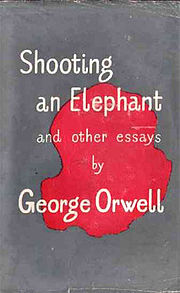
Shooting An Elephant by George Orwell

“In Moulmein, in Lower Burma, I was hated by large numbers of people — the only time in my life that I have been important enough for this to happen to me.”

Orwell tells of his stint in Burma as a police officer under British colonial rule.  He was despised by the people as an agent of the perceived oppressors, but in spite of his job, his sympathies lay with the natives and he felt constant guilt because of his duties.

One day he received word that an elephant had stampeded a Burmese Indian to death and was rampaging through the local bazaar.  It was a tame elephant that had been chained when it had gone “must,” (a periodic cycle experienced by a bull elephant when its hormones are elevated), but it had broken the chains and escaped.  Orwell took his rifle and a small gun, not at all sure what he could do to stop the invader.  Initially he had no intention of shooting the animal, but when he arrived at the scene, the locals were in high emotion with the anticipation of the killing of the elephant, and Orwell felt he had no other choice.

“And it was at this moment, as I stood there with the rifle in my hands, that I first grasped the hollowness, the futility of the white man’s dominion in the East.  Here was I, the white man with his gun, standing in front of the unarmed native crowd —- seemingly the leading actor of the piece; but in reality I was only an absurd puppet pushed to and fro by the will of those yellow faces behind. I perceived in this moment that when the white man turns tyrant it is his own freedom that he destroys ….”

Approaching the elephant, who was now calmly munching grass, he shot it a number of times, however, it merely groaned and sagged to its knees.  While Orwell knew that he’d fired the fatal shot, the animal took what seemed like forever to expire, and he finally left the scene, hearing later that it died a half an hour after his departure.  Relief flooded him that the elephant had killed a “coolie” because it gave him a pretext for the execution, and he was able to avoid admitting the real reason for his actions …… that he didn’t want to look like a fool.

African Bush Elephant
source Wikipedia

Orwell begins his essay by describing his feeling of helplessness at being part of the British imperialist movement, but ends up inverting it by describing the impotence he feels against the masses, the very people for which he harbours sympathy.  He is trapped between not only a political sytem, but a social one as well, and his powerlessness is very effective.  Once part of a collective, to a certain degree “self” must disappear.  Yet one must retain enough self to act as a human, instead of merely a machine taking orders or acting from impulse, without taking into account reason or morality.  In this case, Orwell is paralyzed and chooses to conform.

Deal Me In Challenge #2